A K-complementarity Technique for
Forming Groups of Tutors in Intelligent
Learning Environments
Yacine La
fifi
, Sa
fi
a Bendjebar and Amina Zedadra
LabSTIC Laboratory, University 8 May 1945 Guelma, Algeria
In e-learning environments, tutors perform the main function of tutoring. They follow up learners and answer their assistance requests which require different skills. These requests may not belong to the tutors’ skills and competencies, so collaboration among other tutors is expected. In fact, this collaboration can improve tutors’ skills and provide learners with effective monitoring. It can be permanent and adaptive, according to learners’ needs and requests. Grouping tutors with different skills is the aim of this research. In this paper, a new technique for grouping tutors is presented. The proposed technique is called K-complementarity. It is based on the complementarity of roles that are assigned to tutors. K-complementarity is based on tutor model and aims at obtaining K groups of tutors who have the most of the roles and skills. The proposed technique has been used by a Computer-Supported Collaborative Tutoring
(CSCTT) system. This system had been tested in an Algerian University. The obtained results showed that the groups’ members are heterogeneous and the groups are homogeneous. Furthermore, each group had more than 80% of the roles by combining those of its members. So, these results can be considered as acceptable and very encouraging.
Keywords: forming groups, collaborative tutoring, K-complementarity, tutor model, complementarity coeffi-cient, intelligent learning environments
1. Introduction and Motivation
Tutoring is a human activity, which has been ap-plied in several fields. In the educational field, this task has become indispensable, especially in higher education institutions. The primary objective of tutoring is to support the learners throughout the learning so that it fully reaches the educational objectives set by the educational institution(Peraya, 2011). Furthermore, it aims at supporting all the activities of learners and
assisting them to find learning difficulties and problems. In other words, distance tutoring or e-tutoring is referred to all the activities that support learners in their learning process(Kopp et al., 2012).
With the development of information and com-munication technologies, many environments have been implemented to support the educa-tional activities of learners (learning, assess-ment, collaboration, etc.). Tutoring task was supported by these systems explicitly or implic-itly. Indeed, in the majority of these systems, support to learners is provided. This support can take many forms: content and path per-sonalization, adaptive interfaces, virtual or real scheduling meetings, etc. Support process is carried out by a human actor or by an artificial entity(as in the case of Intelligent Tutoring Sys-tems). In Intelligent Learning Environments
Secondly, although tutors’ roles are multiple, several tutors had difficulties to understand all these roles. Thirdly, the absence of tutors for personal or technical reasons is another prob-lem. Indeed, if learners recognize tutors’ in-tellectual and moral qualities, they often regret their lack of availability(Decamps & Depover, 2011). Followed without the presence of the tutor, some learners have the feeling of being “lost“ and “forgotten“ on the learning platform and the motivation found quickly affected. Fi-nally, tutors who practice this job for the first time say that it is difficult to understand their roles (Glikman, 2011). So, training task of novice tutors is expected.
Several research questions motivate our con-tributions. The first one is: how to represent tutors’ roles? The aim is facilitating the affec-tation of tutors to learners and facilitating tutor searching task. The second question is how to improve tutors’ skills? The goal is to contribute to the formation of novice tutors on one hand and to benefit from the experiences of other tu-tors on the other. The last question is how can we measure the improvement of tutors’ skills and what is the effect of this improvement on learners’ monitoring?
In order to answer these research questions, first, we propose to identify the required tutors’ roles. Then, we propose to benefit from the positive effects of collaboration among tutors to meet the requirements of all learners who need help and to improve the performance of tutors, especially the novice ones. In other words, we want to bring together tutors with complemen-tary roles to ensure that each group of tutors has the most of the roles. These tutors work together using communication tools to monitor and guide their learners.
The aim of this research is to propose a new technique that aims at grouping tutors accord-ing to their skills and complementary roles. To facilitate this task, each tutor must be repre-sented by a model that has all his features and skills. So, our contributions are particularly re-lated to the proposal of a new structure of the tutor model and the presentation of a new clus-tering technique of tutors based on complemen-tarity principle.
The rest of the paper is organized as follows. In Section 2, we give some research works dealing
with tutors’ roles and grouping of users. Sec-tion 3 is devoted to the presentaSec-tion of our new grouping technique, which is the K-complemen-tarity. To validate our approach, a learning system adopting the new clustering technique has been implemented. Section 4 is devoted to present the main objectives of this system. The results of an experiment, which was conducted in a higher-education institution, are presented in Section 5. Finally, a conclusion and future works will be presented.
2. Literature Review
2.1. Tutors’ Roles and Tasks
According to Glikman(1999), in distance learn-ing, a few learners seek help on their own ini-tiative. To explain this observation, Glikman evokes different explanations. First, learners can organize themselves to find the informa-tion (they need). Then, sometimes they dare not seek help due to the constraint of having to disclose their lack of understanding. Finally, some students do not seek more help because the first contact does not give them satisfaction
(Depover & Quintin, 2011). This help can be provided by human actors called tutors. Nowa-days, tutoring is becoming an indispensable task for offering help and assistance.
Due to its many advantages, the tutoring task is adopted in many fields: medicine(Shah et al., 2002; Rhodes & Jinks, 2005; Kerridge, 2008; Aarnio et al., 2013, Hayashi et al., 2013), ed-ucation (Barker, 2002; De Smet et al., 2010; Dillenbourg, 2011; Mangenot, 2011; Porayska-Pomsta & Mellish, 2013), higher education
(Weigle & Nelson, 2004; Owen et al., 2006; Xenos & Papadopoulos, 2007; Jelfs et al., 2009), professional training (Li et al., 2012), chemi-cal engineering(Nisbet et al., 2014), manage-ment(Cohen-Scali, 2013), library(Waite et al., 2011), etc.
features which appear are: facilitator, coach, guide, and resource-person. On the other hand, “the primary role of the tutor is to discuss with the learners so that the knowledge they build is used in diverse and varied situations”(Salmon, 2003).
Tutors’ roles and functions are mostly spe-cific to each distance learning platform(Rodet, 2008). In most distance courses, the tutor has mainly a psychological and methodological role. Other roles are cited by many researchers: guide, evaluator, moderator, etc. According to
(Depover & Quintin, 2011), the function of the online tutor is complex and requires special-ized skills in several areas. Indeed, according to Salmon (2000), tutors’ skills fall into three main areas: skills related to the management of online exchanges, skills related to the con-tent covered by the course and methodologi-cal skills. Other researchers have added ad-ministrative aspect or assessment of learning
(Bernatchez, 2003; Daele & Docq, 2002). As a conclusion about the tutors’ roles, we can say that there is confusion about these roles from one researcher to another. This confusion is due to the lack of works about the standardization and the instrumentation of the tutors’ roles. In other words, there isn’t a consensus about the tasks of each role and how to represent each task. So, a modeling user task is required be-fore any research about the instrumentation of the tutors’ roles.
2.2. Grouping of Users
There are several researches that are interested in grouping different human actors. Learners are the primary beneficiaries of these works. In-deed, in the computer-supported collaborative learning (CSCL) area, there are several tech-niques for grouping learners into small groups. These methods have been applied for a long time in the schools of North America, for example. Jigsaw is the most commonly used method. It is based on grouping learners into small groups with a distribution of tasks assigned to each one of them(Tuparov et al., 2009). In fact, in Jigsaw method, each team is formed of four learners(or three in small groups). Participants will share their knowledge and collaborate for developing a common product.
The grouping of human users for various rea-sons has been studied by several researchers. Lappas and his co-authors(Lappas et al., 2009)
proposed an algorithm to form teams of experts in social networks. To do any task, the authors proposed a technique for forming a team of ex-perts having various skills that are required for this task. Furthermore, the proposed algorithm optimizes group size and communication cost between its members.
Forming groups of users in real-time to do unknown tasks has been studied by many searchers. Reviewing articles is a task that re-quires the formation of groups of reviewers to do a specific task(i.e. evaluate a scientific paper). Anagnostopoulos and his co-authors( Anagnos-topoulos et al., 2012)proposed an algorithm to form groups of experts in social networks to decrease the costs of coordination among mem-bers. These authors proposed algorithms to be applied online or off-line.
As it was mentioned before, many researchers have studied different ways for grouping learn-ers. Grouping process can be manual or au-tomatic, and it can be carried out by teachers or tutors. Furthermore, it can be performed by the system, which takes into account learn-ers’ preferences, their cognitive levels or their learning styles. Deibel(2005)proposed to form groups of learners for increasing interaction dur-ing class work based on learndur-ing styles.
Other techniques and technologies can be used, such as classification(Zakrzewska, 2008), mul-ti-agent systems (De Marchi et al., 2009) or interaction traces. In fact, the grouping of learners may be done by using their traces via a synchronously/asynchronously communica-tion tool. For example, Shi and her colleagues
(Shi et al., 2009) have used forums to form learning groups based on their behavior.
Group size differs from one system to another, and it is a principal criterion for forming groups. Many researches were done on small groups. However, with the emergence of social net-works in the last decade, there are many re-searches that focus on large groups(Legras & Tessier, 2003).
courses, etc.) collaboratively. Indeed, collab-orative process is carried out during the prepa-ration of a course’s content. In the computer-supported collaborative work/learning field, so-me researchers have studied the effects of col-laboration among teachers. Lafifi and Touil
(2010)proposed a collaborative authoring sys-tem that supports the collaboration of teachers during collaborative editing of learning objects and exercises. In addition, Hern´andez-Leo and her co-authors (Hern´andez-Leo et al., 2006)
have developed an authoring tool that can be used by teachers (i.e. Collage). Using social networks platforms teachers can collaborate in order to co-edit learning objects or design so-lutions. In this sense, Hern´andez-Leo and her colleagues (Hern´andez-Leo et al., 2011) pro-posed LdShake, which is a web tool for social sharing and co-edition of learning design solu-tion.
To our knowledge, there is no work that has studied the collaboration among human tutors in e-learning environments. This is mainly due to difficulties in modeling tutor on one hand, and taking into account the tutors’ activities and coordination process on the other hand. Col-laboration among tutors can solve several prob-lems, including those discussed in the previous sections. In fact, tutors can share their expe-riences with others who are not experienced, especially novice ones who always need train-ing for this profession. Absence of tutors for technical or professional problems can be over-come through the collaboration among them. In addition, learners can get many answers to their queries. Finally, several methods and tutoring styles can be used by different tutors belonging to the same group, which is considered as an added value of such systems.
In the next section, we present our new tech-nique, which is based on the use of complemen-tary skills of the tutors belonging to the same group.
3. Principles of K-complementarity Technique
3.1. K-complementarity Applications
The problem of grouping users according to the complementarity feature can be applied in
sev-eral areas. The first area may be human re-sources management. The primary goal is form-ing groups or teams with complementary roles to set up or manage projects where collaboration is required.
Another area of application of this method is agriculture or agronomy. In fact, we can take advantage of this feature(i.e. complementarity)
to get new species or animals.
In the military field, we can use the complemen-tary technique to form groups of soldiers with complementary skills to compose ideal groups
(including soldiers with most skills).
In the educational field, we can use comple-mentarity to form groups of learners, teachers, tutors, designers, developers, etc. In collab-orative learning, learners with different cogni-tive levels and skills can be grouped to form homogeneous groups. Teachers, in turn, can be grouped together to benefit from the experi-ences of other group’s members in courses and exercises preparation. In fact, K-complemen-tarity technique can be used in the case of the co-edition of courses and/or assessment exer-cises by a community of teachers having dif-ferent competencies and skills. The tutors can collaborate to carry out their tasks of monitoring and supervising learners. This collaboration is taken into account by CSCTT(Computer Sup-ported Collaborative TuToring)systems(Lafifi et al., 2012).
3.2. K-complementarity Technique Description
The aim of this section is presentation of the general description of K-complementarity tech-nique. It can be adapted to solve our problem, which is the formation of tutors’ groups who have complementary roles and skills. So, the first step to take into account is identifying the tutors’ roles to be adopted and used. The sec-ond step is proposing a tutor model to be used in the grouping process.
In our case, each tutor is represented by a vector having as sizet(number of roles to use). The K groups that are obtained after the grouping task should have the majority of roles by merging the roles of tutors forming the same group.
We can express the K-complementarity prob-lem as follows. We suppose that we have n
users having each one t skills. Each user is modeled by a vector which hastelements. We want to getKgroups, so that each group’s skills are complementary. Each group is defined by a coefficient (between 0 and 1), which is called
thecomplementarity coefficient.
We can formulate the problem as follows:
• Input: n vectors(representing the profiles
of n users),m(size of groups).
• Output: Kgroups. Each one of them has the
majority of roles, which are complementary.
For each group, we use a complementarity co-efficient, which measures the degree of comple-mentarity in each group. The closer this coef-ficient is to “1”, the more complementary the group is. When this coefficient is equal to “1”, the group is called “full complementary group”.
We suppose that we have n vectors having t
elements. The value of each element can be “1” or “0”. The rule used to calculateKis the following:
If n mod m>=1 then K:=n div m+1 else K:=n div m (with m>=1);
The coefficient of complementarity is calcu-lated as follows:
Coef(i)
=
t
j=1
⎛ ⎜ ⎜ ⎝
⎛ ⎜ ⎜ ⎝1−
(
m
p=1
Tipj)−1
m
⎞ ⎟ ⎟
⎠∗maxp=1...m(Tipj)
⎞ ⎟ ⎟ ⎠
t with:
Coef(i) is the complementarity coefficient of group i.
Ti
pjis the value of the elementjof the vectorp
of groupi.
maxp=1...m(Tipj)is the maximum(0 or 1)of the elements having positionjof all the vectors of groupi.
4. Application of K-complementarity in a CSCTT System
To test and validate the formulas of K-comple-mentarity technique, we designed and imple-mented a computer supported collaborative tu-toring system, called TutClass(TutorClassifier). This system allows grouping tutors into small groups using K-complementarity method. It provides collaboration among tutors to satisfy all learners’ needs; it improves tutors’ skills, and it contributes to the training of new tutors in this job. Furthermore, it can be used by any educational institution adopting tutoring activ-ity.
TutClass provides the users with some services like those of an e-learning system(learning ob-jects downloading, assessment activities, etc.). Furthermore, it can be used by many students from different levels. In the actual version, only the students of the license regime can use the system.
The students found two main sub-systems: a learning management system and a tutoring sys-tem. They can download the learning objects according to their knowledge level, carry out some learning activities, resolve some exercises prepared by teachers and request the assistance of their tutors.
tutors with much information about their learn-ers, provide tutors with a private space request-ing the assistance of their colleagues of the same group and facilitate the collaborative work, fol-lowing up all traces of tutors and learners and grouping tutors using different methods.
4.1. Modeling Tutors
The K-complementarity technique can be adap-ted to solve the problem of composing K groups of tutors. Each tutor is defined by his model that has cognitive and tutoring profiles. The tutoring profile includes all the roles assigned to tutor. For modeling our tutor, we decided to identify his roles. In the literature, we found many roles of the tutors without any classification. After six months of research, we decided to take fourteen roles. The lecturer can read(Lafifi et al., 2010)
for more details about these roles and the main confusion made by many researchers about the tutors’ roles. The main observation that we can quote is that each author or researcher has his point of view about the functions and the roles of the tutors. Furthermore, many authors used the same name, but with different func-tions. As a result, we made a taxonomy which can help the researchers to better understand the roles of tutors(see (Lafifi et al., 2010)). This taxonomy is used by a system called LETline
(http://www.labstic.com/letline/).
In LETline system(Lafifi et al., 2010), fourteen roles were used. Initially, we thought that of-fering a lot of roles helps the tutor in his task of monitoring learners, but we noticed that many tutors had problems, especially the novice ones. In fact, after testing this system by real stu-dents, we found some difficulties. First, the students don’t understand many roles of their tutors. Furthermore, the novice tutors don’t un-derstand some functions of some roles. The number of roles was judged as high by both students and tutors. Some students and tutors show that there are some overlapping functions of the tutors’ roles. Finally, the interviewed tu-tors felt that there were redundant tasks in these roles. In addition, they expressed difficulties to understand and identify the tasks of each role. So, we decided to eliminate some of these lim-its. To do this, we have worked with experts in cognitive psychology to reduce this number and keep only the essential roles and tasks. As a
result, we kept nine roles(Pedagogue, Admin-istrator, Coach, Evaluator, Supervisor, Facili-tator, Organizer, Moderator and Psychologist). All the functions that can be carried out by the tutors belong to one of these roles.
Our goal is to form groups of four tutors in each one(the ideal size for a group according to several researchers in computer supported col-laborative learning-CSCL-). Each tutor is rep-resented by a Boolean vector (indicating role assignment or not) of size nine (number of adopted roles). We remember that grouping process is done by the complementary roles to make sure that each obtained group has the most of the roles.
In TutClass, tutoring profile of a tutor is repre-sented by a vector of size nine. Each element of the proposed vector can take the value “1” for a role assigned to the tutor and “0” other-wise. To fill this vector, we used a question-naire designed for this purpose(see Appendix 2). This questionnaire has a set of questions whose answers are used to determine the roles of the tutor. This questionnaire is established in collaboration with a team of experts from Guelma University. Other techniques can be used, such as data mining techniques or self-assignment process. In fact, there is a PhD research work in the LabSTIC laboratory that uses another method for initializing the tutor model without the questionnaire(Bendjebar & Lafifi, 2013).
To initialize the tutoring profile of the tutors, they must complete a questionnaire about the existing roles. The assignment of roles is made according to the following procedure:
• Each role is defined by a set of questions.
• The tutor has the choice to answer by “yes”, “no” or “maybe”.
• Calculate the percentage of answers of the questions that are related to each role.
• A role is assigned to the tutor if the percent-age of his answers is greater than a pail(for example 50%).
Pedagogue 1 Administrator 0
Coach 1
Evaluator 0 Supervisor 0 Facilitator 1 Organizer 1 Moderator 0 Psychologist 0
4.2. K-complementarity Based Algorithm for Grouping Tutors
The algorithm used for grouping tutors, which is called incremental complementarity algorithm, allows to create groups by incremental process. The steps taken by this algorithm are:
• Step 1: After initializing tutors’ profiles, the
algorithm takes a tutor i at random ( repre-sented by a vector Ti). Then, it puts the tutor
iin the group Gl(initiallyl:=1).
• Step 2: Search for a vector Tj(representing
a tutor j)that has a complementary profile to the profile of Ti. Add the tutor j in the same
group of the tutor i(Gl).
• Step 3: Calculate the union profile, which
is obtained by using “or” operator: Ti:=Ti
“or” Tj.
• Step 4: Repeat from Step 2 until m tutors
(four in the case of TutClass) in the group Gl.
• While there are unassigned tutors, increment the number of groups (i.e. l := l+1) and repeat fromStep 1.
• If the last group has a single tutor, then he belongs to the first group.
In other words, the algorithm fetches vectors
(i.e. tutors) that are complementary. It takes the first vector. Then, it searches for its com-plementary vector(or the closest one)from the other vectors in order to add it to the same group, and so on, until obtainingmvectors(i.e. tutors). We remind the readers that our goal is to get ho-mogeneous groups whose members have com-plementary roles. In other words, it minimizes the distance between groups and maximizes it within the group.
The pseudo code of this algorithm is represented by Algorithm 1 below.
This algorithm uses a function that has as input a vector and as output its complementary(i.e.
Algorithm 1: Incremental complementarity algorithm Input: ntutors(each tutoriis represented by a vectorTi)
m(size of tutors’ groups)
Output: Kgroups Begin
I=1; Repeat
Choose randomly a tutori(represented by a vectorTi)
Put the tutoriin the groupGl
j=1;
While(j<=mandthere is a tutor not classified)do
Ts=complementary(Ti){Search for a vector Ts(representing a tutor s)that has a complementary
profile to the profile of Ti}
Add the tutorsto the groupGl
Calculate the union profile(Ti=Ti“or”Ts).
j=j+1; End while; l=l+1; Until l>k;
Ifthe last group has a single tutorthen put this tutor in the group G1
decrease the number k of groups. End if
Ts =complementary(Ti)). The pseudo-code
of this function is given in Appendix 1.
5. Experimentation
To validate our proposals, we conducted an ex-periment at Guelma University(Algeria). This experiment had several goals:
1. Study the feasibility of K-complementarity technique and its adoption in CSCTT sys-tems.
2. Study the usefulness of our vision on mod-eling tutors and the structure of the proposed model.
3. Extract the benefits and the limitations of our proposals to improve them.
Other objectives are planned, but they will not be taken into account in this paper. They will be the aim of further work.
1. Studying the effects of collaboration among tutors on tutor’s performance, and
2. Studying the impacts of this collaboration on learners’ cognitive levels.
5.1. Participants
In this experiment, twenty tutors were enrolled online in TutClass. These tutors are teachers and doctoral students. They follow up students from the license regime at Computer Science department(“Information systems” specialty). We keep in mind that tutoring is an acces-sory task according to the Algerian law (see
http://www.joradp.dz/JO2000/2009/001/ F Pag.htm, pages 22-23). It can be ensured by
teachers or students who have at least the aca-demic Master degree.
5.2. Methodology
Students and tutors could use the system from any computer connected to the Intranet of the university. First of all, the features of our sys-tem were presented to all the users. Then, they used the system all the days. At the end of the experiment, two questionnaires were distributed to tutors and learners. The questions were about the system’s features and users’ appreciation.
In order to validate our approach and especially the K-complementary technique, we proposed to compare it with another algorithm. In fact, our system provides the administrator with other traditional grouping techniques. As it is men-tioned in a previous section, providing other grouping techniques is one of the main objec-tives of TutClass.
The second offered algorithm is based on or-dering tutors by using roles’ number of each tutor. In other words, this algorithm will clas-sify tutors according to the number of their roles
(descending or ascending). Then, it puts in the same group the tutor having the greatest number of roles with those having the lowest number of roles, and so on.
This process is performed in two iterations:
• Iteration 1: The algorithm puts the first
and the last tutor in the same group, and the second and the penultimate in the same group...until the end of the list of tutors.
• Iteration 2: Again, the obtained groups will
be ordered. Then, the algorithm applies iter-ation 1 to get four tutors in the same group. If there is a group with a single tutor, it puts him in the first group.
5.3. Results and Discussion
After using TutClass system, we distributed two questionnaires to the tutors and the learners. The questions in the questionnaires were about the system’s features and the encountered prob-lems and difficulties. After the analysis of the answers of the learners and the tutors, and the results obtained from the system, we can con-firm that our objectives are achieved and the results are very encouraging.
5.3.1. Study the feasibility of K-complemen-tarity technique and its adoption in a CSCTT system
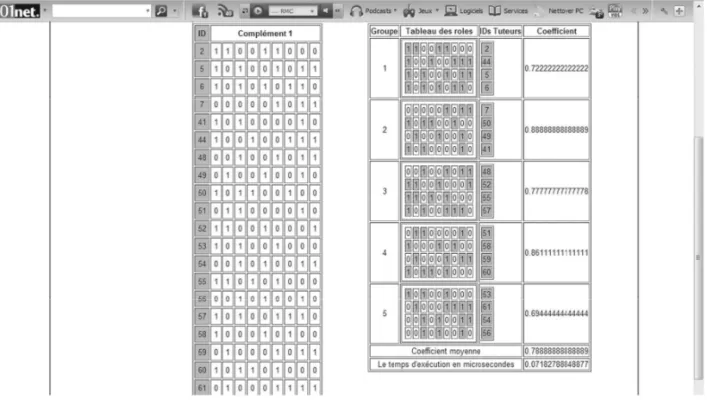
Immediately after their enrollment, tutors were requested to answer a questionnaire to initial-ize their profiles. After applying the algorithm, we obtained the results that are listed in Fig-ure 1 with the following parameters: n = 20
of tutors and the complementarity coefficient of each group.
According to the previous screenshot(Figure 1), we notice that the coefficient of complementar-ity is between 0.69 and 0.88 with an average of 0.78. Furthermore, the figure shows the time taken to do this grouping.
From the results mentioned above, we see that the group’s members are heterogeneous and the groups are homogeneous(each group has eight to nine roles by combining the roles of its mem-bers). Therefore, we can say that our target goal is achieved.
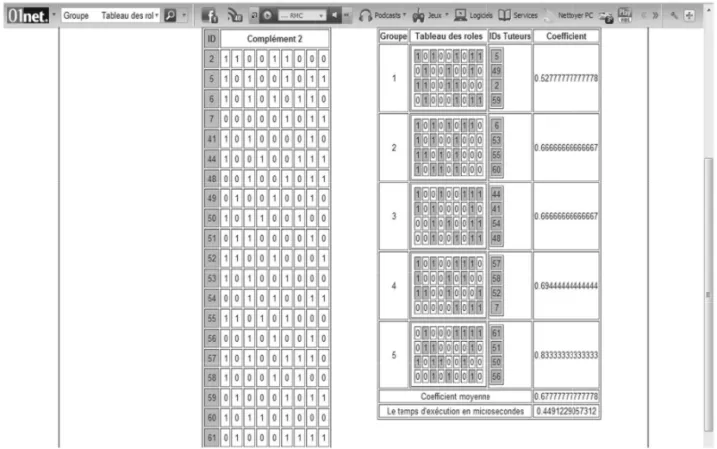
For the second algorithm, we obtained the re-sults that are outlined in Figure 2. From this figure, we see that the complementarity coeffi-cient interval is[0.52, 0.83]with an average of 0.67.
Furthermore, all the obtained groups after ap-plying the proposed algorithm contain nine roles
(i.e. all the roles). Concerning the obtained groups after applying the traditional algorithm, there is only one group that contains nine roles. Indeed, there are three groups that contain eight roles and one group having seven roles.
From these results, we can deduce that the K-complementarity based algorithm gives results better than the traditional one. The obtained groups contain between eight to nine roles, which is an excellent result. Finally, we men-tion that 90% of tutors have less than five roles.
5.3.2. Study the usefulness of our vision on modeling tutors and the structure of the proposed model
After the experimentation of our system, we noticed that the majority of tutors expressed their satisfaction about the model’s components. However, some tutors found that the questions asked to initiate their profiles are too many. They want to get help for this task. In addition, some tutors wish to find mechanisms to sim-plify the initialization of their profiles(such as manual assignment or assignment by default). We remind the readers that our proposed tutor model is primarily based on his tutoring profile. Finally, we can say that our model includes a lot of information that characterize tutors. How-ever, the task of initializing the profiles can be improved. Doctoral work is underway to find other mechanisms and techniques to manage the tutor model.
5.3.3. Extract the benefits and limitations of our proposals to improve them
In the first experiment, we observed that tu-tors and learners were very pleased with this system and its features. In addition to monitor-ing function and learners’ traces visualization,
Figure 2.Grouping tutors using a traditional algorithm.
collaboration activity has been admired by the majority of tutors, especially those who practice the tutoring activity for the first time.
The questionnaire submitted to tutors contains 26 questions. These questions are about the features of the system, the roles and functions of tutors, and the quality of the collaboration among them. For example, to the question: How do you see the effectiveness of the use of the system? 70% of the tutors replied that the system is efficient, 20% that the system is very efficient and only 10% of them replied that the system is not efficient.
The majority of tutors are happy with their team-mates. In fact, 80% of the tutors answer the question “Is the composition of the group good for you?” with “yes”.
However, tutors met some difficulties and prob-lems:
1. The majority of tutors wanted to have a fil-tering tool of learners’ traces. They noticed that there were many useless learners’ traces. 2. The collaboration space has a lot of useless
information.
3. Some tutors express the problem of the ab-sence of tutors grouping method according to their affinity.
4. The collaboration tracking tool requires im-provement. Some tutors have found many difficulties during its use.
On the side of learners, they appreciated the fea-tures of the system. However, they expressed some difficulties:
1. Students cited the absence of the ability to save the displayed traces and therefore, its reuse.
2. A research feature of specific learners’ traces is absent from the system.
3. Students mentioned the lack of tools for sav-ing conversations made by their tutors.
6. Conclusion and Future Work
Our contributions focus on the proposal of a new approach to tutor modeling and a new tu-tors grouping technique. In fact, we contribute to the efforts made in the instrumentation of tutors’ roles by proposing a new tutor model structure, which is based on his cognitive and tutoring profiles. The tutoring profile includes roles that we found essential for taking into ac-count all the assistance requests submitted by learners.
Our second contribution concerns the proposal of a new tutors grouping method. Indeed, if a lot of research was doing on learners grouping for various reasons(collaboration, performance prediction, etc.); no work has been done on the grouping of tutors in e-learning systems. This led us to study the impact of grouping tutors into groups and propose new methods. As a result, we proposed a new technique called K-complementarity, which is based on the tutor-ing profile of tutors. The obtained groups are characterized by a complementarity coefficient, which measures the degree of complementarity between the members of each group.
To validate our ideas and proposed formulas, our contributions have been implemented by a system, which facilitates the collaboration among tutors. The developed system(i.e. Tut-Class) was tested at an Algerian University where good results were obtained. From these results, several improvements can be consid-ered. Indeed, several lines of research are con-sidered in short and medium term.
Firstly, we want to study the effects of collabora-tion among tutors on the performance of learn-ers on one hand and on the tutors themselves on the other. This collaboration has double objec-tives. On one side, it can help tutors to respond to the assistance requests that are sent by learn-ers, by collaborating with other tutors when the target tutor doesn’t know how to solve requests individually or when the response is considered unsatisfactory by the learner requesting assis-tance. On the other side, this collaboration offers an adaptive space for the exchange of experiences between the tutors. So, collabo-ration activity can promote tutors’ training and increase their levels.
Secondly, another research work that we want to start is the filtering of traces left by human actors during tutoring process. These traces must undergo several treatments before being filtered. Thirdly, another future work concerns the study of different techniques for initializing
the profile of the tutor and the establishment of a standard that can be adopted by any e-learning platform adopting tutoring.
Finally, we aim to conduct another experiment of the developed system before its final use at any higher-education institution. This ex-periment, on a larger sample, can validate our choices and in particular, the proposed tech-nique for grouping tutors and the usefulness of the complementarity coefficient.
References
[1] M. AARNIO, S. LINDBLOM-YLANNE¨ , J. NIEMINEN, E. PYOR¨ ALA¨ , How do tutors intervene when con-flicts on knowledge arise in tutorial group? Ad-vances in Health Sciences Education,(2013), 1–17.
[2] C. ALARIO-HOYOS, M. P´EREZ-SANAGUST´IN,
C. DELGADO-KLOOS, G. H. A. PARADA,
M. MUNOZ˜ -ORGANERO, A. RODRIGUEZ-DE-LAS
-HERAS, Analysing the impact of built-in and ex-ternal Social Tools in a MOOC on Educational Technologies. Presented in the Proceedings of the 8th European Conference on Technology Enhanced Learning, EC-TEL 2013,(2013)Paphos, Cyprus.
[3] A. ANAGNOSTOPOULOS, L. BECCHETTI, C.
CASTILLO, A. GIONIS, S. LEONARDI, Online Team
Formation in Social Networks. Presented in the Pro-ceedings of the 21st International World Wide Web Conference (WWW 2012),(2012)Lyon, France.
[4] P. BARKER, On Being an Online Tutor.Innovations
in Education and Teaching International, 39(1) (2002), 3–13.
[5] S. BENDJEBAR, Y. LAFIFI, Initializing the Tutor
Model Using K-Means Algorithm. Modeling Ap-proaches and Algorithms for Advanced Computer Applications. In Studies in Computational Intelli-gence (A. AMINE, O. AIT MOHAMED, L. BELLA -TRECHE, Eds.),(2013)pp. 389–398.
[6] P. A. BERNATCHEZ, Vers une nouvelle typologie des activit´es d’encadrement et du rˆole des tuteurs. Distances,6(1) (2003), 5–25.
[7] R. BOYATT, M. JOY, C. ROCKS, J. SINCLAIR, What
(use) is a MOOC? Presented in the Proceedings of the 2nd International Workshop on Learning Technology for Education in Cloud (LTEC 2013),
(2013)Kaohsiung, Taiwan.
[8] V. COHEN-SCALI, Sexe du tuteur et perception de l’avenir professionnel de jeunes en alternance: une recherche qualitative.Pratiques psychologiques,19
(2013), 265–281.
[10] J. DANIEL, Making Sense of MOOCs: Musings in a Maze of Myth, Paradox and Possibility. Technical report, Korea National Open University, 2012.
[11] A. C. B. DEMARCHI, M. C. MORAES, C. D. TESTA, CV-Muzar Using a Multiagent System for Group Formation.Education and Technology for a Better World,302(2009), 159-168.
[12] S. DECAMPS, C. DEPOVER, La perception du tutorat
par les acteurs de la formation `a distance. In Le tutorat en formation `a distance(C. DEPOVER ET AL. Eds.),(2011)pp. 109–124. De Boeck.
[13] K. DEIBEL, Team formation methods for increasing
interaction during in-class group work. Presented in theProceedings of the 10th Annual SIGCSE Con-ference on Innovation and Technology in Computer Science Education,(2005)New York, NY.
[14] M. DESMET, H. V. KEER, B. D. WEVER, M. VALCKE, Cross-age peer tutors in asynchronous discussion groups: Exploring the impact of three types of tutor training on patterns in tutor support and on tutor characteristics.Computers & Education,54(4) (2010), 1167–1181.
[15] P. DILLENBOURG, Pour une conception int´egr´ee
du tutorat de groupe. In Le tutorat en formation `a distance (C. DEPOVER ET AL. Eds.), (2011)pp. 171–194. De Boeck.
[16] C. DEPOVER, J. J. QUINTIN, Le tutorat et sa mise
en œuvre. In Le tutorat en formation `a distance
(C. DEPOVER ET AL. Eds.), (2011)pp. 39–60. De
Boeck.
[17] D. H. J. M. DOLMANS, I. H. A. P. WOLFHAGEN, R. J. I. HOOGENBOOM, C. P. M. VAN DER VLEUTEN, Is Tutor Performance Dependent on the Tutorial Group’s Productivity?: Toward Further Resolving of Inconsistencies in Tutor Performance. Teach-ing and LearnTeach-ing in Medicine: An International Journal,11(4) (1999), 186–191.
[18] E. GARROT, Plate-forme support `a l’interconnexion
de communaut´es de pratique (icp). Application au tutorat avec te-cap. PhD. Thesis, INSA Lyon, France, 2008.
[19] V. GLIKMAN, Formation `a distance: au nom de
l’usager.Distances,3(2) (1999), 101–117.
[20] V. GLIKMAN, Apprenants et tuteurs : une approche
europ´eenne des m´ediations humaines. Education permanente,152(2002), 55–69.
[21] V. GLIKMAN, Le tutorat en formation `a distance.
Tuteur `a distance: une fonction, un m´etier, une identit´e? (C. DEPOVER ET AL. Eds.), (2011) pp. 280. De Boeck.
[22] S. HAYASHI, K. TSUNEKAWA, C. INOUE, Y. FUKU
-ZAWA, Comparison of tutored group with tu-torless group in problem-based mixed learn-ing sessions: a randomized cross-matched study. BMC Medical Education, 13(158) (2013). http://www.biomedcentral.com/1472-6920/13/158
[23] D. HERNANDEZ´ -LEO, E. D. VILLASCLARAS-FER
-NANDEZ, J. I. ASENSIO-PEREZ, Y. DIMITRIADIS, I. M. JORRIN-ABELLAN, I. RUIZ-REQUIES, B. RUBIA -AVI, COLLAGE: A Collaborative Learning Design Editor Based on Patterns.Educational Technology & Society,9(1) (2006), 58–71.
[24] D. HERNANDEZ´ -LEO, R. LAUREN, M. A. ARRALERO, J. CHACON´ , M. CARRIO´, P. MORENO, J. BLAT, Ld-Shake: Learning design solutions sharing and co-edition. Computers & Education, 57(4) (2011), 2249–2260.
[25] P. HYMAN, In the Year of Disruptive Education. Communications of the ACM,55(12) (2012), 20–22.
[26] A. JELFS, J. T. E. RICHARDSON, L. PRICE, Student and tutor perceptions of effective tutoring in dis-tance education.Distance Education,30(3) (2009), 419–441.
[27] J. L. KERRIDGE, Supporting student nurses on place-ment in nursing homes: The challenges for the link-tutor role. Nurse Education in Practice, 8(6) (2008), 389–396.
[28] B. KOPP, M. C. MATTEUCCI, C. TOMASETTO, E-tutorial support for collaborative online learning: An explorative study on experienced and inexpe-rienced e-tutors. Computers & Education, 58(1) (2012), 12–20.
[29] Y. LAFIFI, K. AZZOUZ, H. FACI, W. HERKAS, Dy-namic Management of Tutor’s Roles in an Online Learning System.International Journal of Learning Technology (IJLT), InderScience Publication,5(2) (2010), 103–129.
[30] Y. LAFIFI, G. TOUIL, Study of the Impact of Collabo-ration among Teachers in a Collaborative Authoring System.Journal of Information Technology Educa-tion: Innovations in Practice,9(2010).
[31] Y. LAFIFI, M. HADJERIS, A. SERIDI, R. BOURBIA, Architecture of a collaborative tutoring system. Procedia – Social and Behavioral Sciences, 31
(2012), 459–463.
[32] T. LAPPAS, K. LIU, E. TERZI, Finding a Team of
Experts in Social Networks. Presented in the Pro-ceedings of the Fifteenth ACM SIGKDD Conference on Knowledge Discovery and Data Mining,(2009)
Paris, France.
[33] F. LEGRAS, C. TESSIER, LOTTO: group formation
by overhearing in large teams. Presented in the Pro-ceedings of the 2nd International Joint Conference on Autonomous Agents and Multi-Agent Systems,
(2003)Melbourne, Australia.
[34] H. LI, C. SUN, L. ZHOU, G. ZHANG, W. SU, Study on Tutor Team of Full-time Professional Degree Graduates. Presented in theProceedings of the 2nd International Conference on Green Communica-tions and Networks,(2012)Gandia, Spain.
[36] J. T. NISBET, M. D. HAW, A. J. FLETCHER, The role of tutors in peer led teaching.Education for chemical engineers,9(1) (2014), 15–19.
[37] D. OWEN, B. HUDSON, T. TERVOLA, Open and flex-ible learning? An evaluation of student and tu-tor experiences in a European e-learning commu-nity. Technology, Pedagogy and Education, 15(3) (2006), 291–306.
[38] D. PERAYA, Le tutorat en formation `a distance:
le cadre applicatif. In Le tutorat en formation `a distance (C. DEPOVER ET AL. Eds.) (2011) pp. 125–136. De Boeck.
[39] K. PORAYSKA-POMSTA, C. MELLISH, Modelling
hu-man tutors’ feedback to inform natural language in-terfaces for learning.International Journal Human-Computer Studies,71(6) (2013), 703–724.
[40] A. L. RASOAVELORINA, Rendre compte des effets des interventions des tuteurs `a travers une Approche Orient´ee Indicateurs. PhD. Thesis, University of Maine, France, 2012.
[41] S. RHODES, A. JINKS, Personal tutors’ views of
their role with pre-registration nursing students: An exploratory study. Nurse Education Today, 25(5) (2005), 390–397.
[42] J. RODET, Tuteur `a distance, entre fonction et m´etier. In Inffo Flash,719(2008).
[43] G. SALMON, E-moderating: The key to teaching
and learning online. Kogan Page, London, 2000.
[44] G. SALMON, E-moderating: The key to teaching
and learning online (2nd ed). RoutledgeFalmer, London, 2003.
[45] F. SHAH, M. EVENS, J. MICHAEL, A. ROVICK, Clas-sifying Student Initiatives and Tutor Responses in Human Keyboard-to-Keyboard Tutoring Sessions. Discourse Processes,33(1) (2002), 23–52.
[46] C. SHAOMING, Discourse analysis of e-tutor’s role
in online collaborative learning system. Presented in theProceedings of the International Conference on E-business and E-government (ICEE),(2011)
Shanghai, China.
[47] X. SHI, J. ZHU, R. CAI, L. ZHANG, User Grouping Behavior in Online Forums. Presented in the Pro-ceedings of the Fifteenth ACM SIGKDD Conference on Knowledge Discovery and Data Mining,(2009)
Paris, France.
[48] G. TUPAROV, D. TUPAROVA, I. ZAFIROVA, The “Jig-saw” collaborative method in e-learning environ-ment Moodle. Presented in the Proceedings of the 2009 International Conference on Computer Systems and Technologies and Workshop for PhD Students in Computing,(2009)Ruse, Bulgaria.
[49] K. WAITE, P. GANNON-LEARY, J. CARR, The Role and Responsibilities of an E-tutor Librarian. Jour-nal of Library & Information Services in Distance Learning,5(4) (2011), 129–148.
[50] S. C. WEIGLE, G. L. NELSON, Novice tutors and their ESL tutees: Three case studies of tutor roles and perceptions of tutorial success.Journal of Second Language Writing,13(3) (2004), 203–225.
[51] M. XENOS, T. PAPADOPOULOS, Computer Aided Evaluation of Higher Education Tutors’ Perfor-mance. Studies in Educational Evaluation, 33(2) (2007), 175–196.
[52] D. ZAKRZEWSKA, Using Clustering Technique for
Students’ Grouping in Intelligent E-learning Sys-tems.Adaptivity and Personalization in Ubiquitous Learning Systems,(2008)Springer Berlin Heidel-berg, pp. 403–410.
Received:March, 2014 Revised:June, 2014 Accepted:July, 2014
Contact address: Yacine Lafifi LabSTIC Laboratory University 8 May 1945 Guelma BP 401 Guelma, 24000 Algeria
e-mail:Laf [email protected]
Safia Bendjebar LabSTIC Laboratory University 8 May 1945 Guelma BP 401 Guelma, 24000 Algeria
e-mail:bendjebar [email protected]
Amina Zedadra LabSTIC Laboratory University 8 May 1945 Guelma BP 401 Guelma, 24000 Algeria e-mail:zedadra [email protected]
YACINELAFIFIis currently working as an Associate Professor at the Computer Science Department of Guelma University, Algeria. Also, he is a senior researcher at LabSTIC laboratory(Guelma University, Al-geria). He works in e-learning research field since 1997. He received his Ph.D. in computer science from the University of Annaba(Algeria)
in 2007. He has several published papers in conferences and journals. Furthermore, he is an editorial board member of many international journals. Currently, he works on educational data mining techniques, CSCL, recommender systems, MOOC and human tutoring systems.
SAFIABENDJEBARis currently a PhD student in computer science at LabSTIC Laboratory(Guelma University, Algeria). She has worked for three years on educational data mining techniques. She is preparing a PhD thesis about the modeling of tutors in e-learning systems. Her current research concerns e-learning systems, tutors modeling, classifi-cation, and data mining techniques.
Appendix 1
The proposed algorithm uses a function for calculating the complementarity of a vector Ti. The
code of this function is the following.
Algorithm 2: Complementary function Input: Vector Ti
D: set of unclassified tutors{tutors don’t belong yet to a group}
Output:Vector Ts
Begin
Take a tutor j(represented by Tj)randomly from D
D=D−{Tj}
Coef=coef−resemblance(Ti, Tj){calculate the degree of the resemblance between
the two vectors Tiand Tj}
Ts=Tj
Forall Tpin Ddo
Ifcoef−resemblance(Ti, Tp)<Coefthen
Coef=coef−resemblance(Ti, Tp);
Ts=Tp
End If; End For
End.
For calculating the degree of resemblance between two vectors Tiand Tj(i.e.coef-resemblance(Ti,
Tj)), we use the following code:
S=0
Forc=1 to size(Ti)do
IfTi[c]=Tj[c]then
S=S+1 End If End For
Appendix 2
The questionnaire used for initializing the tutoring profile of a tutor.
Tutors’ Response
roles Can you perform the following tasks? Yes No Maybe
Identify the learning difficulties
Establish the objectives of the learning objects
Solicit the exchange of the resources between the learners
Pe
dagogue Seek the establishment of relations between some parts of the course
Provide resources related to the contents of the studied subjects Select a set of pedagogical resources that you must schedule and complete with your own production, in order to propose them to the learners
Answer the various administrative questions
Remind learners about the deadlines(calendar: dates of the enrollment, examination dates, etc.)
Ad
min
istrato
r
Answer general questions about the courses
Check whether the objectives of the courses are known and understood Control the order and the flow of the discussions’ subjects
Monitor the members who are apart from the discussions Monitor closely the progress of the learners’ activities Correct the errors of the learners
Establish a work plan
C
oach
Guide the learners toward the best technological and pedagogical choices
Guide the learners in their research query, therefore to develop skills in the research field
Give feedback on the interventions of the learners Facilitate the learning process for the learners
Evaluate and certify the acquired knowledge and the skills developed by the learners
Evaluate the needs, the difficulties, the rhythm and the preferences of each learner
Ev
aluator Solicit the self-assessment of the learners’ activities
Create detailed learning objects during the progression of the course Establish the objectives of the activities and work on the specification of each learner’s course
Technical guide: answer simple questions about technical problems
(you must be familiar with the system)
Supervi
sor
Help the learners to present, communicate, participate and interact Help the learner to choose his personal projects
Help the learner to reflect on his own tasks
Clarify and advise the learners on the adequate choice of communication tools according to the type and the moments of the activity
Facilitato
r
Provide indicators to facilitate the access to the information Clarify points of methodology
Establish the agenda of the session
Pose rules and procedures for the activity of the learner Suggest an agenda and a timetable for the activities
O
rgani
zer
Answer the questions of the learners concerning the working method Control the exchanges between the members of the group
Clarify the rules and procedures of the discussion
Create a pedagogical scenario that offers a high degree of freedom Support the interactions between the learners, especially between those who have different qualification levels
Motivate the isolated learners to integrate in the group Support the interactions among the learners
Moderat
or
Explain the principles of the communication charter
Ask questions and encourage learners to discuss and criticize Encourage the learners to be clear, and to finish the sessions Discuss with the learners the evolution of their learning Raise the problems of motivation, conflicts, etc.
Ps
ychol
ogi
st
Simulate, restart and motivate the learners(especially after the failure in an exam, getting bad marks, etc.)