SEGSE – A MODEL FOR AGENT BASED BEHAVIOUR IN SEMANTIC
WEB
Harish Kumar*
Sanjeev Kumar**
ABSTRACT
This paper presents SEGSE– SEmantic Gateway SystEm– ubiquitous MAS (multi-agent system) composed of specialized agents that provides reliable and efficient gathering and aggregation of keyword based digital data from multiple heterogeneous resources. The agents composing SEGSE use ontological descriptions to search and retrieve semantically annotated knowledge sources, by maintaining a semantic list of the instances of the annotation ontology. The efficient retrieval is made it possible through the semantic routing mechanism, which permits to identify the agent listing the resources requested by a user query based upon specific keyword without having to maintain a central list, and by minimizing the agent communication channel within the MAS. The system is also capable of exhibiting autonomic behaviour. Autonomic behaviour is characterized by self configuration and self healing capabilities, aimed at permitting the system to manage the failure of one or more of its agents and ensure continuous functioning and hence improving the reliability of the system.
Keywords: Multi Agent,Semantic Gateway, Ontology, Keyword Based Query
1 INTRODUCTION
The Semantic Web primarily aims to share knowledge from distributed, dynamic, and heterogeneous sources, whose content is expressed in a machine-readable format by means of
languages such as RDF [1] and OWL, in a similar way to that in which information is shared on the World Wide Web. Agents play a vital role in this scenario; they use these machine-readable representations to collect and cumulate knowledge, as well as to reason in order to manage inconsistencies. Also new facts can be deduced through inference using this scenario. Together with their ability to process Semantic Web content, agents contribute features, such as automatic distribution, autonomy, pro-activeness and social ability that make them particularly suited to manage large, heterogeneous, and distributed knowledge bases. In recent years, many tools have been developed for managing traditional knowledge sources, but such approaches usually imply a centralized, and static environment where the ultimate control is centralised. This type of approach does not promise to scale well to the Semantic Web, which is an open, dynamic, and often chaotic environment.
Distributed, decentralised systems are thought to be a better alternative for scalability [2]; their architecture is characterised by system components each with equal roles and the capability to exchange knowledge and services directly with each other. Peer-to-peer technology (P2P) such as Edutella [2] or Morpheus [3] provides good means for decentralization. P2P systems are networks of peers with equal roles and capabilities, and recently peer-based management systems have been proposed, which exploit P2P technology for sharing and retrieving huge amounts of data [4]. However, most approaches are oriented at file sharing, rather than at the management of semantically enriched content as provided by the Semantic Web. The agent paradigm seems to offer equally good prospects for the
autonomous components that in turn comprise large numbers of interacting, autonomous, self-governing components at the next level down [7]. This type of behaviour is intended to make it easier to manage the complexity and scalability of complex distributed systems, such as those to manage Semantic Web content.
In this paper we concentrate on the reliable and efficient gathering and aggregation of digital
data from heterogeneous sources. We developed a multi-agent system composed of specialised agents that is able to search and retrieve semantically annotated knowledge sources. In addition to searching for digital content, the semantic information used to annotate resources is used to explore the addition of autonomic features to the system, in order to make the system more reliable so that failure of one agent will be taken over by the another agent existing in the MAS. In this paper we propose the system SEGSE (SEmantic Gateway SystEm) and its main functionalities. We examine the two main functionalities offered by the system, namely query management and autonomic behaviour, and we present a set of experiments aimed at evaluating the performance for each of these functionalities.
2 SEGSE
SEGSE’sprimary goal is to enable the semantic retrieval and aggregation of the digital content of web resources. SEGSE is designed as a multi-agent system composed of specialised agents capable of functioning in a scalable, self-managing, open, and dynamic fashion. The system requires resources to be semantically annotated according to one or more ontologies expressed in OWL, and at present is not capable of discovering annotated resources autonomously. For this purpose SEGSE relies on the Annotation System component of Esperonto, which informs it of newly acquired content providing references to both the resources and their RDF annotations. Annotations are semi-structured representations of
information referencing instances (of one or more concepts in the annotation ontology) that appear in the content of web resources.
Neighbourhoods are moderately overlapping, and this permits the routing mechanism to find the result to a query in a finite number of hops, without having to browse the whole ontology and without having to flood the network with a large number of messages. Semantic neighbourhoods are automatically determined when the system receives a notification of new
ontological content – received as new concepts are used to annotate resources. The neighbourhoods are not static but they dynamically change as the system is required to handle further notification of new ontological content, or if the ontology is modified (and a new version of the ontology is used in the annotation). In this way, we have multiple overlapping neighbourhoods, each centered on one concept, and agents have knowledge only of the agents composing their neighbourhood.
Indexing ontological content consists of creating structures that link resources, identified through their URLs, to RDF statements describing instances of the concepts in the ontologies. The routing functionality permits SEGSE to route queries to the agents that are capable of retrieving the resources annotated with the concepts they are specialised on. SEGSE handles queries expressed in RDQL [10] (an RDF query language developed by HP as part of the Jena toolkit) [11] on any combination of concepts and concepts properties (including object properties).
Complex queries are decomposed into simple ones, each regarding a single concept. Each simple query is routed to one of the agents in the network of routers, and the agent consults its index to determine whether it can answer the query. If the agent cannot answer the query, then it routes the request to the agent in its neighbourhood that handles the concept closest to the one in the query. We will make use of heuristics in our algorithm to get a higher number of potential matches. In Semantic routing, the evaluation of similarity should be sufficiently precise to determine a new agent to whom the query can be routed, not necessarily the best agent. In addition, semantic routing is a dynamic process executed on line, and therefore it requires fast computation in order to minimise the time spent by the user waiting for an
answer.
IRS Agents
Query Mgt Agent
Gateway Agent Bridge
Agent
Distribued Platform
Agents
Notification Agents Query
Heartbeat Monitor RDQL
Simple Query 1,2,..,n
Simple Query
Notification of new concept Dynamic creation of the router network
Notification of new instance
Notification of new concept Simple Query
answer set
3 CONCEPTUAL ARCHITECTURE
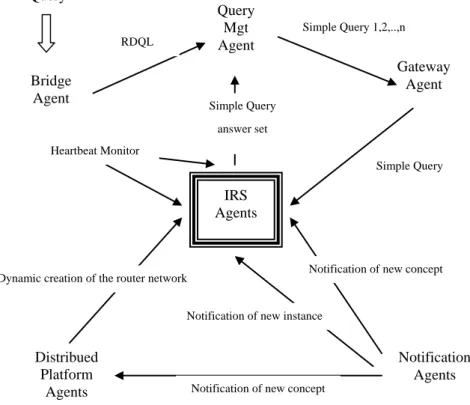
SEGSE’s conceptual architecture is composed of six types of specialised agents providing different functionalities. The heart of the architecture is composed by the network of IRS
Agents, providing indexing, routing, and self management capabilities. These agents are
com-plemented by a number of other specialised agents providing additional services, that implement system management functions. Figure 1 shows the different roles played by agents in SEGSE and the message flow in the system.
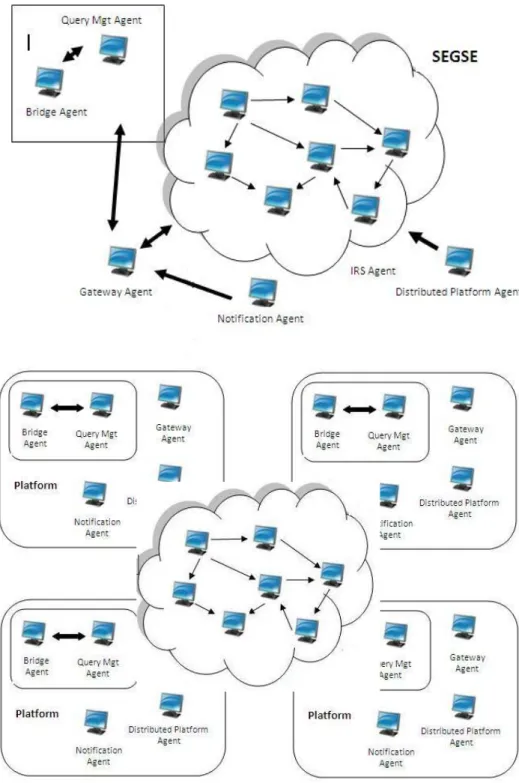
SEGSE is built within JADE – a FIPA compliant agent deployment environment [5]. The system is designed to be distributed over a number of JADE platforms, on different host machines, with each platform containing a part of the indexing system and its own Bridge Agent set. This enables the system to operate even when reduced to one platform, and to dynamically reconfigure the index network in response to temporary or permanent outages of agents and platforms in the system. It also uses the JENA semantic web toolkit to handle RDFS, OWL, and RDQL. SEGSE is able to use ontological definitions expressed in either RDFS or OWL (Lite and DL), using the full range of expressions available. The different roles that agents play in SEGSE are described below, and Figure 2 shows the interactions between the different types of agents on a single platform and on multiple platforms.
Figure 2. SEGSE architecture on a single platform and distributed over multiple platforms
– IRS Agents: IRS agents provide the core functionalities of the system: indexing, routing and
to identify them. The routing index stores the communications address and concept handled by each of the IRS Agents that are semantic neighbours. Routing indexes contain entries for three types of neighbour links:
• actual: neighbour concepts which are handled by existing agents;
• ontology: neighbouring concepts (according to the ontology) for which no agent yet
exists; and
• implied: concepts outside the neighbourhood that have still to be linked to existing
concepts. These links can be implied from the absence of one or more ontology neighbours.
IRS agents are also equipped with self management capabilities that allow them to actively respond to changes in the state of their neighbourhood. In order to ascertain the actual status of their neighbourhood, IRS Agents employ two types of messages: they both monitor the result of their outgoing routing messages (to verify that they do not return an error), and they periodically send heartbeat messages [7] that “ping” their neighbour. In addition, IRS Agents periodically save the state of their content and routing indexes enabling the knowledge to be recovered following any failure of the agent. IRS Agents are distributed over multiple platforms, while the other agents described below are replicated for each of the platforms.
• DP (Distributed Platform) Agents: They enable the distribution over multiple plat-forms and provide management services, such as the creation of a new IRS agent, for
each agent platform on which the network of routers is distributed. The DP Agent is also responsible for triggering the dynamic creation and adjustment of the network of routers upon receipt of the notifications of new content.
• Notification Agents: They are the interface between each platform and the Annotation System of Esperonto, and receive notifications regarding the annotation of new resources, or the addition of new concepts in the ontology. They decompose notifications regarding multiple concepts and re-send these atomic notifications into the IRS Agents network as Agent Communication Language messages.
• Bridge Agents: They provide a connection between each agent platform and the software components operating outside the platform, such as the web-based query
• Query Management Agents (QMA): They decompose complex queries that involve multiple concepts linked by logical connectives, into atomic queries. The atomic queries are then sent into the IRS Agent network; when the QMA receives the responses to each query, these are aggregated by re-applying the logical connectives, thus producing a set of web resources that match the constraints expressed in the complex query. During the process duplicate instances are identified and removed.
• Gateway Agents: They act as a gateway into the IRS Agent network, through which all atomic notifications and queries are passed. Each platform in the system has a Gateway Agent, that maintains a list of significant points within the router system, and send messages into the network by initially routing them to the most appropriate of these points.
Finally, the other main component of SEGSE is the web-based query interface. This enables the construction of queries using concepts from multiple ontologies, logical connectives between the concepts, and specification of the values of concept properties. Responses to queries are displayed as lists of web resources, identified by URLs, that match query constraints together
with the URIs of the instances that annotate them. In addition, query replies also contain a list of the concepts that are neighbours of each the responding agents. This enables follow-up queries in which the original query is modified by changing property values of concepts, exchanging one concept for a similar one, broadening or narrowing a query by substituting ontological ancestors or descendents of a concept, etc.
4 QUERY MANAGEMENT
SEGSE handles queries specified in RDQL on any combination of concepts and concept properties (including object properties). Queries are sent from the local Bridge Agent to the local QMA, where they are decomposed into atomic queries. Query decomposition is achieved by syntactically parsing the query and identifying blocks that form atomic queries, but preserve the semantics of the original query.
The QMA sends each atomic query to the local Gateway Agent, which forwards each of them to the most competent IRS Agent known to the local Gateway Agent that is the IRS Agent that has the highest similarity score with the concept in the atomic query. In the current implementation of SEGSE, these agents are those which have knowledge of the root nodes of each of the ontologies that have been notified to the system. The purpose of this initial semantic routing is to enter the router network in the general semantic area of the queried
node agents might potentially be perceived as a bottleneck, these agents are effectively those that are likely to have the smallest workload from handling queries. In fact, in the domain ontologies used by SEGSE, as well as in most domain ontologies, the majority of the instances are direct instances of very specific concepts (leaf nodes), whilst root nodes have few (if any) instances. Therefore, the additional routing effort of these agents is compensated by
answering fewer queries. In addition, any set of significant entry points could become a bottleneck, and alternatives are constrained by the processing necessary to identify the best entry point, and message workloads.
Once an atomic query is received by the appropriate IRS Agent, it extracts the query constraints expressed in RDQL, then it consults its content index to check if
it stores the URI of instances of the query concept. Any instances that match the query contribute to the answer set, which consists of a list of resources that are described by matching instances, and is returned directly to the QMA that sent out the query. Included in the query reply is information about the concepts handled by neighbours of the replying IRS Agent and the agent address - which is then used in follow-up queries. This then enables users to semantically browse from one concept to other closely related concepts, using knowledge about these relationships held by the IRS Agent and revealed by the original query.
If the IRS Agent does not know the queried concept, the query is routed to the semantic neighbour with the most similar expertise. This semantic routing mechanism is designed to move messages in a series of hops across the network of IRS Agents, until the message is addressed to the IRS Agent indexing instances of the concept in the message.
5 AUTONOMIC BEHAVIOUR
SEGSE has been designed to autonomously react to a number of events that can affect its processing. These include the notification of new ontology, but also exceptional events such as the controlled shut down of an agent. The aim is to have a system that can work in an open environment, such as the Semantic Web, and that is scalable, robust, and requires limited human intervention for its functioning. For this reason, SEGSE has been designed as a multi-agent system in which multi-agents can join and leave the system without having to take (part of) the system off-line, or without degrading the performance of the system.
Autonomic behaviour in SEGSE supervises two main functionalities: dynamic management of the network of IRS Agents, and failure management.
routers from scratch once the system is notified by the Notification Agent that a new ontology is available. Failure management consists of the functionalities that enable the system to continue to operate despite the temporary or permanent loss of agents or whole platforms from an existing index network. Autonomic behaviour is achieved by a number of different mechanisms:
– Creation request messages: When the Notification Agent in one of the platforms receives
a notification of new annotation ontology, it determines autonomously the root concept(s) and generates a creation request message for each of these concepts, to be sent to the Distributed Platform Agent, that in turn, creates a IRS Agent for each root concept.
– Router network population: The population of the network of routers is triggered by the
notification of new content messages received by SEGSE. If the message notifies instances of a concept for which a IRS Agent has not yet been created, the Distributed Platform Agent creates a new IRS Agent, and each of the neighbouring IRS Agents affected by this event update their neighbourhood indices, with the pointers to the new actual neighbours. In this situation, ontology and implied links are created, in order to fill gaps between the existing routers and the newly created one.
– Heartbeat monitor: IRS Agents monitor the success of messages sent to neighbours, and record this in their routing index. When messages are unsuccessful the neighbour is first set to a warning level, and if failure continues for a short time the entry is marked as unavailable. The neighbour will be considered available again if a message is received from it within a time period, but otherwise will eventually be removed from the neighbourhood.
– Index backup and backup recovery: IRS Agents periodically save their knowledge to an XML backup file, which enables the recovery of knowledge following the failure of the IRS Agent or platform. The knowledge stored in the file consists of the contents of both the content index and routing index. Recovery from failure of a platform is addressed by having the Distributed Platform Agent on start-up (following a manual platform re-start)
check for saved state files, and, if any are found, re-creating IRS Agents using the stored knowledge. Recovery from the failure of individual IRS Agents is addressed by them contacting the local Distributed Platform Agent when they shut-down, and the Distributed Platform Agent will then use the saved state to re-create the IRS Agent.
reactively adapt their neighbourhood connections to reflect the loss of neighbour. Recovery from shut-down, like that for failure, is initially a manual process but once started the Distributed Platform Agent will detect the saved-states and restore the IRS Agents.
6 EXPERIMENTAL EVALUATION
We conducted a number of experiments aimed to analyse the performance of the two main functionalities provided by the system: query management, and autonomic behaviour. In our experiments, we used two ontologies developed as part of the use-cases of Esperonto, the Fund Finder and the Cultural Tour ontologies for which we had also the annotated documents storing the instances of the concepts. The Fund Finder is expressed in OWL-Lite, and it is composed of around 50 concepts (12 of which are root concepts), and of 118 instances. The Cultural Tour ontology is an RDFS ontology composed of 60 concepts, and has more than 61000 instances.
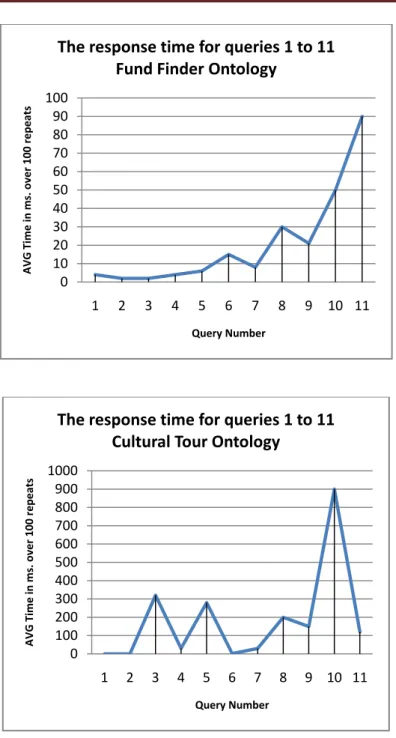
Figure 3: SEGSE response times in relation to queries about the Fund Finder and Cultural Tour ontology 0 100 200 300 400 500 600 700
1 2 3 4 5 6 7 8 9 10 11
A V G T im e i n m s. o ve r 1000 re pe at s Query Number
The response time for queries 1 to 11 Fund Finder Ontology
0 20000 40000 60000 80000 100000 120000 140000
1 2 3 4 5 6 7 8 9 10 11
A V G T im e i n m s. o ve r 1000 re pe at s Query Number
Figure 4: Jena response times in relation to the same queries for each of the two ontologies 0 10 20 30 40 50 60 70 80 90 100
1 2 3 4 5 6 7 8 9 10 11
A V G T im e i n m s. o ve r 100 re pe at s Query Number
The response time for queries 1 to 11 Fund Finder Ontology
0 100 200 300 400 500 600 700 800 900 1000
1 2 3 4 5 6 7 8 9 10 11
A V G T im e i n m s. o ve r 100 re pe at s Query Number
SELECT ?x, ?z WHERE
(?x, <http://www.w3.org/1999/02/22-rdf-syntax-ns#type>,
<http://www.blacoe.uk/Fund_Finder.owl#Discount>)
(?x, <http://www.blacoe.uk/Fund_Finder.owl#Aims>, ?y)
(?y, <http://www.w3.org/1999/02/22-rdf-syntax-ns#type>,
<http://www.blacoe.uk/Fund_Finder.owl#Objective>)
(?y, <http://www.blacoe.uk/Fund_Finder.owl#objectiveName>, "Company_Creation")
(?x, <http://www.blacoe.uk/Fund_Finder.owl#negotiated_by>, ?u)
(?u, <http://www.w3.org/1999/02/22-rdf-syntax-ns#type>,
<http://www.blacoe.uk/Fund_Finder.owl#Negotiator_Body>)
(?u, <http://www.blacoe.uk/Fund_Finder.owl#actsForBody>, ?t)
(?t, <http://www.w3.org/1999/02/22-rdf-syntax-ns#type>,
<http://www.blacoe.uk/Fund_Finder.owl#State_Funding_Body>)
(?z, <http://www.w3.org/1999/02/22-rdf-syntax-ns#type>,
<http://www.blacoe.uk/Fund_Finder.owl#subvention>)
(?z, <http://www.blacoe.uk/Fund_Finder.owl#Deadline>, "30-juny-2005")
(?z, <http://www.blacoe.uk/Fund_Finder.owl#Aims>, ?w)
(?w, <http://www.w3.org/1999/02/22-rdf-syntax-ns#type>,
<http://www.blacoe.uk/Fund_Finder.owl#Objective>)
(?w, <http://www.blacoe.uk/Fund_Finder.owl#objectiveName>, "Quality")
(?z, <http://www.blacoe.uk/Fund_Finder.owl#hasRelatedRegulation>, ?v)
(?v, <http://www.w3.org/1999/02/22-rdf-syntax-ns#type>,
<http://www.blacoe.uk/Fund_Finder.owl#Diari_Oficial_de_la_Generalitat_de_Catalunya>)
(?v, <http://www.blacoe.uk/Fund_Finder.owl#date>, "26/04/1996")
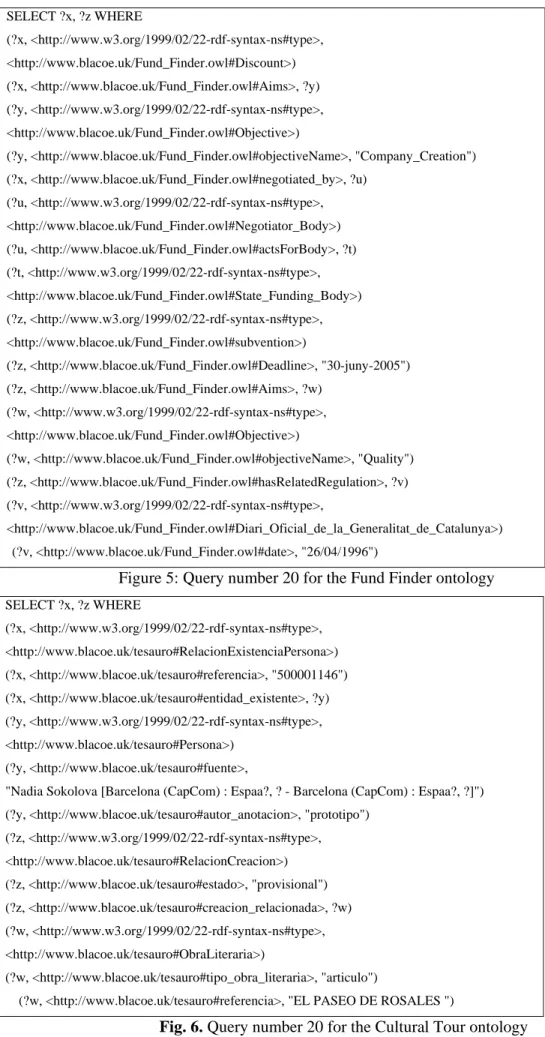
Figure 5: Query number 20 for the Fund Finder ontology
SELECT ?x, ?z WHERE
(?x, <http://www.w3.org/1999/02/22-rdf-syntax-ns#type>,
<http://www.blacoe.uk/tesauro#RelacionExistenciaPersona>)
(?x, <http://www.blacoe.uk/tesauro#referencia>, "500001146")
(?x, <http://www.blacoe.uk/tesauro#entidad_existente>, ?y)
(?y, <http://www.w3.org/1999/02/22-rdf-syntax-ns#type>,
<http://www.blacoe.uk/tesauro#Persona>)
(?y, <http://www.blacoe.uk/tesauro#fuente>,
"Nadia Sokolova [Barcelona (CapCom) : Espaa?, ? - Barcelona (CapCom) : Espaa?, ?]")
(?y, <http://www.blacoe.uk/tesauro#autor_anotacion>, "prototipo")
(?z, <http://www.w3.org/1999/02/22-rdf-syntax-ns#type>,
<http://www.blacoe.uk/tesauro#RelacionCreacion>)
(?z, <http://www.blacoe.uk/tesauro#estado>, "provisional")
(?z, <http://www.blacoe.uk/tesauro#creacion_relacionada>, ?w)
(?w, <http://www.w3.org/1999/02/22-rdf-syntax-ns#type>,
<http://www.blacoe.uk/tesauro#ObraLiteraria>)
(?w, <http://www.blacoe.uk/tesauro#tipo_obra_literaria>, "articulo")
(?w, <http://www.blacoe.uk/tesauro#referencia>, "EL PASEO DE ROSALES ")
RDF model in Jena, the response times averaged over 100 repetitions for each query are depicted in Figure 4.
With respect to the autonomic behaviour exhibited by SEGSE, we measured, for each of the two ontologies, the query response time in two different scenarios. Scenario 1 aims to test how well SEGSE copes with the notifications of new content. This was achieved by creating
new IRS Agents along the route of a query, by means of introducing messages notifying the
acquisition of new content – that is, of new resources containing instances of some concept that was not instantiated before. The experiment was designed to implement the following procedure:
1. Remove all notifications concerning resources containing instances of a concept, for instance Organisation Applicant in the Fund Finder ontology;
2. Add a new notification for the concept SME, subsumed by Organisation Applicant;
3. Build SEGSE: this consists of starting the Distributed Platform agent for the platforms, loading the ontology model and the notifications, and the dynamic generation of the network of routers from the notifications;
4. Run query no. 1, an atomic query with subject SME;
5. Notify one resource with instances of Organisation Application;
6. Run query no. 2, an atomic query with subject SME;
7. Notify one resource with instances of Company;
8. Run query no. 3, an atomic query with subject SME;
However, there are some anomalies with some of the queries in the Cultural Tour ontology. We have identified a number of reasons that contribute to these anomalies:
1. Number of instances returned by each atomic query: For each query we match large sets of instances by URI, and then we match them with the corresponding resources by URL.
2. The time that RDQL takes to process the RDF model: This time varies considerably, as it can be seen by the values in Figure 3, and it is proportional to the number of statements in the RDF model.
3. Large sets of instances and resources returned: the resulting query result messages are quite large and the transmission time increases.
4. Time necessary to check for duplicates when large numbers of resources are returned as results of complex queries.
Scenario 1 and Scenario 2.
With respect to the results obtained when testing the autonomic behaviour, we can see that
SEGSE is able to dynamically adjust its network of routers in order to cope with the notification of new content and with the addition of new agents to the neighbourhood, without degrading the performance in terms of response time.
8 CONCLUSION
In this paper we presented SEGSE – SEmantic Gateway SystEm– a distributed multi-agent system composed of specialised agents that provides robust and efficient gathering and aggregation of digital content from diverse resources. The agents composing SEGSE use ontological descriptions to search and retrieve semantically annotated knowledge sources, by maintaining a semantic index of the instances of the annotation ontology. The efficient retrieval is made possible through the semantic routing mechanism, that permits to identify the agent indexing the resources requested by a user query without having to maintain a central index, and by minimising the number of messages broadcasted to the system. The system is also capable of exhibiting autonomic behaviour. Autonomic behaviour is characterised by self-management and self-healing capabilities, aimed at permitting the system to manage the failure of one or more of its agents and ensure continuous functioning. We tested the performance search and retrieval capabilities of the system, and the experimental data shows that SEGSE generally maintains the response times under a second, showing that the overhead produced by the indexing and routing mechanisms does not impact the system performance. We also tested the autonomic behaviour, and the experimental results show how the system is able to efficiently self configure.
REFERENCES
1. Decker, S., et al.: The semantic web: The roles of XML and RDF. IEEE Internet
Computing 4 (2000) 63–74
2. Nejdl, W., et al.: EDUTELLA: A p2p networking infrastructure based on rdf. In:
Proceedings of the WWW2002, Honolulu, Hawaii, USA (2002) 604–615 3. The Morpheus website. (http: / /mus
4. Halevy, A., et al.: Schema mediation in peer data management systems. In: Proceedings
of the International Conference on Data Engineering (ICDE03), Bangalore, India (2003) 5. 5. Bellifemine, F., et al.: JADE a white paper. EXP In search of innovation 3 (2003) 6. Tamma, V., Payne, T.: Toward semantic web agents: Agent link and knowledge web.
7. Kephart, J., Chess, D.: The vision of autonomic computing. Computer magazine 36 (2003) 41–5 1
8. Tamma, V., et al.: SEGSE: searching for semantic web content. In: Proceedings of ECAI 2004. (2004)
9. Tamma, V., et al.: SEGSE: searching for digital content in esperonto. In: Proceedings of
EKAW 2004. (2004)
10. RDQL
11. The Jenawebsite.
12. Ehrig, M., Staab, S.: QOM quick ontology mapping. Number 3298 in LNCS (2004) 683–
697
13. Wooldridge, M., Jennings, N.: Intelligent agents: Theory and practice. Knowledge
engineering review 10 (1995) 115–152
14. Sterritt, R., Bustard, D.: Towards an autonomic computing environment. Proceedings of
14th International Workshop on Database and Expert Systems Applications, 2003
15. Kumar, S., Cohen, P.: Towards a fault-tolerant multi-agent system architecture. In:
Proceedings of Agents 2000.
16. Bigus, J.P., et al.: ABLE: A toolkit for building multiagent autonomic systems. IBM
Systems Journal 41 (2002)
17. McCann, J., Huebscher, M.: Evaluation issues in autonomic computing. International
Workshop on Agents and Autonomic Computing and Grid Enabled Virtual Organizations (AACGEVO04), Wuhan, China (2004)
18. Sycara, K., et al..: Dynamic service matchmaking among agents in open information sys-tems. ACM SIGMOD Record. Special Issue on semantic interoperability in global information systems (1998)
19. Bayardo, Jr., R., et al.: InfoSleuth: Agent-based semantic integration of information in open and dynamic environments. In: Proceedings of the ACM SIGMOD International Conference on Management of Data. Volume 26,2., New York, ACM Press (1997) 195–
206
20. Ehrig, M., et al.: The SWAP data and metadata model for semantics-based peer-to-peer
systems. In: Proceedings of MATES-2003. Number 2831 in LNAI, Springer (2003) 21. Haase, P. et al.: Bibster - A Semantics-Based Bibliographic Peer-to-Peer System In:
WWW’03 1st SemPGRID Workshop. (2003) 23. Project JXTA. (http: / /www. j
24. Ratnasamy, et al.: A scalable, content addressable network. In: Proceedings of ACM SIG-COMM. (2001)
25. Stoica, I., et al.: Chord: a scalable peer-to-peer lookup service for internet applications.
In: Proceedings of ACM SIGCOMM. (2001)
26. SWAP: Semantic web and peer-to-peer. (http:
27. Arumugam, M., et al.: Towards peer-to-peer semantic web: A distributed environment
for sharing semantic knowledge on the web. In: Proceedings of WWW2002, Honolulu, Hawaii, USA (2002)
28. Lima, T., et al.: Digital library services supporting information integration over the web.
In: Proceedings of WIIW 2001. (2001)
29. Aberer, K., et al.: Gridvine: Building internet-scale semantic overlay networks. Number