81
A Hybrid Algorithm Based on Flower Pollination
Algorithm and Electro Search for Global
Optimization
Md Fadil Md Esa, Noorfa Haszlinna Mustaffa & Nor Haizan Mohamed Radzi
School of Computing, Faculty of EngineeringUniversiti Teknologi Malaysia 81310 UTM Johor Bahru, Johor, Malaysia
Email: [email protected], [email protected], [email protected]
Submitted: 12/01/2018. Revised edition: 22/10/2018. Accepted: 30/10/2018. Published online: 21 November 2018
Abstract—In this paper, we have presented a new hybrid optimization method called hybrid Electro-Search algorithm (Eo) and Flower Pollination Optimization Algorithm (FPA) which introduces Eo to FPA. EO-FPA combines the merits of both Eo and FPA by designing on the local-search strategy from Eo and global-search strategy from FPA. The results of the experiments performed with twenty-two well-known benchmark functions show that the proposed algorithm possesses outstanding performance in statistical merit as compared to the original and variant FPA. It is proven that the EO-FPA algorithm requires better formulation to achieve efficiency and high performance to work out with global optimization problems.
Keywords—Hybrid, Flower Pollination Algorithm, Electron Orbit Algorithm, Global Optimization
I.INTRODUCTION
Global optimization such as the function optimization and engineering optimization, are very significant in the real-world. It can be defined as a set of candidate solution within specific set bound dimension. Each solution has same fitness or objective function. The task is to search the candidate solution with maximum or minimum fitness value assumed as optimum in global [7]. For the more complex problem, the solution contains several level optimums of fitness which are called local optimum. In general, the capability to get the global minimum rapidly and able to avoid the local minima are the properties for a good global
optimization algorithm. Recently, nature-inspired based search algorithms have become the trend in engineering and industry due to their excellent achievement in searching good solutions for complex problems, especially in the global optimization problems. Imitating the nature’s phenomenon, nature-inspired based stochastic algorithms are considered as random search but guided heuristically to the future iteration. Usually, the guide mimics the specific natural behavior [1] that occurs in various fields such as in biology, physic, and evolution.
There are several researchers who have proposed nature-inspired based search algorithms, such as Flower Pollination Algorithm (FPA) [2], Simulated Tornado Optimization [3], Levy Flight [5], Electro-Search Algorithm (Eo) [4] and Electromagnetic Field Optimization [6] for global optimization problem.
II.LITERATURE REVIEW
Despite the reported successful application of searching algorithm in literature, theorem of no free lunch (NFL) has created suspicion in advance with the fact that there is no perfect heuristic algorithm to solve all optimization problems [21].
82 FPA and Eo could be categorized as emerging algorithms of the decade that have potential to be explored more. FPA has received much attention due to the convenience in its implementation with simple design and has fewer control parameters. The first implementation of FPA is to solve a number of practical optimization problems [2]. Furthermore, several hybrids of FPA have been proposed including the CSA algorithm [9], bee pollinator [22], time-varying fuzzy selection mechanism [25], an elite opposition strategy [23], partitioning search mechanism [24] and pattern search [26].
Meanwhile, Electro-Search algorithm (Eo), developed by Tabari and Ahmada, is a physics-inspired based heuristic for search optimization [4]. The advantage of Eo emerges when it allows the global search to have the ability to execute self-tuning parameters.
The previously mentioned advantages contribute in the idea of initiating the hybrid between FPA and Eo as to improve the optimization and propose the hybrid algorithm as a new stochastic algorithm.
Literature has shown that both algorithms have good performance in the implementation of some widely-used benchmark functions. Despite the strong global exploration ability of these algorithms to escape from local optima at the same time, the convergence speed is very slow in obtaining the global optimum. Hence, the hybrid EO-FPA could be a good method to deal with continuous global optimization problems with a good architecture.
Thus, this paper discusses the combination of FPA and Eo to investigate the capability of Eo in enhancing FPA. Furthermore, EO-FPA algorithm is validated by searching the optimum parameters in twenty-two well-known benchmark functions that could solve continuous global optimization problems. The formulated algorithm is then compared with the standard FPA and a Modified Flower Pollination Algorithm (MFA) [9].
Following this section, this paper reviews the main characteristics of the FPA in the next section; and continues with the explanation on the Eo. The process of hybridizing the two algorithms to produce a new modified version of the FPA is then elaborated in Section III. The results of the proposed algorithm that was evaluated using a set of well-known benchmark functions are detailed next in Section IV, along with the discussion and some ideas for possible enhancement of the proposed algorithm. Finally, the conclusion of this paper can be found in the last section.
A. Flower Pollination Algorithm
FPA mimics the process of biotic and abiotic of flower pollination in real life proposed by Yang [2]. The advantages of the process include; simple to implement, has a small number of parameters, and high efficiency [8].
1) Flower Pollination Process
Flower pollination is a plant breeding mechanism that involves the spread of pollen by various distributing agents called pollinator, such as animals, insects, winds, and so on. There is significant relationship between flower and pollinator which has influence on the sustainability of plant species in its habitat [10].
The pollination process can be classified into two types which are abiotic and biotic. Abiotic pollination needs less or no pollinator and resulting in the close distribution area, which called self-pollination. For example, the pollen will be distributed by itself when flower from higher level becomes matured and throwing the pollen to flower at the lower level. Meanwhile, the biotic pollination, which is also known as cross-pollination is usually affected by pollinator behavior and the pollen would have more long-distance radius compared to through abiotic pollination. The pollinators such as birds and insect have their own foraging patterns such as the Levy flight [5].
In certain situations, the pollinator could visit different plant species and distribute pollen to other plant species. The fertilization process that would take place is a special behavior called flower constancy [9]. This process promises maximum reproduction of the species. With regards to the species reproduction, researcher assumed that the ratios involving biotic and abiotic process in flower pollination are around 9:1 [11].
Adaptation from the characteristics of the pollination process, pollinator behavior and flower constancy where FPA was formulated are as in the following rules:
(Rule 1): The abiotic can be recognized as a local pollination process within close area.
(Rule 2): The biotic can be represented as a combination of a global pollination process and pollinators behavior would follow the Levy distribution. It could involve long distance pollen distribution.
(Rule 3): The flower constancy property can be interpreted as a reproduction similarity ratio between two flowers
(Rule 4): Affected from environment such as wind and physical proximity, local pollination has dominant control than global pollination.
2)Flower Pollination for Search Algorithm
Therefore, the concept of flower pollination process as mentioned previously can be mathematically formulated as follows:
For (Rule 1):
(1)
83 follows the Levy flight, L is derived from the Levy distribution. g* is the best-found solution at iteration t.
For (Rule 2):
(2) Same with Eq (1) where x represents the solution vectors and ɛ is derived from a uniform distribution between range [0, 1].
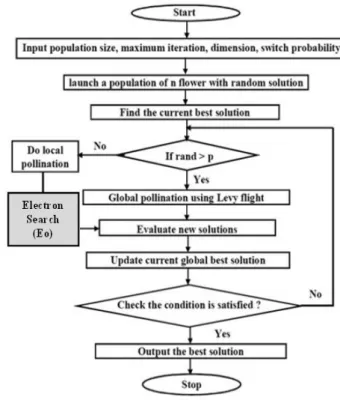
For formulation (Rule 4), the selection of pollination type either local or global can be controlled by a switch probability P. Usually, the local is dominated by global on pollination process. Based on these formulations, the FPA is developed as shown in Fig. 1.
Fig. 1.Flowchart of Flower Pollination Algorithm [2]
B.The Electro-Search Algorithm
This algorithm is a combination of two physic behaviors, which are the orbital movement of the electrons around the atomic nucleus and discharge moving nucleus from position. Therefore the algorithm guides the heuristic searching into optimum solution.
1)Atom Structure and Behavior
In physics, atom is the smallest unit of material. The atom structure consists of a nucleus with several electrons circling around it. When observing more deeply, a nucleus is composed of several protons and neutrons which form 99.94% of the atomic mass. Neutrons do not have electric
charge, while the electric charge for electron is negative and positive for proton. If the number of protons and electrons in the atom is equal, the atom’s electric charge will be neutral. On the other hand, if it’s number of protons and electrons are different, the atom will be charged with either negative or positive. The second condition is called ion. The atom’s elements have specific reaction. Neutrons and protons are attracted to each other by the nuclear force. This reaction is stronger than the electromagnetic force reaction between protons and electrons. The number of protons in each nucleus is known as Atomic number which basically describes an element. The isotopes of an element are then the atoms with the equal number of protons and different number of neutrons. The electrons determine the magnetic properties of an atom [4].
Bohr’s atomic model illustrates the nucleus that consists of neutrons and protons which is represented as the orbital center of the protons movement, which is similar to the movement of planets around the orbits of the sun. This model which is integrated with quantum mechanics feature represents the constrain of the multiple levels of orbits and the radius for particle energy in atom. There are two types of electrons’ movements between different levels of orbits, which are by absorbing, or also called excitation; or emitting, which also known as de-excitation of the energy [4].
2)The Electro-Search for Search Algorithm
Adapting from the analogies of the atom element, limited multilevel orbit and movement type, a set of rules was formulated as below.
(Rule 1): Molecular space which consists of various atom can be interpreted as the problem space of candidate solution.
(Rule 2): Atom can be analogous as a candidate solutions.
(Rule 3): The electrons orbiting the nucleus of each atom at multilevel orbit represented as search process within close area.
(Rule 4): Atomic excitation and de-excitation can be interpreted as short or long distant search atom from current position.
Therefore, the concept of orbiting electron around atom process as previously mentioned can be mathematically formulated as follows:
For (Rule 3):
(3) n∈ {2, 3, 4, 5}
84 where Ni represents the present position of the nucleus, n is the energy level that defines the orbit in which the electrons can move, rand is random numbers between the range [0,1], and r is the orbital radius determined by Eq. (4) except for the first iteration which is defined randomly.
For (Rule 4):
(4)
where Nnew represents the new position nucleus, Ackis the accelerator coefficient and Dk is determined by Eq. (5)
(5)
where at each iteration k, ebest represents the best electron around the nucleus, Nk is the current position of the nucleus
Nbest is the current best nucleus position and Rek is the Rydberg’s energy constant. Based on the formulation, Eo is developed as shown in Fig. 2.
Fig. 2.Flowchart of Electro Search Algorithm [4]
III.MODIFIED FPA(EO-FPA)
There is still the need to fill the gap although the performance of original FPA are excellent for many applications [9]. Based on the complex problems being tested, FPA has been modified from many aspects to enhance its performance such as on its operator behavior [10], domain discretization [13], distribution value and exploration ability[14].
A
mong the issues debated is the FPA exploration ability conducted by Lévy flights that can be the reason of the aggressively generated large steps searching. Regarding this issue, the probability for the new solution produced at out the range of the problem space could increase, while the original exploration ability from Lévy flights model could decrease [9].T
hus, the aforementioned reason is the leading idea in this paper as to propose the modification of FPA with EOA. At this stage of research, the movement of electrons around multilevel orbit nucleus have been formulated to take over the standard biotic during local pollination. This situation implies that the proposed hybrid Eo-FPA still utilizes the Lévy flights searching as the global search and orbiting electron as the local search. The candidate solutions are represented by the nucleus transition using Lévy distribution and driven by proton as the exploitation agent at the local. Based on the formulation, The Eo-FPA is developed as shown in Fig. 3.85 IV.EXPERIMENTS AND RESULT ANALYSIS
A.Test Functions and Initialization Setting
Experiment in this paper used a set of twenty-two widely benchmark functions given in CEC 2011 competition [17] listed in Table I with specific range boundary performance to evaluate the proposed algorithm. This set of experiment involved several types of solution space problems such as many local minima, bowl-shaped, plate-shaped, valley-shaped, steep ridges/drops and other. Besides that, EO-FPA algorithm has also been compared to the original FPA and MFPA to search for global optimum at the given benchmark functions.
Two types of statistical analysis have been used which are simple parameters and non-parametric statistical. The reason of using these statistical tools is because the simple statistical parameters only provide information about the algorithm’s behavior in solving that particular problem. On the other side, the non-parametric statistical has statistically provided better result on the comparison between several algorithms solving a numerical optimization problem.
TABLE I. THE BENCHMARK TEST FUNCTIONS USED IN EXPERIMENT
Function Name
Boundary Parameter
Lower Upper Dimensi on
F1 Ackley -15 30 2
F2 Cross-in-Tray -10 10 2 F3 Drop-Wave -5.12 5.12 2 F4 Eggholder -512 512 2
F5 Griewank -600 600 2
F6 Holder Table -10 10 2
F7 Levy -10 10 2
F8 Rastrigin -5.12 5.12 2 F9 Schaffer N.2 -100 100 2 F10 Schaffer N.4 -100 100 2 F11 Schwefel -500 500 2 F12 Shubert -5.12 5.12 2 F13 Sphere -5.12 5.12 2
F14 Matyas -10 10 2
F15 Zakharov -5 10 2
F16 Dixon-Price -10 10 2
F17 Rosenbrock -5 10 3
F18 De Jong N.5 -65.536 65.536 2
F19 Easom -100 100 2
F20 Michalewicz 0 pi 2
F21 Beale -4.5 4.5 2
F22 Rotated
HyperEllipsoid -65.536 65.536 2
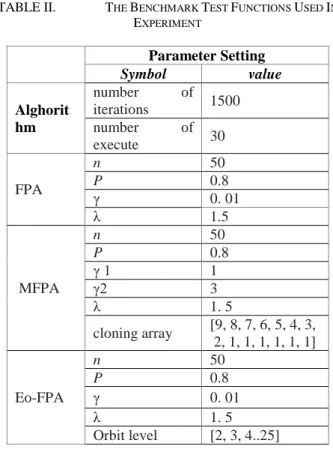
Table II lists out the detailed parameter setting of the FPA, MFPA and Eo-FPA algorithms used in experiment. The experiment was accomplished in the same hardware (Lenovo U41, Core i5, 2.20 GHz, 8GB RAM) and software Matlab2017b platform. The following result was obtained
after applying and implementing our methodology in section three that is, our proposed work.
TABLE II. THE BENCHMARK TEST FUNCTIONS USED IN EXPERIMENT
Parameter Setting
Symbol value
Alghorit hm
number of iterations 1500 number of execute 30
FPA
n 50
P 0.8
γ 0.01
λ 1.5
MFPA
n 50
P 0.8
γ 1 1
γ2 3
λ 1.5
cloning array [9, 8, 7, 6, 5, 4, 3, 2, 1, 1, 1, 1, 1, 1]
Eo-FPA
n 50
P 0.8
γ 0.01
λ 1.5
Orbit level [2, 3, 4..25]
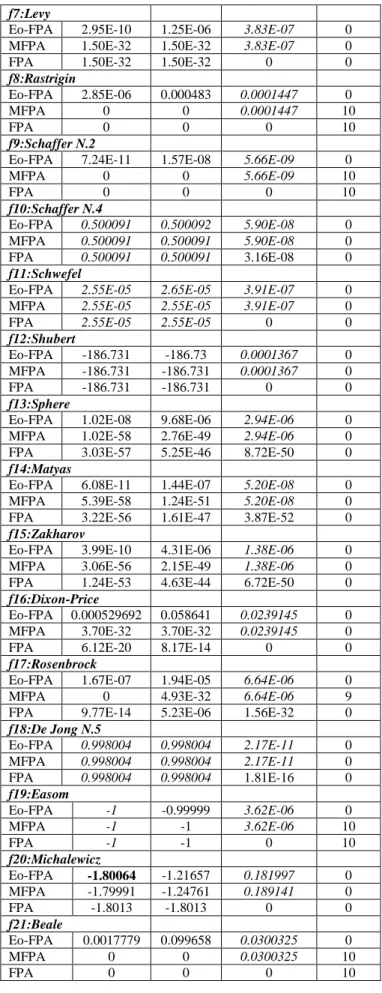
TABLE III. STATISTICS OF OPTIMAL OBJECTIVE VALUES FOR THE 22 TEST FUNCTIONS
Alg Min Max Std #Opt
f1:Ackley
Eo-FPA 6.66E-05 0.007885 0.00210114 0 MFPA 8.88E-16 8.88E-16 0.00210114 0
FPA 8.88E-16 8.88E-16 0 0
f2:Cross-in-Tray
Eo-FPA -2.06261 -2.06261 5.60E-09 0 MFPA -2.06261 -2.06261 5.60E-09 0
FPA -2.06261 -2.06261 4.68E-16 0
f3:Drop-Wave
Eo-FPA -0.999998 -0.99984 5.26E-05 0
MFPA -1 -1 5.26E-05 10
FPA -1 -1 0 6
f4:Eggholder
Eo-FPA -959.64 -958.168 0.552602 0 MFPA -959.641 -959.641 0.552602 0 FPA -959.641 -959.641 0 0 f5:Griewank
Eo-FPA 0.00833868 0.390791 0.124393 0
MFPA 0 0 0.124393 10
FPA 1.57E-11 5.83E-07 0 0 f6:Holder Table
Eo-FPA -19.2085 -19.2079 0.00022422 0 MFPA -19.2085 -19.2085 0.00022422 0
86 f7:Levy
Eo-FPA 2.95E-10 1.25E-06 3.83E-07 0 MFPA 1.50E-32 1.50E-32 3.83E-07 0 FPA 1.50E-32 1.50E-32 0 0 f8:Rastrigin
Eo-FPA 2.85E-06 0.000483 0.0001447 0
MFPA 0 0 0.0001447 10
FPA 0 0 0 10
f9:Schaffer N.2
Eo-FPA 7.24E-11 1.57E-08 5.66E-09 0
MFPA 0 0 5.66E-09 10
FPA 0 0 0 10
f10:Schaffer N.4
Eo-FPA 0.500091 0.500092 5.90E-08 0 MFPA 0.500091 0.500091 5.90E-08 0
FPA 0.500091 0.500091 3.16E-08 0
f11:Schwefel
Eo-FPA 2.55E-05 2.65E-05 3.91E-07 0 MFPA 2.55E-05 2.55E-05 3.91E-07 0
FPA 2.55E-05 2.55E-05 0 0
f12:Shubert
Eo-FPA -186.731 -186.73 0.0001367 0 MFPA -186.731 -186.731 0.0001367 0 FPA -186.731 -186.731 0 0 f13:Sphere
Eo-FPA 1.02E-08 9.68E-06 2.94E-06 0 MFPA 1.02E-58 2.76E-49 2.94E-06 0 FPA 3.03E-57 5.25E-46 8.72E-50 0 f14:Matyas
Eo-FPA 6.08E-11 1.44E-07 5.20E-08 0 MFPA 5.39E-58 1.24E-51 5.20E-08 0 FPA 3.22E-56 1.61E-47 3.87E-52 0 f15:Zakharov
Eo-FPA 3.99E-10 4.31E-06 1.38E-06 0 MFPA 3.06E-56 2.15E-49 1.38E-06 0 FPA 1.24E-53 4.63E-44 6.72E-50 0 f16:Dixon-Price
Eo-FPA 0.000529692 0.058641 0.0239145 0 MFPA 3.70E-32 3.70E-32 0.0239145 0 FPA 6.12E-20 8.17E-14 0 0 f17:Rosenbrock
Eo-FPA 1.67E-07 1.94E-05 6.64E-06 0 MFPA 0 4.93E-32 6.64E-06 9 FPA 9.77E-14 5.23E-06 1.56E-32 0 f18:De Jong N.5
Eo-FPA 0.998004 0.998004 2.17E-11 0 MFPA 0.998004 0.998004 2.17E-11 0
FPA 0.998004 0.998004 1.81E-16 0
f19:Easom
Eo-FPA -1 -0.99999 3.62E-06 0
MFPA -1 -1 3.62E-06 10
FPA -1 -1 0 10
f20:Michalewicz
Eo-FPA -1.80064 -1.21657 0.181997 0 MFPA -1.79991 -1.24761 0.189141 0
FPA -1.8013 -1.8013 0 0
f21:Beale
Eo-FPA 0.0017779 0.099658 0.0300325 0
MFPA 0 0 0.0300325 10
FPA 0 0 0 10
f22:Rotated Hyper Ellipsoid
Eo-FPA 1.94E-07 6.55E-06 2.02E-06 0 MFPA 7.77E-54 2.02E-47 2.02E-06 0 FPA 5.40E-54 5.96E-42 7.32E-48 0
TABLE IV. AVERAGE ERROR FOR THE 22 TEST FUNCTIONS
Function Eo-FPA MFPA FPA
F1 0.0026366 8.88E-16 8.88E-16
F2 2.06261 2.06261 2.06261
F3 0.999954 1 1
F4 959.262 959.641 959.641
F5 0.110591 1 1.02E-07
F6 19.2083 19.2085 19.2085
F7 2.93E-07 1.50E-32 1.50E-32
F8 7.95E-05 1 1
F9 4.28E-09 1 1
F10 0.500091 0.500091 0.500091 F11 2.59E-05 2.55E-05 2.55E-05
F12 186.731 186.731 186.731
F13 1.48E-06 2.77E-50 6.22E-47 F14 5.86E-08 1.76E-52 1.93E-48 F15 1.18E-06 2.61E-50 5.59E-45 F16 0.0201559 3.70E-32 9.09E-15 F17 4.21E-06 4.93E-33 5.67E-07 F18 0.998004 0.998004 0.998004
F19 0.999997 1 1
F20 1.7047 1.71324 1.8013
F21 0.022064 1 1
F22 2.38E-06 3.46E-48 6.10E-43
B.Results and Discussions
The experimental results were evaluated with statistical analysis performance which were minimum, maximum, mean and standard deviation value of the optimized function and successful rate for searching global optimum values. The statistics of performance for the twenty-two test functions are listed as in Table III, while Table IV presents the average value from each set experiment. Throughout the paper, the same result is formatted in italic and the best results are in bold.
Instead of twenty-two functions that had been tested to achieve global minimum, the Eo-FPA succeeded in leading on only one function compared to other algorithms. Meanwhile, the other eight functions shared the equal performance, and missed out on the others.
Results from all functions tested to see the maximum value on produced solution show that Eo-FPA shared the performance at six test functions and overcame all others. These results have influenced the test of average for the produced solution that resulting in the same pattern performance.
87 Test [19] and Wilcoxon Ranks Test [18]. Sign Test result as shows in Table V, Eo-FPA, Eo-FPA shows a significant improvement over FPA but not for MFPA.
TABLE V. SIGN TEST RESULT
Eo-FPA MFPA FPA
Wins (+) 9 10
Loses (−) 9 8
Differences 0 2
TABLE VI. WILCOXON RANKS TEST RESULTS
Comparison R+ R− p-value
Eo-FPA vs MFPA 53 118 0.888
Eo-FPA vs FPA 66 105 0.6727
Table VI shows the R+, R−, and p-values computed for all pairwise comparisons concerning Eo-FPA (the p-values have been computed by using SPSS). Let R+ be the sum of ranks for the problems in which the first algorithm outperformed the second, and R− for the sum of ranks for the opposite value. As stated in the table, Eo-FPA shows none significant improvement over MFPA, and FPA, with a level of significance α = 0.5.
V.CONCLUSION
Hybrid nature-inspired algorithms provide a practical solution for global optimization problems. The natural behavior of electron that orbiting its nucleus and natural flower pollination process inspires Eo and FPA for optimization searching. Due to both algorithms’ advantages, these algorithms could be hybridized to produce algorithms with better performance. The hybrid optimization search algorithm Eo-FPA for global optimization problems has been proposed.
The experimental process was centralizing on solving twenty-two benchmark functions on Eo-FPA, and comparing the results to the original FPA and MFPA algorithms. The results which are based on simple statistic indicate that Eo-FPA could find optimal or close-to-optimal solutions. Meanwhile, the nonparametric sign test shows that the proposed algorithm could compete the original FPA and generate competitive result with MFPA. However, through Wilcoxon ranks test, non-significant difference result were recorded for both FPA and MFPA respectively. For overall result, it can be concluded that the proposed Eo-FPA could still be improvised on its mathematical formulation.
Although the generated solution observed has similar pattern with MFPA, the solution value is low, therefore leads to a gap to achieve optimum value in precision value test function. Future study should consider overcoming this – issue since it has significant influence on the overall Eo-FPA performance.
ACKNOWLEDGMENT
The research is supported by Ministry of High Education Malaysia (MOHE), Soft Computing Research Group (SCRG) UTM Malaysia and conducted in Collaboration with Student Postgraduate Society (SPS) at Universiti Teknologi Malaysia.
REFERENCES
[1] Popa, R. (2016). Handbook of Research on Novel Soft Computing Intelligent Algorithms: Theory and Practical Applications. IGI Global, 80-81.
[2] Yang, X.-S. (2012). Flower Pollination Algorithm for Global Optimization. In J. Durand-Lose, & N. Jonoska (Eds.). Unconventional Computation and Natural Computation. Berlin, Heidelberg: Springer Berlin Heidelberg. 240-249. [3] Hosseini, S. H. et al. (2016). Simulated Tornado
Optimization. In Signal Processing and Intelligent Systems (ICSPIS), International Conference of IEEE, 1-6.
[4] Tabari, A. and Ahmad, A. (2017). A New Optimization Method: Electro-Search Algorithm. Computers & Chemical Engineering, 103, 1-11.
[5] Yang, X. S. (2010). Firefly Algorithm, Levy Flights and Global Optimization. In Research and Development in Intelligent Systems, Springer, London. XXVI: 209-218. [6] Abedinpourshotorban, H. et al. (2016). Electromagnetic
Field Optimization: A Physics-inspired Metaheuristic Optimization Algorithm. Swarm and Evolutionary Computation, 26, 8-22.
[7] Yang, W. et al. (2018). Efficient Validation of Self-adaptive Applications by Counter Example Probability Maximization. Journal of Systems and Software, 138, 82-99.
[8] Alyasseri, Z. A. A. et al. (2018). Variants of the Flower Pollination Algorithm: A Review. In Nature-Inspired Algorithms and Applied Optimization Springer, Cham. 91-118.
[9] Nabil, E. (2016). A Modified Flower Pollination Algorithm for Global Optimization. Expert Systems with Applications, 57, 192-203.
[10] Zhou, Y. et al. (2016). Elite Opposition-based Flower Pollination Algorithm. Neurocomputing, 188, 294-310. [11] Coux, C., et al. (2016). Linking Species Functional Roles to
Their Network Roles. Ecology Letters, 19(7), 762-770. [12] Salguero-Gómez, R. et al. (2016). Fast–slow Continuum and
Reproductive Strategies Structure Plant Life-history Variation Worldwide. Proceedings of the National Academy of Sciences, 113(1), 230-235.
[13] Rodrigues, D. et al. (2015). Binary Flower Pollination Algorithm and Its Application to Feature Selection. In Recent Advances in Swarm Intelligence and Evolutionary Computation Springer, Cham, 85-100.
[14] Metwalli, M. A. B., and Hezam, I. (2015). A Modified Flower Pollination Algorithm for Fractional Programming Problems. International Journal of Intelligent Systems and Applications in Engineering, 3(3).
88 [16] Civicioglu, P. (2013). Backtracking Search Optimization
Algorithm for Numerical Optimization Problems. Applied Mathematics and Computation, 219(15), 8121-8144. [17] S. Das and P. N. Suganthan, (2012). Problem Definitions and
Evaluation Criteria for CEC 2011 Competition on Testing Evolutionary Algorithms on Real World Optimization Problems, Technical Report, 1-42.
[18] Wilcoxon, F. (1945). Individual Comparisons by Ranking Methods. Biometrics, 1, 80-83.
[19] Conover, W. J. (1999). Chapter 3.4: The Sign Test. Practical Nonparametric Statistics. Third ed. Wiley, 157-176. [20] Fesanghary, M. et al. (2008). Hybridizing Harmony Search
Algorithm with Sequential Quadratic Programming for Engineering Optimization Problems. Computer Methods in Applied Mechanics and Engineering, 197(33-40), 3080-3091.
[21] Wolpert, D. H. and Macready, W. G. (1997). No Free Lunch Theorems for Optimization. IEEE TransEvol Comput, 1(1): 67-82.
[22] Wang, R., et al. (2016). Flower Pollination Algorithm with Bee Pollinator for Cluster Analysis. Process Lett. 116(1): 1-14.
[23] Zhou, Y., et al. (2015). Elite Opposition-based Flower Pollination Algorithm. Neurocomputing. doi: 10.1016/j.neucom.2015.01.110.
[24] Mahdad, B. and Srairi, K. (2016). Security Constrained Optimal Power Flow Solution Using New Adaptive Partitioning Flower Pollination Algorithm. Appl Soft Comput, 46: 501–522.
[25] Dubey, H. M. et al. (2015). Hybrid Flower Pollination Algorithm with Time-varying Fuzzy Selection Mechanism for Wind Integrated Multi-objective Dynamic Economic Dispatch. Renew Energy. 83: 188-202.
![Fig. 1. Flowchart of Flower Pollination Algorithm [2]](https://thumb-us.123doks.com/thumbv2/123dok_us/8003516.2121590/3.892.87.433.361.766/fig-flowchart-flower-pollination-algorithm.webp)