Sowmya Parvathaneni et al JMSCR Volume 08 Issue 01 January 2020 Page 587
Original Article
Comparative Analysis of Serum Prostate Specific Antigen Levels in Various
Prostatic Lesions
Authors
Sowmya Parvathaneni*, Kusuma Venkatesh, Madhusudan H R
1Department of Pathology, 1Department of Urology, Kempegowda Institute of Medical Sciences, Bengaluru, Karnataka, India
*Corresponding Author
Sowmya Parvathaneni
Abstract
Background: Prostatic enlargement can present with various urinary tract symptoms due to its location at the bladder neck. Benign prostatic hyperplasia (B.P.H), prostatitis, Prostatic intraepithelial neoplasia (PIN) and adenocarcinoma are the lesions commonly encountered. Use of Prostate Specific antigen (PSA) levels as a screening test aids in the diagnosis and management of prostate cancer.
Materials and Methods: This study was carried out for a period of 2 years in the department of pathology. A total of 160 cases of prostate biopsies were studied and PSA values were noted in 112 cases. The biopsies were processed by routine techniques and studied along with immunohistochemical (IHC) markers in cases of diagnostic problems.
Results: The 112 cases of prostate biopsies which had PSA estimations have been analyzed here. The most common condition was B.P.H, found in 51%, Prostatitis in 15%, PIN in 9.2% and adenocarcinoma in 24%. Majority of the patients were in the age group of 60-69 years. PSA values in the benign cases were in the range of 4-10ng/ml, while malignant cases had levels >20ng/ml. Mean PSA values associated with benign lesions were 8.93, while in malignant cases they were 43.66.
Conclusion: Incidence of adenocarcinoma of prostate is on the rise and therefore it is suggested to include PSA estimation as a screening test in males above the age of 50years.
Keywords: Benign prostatic hyperplasia, Prostatitis, adenocarcinoma, Prostate specific antigen.
Introduction
Prostate is an androgen dependent organ. Androgenic hormones are involved in the development of various pathological processes arising in the prostate.1 Prostatomegaly is a common problem in the elderly males over the age of 50years. In such persons the presenting symptoms include urinary tract symptoms such as hesitancy, increased frequency of micturition and
acute retention of urine. Various benign and malignant processes develop in the prostate and benign prostatic hyperplasia (B.P.H) is the most common benign lesion encountered. It can be treated with medications and simple surgical intervention. Prostate cancer is the most common cancer in the males following lung cancer after the age of 65 years.2 In the year 2013 it was estimated that prostate cancer was the second major cause of
http://jmscr.igmpublication.org/home/ ISSN (e)-2347-176x ISSN (p) 2455-0450
Sowmya Parvathaneni et al JMSCR Volume 08 Issue 01 January 2020 Page 588 cancer deaths in U.S men with 2,38,590 new cases
diagnosed and 29, 720 deaths occurring.3 In Indian urban population it is the most common visceral malignancy encountered. It is the 4th most common cause of cancer deaths in Indian men. It is the cause of significant number of cancer related deaths in elderly men and is emerging as a challenge to urologists, radiologists and surgical pathologists. Age, race, diet and family history can be the significant factors contributing to the development of prostate cancer. Early diagnosis of prostate cancer is required which is still localized to prostate for better management of the patients. Various diagnostic techniques have been developed for the early detection of prostate cancer. Out of them digital rectal examination is one of the main modality for the diagnosis. The accuracy rate of digital rectal examination to diagnose malignancy is around 20-40%.4 Development of Trans rectal ultrasonography (TRUS) has been a major contribution in detecting prostate cancer. Discovery of Prostate specific antigen (PSA) have been an invaluable addition to urological pathology. PSA is the most useful tumor marker in the diagnosis of prostate cancer.5 PSA is an androgen regulated serine protease secreted by both benign and malignant prostatic tissue. Use of serum PSA levels as screening test can cause a marked decrease in the number of metastatic disease diagnosed and deaths occurring due to prostate cancer.
Our objectives in this study were 1) to study the histopathological spectrum of prostatic lesions and 2) to study the utility of serum PSA levels in diagnosing various benign and malignant prostatic lesions.
Methodology
This Retro prospective study was carried out on prostatic biopsies for a period of two years in the department of pathology. This study included 112 cases in which PSA levels were obtained out of the 160 prostatic samples received.The patient details like age, presenting complaints, USG
findings were obtained from the clinical department along with the PSA levels.
Samples received were in the form of Trans urethral resection prostate (TURP) chips and needle biopsies. The amount of TURP chips were weighed and the number of needle biopsies were counted. Biopsies were fixed in 10% buffered formalin and routinely processed. Paraffin blocks were made and 5micron thick sections were stained with Hematoxylin and Eosin (H&E). Detailed microscopic examination was carried out. Histopathological features like pattern of arrangement of glands, cellular and nuclear details were studied. Gleason scoring was done in all cases of adenocarcinoma. In cases of diagnostic problems we used Immunohistochemistry (IHC) for p63 as myoepithelial cell marker and cytoplasmic marker AMACR in the luminal cells were used to differentiate PIN and adenocarcinoma.
For serum PSA estimation the samples were collected in serum vials with a red cap. The amount of sample collected was 0.6ml. These serum tubes were centrifuged within 2 hours of collection. Serum PSA levels were estimated using electrochemical luminescence assays in Cobas 6000 series system. This is an automated analyzer which performs photoelectric assays as well as electrochemiluminescence (ECL) assays. Statistical analysis was done using Microsoft excel, SPSS software version 21 and the results were expressed in the form of tables, graphs and the Mean+ Standard Deviation (S.D) values.
Results
The present study included 112 cases of prostate samples received in the department of pathology in which PSA levels were obtained. The patients studied were in the age group of 40-90 years. Majority of the gross samples received were in the form of TURP chips and remaining were in the form of needle biopsies.
Sowmya Parvathaneni et al JMSCR Volume 08 Issue 01 January 2020 Page 589 adenocarcinoma in 1(0.8%) case, LGPIN in 2
(1.2%) cases, HGPIN in 9 (8%) of cases and adenocarcinoma in 27 (24%) of cases.(Figure 1). The age wise distribution of cases was 2 (1.7%) in the age group of 40-49 years, 9 (8.4%) were between 50-59 years, 47 (42%) between 60-69 years, 45 (40%) in the age group of 70-79 years and 9 (8%) were aged >80 years. Majority of the patients studied were in the age group between 60 and 79 years (Figure 2).
PSA values studied in the patients were in the range of <4 to >20ng/ml. Cases with PSA values <4ng/ml included 30 (51.72%) cases of B.P.H, 8 (47%) cases of prostatitis and 1 (14.2%) HGPIN. Cases with PSA values in the range of 4-10 ng/ml included 16 (27.58%) cases of B.P.H, 3 (17.6%) cases of prostatitis and 1 (14.2%) case of HGPIN. Cases with PSA values in the range of 11-20 ng/ml included 4 (6.89%) cases of B.P.H, 4 (23.5%) cases of prostatitis, 3 (42.8%) cases of HGPIN and 7 (25.9%) cases of adenocarcinoma. Cases with PSA values of > 20ng/ml included 8 (13.7%) cases of B.P.H, 2 (11.7%) cases of prostatitisand 1 (100%) of B.P.H with foci
suspicious of adenocarcinoma, 2(100%) cases of LGPIN, 2 (28.5%) cases of HGPIN and 20 (74%) cases of adenocarcinoma.(Table 1).
Mean PSA value obtained in cases of B.P.H was 8.93+ 11.56, prostatitis was 8.44+ 10.26, PIN was 18.6+ 10.2 and in adenocarcinoma was 43.66+ 30.9. PSA values were compared with Gleason score in adenocarcinoma cases. There were no cases of adenocarcinoma with PSA values < 10ng/ml. Cases with PSA values of 11-20ng/ml included 1 (16.6%) case of prostatic carcinoma with Gleason score of <6, there were 6 (40%) cases with Gleason score of >8. Cases of adenocarcinoma with PSA value >20 included 5 (83.4%) cases with Gleason score <6, 6 (100%) cases with Gleason score of 7 and 9 (60%) cases with Gleason score of >8 (Table 2).
PSA values were correlated with histopathology diagnosis and the spearman correlation obtained was 0.405 which was moderately strong and the p value obtained was 0.0001 which was statistically significant.
Table No 1. PSA Values in Different Hispathological Conditions PSA range
(ng/ml)
B.P.H Prostatitis B.P.H with suspicious
foci of adenocarcinoma
LGPIN HGPIN Adenocarci
noma
Total
<4 30(51.72%) 8(47%) 0 0 1(14.2%) 0 39
4-10 16(27.58%) 3(17.6%) 0 0 1(14.2%) 0 20
11-20 4(6.89%) 4(23.5%) 0 0 3(42.8%) 7(25.9%) 18
>20 8(13.7%) 2(11.7%) 1(100%) 2(100%) 2(28.5%) 20(74.0%) 35
Total 58(100%) 17(100%) 1(100%) 2(100%) 7(100%) 27(100%) 112
Table No 2. Mean PSA Values according to Histopathology Diagnosis
Serial no Histopathology diagnosis PSA levels [Mean+S.D]
1 B.P.H 8.93+11.564
2 Prostatitis 8.44+10.269
3 PIN 18.69+10.24
4 Adenocarcinoma 43.66+30.96
Table No 3. Comparison between Gleason Score and PSA Value in Cases of Adenocarcinoma PSA values
(ng/ml)
Gleason score Total
<6 7 >8
<4 0 0 0 0
4-10 0 0 0 0
11-20 1 (16.6%) 0 6 (40%) 7
>20 5 (83.4%) 6 (100%) 9 (60%) 19
Sowmya Parvathaneni et al JMSCR Volume 08 Issue 01 January 2020 Page 590
Figure 1. Histopathological diagnosis in 112 cases
Figure 2. Age wise distribution of cases
Figure 3 Microphotograph of B.P.H with corpora amylacea in the benign glands (H&E, 100x), inset showing IHC staining for p63 (100x)
1.7% 8.4%
42% 40%
8%
Age wise distribution of cases
Sowmya Parvathaneni et al JMSCR Volume 08 Issue 01 January 2020 Page 591
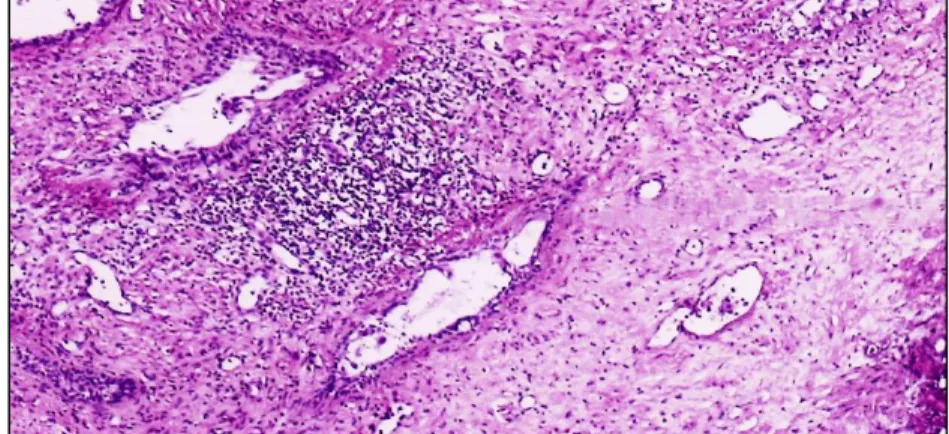
Figure 4. Microscopic features of prostatitis with chronic inflammatory cells in the stroma. (H&E, 100x)
Figure 5. Microscopic features showing a case of HGPIN with enlarged nuclei with prominent nucleoli. (H&E, 100x)
Figure 6. Microscopic image showing a case of adenocarcinoma (H&E, 100x), inset showing IHC staining of cytoplasm positive for AMACR (100x)
Histopathological features were studied in detail and IHC was done in cases of diagnostic dilemma to make a correct diagnosis. Figure 3,4,5 and 6 show the histological features of BPH, Prostatitis, HGPIN and an adenocarcinoma respectively.
Discussion
Sowmya Parvathaneni et al JMSCR Volume 08 Issue 01 January 2020 Page 592 seminal fluid for the liquefaction of semen, only a
little amount is secreted into the circulation.6 PSA is not prostate cancer specific marker, it is an organ specific marker. Apart from the prostate PSA is also expressed in breast tissue, periurethral glands and adrenal neoplasms.7PSA levels can be elevated in various benign lesions, inflammatory processes, infarcts and following mild invasive procedures. In normal healthy men aged over 60 years serum PSA levels increase at the rate of 3.2% per year (0.04 ng/ml).8 In the serum, PSA is present mainly bound to alpha 1-antichymotrypsin, only 5-40% is present in a free or unbound form. In prostate cancer the bound form is more in quantity compared to the free form. Minor amounts of PSA can present in combination with protease inhibitors. Identifying these markers can help in more specific diagnosis of prostate cancer. In normal prostate PSA enters the circulatory blood in little amounts either through leakage or diffusion. In cases of malignancy the normal morphology of prostate is disturbed leading to the significant increase in the release of PSA into the circulation. Therefore, PSA levels in cancerous tissue are 30 times more than normal prostate and 10 times more than B.P.H.9 Since the PSA levels in serum are in trace amounts enzyme immunoassays are necessary for detecting PSA in the serum.
Increase in the volume of prostate contributes to the increase in serum PSA levels and reflects the underlying pathological process going on. Serum PSA level is a very sensitive marker for the early detection of prostate cancer. Majority of the prostate cancers are detected when serum PSA levels are in the range of 4-10ug. Babeian et al in his study indicated that serum PSA levels < 4ng/ml indicate low risk cancer, 4-9 ng/ml indicate intermediate risk and levels > 10ng/ml indicate a high risk cancer.
Around 13% of men with serum PSA levels of 2.5-4ug can have organ confined prostate cancer.10 Increasing age is associated with increase in serum PSA levels. Increase in PSA levels are associated with the stage of prostate
cancer. PSA levels above 100ug are identified with metastasis. Metastasis is rarely identified in cancers with PSA levels below 10ug.P.S.A density is obtained by dividing the P.S.A levels with prostate volume. PSA velocity can detect the increase in serum PSA values 5-10years before the malignancy is detected clinically. Serum PSA levels should be used along with PSA velocity and density for the better diagnosis of prostate cancer. A recently developed noninvasive methodto diagnose prostate cancer is Prostate Health Index (PHI). It is considered as better diagnostic test to diagnose prostate cancer compared to serum PSA levels.11 In men with higher stage prostate cancer the percentage of total PSA, P2PSA levels are more while the amount of free PSA levels are lower It is calculated by combining total PSA, free PSA and pro PSA (P2PSA) levels. Sanda and colleagues have proved that PHI apart from having better ability to diagnose prostate cancer itis also helpful in identifying high grade prostate cancer.
In our study the number of B.P.H cases were 58 (51%) similar to the studies conducted by Akhter et al (50%) and Jasani et al (56%).12The number of prostatitis cases were 17 (15%) and one (0.8%) case of B.P.H. with foci suspicious of adenocarcinoma similar to the studies by Akhter et al.12 Abdel Meguid et al in their study found the prevalence of B.P.H with chronic inflammation in 20.1% of cases.13
The number of LGPIN cases were 1.25% similar to studies by Wadgaonkar et al and Shakaya et al with 2 (1.88%) cases.14The number of adenocarcinoma in our study were 27 (24%) similar to the study conducted by AzmiA Haroun et al (27%).15 Jeevan et al in their study reported an incidence of adenocarcinoma of 17%. In our study perineural invasion was noted in 16 adenocarcinoma cases.
Sowmya Parvathaneni et al JMSCR Volume 08 Issue 01 January 2020 Page 593 conducted by Anushree and Kusuma V et al also
showed similar results.17
In our study B.P.H cases having the PSA values of <4, 4-10, 11-20 and > 20ng/ml were 30 (51.72%), 16 (27.58%), 4 (6.89%) and 8 (13.7%) respectively. In the study conducted by Jasani et al the number of B.P.H cases in the PSA ranges of <4, 4-10 and > 10 were 63.7%, 27.4% and 8.8% respectively. In our study there were no cases of adenocarcinoma below the PSAvalues of 10 ng/ml all the cases showed PSA levels of >10ng/ml. This was similar to the study conducted by H.A Mvalyoma et al. in which 94% of adenocarcinoma cases had PSA values >20ng/ml.18
Chadwick et al in their study showed that serum PSA levels are better screening test to diagnose prostate cancer compared to digital rectal examination.
In our study mean PSA value in benign cases was 8.96 and in malignant cases it was 43.3. These values were similar to the study conducted by Arista Nasr J et al19 in which the mean PSA value in benign cases was 11.2 and in malignant cases the mean PSA value was 45.6. Nadler et al in their study showed that prostatitis was associated with more PSA values compared to B.P.H.
In our study PSA values were compared with Gleason score, there was 1 (16.6%) case with Gleason score of 6 and 6 (40%) cases with Gleason score >8 in the PSA range of 11-20ng/ml. Majority of the adenocarcinoma cases with Gleason score 6,7, > 8 had PSA values >20ng/ml. This was similar to the study conducted by Vani et al with 13 (76%) of cases had PSA values >20ng/ml.20
Conclusion
Prostatic diseases are more frequently encountered in the present scenario as there is better health care, awareness amongst people which has increased longevity of life. Although B.P.H is the most common lesion, conditions associated with prostatitis and HGPIN having more PSA levels have to be identified for proper management. There is a steep rise in the number of prostatic
adenocarcinoma diagnosed with the clinical, radiological examination coupled with PSA levels and confirmation by histopatholgy. In the case of diagnostic dilemma use of IHC can be an invaluable addition to prostate pathology. We advocate that the estimation of PSA should be used as a screening test above the age of 50 years so that prostatic problems are diagnosed early. As there is good targeted therapy for prostate cancer early diagnosis is essential.
Acknowledgements
We thank the ethical committee department for allowing us to carry out the study. We also sincerely thank medical records department for providing us with the case records.
References
1. Cunha GR. Role of mesenchymal-epithelial interactions in normal and abnormal development of the mammary gland and prostate. Cancer.1994; 74(3suppl): 1030-1044.
2. Neal D. The prostate and seminal vesicles. In: Mann CV, Russel RCG, Williams NS, eds. Bailey and Love's short practise of surgery. 22nd ed. Chapman Hall; London: 1995. p970-85.
3. American Cancer Society (ACS) (2013) Cancer facts and figures 2013 [online]. Atlanta, GA: American Cancer society.
Available at
http://www.cancer.org/acs/groups/content @epidemology
surveilance/documents/document/acspc-036845.pdf (accessed 1 August 2013). 4. Akdas A. Turkan T, Turkeril, Cerviki,
Biren T and Gurmen N. The diagnostic accuracy of digital rectal examination, transrectal ultrasonography, prostate specific antigen (PSA) density in prostate carcinoma. Br J Urol. 1995; 76: 54-6. 5. Radiae S. Prostate cancer molecular
Sowmya Parvathaneni et al JMSCR Volume 08 Issue 01 January 2020 Page 594 of oncology. Advanced course. September,
2002: Education boo. 2000. p. 101-4. 6. Lilja H (1985) A kallikrein-like serine
protease in prostatic fluid cleaves the predominant seminal vesicle protein. J Clin Invest 76: 1899-1903.
7. Diamondis EP, Yu H. prostate specific antigen and lack of specificity for prostate cells. Lancet 1995; 345: 1186.
8. Chen CH, Yao HH, Huang SW, Chuang CK, Hsu HS, Wang CJ, Pu YS. Using age-referenced prostate-specific antigen percentile to predict survival outcomes in screened taiwanese men. Int J Cancer. 2012 Sep 2014 doi: 10.1002/ijc.27842. 9. Stamey TA, Yang N, Hay AR, Mc Neal
JE, Freiha FS, Redwine E (1987) Prostate specific antigen as a serum marker adenocarcinoma of the prostate. N Engl J Med 317: 909-916.
10.Catalona WJ, Smith DS, Ornstein DK (1997) Prostate cancer detection in men with serum PSA concentration of 2.6 to 4ng/ml and benign prostatic examination. Enhancement of specificity with free PSA measurements see coments. J Am Med Assoc 277: 1452-1455.
11.Ulf-Hakan Stenman, Jari Leinonen, Wan-Ming Zhang, Patrik Finne. Prostate-specific Antigen. Cancer Biology, Vol 9, 1999: pp. 83-93.
12.Akhter R, Reshi R, Dar ZA, et al. Histopathological study of prostatic lesions on neddle biopsies with serum prostate-specific antigen (PSA). International Journal of Medicine and Medical Sciences 2014; 6(3): 87-91. 13.Abdel-Meguid TA, Mosil HA,
Al-Maghrabi JA. Prostate inflammation association with benign prostatic hyperplasia and prostate cancer. Saudi Med J 2009; 30: 179-83.
14.Wadgaonkar AR, Patil AA, Mahajan SV, Yengantiwar RP. Correlation of serum
prostate specific antigen (PSA) levelin various prostate pathology in elderly men. International Journal of Basic and Applied Medical Sciences 2013. Vol3. (2): 274-281.
15.Azmi A Haroun, Azmy S. Hadidy, Ziad M Awwad, Caramella F. Nimri, Waleed S. Mahafza, Emad S. Tarawneh. Utility of free prostate specific antigen serum level and its related parameters in the diagnosis of prostate cancer. Saudi J Kidney Dis Transpl 2011; 22(2): 291-297.
16.Pooja Katiyar, Roma Singh, Pragya Saxena, Sajjan Gupta. A comprehensive study of prostate pathology in correlation with prostate specific antigen-Hospital based Retrospective study of one year. Journal of Dental and Medical Sciences, 2019. 18: 60-64.
17.Anushree C.N, Kusuma Venkatesh. Morphological spectrum of prostatic lesions- A clinicopathological study. Research Gate 2012.
18.H A. Mwaakyoma et al. correlation of Gleasons score and pretreatment prostate specific aantigen in patients. Proffesional Med J Jun 2010; 17(2): 235-240.
19.Arista-Nasr J, Figuerao-Granados V, Caballero-Mendoza E, Schneider O, Lopez-Corrrasco G, Kana-Falcon M. Serum level of prostatic specific antigen in 100 patients with prostatic biopsy. Rev Invest Clin, 1998 Nov-Dec; 50(6): 487-90. 20.Bangalore ramalingiah Vani, Deepak