A.Ramya et al JMSCR Volume 08 Issue 02 February 2020 Page 30
Concurrent Chemoradiotherapy in Locally Advanced Squamous Cell
Carcinoma of Head and Neck with Capecitabine and Weekly Cisplatin
Authors
A.Ramya
1*, M.Senthilkumaran
2, R.Durga Prasad
31
Assistant Professor, Dept of Radiotherapy, Tamilnadu Government Multi Super Speciality Hospital, Chennai, India
2,3
Assistant Professor, Dept of Radiotherapy, Madras Medical College, Chennai, India *Corresponding Author
Dr A.Ramya MDRT
Abstract
Aims & Objectives: To assess the immediate loco regional response rate and acute toxicity in patients with locally advanced squamous cell carcinoma of the head and neck in Conventional radiotherapy with weekly Cisplatin and Capecitabine.
Materials and Methodology: Single arm prospective study with 30 consecutive patients with locally advanced head and neck cancer presented to our hospital. All patients were treated with conventional radiotherapy 66Gy along with weekly Inj. Cisplatin 40mg/m2 and T. capecitabine 500mg/m2 twice daily along with radiation. The immediate locoregional response rates were assessed clinically and radiologically 6 weeks after concurrent chemoradiotherapy. The toxicity profile of the treatment was assessed with RTOG acute morbidity scoring criteria and CTCAE Version 4. The study was statistically analysed using Chi Square test.
Results: Among 30 patients, Ca Oropharynx was 9 patients, followed by Ca Hypopharynx 8 patients, Ca Oral cavity with 7 patients and Ca Supraglottis 6 patients.73% of patients had complete response and 27% had partial response. Toxicities observed in the study were Mucositis grade 3 in 5 patients and grade 4 in 2 patients; Skin reactions grade 2 in 2 patients. Leucopenia grade 2 in 2 patients. Systemic toxicity diarrheagrade1 was only in 2 patients. There was no renal toxicity, hand foot syndrome in this study. There was no treatment related deaths in this study.
Conclusion: Concurrent chemo radiotherapy with Inj. Cisplatin and T.Capecitabine in locally advanced squamous cell carcinoma of head and neck cancer is better regimen with manageable toxicity with higher complete response rate.
Keywords: concurrent chemoradiotherapy, cisplatin, capecitabine, mucositis, hand foot syndrome.
Introduction
Canceris one of the most dreaded diseases in the world. In developed countries like the United States of America, it is one of the non-communicable notifiable diseases[1]. As the life expectancy of the population rises, there is an increasing incidence in
the trend of cancer in the world. They pose a significant health problem especially in developing countries, including India. Due to high exposure to smokeless and smoke tobacco among Indian people, head and neck cancers in India continues to be a major public health problem mainly among younger
http://jmscr.igmpublication.org/home/ ISSN (e)-2347-176x ISSN (p) 2455-0450
A.Ramya et al JMSCR Volume 08 Issue 02 February 2020 Page 31 generation and it causes significant morbidity and
mortality. Head and neck region cancers represent a heterogeneous group of cancers arising from the mucosa of upper aero digestive organs, lined by squamous epithelium. Every year around 5 million new cases of head and neck cancers are diagnosed worldwide[2]. Head and neck cancers in India accounts for about 30% of all cancers in the males, constitute 11 to 16% in females.Nearly 80,000 oral cancers are diagnosed every year in our country[3].
The treatment of locally advanced head and neck cancers tremendously improved during recent years. Many trials have proved the effectiveness of radiation with concurrent chemotherapy. The major trial META-ANALYSIS OF CHEMOTHERAPY IN HEAD AND NECK CANCER (MACH-NC)- Concurrent chemotherapy with radiation showed an showed an overall absolute benefit of chemotherapy to be 6.5% at 5 years and the hazard ratio was 0.81 (p < 0.0001)[4],[5]. Concurrent chemoradiation with cisplatin as become the standard of care with the standard land mark trials. Weekly Cisplatin schedules have been preferred over three weekly regimens mainly due to more radio-sensitization during long course of radiation and less chemo related toxicity. A study by Tejpal Gupta (TMH) in 2009, compared high dose concurrent Cisplatin with weekly Cisplatin 30 mg/m2 with radiation dose of 70Gy. With a mean follow-up of 19 months, the 5-year local control was 57%, loco-regional control was 46% and the disease-free survival (DFS) was 43% respectively[6]. Another study published by
Homma et al in 2011, including 53 patients with locally advanced squamous cell carcinoma used weekly cisplatin 40 mg/m2 on 7 weeks along with radiation of 70 Gy/2Gy per fraction in 35 fractions. The OS rate (93.7%) and DFS (88%) and toxicity was manageable in all patients[7].
The combination chemotherapy with radiation has been tried in many trials mainly with 5 fluorouracil; Oral Capecitabine, prodrug of 5Fluorouracil, is used in solid tumors like oesophagus, stomach, pancreas, colorectum and its role in recurrent head and neck cancer is well established. Phase I study by University of Virginia conductedby Christopher et
al, determined the maximum tolerated dose of Capecitabine given Concurrently with Carboplatin and Radiation to be 850/mg2in head and neck cancer[8]. Study published in British journal of cancer in 2005, by JG Kim et al, to determine the efficacy and safety of concurrent chemoradiotherapy with capecitabine and cisplatin in patients with locally advanced SCCHN with CR was attained in 78.4% and partial responses in 16.2% patients. The estimated OS and PFS rate at 2-year was 76.8 and 57.9%, respectively[9]. Concurrent chemoradiotherapy with Capecitabine and cisplatin was found to be well tolerated and effective in patients with locally advanced SCCHN provides very good complete response and overall survival.
Aim & Objectives
The aim of this study was to evaluate the use of Capecitabine and weekly Cisplatin concurrently with conventional radiation in locally advanced squamous cell carcinoma of head and neck and assess the locoregional response rates and acute toxicity of the treatment.
Materials and Methods Study Design
The present study was a Single arm prospective study.30 consecutive patients with histopathologically proven squamous cell carcinoma of head and neck who fulfilled the inclusion criteria were recruited with informed consent.
Inclusion Criteria
Biopsy proven newly diagnosed squamous cell carcinoma of the head & neck.
Primary tumor sites: oral cavity, oropharynx, hypopharynx, larynx.
Age 20 - 70 years
Stage III or IV, non-metastatic locally advanced head and neck squamous cell carcinoma
ECOG 0-2
A.Ramya et al JMSCR Volume 08 Issue 02 February 2020 Page 32
Exclusion Criteria
Patients with history of any malignancy previously and received treatment for the same.
Recurrent tumors.
Tumors of nasal cavity, paranasal sinuses and nasopharynx.
Non - Squamous Histopathology
Abnormal hepatic function, renal function, bone marrow reserve.
Patients with uncontrolled comorbid conditions like diabetes,hypertension.
Pregnant females.
Radiation schedule and Chemo dosage
All patients are treated with external beam radiation 66Gy in 2Gy per fraction with 5 fractions per week with concurrent chemo Inj. Cisplatin 40mg/m2 every week, and Tab. Capecitabine 500mg/m2 twice daily, combination of 500mg,150mg tablets throughout the period of irradiation. Intake of Capecitabine is not consistent with the timing of radiation.
Toxicity Assessment
Patients were reviewed every day before radiation for any acute toxic reactions and infections. Reactions like skin desquamation, mucositis, laryngitis, dysphagia etc. were recorded and graded based on RTOG acute radiation morbidity criteria. If a patient developed grade 3 or higher reactions chemoradiation was suspended. Careful attention was given for maintenance of hydration, adequate dietary intake and good oral hygiene. Renal and hematologic parameters were assessed prior to each cycle of chemotherapy.
Follow up and Response Evaluation
All patients were reassessed by clinical examination and with a CECT Neck, 6 weeks after completion of concurrent chemo radiation.
Response to treatment was described based on the Response Evaluation Criteria in Solid Tumors (RECIST 1.1 version) Criteria.
Statistical Analysis
The p value was assessed using Chi square test.
Results
Out of the total 30 patients enrolled in the study, 80% (24) were male, 20% (6) were female patients, all of them completed the planned protocol. The median age was 55yrs, with 43% of the patients in the age group of 51-60yrs and 60% of the patients with ECOG 0.
Site wise distribution
Pre-treatment staging was done clinically, endoscopically and radiographically, majority were the ones having their primary at the oropharyngeal sub-site. The site wise break-up were as follows: Oropharynx- 9 (30%)
Hypopharynx - 8 (27%) Oral cavity- 7 (23%) Larynx- 6 (20%)
AJCC Stage wise distribution
All the patients were either stage III or stage IV, none of the patients belonged to stage I or II. Of these the patients 23.3% were of stage III, 73.3% belonged to stage IVA and 3.3% were of stage IV B.
Response Assessment Response in Primary site
In this study 73% of the patients had complete response and 27% had partial response in primary. There was no static response or progression in the study.
Fig No: 1
Response in nodal site
All patients with N1, N2a, N2b nodes had complete response. Out of the 13 patients with N2c nodes 9 had complete response only 4 patients had partial response. Only one patient had N3 node with partial response. P value = 0.0744.
73% 27%
COMPLETE RESPONSE
A.Ramya et al JMSCR Volume 08 Issue 02 February 2020 Page 33
Fig No: 2
Stage Vs Response
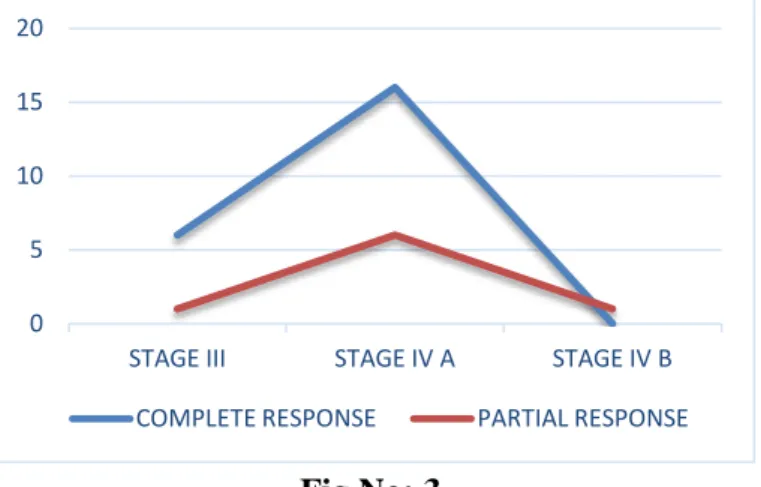
The complete response in Stage IV was 69% but the partial response was 30% which is high compared to Stage III partial response 14%. This is because Stage IV disease is infiltrative and extensively spreading. P Value = 0.398.
Fig No: 3
Toxicity Assessment
The acute toxicity during treatment assessed using RTOG acute toxicity grading criteria.
In this study there was no Grade 5 toxicity.
Fig No: 4
Systemic Toxicity
The treatment related systemic toxicity was assessed with CTCAE V 4.03. There was no grade 5 toxicity. The dreadful toxicity of Capecitabine hand foot syndrome did not occur in any patients in this study.
Table no: 1
TOXICITY GRADE
1 GRADE 2 GRADE 3 GRADE 4 NAUSEA 25 (83.33%) 4 (13.33%) 1 (3.33%) 0 VOMITTING 24 (80%) 6 (20%)
0 0
DIAHORREA 2(6.66%) 0 0 0
Haematological toxicity
Anaemia grade 1 in 8 patients, grade 2 in 4 patients. Leucopoenia- Only 3 patients developed reduction in WBC count level during chemotherapy between 3000 – 4000 grade1. None of the study patients developed thrombocytopenia and renal toxicity.
Discussion
Though MACHNC trials suggests that there is no added benefit with combination chemotherapy over single agent Cisplatin but toxicity as increased. But it also showed that combination of Cisplatin based regimens has better results than other single agent drugs. [4],[5].
The combination of Cisplatin and 5 Fluorouracil has been widely used in locally advanced head and neck cancer along with radiation. The demerits of this combination are high mucositis and diarrhea produced by 5FU resulted in toxicity and treatment breaks. To overcome this toxicity a study done in a Korea institute by LEE et al tried weekly combination of Cisplatin and 5FU. In this study they used weekly Cisplatin 20mg/m2 along with 5FU 750mg/m2, concurrently with radiation dose of 70Gy/35 fractions. There were 38% grade3 toxicities. Also the complete response and partial response in this study was 41% and 50%; the OS at 1yr and 2yr was 69% and 66% respectively. The major drawback in this study chemo related toxicity and treatment breaks[10].
The Capecitabine prodrug of 5FU has been used in many trials in head and neck cancers with lesser 0 1 2 3 4 5 6 7 8 9
NO N1 N2A N2B N2C N3
2 9 2 3 9 0
0 0 0 0
4 1 COMPLETE RESPONSE PARTIAL RESPONSE 0 5 10 15 20
STAGE III STAGE IV A STAGE IV B
COMPLETE RESPONSE PARTIAL RESPONSE
0 5 10 15 20 25
0 0
3
0 0
23
11
22
8 8
5 12 5 11 14 2 5 0 11 8
0 2 0 0 0
A.Ramya et al JMSCR Volume 08 Issue 02 February 2020 Page 34 toxicity.But the dose of Capecitabine when used
concurrently is reduced to 500mg/m2 twice daily. Also, Capecitabine acts as a targeted therapy with its rate limiting enzyme thymidine phosphorylase expressed at higher levels in tumors with hypoxia, acidosis and low pH. This is the condition in most of the solid tumors especially head and neck cancers. Thus, the concentration of Capecitabine in tumor cell is 2.9 times higher than the normal tissues, reducing normal tissue toxicity. This is proved in various pharmacokinetic studies and trials with only Capecitabine with conventional radiation.
This present study was formulated with the idea of using potent chemotherapy drug with radio-sensitization which might have a better toxicity profile, better loco regional control with good response rates.
Whereas a comparative study by Sherif A. Raafat et al between Cisplatin 30mg/m2weekly Vs Capecitabine 500mg /m2 twice daily with radiation 70Gy, showed Complete response (CR) with cisplatin is 60% Vs Capecitabine arm CR of 77%. Toxicity – mucositis in 93% of Capecitabine group Vs 57% in cisplatin group[11].
Subset analysis of the present study showed 80% CR in patients age less than 50yrs, due to better nutrition and better performance status. The male population had better CR 75% compared to females 66%.
As the site of primary tumor is considered Larynx as 100% CR (supraglottis) followed by oropharynx with CR 77% and Hypopharynx with CR 62.5%. the Cr in oral cavity was comparatively less of 57% with high partial response 42.5% compared to other sub sites. This can be explained since Oral cavity lesions are well differentiated tumor, so their response to Chemo RT is inferior than moderately or poorly differentiated histology. This study also showed similar results with poorly differentiated high CR > moderately > well differentiated histology.
As the primary objective of this present study was discussed above, the secondary objective of toxicity assessment showed no treatment related death. All acute toxicities were manageable.
The statistical analysis of this study could not be considered because the sample size is very small. Though the study shows P value insignificant, the results discussed above has higher complete response rates with manageable toxicity.
Conclusion
The head and neck cancer affect the quality of life in patients due to disfigurement, dysphagia, hoarseness of voice etc; most of the patients in our country present in advanced stage due to lack of awareness, illiteracy, poor socioeconomic status. Though there is lack of long term follow up of this study, locoregional control was effective. Large scale randomized study is recommended in near future for PFS and OS.
This study of concurrent chemoradiation with Capecitabine and weekly cisplatin is a feasible option in our patients with manageable toxicity.
References
1. National Notifiable Diseases Surveillance System (NNDSS). Available from http://wwwn.cdc.gov/nndss/script/conditions ummary.aspx?CondID= 32.
2. Parkin DM, Bray F, Ferlay J, Pisani P. Global cancer statistics, 2002. CA Cancer J Clin 2005; 55:74.
3. Head and neck cancer in India. Availbable
http://www.veedaoncology.com/PDF-Document/Head-neck%20Cancer%20In%20 India.pdf.EY.
4. Meta-analysis of chemotherapy in head and neck cancer (MACH-NC): An update on 93 randomised trials and 17,346 patients Jean-Pierre Pignona,*, Aurélie le Maître a, Emilie Maillard a, Jean Bourhis b, on behalf of the MACH-NC Collaborative Group.
5. Pignon JP, Bourhis J, Domenge C, Designé L. Chemotherapy added to loco-regional treatment for head and neck squamous-cell carcinoma: three meta-analyses of updated individual data. Lancet 2000; 355:949-55. 6. Tejpal Gupta, Jai P Agarwal, Sarbani Ghosh
A.Ramya et al JMSCR Volume 08 Issue 02 February 2020 Page 35 Radiotherapy with concurrent weekly
Cisplatin in loco regionally advanced squamous cell carcinomas of head and neck: a single institution experience.
7. Homma A, Inamura N, Oridate N, Suzula S, concomitant weekly Cisplatin and radiotherapy for head and neck cancer. Jpn J Clin Oncol.2011 aug ; 41(8) ; 980-6.
8. Phase I Study of Capecitabine, Carboplatin and Intensity Modulated Radiation Therapy for Head and Neck Cancer CHRISTOPHER Y. THOMAS1, PAUL READ2, GINA PETRONI3, JAMES REIBEL4 AND PAUL
A. LEVINE4 1Division of
Hematology/Oncology and Departments of 2Radiation Oncology, 3Public Health Science and 4Otolaryngology and Head and Neck Surgery, University of Virginia Health Sciences Center, Charlottesville, VA 22908, U.S.A
9. Phase II study of concurrent chemoradiotherapy with Capecitabine and cisplatin in patients with locally advanced squamous cell carcinoma of the head and neck JG Kim1, SK Sohn1, DH Kim1, JH Baek1, SB Jeon1, YS Chae1, KB Lee1, JS Park*,2, JH Sohn2, JC Kim3 and IK Park3 1Department of Oncology/Hematology, Kyungpook National University, College of Medicine, Kyungpook National University Hospital, Daegu, Korea;
10. Lee YJ, Lee CG, Cho BC, Kim GE, Choi HJ, Choi EC et al. Weekly 5-fluorouracil plus cisplatin for concurrent chemoradiotherapy in patients with locally advanced head and neck cancer .Head Neck. 2010 Feb;32(2):235-43.
11. Synchronous Chemoradiotherapy in Patients with Stage III and IV Head and Neck Cancer: Comparing Cisplatin with Capecitabine* Sherif A. Raafat1, Emmad E. Habib2, Ashraf M. Maurice2 1Otolaryngology Department, Faculty of Medicine, Cairo University, Cairo,Egypt;
2Clinical Oncology Department, Faculty of Medicine, Cairo University, Cairo, Egypt.