IC, 2017 – 13(1): 185-251 – Online ISSN: 1697-9818 – Print ISSN: 2014-3214 http://dx.doi.org/10.3926/ic.923
6
thInternational Accounting Congress of Barcelona (1929) organised
by the Association of Accountants of Catalonia
Josepa Alemany1 , Joaquim Rabaseda2
1Universitat Pompeu Fabra (Spain)
2Universitat de Girona (Spain)
[email protected], [email protected]
Received October, 2016 Accepted December, 2016
Versió en català
Abstract
Purpose: the work presented is a descriptive, contextual and detailed analysis of the activity, and the conclusions developed in the first international accounting conference held in Barcelona. The 6th International Conference on Accounting which took place in Barcelona coinciding with the International Exhibition of 1929, was organised by the Association Internationale de Comptabilité of Brussels. This association proposed holding regular meetings to discuss and study technical accounting and economic issues related to that time.
Design/methodology: the originality of the work lies in being an analytical description of the original documents prepared by the Association of Accountants of Catalonia about the conference.
Findings: this study allows redoing assumptions made in previous works, because the documents before this work were contradictory regarding dates, facts and some of the content covered.
Originality/value: the present study continues the research on topics of history of accounting in Catalonia. It is expected to complement this work by a deeper analysis of the contents and the topics covered in the papers presented at the conference, and by linking them with the theoretical accounting lines existing at that time.
Keywords: 6th International Accounting Congress, Association of Accountants of Catalonia, Association Internationale de Comptabilité, Universal Exhibition 1929 of Barcelona, Accounting History
Jel Codes: M41, N23, N24
1. Introduction
This work is divided into six sections. In the first, the Congress is framed by doing a summary of the International Congresses of European Accounting organised by the Association Internationale de Comptabilité. In the four following sections, there is a description of the Congress and finally, in the sixth section, there are conclusions, limitations of the study and possible lines to follow up, as well as bibliography. Two annexes finished the work, Annex A is the speech of Mr. Fernando Boter in the Fifth Commission session and Annex B a summary of the conference made by Mr. Vidal y Guardiola.
The four sections dealing with the Congress are broken down as follows. In the first section aspects prior to the completion of the Congress are described, such as the organisation, congressmen and the program of activities; in the second section the preparatory aspects of the Congress are described, which are specified in a previous session, on the elaboration of a regulation and the process followed by the formation of committees; and the third section describes the development of the Congress, the inaugural session, working sessions, two lectures and the closing session. The fourth section of the Congress includes the most relevant aspects, such as the development of sections and conclusions of each section.
2. The European International Accounting Conferences (1910-1939)
The 6th International Conference on Accounting was part of the conferences organised by the
Association Internationale de Comptabilité (AIC) in the period from 1910 until 1939. The first Congrès International des Sciences Comptables was held in Brussels during the Universal Exhibition of 1910 and was organised by the Société Académique de Comptabilité de Belgique (SACB) and as a result of the Congress the AIC was established. This is considered the first Congress organised under the auspices of the AIC, although the actual foundation of the organisation was made during the second Congress (Lemarchand, Nikitin & Zimnovitch, 2008). From the first Congress until 1939, a total of 10 European International Accounting Conferences were organised according to Félix (2011a).
Paul Otlet and Herni Lafontaine (Nobel Peace Prize, 1913) founded, in 1907, the Union des Associations Internationales (UAI) was that quickly federated the existing most accounting organisations. Contacts between the SACB and IAU are fruitful and newsletter edited together in 1907, as an example, Gabriel Faure published the article La classification décimale et son emploi en comptabilité (Félix, 2012).
Paul Otlet and Henri Lafontaine system are the parents of Universal Decimal Classification (UDC). Otlet not only interested in the classification of accounts but also in the organisation of the accounting profession from the international point of view (Rayward, 1991). Both create an extremely comprehensive recording system that exceeds the limits of accounting and that can be applied to other activities, both in economy and other fields, such as the library. Ouriemmi (2015) states that accounting researchers do not know enough of their contributions relating to the accounting decimal plan.
In the second Congress, 21 countries participated. According to the organisers, in this Congress took a decisive step in the unification accepting a synoptic-synthetic Journal book, in which accounts represent an essential synthesis of nature applicable to any financial institution. Congress proposed the use of Esperanto as a language of international accounting and administrative relations (Félix, 2011b).
The third Congress was held in Ghent in 1913 and brought together representatives of 20 countries. The next meeting was held in Luxembourg, but cancelled due to the political situation (Germany invaded Belgium in 1914).
It was not until 1926 that activity resumes. During this year two Congresses simultaneously were, one in Brussels, the Fifth Congress of the AIC and another in Amsterdam, the second Congress of the
International Congresses of Accountants (ICA).
The fact that there were two simultaneous congresses in time is a reflection of the situation in which accounting associations were then. There were two organisations that brought together different countries and accounting concepts. On the one hand the AIC that grouped countries of continental Europe, such as Germany, France, Italy, Belgium, Luxembourg, Greece and Spain, and in the other hand the ICA, a network which included the United States, Britain, the Netherlands and some Scandinavian countries. The ICA had organised what was considered the first International Accounting Conference in 1904 in Saint Louis (Samuels, 1985) with a strong British presence. Forrester (1992) states that only one non-Anglo-Saxon accountant participated.
nor the periodic exchanges of SACB. In this Congress Otlet presents L’avenir de la Comptabilité et ses rapports avec les besoins de l’Organisation Mondiale (The future of the Accounting and its relationship to the needs of the World Organisation), is a testimony to his point of view toward culture, his visionary thinking and openness to the future. The Association of Accountants of Catalonia was present with the assistance of some of its members and its director, Mr. Antonio Planas, was appointed vice president of the Congress (Amat, 2014).
In the fifth Congress representatives Romanians make an effort to try to unite the two meetings in the future, but it was not so and the next Congress of the AIC, the 6th, will be held in Barcelona in 1929, parallel same time the Expo, with a majority interest of continental and Latin countries and a major presence of Latin America. It was also the Romanian delegation, which maintained a good relationship with the ACC, who proposed the ACC to organise the next congress of the AIC in Barcelona (Organitzatió, 1929, pp. 723). The third Congress of Chartered Accountants, ICA, was in New York in 1929.
The seventh Congress of the AIC took place in Bucharest (Romania) to celebrate the 10th anniversary of the Romanian accounting professional organisation.
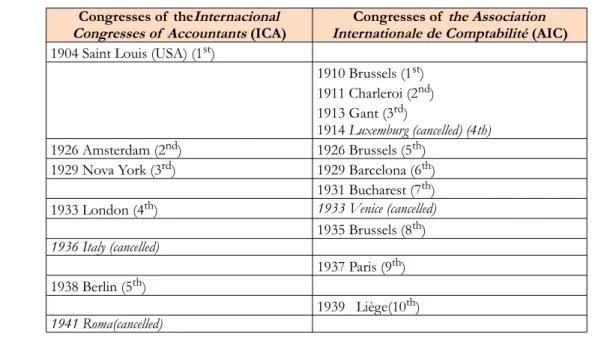
Congresses of theInternacional
Congresses of Accountants (ICA) Internationale de Comptabilité (AIC)Congresses of the Association 1904 Saint Louis (USA) (1st)
1910 Brussels (1st) 1911 Charleroi (2nd) 1913 Gant (3rd)
1914 Luxemburg (cancelled) (4th)
1926 Amsterdam (2nd) 1926 Brussels (5th) 1929 Nova York (3rd) 1929 Barcelona (6th)
1931 Bucharest (7th) 1933 London (4th) 1933 Venice (cancelled)
1935 Brussels (8th)
1936 Italy (cancelled)
1937 Paris (9th) 1938 Berlin (5th)
1939 Liège(10th)
1941 Roma(cancelled)
Table 1. Conferences International Accounting before the Second World War. Source: Lemarchand et al. (2008)
The Congress for which the documentation is available are few, a lot has been destroyed during the two wars, the other is very inaccessible. Often the information is contradictory. An example would be an article of Forrester (1992, pp. 544) that refers the work of Most (1962, pp. 181) that discussed the contribution of M. Lucas, presenting the work Le Cycle Económique on the Congress in Barcelona, curiously we do not found in the proceedings of the Congress in Barcelona.
3. Organisation of the Congress
The Congress was organised in a Committee of Honour, an Organising Committee, a Sub-Committee of Madrid, a list of gentlemen congressmen and several guests of honour. Following each of them is detailed.
3.1. Honorary Committee, Organising Committee and Sub-Committee Madrid
The Honorary Committee consisted of 17 Honorific Gentlemen and 13 Distinguished Gentlemen. The first went from the President of the Council of Ministers and five ministers, Captain General of Catalonia, and the mayors of Madrid and Barcelona, to the Chief Justice of the Treasury and the Chairman of the Higher Banking. The Distinguished Gentlemen ranging from the President of the Spanish Overseas Trade Board and the Inspector General of Accounts to the directors of the Higher School of Commerce of Madrid, Barcelona and Bilbao, to the President of the Academy of Jurisprudence and Legislation.
The Organising Committee, their mandate was to study the most important and urgent international issues raised at that time, and selected issues, which, grouped by sections, constituted the Congress program as will be seen later.
The Sub-Committee of Madrid comprised by four members: the President, the Vice President and two vocals. The President was Julio Zarraluqui Martínez and the Vice President, Rafael Pérez Barrera, both were State Accounting Experts.
3.2. Congressmen and Guests of Honour
The list of delegates is broken down by countries participating, in the act of Congress were 18, which are detailed in Table 2.
Country (*) Congressmen CommissionerGeneral Trustees Others
Germany 1
Argentina 1 1 3
Belgium 4 3 (Partnerships)
Brazil 5 1 2
Colombia 1 1
Cuba 2
Chile 1 2
United States 2
France 25(a) 1 11
Great Britain 1
Greece 1
Italy 4 1 8
Luxembourg 1
Mexico 1 2
Portugal 1
Puerto Rico 1
Romania 2 1
Spain 127 29 (b)
Total (= 18 Countries) 174 11 59 3
(*)E. E. Felix says there were 14 countries who announced their participation, but four of them desisted (Germany, Brazil, Hungary and Switzerland), neither Hungary nor Switzerland are available in the documentation of the Congress. Forrester (1996) indicates that there were 14 participating countries, 150 delegates, five governors and 60 professional associations. (a)From the 25 congressmen from France, two were individual members, the other were groups and associations. It was the largest representation after the Spanish. Interestingly, E.E. Felix (2012) indicates that the French delegation was present and was the largest, with 6 people. However, according to Lemarchand et al. (2008), took part 26 accounting organisations headed by Mr. Alfred Barran, who was the Commissioner General and a group of companies, mostly newspaper publishers and business professional accounting machinery, were sponsors of the Congress. But in the list of the congressmen we have not been able to find any company name. Also participated six delegates led by René Delaporte, according to Delaporte (1930) referenced Lemarchand et al (2008).
(b) Went from the Rotary Club to the Bankers Association of Barcelona and the Book Official Chamber (Camara Oficial del Llibre).
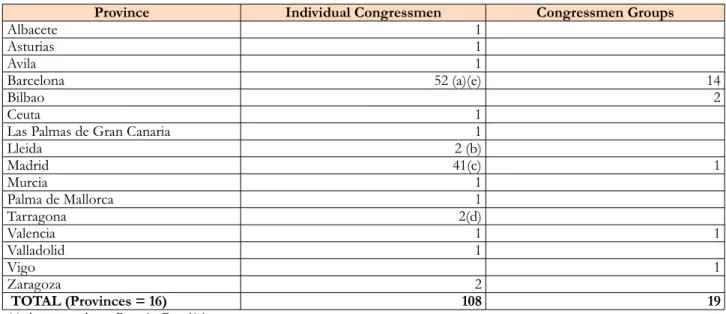
The presence of the Spanish Congressmen, according to participant province can be seen in Table 3 below.
Province Individual Congressmen Congressmen Groups
Albacete 1
Asturias 1
Avila 1
Barcelona 52 (a)(e) 14
Bilbao 2
Ceuta 1
Las Palmas de Gran Canaria 1
Lleida 2 (b)
Madrid 41(c) 1
Murcia 1
Palma de Mallorca 1
Tarragona 2(d)
Valencia 1 1
Valladolid 1
Vigo 1
Zaragoza 2
TOTAL (Provinces = 16) 108 19
(a) Among others, Román Perpiñá.
(b) Georges Llobera and Pablo Viladot from Guissona.
(c) In part, the only congressman women, Enriqueta Pinilla de Heredia, according to the book of the Congress. The Congressman Group is Unión Eléctrica Madrileña.
(d) José Fusté and Francisco Plana, both from Valls.
(e) The journal Organització, pp. 736, relates that the President of the Association, Mr. Vandellós at the opening ceremony of the Congress, offers two bouquets of flowers to the only two female delegates registered for the Congress, Ms. Enriqueta Pinilla de Heredia and Ms. Clua Maria Capdevila, who contributed with their beauty to give sympathetic note of the sessions of the Assembly.
Table 3.Participation of the Spanish delegation
Guests of honour were the directors of eleven newspapers, without indicating the name of the newspaper.
As aspects to note, firstly, in an internationally level, the high participation of Latin American countries (Argentina, Peru, Chile, Mexico, Colombia, Cuba, Puerto Rico and Brazil), secondly, the low participation of Great Britain, only a congressman, thirdly, no participating countries of northern Europe, and finally, two congressmen of the United States of America.
3.3. Program
The program of activities of the Congress, which was held in the headquarters of the American Institute of Economics (IEA) in Via Laietana, 28, of Barcelona, during the 8th to the 12th of November 1929, which was detailed below.
• Friday, 8th November 1929 in the afternoon, the congressmen were received at the headquarters of the ACC in the 29 of Avignon street of Barcelona and then, there was the inauguration ceremony in the Hall Centre (Saló de Cent) in the City Council of Barcelona.
• Saturday, 9th November the Commission met at IEA and in the afternoon took place the first session of Congress.
• Sunday, 10th was a day off.
• Monday, 11th the Commissions met at IEA and in the afternoon session took place the 2nd session of the Congress.
• Tuesday, 12th the Commissions met at IEA. In the afternoon there was the 3rd session of the Congress at the IAE and the closure act was in the Saló d’Actes of Press House of the International Exhibition of Barcelona.
Three visits were organised for delegates. The first visit was to the International Exhibition of Barcelona before starting the Congress, according to the journal Organització. Another visit to the car factory Hispano Suiza SA, and third to the textile factory of Espanya Industrial. They also took advantage to go to Montserrat (Catalan Monastery near Barcelona). The lecture by D. Miguel Vidal y Guardiola, from the Chamber of Commerce and Navigation, entitled Relations of interdependence between progress and perfecting accounting tax systems was held in the headquarters of the Barcelona Provincial Council. A second lecture by Don Pedro Gual Villalbí, was given at Fomento del Trabajo Nacional without indication of the title, and another, which only is referred in the magazine Organització, by Mr. Paquet, about
4. Preparation of the Congress
The organisers were very active in order to carry out the necessary permits to organise the Congress. According to the journal Organització, this was the most difficult task of all who were entrusted to the Executive Committee. The law obliged to apply the relevant permission from the Spanish Government. They had to make three instances, because all of the above were misled, "perhaps because we did not know exactly what it was that the Ministry had to grant us the necessary authorization; but finally, after many negotiations, appeared one day in the Gazette awaited R.O. (Real Order) authorized us to meet him, issued by the Ministry of Labour. This setback private to intensify the propaganda in Spain... was spreading the idea that our Congress, despite having an international character, wearing a rather exclusive and localized guidance in our land (Catalonia)." (Organització, pp. 731-732).
4.1. The preparatory session
The session of the Congress was made Friday, 8th November at the headquarters of the ACC, Duke Victoria street, 15, first floor, of Barcelona (new address). Attended by the President of the ACC, the President of the Organising Committee and seven members. They chose Mr. Bausili as the President of the Congress and as Secretaries, Mr. Padrós and Mr. Francitorra. The organisation and acts of Congress, as well as the names of congressmen who integrated the different committees, were presented. It also approved the Regulation of the Congress that had been prepared by the ACC.
4.2. Regulations and Rules Committees
During the session, the Regulation of the Congress, that had been elaborated by the ACC, was approved. The Regulation consisted in 10 chapters and 10 articles. Each chapter had an article and each article had one or more sections. The chapters were as follows:
I. Questions to deal with. In Article 1 paragraph a, six key issues were defined to be threated in the Congress, and subsequently constitute the Committees (Art. 5a). The topics were:
• Study and establishment of Balances types for industrial and commercial enterprises.
• Agencies to verify the administration and the accounting of the companies. Regime of trust companies. Accounts Commissioners and Chartered Accountants (original in italics).
• The accounting in corporations of Public Law.
• The setting of an accounting doctrine.
• The accounting expert in their international relations.
• General issues.
It was allowed to deliver proposals to the General Secretariat until 24 hours after the conclusion of the opening session, when the topic is related to the essential ends of the Congress, presented in writing, specific conclusions and whenever there was an agreement with the Bureau (Art. 1b).
II. The members and their order. Enrolment was necessary to be a member of the Congress, as for entities and as for individuals, and issues of priority were placed by alphabetic order.
III. The languages used. The languages of the Congress were: Spanish, French and English. No results of presentations in English, Catalan was forbidden.
IV. The Bureau. The Bureau of the Congress was constituted by the Presidents elected directly by the Congress in the preparatory session and with secret vote, by the Vice Presidents and Secretaries appointed by the Presidents and by the Secretaries of the Committees.
V. The Committees. In the preparatory session, after the President election, came to elect the Committees in a secret ballot. They defined seven Committees which corresponded one for each one of the seven topics to be covered in Article 1, and an additional one for the general issues (Art. 5). Each one of the Committees consisted of five congressmen who designated a President and a Secretary before the inaugural session (Art. 5b). Their task was to exam the topics and the preparation the Congress papers (Art. 5c). Committees could apply for an opinion to any member of the Congress.
VII. The plenary sessions. The plenary session begins with the reading of the order of the day accorded by the Bureau. Each subject was discussed in a general and particular debate, admitting two alternating turns pro and against. The President could extend the discussion turns, exceptionally (Art. 7b). The expositions could not be longer than fifteen minutes and each speaker could do only one rectification for no longer than ten minutes. Interventions in support of amendments had the same time. The ones which had not answered to allusions are no longer than five minutes (Art. 7c). Discussions finished with the summary of the President and the reading of the conclusions adopted (Art. 7d).
VIII. Acts. Congressmen involved in a plenary session of a Committee had one hour to handed to the Secretary General a summary of his speech to be included in the proceedings (Art. 8a). The Secretary General was the depositary of the Acts from the plenary sessions and the committees.
IX. Voting. The agreements took place in a relative majority of votes, they were nominal, and the President who solved in case of a tie. The collective representation of each congressman would have only one vote.
X. Interpretation of the Regulation. The President of the Conference was who had to interpret the Regulation.
5. Development of Congress
The Conference began with an opening session, was developed in accordance with the program and statutes, in seven different thematic sections, and ended with the closing session. They point out the lectures given by Mr. Paquet and Mr. Vidal y Guardiola.
5.1. Opening Session
for Social Policy Officer, on behalf of the Mayor, a representative of the High School of Commercial Studies, the delegate of the Exhibition Committee and President of Accountants of Catalonia.
Besides also occupied important positions the President of the Fomento del Trabajo Nacional, representations of Official Cameras of Trade and Industry, Consular Corps, the Academy of Scientific Companies, the Association of Commercial Agents, the Association of Chartered Accountants of Bilbao. At International level, took part delegates of Corporations of Germany, Argentina, Belgium, Brazil, Colombia, Cuba, Chile, Greece, Luxembourg, Mexico, Portugal, Puerto Rico, Romania and other countries, as well as all the Spanish regions. They also occupy seats several members of the Bureau of the Congress (sic). Captain General and Gobernador Civil excused his absence, according to the journal Organització.
5.2. Work Sessions
The working sessions of the first three committees, namely first section, second and third took place in the premises of the American Institute of Economics of Barcelona, the first day of the Congress, Friday. The activity was resumed the following Monday, November the 11th, and met committees fourth section, fifth and sixth on the premises. As an example of the work of the committees can read what Mr Fernando Boter at the session of the Commission fifth said, in Annex A. Finally, the seventh section Committee met on the 12th November in the Hall of the Palace of Agriculture of the Expo. Same day, during the morning was a visit to La España Industrial, SA., according to the journal
Organització. Management and senior employees of the company accompanied and explained in detail the manufacturing process, from entering cotton raw until converted into pieces of tissue to sending to the centres of manufacture.
5.3. Conference of Mr. Paquet
Delaporte, congressman stressed. Who intervened by contributing of an historical perspective of the origins of the concept “account” to reach a technical definition of the term.
5.4. Conference of Mr. Vidal y Guardiola
The closing Conference was on November the 11th, 1929, at seven p.m., in the Chamber of Sessions of the Diputación of Barcelona, by Mr. Vidal and Guardiola, with the title Relaciones de interdependencia entre el progreso contable y el perfeccionismo de los sistemas tributarios (Interdependence relations between the accounting progress and the perfectionism of the taxing system). The President of the Congress, Mr. Bausili, said at the beginning of the Conference, that the findings of Mr. Vidal y Guardiola could be submitted to the International Society of Brussels for purpose in the League of Nations.
Mr. Vidal y Guardiola began his lecture saluting in French to foreign congressmen and asking for dispensation to continue in Spanish. His words began referring to Sir Josiah Stamp saying that all professions have their significance and that the accounting is not small. He finished the dissertation remembering the need to create the existence of an Institute of Chartered Accounts to protect users from an inconsiderate tax regulations and to encourage the disappearance of defrauders.
In Annex B can read the summary of the conference which was published in the book of Acts. In short, every paragraph is referring to some of the ideas and conclusions discussed in Congress.
5.5. The closing ceremony and banquet
Mr. Heredia chaired the closing session, together with Mr. Delaporte, Mr. Alatorre, representative of the Mexican Government, Mr. Leblanc, representing Peru, Mr. Gutiérrez of Colombia and as a Secretary Mr. Francitorra and Mr. Padrós.
Mr. Heredia argued that the State was interested in Officials Chambers, among others existed the Trade and the Accountants. In addition, praising the energy and vitality of the Spanish people to organise and manage the progress of current trade, which crystallised in the magnificent Expo Barcelona.
of the Congress. The President of Congress, Mr. Bausili, among other interventions, closed the event by thanking the participation of delegates. Mr. Buigas, present at the event, showed delegates the complicated machinery that produced the water and light effects of the Magic Fountain of the Exhibition. The next day, following the journal Organització, the Diputación of Barcelona flattered the delegates with a trip to Montserrat throughout the day.
6. Sections
The development of the Congress was divided into sections. For each section, which was organised by a committee, there was a plenary meeting. It drafted three documents for each of the committees, as is the book of the Congress. In the first document described the section in question, date and time, the title of each communication, the name and affiliation of the speakers, a summary of each communication, and in some cases, the full paper.
A second group of documents are the acts of the plenary meetings of each of the sections. They were written very detailed, with the date, time and place of the celebration, the names of those responsible, and the interventions of the meeting, were themselves responsible, were the speakers. In some case the speeches are totally or partially transcribed.
The third group of documents are the conclusions of each of the sections. The conclusions were separated by points agreed in each of the sections, double-column, and the text written in Spanish and French.
6.1. Section one. Study and establishment of a balance type
Met on November the 9th in the morning. The President was Fernando Boter. The works presented by the speakers had, as general theme, the study and establishment of a Balance type for industrial and commercial enterprises. These works were the following
• “The Rational Balance: what the Balances hidden, what they show. Regulation Projects. Balance type” (Le bilan rationel: ce que les bilans cachent; ce qu’ils enseignent. Projects de réglamentation. Bilan type). Speaker: Louis Pourchier of Marseille, France.
• “Unification of Balances”(L’unification des bilans). Speakers: Chamber of Accountants issued from the Superior Schools of Business recognised by the State (Chambre des Experts Comptables sortis des Écoles Superieures de Commerce reconnues par l’État), France.
• “Contribution to the study of the Balance unification” (Contribution à l’étude sur l’unification du bilan). Speaker: Trade Association of the Business Employees of Bordeaux (Chambre Syndicale des Employés de Commerce de Bordeaux), France.
• “Study and elaboration of the Balance type in the industrial and commercial companies” (Estudio y confección del balance tipo en las empresas industriales y comerciales). Speakers: J. Voltas, L. Cuatrecasas and P. Marcé, Spain.
• “Study and project of Balance for industrial and commercial companies” (Estudio y proyecto de Balance para empreses Industriales y Comerciales). Speaker: Mr. Manuel Dueñas Bueno, Chief of Accounting of the Spanish Society of Cement Portland “Hispania” (Sociedad Española de Cementos Portland “Hispania”) of Madrid, Spain.
• “Study of a balance type for the industrial and commercial companies” (Étude d’un bilan-type pour les entreprises industrielles et commerciales) of the Friendly Company of the Accountants Graduates of the Free School of Trade and Accounting of Nantes (Société Amicale des Comptables Diplomés de l’École Libre de Commerce et de Comptabilité of Nantes), France.
• “Project of the Balance type” (Projet de bilan-type). Speakers: Maurice Lucas of Tahon-les-Vosges, France, member of the Committee of the French Organisation.
• “The Balance type” (El Balance Tipo). Speaker: D. Fernando Boter, full professor and former professor of the Commercial Higher Studies of the Mancomunity of Catalonia (Escuela de Altos Estudios Comerciales de la Mancomunidad de Cataluña), Spain.
• the possibility of doing balances for different categories of companies, as was done in Switzerland or Spain,
• to do scientifically structured balances or
• balances with a "rapport" to add the features of the companies, and the form or criteria followed.
Mr. Delaporte proposed making various kinds of balances considering whether it was stock clearance balance or management balance, and commented the difficulty in using the criteria of valuation to be followed in each case. Mr. René Delaporte was one of the vice presidents of the congress, lawyer, member of the Institute of Official Diploma of Accounting (Institut de Diplomés Officiels de Comptabilité) of Paris, and Knight of the Legion of Honour.
As a summary of this meeting, which was the largest and most contributions were made, the following four conclusions were written:
• The first stated that, considering the great difficulty to establish a Balance type applicable to all ranges of companies, to be stated that the principle that assets accounts were classified according to the degree of availability and liabilities accounts according to the degree of enforceability, and they accepted the schematic formula adopted there.
• The second one, was to recommend that groups of companies with similar characteristics have a similar formula-type of Balance.
6.2. Section two. The cost price
Met on November, the 9th in the morning. Josep A. Vandellós was the President. The work and the speakers were dealt communication aspects of the procedures and elements to take into account to establish the cost price. They were presented as follows:
• “Procedures and elements to take into account to stablish the cost price” (Procedimientos y elementos a tener en cuenta para establecer el precio de coste). Speaker: Mr. Santiago Codina, Spain.
• “Procedures and elements to take into account to stablish the cost price” (Procedimientos y elementos a tener en cuenta para establecer el precio de cost). Speaker: Manuel Dueñas Bueno of Madrid, Spain.
• “Study about the cost price” (Étude sur les prix de revient). Speaker: Lucien Headquarters (Memory presented by the "Union des Groupements Comptables du Midi de la France et de l 'Afrique du Nord), France.
• “Procedures and factors to take into account to stablish the cost price”. (Procédés et facteurs dont il y a lieu de tenir compte pour l’établissement du prix de revient). Speaker: Maurice Lucas Tahon -les-Vosges, France, Accountant Expert S.C.F.
• “General formula of the industrial price cost” (Fórmulas generales de precio de coste industrial). Speaker: Fernando Boter, full professor and former professor at the Commercial Higher Studies of the Mancomunity of Catalonia (Escuela de Altos Estudios Comerciales de la Mancomunidad de Cataluña), Spain.
• “The interest of the capital as a factor of the cost price” (El interés del capital como factor del precio de coste). Speaker: Fernando Boter, Spain.
• “Procedures and elements to take into account to stablish the cost price” (Procédés et éléments dont il faut tenir compte pour établir le prix de revient). Speaker: E. René Delaporte (H.G.C.), France.
The development of this meeting led to an interesting debate involve a high turnout. As a result of this, three conclusions came to:
• The second indicates that the final distribution of the expenses could be done in seven different methods:
◦ a percentage of the productive workforce wages,
◦ based on hours of direct workforce,
◦ according to the total value of materials used and productive workforce wages,
◦ according to working hours of the machinery,
◦ according to the machinery expenses,
◦ according to the division of the different elements involved and
◦ the price of the materials, if the materials are “rich”.
• And the third conclusion was that the depreciation accounting has to be made as the manufacturing operations took place.
6.3. Section three. Administration and Accounting of the Company. Trust Companies and External Auditor
Met on November, the 9th in the morning. The President of the section was Mr Andreu Bausili. The papers and works presented were related to the bodies responsible for verifying the administration and accounting of the companies. The Fiduciary Societies Regime, and the External Auditor and Chartered Accountants. There were only two presentations.
• “The Accounting Reviewers in Spain” (Los revisores de cuentas en España). Speaker: Spanish Fiduciary Society, S.A. (Sociedad Fiduciaria Española, S.A.), Spain.
During this session, will read a telegram addressed to His Excellency Minister of National Economy in which it requested the creation of the Institute of Chartered Accountants (Instituto de Censores de Cuentas). They draw four conclusions:
• The first conclusion was about the need to unify the different accounting systems to facilitate the control of the accounts.
• The second and third conclusions were the convenience to create the Institute of Chartered Accountants, in order to have the maximum authority, personality and independence of the public powers.
• The final conclusion was that the report and the certificate of Balance Corporations and partnerships for action, were obligatory, and for the other companies were a part of the request. It also requested that it be free to choose the auditors, provided they were registered with the Institute.
6.4. Section four. Accounts of public corporations
Met on November, the 11th in the morning. It was chaired by Mr. Juli Zarraluqui. The work of the speakers tried to accounting issues in public corporations, and were as follows:
• “Report about the Communal Accounting” (Rapport sur la Comptabilité Communale). Speaker: Georges Barés, President of the Accounting Association of the Bearn and the Basque Country (French) (Association des Comptables du Béarn et du Pays Basc (Français)) of Pau, France.
• “The Public Treasury” (La Hacienda Pública). Speaker: Mr. Pacífico Gutiérrez Monyoya, delegate of Colombia.
• “Accounting General Intervention” (Intervención General de Contabilidad). Speaker: Mr. Eloy Delgado, representative of the State Accountants Body of Madrid, Spain.
• “The reform of public accounting in Romania”. (La réforme de la comptabilité publique en Roumanie). Speaker: Dr. V. M. Ioachim, Secretary of the Chamber of Commerce and Industry of Bucharest, Director of the Superior Council of the Body of Accounting Experts and Authorized Accountants of Romania.
• “On the control of the State in the autonomous public organisms and in the companies of mixed economy” (Sobre el control del Estado en los organismos públicos autónomos y en las empresas de economía mixta). Speaker: Mr. Rafael Pérez Barrera, Chief of the Accounting of the State, Financial Advisor to the Government Delegation in the National Telephone Company (Compañía Telefónica de España) of Spain.
The findings, basically recommendations, were the following:
• The situation and the results of all public accounts (State Departments, local businesses and officially operated) are gathered in an official Centre.
• The use of double-entry bookkeeping for all public bodies.
• The creation of special bodies to develop appropriate technical functions. Mr. Delaporte pointed out to become extended to all countries participating in the Congress.
6.5. Section five. Accounting Doctrine
Met on November, the 11th in the morning. The President was Mr. René Delaporte. The papers and presentations were related to the setting of accounting doctrine. The presentations were as follows:
• “Fundamental principles of Bookkeeping by double entry” (Principios fundamentales de la Teneduría de Libros por partida doble). Speaker: Mr. Fernando Gaya, S. J., Spain.
• “Essay on the synthesis of the fundamental principles of accounting science” (Essai de synthèse des principes fondamentaux de la science comptable). Speaker: Mr. F. Thevenot, graduate in Law and Accounting Expert of Marseille, France.
y puede darse su definición clara, propia y precisa). Speaker: Mr. Salvador Feliu de la Peña of Palma of Majorca, Spain.
• “Report of Accounting Doctrine” (Rapport sur la doctrine comptable) Speaker: Mr. Moreau, President of Agricultural Association of Accountants of France and member of the Association of Accountants of the Seine, and Mr. A. Bertran, entitled Accountant Expert of the State, official delegate of France.
• “Positive Tendances of Accounting” (Tendances positives de la Comptabilité). Speaker: Mr. Francisco d’Auria, delegate of the Brazilian Institute of Accountants and representative of the class of "Comptabilistes" and the Brasilian "Revista Brasileira de Contabilidade” of Rio de Janeiro, Brazil.
• “Establishing an accounting doctrine” (Fixation d’une doctrine comptable). Speaker: Mr. Mauricio Lucas, Accounting Expert, member of the French Organization Committee, France.
• “Reasoned Concepts of Account Science” (Concepts raisonnés de la science des comptes). Speaker: Mr. F. René Delaporte, (H.E.C.), France.
The Congress, facing the three schools of accounting: the personification of accounts, the positive theory and the accrual accounting theory, considering that all agreed on the practical application and only differ in the way of expounding the doctrine, considered that had to continue studies until each school, with good will and ways, reached a general doctrine that unified the three positions and adopted by the exposure of accounting. The conclusions were passed unanimously.
In the discussion of this section, Mr. Fernando Boter make a speech in French on the different accounting doctrines. The speech transcript is included as Annex 1.
6.6. Section six. The accountant and International relations
Met on November, the 11th in the morning, chaired by Mr. Rafael Heredia. The studies were grouped by issues related to Accounting Expert in International relations, and were below.
• “The Accounting Expert in its international relations (El experto contable en sus relaciones internacionales). Speaker: Mr. Ramón Delgar y Ventosa, Commercial Lawyer and Expert of Barcelona, Spain.
• “Proposal for the creation of the International Accounting Federation” (Proposición para la creación de la Federación Internacional de Contabilidad). Speakers: Mr. Rafael Borí and José Gardó, congressmen of Barcelona, Spain.
Mr. Gay de Montella made a speech highlighting the importance of the issues that were discussed at this meeting. Decisions were taken about the ability of the Courts to recognise the certificates on settlements in accounting books of traders and companies, in disputes between different countries, made by professional with recognised title by the State, where the subject of Accounting testing, was. He added that Governments also had to published the previous agreement, and dictate and change the corresponding laws to be applied.
Before finishing the session was a minute of silence as the day of commemoration of the dead of the Great War.
6.7. Section seven. General issues
Met on November, the 12th in the morning. Presided by Mr. Rafael Gay de Montella. The papers and speakers dealt with general issues that had not been included in previous sections, and were as follows:
• “Proposal on the legalisation of the books of Current Accounts” (Proposición sobre la legalización de los libros de Cuentas Corrientes). Speakers: Sr. Rafael Borí and José Gardó, congressmen of Barcelona, Spain.
• “Accounting control of companies from the tax point of view” (El control contable de empresas desde el punto de vista fiscal). Speaker: Sr. Joaquín Buxó y Abaigar, Intendent Commercial, Mercantile Body of Teachers in the service of the Treasury, Spain.
• “The accounting on loose sheets” (La contabilidad en hojas sueltas). Speaker: Mr. Manuel Calleja of Barcelona, Spain.
• “Depreciation methods by annuities” (Mèthode de dépreciation par annuités). Speaker in French: Mr. David Stimmelblan, C.P.A. of Chicago, Illinois, United States of America.
• “Communication Concerning Accounting Terminology” (Communication concèrnant la terminologie comptable). Speaker: Jean Dumon of Brussels, Belgium.
• “Unification of accounting rules” (Unification des règles comptables). Speaker: Jean Dumon of Brussels, Belgium.
• “Report on the relationship of accounting principles and the tax on industrial and commercial profits in France” (Informe sobre las relaciones de los principios de contabilidad y el impuesto sobre los beneficios industriales y comerciales en Francia). Speaker: Mr. L. Maurice Cuilhé, Honorary President of the company "Des Conseils Fiscaux de France" of Paris, France.
• “Accounting and business rationalization” (La comptabilité et la rationalisation des entreprises). Speaker: Mr. Arsène Malonne, Accounting Expert of Tamines of Namur, Belgium.
• “The legalization of accounting by records” (La legalización de la contabilidad por fichas). Speaker: Mr. Fernando Boter, full professor and former professor at the Commercial Higher Studies of the Mancomunity of Catalonia (Escuela de Altos Estudios Comerciales de la Mancomunidad de Cataluña), Spain.
Practically they made a conclusion for each of the works presented. The Congress proposed to constitute a Federation on each country involved in the study of accounting issues, and that these associations were represented in the International Standing Committee within the International Association of Accounting (AIC). The objectives should have these organisations were multiple, among others, the following agreements were reached.
• To study accounting issues and have standard criteria for different legislations.
• To publish a periodical journal of international accounting issues, by the AIC from Brussels.
• The possibility to use accounting books made from sheets or books with mobile sheets, meanwhile did not correspond to legal changes, as approved at the Fifth International Conference on Accounting.
• Recommend that, when it comes to venture capital, balance sheets and income statement were published in the Official Journal, which had compulsory in all countries.
• The Association of Accountants of Catalonia and the Commercial Graduate High School Central of Madrid had to propagate and disseminate the decisions taken at the Congress in the rest of Spanish organisations and transmit to the Bureau Permanent de la Société International de Comptabilité of Brussels the documentation relating to Spanish problems and the study to formed a National Federation of Associations and organisations in Spain devoted to accounting issues.
• Finally, it was approved, unanimously, that the next Congress will be held in Bucharest (Romania).
Felix (2012, pp. 31) quoting de Beelde (2003), says that in this conference organised in collaboration with an Association of Accountants of Catalonia, presented an Accounting Decimal Classification, which we did not find.
7. Conclusions, limitations of the study and futures contributions
The Sixth International Conference on Accounting took place in Barcelona in 1929, taking advantage of the Universal of Exhibition. This was an important event for the Association of Accountants of Catalonia (ACC), which had organised the I Congress of Accounting of Catalonia in 1926. To organise an international conference meant to inform the rest of the countries the existence of the association, its activities and led to the first step in its internationalisation. It welcomed representatives from European and American countries, from all Spanish regions, and nearly all provinces of Catalonia. It dealt with the economic and accounting issues of the moment.
Balance for each company and in different periods. If any modifications should have taken, it has to include an explanatory note of the fact. For groups of companies with similar characteristics, it was proposed that the balance-type formula was similar. Finally, it was proposed to establish the order of the items of the assets and liabilities based on the degree of availability and enforceability, without specifying whether the criterion to apply should be increasing or decreasing; sensing all the necessary correlation between the two figures, there was no express reference.
In the second section, that dealt with the allocation of expenses to manufacturing costs, it was proposed that the interests of capital, used in the process and the amortisation of fixed assets, as the process develops, has to be part of these costs. They propose different methods of recognition of these expenses.
In the third section, in which the theme was the control of the accountings, it was agreed the need to unify the various accounting systems and made a proposal for the creation of the Instituto de Censores Jurados de Cuentas. Also, there was freedom to choose the auditors, provided they were registered with the Institute. Finally, the proposed the requirement to make the report and certificate of the Balances of companies in which the capital is divided into titles, and any other companies in which is formulated by part request.
The accounts of public bodies were the subject of the fourth section. This section proposed, firstly, the use of doubly entry method for all public bodies, secondly, the creation of technical bodies in all countries participating in the Congress, to perform its functions and, finally, the collection the situation and results of all public accounts in an official centre.
The fifth section spoke about the accounting doctrine. The main conclusion was to consider the coincidence in the bottom of the three accounting doctrines of the moment and the difference was in the way of exposing them. On the other hand, they considered the convenience to continue the studies for each of the three doctrines in order to arrive at a unified Accounting doctrine that satisfied the three positions, in a way that this doctrine was possible to adopt for general Accounting exposure.
Finally, in the seventh section, which included general aspects not covered in the previous sections, it was proposed that each country should become a federation of organisations dedicated to the study of accounting issues, and that these associations were represented at the International Association of Accounting (AIC). These federations should study accounting issues, unify the most common expressions, and have a consistent approach of the various legislations. Also, it was proposed to use accounting books or books made from sheets with mobile sheets until they made the corresponding legislative changes. Balance Sheet and Income Statement should be mandatory for companies with share capital and in all countries. Finally agreed to participate and join the International Confederation of Workers, and disseminate the decisions taken at the Congress.
The limitations of the study, as a whole first plunge into a historical subject, it is very predictable. The difficulty in finding original documents that provide information for the development of the first Congress is limited, just as happens in most Congresses organised by the AIC. Some documents disappeared during the Spanish Civil War and during the Second World War, others are difficult for access. In other circumstances, when information is available, according to the document to be studied, the information is contradictory. This is an aspect common to all the studies done until today. A second limitation, therefore, comes from the lack of available documentation.
A further study of both the content covered in the sessions of the Congress regarding the social-economic context would be good as a continuation of this present contribution. Contextualise the contributions made by the Catalans accountants, as the organisers and as the speakers, in relationship to the development of accounting science at that moment. A good follow-up study may be to make a more complete study of the content of the presentations, highlighting the important contributions made and whether extended in future conferences and in the development of accounting, as well as issues related to the economic-social context of the time they made the conference.
In short, the future contributions could analyse the contributions made to the development of the accounting profession by members of the ACC in a nationally and internationally level, knowing the influence received from other accounting organisations and other regions and countries, as well as the economic and cultural context of the ACC and active members of their professional activity. This study could form part of a broader, as would be the study of the history of the Accounting in Catalonia.
References
Amat, M. (2014) Associació de Comptables de Catalunya (1924-1940). Revista de Catalunya, 288, 73-84. Associació de Comptables de Catalunya (1929). Organització. Revista Tècnica d’Administració i Comptabilitat,
Portaveu de les Aspiracions del Comptable. Associació de Comptables de Catalunya. Barcelona, 53-54.
Asociación de Contables de Cataluña (1929). VIº Congreso Internacional de Contabilidad. Llibre del Congrés. Barcelona.
Carmona, S. (2004). Accounting history research and its diffusion in an international context. Accounting History, 9(3), 7-23. https://doi.org/10.1177/103237320400900302
De Beelde, I. (2003). The development of a Belgian Accounting Code during the first half of the 20th century. The Accounting Historians Journal, 30(2), 1-28.
Delaporte, R. (1930). Le VIe Congrès International de Comptabilité, Bulletin de la Compagnie des chefs de comptabilité, 52, 885-886.
Félix, E.E. (2011a). Paul Otlet (1868-1944) et l’Association Internationale de Comptabilité AIC.
Groupement Francophone des Professionnels de la Comptabilité, 4, 10-12.
Félix, E.E. (2011b). Paul Otlet (1868-1944) et le deuxième Congrès International des Sciences Comptables de Charleroi en 1911. Groupement Francophone des Professionnels de la Comptabilité, 3, 11-13. Félix, E.E. (2012). Paul Otlet (1868-1944) et la comptabilité: La Classification Décimale Universelle (CDU), les
schémas et diagrammes et leur emploi en comptabilité, l’Association Internationale de Comptabilité (AIC). Available online at: http://www.bureaufelix.be/QS/default.asp?iID=KMGJI&item=MIHJD#MIHJD
Forrester, D.A. (1992). Historia revisada de los Congresos Internacionales de Contabilidad. Revista Española de Financiación y Contabilidad, 72, 527-549.
Forrester, D.A. (1996). European Congresses of Accounting: A review of their history. European Accounting Review, 5(1), 91-104. https://doi.org/10.1080/09638189600000005
Hernández-Esteve, E. (1995). A review of recent Spanish publications in accounting, business and financial history. Accounting, Business & Financial History, 5(2), 237-270.
https://doi.org/10.1080/09585209500000041
Lemarchand, Y., Nikitin, M., & Zimnovitch, H. (2008). International congresses of accountants in the twentieth century: A French perspective. Accounting, Business & Financial History, 18(2), 97-120.
Mommen, M.H. (1957). Le plan comptable selon differentes formes d’expressions et son aboutissement International
(Volumens I and II). Brussels: Cambel Ed.
Most, K.S. (1962). Uniform Cost Accounting. London: Gee.
Ouriemmi, O. (2015). Le Schéma Universel de Comptabilité de Paul Otlet (1901): le tournant décimal.
Comptabilité-Contrôle-Audit, 21(3), 93-118. https://doi.org/10.3917/cca.213.0093
Rayward, B. (1991). The case of Paul Otlet, pioneer of information science, internationalist, visionary: reflections on biography. Journal of Librarianship and Information Science, 23, 135-145.
https://doi.org/10.1177/096100069102300303
Samuels, J.M. (1985). Historical Nuggets. The Accounting Historians Journal, 12(1), 99-105.
Annex A
Speech by Mr. Fernando Boter at the meeting of the 5th Committee
This is followed by discussion of the agreements of the Fifth Committee under the Presidency of Monsieur Paquet, who gave the floor to the Secretary of the Conference, Mr. Gardó, who read the recommendations approved by the Commission.
Monsieur Delaporte, after reading them in French, substantiates and supports these recommendations, highlighting the importance of the work carried out for the establishment of an Accounting doctrine. Mr. Fernando Boter spoke in French and expressed himself in the following terms:
“I must confess, gentlemen, to begin with, that I am an advocate of the exposition of the accounting doctrine on the basis of classical personalist theory.
Above all there are two objections to this personalist theory, that firstly, it fails and must be taken into account that it is ancient, and then, that it is based on fiction.
The argument that this theory is old can have no weight. In accepting it, one would have to admit the disturbing theory that there must be a continual change of mind as theories grow old. On the other hand, it would have signified that one could use the same argument at some time against all other so-called modern theories.
The second objection is true. But accounting must not be ashamed of it; it must not believe that it can not aspire to merit the consideration of science. The Euclid postulate, the ideas of zero, infinite, atom, cell, etc., serving as the foundation for several sciences, although there are discussions and disputes about these notions.
But the fiction of the personality of the accounts is only a conventionalism, coming from the nature in the same way as the commercial transactions. Indeed: if A and B constitute a public limited company, the set of things and values that compose its capital form a person capable of carrying out all kinds of acts and contracts (legal conviction and fiction that accounting can not discuss nor refuse). In a collective or limited partnership society, the company personality is also different from that of the partners, although they do not have the same responsibility. Consequently, the commercial reality (conventional reality, if you like) already gives us the fact of a set of things considered as a person; the classical theory confines itself to advancing a little more (in the same principle), and it personifies each of the groups (counts) that one can make with the things making up the whole.
This fiction according to which a set of things is considered a person does not only appear in modern business reality. At the time of the Romans, the civil and ordinary reality imposed the existence of the
hoirie vancante, a set of things for which the owner or inheritance was unknown at the time, but who could carry out acts and contracts.
and making them see unsuspected aspects. These are explorations that allow us to make sure of the solidity of the building where we all work. "
Monsieur Maurice Leblanc intervenes in the debate by endorsing some of the considerations made by Mr Boter and calls for continued work to arrive at the establishment of a true accounting doctrine, which underpins the scientific principles on which accounting is based.
The Rd. Fernando Gaya, S. J. to support his thesis based on metaphysical principles on which to base the theory of double entry.
Monsieur Paquet summarises the different opinions expressed by the Congressmen who have taken part in the deliberations and then unanimously approves the proposal that is published in the corresponding place.
Annex B
Summary of the Conference of Mr. Vidal y Guardiola
Organised by the Preparatory Committee of the Congress, before it ended, at 7 pm on November the 11th., the announced conference of Mr. Miguel Vidal and Guardiola took place in the Meeting Room of the Diputación of Barcelona.
In this conference, Mr. Vidal and Guardiola developed the theme: "Relations of interdependence between accounting progress and the improvement of tax systems".
The vice-president of the Diputación took the chair of the act, being seated in the other seats of the same the ones Edvino Tomini, Nestor Paquet, René Delaporte and the president of the Congress Mr. Bausili.
The vice president of the provincial corporation opened the act, stating that unavoidable attentions of the position had prevented the president of the County Council from attending the conference and on behalf of the County Council greeted those present and praised the importance of the Congress as well as the importance of the topic of the conference.
Mr. Vidal and Guardiola began their lecture by greeting the foreign congressmen in French and "asking them to dispense with continuing in Spanish.
With reference to words of the well-known English economist and businessman, former Treasury official, Sir. Josiah H. Stamp says that all professions have their significance and that of accountants is not small.
Accountants must make great efforts to achieve perfection in their twofold task: organisation of the self-criticism of the directors of commercial and industrial enterprises and control of economic collaboration with the administration of others' interests.
Tax concerns are in many cases an obstacle for the progress of accounting, and legislative efforts to issue standards for the guarantee of shareholders and creditors would have been much more resounding if the accountants had not been influenced by the force of things to the organisation of a defence accounting against the Treasury.
The problem of tax morality, in close dependence on the level of culture in each country, is so difficult to resolve that it would not be worth worrying about it if serious questions of social justice were not involved.
The advance of direct taxes has placed industrial and commercial accounting at the centre of interest for the settlement of contributory quotas and so far all projects aimed at establishing a modern system of direct taxes that has not been supported by the data supplied for good accounting.
Taxpayer resistance does not always have the character of fraud; many times it is a legitimate defence. And in the general interest, the latter should disappear.
The struggle between the legislator and the taxpayer arises very differently depending on the theoretical concepts and accounting practice on which the legislator is based. The most unpleasant situation occurs when the Treasury does not have a uniform criterion for all persons and entities with their own personality in economic life.
Alludes to the theories of Schanz and Einaudi and on the basis of a comparison between the English and North American direct taxes, he alludes to the accounting aspect of the tributary definitions of the impossible revenue.
abuses and even crimes committed through accounting and the tendency of the Treasury to avoid fraud can easily be found.
Modern accounting, to be useful to society does not need to become Celestina of fraud. But, on the other hand, it must transform, modernize and give practical sense to tax legislation.
The problem of amortisations is one of the most delicate and it is no coincidence that one of the most benevolent legislation is that of the most advanced country, the United States.
The tax legislation of all countries can ultimately be classified as good or bad, as it foments or hinders the capitalization process, both in individual and collective economies.
A tax on profits may violate this principle by overtaxing the amortisation funds corresponding to physical exhaustion, material wear and economic loss of the Asset. It may also contravene this principle by dealing with exaggerated rigorous increases in Asset values accounted for but not distributed if they are intended for all sorts of compensation funds.
Much needed is a review of all taxes that tax the circulation of wealth from the moments in which it produces nothing. It is, especially in relation to all the movement of capital to which rationalisation and concentration of companies results.
Summarises his lecture by saying that the basis for a concordance between the two accounting trends of defence of the tax and the taxpayer's defence could be: 1) application of the same accounting rules to all persons and entities subject to direct tax; 2) rigorous imposition of distributed profits, even through all sorts of dissimulation procedures; 3) tax exemption from purely formal wealth movements, and 4) adjustment of the tax on reserves and amortisation funds to the origin and destination of each of the accounts.
On the basis of the application of these rules, the Chartered Accountants (Censores de Cuentas), constituted in Institute, and within a regime, indispensable for them, of freedom of action, may simultaneously be economic and tax advisers. And a great step will have been taken towards the disappearance of the fraudsters, because the abolition of the innocent victims of a disregarded tax regulation will have begun.
Versió en català
Títol: VIè Congrés Internacional de Comptabilitat de Barcelona (1929) organitzat per l'Associació de Comptables de Catalunya
Resum
Objecte: el treball que es presenta és una anàlisi descriptiva, contextualitzada i detallada de l’activitat, el desenvolupament i les conclusions del primer congrés internacional de comptabilitat fet a Barcelona. El VIè Congrés Internacional de Comptabilitat que va tenir lloc a Barcelona coincidint amb l’Exposició Internacional de l’any 1929, va estar organitzat per
l’Association Internationale de Comptabilité de Brussel·les. Aquesta associació proposava la celebració de trobades periòdiques per examinar i estudiar els problemes tècnico-comptables i econòmics del moment.
Disseny/metodologia/enfoc: La originalitat del treball rau en ser una descripció analítica de la documentació original elaborada per l’Associació de Comptables de Catalunya sobre el congrés.
Aportacions i resultats: Aquest estudi permet refer suposicions fetes en treballs anteriors, perquè la documentació prèvia a aquest treball era contradictòria en relació a dates, fets i alguns dels continguts tractats.
Limitacions: La major limitació del treball ve donada per l’escassetat de documentació escrita existent sobre aquest congrés.
Originalitat / Valor afegit: El present estudi continua la línia de recerca sobre temes d’història de la comptabilitat a Catalunya. Es preveu complementar el present treball fent una anàlisi més aprofundida dels continguts i de les temàtiques tractades en les ponències presentades en el congrés, i enllaçant-los amb les línies teòrico-comptables existents en aquell moment.
Paraules clau: VIè Congrés Internacional de Comptabilitat, Associació de Comptables de Catalunya, Association Internationale de Comptabilité, Exposició Universal 1929 de Barcelona, Història de la Comptabilitat
1. Introducció
El treball que es presenta té l’objectiu de donar a conèixer el VIè Congrés Internacional de Comptabilitat, que es va celebrar a Barcelona l’any 1929, organitzat conjuntament per l’Associació de Comptables de Catalunya i l’Association Internationale de Comptabilité, amb la participació d’organismes professionals comptables de l’estat espanyol, i és part d’un treball més ampli que està duent a terme un grup d’investigadors, sota l’auspici de l’Associació Catalana de Comptabilitat i Direcció (ACCID). Aquest grup d’investigadors està recuperant i estudiant documents sobre l’Associació dels Comptables de Catalunya, que va tenir activitat des de l’any 1924 fins l’any 1940. Dins d’aquest marc s’inscriu el treball que es presenta, el qual es basa en el document “VI.º Congreso Internacional de Contabilidad, organizado por la Asociación de Contables de Cataluña, Barcelona, noviembre 1929”. Aquest document descriu l'organització, els participants i els estatuts del Congrés, la seva preparació i el desenvolupament. Presenta un resum de les sessions en què van participar els congressistes i desenvolupa amb més detall aquelles que van tenir un major impacte des del punt de vista dels organitzadors. Finalment, i en un apartat diferenciat, es presenten les conclusions de cada una de les sessions. El document consta de 136 pàgines, està redactat en castellà i respecta l’idioma original de les comunicacions d’autors francesos. Les conclusions de cada sessió estan escrites, a doble columna, en castellà i francès. No s’ha trobat cap text en cap altre idioma. S’acaba el document amb un índex detallat del contingut. La informació recollida s’ha contrastat amb els articles sobre el congrés apareguts a la revista “Organització” editada per l’Associació de Comptables de Catalunya (ACC).
Aquest treball s’estructura en sis apartats. En el primer, es contextualitza el Congrés fent un resum dels Congressos Internacionals de Comptabilitat Europeus organitzats per l’Association Internationale de Comptabilité. En els quatre següents es fa una descripció del Congrés; i finalment, en el sisè s’aporta les conclusions, les limitacions de l’estudi i les possibles línies a seguir, així com la bibliografia utilitzada.
i la sessió de clausura. El quart apartat del Congrés recull els aspectes més rellevants, com el desenvolupament de les seccions i les conclusions de cada secció.
2. Els Congressos Internacionals de Comptabilitat Europeus (1910-1939)
EL VIè Congrés Internacional de Comptabilitat forma part dels congressos que va organitzar l’Association Internationale de Comptabilité (AIC) en el període que va des de l’any 1910 fins el 1939. El primer “Congrès International de Sciences Comptables” es fa a Brussel·les durant l’Exposició Universal del 1910 i l’organitza la Societé Académique de Comptabilité de Bélgique (SACB); com a conseqüència del Congrés es crea l’AIC. Aquest es considera el primer Congrés organitzat sota els auspicis de l’AIC, encara que la fundació efectiva de l’organització es va fer durant el segon Congrés (Lemarchand, Nikitin & Zimnovitch, 2008). A partir del primer Congrés i fins l’any 1939, s’organitzaran un total de 10 congressos internacionals europeus de comptabilitat, segons Félix (2011a).
El President d’Honor del segon Congrés International, que es va celebrar a Charleroi el mes de setembre del 1911, va ser en Paul Otlet, en reconeixment per la seva activitat com a fundador de l’AIC. La visió internacional d’Otlet va fer definir l’objectiu principal de l’AIC com “la unificació i la internacionalització dels sistemes comptables i dels estats financers, l’adopció d’un marc comptable universal, l'organització periòdica de congressos internacionals i la publicació periòdica d’un butlletí” (Mommen, 1957).
Paul Otlet i Herni Lafontaine (Premi Nobel de la Pau, 1913) van fundar, el 1907, la “Union des Associations Internationales” (UAI) que ràpidament va federar la majoria d’organitzacions comptables existents. Els contactes entre la SACB i la UAI són fructífers i en el butlletí que editen conjuntament, en el 1907, Gabriel Faure publica l’article: “la classification décimale et son emploi en comptabilité” (Félix, 2012).