www.ijemst.com
Connectivity Theory at Work: The
Referrals between Science and
Mathematics in a Science Unit
Deniz Mehmetlioglu1, Yasemin Ozdem2 1Agri Ibrahim Cecen University
2Gaziosmanpasa University
To cite this article:
Mehmetlioglu, D. & Ozdem, Y. (2014). Connectivity Theory at work: The referrals between
science and mathematics in a science unit.
International Journal of Education in
Mathematics, Science and Technology, 2
(1), 36-48
This article may be used for research, teaching, and private study purposes.
Any substantial or systematic reproduction, redistribution, reselling, loan, sub-licensing,
systematic supply, or distribution in any form to anyone is expressly forbidden.
Authors alone are responsible for the contents of their articles. The journal owns the
copyright of the articles.
Volume 2, Number 1, January 2014, Page 36-48
ISSN: 2147-611X
Connectivity Theory at Work: The Referrals between Science and
Mathematics in a Science Unit
Deniz Mehmetlioglu1*, Yasemin Ozdem2 1
Agri Ibrahim Cecen University 2Gaziosmanpasa University
Abstract
Researches carried out all around the world showed that students learn more effectively if they are able to make connections between subjects. This case reports based on an investigation of how mathematics concepts were connected to science concepts by a science teacher in an elementary science classroom, and on the science teacher’s views about connectivity. The progress of the instruction of a unit on the structure and properties of matter was observed in a class of forty eight students in a public school in Ankara. The science teacher was interviewed and her views were compared to her practice. The researchers undertook eight hours of observation, and data was collected through field notes and video-recordings. The findings showed that the teacher made connections between the topic and the mathematical components, such as the symbolic representations, arithmetic, counting, equations, the least common multiplier, and the distributive property of multiplication over addition. Although she thought that physics is more available for more connection when it compared to mathematics, we observed that many connections are possible in other areas of science as well.
Key words: Connectivity theory, Elementary education, Science and mathematics
Introduction
Recently, interdisciplinary approach in research studies is apparent in both science education and mathematics education literature. This approach is an indication of the removal of the boundaries between disciplines. Especially, the distinctions between science and mathematics strands declinesand researchers are interested in integrations of these disciplines or emphasize the connections between them.
The necessity for the connectivity for disciplines can be found in the sentences of Moore. In 1902, Moore’s argued that: “Engineers tell us that in the schools algebra is taught in one water-tight component, geometry in another, and physics in another, and that the student learns to appreciate (if ever) only very late the absolutely close connection between these different subjects” (as cited in Frykholm & Glasson, 2005, p.1). These words have resonance today. Although in our daily lives we do not separate tasks into specific subjects before we act, in schools we teach knowledge as different disciplines (Rogers, Volkmann, & Abell, 2007). This leads to a very late appreciation of connectivity between these disciplines in minds of the students. Connectivity is defined as “making connections among objects, or phenomena, or situations; and thinking about how they impact each other or at what points they are affected from each other” (Umay, 2007). Therefore, it seems only logical that schools should not separate disciplines fully from each other, but should emphasize the connectivity within a discipline and between disciplines. Here we construe connectivity as, “making connections among objects, or phenomena, or situations; and thinking about how they impact each other or at what points they are affected from each other” (Umay, 2007).
According to Park-Rogers et al. (2007), “connections between science and mathematics seem natural” because we use mathematics to organize and analyze data in tables and graphs, to see and make sense of patterns in the data, to represent scientific phenomena and concepts, and we use science, in reverse, to provide us concrete examples of abstract mathematical ideas. Similarly, in Science for All Americans, it is suggested that “Mathematics is the science of patterns and relationships. Mathematics is also an applied science. Mathematics is the chief language of science”(Rutherford & Ahlgren, 1990, pp. 16-18). That is, the mathematics function as a
language of science and it is indispensable part of science. Without the mathematical representations, science would become inarticulate. Reversely, science becomes an object, a realization of mathematical ideas in real world. Therefore, this interdependency of science and mathematics should always be noticed in schools (Lonning & DeFranco, 1997). However, there are a few empirical studies investigating skills, beliefs, knowledge, and experiences necessary for teachers to implement the connectivity between science and mathematics (Frykholm & Glasson, 2005).
Curriculum efforts in many countries accordingly emphasize making connections among disciplines such as science and mathematics, science and history, or mathematics and music. Specifically, curriculum reforms in elementary science and mathematics education refer to the need to foster students' understanding of and appreciation for the connections between these subject areas as well as their applications (Frykholm & Glasson, 2005; Ministry of National Education in Turkey (MoNE), 2006; National Council of Teachers of Mathematics, 2000). Therefore, based on this idea, as researchers we think that this study will give an idea to curriculum developers to be aware of the inconsistencies between the discipline in a school science and mathematics curriculum at an elementary level. Secondly, the teachers might benefit from this study by realizing the connections that could be made in a science unit in an elementary science classroom, and help students to construct a holistic view of the world by connecting various disciplines when evaluating a situation. Third, this study might be an initiation of an effort for the researchers to investigate the effective ways to adapt various disciplines to each other and the effectiveness of integrated curriculum.
Connectivity in the light of constructivism and Integrated science and mathematics
Over the past decade, constructivism has been employed widely in the education system. The constructivist approach suggests that new information can only be acquired in connection with old knowledge. It proposes connections in terms of knowledge, meaning, and learning as well as connections between experiences in the classroom and real life. Thus, in constructivist approach, we could not think the teaching and learning of disciplines as separated and unrelated. As Furner and Kumar (2007) forwarded, “more and more educators are coming to realize that one of the fundamental problems in schools today is the “separate subject” or “layer cake” approach to knowledge and skills” (p.186). Therefore, curriculum reforms which center constructivism as an approach to teaching and learning make interdisciplinary connections. Interdisciplinary or integrated curricula are designed to enable students to make connections among disciplines, among contents and situations in the real life, and among their learning and experiences (Barab, 1999).
In terms of learning of science and mathematics, constructivist curricula suggest a major shift from learning as accumulation of facts and concepts to learning in connection with other disciplines as socially negotiated constructions (Cobb, 2000; Frykholm & Glasson, 2005; Roth & Bowen, 1994). This approach to learning of science and mathematics recognizes the common grounds that both disciplines have and explores the ways to appropriately and effectively connect these disciplines in schools (Berlin & Lee, 2005). For example, National Council of Teacher of Mathematics in USA identified one of the five process standards for school mathematics as connections standard. From prekindergarten through grade 12, this standard provides two separate components. Firstly, it helps in connection within and among mathematical ideas. Students learn to make connections among mathematical ideas to build a web of connected ideas. Secondly, the standard refers to connections between the real world and other disciplines. Hence, children can see that mathematics have a great role in science, art, and social studies. Briefly, it offers that mathematics should be integrated with other disciplines and the applications related with the real world should be explored (NCTM, 2000). There are different models suggesting connections between science and mathematics.
In Turkey, the science and technology curriculum makes connections with other disciplines such as Turkish language, history as well as mathematics. For example, in the explanations part of the curriculum it is stated that teacher needs to make connections within and among disciplines (MoNE, 2006, p.12). An example of connection between science and mathematics can be found in 6th grade unit of force and motion, where the teacher is asked to establish connectivity between the unit and tables and graphs in mathematics (MoNE, 2006). However, this connectivity cannot be observed in the objectives part of the curriculum.
In this article, we focused on this specific issue, namely, how much mathematics and science connectivity was achieved in one elementary science classroom and how the teacher’s practices were consistent with her views about connectivity. Therefore, in this case study, we focused on the practice of an elementary science teacher while implementing the unit of “The Structure and Properties of Matter” at 8th grade in a public school in Turkey.
Method
Research Questions
To investigate how mathematics and science are connected in elementary science classrooms, a unit “The Structure and Properties of Matter” was selected. Usually, connectivity between science and mathematics is thought to be dense in physics. This general acceptance of connectivity between physics and mathematics is not the only one where connectivity plays role in science. This is the reason why a chemistry topic was chosen as the unit in the study. Besides, in Turkey, teachers should follow the curriculum in their teaching of units and this unit was the topic of study in the classroom at the time of the research. In line, the following research questions guided the process of this study:
RQ1- What type of mathematics is connected into the science unit?
Additionally, we are interested in how the teacher’s views regarding connectivity are related to her practice. Therefore, we also explored the following research questions in this study:
RQ2- What are the views of an elementary science teacher about the connection of mathematical concepts into science units?
RQ3- How do teacher’s views about the connection of mathematics concepts into science lessons are consistent with her practices?
Research Design
The study is a single case study. A case study is defined as “an empirical inquiry that investigates a contemporary phenomenon within its real-life context, especially when the boundaries between phenomenon and context are not clearly evident” (Yin, 1994, p.13). By concentrating upon a single phenomenon or entity (the case), this approach seeks to describe the phenomenon in depth (Merriam, 2002). Stake (1980) counters the claim that single case studies are not an adequate basis for generalizations. Yin (2003) is speaking specifically about case studies and makes the claim that they can be a preferred research method, when it represents a case in confirming, challenging, or extending the theory.
Accordingly, this study is planned to be a case study where an intensive description and analysis of a phenomenon will be made. The phenomenon here is the connectivity between science and mathematics in a science course. It deals with the operational links between science and mathematics needing to be traced over a course of unit. That is, the purpose of this case study is to explore how the connectivity is constructed between elementary science and mathematics for the unit of “The Structure and Properties of Matter” at 8th grade in a public elementary school.
Data Sources
operations, signs, and terms used by the teacher during instruction. Semi-structured interview was done to reveal the science teacher’s views about the connectivity between science and mathematics in general since the views of the teacher highly impact the enacted curriculum. Field notes, such as observation notes taken by the researchers during the class, were taken during the observation of the study of the unit in the classroom to ensure the triangulation of data for the trustworthiness of the study. It took 4 weeks to cover the study of whole unitin the class. Therefore, video recording was done for 4 weeks (8 hours). Two researchers were involved in the collection of data.
Context of the Study: A science course on “The Structure and Properties of Matter”
This case study was conducted in an 8th grade student class during 2010-2011 education years at a public elementary school in Ankara. The unit of analysis was the teaching-learning activities applied in the class by the science teacher when studying the unit “The Structure and Properties of Matter”. The teaching-learning activities are those which take place in classroom and may involve direct instruction, cooperative learning activities, demonstration, questioning, collaborative learning, and experiments.
The content of the unit includes three main titles: periodic table, chemical bonding, and chemical reactions. In the periodic table section, students are expected to learn about the element, the construction of periodic table, electron distribution in orbitals. In the section of chemical bonding, students learn about the ionic and covalent chemical bonds. And lastly, in the section of chemical reactions, they use the knowledge of chemical bonding to understand chemical reactions, such as acid-base reactions. This study was conducted during the teaching of the sections periodic table and chemical reactions.
The instruction took place in an elementary science classroom with 48 students. The school was a public school at the central district of Ankara and so the students were coming from the families with mid-level socio-economic status. There were no students with special needs. Science lessons took place in a classroom environment where student sit two in a desk. Science lessons are conducted consequently as two 40 minutes classes with 10 minute break. Researchers attended to both lessons each week during the investigation.
Participant
The science teacher has a Bachelor of Science degree from the department of elementary science education as a major and elementary mathematics education as a minor at a well-known public university in Turkey. She has 7 years of teaching experience. Because of her educational background and her teaching experience, she is expected to have a good understanding of the needs of curriculum in connecting various disciplines to science content, and be able to demonstrate the use of several teaching methods in her teaching.
The teacher of the case here was selected because of her interest in connectivity in science and mathematics education. She was a convenient one to study and she talked about connectivity many times with the researchers. Moreover, her background was another reason for studying with this teacher. Because she had courses both in science education and mathematics education, she could have teaching ability and understanding in both areas.
During this study, she taught to 48 grade-8 elementary students. She was mainly following the science textbook, which is common for all 8th graders in the nation. She was enhancing her lecture by means of educational software such as simulations prepared and distributed by Ministry of Education. She was also promoting learning by conceptual tests and questionnaires related to the topic of study.
Data Collection Instruments and data analysis
Video records
categories based on these codes and the authors of this study and a reviewer came together to discuss these categories. After the discussion, the researchers decided the main categories which are going to frame the connectivity in the unit of “The Structure and Properties of Matter”.
Field Note
During the instruction, researchers had a firsthand experience with the notes on the board. It allowed the researcher control over the questioning process and catch attention regarding the behavior and actions in the classroom. Researchers took field notes regarding the activities in the study area. In those field notes, the researchers recorded the questions that the teacher asked in the classroom. They were used to provide clarity of the intent behind the connections made in the classroom.
Interview
We also conducted an interview with the teacher after the course. An initial interview was not preferred in order not to cause any bias. That is, the teacher may feel obliged to make connections during her teaching if we would ask questions related to connectivity. Sample interview questions were ‘what do you think about the connectivity between/within disciplines; do you make connections in your teaching, could you give an example; which courses have a connectivity with science course; do you make connections with mathematics in your science course; when do you feel need to make connections; do you believe that connectivity enhances the students’ learning science concepts’. The interview transcripts were used for comparison to researchers’ findings related to the use of connectivity in the classroom. Therefore, the analysis of interview transcripts were compared to the results obtained in the previous stage of analysis in order to find consistencies and inconsistencies between the teacher’s views about connectivity and her classroom implementations of the curriculum.
Results
The analysis of the video records, researchers’ log, interview, and field notes yielded two types of data related to the connectivity between science and mathematics that occurs during the instruction. First, data revealed the quantity and types of connections. In the following, the resulting pattern is discussed along with the scope of the connections. Second, we realized that the unit includes mainly two themes, which are periodic table and chemical equations, when investigated in terms of connections. There is another discussion about these themes below.
The quantity and types of connections
The Turkish science and technology curriculum notices teachers about connections within the discipline and between disciplines. For the unit investigated in this study, there was not a connection indicated in the curriculum. However, during the observation we realized that many connections can be made for the content of this unit. In order to draw conclusions about the scope of the connections, we investigated all connections made. As a result, the teacher made connections between the topics and the following mathematical components: symbolic representations, such as positive ions and negative ions; mathematical questions, such as how many electrons, how many orbital, what is the number of electrons etc.; arithmetic, such as addition, subtraction, and multiplication; counting for the number of electrons in each orbital; intersection and union, such as the joint use of electrons; distributive property of multiplication over addition for the calculation of the number of atoms in a compound; equations for the teaching of chemical reactions; the least common multiplier for the balancing of chemical reactions; and equality for the number of atoms in each side of a chemical reaction.
Table 1. Summary of Connectivity Processes
Category label Description of the category Included Coding
Verbal Expressions Related to
Mathematics (VERM)
Establishing a connection between words related to mathematical concepts
Mathematical questions Intersection and union Equality
Numeric Expressions Related to Mathematics (NERM)
Establishing a connection between mathematical symbols and numerical expressions
Symbolic representations Arithmetic
Distributive property of multiplication over addition Equations
The least common multiplier
Verbal expressions related to mathematics (VERM)
VERM is connected to the science unit “the structure and properties of matter” when an element was supposed to be placed in periodic table based on its electron number or atomic number. Examples of this connection can be seen in the following. The examples show how mathematical questions form VERM.
Usually, the questions that ask the quantity of something and questions that can be replied by numerical expression are coded as mathematical questions. For example,
Teacher (T): How many orbitals are there in electron distribution? T: What is the atomic number of the element?
T: How many electrons could it lose? (Field note)
Another coding in the category of VERM is found when a chemical bonding, specifically covalent bonding, is described, such that
T: This time instead of they lose or gain electrons, they share the electrons each other. T: They both need 1 electron so they use it together, they share this electron. (Video record)
Here the term “share” is considered to be connection between science and mathematics because both the explanation of the sharing of an electron and the illustration of two atoms sharing electrons are similar to the mathematical expression of intersection and union. For example, while the teacher was showing atoms sharing electron, she was drawing two circles which intercept in at least one point. When the number of electrons shared is increased, the shape becomes more similar to the intersection of two sets, which is made up of the objects contained in both sets. The teacher was aware of this similarity, and she explicated the sharing of electrons by using mathematical intersection.
When a chemical reaction is represented with chemical formulas and equalities in the lesson, these were also categorized as VERM. For example,
Teacher wrote on board: Fe + O2 Fe2O3, and said that
The teacher made the similarity between “arrow” and “equal” symbol explicit when she was writing a chemical equation. The use of connection as in this example was coded as equality. Equalities in mathematics and in chemical equations are similar in terms of the total number being the same in both sides of the equation. It is the logic behind equating the number of atoms on both sides of chemical equation. That is, the number and the type of atoms must be similar for a chemical equation to be equated. In the example, the number of atoms in the left side of the chemical equation is 3, while the number of atoms in the right side is 5. A learner must know that the number of atoms on both sides must be the same since it is an equation as in mathematics. Therefore, mathematical symbols as in equations were also categorized as VERM.
Numerical expressions related to mathematics (NERM)
NERM is connected to the science unit “the structure and properties of matter” when the ionic charge of an atom were shown. In the examples, the teacher explained the use of mathematical symbols, plus (+) and (-), to represent the charge of the ions.
An ion is an atom or molecule in which the total number of electrons is not equal to the total number of protons, giving it a net positive or negative electrical charge. Here mathematical symbols along with numbers show how many electrons an atom loose or gain to be an ion. Therefore, these symbolic representations are categorized as NERM.
T: When Na (Sodium) lost 1 electron, it becomes an ion. Then what would be its charge? +1. T: Which group Ca (Calsium) is in? 2A, which means it has +2 ionic charge. (Field note)
Another coding in the category of NERM is found when calculating the number of electrons in orbitals, such that
T: it tends to gain electron in order to complete the number of electrons in the last orbital to 8. Therefore, it takes 2 electrons.
T: For F (Flourine), its electron distribution in orbitals likes 2 in the first orbital and 7 in the second. T: It has 7 electrons. To complete the last orbital to 8, it would gain 1 electron. (Video record)
Here, the teacher used simple arithmetic calculations to show how to decide the total number of electrons an atom has in order to be stable. Arithmetic calculations here require the use of numbers, which shows the quantity of electrons, an atom has in its last orbital. Therefore, the arithmetic used in these examples is categorized as NERM.
When calculating the number of atoms in a chemical compound, distributive property of multiplication over addition is used. For example,
T: We have CaCl2 compound. What is the number of atoms in this compound? Students (S): 1 Ca and 2 Cl (Clorine).
T: Totally there are 3 atoms. Let’s do some mathematics: (she writes on board Fe2(CO3)3. (Field note)
We use the distribution property of multiplication over addition. We will multiply the number inside the parenthesis with the number out of the parenthesis. How many number of atoms are there?
S: 3 Carbon and 9 Oxygen
T: You are right. 3 times 1 equals 3, there are 3 carbons; 3 times 3 equals 9, there are 9 oxygens. (Video record)
these atoms are shown inside a parenthesis. When some of the atoms are inside the parenthesis, the student should use distributive property in order to find the number of atoms. The teacher in this study explicitly informed students about the use of this mathematical property in the calculation of the number of atoms. The use of distributive property in these examples requires numbers so it is categorized in NERM.
The NERM category also includes equations and the use of the least common multiplier. For example, when equalizing the number of atoms in the reactants and the number of atoms in the products in a chemical reaction, the teacher used the least common multiplier in order to equate chemical equation. Examples of this connection can be seen in the following:
Teacher wrote on the board: Ag2O Ag + O2, and invited one of the students on board to equalize the chemical reaction. The student wrote: 2 Ag2O 2Ag + O2. (Field note)
The teacher said that:
T: what happened to silver in this case? 4. How many in the products? 2. What should I do? Well, we should multiply by 2, therefore we multiply with 4 (2 x 2).
Another way of equalizing this reaction is to make 2 oxygens in the products as 1. I should make 2 as 1. How could I do that? I do multiplication, so (writing on the board)
2 * x = 1
Which number should I multiply with 2 to make it 1? I transfer 2 to the other side of the equation. Then x turns to be ½. (Video record)
In another case;
T: There are 2 oxygens. I want to make it 3. I should multiply 2 by such a number that it could be 3. (writing on board)
2 * x = 3 x = 3/2
T: If you don’t want to mass with the fractions, you should think about which number is the least common multiplier for 2 and 3. That is 6. (Video record)
These examples illustrate the use of least common multiplier to equate a chemical reaction. It is used when the number of atoms in one side of the chemical reaction equation is not equal to the other side, to equate the number of atoms on both sides, one must identify the least common multiplier of the two sides. This process requires the mathematical knowledge of the least and the most common multiplier. Therefore, here another numerical expression in mathematics, that is the least common multiplier, needs to be used to equate the number of atoms. Therefore, these kinds of connections are categorized under NERM.
In addition to the video records, field notes, and researcher’s logs provided above, the interview results conducted with the teacher is another data source for the current study. The following interview scripts are some of which were obtained from the teacher interview.
Researcher (R): How did you make connections between science and mathematics while planning the unit? T: It is hard to make connections in the current curriculum content. For this reason, I did not benefit much from the mathematics curriculum. I transferred the mathematics subject that I found appropriate to be integrated to my science course.
R: Is this valid for all units or only for the current unit?
R: Can you easily transfer mathematics objectives to science courses?
T: As it is the case in this lesson, I do not have difficulty in transferring and using basic mathematics. However, I have problems in using upper grade mathematics. Sometimes, my mathematical knowledge is insufficient.(Interview)
The teacher mentioned that it was difficult to integrate the current science and mathematics curriculum and emphasized that it would be more appropriate to integrate the physics learning area which is under science curriculum with mathematics. Moreover, the teacher pointed that in order to make connections between science and mathematics, it is required that the teacher should have sufficient mathematics knowledge as well as science knowledge. In addition, it was mentioned in the interview that the lack of content knowledge results in difficulty in the integration of the two fields –science and mathematics.
Themes in the unit in terms of connectivity
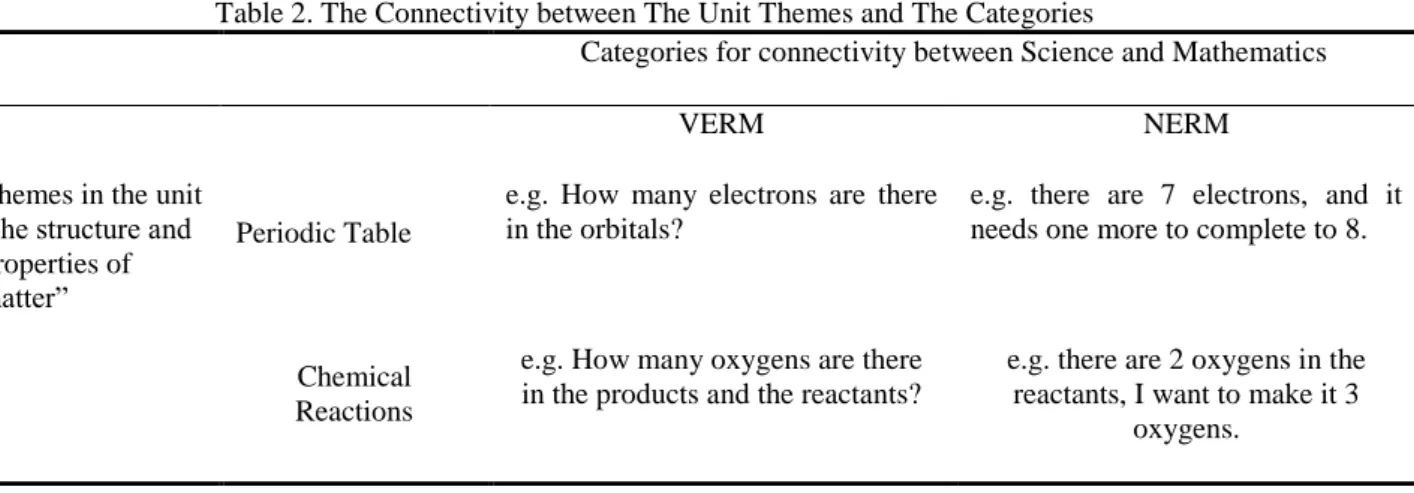
For the unit “The structure and properties of matter”, the science and mathematics connection is established in specific themes. One of the themes is periodic table, which involves the learning of metals, nonmetals, electron distribution, determining the number of groups and periods, calculating the charge of ion, and placing the electrons in orbitals. The second theme is chemical reactions, including calculating the number of atoms in a compound, writing formulas for compounds, and equalizing the number of atoms in a given chemical reaction. In both themes, there were VERM and NERM categories for science and mathematics connection. This connection framework was presented as in Table 2.
Table 2. The Connectivity between The Unit Themes and The Categories
Categories for connectivity between Science and Mathematics
VERM NERM
Themes in the unit “the structure and properties of matter”
Periodic Table
e.g. How many electrons are there in the orbitals?
e.g. there are 7 electrons, and it needs one more to complete to 8.
Chemical Reactions
e.g. How many oxygens are there in the products and the reactants?
e.g. there are 2 oxygens in the reactants, I want to make it 3
oxygens.
During the instruction of the unit, the connections between science and mathematics are found to be inserted in one of these themes.
Discussion and Conclusion
In this study, the teacher emphasized the science curriculum objectives in her classroom and she also allowed the students to make connections between science and mathematics. There was no mathematics curriculum objective in the teaching planning. Moreover, the teacher did not pay attention to the mathematics curriculum to see if there are any objectives stated in the mathematics curriculum in regard to the content taught in the science classroom. Rather, she presented various examples related to nature and real life in her teaching. Thus, the number connections might not be as much as an experienced teacher would make. Considering the Kiray’s (2010) content-centered balance model, the practice of the teacher in this study can be placed on the science-centered mathematics-assisted integration part. Mathematics is regarded as an interval discipline (Kiray, 2012) in this teacher’s class.
concepts such as positive and negative ions are presented as results of mathematical operations. As the researchers, we think that these connections should be made clear to students in order them to comprehend that disciplines are not separated from each other with strict lines but they are used connectively. Kiray and Kaptan (2012) support this idea by indicating that the connectivity understanding can enhance the success of students in transferring mathematics and science exceeding the scope of the class. Similarly, Kaya, Akpinar, and Gokkurt (2006) and Kaya, Kesan, and Kaya (2011) showed evidence to the significant difference in academic achievement in favor of the students who are taught by science-mathematics connectivity. However, warnings should be made to prevent students to make faulty connections. For example, students should be made aware of the distinctions between the use of superscripts to indicate the atomic number of an atom in chemistry and the use of exponential numbers in mathematics.
In Turkey, there is a centralized examination system which forces the teachers to use discipline-centered approach to teaching (Kiray, 2012; Venville, Wallace, Rennie, & Malone, 1998). That is, teachers cannot reflect connectivity in their science or mathematics classrooms because neither the examination system requests them to do so or the science or mathematics curriculum pay enough attention to the connections between science and mathematics. The connectivity only pointed in the curriculum as a side option to the teacher. That is, the connections between disciplines are given as proclamations in the curriculum but not as objectives. Therefore, the teachers feel themselves restricted to follow the sequence of the curriculum in terms of both science and mathematics objectives (Kiray, 2012). Similarly, the teacher in this study noted to the difficulty of following the curriculum and the unharmonious sequence of the topics in two curricula in the interview. The teacher was first responded to the question about connectivity in general. She stated that she experiences problems to connect disciplines in science lessons. The main problem explained by her is the inconsistency between the curricula of two courses. For example when the mathematics curriculum was far behind the science in terms of the use of basic skills, it was hard for her to make the connections. This is true since the comparison data obtained in the study by Ceken and Ayas (2010) showed that the concepts of ratios and proportions are located in the second term of 6th grade at elementary level, but Science and Technology curriculum include such concepts in the first term. To solve this problem, Ceken and Ayas (2010) proposed the placement of objectives of these subjects simultaneously in the scope and sequence of curriculum planning. The researchers made important suggestions regarding the examination of the potential objectives identified in the curricula in such a way that the related skills would help the knowledge transfer across disciplines through an inter-disciplinary study method (Ceken & Ayas, 2010). Therefore, in addition to teachers, we suggest the curriculum planners to focus on the connectivity and harmony in planning teaching for connectivity.
Besides, the teachers’ content knowledge might not be adequate to teach the disciplines in connection. Baskan, Alev and Karal (2010) indicated that teachers generally think that connectivity is necessary, but they don’t have clear ideas in implementation of this connectivity and they hardly suggest a few integration or relation techniques. As the teacher in this study indicated, though she feels adequate to teach connectivity, there is insufficient knowledge about how to implement connectivity in a course and less or no training about connectivity in teacher education programs. On the other hand, as Lehman and McDonald (1988) noted that although teachers perceive themselves making many connections, they may not be successful in doing so as frequently as they perceive. Therefore, we should focus on whether other connections are possible in a unit. Although the teacher and us did not plan for connectivity but rather observe the case in this study, further research may foresee the possible connections and evaluate the teachers’ adequacy based on these pre-planned connections.
and increased appreciation for science. Therefore, Friend (1985) suggests connectivity for the students who have the similar ability levels. Similarly, in the interviews, the teacher stated that students usually are not aware of the connections made, and the teacher thinks that it is usually not necessary to explicitly mention about these connections during the lecturing since it may distract the students’ attention.
There are a few researches about the connectivity in curriculum in Turkey. However, international studies provide a strong rationale for connectivity in science and mathematics education that would be supported by all stakeholders of science and mathematics education community (Dawson, Miller, & Metheny, 1995; Lederman & Niess, 1998; McBride & Silverman, 1991). The educational researchers should pay attention to the connections among disciplines since the curriculum is an integrated one in science and mathematics at elementary level although not in the level of objectives.
Future research may focus on various options of connectivity and support the teachers to improve their self-efficacy in achievement of total integration (Kiray, 2010; 2012). The necessity for the pre- and in-service teacher training as well as the improvement of the program in terms of connections should not be ignored (McBridei & Silverman, 1991). For in service science teachers, there might be workshops that include model lessons and materials as well as opportunities to work collaboratively with mathematics teachers (Lehman & McDonald, 1988). In addition, the research can be enriched with studies which investigate the connectivity in different areas as well as daily life. Such an attempt to collaborative work would help to cross the invisible boundaries in universities between science and mathematics educators, and would lead to grown shared experience among scholars (Basista & Mathews, 2002). Follow-up studies, extended observations, and detailed interviews as well as demographic information regarding the content knowledge of the teachers are needed to understand the barriers in front of connectivity for further research (Berlin & White, 2010). Besides, an alternative approach to connectivity might be to prepare connected curriculum instead of thinking each discipline separately (Davison, Miller, & Metheny, 1995; Lederman & Niess, 1998). That is, connectivity between science and mathematics might be combined into a single curriculum, which might be called as “connected science and mathematics”.
As a recommendation, we may also suggest that the science educators should be aware of the deficiencies in understanding mathematics concepts especially in chemistry education and be in cooperation with mathematics educators in the fulfillment of mathematics content knowledge in teaching of science concepts. That is mainly because, as Kurt and Pehlivan (2013) demonstrated, there are some obstacles in the efforts to make connections between disciplines. The researchers stated that teachers’ lack of sufficient experience in implementing connectivity since their pre-service or in-service training do not provide them with the opportunity to use it. Therefore, we think that the cooperation between disciplines in terms of teaching programs and curriculum planning would be helpful to overcome these barriers.
Acknowledgements
We are thankful to our teacher A. Bilgin for her cooperation in this study.
This short version of this study was presented in European Science Education Research Association (ESERA), Lyon, France in 2011 with the title “A case study of a science unit to make connections between elementary science and mathematics”.
References
Azzarito, L., & Ennis, C. D. (2003). A Sense of connection: Toward social constructivist physical education. Sport, Education and Society, 8(2), 179-197.
Barab, S. A. (1999). Ecologizing instruction through integrated units. Middle School Journal, 30, 21-28.
Basista, B. & Mathews, S. (2002). Integrated science and mathematics professional development programs. School Science and Mathematics, 102(7), 359-370.
Baskan, Z., Alev, N., & Karal, I. S. (2010). Physics and mathematics teachers’ ideas about topics that could be related or integrated. Procedia Social and Behavioral Sciences, 2, 1558-1562.
Berlin, D. F. & White, A.L. (2010). Preservice mathematics and science teachers in an integrated teacher preparation program for grades 7–12: A 3-year study of attitudes and perceptions related to integration. International Journal of Science and Mathematics Education, 8, 97-115.
Ceken R. & Ayas, A. (2010). İlköğretim fen ve teknoloji ile sosyal bilgiler ders programlarında oran ve orantı. Gaziantep Üniversitesi Sosyal Bilimler Dergisi, 9(3), 669-679.
Cobb, P. (2000). The importance of a situated view of learning to the design of research and instruction. In J. Boaler (Ed.), Multiple perspectives on mathematics teaching and learning. Westport, CT: Greenwood Publishing Group, Inc.
Davison, D.M., Miller, K.W., & Metheny, D.L. (1995). What does integration of science and mathematics really mean?. School Science and Mathematics, 95(5), 226-230.
Furner, J. M., & Kumar, D. D. (2007). The mathematics and science integration argument: A stand for teacher education. Eurasia Journal of Mathematics, Science & Technology Education, 3(3), 185-189.
Friend, H. (1985). The effect of science and mathematics integration on selected seventh grade students’ attitudes toward and achievement in science. School Science and Mathematics, 85(6), 453-461. Froyd, J. E., & Ohland, M. W. (2005). Integrated engineering curricula. Journal of Engineering Education,
94(1), 147-164.
Frykholm, J., & Glasson, G. (2005). Connecting science and mathematics instruction: Pedagogical context knowledge for teachers. School Science and Mathematics, 105(3), 127-141.
Greene, L.C. (1991). Science-centered curriculum in elementary school. Educational Leadership, 49(2), 42-46. Kaya, D., Akpinar, E. & Gokkurt, O. (2006). İlköğretim Fen Derslerinde Matematik Tabanlı Konuların
Öğrenilmesine Fen-Matematik Entegrasyonunun Etkisi, Bilim, Eğitim ve Düşünce Dergisi, 6(4), retrieved from http://www.universite-toplum.org/text.php3?id=288?ref=abazatv.com
Kaya, D., Kesan, C., & Kaya, U. (2011). A survey about teaching of hybrid subjects in science and mathematics and evaluation of student success. e-Journal of New World Sciences Academy, 6(1), retrieved from http://www.newwsa.com/download/gecici_makale_dosyalari/NWSA-3721-1-3.pdf
Kıray, S.A. (2010). İlköğretim ikinci kademede uygulanan fen ve matematik entegrasyonunun etkililiği, Doktora Tezi, Hacettepe Üniversitesi Sosyal Bilimler Enstitüsü, Ankara.
Kıray, S.A. & Kaptan, F. (2012). The effectiveness of an integrated science and mathematics programme: Science-centred mathematics-assisted integration. Energy Education Science and Technology Part B: Social and Educational Studies, 4(2), 943-956.
Kıray, S.A. (2012). A new model for the integration of science and mathematics: The balance model. Energy Education Science and Technology Part B: Social and Educational Studies, 4(3), 1181-1196
Kurt, K. & Pehlivan, M. (2013). Integrated programs for science and mathematics: review of related literature. International journal of education in mathematics. Science and Technology, 1(2), 116-121.
Laughlin, C. D., Zastavker, Y. V., & Ong, M. (2007). Is integration really there? Students’ perceptions of integration in their project-based curriculum. Paper presented at 37th ASEE/IEEE Frontiers in Education Conference, October 10 – 13, Milwaukee, WI.
Lederman, N.G. & Niess, M. L. (1998). 5 apples + 4 oranges= ? School Science and Mathematics, 98(6), 281-284.
Lehman, J.R. & McDonald, J.L. (1988). Teachers’ perceptions of the integration of mathematics and science. School Science and Mathematics, 88(8), 642-649.
Lonning, R. A., & DeFranco, T. C. (1997). Integration of science and mathematics: A theoretical model. School Science and Mathematics, 97, 212–215.
McBridei, J.W. & Silverman, F.L. (1991). Integrating elementary/ middle school science and mathematics. School Science and Mathematics, 91(7), 285-292.
Merriam, S. B. (2002). Qualitative research in practice: examples for discussion and analysis. California: Jossey-Bass.
Ministry of National Education in Turkey (2006). İlköğretim Fen ve Teknoloji Dersi (6, 7 ve 8. Sınıflar) öğretim programı- Elementary Science and Technology Curriculum (6th, 7th & 8th grades). Ankara.
National Council of Teachers of Mathematics. (2000). Principles and Standards for School Mathematics. Reston, VA: Author.
Park Rogers, M. A., Volkmann, M. J. & Abell, S. K. (2007). Science and mathematics: A natural connection. (Perspectives Column). Science and Children, 45(2), 60-61.
Pang, J., & Good, R. (2000). A review of the integration of science and mathematics: Implications for further research. School Science and Mathematics, 100(2), 73-81.
Roth, W-M., & Bowen, M. G. (1994). Mathematization of experience in a grade 8 open-inquiry environment: An introduction to the representational practices of science. Journal of Research in Science Teaching, 31(3), 293-318.
Stake, R. (1980). The case method inquiry in social inquiry. In H. Simons (Ed.), Towards a science of the singular (pp.5-8). Norwich: CARE.
Strauss, A., & Corbin, J. (1990). Basics of qualitative research: Grounded theory procedures and techniques. Sage Publications.