IC, 2016 – 12(1): 357-389 – Online ISSN: 1697-9818 – Print ISSN: 2014-3214 http://dx.doi.org/10.3926/ic.703
Effect of internal controls on credit risk among listed Spanish banks
Ellis Kofi Akwaa-Sekyi1,2, Jordi Moreno Gené1
1Universitat de Lleida (Spain), 2Catholic University College of Ghana (Ghana)
[email protected], [email protected]
Received July, 2015 Accepted January, 2016
Abstract
Purpose: The paper examines the effectiveness of internal control systems, explores the exposure of Spanish banks to the dangers of default as a result of internal control systems and establishes a relationship between internal controls and credit risk.
Design/methodology/approach: Quantitative research approach is used to test hypotheses on the relationship between internal controls and credit risk among listed banks in Spain. Data from Bankscope and company websites from 2004-2013 were used. Generalized Least Squares (random effect) econometric estimation technique was used for the model.
Findings: We find that internal control systems are in place but their effectiveness cannot be guaranteed. This exposes Spanish listed banks to serious default situations. There is significant effect of internal controls on credit risk especially the control environment, risk management, control activities and monitoring. The non-disclosure of material internal control weakness is a contributory factor to the ineffective internal control systems. There is however a perceived board ineffectiveness which does not augur well for effective internal control systems. Board characteristics for Spanish banks confirm the agency theory.
Practical implications: Bank management will find the work useful to ensure strict enforcement of internal control mechanisms and see it as both credit risk and operational risk issues. Central bank should hurry to compel banks to disclose material internal control weakness as provided in the reviewed COSO framework.
Social implications: Ineffective internal controls lead to credit risks, bank closure and loss of investments. Society suffers a lot from such losses and contagion. Disclosure of material internal control weakness is a social responsibility of banks.
Originality/value: The authors are yet to come across the use of purely quantitative variables to model the effect of elements of internal controls on credit risk. This study opens and adds a new dimension of internal controls not only to be seen as operational risk issue but also credit risk.
Keywords: Agency problem, Banking, Credit risk, Internal controls
Jel Codes: G21, G32
1. Introduction
In the wake several corporate scandals, market failures and loss of investments, there is clarion call to ensure market discipline especially on the part of industry players. As much as possible, losses should be unanticipated than purposely orchestrated as is seen in many corporate organizations. The possible adoption of soft-laws, self-regulation and high sense of ethical behaviour has gained much prominence in the world of business. Financial intermediation is the flow of funds from surplus to deficit units. The units also known as market participants are made up of individuals, households, institutions or firms, governments and foreigners (Casu, Giradone & Molyneux, 2006). One important issue bedevilling financial intermediation is information asymmetry. This menace has the tendency to lead to moral hazards and adverse selection. Most financial institutions have suffered from moral hazards on the part of clients expressed through default.
banks but bank self-regulation, internal discipline, compliance and building of stakeholder confidence through internal controls will be better embraced.
Developments in the financial services industry especially with financial intermediation have been so rapid in recent times. New product development and innovation, diversification of financial services products, excessive competition, crave for significant market share through excessive branching into new geographical areas and desires to benefit from economies scale and scope have unnecessarily exacerbated the risk exposure of financial institutions and for that matter banks.
Shareholder value maximization- the prime objective of the firm requires that institutions minimize their risks as much as possible. In contrast to this, managerial risk aversion hypothesis which is traced from the agency argument holds that management will more often than not pursue actions to minimize their personal risks. Managers therefore engage in actions that may endanger the maximization of shareholder wealth. Irrespective of whether ensuring shareholder value maximization or managerial risk aversion, the issue of risk management must be addressed. This attempt to align the two divergent stances of shareholders and management is achieved through effective internal controls. Shareholders and other indirect stakeholders have confidence in an effective and efficient internal control system. It is also in the interest of management to see internal controls as a managerial tool rather than to antagonize the introduction of all forms of internal control measures.
Olatunji (2009) studied the impact of internal control system in banking sector in Nigeria but limited the scope of internal controls to fraud which is found under operational risk. Lakis and Giriunas (2012) also described internal controls as a measure to deal with fraud. Our present study builds on already existing works to provide a wider view of internal controls covering all the elements globally accepted and used like COSO and Basel Committee on Banking Supervision. Bedard (2011) used the US Sox internal controls which focus on financial reporting. Ji, Lu and Qu (2015) focused on Chinese Sox internal controls which added among others organizational structure and human resource management. We use a broader scope of internal controls (COSO model) which covers five broad areas namely control environment, risk assessment, control activities, monitoring and information and communication systems.
another dimension of the relationships between internal controls and credit risk to add up to the already existing good works of the authors cited.
Jin, Kanagaretnam, Lobo and Mathieu (2013) found that if banks comply with internal controls, they reduce their risk taking behaviour and are less likely to experience failure. The ramifications of credit risk for banks extend beyond the investors, to the industry, the nation and the international community. Credit risk issues have monetary implications and seriously jeopardize bank market discipline (Delis & Karavias, 2015). The aftermath of the global financial crisis has been very devastating for many nations including Spain. The banking industry has been hardest hit by Spain’s economic downturn and the situation was described by Carballo-Cruz (2011) as the worst crisis the country has faced in the last fifty years. The volume of non-performing loans has been on the increase and many banks have collapsed bringing the number of savings banks from 45 in 2009 to 7 in 2014 (Chislett, 2014). Chislett reported that non-performing loans ratio moved from 0.6% in 2007 to more than 25% in 2014. The situation is a recipe for investigation hence the choice of the study area.
The purpose of this study is to examine the effectiveness of internal control mechanisms among Spanish banks, investigate exposure of Spanish listed banks to default risk as a result of poor internal control mechanisms and determine how internal controls affect credit risk.
The study will go a long way to make new revelations and confirm previous research on how internal controls affect not only operational risk as presented in most finance literature but also credit risk. The structure and effectiveness of internal controls is evident in the reporting of banks and this is explored to unveil its relationship with a core function of banks which is making loans. Thus the study reinforces prudence and cautiousness on the part of management even though the profit maximizing objective cannot be shirked in the process of discharging a critical function. This study opens a grey area in the use of quantitative variables to study an area which hitherto has been studied with the use of primary data. The rest of the paper covers literature review, hypotheses and variables, design/methodology/approach, findings and conclusion.
2. Literature Review
The Spanish banking industry comprise mainly three types of banks; commercial banks, savings banks and credit unions (Alamá, Conesa, Forte & Tortosa-Ausina, 2015). Unfortunately, the industry has witnessed very unpleasant moments in recent times for which Carballo-Cruz (2011) had no better way of describing than to say the worst crisis the country has experienced in the last five decades. Tracing the evolution of the crisis, the writer thinks it is an extension of the international financial crisis but emphasizes that internal imbalances in the pre-crisis period prepared fertile grounds for the crisis to escalate.
In an earlier study, Lozano-Vivas (1998) described the Spanish banking industry as so competitive that commercial banks had to adjust their deposits and loan rates. Unjustifiable adjustment of cost of funds have serious implications for the kind of credit market products and the processes of initiating, negotiating, funding, servicing and monitoring loans. The immediate effect of the crisis became evident at the demise of 38 savings banks within five years when their number reduced from 45 in 2009 to 7 in 2014. Chislett (2014) reported the abnormal rise in non-performing loans from 0.6% in 2007 to more than 25% in 2014 thus warranting a European Stability Mechanism for a bailout where about €100 billion was injected into the industry as a form of capitalization. The regionally based unlisted banks known as Cajas accounted for around half of the loans in the domestic banking system and are touted as orchestrators of the crisis. These Cajas exploited an existing weak and relaxed market coupled with political interference, incompetent board of directors, reckless banking practice through over branching and over-ambitious investments (Chislett, 2014).
From a behavioural compliance theory approach, managers should do all they can to profile the company in a manner that consolidates a positive reputation which are inclined to sound corporate governance pedestals. Given new names such as soft laws and soft regulations (Morth, 2004; Sahlin-Anderson, 2004) managers should learn by intuition, to oblige to principles and best practices. The behavioral compliance theory draws motivation from efforts to rally support from stakeholders by raising the reputation of the company through compliance to corporate governance principles. Attempts to avert any negative profiling of companies or engaging in acts to ruin the reputation of the company on the part of managers are enforced through sound and established internal controls.
From the agency theory, managers may engage in actions that perpetuate their personal aggrandizement. Hart (1995) contends that there is a trade-off between incentives and risk sharing. The cost associated with possible conflict of interest between agents and principals are known as agency costs. These according to Hart are traceable to auditing, budgeting, compensation and other forms of internal controls instituted to check management and employee misbehaviour. According to Letza, Kirkbride, Sun and Small (2008), the argument underlying the agency theory is that, managers will only act to maximize shareholder value if only it is not in conflict with his or her own personal self-interest. Managers or employees may carelessly initiate, originate and fund potentially unsuccessful loans if internal controls are not religiously adhered to. The many cases of credit risk expressed in non-performing loans, delinquencies and all forms of loan restructuring which makes the loan books dirty are traceable to poor adherence and non-compliance to established loan granting procedures. Some loan defaults are employee-caused, others are bank-caused and others are client-led. Internal controls seek to address the employee and bank-led causes of default. The deliberations above support the fact misbehaviour on the part of management (which in this case carelessly contracted loans is being cited) could be controlled with proper internal controls.
an improvement upon the COSO framework thus giving emphasis to monitoring and reporting. It is therefore not surprising to find most internal control research directed towards financial reporting. The SOX Act requires that management reports material internal control weakness to the board and external auditors. The adequacy of internal control systems and the attestation by independent auditors on the report by management is provided in the Act.
Basel Committee on Banking Supervision (2010) defined internal controls as ensuring that senior management establishes and maintains an adequate and effective internal control system and processes. The system and processes should be designed to provide assurance in areas including reporting (financial and operational), monitoring compliance with laws, regulations and internal policies, efficiency and effectiveness of operations and safeguarding of assets. After an extensive theoretical study of internal controls, Lakis and Giriunas (2012) defined internal controls as that part of enterprise management system ensuring the implementation of goals, effective economic-commercial performance of the enterprise, observation of accounting principles and effective control of work risks that enables the organization minimize the number of intentional and unintentional mistakes, to avoid frauds in the process of enterprise performance made by authority or employees. Their definition emphasizes effective risk management just as the Basel Committee on Banking Supervision definition.
From the deliberations, we try to define internal controls as a managerial tool which covers all set of daily activities in all areas of the organization, at all levels towards safeguarding the assets, ensuring compliance and transparency, communicating material weakness, protecting stakeholder interest in order to achieve the long-term goals of the organizational. We see internal controls as such a comprehensive activity that it covers the entirety of all that goes on in an organization. Even though external controls could be seen as a separate discipline, effective internal control systems should ensure that everything including external controls are religiously adhered to.
The benefits of observing internal controls are unchallenged. Although Bhagat and Jeffers Jr. (2002) outline external governance and other factors as capable of aligning the interests of managers and owners, internal governance does this better and goes a long way to deepen ethical behaviour on the part of managers. Legislation provide a one-size-fits-all approach to curb misbehaviour, internal controls have proven very successful in the world of business as capable of minimizing the pursuit of opportunistic tendencies by management. Internal controls minimize the agency costs and therefore increase profits and sales of companies who invest in it (Alves & Mendes, 2004; Fernández-Rodríguez, Gómez-Ansón & Cuervo-García, 2004; Goncharov, Werner & Zimmermann, 2006). Internal controls enhance the reputation of listed companies which has the tendency to affect share price positively (Fombrun & Shanley, 1990). This was confirmed by Hart (1995) who contended that reducing agency costs increase firm value.
The effectiveness of internal controls have been studied along the dimensions of the efficiency and effectiveness of activities, reliability of information and compliance with laws and regulations (Jokipii, 2006). Internal control systems were developed by the Basel Committee on Banking Supervision to ensure prudence and stability in the financial system. Anecdotal evidence from numerous bank failures and even the quite recent financial crisis gives support to the fact that credit is a major contributory factor to these failures. Banks benefit from transforming their liabilities into assets thus an incentive for optimal risk benefit behaviour is pursued but bank managers owe their principals a duty of care (fiduciary relationship). Moral hazards and adverse selection emanates from the exploitation of informational economies by counter parties and can be best be minimized if management is extra careful in its asset creation function. There is much empirical support to the fact that loans constitute the greatest proportion of bank assets (Casu et al., 2006; Mishkin, 2006). Ellul and Yerramilli (2013) reported that financial institutions with strong internal risk controls are able to survive financial crises and refute the claim that the financial crisis did not affect all institutions the same way as speculated by some experts in finance. It is not uncommon to find bank managers over-ambitiously creating very risk assets (credit facilities) in the name of higher return expectation. Although there are a myriad of factors that contribute to credit risk, the most avoidable ones could be dealt with if there are sound and religiously-adhered-to internal controls within the institutions.
The rate of credit defaults has been so alarming in all areas of the financial services industry. General Accounting Office (GAO) (1994) expressed worries about a seemingly unjustifiable provision for loan losses which lack evidence. Although the work of Altamuro and Beatty (2010) addressed this conservative attitude, they did not study the exact relationship between internal controls and credit risk. It was reported in separate studies that weak internal controls affect loan loss provision (GAO, 1991; GAO, 1994).
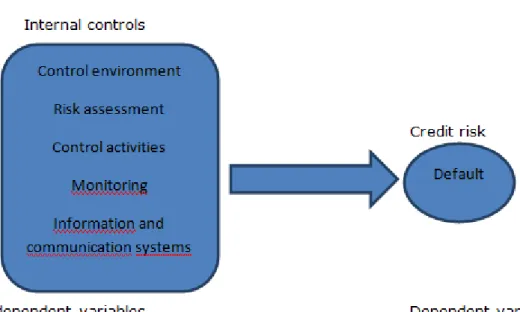
Figure 1. Effect of internal controls on credit risk (Author’s construct)
The framework for the study comprehensively encompasses all the elements of internal controls which are control environment, risk assessment, control activities, monitoring and information and communication systems. The key objectives of internal controls are effectiveness and efficiency of operations, reliability of financial reporting and compliance with applicable laws. These cardinal objectives of internal controls and attributes which are preventive, detective and curative have all been covered in the study.
3. Variables and hypotheses
3.1. Credit Risk
(Cebenoyan & Strahan, 2004). Banks in Japan have had souring figures in the amount of non-performing loans and provision for loan losses which are normally used as proxies for credit risk (Fukuda, Kasuya & Akashi, 2009). The writers reported of the warning from the Japanese government on the need for banks to reduce non-performing loans since it has seriously affected the financial health of the banking industry. Jiménez, Lopez and Saurina (2013) cited Salas and Saurina (2002) who studied Spanish commercial and savings banks and found that credit risk measured by non-performing loans is by bank size and rapid credit expansion. Further evidence is provided about Spanish banking industry that lenient credit terms among other factors determines non-performing loans (Saurina & Jimenez, 2006). The cases of rapid credit expansion and lenient credit terms are traceable to weak internal control structures. Credit risk affect the bank reputation and translate to other risks especially in situations where internal governance mechanisms are very weak (Haq, Faff, Seth & Mohanty, 2014). This makes credit risk an important issue for banks to deal with and we therefore use it as the dependent (outcome) variable around which internal controls and other bank specific factors revolve. From the discussions above, we conjecture a relationship between internal controls and credit risk and therefore hypothesize that:
There is significant relation between internal controls and credit risk.
3.2. Board Size
The size of the board of directors have influences over deliberations and control over management (Aliyu, Jamil & Mohamed, 2014). There are different schools of thought as to whether large or small board sizes positively affect performance of firms. Small board size reduce the agency cost associated with large board size (Eldenburg, Hermalin, Weisbach & Wosinska, 2004). Uwuigbe and Fakile (2012) chastised large board size for ineffectiveness and possible lack of coordination as compared to smaller board size. On the other hand (Chen & Al-Najjar, 2012) confirmed that large board size contributes positively to the performance of firms. Although this study is not about board size and performance, the bottom-line is the board’s ability to contribute to deliberations, provide reliable information and avoid manipulations in board decisions. We therefore hypothesize that:
3.3. Board Expertise in Finance
The numerous corporate scandals that occurred at the blind side of the board of directors of affected companies have brought caution to board composition. Some authors refer to it as board experience. Most board members especially for banks require that at least a good number of them should have some form of expertise in Banking and Finance. This requirement is given emphasis in the Sarbanes-Oxley Act of 2002. Burak Güner, Malmendier and Tate (2008) reported that board members with finance background significantly affect capital budgeting and capital structure decisions and policies of non-banks. We abstract from this finding and expect that with their expertise, board members with finance background should be capable of taking good risk assessment decisions which is a major pillar of internal control systems. Interesting and varying results on board expertise in finance were discovered in the pre and peri crisis period on the stock performance of banks (Minton, Taillard & Williamson, 2010). We hypothesize from the above that:
Board expertise in finance significantly affects credit risk.
3.4. Management Experience
Apart from the board being experienced in finance, management should also be on top of their jobs. The agency problem rests so much on managerial decisions. The experience of management will go a long way to determine the kind portfolios they construct as well as other critical investment decisions (Burak Güner et al., 2008). The risk management element of internal controls requires that management become very experienced to ensure effective risk management and internal control. Ikpefan and Ojeka (2013) cited Central Bank of Nigeria (2006) that management and board expertise were vital corporate governance requirement to ensure effective internal governance. We therefore hypothesize that:
Management experience has significant relationship with credit risk.
3.5. Revenue Diversification
of diversification is captured as an important element which could be bring about management misbehaviour (McNally, 2013). There are mixed reports about the effect of diversification on non-performing loans and in some cases no relation is reported at all (Hu, Li & Chiu, 2006). We anticipate a significantly positive relationship between diversification and credit risk since the incentive to be more profitable increases the risk exposure of banks as they expand and diversify. We hypothesize that:
Revenue diversification has significant positive effect on bank credit risk.
3.6. Board Independence
One of the internal control elements is monitoring which is mostly performed by the board of directors. This means that if the board is very independent, there is the tendency for a better monitoring function. The ability for an independent board to be more efficient in monitoring management is given support from literature (Eling & Marek, 2009; Pathan, 2009). Eling and Marek found that monitoring had significant effect on risk taking behaviour of insurance companies in the UK and Germany. An earlier report by Agrawal and Mandelker (1990) revealed that monitoring should be actively done and that board members can be large in numbers and independent but not active. We therefore hypothesize that:
Board independence significantly affects bank credit risk.
3.7. Compliance, Prudence and Safety
Banks are the most heavily regulated institution because of the risky nature of their business (Mishkin, 2006). Not all deposits are allowed to be given out as loans hence some reserve requirements should be kept against liquidity problems. Such practices ensure prudent bank management and safe keeping of bank assets (Casu et al., 2006). Internal control systems ensure compliance with such regulatory requirements. We hypothesize that:
Compliance, prudence and safety significantly affect credit risk.
3.8. Audit Quality
corporate accountability. Audit committees perform internal governance function to protect the company from impairment suffered from reputational risks (Zhang, Zhou & Zhou, 2007). It is expected banks with good audit quality will enhance effective internal control systems and therefore reduce credit risk. We hypothesize that:
Audit quality has significant relationship with credit risk.
3.9. Quality and reliability of financial information
Stakeholders would want to express confidence in the timeliness and reliability of financial information management present. Especially with regulators, compromises with this condition attract fines and sanctions. Reliable financial information is an audit function banks would want to engage first class auditors to earn the organization some reputational capital (Zhang et al., 2007).
The quality and reliability of financial information significantly affect credit risk.
Apart from the independent variables, there are some variables which can influence credit risk but are not directly captured as internal control variables. These variables are controlled in the study and can be seen below.
3.10. Bank Size
There is enough literature support for bank size to affect decisions of internal controls and bank operations (Laeven & Levine, 2009). There is the tendency for large banks to be more very mindful of internal controls than small size banks. Size can determine the variety of credit products available to a financial institution (Eling & Marek, 2009). Small firms are likely to have lesser incentive to improve internal controls (Ashbaugh-Skaife, Collins & Kinney, 2007; Doyle, Ge & McVay, 2007) whilst larger banks might be well-resourced to invest in internal controls.Bank size was found to have negative relation with credit risk measured by non-performing loans (Hu et al., 2006). We therefore control for bank size and hypothesize that:
3.11. Bank Age
Age of business affect the kind of investment and financing decisions. So much experience is acquired and companies which have been in business for long have good links and access to a lot of opportunities than new and upcoming ones. It is reported firms that have existed for long have less material internal control weakness (Tang, Tian & Yan, 2015). We hypothesize that:
Bank age significantly affect credit risk.
3.12. Profitability intent (Net Interest Margin)
Altman (1968) and Hillegeist, Keating, Cram and Lundstedt (2004) found that a company could probably fail if it is unprofitable and highly leveraged. In a bid to avoid failure, banks pursue efforts to be very profitable (Shumway, 2001). There are various measures of profitability but the nature of the study focuses so much on loan activities so the most appropriate measure of profitability is net interest margin. We argue that the tendency to maximize profits which is very common with management could affect the kind of assets created. We therefore hypothesize from these abstractions that:
Net Interest Margin significantly affects credit risk
3.13. Corporate restructuring
When companies are restructured through a merger or acquisition or by any kind, the rules of engagement may change including internal controls. Chen, Dong, Han and Zhou (2013) found evidence of relation between corporate restructuring and internal control practices. It is therefore likely that after a restructure, internal control systems might improve or deteriorate which can affect the loan decisions and credit risk. We therefore conjecture that:
Corporate restructuring significantly affects credit risk.
3.14. Leverage
failure could emanate from high leverage (Altman, 1968; Hillegeist et al., 2004). We therefore hypothesize that:
Leverage significantly affects bank credit risk.
3.15. Design/Methodology/Approach
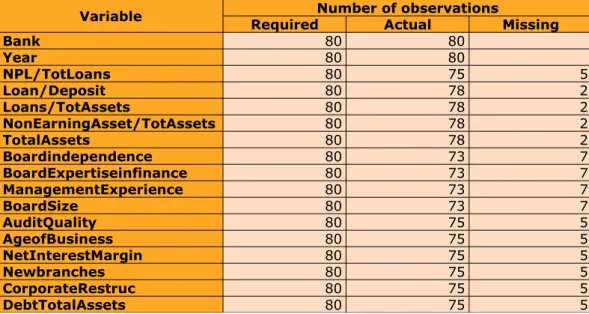
The study design is purely a quantitative approach to establish the relationship between internal controls and credit risk. The statement and statistical test of hypotheses makes our study a deductive approach. Secondary data was obtained from Bankscope for eight banks listed on the Spanish Stock Exchange which had data available on over fifteen variables from the period 2004-2013. The sample description can be found in Table 1.
Variable RequiredNumber of observationsActual Missing
Bank 80 80
Year 80 80
NPL/TotLoans 80 75 5
Loan/Deposit 80 78 2
Loans/TotAssets 80 78 2
NonEarningAsset/TotAssets 80 78 2
TotalAssets 80 78 2
Boardindependence 80 73 7
BoardExpertiseinfinance 80 73 7
ManagementExperience 80 73 7
BoardSize 80 73 7
AuditQuality 80 75 5
AgeofBusiness 80 75 5
NetInterestMargin 80 75 5
Newbranches 80 75 5
CorporateRestruc 80 75 5
DebtTotalAssets 80 75 5
Table 1. Description of sample and variables
The table above shows the variables, the expected number of observations, actual observations available for analysis and the missing values.
report major internal control information for public use. There are basic requirements about corporate governance and board characteristics of listed companies which is very crucial in this study. The unavailability of data for certain years on certain variables makes the data unbalanced, however basic assumptions regarding the use of panel data were met thus justifying the study.
4. Empirical models
We propose a general equation for the study that credit risk is a function of internal controls. This equation is further decomposed to arrive at the overall model that contains all the independent and control variables using their proxies. From Equation (1)
CRit = f(INTCONT) (1)
Where
CRit = Credit risk for bank i for the time period t
INTCONT = internal controls
The Equation (1) above covers the topic that credit risk is a function of internal controls which means that there is a linear relationship between internal controls and credit risk. We decompose Equation (1) to obtain the variables representing internal controls to obtain (2)
INTCONT= f(bodindp,bodexpfin, bodsize, mgtexp, lns/dep, lns/totass,
nea/totass, audqua, nwbrnch) (2)
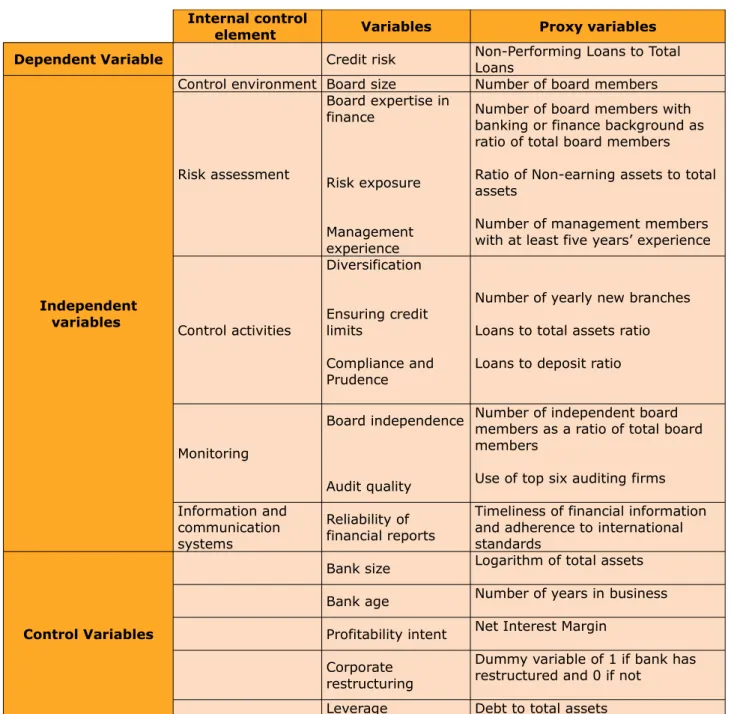
Internal controls as explained by the COSO report cover five broad elements which are control environment, risk assessment, control activities, monitoring and information and communication systems (Chen et al., 2013). These elements have been represented by the variables like board independence (bodindp), board expertise in finance (bodexpfin), board size (bodsize), management experience (mgtexp), loans to deposit ratio (lns/dep), loans to total assets (lns/totass), non-earning assets to total assets (nea/totass), audit quality (audqua), new branching (nwbrnch). These variables which cover all the five broad domains of internal controls found in the conceptual framework constitute the independent variables for the study.
(Bnksz), bank age (bnkage), profitability intent (NIM), corporate restructuring (corpres) and leverage (lev). When all the independent and control variables are included in the regression model, we obtain Equation 3.
LLP/TLit = β0it + β1itbodindp + β2itbodexpfin + β3itbodsize + β4itmgtexp +
β5itlns/dep + β6itlns/totass + β7itnea/totass + β8itaudqua + β9itnwbrch +
β10itbnksz + β11itbnkage + β12itnim + β13itcorpres + β14itlev + εit
(3)
where the subscripts i denotes Spanish Listed Banks (i= 1,2,3,4……. 71), t represent time period (t= 2004, 2005, 2006…. 2013), β1, β2, β3……… β14 are the parameters to be estimated and ε represent the idiosyncratic error term.
The independent variables which are the elements of internal control and the control variables have been included in Equation (3) for the general model.
Although the data is not perfectly balanced panel due to data unavailability for some banks in some years for some variables, the data passed reliability tests thus making the results very reliable. We use Generalized Least Squares regression to estimate the econometric model. Two main estimation techniques are used for GLS which are random effect and fixed effect models. Usually, for panel data (times series cross-sectional data) fixed effect models controls for all time-invariant differences between the individuals so the estimated coefficients cannot be biased hence fixed effect model estimation is not ideal for time-invariant causes of the dependent variables (Torres-Reyna, 2007). For random effect estimations, the assumption is that the entity’s error term is not correlated with the predictors thus allowing for time-invariant variables in the explanatory variables.
Internal control
element Variables Proxy variables Dependent Variable Credit risk Non-Performing Loans to Total Loans
Independent variables
Control environment Board size Number of board members
Risk assessment
Board expertise in finance
Risk exposure
Management experience
Number of board members with banking or finance background as ratio of total board members
Ratio of Non-earning assets to total assets
Number of management members with at least five years’ experience
Control activities Diversification Ensuring credit limits Compliance and Prudence
Number of yearly new branches
Loans to total assets ratio
Loans to deposit ratio
Monitoring
Board independence
Audit quality
Number of independent board members as a ratio of total board members
Use of top six auditing firms
Information and communication systems
Reliability of financial reports
Timeliness of financial information and adherence to international standards
Control Variables
Bank size Logarithm of total assets
Bank age Number of years in business
Profitability intent Net Interest Margin
Corporate restructuring
Dummy variable of 1 if bank has restructured and 0 if not
Leverage Debt to total assets Table 2. Definition of variables
5. Descriptive statistics
The descriptive statistics covers the dependent, independent and control variables used in the study over the ten year period.
Variable mean max min sd skewness kurtosis p50
NPLTotLoane 3.793453 19.56 .27 4.073303 1.995312 7.492439 2.66
LoansDeposit 1.074995 1.497998 .6033253 .178887 .1513604 2.868119 1.077153
LoansTotAs .6926197 .8606263 .5223484 .0952179 .0155338 1.763342 .6896575
NonEarnings .0698189 .1550488 .0154269 .0337686 .2425023 2.408426 .0727355
TotalAssets 3.59e+08 1.68e+09 1483779 4.63e+08 1.611447 4.553111 1.42e+08
Boardindepe .4579452 .786 .19 .1511041 .4903246 2.634548 .45
BoardExpere .8990064 1 .5238095 .1171934 -1.534463 4.646694 .9333333
Managemente .9978256 1 .9444444 .0106035 -4.661183 22.84297 1
BoardSize 14.9589 21 8 3.878138 -.1801839 1.65548 15
AuditQuality 1 1 1 0 . . 1
Ageofbusins 80.45333 156 0 56.69389 .0671837 1.412734 80
NetInteresn 1.91596 2.95 .094 .5678443 -.1342021 3.022213 1.906
Newbranches 118.3733 2212 -612 380.7738 2.358308 14.12196 55
Corporaterg .36 1 0 .4832324 .5833333 1.340278 0
DebtTotalAs .9418331 .9656088 .91568 .0107296 .2103136 2.917855 .941469 Table 3. Descriptive statistics
6. Findings
The study sought to examine the effectiveness of internal control systems, explore the exposure of Spanish listed banks to default problems and establish the relationship between internal controls and credit risk. The effectiveness of internal controls is seen from the descriptive statistics. The mean values for control environment, risk assessment, control activities and monitoring are indications of attempt to make provision for effective internal control systems. There is high board independence, large board size, experienced management and high quality auditors. The study reveals that there is excessive desire to expand through over branching. This has serious implications for cost of maintaining branches and controlling activities. There is the tendency for head office to lose control in monitoring effectively what goes on in all branches at all times. When there is proliferation of bank branches in specific geographical areas, credit pollution through multiple borrowing is likely to occur since the same clients will receive duplicated credit services from different branches (Steinwand, 2000). The loan to deposit ratio of more than one (1) indicates that all deposits are absorbed by loans a situation which could trigger liquidity problems should there be any delay in the servicing of the loan. There is over-reliance on loans as the major asset component. This does not commensurate with the long years of existence and experience and expertise of board and management. Bank profitability intent is maintained within normal practice there is the need to compliment it with good banking practices in order to keep credit risk in control.
Variables like loans to deposit ratio debt to total asset ratio cast doubts on risk assessment function of top management and board. The encouraging figures for the characteristics of the board, management and auditors do not reflect the figures for monitoring, control environment, risk management, control activities and information and communication. This confirms Agrawal and Mandelker (1990) who emphasized board effectiveness and not necessarily board characteristics. The conditions created exposes Spanish banks to so much credit risk conditions. Risk taking decisions should be done upon careful risk assessment, measurement, implementation and evaluation. There was no evidence of reporting material internal control weakness and this seriously increases the risk exposure of banks.
between internal control weakness and credit risk. It was reported by Chen et al. (2013) that effective internal control system ensures good financial reporting and increases the confidence of investors on the capital market. In the case of banks as found in this case, if effective internal control systems are enshrined, the already waning public confidence in the Spanish banking industry as a result the collapse of several savings banks and over-indebtedness could be repaired to some extent. The emphasis on effective internal controls was found by Ellul and Yerramilli (2013) who reported that financial institutions with strong internal risk controls survive financial crisis. This is confirmed in our study looking at the explanatory power of internal controls to credit risk. The result is again in tandem with the findings of Tang et al. (2015) who found that internal control material weakness increases credit risk of firms. The authors established some relationship between internal controls and credit risk as has been found in our study.
Variables (1) Fixed effects (2) Random effects (3) Hausman test
LoansDeposit -4.247
(4.166)
-8.888** (3.739)
-8.888** (3.739)
LoansTotAssets -14.116
(12.055)
13.822* (8.147)
13.822* (8.147)
NonEarningAssetTotAssets 70.676***
(26.055)
122.642*** (17.166)
122.642*** (17.166)
TotalAssets 0.000**(0.000) (0.000)-0.000 (0.000)-0.000
Boardindependence (5.092)5.109 10.149**(4.099) 10.149**(4.099)
BoardExperticeinFinance (7.676)6.333 13.016**(6.251) 13.016**(6.251)
ManagementExperience (35.714)-11.938 (36.456)-27.099 (36.456)-27.099
BoardSize (0.337)0.601* 0.514***(0.169) 0.514***(0.169)
Ageofbank (0.044)0.076* -0.034**(0.015) -0.034**(0.015)
NetInterestMargin -4.538***(1.222) -4.304***(1.102) -4.304***(1.102)
Newbranches (0.001)-0.001 -0.002*(0.001) -0.002*(0.001)
Corporaterestructuring (0.870)0.235 (0.896)0.828 (0.896)0.828
DebtTotalAssets (54.149)-42.671 (49.283)-21.349 (49.283)-21.349
Constant 47.236
(62.060) 29.993 (58.239) 29.993 (58.239) R-squared 0.724
Sample size 73.00 73.00 73.00
Standard errors in parentheses *** p<0.01, ** p<0.05, * p<0.1
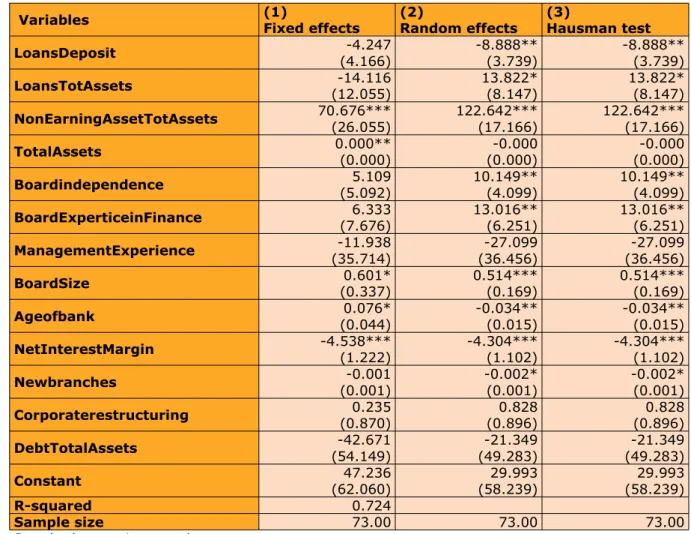
Looking at the individual explanatory variables, seven of them significantly explain credit risk at least at 95% confidence interval. Board size falls under the purview of control environment in the internal control framework. It is found that board size significantly affect credit risk. This finding agrees with Aliyu et al. (2014) who reported that board size influences good decisions and control. An effective control environment created by the board as a result of their size ensures segregation of duties and good human resource capacity. The positive correlation between control environment and credit risk rather confirms that larger board sizes do not necessarily ensure sound control environment (Uwuigbe & Fakile, 2012) contrary to the claim by Chen & Al-Najjar (2012) that larger board sizes ensure effective monitoring. In the study of Tunisian banks, Salhi and Boujelbene (2012) found same positive relation between board size and bank risk taking.
It is found that loan-to-deposit ratio which is a proxy variable for compliance and prudence found under the control activities element of the internal control framework significantly explained variations in bank credit risk. Control activities include ensuring approval limits are observed, minimizing conflict of interest and ensuring segregation of duties (Basel Committee on Banking Supervision, 2010). Although the result shows very significant relation between control activities and credit risk, the correlation coefficient surprisingly shows a negative relationship. This is contrary to our expectation and might be an indication of improper enforcement of these internal control mechanisms as reported by Agrawal and Mandelker (1990). They attribute such weaknesses to inactive board of directors.
Board independence which falls under the monitoring component of the internal control framework significantly affects credit risk. The ability of independent board members to significantly affect risk taking behaviour, corporate decisions and overall performance has been confirmed (Eling & Marek, 2009; Pathan, 2009) and the result adds up to those schools of thought. It was reported by Erkens, Hung and Matos (2012) that financial firms with large board independence increased their risk taking behaviour. This is not different from the positive relation our study has found between board independence and credit risk.
How long the bank has been in existence significantly affected credit risk and the correlation was a negative one which means that the longer the years in business, the better the bank can minimize credit risk and vice versa. This was an expected result and confirms the findings of who found that the longer the years in business, the better the internal control system and vice versa (Tang et al., 2015). The study found that the intention to be profitable (measured by net interest margin) significantly affected credit risk (Shumway, 2001). This could lead to over-ambitious credit facilities which might eventually go bad. However, our expected negative correlation between profit intention and credit risk was not sustained.
It was found that all the banks used the top four international auditing firms so audit quality was dropped for collinearity in the running of the results. Again, financial information was reported on timely basis and as required so there was no need including that in output. The result confirms earlier studies on the relationship between internal controls and risk. Ashbaugh-Skaife, Collins, Kinney Jr and Lafond (2009) found that weak internal control systems significantly resulted in higher idiosyncratic and systematic risks of firms.
7. Conclusion
The seemingly ineffective internal control systems and the absence of strict enforcement of disclosure of material internal control weakness exposes the listed Spanish banks to major risks. This is because credit risk is a starting point for potential liquidity risk, insolvency and possible failure as have been witnessed in Spain. It is not surprising to see quite some number of banks no longer in operation; a situation that impairs public confidence in the banking system.
There is significant effect of internal controls on credit risk. The control environment, risk management, control activities and monitoring significantly affect credit risk. Board independence, expertise, large size and management experience does not guarantee effective internal controls. The agency problem still exists with independent board members who are not motivated to protect shareholders’ investments. Internal control is not only under the purview of operational risk but also credit risk. When internal governance is effective, credit risk could be minimized. It is therefore not out of place to say that there is no bad borrower but a bad lender. Given that internal control systems were effective, some of the catastrophes (collapse of banks) could have been avoided. The situation whereby Spanish banks do not report material internal control weakness is not in the best interest of stakeholders and a full adoption of the revised COSO internal control framework that emphasizes reporting material internal controls will improve upon the situation.
8. Limitations/implications
9. Practical implications
Banks have existing internal control systems and observe some of the principles. The study found that financial reporting and involvement of high class auditors was the practice of all the banks. Some banks are no longer in business leading to the involvement of only eight banks which was not the situation in Spain some few years ago. Practically, the result provides much confirmation as to how effective internal control systems could help minimize credit risk. This brings on board a new dimension of establishing the relationship between credit risk and operational risk because most risk management research classifies internal controls under operational risk. Bank management should not only consider internal controls as an operational risk issue but also credit risk. Again, it is not enough just to have the control mechanisms in place but the full implementation thereof. Shareholders should be wary of independent board members for their lack of motivation to protect the interest of shareholders (agency problem).
10. Social implications
Banks through financial intermediation keep the economy running. Banks owe it a social responsibility to stay in business. The failure of banks affects depositors through the loss of investments which brings serious externalities on other banks. When one bank fails, the confidence of public in banks is seriously impaired.The study emphasizes the social capital banks gain through effective and reliable internal control systems especially when material internal control weaknesses are reported.
Acknowledgments
iWe would like to acknowledge Frank Gyimah Sackey (University Rovira and Virgila) and Vincent Kyere Nartey (University of Bonn) for their support and assistance towards the completion of the work.
References
ALAMÁ, L.; CONESA, D.; FORTE, A.; TORTOSA-AUSINA, E. (2015). The geography of Spanish
bank branches. Journal of Applied Statistics, 42(4): 722-744.
http://doi.org/10.1080/02664763.2014.980792
ALIYU, N.S.; JAMIL, C.Z.M.; MOHAMED, R. (2014). The Mediating Role of Management Control System in the Relationship between Corporate Governance and the Performance of Bailed-out Banks in Nigeria. Procedia-Social and Behavioral Sciences, 164: 613-620.
http://doi.org/10.1016/j.sbspro.2014.11.154
AL TAMIMI, H.H.A.; AL MAZROOEI, M.F. (2007). Banks’ risk management: A comparison study‐ ‐ of UAE national and foreign banks. The Journal of Risk Finance, 8(4): 394-409.
http://doi.org/10.1108/15265940710777333
ALTAMURO, J.; BEATTY, A. (2010). How does internal control regulation affect financial
reporting?. Journal of Accounting and Economics, 49(1-2): 58-74.
http://doi.org/10.1016/j.jacceco.2009.07.002
ALTMAN, E. (1968). Financial ratios, discriminant analysis and the prediction of corporate bank ruptcy. Journal of Finance, 23: 589-609. http://dx.doi.org/10.1111/j.1540-6261.1968.tb00843.x
ALVES, C.; MENDES, V. (2004). Corporate Governance Policy and Company Performance: The Portuguese case. Corporate Governance: An International Review, 12: 290-301.
http://dx.doi.org/10.1111/j.1467-8683.2004.00370.x
AMERICAN INSTITUTE OF CERTIFIED PUBLIC ACCOUNTANTS (AICPA) (2006). Internal
Control-Integrated Framework: Executive Summary, Framework and Appendices, and Illustrative Tools for Assessing Effectiveness of a System of Internal Control (3 volume set). AICPA.
ASHBAUGH-SKAIFE, H.; COLLINS, D.W.; KINNEY JR, W.R.; LAFOND, R. (2009). The Effect of SOX Internal Control Deficiencies on Firm Risk and Cost of Equity. Journal of Accounting Research, 47(1): 1-43. http://doi.org/10.1111/j.1475-679X.2008.00315.x
ASHBAUGH-SKAIFE, H.; COLLINS, D.W.; KINNEY, W.R. (2007). The discovery and reporting of internal control deficiencies prior to SOX-mandated audits. Journal of Accounting and Economics, 44(1-2): 166-192. http://doi.org/10.1016/j.jacceco.2006.10.001
BASEL COMMITTEE ON BANKING SUPERVISION. (2010). Principles for enhancing corporate
governance. Available online at: www. bis.org
BEDARD, J. (2011). Detection and severity classification of Sarbanes-Oxley section 404
internal control deficiencies. Accounting Review, 86 (3): 825-855.
http://dx.doi.org/10.2308/accr.00000036
BHAGAT, S.; JEFFERIS, R.H. (2002). The Econometrics of Corporate Governance Studies.
BURAK GÜNER, A.; MALMENDIER, U.; TATE, G. (2008). Financial expertise of directors. Journal of Financial Economics, 88(2): 323-354. http://doi.org/10.1016/j.jfineco.2007.05.009
CARBALLO-CRUZ, F. (2011). Causes and consequences of the Spanish economic crisis: Why
the recovery has taken so long?. Panoeconomicus, 3: 309-328.
http://dx.doi.org/10.2298/PAN1103309C
CASU, B.; GIRADONE, C.; MOLYNEUX, P. (2006). Introduction to Banking (pp. 50-75). Pearson FT.
CEBENOYAN, A.S.; STRAHAN, P.E. (2004). Risk management, capital structure and lending at banks. Journal of Banking and Finance, 28(1): 19-43. http://doi.org/10.1016/S0378-4266(02)00391-6
CHEN, C.H.; AL-NAJJAR, B. (2012). The determinants of board size and independence:
Evidence from China. International Business Review, 21(5): 831-846.
http://doi.org/10.1016/j.ibusrev.2011.09.008
CHEN, H.; DONG, W.; HAN, H.; ZHOU, N. (2013). A comprehensive and quantitative internal control index: Construction, validation and impact (p. 64). Presented at the American Accounting Association Annual Meeting. Available online at: http://www.ssrn.com/abstract=2368000
CHISLETT, W. (2014). Spain’s banking crisis: A light in the tunnel. Elcano Royal Institute, ARI, ARI 11/2014: 1–8.
COSO (Committee of Sponsoring Organisations of the Treadway Commission) (1992). Internal Control-Integrated Framework. New York: AICPA.
DELIS, M.D.; KARAVIAS, Y. (2015). Optimal versus realized bank credit risk and monetary policy. Journal of Financial Stability, 16: 13-30. http://doi.org/10.1016/j.jfs.2014.11.004
DOYLE, J.T.; GE, W.; MCVAY, S. (2007). Accruals Quality and Internal Control over Financial Reporting. The Accounting Review, 82(5): 1141-1170. http://doi.org/10.2308/accr.2007.82.5.1141
ELDENBURG, L.; HERMALIN, B.E.; WEISBACH, M.S.; WOSINSKA, M. (2004). Governance, performance objectives and organizational form: Evidence from hospitals. Journal of Corporate Finance, 10(4): 527-548. http://doi.org/10.1016/S0929-1199(03)00031-2
ELING, M.; MAREK, S. (2009). Corporate Governance and Risk Taking: Evidence from the U.K. and German Insurance Markets. University of ULM.
ELLUL, A.; YERRAMILLI, V. (2013). Stronger risk controls, lower risk: Evidence from U.S. bank holding companies. Journal of Finance, 68(5): 1757-1803. http://dx.doi.org/10.1111/jofi.12057
FERNÁNDEZ-RODRÍGUEZ, E.; GÓMEZ-ANSÓN, S.; CUERVO-GARCÍA, A. (2004). The Stock Market Reaction to the Introduction of Best Practices Codes by Spanish Firms. Corporate Governance: An International Review, 12: 29-46.
http://dx.doi.org/10.1111/j.1467-8683.2004.00341.x
FOMBRUN, C.; SHANLEY, M. (1990). What’s in a Name? Reputation Building and Corporate Strategy. Academy of Management Journal, 33: 233-258. http://dx.doi.org/10.2307/256324
FUKUDA, S.; KASUYA, M.; AKASHI, K. (2009). Impaired bank health and default risk. Pacific-Basin Finance Journal, 17(2): 145-162. http://doi.org/10.1016/j.pacfin.2008.06.002
GAO (1991). Failed banks: Accounting and Auditing Reforms Urgently Needed. Report to the Congressional Committees
GAO (1994). Depository institutions: Divergent loan loss methods undermine usefulness of financial reports. United States General Accounting Office–Report to Congressional Committees.
GONCHAROV, I.; WERNER, J.R.; ZIMMERMANN, J. (2006). Does compliance with the German corporate governance code have an impact on stock valuation?: An empirical analysis.
Corporate Governance: An International Review, 14(5): 432-445. http://doi.org/10.1111/j.1467-8683.2006.00516.x
HAQ, M.; FAFF, R.; SETH, R.; MOHANTY, S. (2014). Disciplinary tools and bank risk exposure.
Pacific-Basin Finance Journal, 26: 37-64. http://doi.org/10.1016/j.pacfin.2013.10.005
HART, O. (1995). Corporate governance: Some theory and implications. The Economic Journal, 105(430): 678-689. http://dx.doi.org/10.2307/2235027
HILLEGEIST, S.A.; KEATING, E.K.; CRAM, D.P.; LUNDSTEDT, K.G. (2004). Assessing the
probability of bankruptcy. Review of Accounting Studies, 9: 5-34.
http://dx.doi.org/10.1023/B:RAST.0000013627.90884.b7
HU, J.-L.; LI, Y.; CHIU, Y.H. (2006). Ownership and Non-Performing Loans: Evidence from Taiwan’s Banks. The Developing Economies, 42(3): 405-420.
http://dx.doi.org/10.1111/j.1746-1049.2004.tb00945.x
IKPEFAN, O.; OJEKA, S. (2013). Corporate Governance as a tool for curbing banks distress in Nigeria Deposit Money Banks: Empirical Evidence. Research Journal of Finance and Accounting, 4(13): 41-51.
IMF (INTERNATIONAL MONETARY FUND) (2012). Spain: Safety Net, Bank Resolution, and Crisis Management Framework— Technical Note. IMF Country Report No. 12/145: 1-39
JIMÉNEZ, G.; LOPEZ, J.A.; SAURINA, J. (2013). How does competition affect bank risk-taking?
JIN, J.Y.; KANAGARETNAM, K.; LOBO, G.J.; MATHIEU, R. (2013). Impact of FDICIA internal controls on bank risk taking. Journal of Banking and Finance, 37(2): 614-624.
http://doi.org/10.1016/j.jbankfin.2012.09.013
JI, X.; LU, W.; QU, W. (2015). Determinants and economic consequences of voluntary disclosure of internal control weaknesses in China. Journal of Contemporary Accounting and Economics, 11(1): 1-17. http://doi.org/10.1016/j.jcae.2014.12.001
JOKIPII, A. (2006, September). The Structure and Effectiveness of Internal Controls- A Contingency Approach (Acta Wasaensia No. 166). University of Vaasa, Finland.
KIM, J.-B.; SONG, B.Y.; ZHANG, L. (2011). Internal control weakness and bank loan contracting: Evidence from SOX Section 404 Disclosures. The Accounting Review, 86(4): 1157-1188. http://dx.doi.org/10.2308/accr-10036
LAEVEN, L.; LEVINE, R. (2009). Bank governance, regulation and risk taking. Journal of Financial Economics, 93(2): 259–275. http://doi.org/10.1016/j.jfineco.2008.09.003
LAKIS, V.; GIRIUNAS, L. (2012). The concept of internal control system: Theoretical aspect.
Ekonomika 2012, 91(2): 142-152.
LETZA, S.; KIRKBRIDE, J.; SUN, X; SMALL, C. (2008). Corporate governance theorizing: Limits, critics, and alternatives. International Journal of law and management, 50(1): 17-32.
LOZANO-VIVAS, A. (1998). Efficiency and technical change for Spanish banks. Applied Financial Economics, 8(3): 289-300. http://dx.doi.org/10.1080/096031098333041
MAIJOOR, S. (2000). The internal control explosion. International Journal of Auditing, 4: 101-109. http://dx.doi.org/10.1111/1099-1123.00305
MCNALLY, S.J. (2013, June). COSO McNallyTransition Article-Final COSO VersionProof_5-31-13.pdf. Available online at: http://www.coso.org/documents/COSO%20McNallyTransition%20Article-Final
%20COSO%20Version%20Proof_5-31-13.pdf (Las access date: April 9th, 2015).
MINTON, B.; TAILLARD, J.P.A.; WILLIAMSON, R. (2010). Do independence and financial expertise of the board matter for risk taking and performance?. Charles A. Dice Center Working Paper No. 2010-14.
MISHKIN, F. (2006). The Economics of Money, Banking and Financial Markets (8th ed. pp. 219-279). Boston, USA, Pearson Education Inc.
MORTH, U. (2004). Soft law in governance and regulation: An interdisciplinary analysis. Cheltenham: Edward Elgar.
OLATUNJI, O.C. (2009). Impact of internal control system on banking sector in Nigeria.
PATHAN, S. (2009). Strong boards, CEO power and bank risk-taking. Journal of Banking and Finance, 33(7): 1340-1350. http://doi.org/10.1016/j.jbankfin.2009.02.001
RITTENBERG, L.; SCHWIEGER, B. (2001). Auditing Concepts for a Changing Environment. FL: Harcourt College Publishers.
SAHLIN-ANDERSSON, K. (2004). Emergent cross-sectional soft regulations: Dynamics at play in the global compact initiative. In: U. Morth (Ed.), Soft law in governance and regulation: An interdisciplinary analysis (pp. 129–152). Cheltenham: Edward Elgar.
SALHI, B.; BOUJELBENE, Y. (2012). Effect of internal banking mechanisms of governance on the risk taking by the Tunisian banks. International Journal of Economics, Finance and Management, 1(1): 8-19.
SAURINA, J.; JIMENEZ, G. (2006, March). Credit Cycles, Credit Risk, and Prudential Regulation. Available online at: http://mpra.ub.uni-muenchen.de/718/1/MPRA_paper_718.pdf. (Las access date: April 9th, 2015).
SHUMWAY, T. (2001). Forecasting Bankruptcy More Accurately: A Simple Hazard Model. The Journal of Business, 74(1): 101-124. http://doi.org/10.1086/209665
SOBEHART, J.; KEENAN, S.; STEIN, R. (2001). Benchmarking quantitative default risk models: A validation methodology. Algo Research Quarterly (Algorithmics), 4 (1/2): 57-72.
STEINWAND, D. (2000). A risk management framework for microfinance institutions. MicroFinance Network prepared for Deutsche Gesellschaft für Tech nische Zusammenarbeit, Chicaco. Available online at: http://www.gtz.de/en/
TANG, D.; TIAN, F.; YAN, H. (2015). Internal Control Quality and Credit Default Swap Spreads. (In-Press). http://dx.doi.org/10.2308/acch-51100
TORRES-REYNA, O. (2007). Panel Data Analysis- Fixed and Random Effect using Stata. Available online at: http://dss.princeton.educ/training Retrieved on 20-03-2015
UWUIGBE, O.R.; FAKILE, A.S. (2012). The Effects of Board Size on Financial Performance of Banks: A Study of Listed Banks in Nigeria. International Journal of Economics and Finance, 4(2): 260-267. http://doi.org/10.5539/ijef.v4n2p260
ZHANG, Y.; ZHOU, J.; ZHOU, N. (2007). Audit committee quality, auditor independence, and internal control weaknesses. Journal of Accounting and Public Policy, 26(3): 300-327.
Appendix A
Pearson’s correlation coefficients (Pair wise 2 sided)
AB BEF BI BS CR DTA LD
AB 1
BEF 0.46* 1
BI 0.631* 0.1361 1
BS 0.0387 -0.603* -0.064 1
CR 0.3352* 0.1991 0.2076 0.1231 1
DTA -0.03 0.1812 0.1196 -0.296* 0.0046 1
LD -0.248* 0.3381* -0.369* -0.326* 0.1016 -0.134 1
LNTA 0.638* 0.3654* 0.2262 0.0971 0.3204* -0.261* -0.135
LTA -0.495* -0.065 -0.294* -0.093 -0.188 0.062 0.582*
ME 0.0356 -0.086 0.1098 -0.167 0.0288 0.1488 -0.259*
NB 0.2093 0.1064 -0.051 0.1492 0.2412* 0.1482 0.007
NEATA 0.6599* 0.2719* 0.2397* 0.0917 0.209 -0.368* -0.203
NIM 0.5508* 0.1764 0.4022* 0.2969* 0.0605 -0.408* -0.163
NPLTL 0.0648 -0.023 0.0757 0.0931 0.1497 -0.104 -0.181
TA 0.6521* 0.0488 0.2635* 0.341* 0.0771 -0.194 -0.412*
NOTE: * indicates p<0.05
LNTA LTA ME NB NEATA NIM NPLTL TA
AB BEF BI BS CR DTA LD
LNTA 1
LTA -0.771* 1
ME 0.017 -0.282* 1
NB 0.178 -0.156 0.039 1
NEATA 0.6975* -0.62* 0.1812 0.1854 1
NIM 0.3288* -0.11 -0.255* -0.025 0.3647* 1
NPLTL 0.1254 -0.201 0.1516 -0.036 0.4724* -0.161 1
TA 0.7774* -0.725* 0.1151 0.2596* 0.6569* 0.4667* 0.0101 1
Appendix B
Key for abbreviated variables
NPL_Tot Loans NPLTL
Loans_Deposit LD
Loans_Tot Assets LTA
NonEarningAsset_Tot Assets NEATA
Total_Assets TA
Natural Logarithm of Total Assets LNTA
Boardindependence BI
BoardExperticeinFince BE
Magement_Experctice ME
Board Size BS
Ageofbusiness AB
NetInterestMargin NIM
Newbranches NB
Corporate_restructuring CR
Debt_Total Assets DTA
Intangible Capital, 2016 (www.intangiblecapital.org)
Article's contents are provided on an Attribution-Non Commercial 3.0 Creative commons license. Readers are allowed to copy, distribute and communicate article's contents, provided the author's and Intangible Capital's names are included. It must not be used for