THE GRADUAL
RELEASE OF
RESPONSIBILITY
Have you ever…
True confessions!
Have you ever
taught a great
lesson and then
realized that
your students
had no idea what
Objectives
The presenter will:
Demonstrate how an awareness of GRR can
•
strengthen teaching abilities
Agenda
•
Define and Describe 4 stages
•
Present 4 Common Teaching Scenarios
•
Deepen Knowledge + Show Power
Strategies
•
Discuss Teacher Training
•
Give Some Refinements
DEFINE AND
DESCRIBE
The
Gradual Release of
Responsibility
Instructors “…purposefully yet
gradually release
responsibility for learning from
teacher to student” in four
distinct steps.
The Gradual Release of Responsibility
Focus Lesson
Guided
Instruction
Collaborative
Learning
Independence
T
ea
ch
er
• Direct
Instruction
• Demonstrate
• Model
• Question
• Prompt
• Model
• Hover
• Clarify
• Guide
• Assess
S
tu
d
e
n
t
• Active
listening
• Active
contribution
• Ask and
respond to
questions
• Active
learning
• Peer or
group work
FOUR COMMON
Gerund vs. Infinitive as Object
Confusing to students:
Different forms but the same
grammatical function
They
enjoy
dancing.
They
hope
to dance
every
day.
They
prefer
to dance
at
clubs.
Gerund vs. Infinitive as Object
Lesson Objective:
Identify and use important verbs with
the correct form:
infinitive or gerund
Strategy:
Lesson Scenario #1
Scenario 1:
Teacher delivers a
stellar lesson on
Lesson Scenario #2
Teacher delivers a stellar lesson on
gerunds vs. infinitives.
Focus Lesson
Students complete fill-in-the-blank (FIB)
exercises in the workbook.
Lesson Scenario #3
Teacher delivers a stellar lesson.
Focus Lesson
He then monitors his classroom as
the students work in pairs using
sentence starters.
Collaborative Learning
Students complete exercises in the
workbook.
Independent Learning
I am considering…
Did he pretend…
She didn’t allow…
…
not good enough to "
result in
deep learning, critical or creative
thinking or the ability to mobilize
strategies as needed.
”
(Fisher & Frey, 2008)
Lesson Scenario #4
Focus
Lessons
Guided Instruction (We do it together)
Collaborati
v
e Learning (You do it together)
Lesson Scenario #4
Independence
•
Online homework
•
A quiz
•
Application in
Recap - The Stages of GRR
1. The Focus Lesson –“I Do”
2. Guided Instruction – “We Do Together”
3. Collaborative Learning – “You Do Together”
DEEPEN
Power Strategies
What do you think?
1. Which stage can be the
trickiest stage?
2. Which is the stage in which
questioning strategies are
The Focus Lesson (I do it)
Purpose:
•
Objectives
•
Model the task
•
Model your thinking
What it is:
•
Direct Explanation
•
Demonstration
•
Modeling
•
Think-alouds
•
Short!
What it is not:
•
Time to question
Power Strategies!
The Mini-lesson
Write-alouds and graphic
organizers
Post short algorithms
Noun Clause = Q + S + V
Q/S + V
Guided Instruction (We do it together)
Purpose:
•
Practice
•
Question
•
Notice student errors
and
misunderstandings
What it is:
•
Strategic use of
questions, prompts and
cues
•
The trickiest time!
What it is not:
•
A re-teaching: What
does the error tell you?
•
Every day and every
Quote
“Deny students the ability to
practice with you and you
deny them the very thing they
need to become competent.”
Error Analysis and Questioning
Better Questioning:
•
I notice you mentioned… Tell
me more.
•
Please go on.
•
How did you come to that
answer?
•
Why do you think that?
•
Why is that so important?
•
How do you know?
Flat Questioning
•
Who knows what ____
means?
•
Is this clear?
•
Talk about this in your
group.
Error Analysis and Questioning
Power Strategies!
Sorting and Labeling
Talk with Your Feet
Jump to the Right/
Jump to the Left
Guided Instruction: Sorting
Each student gets a flashcard to sort into three categories:
air, land, sea
The teacher asks
“
What is the name of this vehicle
?”
She uses this sentence frame:
A ______. A ______ is to travel by _______.
The class repeats chorally as each student places their flashcards in
the correct box.
Teacher:
What is the name of this vehicle?
A boat. A boat is to travel by sea.
Sorting Example
Air
Land Sea
Airplane
Jet
Helicopter
Car
Truck
Motorcycle
Sailboat
Ship
Canoe
Collaborative Learning
(You do it together)
Purpose:
•
to build language
•
to practice
What it is:
•
Peer and group work
•
Language support
What it is not:
•
A pass!
•
Accountability is a
Power Strategies! (Accountability)
•
Exit Slip
•
Sentence Frames
•
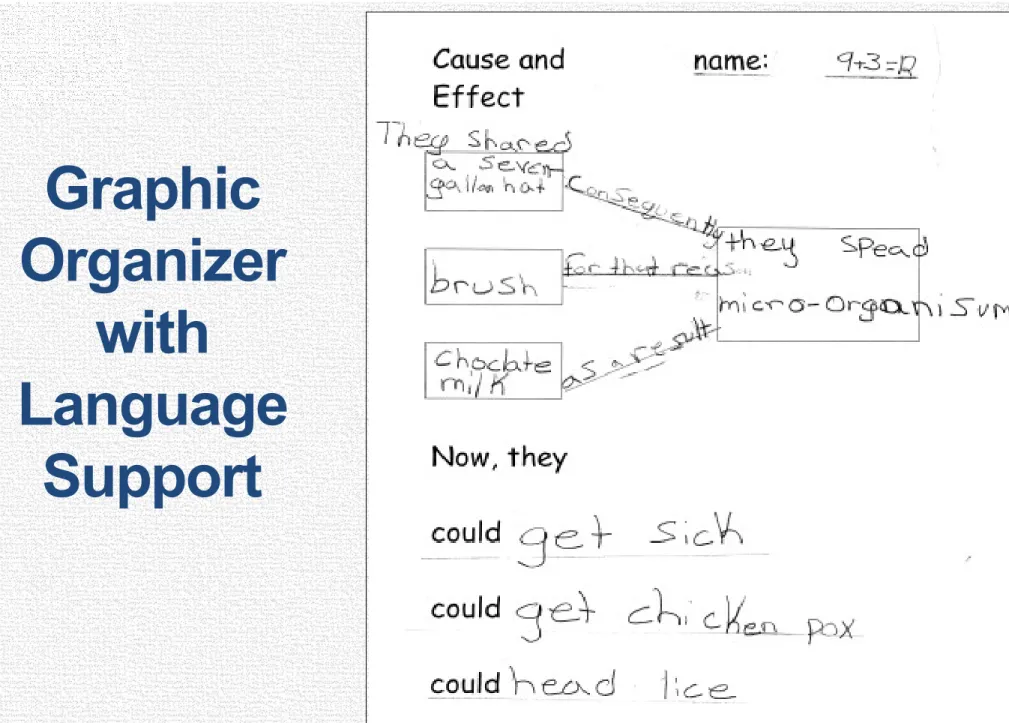
Graphic
Organizers with
Language
Support
Graphic
Organizer
with
Quick Check
In a group of 4, students
brainstorm useful verbs to use
when talking about taking risks.
The teacher lists the verbs and
uses them in his lesson. He asks
Quick Check
In pairs, on the topic of risk taking,
students count how many times
they can correctly use a gerund or
Independent Practice (You do it alone)
Purpose:
•
Independence
•
Accountability
What it is:
•
Doing the actual task
•
Active practice
What it is not:
Power Strategies!
•
Oral assessment
•
Graphic
Representation
•
Visual Representation
Now what do you think?
Which stage can be the trickiest stage?
Guided Instruction
Which is the stage in which questioning
strategies are extremely important?
Independent
A student notices
gerund vs. infinitive
differences while trash
talking a native English
speaker on a video
game.
Ss complete an
online exercise on
gerunds vs.
infinitives.
Then they participate
in a conversation via
audio chat on Live
Mocha.
Note
Independent
The 5-minute
most basic
Apply the GRR to this common teaching scenario
1. Song:
“
Put On Your Shoes
”
Story:
“
Froggy Gets Dressed
”
(by Jonathan London)
2. The teacher and students create a graphic
organizer of the story’s sequence.
3. The students fill out a worksheet
Communicative Language Teaching
Objective:
Teachers begin to
implement communicative language
teaching practices in their
classrooms.
Communicative Language Teaching
I do it
I model the lessons with teachers
and their students.
Communicative Language Teaching
We do it together
:
Communicative Language Teaching
You do it together
Participating in a
Communicative Language Teaching
You do it alone
What do you think?
3. Which is the stage that can be
skipped?
SOME REFINEMENTS
Gap between training and instruction
✔
Students are
asked to show
something that
they have not
practiced
✔
Limited feedback
or error correction
✔
Teacher lessons not
followed by practice
sessions
✔
Summative evaluations
given before formative ones
✔
Homework is given
Some refinements
✔
This is not needed in
every lesson.
✔
It’s not a linear process.
Some refinements…
✔
Often one of the middle
steps is missing.
✔
There may be no individual
accountability during the
Now what do you think?
Which is the stage that can be
skipped?
None!
What is the best sequence for effective
instruction?
The Double Blank Stare
Now you
have a tool
for reflection!
OUTCOMES
Student Outcomes
…Students receive instruction that
"results in deep learning, critical or
creative thinking or the ability to
mobilize strategies as needed.”
Teacher Outcomes: Zen-like
(www.handisports.com)
**Framework for reflection
**Formative assessment
in the truest sense
** You set the floor but not
the ceiling
**You remain a learner
**You hone your craft
**Student-centered:
Haim G. Ginott
“I’ve come to a frightening conclusion that I
am the decisive element in the classroom. It’s
my personal approach that creates the
climate. It’s my daily mood that makes the
weather. As a teacher, I possess a
tremendous power to make a child’s life
miserable or joyous. I can be a tool of torture
or an instrument of inspiration. I can humiliate
or heal. In all situations, it is my response that
decides whether a crisis will be escalated or
de-escalated and a child humanized or
Thank you!
The Gradual Release of Responsibility
Objectives:
Introduce the Gradual Release of Responsibility
Demonstrate how this simple awareness can
•
strengthen teaching abilities
Sources
• Fisher, Douglas, and Nancy Frey. Better learning through structured teaching: A framework for the
gradual release of responsibility. ASCD, 2013.
• Fisher, Douglas, and Nancy Frey. "Releasing Responsibility." Educational Leadership (2008). • Marzano, Robert J. The art and science of teaching: A comprehensive framework for effective
instruction. Ascd, 2007.
• Maynes, Nancy, Lynn Julien-Schultz, and Cilla Dunn. "Modeling and the Gradual Release of Responsibility: What Does It Look Like in the Classroom?."Brock Education Journal 19.2 (
• Pearson, P. D., and G. Gallagher. "The gradual release of responsibility model of instruction." Contemporary Educational Psychology 8.3 (1983): 112-123.
• Stewart, B.L., Luis Humberto Rodriguez Silva, and Juan Antonio Torres Gonzalez. “Integrating Language Skills through a Dictaglos Procedure” English Teaching Forum. 52 (2014): 12-19
• Webinar 15.1: Lesson Planning 101: Mapping Activities for a Clear Path to Learning January 5, 2015 Shaping the Way We Teach English Webinar http
://shapingenglish.ning.com/forum/topics/webinar-15-1-lesson-planning-101-mapping-activities-for-a
-clear