1
THE EFFECTIVENESS OF INFORMATION GAP METHOD TO TEACH SPEAKING VIEWED FROM
STUDENTS’ CREATIVITY
Deri Herdawan [email protected]
Abstract
The objective of this experimental research is to reveal the effectiveness of Information Gap Method to teach speaking to high school students in Tumijajar. This study involves three variables. Two independent variables are teaching methods (Information Gap Method and Audio Lingual Method) and students’ level of creativity. The dependent variable is speaking skill. The research examines the effect of the two independent variables on the dependent variable. The samples were two classes which consist of 30 students of class X2 as the experimental class and 30 students of class X4 as the control class. The instruments used to gather data in this research cover speaking test and creativity test. The data were analyzed using ANOVA and Tukey test. From the analysis, it reveals that: (1) Information Gap Method is more effective than Audio Lingual Method to teach speaking; (2) the students having high level of creativity have better speaking skill than those having low level of creativity; and (3) there is an interaction between teaching methods and the students’ level of creativity to teach speaking. While Information Gap Method is effective to teach speaking, to implement the methods, a teacher must consider about the students’ level of creativity.
Keywords: speaking skill, Information Gap Method, Audio Lingual method, creativity, experimental research
INTRODUCTION
Of four English language skills, speaking is often seen as the most important skill to master. Richard and Rodgers (2001:40) state that speech was regarded as the basis of a language. It is the least that we have to master in order to perform in a language. Furthermore, Genc (2007:6) says that when people learn a lang-uage, they usually start from listening, then speaking, then reading, and finally writing. This refers to the fact that speaking is naturally one of the earlier skills that are acquired.
2
Related to the aforementioned functions of speaking, mastery of speaking in English has been a priority for many second language or foreign language learners, including in Indonesia. Based on Standard Content released by Badan Standar Nasional Pendidikan (2006:125-142), speaking is one of the basic competences which should be mastered by students in English subject. In the class, the students are required to practice their speaking by doing effective speaking activities. An effective speaking in-volves students to actively participate and create a lively communication.
However, learning speaking is assured not easy. Many classroom activities have failed in creating an effective language learning due to students’ passivity. There are some causes that might lead to this condition: (1) It can be students’ lack of vocabulary, making them unable to produce appropriate words to the meaning intended; (2) Their shallow understanding of English language structure hinders them to produce grammatically correct sentences; (3) Mispronuncing words that makes his partner unable to recognize the word uttered; (4) Their halted speech due to lack of fluency that make compre-hension difficult; and (5) The lack of idea or topic understanding that make them difficult both to produce and to comprehend utterances. It is then concluded that students should master all aspects of speaking, which consist of pronunciation, grammatical acc-uracy, adequacy of vocabulary, fluency, and interactional strategy (involving comprehension) as suggested by Weir (2005:195-196). Those aspects of speaking are important to master by the students because they will help the students to participate actively in speaking.
With all those problems, it is important to conduct a research dealing with speaking because it can help the teacher to find the effective way in teaching. Krashen (1982:32) states that effective language teacher is someone who can provide input and make it comprehensible. A compre-hensible input is important because it is the source of intake which later will be processed to yield output. When the teacher uses ineffective or inappro-priate way of teaching, the students can get bored or be unmotivated to learn, let alone comprehending the material. By using the effective way in teaching, that situation can be avoided and the best result of teaching speaking can be achieved.
3
define IGM as a teaching method that aims at the creation of a communication gap where learners, usually in pairs, have to share in-formation in order to solve a problem.
In IGM, students are divided into peer group, with each student pos-seses different set of information. The objective is that the two students in each group should communicate in order to get necesary information from the pair to complete the task. Prior to the activity, the teacher pre-teach the vocabulary and language structure needed to carry out the task. An example of how the activity should be done can be demonstrated in order to make it easy for the students to understand the activity.
IGM involves the students in sharing the information that they have in order to solve a problem, gather information, or make decisions (Rees, 2005:156). IGM gives every student the opportunity to speak in the target language for an extended period of time and students naturally produce more speech than they would other-wise. In addition, speaking with friend is less intimidating than presenting in front of the entire class and being evaluated. Another advantage of IGM is that students are forced to negotiate meaning because they must make what they are saying comprehensible to others in order to accomplish the task.
Another method to teach speaking is Audio Lingual Method (ALM). It is quite the opposite of IGM in its teaching and learning process. ALM is a method which is heavily based on principles advocated by behaviorist psychologists about habit formation model of learning (Brown, 2007:111). In ALM, dialogues are the basic form of instructional materials. They are used for repetition and memorization. Correct pronunciation, stress, rhythm, and intonation are greatly emphasized. The activity in ALM is teacher-centred in which it drills students in the use of correct grammatical sentence patterns. Students memorize the dialogue through mimicry. They usually take the role of one person in the dialogue, and the other roles are played by the teacher or other students. Students are not encouraged to initiate an interact-ion because this may lead to mistakes, which are not tolerable in ALM.
4
In addition, there are also other factors that needs to take into account in teaching speaking; creativity of the students. It is stated in Law 23 of 2003 about the National System of Education, that one of the aims of the National Education implemented is to form potential learners to be creative human. In addition, there is another source that mentions creativity as one of the factor that should be taken into account. The purposes of the making of guidance of curriculum develop-ment is to give chance to the learners to learn building and finding their self-actualization through active, creative, effective, and enjoyable learning process (BSNP, 2006:3). In short, creativity is also an influential factor that will determine the course of how speaking mastery will be done.
The question that arises now is how much creativity influences speaking mastery. According to Grainger, Kathy, and Andrew (2005:13), the creative thinking process involves the decision making about the stance, content, structure and language, and creating combinations and connections bet-ween ideas and images. It means that the generation of ideas or concepts in speaking is reflected on creativity. Furthermore, the character-istics of creativity, which includes fluency, flexibility, originality, and elaboration, are closely related word or sentence production. Creative students are be able to deliver their ideas more easily since their creativity will help to think of another way of delivering their idea when they get stuck in one way. they have what it takes to generate ideas between the existing concepts and convey it in better (comprehensible) ways to their partner. Meanwhile, less creative students will find it difficult to get out of situation when they get stuck on how to deliver their ideas. Considering the explanations above, it can be assumed that creativity of the student is influential to students’ speaking skill
5 RESEARCH METHOD
The procedure of the research covers composing proposal, preparing instru-ments, conducting research in the school, collecting the data, analyzing the data, and reporting the result. The research was conducted on the tenth grade high school students in Tumijajar, taking time between December to March of 2013/2014.
This research uses experimental design where the writer examines the effect of two independent variables on a dependent variable. Independent variables are the teaching methods and students’ creativity while the de-pendent variable is speaking skill. The population in this research was the tenth grade students which are grouped into ten classes. Two sample classes were picked randomly out of the ten classes by using cluster random sampling. In determining which class acts as experimental and which one acts as control group, the researcher used lottery to draw the class. Each of the chosen classes got 12 meetings of treatment.
There were two instruments used to collect the data, namely speaking and creativity test. Speaking test was used to collect the data of students’ speaking. The speaking test was used to know the students’ speaking skill after being given treatment and the creativity test was used to know students’ level of creativity. The writer administered a readability test of the test instruction for both tests before-hand which to make sure that the tests’ instruction were understandable for the students.
The techniques for analyzing the data of this study were descriptive and inferential statistics. The descriptive statistics were used to know the mean, median, mode, standard deviation, histogram, and polygon of students’ score of speaking. Inferential statistics used was multifactor analysis of variance (ANOVA 2x2). It was used to test the hypothesis. Ho is rejected if Fo is higher than Ft. The analysis was continued to know which group is better using Tukey test.
RESEARCH FINDINGS
6
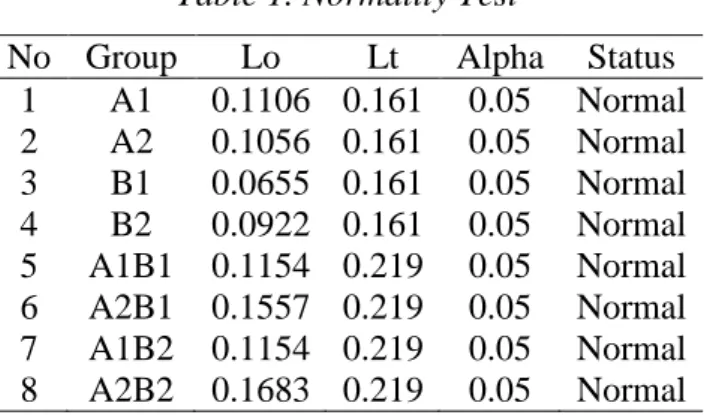
Table 1. Normality Test
No Group Lo Lt Alpha Status 1 A1 0.1106 0.161 0.05 Normal 2 A2 0.1056 0.161 0.05 Normal 3 B1 0.0655 0.161 0.05 Normal 4 B2 0.0922 0.161 0.05 Normal 5 A1B1 0.1154 0.219 0.05 Normal 6 A2B1 0.1557 0.219 0.05 Normal 7 A1B2 0.1154 0.219 0.05 Normal 8 A2B2 0.1683 0.219 0.05 Normal
The data in table 1 show that all the highest value of Lo is lower than Lt or (Lo<Lt) at the significance level α = 0.05, it can be concluded that the data are in normal distribution.
Table 2. Homogeneity test
χo2 = (ln10) {B-∑(ni-1) logsi2}
χo2 = (2.3026){91.5173-90.9255} = 1.362 χt2 (0.05) = 7.815
The calculation using the data in table 2 gives result that χo2 (1.362) is lower than χt2 (7.815). Thus, it can be concluded that the data of all four groups are homogenous.
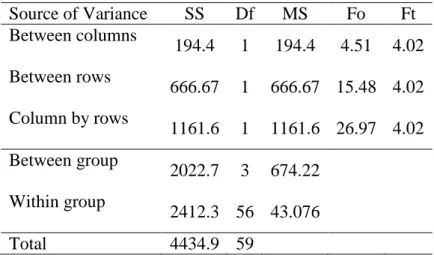
Meanwhile, the mean scores of speaking from each groups can be seen in table 3. The mean scores are used in analysis of variance for hypothesis testing by using ANOVA and interaction effect by using Tukey test, each prenesnted in table 4 and table 5, respectively.
Table 3. Mean Scores
A1 A2 Total B1 76.40 64.00 70.20 B2 60.93 66.13 63.53 Total 68.67 65.07
Sample Df 1/df si2 Log si2
(df)logsi2 1 14 0.07 29.2 1.46 20.52 2 14 0.07 45.0 1.65 23.15 3 14 0.07 43.4 1.63 22.92 4 14 0.07 54.5 1.73 24.31
7
Table 4. Analysis of Variance
Source of Variance SS Df MS Fo Ft Between columns
194.4 1 194.4 4.51 4.02 Between rows
666.67 1 666.67 15.48 4.02 Column by rows
1161.6 1 1161.6 26.97 4.02 Between group
2022.7 3 674.22 Within group
2412.3 56 43.076
Total 4434.9 59
8
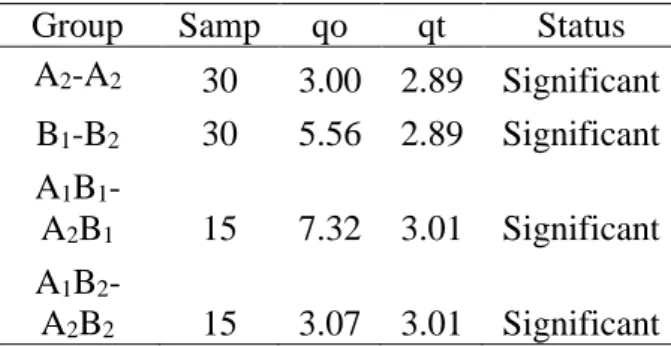
Table 5. The Summary of Tukey Test
Group Samp le
qo qt Status A2-A2 30 3.00 2.89 Significant B1-B2 30 5.56 2.89 Significant A1B1-
A2B1 15 7.32 3.01 Significant A1B2-
A2B2 15 3.07 3.01 Significant
9 DISCUSSION
A discussion related to the findings is presented as follows:
IGM is more effective than ALM to teach speaking
In a classroom, it is important for the students to work cooperatively rather than competitively to improve their skill in speaking. IGM is one of the way that can facilitate the above principle. In IGM, students are paired each other with the objective of finishing a task. Each student plays an important role because the task cannot be finished unless they complete their job. As explained by Kayi (2006:5), in Information Gap, each partner plays an important role because the task cannot be completed if the partners do not provide the information the other needs.
In IGM, students are also given more chance to talk. Since there are only two students in group, each student does not have to wait too long for them to get their turn to speak. Furthermore, working in a small group, as well as peer group, makes students become more friendly than working in large group. It is line with Hess’ explanation (2001:6) that Information Gap is a means to share a task jointly and to create a kind of atmosphere that encourages students to help one another or ask help from other. Neu and Reeser (1997:156) also mention the benefits of Information Gap are that it gives every student opportunity to speak in the target language for extended period of time. In addition, speaking with peers is less intimidating than presenting in front of the whole class and being evaluated.
On the other hand, ALM is a method which sees language learning as mechanical habit formation. It is the teacher’s job to act as the model for the students by performing dialogues that are formed to be grammatically correct. The students then practice their speaking on the dialogues by imitating the model repeatedly until they get used to it and finally master it. Errors are seen as intorrelable. Whenever students make one, it is immediately corrected in an attempt to prevent the students to pick the errors as their habit instead of the correct form. It is supported by Harmer (1991:79) who claims that by using Stimulus, Response, Reinforcement model, through continuous possitive reinforcement, ALM tries to engender good habits in learners
10
a matter effortless and continuous repetition and imitation. In short, this method makes the students depend on the teacher’s guidance almost all the time, hence making the students passive. Thus, it does not promote achievement in creativity, thinking, and problem solving. Therefore, IGM is more effective than ALM, as supported by the result of the first hypothesis.
Students having high creativity have better speaking skill than those having low creativity
The students having high creativity have better speaking skill because their creativity enable them to explore ways to take part actively in teaching learning process. They are able to adapt themselves in any situation or condition to achieve their goal. More-over, it is the nature of creative students to have great interest in problem solving and are good at ones. When they are given instruction to solve a problem, they are able to produce various ideas and deliver those ideas in respond to others. Amabile’s (1996:1) explains that creative students are good at the production of novel and useful ideas in any domain. In addition, high creative students are also able to produce many points of view in solving problems. The imaginative thinking possesed by creative students will allow them to create unusual response in solving problems. These are particularly important when they are stuck in solving their problem. Munandar (2009:71) supports those statements as she states that creative students are able to give many ideas, to solve problem from various points of view, have great curiosity towards problem solving, have imaginative thinking, ask good questions, and have unusual responses in solving pro-blems.
11
In the line with the characteristics of low creativity, Stenberg and Williams (1996:11) adds that students who are less creative tend to make mistakes when encouraging ideas or solutions. Also, in Rockler (1988:45), Guilford and Torrance explain that without creativity, people find it difficult to solve problems and have little opportunity for creative ex-pression. When students having low creativity are faced with a problem solving situation, they have hard time to present their ideas and when they are stuck in their problem, they struggle to find a way out. Those are the reasons why their speaking scores are lower than students having high creativity. Therefore, from this case, it can be said that students having high creativity have better speaking skill than those having low creativity.
There is an interaction between teaching methods and students’ creativity in teaching
speaking
Students who have high creativity are usually active, have great curiosity, and have spirit in explroing their ability for getting other and better competency and skill. Because of that, they like to have class situations in which they can express their ideas and explore their skills in challenging activities. Coulson in Rodriguez (2002:23) claims that high creativity students are those with a focus on four stages of exploring, inventing, choosing, and implementing creativity into organization.
Related to that, IGM is suitable for creative students since the procedures of this method provides what the high creativity students need. Activities in IGM require the students to share information from each other by any possible means. In doing those activities, creativity plays essential role since it will enable the students to perform well in their speaking. Their ability to express idea will help them in delivering the information they have to their partner. In addition, when they are stuck in sharing the information, they try to see it from different angle to find other alternatives to deliver the information. It is in line as Neu and Reeser’s statement (1997:156), in IGM, students are forced to negotiate meaning because they must make what they are saying comprehensible to others in order to accomplish the task. Thus, IGM is an effective way to teach speaking for students having high creativity.
12
result, low creative students struggle to achieve good speaking on their own. They need thorough and continuous guidance in order to improve their speaking skill.
A constant guidance from the teacher is what ALM has to offer to low creativity students. As this method focuses on accuracy, the activities of this method involve drills, patterns, and dialogues. As stated by Brown (2001:23), drills and patterns are typical of ALM. In this method, students do not need to produce or create something in relation to problem solving. They simply follow what the teacher says repeatedly. When errors done by students occur the teacher directly corrects it. In short, it is a method that matches perfectly with the characteristics of students having low creativity. The results of the research is in line with this that ALM is more effective to teach speaking for students having low creativity. Thus, there is an interaction between teaching methods and stu-dents creativity in teaching speaking.
CONCLUSION AND SUGGESTION
Referring to research finding, some conclusions can be stated: (1) IGM is more effective than ALM to teach speaking; (2) The students having high creativity have better speaking skill than those having low creativity; (3) There is an interaction between teaching methods and the students’ level of creativity to teach speaking
In teaching speaking, teachers need to try many methods to improve the students’ ability. One of the good methods to teach speaking is IGM. To make IGM works properly, it needs to be applied in the teaching and learning process in accordance to the steps provided. The steps of IGM which can be summarized as pre-teaching vocab-ulary, modeling the activity, organizing the students into pair group, guiding their practice, and sharing the experience serve as the medium for the students to improve their speaking skill. However, the result of the method applied is also influenced by the students’ characteristics, one of them being creativity. As proved by the research conducted by researcher, IGM is more suitable for the students with high creativity. Meanwhile, ALM is more suitable for the students with low creativity.
13
14 REFERENCES
Amabile, Teressa. 1996. Creativity and Innovation in Organization. Boston: Harvard Businnes School.
Brown, H. Douglas. 2001. Teaching by Principles: An Interactive Approach to Language Pedagogy. Sec. Edition. San Fransisco: Longman.
Brown, H. Douglas. 2007. Principles of Language Learning and Teaching. Fifth Edition. New York: Pearson Education Inc.
BSNP. 2006. Standar Isi untuk Pendidikan Dasar dan Menengah. Jakarta: Badan Standar Nasional Pendidikan.
Byram, Michael and Garcia, M. C. Mendez. 2009. Communicative Language Teaching. pp. 491-516. In Karlfried Knapp and Gerd Antos (eds), Handbook of Foreign Language Communication and Learning. Berlin: Mouton de Gruyter.
Cook, Vivian. 1996. Second Language Learning and Language Teaching. Oxford: Oxford. University Press.
Genc, B. 2007. An Analysis of Communication Strategies Employed by Turkish Speakers of English. Turkey: Cukurova University Press.
Grainger, Teresa, Kathy Goouch, and Andrew Lamberth. 2005. Creativity and Writing: Developing Voice and Verve in the Classroom. Routledge: Taylor & Francis Group.
Harmer, Jeremy. 1991. The Practice of English Language Teaching 3rd Edition.
New York: Longman inc.
Hess, N. 2001. Teaching Large Multilevel Classes. Cambridge: Cambridge University Press.
Kayi, H. 2006. Teaching Speaking: Activities to Promote Speaking in Second Language.
The Internet TESL Journal. Vol. XII. No. 11. pp. 2-7.
Krashen, S. D. 1982. Principles and Practice in Second Language Acquisition. Oxford: Pergamon.
15
Neu, H. And Reeser, T. 1997. Information Gap Activities for Beginning French Classes.
Boston: Heinle Heinle.
Pope, R. 2005. Creativity: Theory, History, and Practice. Newyork: Routledge.
Rees, G. 2005. Find the Gap–Increasing Speaking in Class. Retrieved on December 27, 2012 from http://www.teachingenglish.org.k/think/speak/find gap.shtml.
Richards, Jack C. and Rodgers, Theodore S. 2001. Approaches and Methods in Language Teaching: Second Editions. Cambridge: Cambridge University Press.
Rockler, Michael J. 1988. Innovative Teaching Strategies. Arizona: Gorsuch Scarisbrick Publisher.
Rodriguez, S. Perkins. 2002. The Impact of Enabling Creativity and Innovation within the Organization. New York: Stern School of Business.
Sternberg, R. And Williams, W. 1996. How to Develop Students Creativity. The Association for Supervision and Curriculum Development.
Utami Munandar, S.C. 2009. Pengembangan Kreatifitas Anak Berbakat. Jakarta: Rineka Cipta.