Utilising Open Source Software Development for Effective EHR Development
Mirjan Merruko
School of Information Sciences
Computer Science / Software Development M.Sc. Thesis
Supervisors: Eleni Berki, Pirkko Nykänen April 2013
University of Tampere
School of Information Sciences
Computer Science / Software Development
Mirjan Merruko : Utilising Open Source Software Development for Effective EHR Development
M.Sc. thesis, 51 pages, 8 index and appendix pages April 2013
Developing national Electronic Health Record (EHR) systems has been a challenge for many countries. The costs in various cases have considerably increased and the projects are behind schedule without matching the aims. Moreover the users have not been very satisfied with those systems because of the problems that have appeared in the current developments. These have been attributed to the lack of attention on the social aspects of developing and adopting EHR systems.
Free/Libre/Open source software development on the other hand, is a software development process which has many social elements and follows a different approach to the evolution of systems than the one found in “traditional” processes.
After presenting an overview of open source software development and issues related to EHR systems this work supports the use of an open source software development process at the heart of EHR development efforts in order to enable a radically different approach. This process places emphasis on collaboration, on the development of systems that are shared between the collaborating organisations, in encouraging the involvement of academia and volunteers to these projects, all of which could result in reduced development costs and in making the process more effective.
Key words and terms: Electronic Health Records, Open Source Software, Health Information Systems, Software Quality, Software Process Improvement
Contents
1 Introduction – The Research Problem...6
1.1 Research Questions and Motivation...6
1.2 Research Process And Methods...7
1.3 Thesis Outline, Who Can Use This Thesis And For What?...8
2 Open Source Software Development 2.1 Introduction...10
2.2 Open Source Software Quality...10
2.3 Stakeholders' Reasons For Getting Involved In Open Source...11
2.4 The Development Process Followed In Open Source Software Development. .12 2.4.1 The Cathedral Phase – Lifecycle Considerations...12
2.4.2 The Transition – Methodological Considerations...13
2.4.3 The Bazaar Phase...14
2.5 Community Structure And Evolution Of Open Source Projects...16
2.6 The Evolution Of Open Source Towards A More Business-Friendly Road. 17 2.7 Management Style – The Software Project Governance Framework...18
3 Electronic Health Record Systems 3.1 The Term EHR...22
3.2 EHR Expectations : Why Are They Used?...23
3.3 Enabling Patient Mobility And Integrated Care...24
3.3.1 National EHR In Canada...24
3.3.2 National EHR In Australia...25
3.3.3 National EHR In UK...26
3.3.4 National EHR In The Netherlands...27
3.3.5 National EHR In Denmark...28
3.3.6 A Comment On The Strategies...28
3.3.7 Strategy Related Lessons...29
3.4 Local EHR Systems...30
3.4.1 On The Application Setting Of The Local EHR Systems...30
3.4.2 Factors And Barriers Of EHR Adoption...31
3.4.3 A Systemic View Of Usability And Some Possible Implications...33
3.4.4 Standards And Interoperability...34
3.4.5 Current Local EHR Systems In Two Countries...34
3.4.6 Cost Related Studies...37
3.4.7 The Implementation Process And The Role Of User Involvement 37 3.5 Where Is The Value Of EHR?...38
3.6 Chapter Summary And Implications For A Strategic Approach...39
4 Using Open Source For An Effective EHR Development Strategy 4.1 Introduction...41
4.2 Creating A Network And Setting Up A Releasing Authority...41
4.3 Choosing A System As A Starting Point...42
4.4 How Open The Project Should Be – Issues Of Community And Management. 44 4.5 The Structure Of The Community...45
4.6 Conclusion...46 5 Limitations And Future Directions 47
References ...49 Appendices
1 Introduction – The Research Problem
Healthcare systems are facing multiple problems worldwide, such as increasing costs[Charette, 2006 ][Noteboom and Qureshi, 2011], poor quality of service and lack of patient care integration[Noteboom and Qureshi, 2011], with the industrial countries spending on average 10% of their Gross Domestic Product on healthcare [Charette, 2006]. The increased need to manage chronic illnesses, along with an ageing population, impose an even greater burden on healthcare systems [Spil et al, 2010].
Several countries have invested in Health Information Technology (HIT) initiatives, aiming at reducing medical errors, increasing quality of care and patient mobility, all of which could result in reduced healthcare costs. Some of these countries are Australia, Canada, the US and many EU countries[Charette, 2006][European Commission, 2007] [Jalal-Karim and Balachandran, 2008]. The national Infostructure project in Canada, had received a total of 1.2B Canadian dollars in 2004 to advance Electronic Health Records (EHR) and tele-health systems [Noseworthy, 2004], while the Obama administration in the US, has spent $19B in stimulus support for EHR systems with the aim of reducing the estimated, 98.000 deaths and millions of injuries of injuries due to medical errors [Shneiderman, 2011], both of which demonstrate the amount of attention given towards HIT.
At the centre of these initiatives are the EHR systems[Charette, 2006][Jalal-Karim and Balachandran, 2008][Karim et al, 2011]. Although we will look at the meaning of EHR in more detail later, it is enough to say at this point that an EHR is a repository of patient data, stored and exchanged securely in digital form, which is accessible by multiple authorized users [Häyrinen et al, 2008]. An EHR related project is present in the HIT strategic plan of most EU countries[European Commission, 2007] and national EHR implementations are internationally pursued [Cresswell et al, 2012]. The EHR systems are expected to increase efficiency of healthcare delivery, improve patient information collection, speed up administrative processes, improve working conditions and, with a high enough level of user acceptance, result in improved safety, efficiency and quality in healthcare [Carayon et al, 2009].
However, several attempts at implementing a national EHR have faced problems. The rising implementation costs are an important issue, as in Australia where they started from an estimated AU$500M in 2000 and rose to AU2$B in 2006 [Charette, 2006], in the U.K. they started from an estimated £2.6B in 2002 to at least £15B in 2006 [Charette, 2006], and in the U.S. the estimate was $100B to $150B in implementation costs and $50B per year of operation [Charette, 2006]. There is a conflicting view on EHR functionality, information profile and implementation strategy [Charette, 2006] and the failures are attributed to lack of attention at the socio-economic factors [Charette, 2006], and to approaching the issue of implementation as a technical one while neglecting the human and organisational aspects [Carayon et al, 2009].After presenting the research problems to be handled, I next formulate the research questions. 1.1 Research Questions and Motivation
The reason for starting this research exploration was a personal interest on the dynamics of open source software (OSS) development process and its quality assurance issues. There is a great variety in OSS development, and the community elements along with the interactions that take place inside the community can make OSS a very flexible tool for developing systems in an evolutionary fashion with the possibility of a substantial user input. The main aim has been to argue about the possible use of OSS beyond simply using existing free software components of OSS projects.
This particular argument can be made in the case of EHR systems if three research questions are answered. These questions were considered to be :
1. How is OSS developed and what is the form of this development process?
2. How are EHR systems developed and implemented at this point and what problems are associated with this process?
Based on the answers provided in questions one and two above, I will proceed to answer the third research question :
3. Why an OSS process could (or could not) be beneficial for the development of EHR systems.
The ambition of this work is to show how different social structures in the real-world can be fostered through the use of an OSS development community resulting in better systems and allowing the evolution of both the community of the users and the systems themselves. The perceived success, from my point of view, would be to stimulate some discussion on the possibility to use OSS in a way like this in large scale projects with an evolutionary nature, where the community of users has to mature along with the systems.
1.2 Research Process And Methods
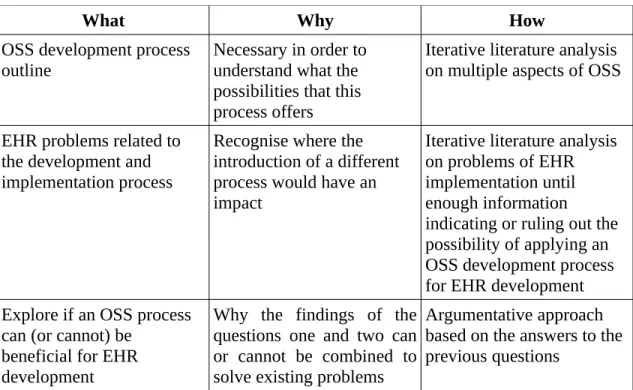
The research process that was followed for this work was an incremental process of literature analysis. In each iteration a literature analysis took place which was aimed at enriching previous knowledge according to research questions one and two. During every iteration the basic criteria to answering the questions one and two were :
• Does this give enough information on the implementation aspects of EHR systems, so that an OSS process can be seen as an alternative?
• Or, does this rule out the possibility of using an OSS process to improve the current approach?
The first iteration dealt with a simple question. It was necessary find out first and answer if the software qualities that are necessary for EHR systems can be satisfied from an OSS process. The next iterations aimed at attaining a more holistic view of EHR implementation and adoption, focusing more on social aspects. During the third iteration the use of OSS in this problem was considered and in the fourth iteration the possibilities that were seen based on the information gathered from the literature analysis were outlined. The literature analysis was considered adequate for answering these two questions.
What Why How OSS development process
outline
Necessary in order to understand what the possibilities that this process offers
Iterative literature analysis on multiple aspects of OSS
EHR problems related to the development and implementation process
Recognise where the introduction of a different process would have an impact
Iterative literature analysis on problems of EHR implementation until enough information indicating or ruling out the possibility of applying an OSS development process for EHR development Explore if an OSS process
can (or cannot) be beneficial for EHR development
Why the findings of the questions one and two can or cannot be combined to solve existing problems
Argumentative approach based on the answers to the previous questions
Table 1: Research Questions - Reasons for their choice and the method they were approached
1.3 Thesis Outline, Who Can Use This Thesis And For What?
The thesis starts by presenting an overview of OSS development. This chapter is considered as an answer for research question one. It presents issues such as :
• Software quality in OSS
• Reasons stakeholders get involved in OSS
• How the process unfolds
• The structure of the communities in OSS
• How OSS has evolved over time
• A framework for rating how “open” is a project based on four dimensions.
An overview of EHR systems follows. This chapter is considered the answer to research question two. The overview includes information :
• On the term EHR
• Reasons for using EHR systems
• Practices in different countries regarding national EHR systems and their strategies
• Information on the systems currently used in healthcare organisations
• Issues regarding the value of EHR systems
• Implications for a strategic approach.
The outcome of the analysis is presented afterwards. This has the form of an argument regarding the positive dynamics and the challenges that a different approach having at its core the use of OSS might have. This part contains thoughts on the form this process might take, focusing on both external and internal aspects to the development process. This chapter tries to provide an adequate answer to research question number three.
The suggested approach could benefit most stakeholders of the EHR systems, and companies developing systems that operate on top of EHR systems or EHR modules. However, it would possibly be detrimental for the existing developers of EHR systems
who would have to adapt to a new landscape while seeing their systems getting devalued. The conclusion comments on the limitations of this work and possible future directions.
This work could be of value to policy makers who can consider this approach and the possible value such a policy can have for :
• local research
• lowered costs through the larger scale of implementation for many healthcare organisations by using a single core team and the contributions of volunteers
2 Open Source Software Development
2.1 IntroductionThis chapter is an overview of OSS development. OSS is technically, a software licensing model. However the impact it has had on software development practices has been significant [Capra and Wasserman, 2008].
A software product can be considered free and open source (FOSS) if its license grants the right to use the software, copy and redistribute it, modify it and distribute the modified version [Samoladas and Stamelos, 2003].
Those four characteristics cannot give a complete picture on OSS. OSS is not homogeneous, and despite many types of software sharing this label there are differences in practices, culture and licenses [Kilamo et al, 2011]. In the case of licenses for example, some are permissive, some impose restrictions on redistribution and others impose the use of the same license on any derivative work [Kilamo et al, 2011]. What all OSS projects have in common are transparency of development and the ability to construct complex systems out of readily available software parts [Kilamo et al, 2011].
A description that is used quite often in literature to describe the life-cycle of an OSS project supports that a person or a group have an idea of how to write a software to satisfy some personal need, they develop some software to satisfy it and make it available online with its source code. Since the software and the source code are available, people make contributions in the form of bug fixing or added functionality. The contributions form the new test version of the software which after adequate testing and corrections becomes the next stable version of the software, and the development cycle starts again with new contributions. [Samoladas and Stamelos, 2003]
These interactions take place in the context of a community of users and developers and the systems evolve according to the needs of the community. The software system is not necessarily carefully designed in advance. The access to the source code and the right to create derivative works allows the system to evolve, not only according to initial plans but “naturally” as well [Nakakoji et al, 2002].
This chapter contains :
• The presentation of a study on (Free and OSS) F/OSS quality
• An overview on the reasons for different stakeholders to use OSS or participate in the development process
• A structured description of the OSS development process
• A framework for assessing how “open” is the management of the project
• How communities evolve and finally how OSS development has taken a more business-friendly turn.
2.2 Open Source Software Quality
A study by Samoladas and Stamelos [Samoladas and Stamelos, 2003] gives us some information regarding software quality in OSS. The ISO 9126 quality model was used to assess the quality of FOSS according to information found in literature. The major properties of the ISO quality model are functionality, reliability, usability, maintainability, portability and efficiency [Samoladas and Stamelos, 2003] and information on the performance of OSS according to those properties is given.
Functionality refers to the existence of functions required to fulfil the users needs. Some OSS projects have eliminated all the competition in their application area, with BIND (Berkeley Internet Name Domain) being given as an example in the paper.
Moreover, There is a number applications that are very popular such as programming tools, relational databases and one very noteworthy example is the Apache web server which was used by 62.7% of the web servers at the time of the study. It is also suggested that since the OSS movement has shown a commitment to following implementation standards, access to those standards without royalty fees can produce feedback from users of those implementations which would lead to improvement and optimisation of the standards. On the negative side here is the lack of popular desktop applications or applications to address specific needs, putting into question the strength of OSS as an approach in developing applications for a specific group of users. [Samoladas and Stamelos, 2003]
Reliability refers to the ability of the system to maintain its performance for a period of time under specific conditions. An important aspect to reliability is finding and fixing bugs present in the software. One of the strengths of OSS is the very quick rate of bug fixing which in some cases has been quite rapid. In the case of Apache project for example, a cumulative 50% of the problems were fixed within one day, 75% with 42 days and 90% within 140 days. Moreover in two very mature projects, Mozilla and Apache, the process they use for their development leads to fewer bugs making it into the source code. Furthermore, the availability of the code is considered a positive aspect in the long term for improved software security. [Samoladas and Stamelos, 2003]
Usability refers to how much effort from the side of the user is necessary to use the system. Regarding this property OSS has not demonstrated anything better than what is found in proprietary software. This is attributed to the lack of designer skills among the developers, and the inherent differences between the role of the developer and the role of the user, as well as the lack of usability experts in the community. Moreover Samoladas and Stamelos note that usability is something that has to be planned in advance, something that in not always the case of OSS development. [Samoladas and Stamelos, 2003]
Regarding the rest of the attributes, namely maintainability, portability and efficiency, Samoladas and Stamelos mention the importance of maintainability for OSS development, which can be seen as an open maintenance process, how it is possible to port some software application when the source code is available and that no studies have been done on efficiency. [Samoladas and Stamelos, 2003]
In general OSS quality seems to be high, comparable to proprietary closed-source applications and in some cases it is higher than closed source software. This is a very good reason to consider OSS alternatives to closed source applications since OSS is free of charge. This also shows that the process itself seems to have some strengths attributed to the availability of the source code.
2.3 Stakeholders' Reasons For Getting Involved In Open Source
OSS might be used by simple users, companies, public organizations and developers as well.
Reasons such as cost and software quality should be obvious based on what was presented. It is important though, to have a look at some reasons why businesses would want to release their software as OSS, why developers would want to participate in OSS development and why public institutions might be interested in using OSS.
Regarding the involvement of companies in OSS development, Sirkkala et al. have grouped the objectives that a company can achieve through OSS into the categories of marketing, business models, and shared costs [Sirkkala et al, 2009].
A company can satisfy a number of goals relevant to marketing such as the promotion of growth in the field, advertising itself and its products through participation in OSS communities and recruiting skilled members from the community
who have become familiar with the company and its product through their participation in the community. [Sirkkala et al, 2009]
The company can achieve a set of business goals by providing services based on the product for a fee, or offer consulting. In the case that the company uses the software for its internal processes the community can extend the software while lowering the costs for the company and possibly allowing them to be shared among the company and other users. Other benefits in this category are gaining knowledge about and networking with other companies and communities. The aspect of shared costs seems to be closely related to the business models. Software related issues here are adding functionality through the community and/or improving overall quality of the product. [Sirkkala et al, 2009]
Moving on to the developers, reasons to participate in this sort of development are learning by expert developers through contributions and interactions within the community [Nakakoji et al, 2002], possibly being recruited by companies which might make use of the community for recruiting, the feeling of creativity felt during development and peer recognition through the software development [Camara and Fonseca, 2007]. An increasing number of developers though, take part in OSS development as part of their job. In Europe the majority of OSS developers receives some reward for their work in OSS [Camara and Fonseca, 2007].
Finally, public institutions might benefit from lower cost and independence from proprietary software which would help avoid vendor lock-in [Camara and Fonseca, 2007]. Other potential benefits are availability of low-cost software and the ability to adapt the products to fit local needs [Camara and Fonseca, 2007]. One of the problems is that there are not many successful desktop applications available with most of the successful systems being infrastructural products and adapting the software is not always an easy task [Camara and Fonseca, 2007].
2.4 The Development Process Followed In Open Source Software Development As we have seen a number of different stakeholders can benefit by participating in OSS development, and that the OSS development communities have produced some products of a very high quality. What is important now is to have a structured picture of the general form of this development process. A structured approach of a general OSS development process is provided by Anthony Senyard and Martin Michlmayr in [Senyard and Michlmayr, 2004].
Senyard and Michlmayr follow the terminology of the metaphor of the cathedral and the bazaar which is found in OSS literature and was given by Eric Raymond, who compared traditional proprietary software development to building a cathedral and then the diametrically opposite of a market bazaar is compared to OSS development where software is built through the interactions of the community. Senyard and Michlmayr argue that these are phases that a software passes, within the same life-cycle and are not mutually exclusive states found in one or the other development process. [Senyard and Michlmayr, 2004]
2.4.1 The Cathedral Phase – Lifecycle Considerations
The development of an OSS project starts by an individual or a small group, called the core group, which has not made any contact with a community. The development process at this phase is similar to the processes followed in proprietary software and contains the activities of requirements, design, implementation and testing which are not necessarily done in a well defined manner. The role of design should be emphasised here, as a modular design is necessary and can have a profound effect on the evolution of the community. [Senyard and Michlmayr, 2004]
When starting an OSS project it is first suggested to search for an existing project which aims to satisfy the same need as the project in mind or aiming at doing so according to its scope and vision. If a project of this sort is found, then the potential project initiator can participate in it. In case of disagreement with the design decisions, dislike towards the individuals developing it or the programming language used the potential initiator might decide as well not participate. Senyard and Michlmayr note that these reasons sometimes can be legitimate because of fundamental flaws in existing projects but they can lead to “two mediocre software projects while one superior software project would have been possible had the two efforts joined forces”. [Senyard and Michlmayr, 2004]
2.4.2 The Transition – Methodological Considerations
The transition of the process from cathedral to the bazaar can start once a working prototype has been developed [Senyard and Michlmayr, 2004]. The transition has to begin at the right moment, when the prototype is stable, with a sufficient amount of functionality but at the same time in need of improvement [Capiluppi and Michlmayr, 2007]. Another point found from empirical research in two projects is the tendency of new developers to work on newly added modules, indicating that the transition has to be actively sought by the core members who should try to attract new contributors by adding new ideas to the project and expanding it in new directions [Capiluppi and Michlmayr, 2007].
Some other elements important during the transition are mentioned in the work of Kilamo et al [Kilamo et al, 2010] and while they deal more specifically with proprietary software released as OSS, some of those aspects seem interesting for all the cases of transition. Those elements are related to the software, the community, the legalities, and the releasing authority [Kilamo et al, 2010].
Software related issues revolve around the architecture which has to be extensible, the source code which must follow conventions, be approachable to others and documented. Software quality is tied to the architecture to some extent and also the perceived quality must be high to attract users. [Kilamo et al, 2010]
The type of the desired community and the role of participants dictates to a degree what will be released, this is relevant in the cases of releasing parts of a proprietary software as . The purpose of the software should be something that attracts users, fulfils their needs and sparks the interest of developers so that it can attract contributions. There has to be a potential for an active community to reap the benefits, as 100 users can support one full time developer, and the active community can take over activities such as guiding new users, creating documentation, and testing in order to allow
developers to fully focus on implementation. The last element in community issues is concerned with the partners of the developer entity. Either that is a company or a different type of group, the decision will directly affect them. [Kilamo et al, 2010]
Legalities include licensing and branding, which are things that all projects must deal with, and copyright and intellectual property rights which seem to be more specific to companies. The choice of the license will have an effect on the type of users the project will attract. Some licenses restrict commercial use of the software while others can be considered business-friendly and choosing the second for example has more chances of attracting businesses. Branding refers mostly to finding a good name available for the project. Finally, copyright and intellectual property rights are not an issue when the code is owned by the releasing authority but if the components are owned by other organisations or individuals they have to be clear before being released as OSS. [Kilamo et al, 2010]
The releasing authority is the last element that Kilamo et al address in their framework. It can be a company or another entity such as a university, a non-profit organisation or an individual. The transition requires a change of culture and mindset towards outside developers from the releasing authority by providing them with similar guidelines and conventions as the internal developers, providing equal access to the source code and showing mutual respect. Laying down a process for participants to follow, providing support and infrastructure for distributing the code, and enabling participation and communication within the project, are the responsibility of the releasing authority.[Kilamo et al, 2010]
2.4.3 The Bazaar Phase
A successful transition and the growth of a community will put the project in its bazaar phase. The aim of OSS projects is to reach this phase and gain access to a community of contributors [Senyard and Michlmayr, 2004]. Key characteristics of this phase are the cooperation within the community in order to review and modify the code and volunteers working on the project at the same time [Senyard and Michlmayr, 2004].
The code is publicly available and contributions are encouraged during this phase. Contributions come in the form of feature request, feature implementation, bug report and bug fixing, writing tutorials and user documentation and reporting usability problems. [Senyard and Michlmayr, 2004]
The advantages of the bazaar phase are peer review, concurrent development, and
opening the requirements to the users [Senyard and Michlmayr, 2004]. The availability of the code enables the participation of a wide base of participants at different levels
and this creates the conditions for a better bug fixing environment, the concurrent development can allow activities like adding features and fixing bugs to happen at the same time [Senyard and Michlmayr, 2004]. In order for concurrent development to take place a high degree of modularity in the design of the software is required[Senyard and Michlmayr, 2004].
This process can sometimes lead to a complete redesign of the system [Senyard and Michlmayr, 2004]. The expanding requirements and the parallel development can make the initial design inadequate [Senyard and Michlmayr, 2004]. The bazaar phase generates insights into the design showing limitations, the design might not be flexible enough to incorporate the new features and the drive for technical excellence present in the community can be reasons that lead to this redesign [Senyard and Michlmayr, 2004]. This process is once again done following a cathedral style with a core team carrying it out[Senyard and Michlmayr, 2004]. Senyard and Michlmayr also support that since there are no constraining economic requirements this drive for excellence can be pursued [Senyard and Michlmayr, 2004], but if a company is the driving force of the project the economic requirements would definitely restrict this this decision.
The bazaar phase is not reached by all the projects and not all of them have to reach it. Projects with a small scope can be written by only one person and still have a high quality, but projects with a larger scope can only be completed by a community [Capiluppi and Michlmayr, 2007]. Examples of this can be system utilities that implement a single simple function as opposed to the various distributions of Linux operating systems which are a collection of multiple utilities and other complex applications.
In the case of companies releasing their software as OSS, there has to be some effort in order to facilitate the growth of a community. A set of data can be used in order to be able to make decisions that support this goal [Kilamo et al, 2011]. The period when the community is fostered should be placed in the beginning of the bazaar phase.
This period has been called the community watchdog phase and focuses on the concentration and analysis of data [Kilamo et al, 2011]. Some of the important information that can be utilised are the number of contributors, the number of mailing list subscribers, the amount of requests, feedback, inquiries, the visibility of the project in social media, the number of participants in project events and meetings, the number of scientific publications mentioning the community, the number of downloads, and the number of reported bugs [Kilamo et al, 2011].
For the development activity of the project, the type and impact of contributions and the number of projects built on top of the product are interesting measures [Kilamo
et al, 2011]. These measures could be utilised by other organisations aiming at building a community around them and release software as OSS.
2.5 Community Structure And Evolution Of Open Source Projects
Nakakoji et al describe the structure of an OSS community through an onion layer model, with the most influential actors of the project being positioned to the inner layers being and the less influential to the outer ones. The most influential one is the project leader who has more influence than core members, who in turn have more influence than active members and so on [Nakakoji et al, 2002].
The participants in OSS projects can be :
1. Passive users : They simply use the product. [Nakakoji et al, 2002]
2. Reader : The active users of the system who try to understand how it works by reading the code. [Nakakoji et al, 2002]
3. Bug Reporter : The people who report bugs. They do not fix the bugs, neither it is necessary for them to read the code. [Nakakoji et al, 2002] 4. Bug Fixer : They fix bugs found by them or reported by bug reporters. They
should understand the parts of the code where the bug is found. [Nakakoji et al, 2002]
5. Peripheral Developer : They contribute through adding new functionality to the project. Their involvement is short and sporadic. [Nakakoji et al, 2002] 6. Active Developers : Regular contributors of features and bug fixes. They
are highly influential to the development of OSS. [Nakakoji et al, 2002] 7. Core Members : They guide and coordinate the project. The members have
been involved in the project for a long period of time and have made significant contribution to the project. [Nakakoji et al, 2002]
8. Project Leader : This is usually the person who initiated the project. Is responsible for the vision and the overall direction of the project. [Nakakoji et al, 2002]
These roles do not exist in all the projects and the percentage of each varies from project to project. What is common though is that most of the members are passive users and most of the code is contributed by a small number of developers [Nakakoji et al, 2002]. Moreover, a user can assume different roles and may start as a passive user and through contributions can move to the inner layers of the model [Nakakoji et al, 2002]. In the community it is important to enable mobility and have members aspiring to be promoted into the inner layers, as this increases the sustainability of the system, because a replacement can be found if a core member decides to leave the project [Nakakoji et al, 2002]. However there has to be some caution in how open the project is or how much promotion is possible as “too much openness can be harmful when it leads to incompetent developers or people who demotivate important contributors getting involved”[Capiluppi and Michlmayr, 2007].
The evolution of the community is important for the evolution of the system itself, and each contribution affects the system and at the same time has an impact on the profile of the community member who made the contribution [Nakakoji et al, 2002]. Nakakoji et al propose three different classifications for the projects and the community dynamics they involve. They name these categories exploration oriented, utility oriented, and service oriented [Nakakoji et al, 2002]. These categories are not the only types of projects that can be found in OSS, as the authors admit but they do provide some information on the dynamics of communities built around software systems with some specific characteristics.
Exploration oriented projects are innovative projects. They are distributed through OSS to stimulate interaction and share ideas through the code in the same manner that scientific research is shared through publications. The quality requirements for these projects are usually very high. These projects are controlled by a leader and there is the risk of splitting in the case of a disagreement between the leader and the majority of the community. [Nakakoji et al, 2002]
Utility oriented projects cover some needs for functionality and are built through a combination of existing software. Their goal is to provide adequate functionality, unlike exploration oriented projects who aim to provide solutions of the highest quality. In functionality oriented projects the case of a split is something common and there might be quite a few projects offering the same functionality. These projects compete for community members and the one who gets most of the support eliminates the competitor. [Nakakoji et al, 2002]
Service oriented projects aim to offer a stable and robust service to direct and indirect users of the systems. The changes in these systems have to be conservative and carefully planned. The leadership in this project belongs to a core team and the decisions are made collectively. It can be seen as centralised but not revolving around an individual. Most of the community members are passive users is these projects and on occasion active and peripheral developers appear during periods when new functionality is being added. [Nakakoji et al, 2002]
In cases of businesses working as a unit on top of a shared platform by offering their services and products, like the case of growing an ecosystem, the onion model does not provide the whole picture of business partners and their connections [Kilamo et al, 2011].
2.6 The Evolution Of Open Source Towards A More Business-Friendly Road Up to this point, the term FOSS has been used once and the term OSS has been used to refer to this development process. There is however a difference between those two terms. Fitzgerald [Fitzgerald, 2006] argues that OSS has gone through a transformation from its first form where individuals and groups developed a system to
cover their personal needs, to a more business friendly form. This transformation is explained through a comparison of FOSS and what Fitzgerald calls OSS 2.0. The argument here is that OSS has undergone a “deep transformation” but besides describing a growing tendency for taking a business interest in OSS as a new trend, the argument does not seem strong enough to convince that the former drive in FOSS has disappeared as the word “deep transformation” would imply. It can be seen though that a qualitative change has taken place in the wider OSS development community.
The first difference can be found behind the reasons for starting an OSS project. In FOSS projects are based on satisfying some need through the use of the software. The group doing the planning and the analysis is interested in covering its own needs in the first place, and for this reason the most successful FOSS projects have been infrastructural projects covering the needs of a wide group of users [Fitzgerald, 2006]. In the case of OSS 2.0 design and analysis are carefully done, the development is more formal and involves paid developers unlike the bazaar nature of FOSS [Fitzgerald, 2006]. The opening of closed-source proprietary software has created the possibility of success in projects that are aiming to satisfy the needs of a particular group of users [Fitzgerald, 2006].
The second difference is between the business use possible in the two types of projects. In FOSS the business strategies included support services on the projects or using a free and version of a software to increase the market for an alternative proprietary version. In OSS 2.0 a product might be released to reduce the market share of a competitor by offering alternatives to their products. Other business uses are using an OSS product as a platform for adding extensions on top of it, offering services and support, offering a commercial versions through the use of dual-licenses, using the community to extend the software for free, offering training and certification. [Fitzgerald, 2006]
These trends pose challenges for research and practice. The one that is particularly relevant in the context of this work is stimulating OSS development in domains which require specialised domain knowledge for developing a product [Fitzgerald, 2006] such as the healthcare IT domain.
2.7 Management Style – The Software Project Governance Framework
The aspects of OSS that were presented show that there is a variety of participants, of their roles and motivations. Eugenio Capra and Anthony Wasserman [Capra and Wasserman, 2008] provide a framework for evaluating the style of management of an OSS project through the use of four dimensions. These dimensions are contributions, project leadership, working practices and testing [Capra and Wasserman, 2008]. Two types of projects are defined as opposite on all of these dimensions and they are the “traditional closed source projects” and the “completely open”. The framework rating can put a project anywhere between the two of them.
The “traditional closed source project” is led by a company which has complete control over the decisions, and has a defined structure and process which aims to produce a product of high quality on a predictable schedule. The developers are paid by the company and report their progress to the management. Their communication is not open to people outside the company, and most of the testing is done before the product is released. While there might be interactions with the users, all the decisions are up to the company. The users might have a beta version available before the final release of the product and mechanisms to report software issues. [Capra and Wasserman, 2008]
On the other hand, a “completely open” project has its own community which is open to anyone who is interested in participating. The code is available online and can be acquired and used according to the project's license. The group or individual leading
the project decides on the license to be used, on who can make code changes to the project's repository, and when the version of the software should be considered as a stable release. In some projects decisions are made through informal discussions and in others there might be a voting procedure. The participants rarely meet in person and do most of the work through online means of communication. Both volunteers and paid developers are participating but most of the code is developed by volunteers. Imposing deadlines on the developers under these conditions is difficult or even impossible, as opposed to what can be done in commercial organisations. The testing process is done by the community of users who are expected to provide bug reports through the use of online bug tracking systems and provide a solution to the bug whenever that is possible, or this is left up to the contributors. User support is provided informally by other users of the community. [Capra and Wasserman, 2008]
Each of these dimensions has a value from 1 to 4 and the descriptions to these values are mostly qualitative with some involving quantitative measures as well.
The dimension of contributions measures the reliance of the project on hired developers. [Capra and Wasserman, 2008]
Value Description
1 100% of the code is developed by hired
developers
2 >80% of the code is developed by hired
developers
3 >50% of the code is developed by hired
developers
4 Most of the code is developed by
volunteers
Table 2: Contribution Dimension [Capra and Wasserman, 2008]
The dimension of leadership measures how formally organised is the project and how open the decision-making process is. [Capra and Wasserman, 2008]
Value Description
1 Roadmap and development process are led by one company or organization which has a predominant leadership role, makes decisions and sets schedules.
2 Roadmap and development process are led by one company or organization. However, free discussion and participation to the governance of the project is fostered.
3 The community is ruled by some formal rules and principles. Decisions are made mainly by voting or by governance bodies directly elected by contributors.
4 The community completely lacks a formal organization and governance bodies.
Decisions are made by informally discussing issues.
Table 3: Leadership Dimension [Capra and Wasserman, 2008]
The dimension of working practices measures the extent to which the developers are distributed geographically.
Value Description
1 Developers work on the same site,
communicate in traditional ways and have regular physical meetings.
2 Most developers work on the same site
and have regular physical meetings, with some remote participants
3 The community is dispersed and most
developers are remote. Some subsets of developers, however, work at the same location and meet regularly.
4 The community is widely dispersed and all
the developers communicate through virtual tools. Physical meetings are totally absent or very rare (1-2 per year).
Table 4: Working Practices Dimension [Capra and Wasserman, 2008]
The dimension of testing measures to what extent the testing is done through a well-defined internal process or by the community after the release of the software.
Value Description
1 All the testing is controlled internally by
specific QA roles. New versions of the application are released only after being thoroughly tested.
2 Most testing (>50%) is performed
internally before new versions of the application are released. The user community is leveraged as a broader testing platform, for example by releasing beta versions and then collecting feedback and bug notifications.
3 Some testing (<=50%) is performed
internally, but most of it is left to the community of users.
4 Testing is completely left to the
community of users.
The graphical representation of the framework's application can be seen seen in figure 5.
The framework can give a good picture of the nature and management style of a project. All the types of projects despite their differences in management style are encouraging and appreciating contributions in any form, even simple bug reports, and they give the complete ownership of the project to the community [Capra and Wasserman, 2008], although the extent that this can happen could depend on the driving force behind the project. It is hard to think that a company with an agenda and goals to fulfil, would be unlikely to not pursue some of its strategic goals from the release and give the complete ownership to the community.
Regarding the type of the software, a strict control is important in cases where there is a technical risk associated with the project and is necessary need to separate the core of the software from the user space. On the other hand, a loose control might be more suitable in cases that adding more features would add to the value of the software without imposing risks [Senyard and Michlmayr, 2004].
Figure 5: Graphical Representation of Project Classification [Capra and Wasserman, 2008]
3 Electronic Health Record Systems
During the introduction, the term EHR was used without providing much information about the meaning of the term or the type of system it refers to. In this chapter the ambiguity surrounding the term is presented and a classification that satisfies the needs of this work is adopted, some expectations for the development of EHR systems are suggested and then documented in more detail. The expectations from EHR systems which will receive most attention are those related to strategic approaches for large scale EHR development and the impact of an EHR in the healthcare delivery process itself.
Before moving, information will be presented on the strategies employed so far in different countries and their architectures, we move to a study of some aspects of the EHR systems used in a local setting, dealing with who the users of the system are, what some of their expectations are, what the work environment in which the EHR is applied look like and some related adoption barriers.
Next we will deal with issues related to where the value of EHR is expected to come from, few criticisms of EHR systems, a small overview of the standards used so far, and a summary of the important aspects which have to be considered in the implementation approach and the possible need to reconsider a key element in the strategies employed so far.
3.1 The Term EHR
According to the International Organization for Standardization (ISO) an EHR is a repository of patient data, stored and exchanged securely in digital form, which is accessible by multiple authorized users [Häyrinen et al, 2008]. The information contained in the EHR might refer to the past, the present or the future, and their purpose is to support efficiency, continuity and improved quality of integrated healthcare delivery [Häyrinen et al, 2008].
Moreover, according to the Institute of Medicine (IOM), “An Electronic Health Record (EHR) is a patient record that resides in a computer system specifically designed to support care providers by providing accessibility to complete and accurate patient data, medical alerts, reminders, clinical decision support systems, links to medical knowledge and other aids” [Spil and Katsma, 2007].
We could say that the ISO definition offers a somewhat static picture more focused on the records, while the IOM definition refers to a system which plays an active role in supporting the healthcare delivery process, through the use of features such as alerts, reminders and decision support.
There is a number of terms referring to healthcare information systems, some of which are Electronic Medical Record (EMR), Patient Care Information Systems, Electronic Care Record, Electronic Health Record, Computer-based Patient Record and Electronic Patient Record. The different terms might show different views on the systems or different functionality levels [Spil and Katsma, 2007].
Häyrinen et al's statement that “the meaning of EHR is unstable”[Häyrinen et al, 2008] seems to be supported by the different terms used to refer to similar systems, and the subtle differences between the IOM and ISO definitions. For instance, EMR and EHR have been used in research and practice to refer to the same concept [Sherer, 2011]. It is for this reason probably, that in 2008 it was proposed to use the term EMR to refer to systems used in a local setting, and the term EHR for interoperable systems that are used in more than one organisation [Sherer, 2011]. This was proposed by the National Alliance for Health Information Technology, a USA-based not-for-profit
association of health care providers, information technology vendors, and health and technology associations which ceased its operations in 2009 [Medical News Today, 2009]. In the context of their article, Møller and Vosegaard [Moller and Vosegaard, 2008] use the term 'EHR' to refer to “the patient-centric view of data collected from several source systems”.
The categorization by Kwak [Kwak, 2005] was found to be very helpful in the context of this work. In this categorization the systems are grouped into Local EHR, Shared EHR, Personal Health Records, and Public Health EHR [Kwak, 2005]. Local EHR systems refer to systems which are used in individual healthcare facilities. The shared EHR systems refer to systems covering a number of organizations, facilitating the use of shared and integrated records in different settings. PHR refers to records maintained and controlled partially or completely by the patient. Finally, Public Health EHR refers to aggregated and anonymous patient data, usually used for public health and epidemiological purposes, research, health statistics, policy development and health service management [Kwak, 2005].
The conflicting terms and views regarding EHR systems make it necessary to understand why EHR systems are developed in the first place and what their use is. 3.2 EHR Expectations : Why Are They Used?
Regarding the goals of an EHR project, it can be argued that they are to improve the healthcare delivery process, to speed up administrative processes, to enable and to encourage patient involvement [Häyrinen et al, 2008] with their health and wellness, and providing integrated healthcare services in large geographic areas. All these should lead to improved patient safety, efficiency and quality of healthcare. Secondary uses include evaluation, quality improvement and original research [Noseworthy, 2004].
Administrative processes are facilitated through the support of features such as billing and scheduling [Carayon et al, 2009], and by avoiding errors, duplication and saving time through the use of electronic means instead of paper [Edwards, 2006]. In Denmark for example in 1994 an estimated 20-30% of administrative spendings was used for handling paper [Edwards, 2006].
Patient involvement is enabled by providing access to health information and providing support through applications, possibly for involving the user in chronic disease management which is imposing a burden on healthcare systems [Sherer, 2011] .
Providing integrated healthcare services in large geographic areas refers to the support of continuity and integration of patient care. Lack of patient care integration was mentioned in the introduction as one of the issues the healthcare systems are facing. Allowing unified access to patient information and collaboration between healthcare personnel in large regions is the key in achieving this. This requires a shared EHR system of some sort and shared models of care [Noseworthy, 2004].
The impact on the healthcare delivery process is related to aiding the work process of the healthcare personnel by :
• Enabling evidence based decision making
• Reducing duplication in tests, pharmaceutical management [Noseworthy, 2004]
• Avoiding the inaccuracy and incompleteness of paper records [Carayon et al, 2009].
Next, the aspects of providing integrated healthcare services in larger areas and the impact on the healthcare delivery process will be further analysed.
3.3 Enabling Patient Mobility And Integrated Care
Access to electronic records in large geographic areas is the key to enabling patient mobility and continuity of care. It is a very complex matter and different strategic approaches are taken to achieve it. In order to start understanding this, we have to take a look at the strategic approaches and the architectures employed so far, then deal with the issues arising from them.
This section will provide a few information on the strategic and architectural approaches taken by Canada, Australia, UK, Denmark and the Netherlands. The information is not very detailed, but provides a good ground for further reasoning. All the information presented here for Canada, Australia and UK is taken from [Jalal-Karim and Balachandran, 2008] and therefore no citation will be provided below and it should be taken for granted that everything is found there, while the information for Denmark is taken from [Moller and Vosegaard, 2008], and the information on Netherlands is taken from [Spil et al, 2010] and [de Smet, 2011] and will be cited accordingly.
3.3.1 National EHR In Canada
The main characteristics of the Canadian approach is the mainly publicly funded healthcare system since 1968 and the key role of a not-for-profit organisation called Infoway in promoting and speeding up the development and adoption of EHR systems. The goal of Canada is to achieve complete national coverage by 2020.
The funding program for Infoway started in 2002 in order to develop the national EHR strategy, in 2003 it was expanded to include telehealth and it had received a total of $1.2B Canadian dollars up to that time.
The architectural approach can be seen in Figure 6 where two systems are connected through services provided by the Health Information Access Layer (HIAL). The HIAL contains common services, and services for standards and communication, which serve the purpose of integrating the various applications. The next abstraction layer used in this architecture is the EHRi. The EHRi is used for creating or using EHR
F igure 6 - Canada EHR Solution: Distributed, Message-based, Peer-to-Peer Network of EHRS Systems. [Jalal-Karim and Balachandran, 2008]
content compatible with the HIAL and contains EHR and domain related repositories of information such as medication, laboratory tests and diagnoses. The EHRi is used to “push” and “pull” data from the EHR system.
With this approach the national EHR is a peer-to-peer connected network of local EHR systems, across the whole country, where a user who has access to a local EHR system also receives secure access to information in other local EHR systems through the use of the abstraction layers.
3.3.2 National EHR In Australia
In the case of Australia, the e-health agenda has been managed at a national level since 1990. The national strategy follows what is called the HealthConnect Business Architecture, which is aimed at constructing a national health information network and a number of patient event summaries for the use of the HealthConnect system.
The HealthConnect EHR service will involve connection, storage and sharing of patient information in the form of patient event summaries, through the use of a secure network.
The HealthConnect program's role switched from trials and national architecture design to co-ordinating healthcare organisations in order to ensure that they follow the mandatory standards, specification and infrastructure developed by the National E-Health Transition Authority (NEHTA). NEHTA's role is to develop standards and improved ways for secure collection and exchange of information.
The project has followed several stages including research and development for the value and the feasibility of HealthConnect during 2000-2003; research and development for the implementation of HealthConnect such as work on architectural design; and system and data components during 2003-2005; and transition from research and development to national level implementation during 2004-2008.
The architecture of HealthConnect, as seen in figure 7, is built around a series of event summaries which follow a defined format with metadata, data items and allowed code sets. The summary contains crucial information for issues such as allergies, observations, test orders and results, diagnoses, medication and referrals. The local EHR systems are still used and have to maintain their records. The information will be stored in the HealthConnect Record System (HRS) and the National Data Store (NDS). The HRS provides access to event summaries and the NDS would preserve archival copies of EHR files.
3.3.3 National EHR In UK
In the case of UK we are informed that with the start of its national EHR strategy in 1998 the National Healthcare System went through a significant restructuring.
The country was divided into five parts, and each of those parts was assigned a different IT supplier and a different database which could be further divided into two or more parts.
Regarding the strategy, the Department of Health is the entity which created the EHR program structure through an agency called Connecting for Health. The National Programme for IT wants to introduce an integrated system called NHS Care Records Service (NCRS) as seen in figure 8. Development is taking place locally in the five areas into which the country is divided providing various services and the goal is to allow a 24 hour per day, 7 days per week secure access to the healthcare records.
National implementation started in 2003 and contracts were given to one National Application Service Provider (NASP) and five local service providers. NASP is responsible for the implementation and purchase of IT systems common to all the NHS users.
From an architectural standpoint, the NCRS is based on two components : the Detailed Care Record and the National Summary Care Record which is stored in the national database called SPINE. The summary contains crucial data such as NHS Number, date of birth, name and address, allergies, adverse drug reactions and major treatments. SPINE is the central database of Summary Care Records for more than 50 million patients and uses local systems as sources.
3.3.4 National EHR In The Netherlands
Moving on to the case of Netherlands, we are informed that around the year 2002, the Dutch Ministry of Health put Nictiz in charge of designing and introducing a national EHR system [de Smet, 2011]. The data will remain in the local EHR systems and the national one will be a “virtual” EHR [de Smet, 2011].
The 2010 Dutch government expected to have an operational national EHR in September 2009, while the previous government expected it to be operational by 2006 and both deadlines have not been met [Spil et al, 2010].
The local EHR systems currently in use are General practitioners Information Systems (GpIS), Out-of-hours clinics Information Systems (OcIS), Pharmacy Information Systems (PhIS) and Hospital Information Systems (HIS) [de Smet, 2011]. IS are used by all hospitals, pharmacies and out-of-hours clinics and nearly all the GPs [de Smet, 2011]. Regional EHR systems were set up, but they usually covered a certain discipline out of the ones mentioned and integration was difficult due to the use of different structure [de Smet, 2011].
In the current Nationwide EHR, by the end of 2010, nearly half of the GPs, out-of-hours clinics and pharmacies and 10% of the hospitals were connected as their systems comply with the messaging standards and can connect to the Health Information Broker (HIB) [de Smet, 2011], confirming what Spil et al [Sherer, 2011] mentioned in their 2010 paper that “only a few of the 110 general and academic hospitals in Netherlands are ready to participate in such an interoperable EHR infrastructure, given the state of their own EHR implementation” [Spil et al, 2010], as 10% can certainly said to be “a few”.
The architecture employed in the case of Netherlands can be viewed in Figure 9, and it is built around the HIB which provides the compound query service (Qry) to the connected EHR systems [de Smet, 2011]. All the information exchange is done through the HIB which controls the access through the National Authorisation Protocol, Record Locator, Access Log and Identification and Authorisation modules.
3.3.5 National EHR In Denmark
The Danish EHR is a system to which all hospitals upload extracts on a regular schedule, and is a view of data collected from several systems acting as sources. The data are received by the central database in a custom XML message format from the source systems. The high level architecture can be seen in figure 10.
The Data Model is made of events which can be arranged or filtered based on criteria set by the user. There are 18 event types and they were identified by clinicians involved in the project. The EHR then uses a relational database between the document store and the applications which acts as a cache with the actual documents stored in the document repository (figure 11).
Therefore a persons record is made up of containers which describe the course of events in a particular medical treatment. The EHR is a relational database containing large parts, is extensible and is updated automatically whenever it is updated by receiving new data in the specific acceptable XML format.
3.3.6 A Comment On The Strategies
Having seen a few different strategies for national EHR implementation in different countries, we can notice that nowhere in those cases has the national EHR been a replacement for a local EHR system, but rather it aims to connect the local systems to
Figure 10: High Level Architecture of The Danish EHR[Moller and Vosegaard, 2008]
Figure 11: EHR Solution Using a Relational Model for Cross-searching of Document Contents [Moller and Vosegaard, 2008]
one another. In the case of Canada this will be done by forming a peer to peer network through the use of abstraction layers and in the other four by creating a system that receives data from various systems and integrates them in its own standards based, data model, which takes the form of extracts and summaries (Australia, UK) or a different one considered more appropriate.
Moreover, what we can see from conclusions of Jalal-Karim and Balachandran [Jalal-Karim and Balachandran, 2008] , note that while significant progress has been made in the three countries they presented in their paper, no strategy has lead to a national EHR system. This is also supported by Cresswell et. al. [Cresswell et al, 2012]. Therefore the study of the local EHR systems becomes crucial, as this is the common element in all the strategies. Before we do so, it is beneficial to see some important lessons learned which are related to the implementation strategy.
3.3.7 Strategy Related Lessons
The case study by Cresswell et al [Cresswell et al, 2012] touches some interesting issues regarding national EHR implementation based on the English experience in this. In the case of Denmark we have some information by Møller and Vosegaard [Moller and Vosegaard, 2008] and from Edwards [Edwards, 2006]. In [Edwards, 2006] issues regarding healthcare information exchange in general can be found, some of which are related to EHR systems. As [Edwards, 2006] is included in the references of [Moller and Vosegaard, 2008], references to both for the same issue will be avoided.
The most important pre-requisite for implementation of complex EHR systems was the existence of some system which is used in one setting or could be modified in order to fit the local needs [Cresswell et al, 2012]. This demonstrates the evolutionary character of EHR development. The same is supported by [Moller and Vosegaard, 2008] which states that while a high quality, semantically consistent data is the ideal solution, the initial phases can have much less. We can see that while there was an overall lack of usability in the systems, it was more apparent in the case of previously untested systems [Cresswell et al, 2012].
This evolutionary process has to be respected in all the cases, as ambitious timelines had a negative impact on the process by forcing users to find ways around the use of the system, such as resorting to the use of paper record keeping due to the easier working pattern offered, and updating the system information at a later point. This was due to lack of usability and having systems which did not fit into the local setting. [Cresswell et al, 2012]
The importance of the local level is also mentioned in [Edwards, 2006], where one of the suggestions is to “devote plenty of resources to local implementation and training”, something which is expected to aid adoption, and avoid cases of resorting to the use of paper.
Involving the users through consultations was found beneficial in motivating them to use the system. Regarding the stakeholders in general, the need to align their interests at the national level was observed. The stakeholders also involve developers, who were found to be more interested in financial benefits rather than delivering quality systems. [Cresswell et al, 2012]
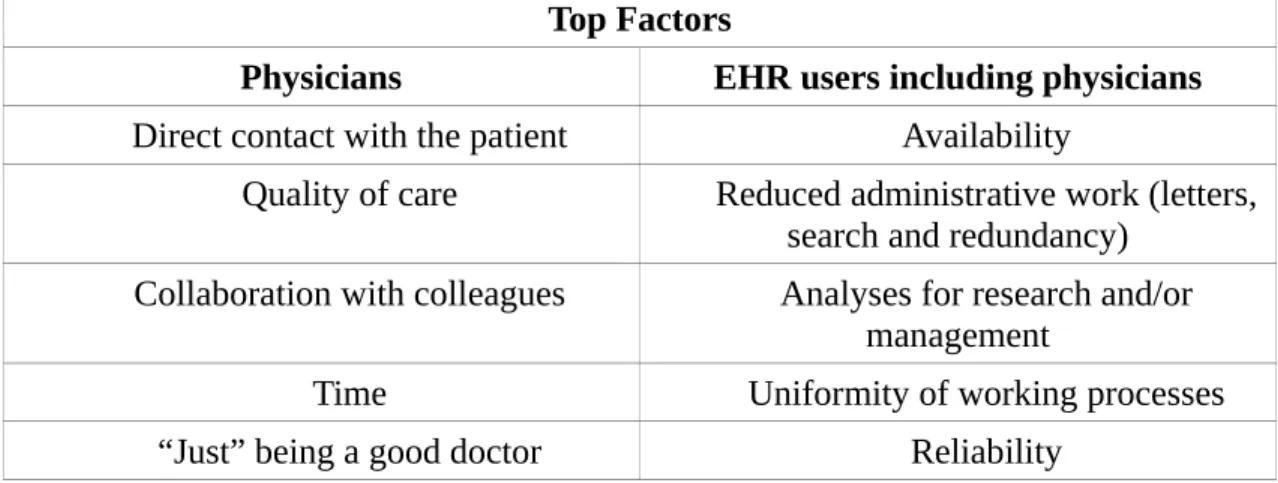
There was some tension between the necessity to satisfy local needs and considering standards for interoperability [Cresswell et al, 2012]. If we were to choose between the two, Cresswell et al suggest that satisfying local needs comes first as imposing national systems was considered unlikely to work [Cresswell et al, 2012]. However there is a need to find some balance between the two because if there are no standards, integration of the individual systems would have major risks [Cresswell et al, 2012]. Standards are considered among the critical success factors in [Edwards, 2006]
![Figure 4: The General Structure of A Community [Nakakoji et al, 2002]](https://thumb-us.123doks.com/thumbv2/123dok_us/8699705.2354440/16.891.130.762.733.1096/figure-general-structure-community-nakakoji-et-al.webp)
![Table 2: Contribution Dimension [Capra and Wasserman, 2008]](https://thumb-us.123doks.com/thumbv2/123dok_us/8699705.2354440/19.891.138.762.799.1164/table-contribution-dimension-capra-and-wasserman.webp)
![Table 4: Working Practices Dimension [Capra and Wasserman, 2008]](https://thumb-us.123doks.com/thumbv2/123dok_us/8699705.2354440/20.891.128.770.680.1076/table-working-practices-dimension-capra-wasserman.webp)
![Figure 5: Graphical Representation of Project Classification [Capra and Wasserman, 2008]](https://thumb-us.123doks.com/thumbv2/123dok_us/8699705.2354440/21.891.158.727.117.686/figure-graphical-representation-project-classification-capra-wasserman.webp)
![Figure 7 - HealthConnect systems overview[Jalal-Karim and Balachandran, 2008]](https://thumb-us.123doks.com/thumbv2/123dok_us/8699705.2354440/25.891.181.763.658.938/figure-healthconnect-systems-overview-jalal-karim-balachandran.webp)
![Figure 8 - The NHS NCRS [Jalal-Karim and Balachandran, 2008]](https://thumb-us.123doks.com/thumbv2/123dok_us/8699705.2354440/26.891.190.749.357.881/figure-nhs-ncrs-jalal-karim-balachandran.webp)
![Figure 9 - Dutch Nationwide EHR[de Smet, 2011]](https://thumb-us.123doks.com/thumbv2/123dok_us/8699705.2354440/27.891.144.762.613.969/figure-dutch-nationwide-ehr-de-smet.webp)
![Figure 11: EHR Solution Using a Relational Model for Cross-searching of Document Contents [Moller and Vosegaard, 2008]](https://thumb-us.123doks.com/thumbv2/123dok_us/8699705.2354440/28.891.131.763.235.480/figure-solution-relational-searching-document-contents-moller-vosegaard.webp)