Trin & Stor
Model Numbers: ST Series Version Date: 2012-04-19STORAGE TANK
INSTALLATION AND OPERATION INSTRUCTIONS
Storage companion to a Water Heater or Solar Thermal System TABLE OF CONTENTS
1.0 INTRODUCTION ...2
Trin & Stor Specifications ...2
General Installation Requirements ...2
I.O.M. Checklists ...2
Safe Temperatures for Potable Water ...3
2.0 STORAGE TANK PIPING ...5
Storage Tank Piping ...5
Connection to a Water Heater...6
3.0 FIELD WIRING ...8
TPI Thermostat Wiring ...8
TPI and Water Heater Controls... 10
4.0 START UP AND CHECK OUT ... 11
5.0 ANNUAL MAINTENANCE AND INSPECTION... 11
6.0 PARTS LIST ... 11
7.0 TROUBLESHOOTING ... 11
HAZARD SYMBOLS AND DEFINITIONS
Danger Sign: Indicates a hazardous situation which, if not avoided, will result in serious injury or death.
Warning Sign: Indicates a hazardous situation which, if not avoided, could result in serious injury or death.
Caution Sign plus Safety Alert Symbol: Indicates a hazardous situation which, if not avoided, could result in minor or moderate injury.
Caution Sign without Safety Alert Symbol: Indicates a hazardous situation which, if not avoided, could result in property damage. Notice Sign: Indicates a hazardous situation which, if not avoided, could result in property damage.
Tanks must be installed by a licensed installer. Improper installation, use, neglect or abuse of this product will void the warranty.
NEW PRODUCT LINE
Storage Tanks
Stainless Steel Tank TPI Thermostat
1.0 INTRODUCTION
Trin & Stor SpecificationsTable 1-1 Storage Tank Specifications
Weight (lbs) Model Storage Capacity (US Gal) Type Empty Filled ST80 80 160 995 ST120 119 Stainless Steel Storage Tank 175 1275
The "ST" Series consists of a high performance stainless steel tank and can be used as a storage companion to a water heater or solar thermal system. For the complete NTI Trin & Stor line, visit www.nythermal.com.
Table 1-2 Storage Tank Characteristics Attribute ST Series
Tank stainless steel
Insulation EPS foam
Jacket grey plastic
top 12"
connection side 12"
Recommended Service
Clearances water heater connections as required
MAWP 150 psi
Restrictions Max tank temp 190oF
Max water heater temp 210oF
Water Chemistry - Water used in the storage tank must meet the water chemistry limits specified in Table 2-1. Levels outside the limits may corrode the tank and shorten its life resulting to damage to tanks and voiding the warranty.
General Installation Requirements
Generalized instruction and procedures cannot anticipate all situations. For this reason, only a qualified installer should perform the installation.
Users Responsibility – This manufacturer anticipates the proper installation and care in use of the product. As with any hot water system, there is a risk of property damage and personal injury inherent in the use. NTI cannot supervise the installation and therefore makes it a specific condition for the warranty that the customer will supervise the installation and use of the product to be sure they are performed in accordance with the instructions and I.O.M. Checklists in this manual. It is the User’s responsibility to maintain the appliance by having it inspected on an annual basis, serviced as required, and to use the product for the purpose it was intended.
Installers Responsibility – A qualified installer is a licensed person who has appropriate training and a working knowledge of the applicable codes, regulations, tools, equipment and methods necessary to install a storage tank or water heater. The Installer assumes all responsibility for a safe installation and that it meets the requirements of this document, as well as National and local codes.
I.O.M. Checklists
The various Installation, Operation and Maintenance (IOM) Checklists contained in this manual are meant to be read in conjunction with the details, drawings and safety information to ensure a complete and proper installation. General Information
1. Review system specifications and characteristics. 2. Know the Water Chemistry and Warranty requirements. 3. Be informed of potential hazards associated with potable water. DOs & DON’Ts
1. DO NOT install tank close to high temperature appliances or wood stoves as tank jacket is combustible. 2. DO NOT install where there is a risk of property damage in the event of an eventual leak at some
unpredictable time.
Storage Tanks Installation and Operation Instructions Trin & Stor
3
Pre-Installation Checklist Inspection and Preparation
1. Remove packaging. Inspect for damage during shipping. 2. Package contents should contain the following:
Storage Tank (verify correct model number)
Temperature and Pressure Relief Valve (150psi)
TPI Thermostat Locating the Tank
1. Solid foundation, dry location, near water heater. 2. Leave room to service storage tank and controls.
3. Ensure there is sufficient room for piping and servicing the storage tank and water heater. 4. Area free of flammable liquids or combustible vapors.
5. Ensure the location chosen for the tank is capable of supporting the tank when filled with water. 6. Locate in room where temperature never drops below 50oF (10oC).
Water Damage Protection
1. Where possible, locate the storage tank in an area where potential leaks from the tank, fittings, connections, or relief valve will not result in water damage to adjacent areas or lower floors.
2. If the area surrounding the tank is susceptible to water damage, install a catch pan c/w drain under the tank. Water Damage - This manufacturer is not responsible for any water damage that may occur in connection with the storage tank or any of its components.
Intended Purpose - This appliance is not intended to convey or dispense water for human consumption such as drinking or cooking.
Annual Service - Failure to have the Storage Tank properly serviced and inspected on a regular basis by a qualified technician may result in property damage or serious injury. Safe Temperatures for Potable Water
Two factors used to determine safe hot water temperatures are Legionella and scalding. Potable water needs to be stored at temperatures hot enough to limit the growth of Legionella, yet be cool enough to prevent scalding. Since both hazards present a potential risk to the user, they must be monitored and controlled. Table 1-4 indicates how water temperature affects Legionella bacteria and contributes to scald injury. Use of a thermostatic mixing valve in the storage tank plumbing system can help protect against both of these hazards. By storing potable water at higher temperatures, bacteria growth is controlled, while still providing high temperature water for dishwasher applications and low temperature water for bathing. Before proceeding, read the following carefully and take all necessary precautions to avoid potential illness and/or injury that can result from Legionella or scalding hazards.
Legionella Hazard - This bacteria is naturally occurring in surface water and ponds. It can also be found in man-made water systems around the world such as water storage tanks, water distribution systems, fountains, hot tubs, humidification systems, refrigeration systems and grocery produce misters. Health authorities agree that Legionella bacteria most often enter the lungs due to aspiration when contaminated water spray is breathed in as opposed to ingesting drinking water contaminated with the bacteria. Typical illnesses attributed to Legionella include flue like symptoms (Pontiac Fever) and a potentially fatal type of pneumonia (Legionnaires’ disease). Failure to follow instructions may result in illness or death. Contributing Factors to Legionella - Experts acknowledge that Legionella is an identified risk in most water systems. Although eradicating Legionella is improbable, precautions can be taken to control and monitor conditions that promote bacteria growth. According to the World Health Organization (WHO); American Society of Heating, Refrigeration, and Air-conditioning Engineers (ASHRAE); Canada Safety Council (CSC); and Centers for Disease Control (CDC), contributing factors to the growth of Legionella in potable water systems include:
• Minerals and nutrients present in the source water and systems materials
• Stagnation or low flow characteristic of dead ends in distribution piping systems and storage tanks
• Scale, corrosion, and bio film
• Tepid water in cold water lines
• Water storage temperatures optimal for bacteria growth
• Chlorine concentration
Scald Hazard - Hotter water increases the risk of scald injury. There is a hot water scald potential if the storage tank thermostat is set too high. Before changing the temperature setting on the tank thermostat, refer to the thermostat manufacturers recommended settings. Failure to follow these instructions may result in serious injury or death.
A scald injury can occur when hot steam or liquid makes contact with one or more layers of skin. Scald severity (degree of burn) is directly impacted by exposure time and temperature. Refer to Table 1-4. The following basic precautions are common sense:
• Young children and elderly adults burn more quickly and should use cooler water.
• Never leave a child alone while drawing water in a bathtub.
• Test the water temperature before bathing or showering.
• Turn cold water on first, then add hot water until the temperature is comfortable. Thermostatic Mixing Valve - When the system requires water at temperatures higher than required for other uses, such as high temperature applications typically greater than 46oC (115oF), a means such as a thermostatic mixing valve shall be installed to temper the water for those uses in order to reduce scald hazard potential. Anit-scald devices such as a thermostatic mixing valve allows potable water to be stored at a higher temperature to limit bacteria growth, and allows water at the tap to be delivered at a lower temperature to prevent scalds. Failure to follow these instructions may result in serious injury or death.
This appliance is not intended to convey or dispense water for human consumption such as drinking or cooking.
Legislation and Guidelines - At the time this document was written, standards and guidelines regulating the prevention of Legionella in the United States and Canada were mostly voluntary. The American Society of Heating, Refrigerating and Air-Conditioning Engineers, Inc. (ASHRAE) is currently in the process of converting its guideline entitled "Minimizing the Risk of Legionellosis Associated with Building Water Systems" (ASHRAE Guideline 12-2000) into an official standard. Consult with your local authorities as to recommended guidelines for controlling Legionella in potable water systems.
Storing water at temperatures >140°F may not be permitted in some States, so check with the authorities having jurisdictions. In Canada, recent changes to the National Plumbing Code requires that domestic hot water be stored at or above 61oC (140oF) and then mixed down to safe temperatures at the tank outlet.
General Guidelines - In the absence of a National standard or local codes, the following are general guidelines for “good practice” on maintaining, monitoring and operating your potable water system:
• Store domestic hot water at temperatures > 61oC (140oF).
• Store and distribute cold water at temperatures below 20oC (68oF).
• System supply for uses other than high temperature applications typically greater than 46oC (115oF) shall be equipped with a thermostatic mixing valve on the hot water outlet to reduce potential scald hazards.
• Clean aerators and nozzles on water fixtures on a regular basis to reduce scale build-up.
• Clean storage tanks and remove sediment. Flush storage tanks and piping systems regularly for 10-30 minutes at high water temperatures (depending on guidelines used) to rid the system of sediment and scale that develops, typically in the bottom of storage tanks where water temperature is coolest; and piping runs where water can stagnate.
Storage Tanks Installation and Operation Instructions Trin & Stor
5
• Avoid dead-ends in piping system. If unavoidable, provide a drainage port in these areas at the lowest point to flush out stagnant water regularly.
• Insulate Domestic Hot Water recirculation lines and keep pipe runs as short as possible.
• Recommend annual water testing of water in your tank and piping system(s) to monitor water conditions.
• Keep a maintenance record of when your water heater and storage tank were cleaned, piping systems flushed and who did the service work.
Table 1-4 How Water Temperature relates to Legionella and Scald Hazard
Water Temperature 1 Legionella Bacteria 1 Water Temperature 2,5 Exposure Time vs Burn 5
158-176oF 70-80oC Disinfection range 158oF 70oC 1 second - 2nd or 3rd degree burn
140-149oF 60-65oC Bacteria die within minutes 140oF 60oC 5 seconds - 2nd or 3rd degree burn
122-131oF 50-55oC Bacteria die within hours 131oF 55oC 5 seconds - 1st degree burn
68-113oF 20-45oC Bacteria thrive and multiply 122oF 50oC 1 minute - 1st degree burn
below 68oF below 20oC Bacteria is dormant 111oF 44oC 5 hours - 1st degree burn 3,4
Notes:
1
Published by Chartered Institute of Plumbing and Heating Engineering, Databyte series, "Safe Hot Water Temperatures".
2 The elderly and small children are susceptible to bad burns at shorter exposure times than listed in this table.
3 A thermostatic mixing valve should be installed on DHW storage tanks when outlet temperatures exceed 115oF [46oC].
4 Typical water temperature for bathing or showering range between 98-113oF [37-45oC].
5 Temperature-Time-Burn Chart published by John Hopkins University, excluding notes.
2.0 STORAGE TANK PIPING
Failure to follow the instructions provided in this section will void your NTI warranty and may result in property damage.
Storage Tank Piping
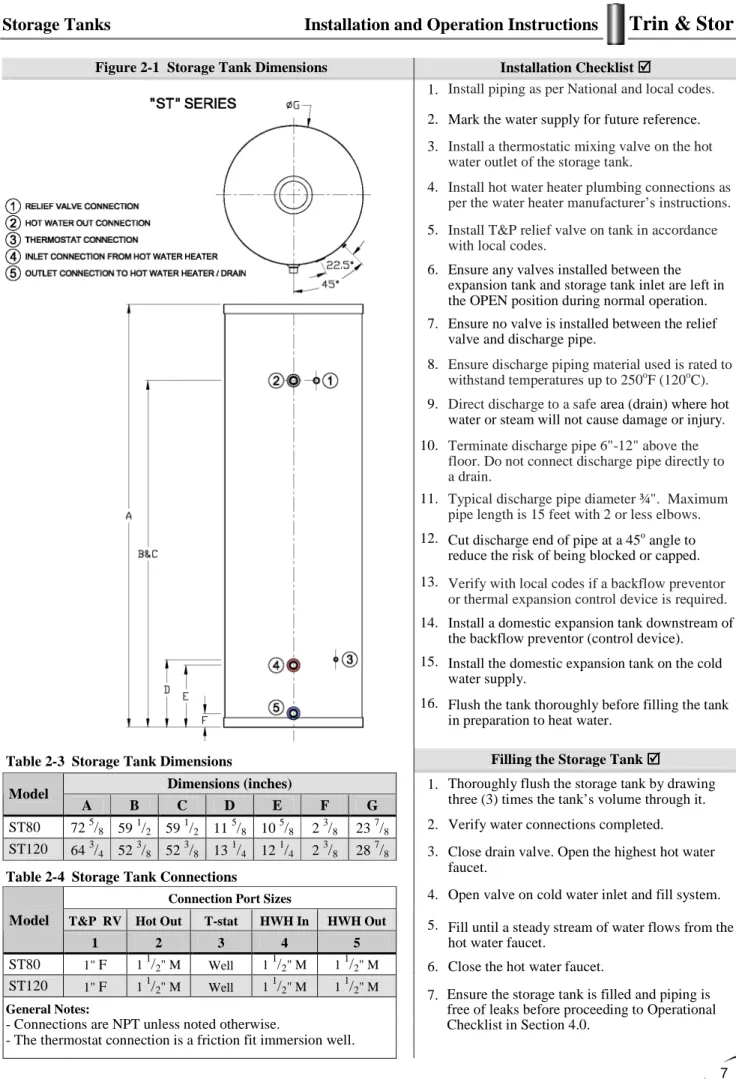
Tank connection ports are identified in Figure 2-1 and dimensioned in Tables 2-3 and 2-4 and their function is described in detail below. For multiple storage tanks, pipe the tanks in parallel using equal pipe lengths between each tank and a common tee to ensure equalized draw.
Energy Efficiency - Although the NTI Trin & Store Storage Tank is well insulated, insulating long pipe runs can improve the system efficiency by conserving energy and reducing standby losses.
System Preparation - Prior to connecting plumbing to the storage tank, flush the entire system to ensure it is free of harmful impurities. Check the water composition of the domestic water supply to determine if it is within the water chemistry limits specified in Table 2-1. If levels are outside the acceptable limits, consult a qualified water treatment expert about treatment options for domestic water.
Damage to tanks resulting from water chemistry levels outside the ranges specified in Table 2-1 can cause corrosion, shorten the life of the tank, and void the warranty.
Table 2-1 Water Chemistry Requirements Characteristic "ST" series Min 6.0 PH Max 8.0 Min 0.0 Chloride (ppm) Max 80.0
Flushing the Storage Tank - Many solder fluxes can severely corrode stainless steel. Once piping connections are completed, flush the storage tank by drawing at least three (3) times the tank’s volume through the storage tank prior to heating domestic water in the tank. Failure to flush the tank will void the warranty.
System Components - As a minimum, a properly installed system will include the following major components identified in Table 2-2. It is the responsibility of the installing contractor and system designer to consider all aspects of a proper system design including compliance with local codes, including additional components required for prevention of thermal-siphoning (i.e. heat traps), isolation valves, drain and purge valves, etc.
Table 2-2 Major Component Checklist
Factory Supplied Components Field Supplied Components
Storage Tank System Backflow Preventor2
Temp & Pressure Relief Valve (150PSI) DHW (Potable Water) Expansion Tank2,3
TPI Thermostat1 Thermostatic (Anti-Scald) Mixing Valve
Drain Valve
Potable Water Circulator (as required)
Notes: 1
All NTI Storage Tanks come standard with a TPI thermostat.
2
Check if required by local codes.
3
Expansion Tank is mandatory if using a System Backflow Preventor.
Temperature and Pressure Relief Valve - Factory supplied T&P relief valve, sized to ASME specifications
and compliant with Standard ANSI Z21.22•CSA 4.4 Relief Valves for Hot Water Supply Systems.
T&P Normal Operation - The relief valve is not intended for constant duty such as
repeated operation due to normal system expansion. If this occurs, correct the situation by installing a properly sized domestic expansion tank as per the expansion tanks manufacturer’s instructions.
Location - Do not conceal, plug, or remove the relief valve from its designated point of installation. Failure to comply may result in property damage, personal injury or death.
Drain Valve - The Storage tank requires a field supplied drain valve to facilitate emptying the tank for
inspection and servicing. Refer to Table 2-4 for drain port size and type.
System Backflow Preventor - Most plumbing codes require a thermal expansion control device be installed if a backflow preventor, pressure reducing valve or check valve is installed on a domestic supply line. If a backflow prevention device is used, then an expansion tank is mandatory (not optional) and must be installed downstream of any device used to control system thermal expansion. When using multiple storage tanks, check if a single BFP is required on the domestic supply or if each tank requires it’s own backflow preventor and expansion tank. DHW (Potable Water) Expansion Tank - This manufacturer recommends installing a potable water expansion tank in the hot water system for the purpose of absorbing the increase in water volume caused by rising water temperature. If required by local codes, the expansion tank must be sized in accordance with the water volume of the system. Refer to the expansion tank manufacturer’s literature for proper sizing information.
Thermostatic (Anti-Scald) Mixing Valve - A mixing valve is recommended on branches supplying low
temperature water to endpoint plumbing fixtures when domestic hot water is stored above 46°C (115°F).
Temperature Limiting Device - When the tank requires water at temperatures higher than 46°C (115°F), a mixing valve shall be installed to temper the water and reduce the risk of scalding. Failure to follow these instructions may result in serious injury or death.
Connection to a Water Heater
The NTI Trin & Stor Storage Tanks are intended to be heated by an external hot water heater or solar thermal system and supplied directly to the storage tank using connection ports 4 and 5. See Figure 2-1.
High Temperature Applications - Trin & Stor Storage Tanks are specifically designed for low temperature applications [<100oC (210oF)] and are NOT intended to be used as a pool heating system or in conjunction with high temperature steam producing appliances where water temperatures could potentially exceed 100oC (210oF). Failure to follow these instructions may damage the tank resulting in property damage, serious injury or death.
Storage Tanks Installation and Operation Instructions Trin & Stor
7
Figure 2-1 Storage Tank Dimensions Installation Checklist
1. Install piping as per National and local codes.
2. Mark the water supply for future reference.
3. Install a thermostatic mixing valve on the hot
water outlet of the storage tank.
4. Install hot water heater plumbing connections as
per the water heater manufacturer’s instructions.
5. Install T&P relief valve on tank in accordance
with local codes.
6. Ensure any valves installed between the
expansion tank and storage tank inlet are left in the OPEN position during normal operation.
7. Ensure no valve is installed between the relief
valve and discharge pipe.
8. Ensure discharge piping material used is rated to
withstand temperatures up to 250oF (120oC).
9. Direct discharge to a safe area (drain) where hot
water or steam will not cause damage or injury.
10. Terminate discharge pipe 6"-12" above the
floor. Do not connect discharge pipe directly to a drain.
11. Typical discharge pipe diameter ¾". Maximum
pipe length is 15 feet with 2 or less elbows.
12. Cut discharge end of pipe at a 45o angle to
reduce the risk of being blocked or capped.
13. Verify with local codes if a backflow preventor
or thermal expansion control device is required.
14. Install a domestic expansion tank downstream of
the backflow preventor (control device).
15. Install the domestic expansion tank on the cold
water supply.
16. Flush the tank thoroughly before filling the tank
in preparation to heat water.
Table 2-3 Storage Tank Dimensions Filling the Storage Tank
Dimensions (inches) Model
A B C D E F G
1. Thoroughly flush the storage tank by drawing three (3) times the tank’s volume through it.
ST80 72 5/8 59 1 /2 59 1 /2 11 5 /8 10 5 /8 2 3 /8 23 7
/8 2. Verify water connections completed.
ST120 64 3/4 52 3/8 52 3/8 13 1/4 12 1/4 2 3/8 28 7/8 3.
Table 2-4 Storage Tank Connections
Close drain valve. Open the highest hot water faucet.
Connection Port Sizes 4. Open valve on cold water inlet and fill system.
T&P RV Hot Out T-stat HWH In HWH Out
Model
1 2 3 4 5
5. Fill until a steady stream of water flows from the
hot water faucet.
ST80 1" F 1 1/2" M Well 1 1/2" M 1 1/2" M 6. Close the hot water faucet.
ST120 1" F 1 1/2" M Well 1 1/2" M 1 1/2" M
7. Ensure the storage tank is filled and piping is
free of leaks before proceeding to Operational Checklist in Section 4.0.
General Notes:
- Connections are NPT unless noted otherwise.
3.0 FIELD WIRING
Ensure all field wiring complies with this manual and is installed in accordance with the National Electrical Code ANSI/NFPA 70 or Canadian Electrical Code CSA C22.1, and any applicable local codes. Install the TPI Thermostat in accordance with these instructions, the installation checklist(s), and Figures 3-1 to 3-5.
TPI Thermostat Wiring
24VA Transformer (Hot, GND) – The TPI requires a 24VAC power supply which can be provided directly from the hot water heater (see water heater manufacturers’ instructions) or a field provided 24VAC transformer. Note the TPI may draw up to 0.6 W. TPI contacts are rated for 125V@10A.
Pump/TT Output Contacts - The TPI is equipped with a normally open isolated end switch (Pump/TT) that closes when the tank temperature drops below the TPI setting. Use the Pump/TT contact, to activate the Hot Water Heater or domestic recirculation pump. See Figures 3-6 to 3-8 for examples.
Avoid Shocks - To avoid electrical shock, turn off electrical power prior to opening any electrical box on the unit. Ensure the power remains off while any wiring connections are being made. Failure to follow these instructions may result in component failure, serious injury or death.
Wire Protection - When passing 110VAC wiring through the TPI housing, the installer must use appropriate conduit and a chase nipple to secure the wiring and prevent chafing. Failure to follow these instructions may result in serious injury or death.
Component Damage - DO NOT use the TPI if it has been under water. Failure to replace electrical damaged components may result in component failure, serious injury or death Figure 3-1 TPI Thermostat Features
Dimensions 5.0"H x 2.6"W x 1.7"D
Control voltage 24VAC Maximum control power 0.6 W TT contact rating 125V, 10A
Adjustment increment 1oF.
Temperature set point range 110oF to 160oF.
Temperature differential range 5oF to 20oF.
10k sensor accurate to within 2 degrees.
Fits any standard immersion well, no special
adapter required. Mounts to tank using self tapping screw provided.
Indicating light provides status of power,
call for heat, up to temperature, normal operation
Figure 3-2 Installing the Sensor Installation Checklist
1. Place the hole located in the back of the TPI
over the immersion well.
2. Mount the TPI flush against the tank.
3.
Use Screw A (self-tapping) provided to attach the TPI to the exterior of the tank.
4. Slide the temperature sensor all the way into
the immersion well until it contacts the end. The sensor will measure temperature adequately by resting against the bottom of the immersion well. The sensor does not need to make intimate contact with the entire well surface to work properly. Sensor is soldered directly to TPI so DO NOT bend sensor connection sharply or overwork it.
Fit flush against the tank (complete installation) Sensor TPI Tank Wall Sensor Screw A Differential Adjustment Indicator
Light Temperature Adjustment
Sensor
Storage Tanks Installation and Operation Instructions Trin & Stor
9
Figure 3-3 Wiring the Controls Installation Checklist
5. Turn off electrical power supply to water
heater. Run all 24VAC wiring thru the square notch in bottom of TPI case.
6. Connect incoming 24VAC supply to 24VAC
Terminals on the bottom right corner of TPI.
7. Connect 24VAC PUMP/TT outgoing wiring
to terminals on the bottom left corner of TPI.
8. If using 110VAC PUMP/TT output wiring,
use knockout at bottom of TPI case with appropriate chase nipple.
9. Refer to Figures 3-6 through 3-8 for TPI
control configuration drawings.
Figure 3-4 Adjusting the Temperature Installation Checklist
10. Locate the temperature setting slide on the
right-hand side of the TPI. The Factory
setting is 120oF (49oC). To adjust the
temperature setting, slide the lever to the desired setting using the indicator scale.
Normal range is 100oF to 140oF.
11. If domestic hot water is to be stored at
temperatures above 115°F (46°C), an anti- scald mixing valve shall be installed on the tank’s hot water outlet to mix the water down to safe temperature levels.
12. If setting temperature above 140oF, read
"Safe Temperatures for Potable Water" before removing the SCALD DANGER label on the temperature slide. Higher water temperatures mandatory in Canada may not be permitted in certain US jurisdictions.
Figure 3-5 Operation and Differential Installation Checklist
13. Locate the differential setting slide on the
left-hand side of the TPI. Factory setting is 10°. Slide the lever to the desired setting, using the indicator scale.
14. The TPI will close the output contact (call
for DHW) when the temperature drops below the setting minus the differential. A small differential with high water setpoints can result in water heater cycling and reduce efficiency.
15. Once wiring is complete, turn on electrical
power. Indicator light at the top of the case will be solid green if powered.
16. Replace TPI cover and secure with Black
Screw provided.
17. Check water temperature at faucet to verify
desired temperature is achieved.
SCALD DANGER SEE MANUAL BEFORE REMOVING Temperature Setting Slide Differential Setting Slide PUMP/TT Terminals (24VAC) Square Notch Incoming Terminals (24VAC) Incoming Terminals (24VAC) PUMP/TT Terminals (110VAC) To Circulator Close Nipple Conduit
TPI and Water Heater Controls
TPI Control Configurations Figure 3-6 TPI and Water Heater with DHW Input
TPI connected to Water Heater with DHW Input - TPI output contacts "Pump/TT" are connected to the water heater’s dedicated DHW input. The water heaters circulator control will activate the circulator. 24VAC is provided by a field supplied transformer or via a 24VAC supply from the water heater (refer to water heater I&O manual). See Figure 3-6.
TPI connected to NTI Trinity LX Water Heater - Wire the TPI 24VAC input to LX contacts "COM" and "R"; connect TPI output contacts (Pump/TT) to LX DHW input terminals, "DHW" and "Sensor COM". Refer to water heater application manual, Appendix C. See Figure 3-7.
TPI connected to Recirculation Pump - TPI activates a recirculation pump installed between the water heater and storage tanks. 24VAC is provide by a field supplied transformer or via a 24VAC supply from the water heater (refer to water heater I&O manual), TPI output contacts "Pump/TT" complete 120VAC to a recirculation pump. See Figure 3-8.
Figure 3-7 TPI and NTI Trinity LX Water Heater Figure 3-8 TPI and Recirculation Pump
Storage Tanks Installation and Operation Instructions Trin & Stor
11
4.0 START UP AND CHECK OUT
Operational Checklist1. Ensure all electrical connections are made correctly and no high voltage wires are exposed. 2. Set the TPI Thermostat to the desired temperature.
3. Verify that there is power to the TPI Thermostat.
4. Ensure piping system is free of leaks and that air has been purged from system. 5. Initiate a call for hot water by opening hot water taps on domestic water fixtures.
6. Verify that the water heater or recirculation pump starts when the thermostat calls for heat and shuts down when the call ends (tank is up to temperature). See Figures 3-6 to 3-8.
7. Check for proper operation of relief valve by opening it manually.
8. If relief valve functions continuously during normal operation, the expansion tank may need to be upsized.
5.0 ANNUAL MAINTENANCE AND INSPECTION
Inspection Checklist
1. Perform a visual inspection of all valves, drains, and system piping for signs of leaks. Maintenance Checklist
1. Verify maximum water temperature at hot water fixtures to verify mixing valve temperature settings.
2. Manually operate T&P relief valve by moving lever to open position until hot water is released and allow it to snap close. If closed relief valve continues to leak, close cold water inlet, drain tank, and replace relief valve. 3. If relief valve functions continuously during normal operation, the expansion tank may need to be upsized. 4. Ensure the water heater and/or solar thermal system is maintained in accordance with its installation manuals. 5. Check function of field-installed controls, thermostats, and circulators.
6. Check tank PH and chloride levels to determine if water chemistry is within the specified range. 7. Any additional procedures required by local codes.
Draining the Storage Tank
1. Disconnect the power supply to the heat source.
2. Purge hot water from the tank by opening a hot water faucet. 3. Close the cold water supply shut off valve.
4. Open the drain valve and divert water in tank to alternate storage location or floor drain. 5. Open highest hot water faucet to allow air to enter the system.
6.0 PARTS LIST
Table 6-1 Storage tank
Item Part # Models Description
1 84156 ST80, ST120 Relief Valve, T&P, ¾", 150 psi
2 84158 ST80, ST120 TPI Thermostat
Installers requiring technical assistance can contact NTI directly at 1-800-688-2575.
7.0 TROUBLESHOOTING
Locate the TPI indicator light at the top of the case as shown. Refer to Table 7-1 for TPI troubleshooting guide. Figure 7-1 TPI Thermostat Indicator Light Status
Unlit No power to unit.
Solid Green Powered.
Temperature is in range. No demand. Demand satisfied. Pump/TT output should be open.
Flashing Green Calling for heat.
Temperature is out of range. Pump/TT output should be closed.
Flashing Red TPI has sensed failure.
Replace TPI module.
NY Thermal Inc. 65 Drury Cove Road Saint John, NB E2H 2Z8 Canada Technical Assistance: 1-800-688-2575