Choices to Develop Your Writing
by Beth L. HewettThis essay is a chapter in Writing Spaces: Readings on Writing,
Volume 1, a peer-reviewed open textbook series for the writing classroom, and is published through Parlor Press.
The full volume and individual chapter downloads are available for free from the following sites:
•
Writing Spaces: http://writingspaces.org/essays•
Parlor Press: http://parlorpress.com/writingspaces•
WAC Clearinghouse: http://wac.colostate.edu/books/ Print versions of the volume are available for purchase directly from Parlor Press and through other booksellers.To learn about participating in the Writing Spaces project, visit the Writing Spaces website at http://writingspaces.org/.
This essay is available under a Creative Commons License subject to the Writing Spaces Terms of Use. More information, such as the specific license being used, is available at the bottom of the first page of the chapter.
© 2010 by the respective author(s). For reprint rights and other permissions, contact the original author(s).
Library of Congress Cataloging-in-Publication Data
Writing spaces : readings on writing. Volume 1 / edited by Charles Lowe and Pavel Zemliansky.
p. cm.
Includes bibliographical references and index.
ISBN 978-1-60235-184-4 (pbk. : alk. paper) -- ISBN 978-1-60235-185-1 (adobe ebook)
1. College readers. 2. English language--Rhetoric. I. Lowe, Charles, 1965- II. Zemliansky, Pavel.
PE1417.W735 2010 808’.0427--dc22 2010019487
59
Choices to Develop Your Writing
Beth L. Hewett
Introduction
Every semester, I ask my students for topic ideas, and then I write an essay for them.* When we’re in a traditional classroom, they watch me write the initial draft using a computer and projector; they comment on the writing, and I present revisions to them later. When we work online, they receive copies of all my drafts with changes tracked for their review and comments. My students like this exercise—partially because they don’t have to do the writing, but mostly because they like to see what I can make of an assignment they give me. They tell me that they struggle with beginning the writing and that the model I of-fer teaches new ways of understanding writing and revision. I like this exercise for the same reasons.
This chapter addresses how to make decisions about essay develop-ment and revision. It pays particular attention to using feedback from peers, instructors, or other readers. While you’ve probably had a lot of instructor feedback and many opportunities to review other students’ writing and to have them review yours, you may not have learned much about how to make revision choices related to such feedback. To * This work is licensed under the Creative Commons Attribution-Noncommercial-No Derivative Works 3.0 United States License and is sub-ject to the Writing Spaces Terms of Use. To view a copy of this license, visit http://creativecommons.org/licenses/by-nc-nd/3.0/us/ or send a letter to Creative Commons, 171 Second Street, Suite 300, San Francisco, California, 94105, USA. To view the Writing Spaces Terms of Use, visit http://writing-spaces.org/terms-of-use.
help you learn about making choices, I present my own argumentative essay that I developed from my students’ feedback, and I analyze my decision-making processes as a model for you.
In this chapter, you’ll see various stages of an in-progress essay: 1. Choosing among topics
2. Brainstorming
3. Writing an initial, or “zero,” draft
4. Writing a preliminary draft that is intended to be revised 5. Using student feedback to revise
6. Completing a presentation draft
7. Considering how to make these processes work for you
The drafts, feedback, and commentary demonstrate how you can develop an essay from early thinking to preliminary writing to presen-tation-quality writing. Although there are many other ways to write an essay, this model may give you some ideas for your own writing. In addition, don’t be surprised if you need more drafts for your essays than you see presented here. This essay was a short one (for me), and so I was able to revise fairly thoroughly in one step. However, a longer project usually takes me many drafts and many feedback rounds to develop fully.
My essay was developed much like your essays are even though I’m a more experienced writer. My assignment was to write an argu-ment, so I was constrained by the genre’s requirements. The argument needed to state a position (my assertion or thesis) and had to support that position with good reasons and sufficient evidence to substanti-ate those reasons. I had a choice of topics, but I didn’t have complete freedom to write about just anything I wanted. The topic I ultimately chose was one that I was interested in but knew little about, so I need-ed to do a lot of research. Because my class was taught in a completely online setting and because I was working from home, I didn’t have a physical library to go to, so I used my university’s library search en-gines and the Internet for my research. Finally, I had only four work days to begin and complete a preliminary draft for student review; the process took twelve solid work hours.
My Students’ Suggested Writing Topics
To figure out what I would write about, I asked my students to suggest an assignment for me. As the example topics show, some them were pretty mundane—easy to do, but insubstantial and, frankly, boring. Other topics were substantial, but difficult to research and write about thoughtfully in just four days for the class. Finally, one student sug-gested a topic that captured my interest and that of other students; peers added their questions, and I knew this was the topic I wanted to address even though I knew little about it.
Students’ Suggested Topics
• Write about a cell phone charger. I had a teacher in high school that would pick random things every class and make us write about it for 10 minutes to “warm up” our brains. I hated those assignments.
• Why are liquid laundry detergents superior to powdered de-tergents?
• Does modern technology make life better and more conve-nient?
• How will the recent election of President Barack Obama affect race relations in the U.S.?
• What are your thoughts and opinions on adoptions by homo-sexual couples?
• Nadya Suleman gave birth to octuplets. Should the doctors have advised her against in vitro fertilization since she’s not financially stable to take care of all of those children? If she does end up on welfare should taxpayers be outraged? At what point or if at any should the government step-in in situations such as this?
• One angle to look at this sort of story is whether humans should impregnate themselves with “litters” of babies. • Personally, I would also like to know what doctor would
inseminate this woman without [who didn’t have] the funds to do so. It makes me wonder if he/she just wanted part of the publicity.
When you find a topic that is interesting and challenging, you’ve probably got a good subject that will sustain your attention during the
harder parts of the writing. In this case, I was fascinated by the idea of a woman giving birth to eight children and the moral questions that the students asked about this case. I wondered what the woman’s moti-vation was for having more children when she already had six of them, was unmarried and without a supportive partner, and unemployed.
Notice that the interest level of the topic doesn’t guarantee an easy one to research. I chose to do quite a bit of digging into the issue be-cause I had an “itch to know”; my curiosity was sufficient reason for me to do this work. Although school assignments may not seem this way, the motive behind research is—or should be—the genuine need or desire to answer a question for which you don’t have the answer but about which you really want to know more.
My topic choice also took into consideration that my students would be writing an essay that supports a position during the semester. I wanted to write a similar type of essay that would provide a model for them at that time in their writing development. Thus, choosing my topic was connected to the rhetorical situation of my teaching these students to write arguments that are designed to convince audiences.
Brainstorming
One way that writers can find ideas is commonly called “brainstorm-ing.” While there are many ways to find ideas, brainstorming is popular because writers often learn how to do it by such strategies as journaling, listing thoughts, and circling and connecting ideas.
To brainstorm my essay topic, I developed a series of questions that interested me. I also did some preliminary research. Although I didn’t list where that research came from in my notes here, I did list them on my original notes so I could be sure to credit my sources with their ideas and words.
Brainstorming
• Octuplets = irresponsibility? • Selfishness?
• Freak of non-nature?
• Potential for abuse of children • How the children will/may grow up • Include stats
• The increase in multiple births in the past 29 years clearly is due to supplemental fertilization methods like invitro fertilization (IVF). Increase of rates XYZ.
• Newborn octuplets have taken the world by surprise and got-ten our atgot-tention: how were they conceived (IVF), who is the mother and why would she have asked to have so many em-bryos implanted (six other children, divorced and single, no job, on disability, lives with mother)—what about them? • Multiple birth children are exploited; humans not made
to have litters; how do we care for all these children? Sensationalism: TV, movies, books, Quintland. Can we predict the ramifications for the children? Yes. Dionne quintuplets; Jon/Kate + 8
• Assertion? As the rate of multiple births increases due to vari-ous fertility treatments, we must be thoughtful about the pos-sibility that children of such births will be exploited by their parents and a curious society. (curiosity, money, nurturing) (to insist on protecting these kids would be a persuasive paper) • Assertion? As fertility treatments increase the rate of multiple
births, the potential for both parents and society to exploit these children also increases.
Notice that while I just listed some ideas, my notes show that I also began my research. First, I needed to learn about the topic, which is to earn an “informed opinion,” and then I could express that informed opinion through a thesis, or assertion. I wrote two possible assertions at this early stage. They helped me to narrow down what I believed I wanted to argue.
Initial, or Zero, Draft
After brainstorming, many people write an initial draft, which I am calling a zero draft. The zero draft gets the writing started and gener-ally isn’t going to be ready for others to see. This draft is a great way to begin because you don’t have to be neat and tidy or super correct sentence-wise. Since this draft just begins to organize ideas, a zero draft should never be turned in as a completed draft for grading; trust me—these drafts just aren’t ready for prime time. Zero drafts also
tend to be fairly useless in a peer response session, so write a complete preliminary draft for that purpose. Unless your instructor asks you to provide it, this draft is yours alone. Return to it as you write your pre-liminary draft to keep track of how your earliest ideas are developing. You’ll be interested in seeing whether your preliminary draft follows these early ideas or veers from them.
Zero Draft
For demonstration purposes, I’m showing you only one paragraph of my zero draft. It provides the barest details of what the first para-graph of my preliminary draft would become. Don’t worry if my zero draft looks stronger than one of yours might. I write professionally and I teach writing—it’s natural that I would get a good start. When you look at the preliminary draft, however, you’ll see that I can do much better! The assertion, which is the last sentence in both examples, is much more focused in the preliminary draft than it is in the zero draft
For people who really become stuck or “blocked” when beginning to write an essay, the combination of some brainstorming and a zero draft can get you started writing fairly painlessly. If you’re really stuck, just take some of your brainstorming ideas and begin writing without
Zero Draft
The Exploitation of Multiple Birth Children
Two weeks ago, Nadya Suleman gave birth to octuplets in a California hospital. Although all eight babies lived, they were very small and some may die. Suleman now is the mother of fourteen children—six between the ages of 2 and 7. She is unemployed, without a husband or partner, and lives in her mother’s home (she fights with her mother enough that her mom has said so publically). Suleman’s babies and her own poverty are the talk of the tabloids and everyone seems to have an opinion. But people have always been excited when multiple children are born to women. But there will likely be more of these births because of in vitro fertilization. Both parents and society tend to exploit these children, but it is not acceptable because it is harmful to the children.
looking at the paper or screen. Take time to begin developing your thinking before worrying about whether it makes much sense. As long as you take time for writing additional drafts, this zero draft process will be helpful.
Preliminary Draft
How does this first paragraph change in the preliminary draft? As we can see from the example preliminary draft that follows, the argument becomes more fully fleshed out. It contains more detail in general and it uses various source citations for authority. One of the reasons that I included these citations was to give my readers a sense that I had earned an informed opinion. My process before writing this next draft was to deepen my knowledge of the topic through more research and to try to express my informed opinion through a coherent asser-tion. Throughout the entire argumentative essay, I needed to support that opinion so that readers could be convinced that it is reasonable. Readers didn’t have to agree with me or with each other for my argu-ment to be successful. Because people argue only about those things for which there is no definite or single position, it isn’t possible to get everyone in my audience to agree with me—which is why my readers only needed to find the argument reasonable.
Let’s look now at the complete preliminary draft. After I finished this draft, I posted it for my students to review. Their feedback is shown in the right hand column. At various places in this draft, I make a break and respond to the comments to show my thinking and decision making process. Since I’m writing this chapter for you months after teaching this particular class, I provide you with some hindsight thinking as well.
Bold text shows what I added to the preliminary draft in response to student feedback and my own developing thinking. A strikethrough shows what I deleted in revision. If you can imagine that these changes were all accepted, then you have a good sense of what the presentation draft looked like. Notice that the revision was fairly substantial in that I addressed what I considered to be most important: content, organiza-tion, and sentence-level issues in that order.
Preliminary Draft and Tracked Changes
The first revision change I made was in response to Student 1’s com-ment, which was a good catch on his part. It’s surprising that such a small change as adding a date to an event can contextualize an entire argument. In this case, I substituted the actual date of the octuplets’ birth, which makes the piece understandable in the future.
Student 2’s feedback clearly indicated that there was a potential misunderstanding of the thesis, or argumentative assertion. This ar-gument opens with an anecdote about a mother of octuplets, which doesn’t mean that this mother is necessarily its subject. The assertion appears in the last sentence of the opening paragraph, a common place Fig 2
The Exploitation of Multiple Birth Children Two weeks ago, On January 26, 2009, Nadya Suleman gave birth to octuplets in a California hospital. To date, all eight babies are alive, but they weighed only between 1 pound, 8 ounces and 3 pounds, 4 ounces at birth, which means that they will be in the neonatal unit of the hospital for weeks to come. Suleman now has fourteen children—six between the ages of 2 and 7—all of them conceived by in vitro fertilization (IVF), but she also has no job, no husband or significant other, and no home of her own. She lives with her mother, who publicly has expressed disgust with her daughter’s obsessive desire for multiple children (“Grandma,” 2009). ). Although in the past she has subsisted with disability payments for a job‐ related injury, Suleman said she refuses Welfare money to support herself and her children (Celizic 2009). However, she has retained a publicist, who mentioned that she’s looking at seven‐figure offers for her “story” (Celizic 2009; Rochman 2009). Suleman’s babies and her own life circumstances are being discussed ad nauseam by the media, medical and mental health professionals, and everyday citizens alike. The flurry of interest in Suleman’s situation is just a recent example of the excitement people tend to experience when multiple births occur. However, as fertility treatments increase the rate of multiple births, the potential for both parents and society to exploit these children also increases. Even though it might be
understandable given the financial challenges of raising multiple children, such exploitation is unacceptable because it skews the children’s experiences of family at best and it is emotionally harmful to the children at worst.
Comment [BLH1]: Studen t 1: …future readers need a specific date to reference.
Comment [BLH2]: Studen t 2: I did find it difficult to establish the thesis statement. Increase IVF & multiple births, health risks, publicity, family structure, single mother and time dedication were all mentioned as part of what I found to be the thesis.
for a thesis in a short essay. This essay’s goal is to support the position that exploiting multiple children harms them by skewing their experi-ence of family and emotionally harming them. Notice that the goal is broader than just Suleman’s case, as indicated by the word “example” in the third from the last sentence. In order to further help readers to understand that Suleman isn’t the topic, I deleted detailed information about her that might have caused some readers to think the argument is all about her. I moved that information to later in the essay when I talk about Suleman as an example of an exploitative parent.
Student 3 found my uses of language to be somewhat informal on various occasions. I didn’t always agree with this reader’s advice; for example, there’s nothing wrong with beginning a paragraph with a question, but she was right that I was being informal in a way that she wasn’t being taught to be informal in most of her college writing. Fig 3
How frequent are In order to understand the problems surrounding multiple births, it is useful to
consider the general frequency of multiple births.?
Because of fertility treatments that were not available more than twenty‐five years ago, the rates have increased considerably. In 1980, the number of human spontaneous twin births, for example, was only 68,339 out of all the births in the United States that year (Fierro, 2008 & n.d.). In 2005, however, the twin birth rate was 133,325, nearly twice the number from 25 years previous (NOMOTC, 2009). The increase in multiple births in the past 29 years is due in part to fertilization treatments like IVF. 1980 marks a period when fertility methods and procedures became more readily available, if still costly. According to Fierro (2008 & n.d.) of About.com, the odds for having twins when pregnancy results from fertility treatments have increased nearly 60% since 1980. Triplets, which once occurred spontaneously in every 1 of 8,100 births, have increased in frequency by 400% since 1980, while quadruplets, which once occurred spontaneously in every 1 of 729,000 births, also have increased by orders of magnitude. Indeed, she estimates: “that 60% of the triplets are the result of fertility enhancing treatments; while 90% of quadruplets … are due to reproductive technology” (2008). Although the author noted that these statistics are estimates gathered from several sources, the numbers seem reasonable given the increasing popularity of fertilization treatments among women in the later period of child‐bearing years.
Comment [BLH3]: Studen
t 3: At times the language
seems too colloquial,
beginning paragraphs with
“Ah” or a question, and using
phrases such as “the norm.”
Comment [BLH4]: Studen
t 4: I think that the part about
the biology of the human
towards having multiples is
To that end, I eliminated the initial paragraph question and created a sentence that was somewhat more precise.
I had to agree with Student 1’s remark that about.com wasn’t a strong source. I knew that fact when I first used the source, and I searched the Internet and the library search engines for something more authoritative. I wasn’t able to find a better source, but I think that if I had talked to a librarian about these statistics, I probably would have done better. My way of trying to mitigate possible prob-lems from using this source was to make sure that I used the available statistics well from the preliminary draft onward; the rest of the para-graph demonstrates how I used this source.
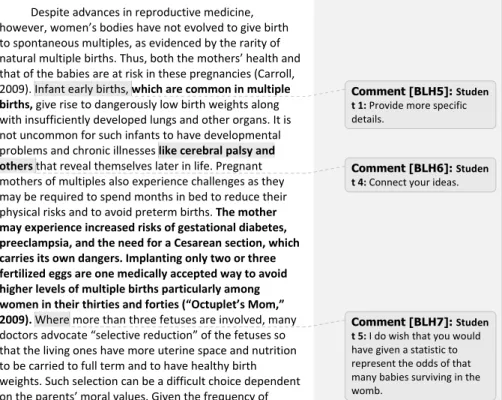
On the whole, this paragraph seems out of place in the sense that it doesn’t directly deal with the assertion. To some degree, I think that is what Student 4 was indicating. Yet, the information also seems necessary as context. In a longer essay, this paragraph (and even more contextual material) might come in a section called “Background.” I thought a lot about the student’s advice; I tried moving this material to another place in the argument, and I also tried deleting it altogether. Finally, I decided it was needed information and I left it where it was. Fig 4 Despite advances in reproductive medicine, however, women’s bodies have not evolved to give birth to spontaneous multiples, as evidenced by the rarity of natural multiple births. Thus, both the mothers’ health and that of the babies are at risk in these pregnancies (Carroll, 2009). Infant early births, which are common in multiple births, give rise to dangerously low birth weights along with insufficiently developed lungs and other organs. It is not uncommon for such infants to have developmental problems and chronic illnesses like cerebral palsy and others that reveal themselves later in life. Pregnant mothers of multiples also experience challenges as they may be required to spend months in bed to reduce their
physical risks and to avoid preterm births. The mother
may experience increased risks of gestational diabetes, preeclampsia, and the need for a Cesarean section, which carries its own dangers. Implanting only two or three fertilized eggs are one medically accepted way to avoid higher levels of multiple births particularly among women in their thirties and forties (“Octuplet’s Mom,” 2009). Where more than three fetuses are involved, many doctors advocate “selective reduction” of the fetuses so that the living ones have more uterine space and nutrition to be carried to full term and to have healthy birth weights. Such selection can be a difficult choice dependent on the parents’ moral values. Given the frequency of multiple births from IVF and other fertility treatments, beyond these obvious health issues involved, we have the responsibility to consider how multiple births potentially affect the children and their relationships to their parents and society as a whole. It certainly is not the norm for a woman to give birth to more than one child at a time. While many mammals give birth to litters, humans typically give birth to only one child. Spontaneous multiple human births do occasionally occur in nature, just as rarely a cow will birth twin calves or a horse twin foals. That is why people delight in seeing twins, whether fraternal or identical. The relative rarity of
Comment [BLH5]: Studen
t 1: Provide more specific details.
Comment [BLH6]: Studen
t 4: Connect your ideas.
Comment [BLH7]: Studen
t 5: I do wish that you would have given a statistic to represent the odds of that many babies surviving in the womb.
Comment [BLH8]: Studen
t 5: The essay goes on to speculate as to why people pay close attention to multiple births, but does not provide evidence that the public actually does pay attention or why this is the case.
From Topic to Presentation 69
These two paragraphs are fairly intimately connected in terms of content, so let’s look at them together. I added the information about the challenges of multiple births here and in paragraphs found below to satisfy readers like Students 1 and 4, who needed more information and wanted better transitions. Throughout the revised essay, I used their advice and added more detailed material wherever it seemed use-ful. Pointing me to the need for strong transitions was especially good advice. When I write early drafts, I don’t worry much about transitions because I know that my organization of certain material will change and that I’ll insert appropriate transitional later. I like it when students notice that the “glue” that holds an essay together is missing.
Student 5 really wanted some statistics and other evidence of my argument’s main points. I agreed that I needed to find more statistical proof to support a point about the unnatural nature of multiple births. Doing so would have helped to show why people are so interested in them. This paragraph also has background material that I used to get to the heart of my thesis: that there’s disruptiveness about mul-tiple birth children’s and parents’ lives. It provides a reason for why twins may cause typically respectful, yet curious people to
become intrusive, asking questions about the twins’ sizes, hair and eye coloring, emotional dispositions, personality traits, and even bathroom habits. Not only is this intrusion off‐putting, but it also can make the children feel abnormal when children usually want nothing more than to be considered normal. Indeed, both the parents and the twins themselves experience their lives as more public than parents of singles and their children typically do. Naturally, our interest levels increase when triplets and quadruplets are born, and they go sky high when higher numbers of multiple birth children arrive. But our interests can be dangerous to the emotional well being of the children.
Despite advances in reproductive medicine, however, women’s bodies have not evolved to give birth to spontaneous multiples, as evidenced by the rarity of natural multiple births. Thus, both the mothers’ health and that of the babies are at risk in these pregnancies (Carroll, 2009). Infant early births, which are common in multiple
births, give rise to dangerously low birth weights along with insufficiently developed lungs and other organs. It is not uncommon for such infants to have developmental problems and chronic illnesses like cerebral palsy and
others that reveal themselves later in life. Pregnant mothers of multiples also experience challenges as they may be required to spend months in bed to reduce their physical risks and to avoid preterm births. The mother
may experience increased risks of gestational diabetes,
preeclampsia, and the need for a Cesarean section, which
carries its own dangers. Implanting only two or three
fertilized eggs are one medically accepted way to avoid
higher levels of multiple births particularly among
women in their thirties and forties (“Octuplet’s Mom,”
2009). Where more than three fetuses are involved, many doctors advocate “selective reduction” of the fetuses so that the living ones have more uterine space and nutrition to be carried to full term and to have healthy birth weights. Such selection can be a difficult choice dependent on the parents’ moral values. Given the frequency of multiple births from IVF and other fertility treatments, beyond these obvious health issues involved, we have the responsibility to consider how multiple births potentially affect the children and their relationships to their parents and society as a whole.
It certainly is not the norm for a woman to give birth to more than one child at a time. While many mammals give birth to litters, humans typically give birth to only one child. Spontaneous multiple human births do occasionally occur in nature, just as rarely a cow will birth twin calves or a horse twin foals. That is why people delight in seeing twins, whether fraternal or identical. The relative rarity of
Comment [BLH5]: Studen t 1: Provide more specific
details.
Comment [BLH6]: Studen t 4: Connect your ideas.
Comment [BLH7]: Studen t 5: I do wish that you would
have given a statistic to
represent the odds of that
many babies surviving in the
womb.
Comment [BLH8]: Studen t 5: The essay goes on to
speculate as to why people
pay close attention to
multiple births, but does not
provide evidence that the
public actually does pay
attention or why this is the
people respond so intrusively to multiple births. But the feedback is well-taken. This material needed authoritative support—not statistics necessarily—but pertinent thoughts about human behavior around multiple birth children.
The final sentence of the second paragraph takes the background information and links it to the assertion. Unfortunately, this technique didn’t work for some of my student readers who were already confused about the thesis—wrongly believing it was about Suleman alone. I left this sentence intact because I believed that the other changes to the essay would make this thesis link more obvious in the presentation draft.
For those who are curious about methods for arguing an assertion like this one, at the end of this second paragraph, I reasoned from the lesser to the greater: if something is true at a smaller number (twins, triplets), it also will be true at a higher number (sextuplets, octuplets). I’ll say more about such reasoning later in this chapter.
Although Student 6 believed that opening the next paragraph with the words “an historical example” was unnecessary, I thought the idea of history was quite important because I also used two contemporary examples. Instead of deleting the sentence as advised, I added material to help make that connection: “because it demonstrates that multiple births can be problematic even when they arise from natural causes.”
It’s helpful to remember that “positive” criticism like that from Stu-dent 5 can be useful to writers by reinforcing what they are doing well. In this case, the example of the Dionne children is reasoning from past fact to future fact: what happened in the past will happen in the future. Some student readers, like Student 7, were unconvinced because the situation was a little different in the 1930s. Yet, the quin-tuplets from natural birth were just as much a curiosity in the 1930s as octuplets or sextuplets from IVF birth are in the twenty-first century. Additionally, the financial issues that the Dionne parents experienced are similar to the two main cases I cited. Finally, the “zoo” atmosphere of the Dionne quintuplets certainly can be compared to the television screen that gives the world a peek into the Gosselin sextuplets (dis-cussed later in the essay) and the Suleman octuplets. For these reasons, I left the historical example intact and developed it even more.
In the second paragraph of this set, I restated the assertion. This paragraph and the following one directly support the thesis, which, as you recall, isn’t about Suleman, but about the potential exploitation
of all multiple birth children. These causes of death for the Dionne adults are suggestive evidence of the health problems I noted earlier in the essay about multiple birth children, for example.
This third paragraph particularly makes a transition from the past to the present. I made changes to address level of formality appropri-ate to what my students also were writing. But I also added mappropri-aterial
Fig 5
An historical example will be useful here because it demonstrates that multiple births can be problematic even when they arise from natural causes. In 1934, in a
small farming town in Ontario, Canada, quintuplet
daughters were born to Olivia and Elzire Dionne, who
already had six children and were economically quite poor.
The world was fascinated and, even as the astounded
parents began to absorb the shock of having five babies
who each weighed less than 2 pounds at birth, their family
doctor moved in, created a nursery out of the first floor of
the family’s farmhouse, and barred the parents from even
holding their children (Kehoe, 1998). In short order, the
parents were deprived of custody of the little girls, in part
because the unlucky father had contracted to move the
children to Chicago as an exhibit for the Chicago Century
of Progress Exposition, which was a small world’s fair. The
Ontario government intervened and suspended the
parents’ parental rights, stating: “’The lives of children are
a bigger concern in Canada than profits of an exploitation
or promotional undertaking.’” Ironically, they the government proceeded to build a small theme park,
Quintland, around the children across from the family
farmhouse. Between 1935 and 1943, they were exhibited
“two to three shows a day, seven days a week” and were
viewed as they played by “more than three million
people”; as many as “6000 people a day” walked through
their observation galleries. By the age of five, the girls
knew that they were being observed, just as they knew
that they were unhappy when their parents had to leave
them each day (Kehoe, 1998; see also Leroux, 2000).
According to Kehoe (1998), the quintuplets were further
exploited through commercial endorsements for food,
soap, and likeness dolls, as well as movies and a song.
They had an official photographer and biographer
appointed by the State and even their parents were not
allowed to take photographs of them. Interestingly,
Ontario—but not the family—made money on this
venture; the take was more than 11.5 million dollars in
current dollars. The girls received a much smaller amount
of money in a trust fund that was mismanaged and quickly
depleted.
Comment [BLH9]: Studen
t 6: …it was unnecessary to
include the part about it being
“a historical example”
because the reader may
naturally be able to come to
the conclusion based on the
data you provide.
Comment [BLH10]: Stud
ent 5: Another strength your
essay had was telling the
story of the Dionne
sisters….They grew up and
noticed they were other
people’s entertainment and
not actually living a “normal”
life.
Comment [BLH11]: Stude nt 7: However I’m not sure
I’m convinced that the same
exploitation will happen to
the Gosselin’s or the
Suleman’s because as a
society we have evolved in
ways that would not
showcase multiple births as if
the kids were like animals at
the zoo to be observed. . . .
I’m sure there is much to be
learned from the Dionne’s
sisters, especially after the
letter they wrote explaining
how their parents desire for
money and fame destroyed
their livelihood during the
childhood and adult years,
which really does convince
me that constant exploitation
of multiple births can really
hinder the lives of children.
However who’s to say that
the Gosselin or Suleman
children will even be affected
by their parents exploiting
about another set of multiple birth children that may not be as famous because they are not always in the public eye. Despite the major excite-ment of their birth as the first set of octuplets ever recorded (one died shortly after birth), the Chukwu octuplets appear to be living fairly normal lives. It is here that I use an argumentative strategy of pro-viding a counterargument. A counterargument is an acknowledgment
This exploitation took its toll on the Dionne sisters. Even after they were returned to their parents, there was emotional and physical discord. They left home as soon as they turned eighteen. In their adult lives, they entered (and exited) a convent school, refused all contact with their parents who they deemed as having abandoned them, married, divorced, and—began to now live together again on a single small monthly income under $800.00 total. In recent years, three of the surviving quintuplets (one died from epilepsy and another of chronic ill health and alcoholism) accused their deceased father of sexual abuse. In 1995, they sued the government of Ontario for the mismanagement of their trust fund and their public life of emotional pain (Kehoe, 1998; Webb, 2008). In 1998, they won a settlement between two and four million dollars—the amount was determined after the government established that the children had earned more than $500 million dollars in current dollars for Ontario (Fennell, 1998).
Ah, but this would not happen today, some will assert. That was then—d It may be difficult to relate an historically distant example like the Dionne children to what can occur in the twenty‐first century. Yet, as multiple births become more common because of assisted pregnancies, the exploitation of the Dionne quintuplets can be seen as foreshadowing what can happen as mass media removes the need to drive hundreds of miles to see such “oddities.” Human nature has not changed much in less than one hundred years. During the Great Depression years and prior to World War II, people needed the excitement of a miraculous birth to distract them from their problems. People still are excited by the advent of multiple births—as evidenced by the exuberant coverage of the first born set of octuplets in 1998 and the expressed sorrow at the death of one of the eight. The Chukwu octuplets are now ten years old and, by all accounts, seem to be living relatively normal lives with their parents and grandparents (Inbar, 2009). Their stability might make us think that nNow, in 2009, such an exploitative situation as the Dionne quintuplets
experienced could not happen.
Comment [BLH12]: Stud
ent 3: This sentence is too colloquial.
that there are valid points of view other than the one I argue; acknowl-edging (and sometimes refuting) counterarguments can increase my ethos, or believability, as a writer. I needed to provide evidence that I’ve considered assertions other than my own and that my position still is the most reasonable. This brief material about the Chukwu fam-ily (and later the McCaughey septuplets) counterargues that multiple birth children don’t have to be exploited. After admitting this fact, however, I return to my argument in the next paragraph and reveal yet another example of exploited famous multiples: the Gosselins.
Fig 6
But, it exploitation does happen daily for eight children born to Jon and Kate Gosselin. Their television show reveals the day‐to‐day lives of their twin eight‐year old daughters and sextuplet four‐year olds. Their program “Jon & Kate Plus Eight” is in its fourth season on TLC and it its most popular show (Bane, 2008). The family plays together on the show, the parents bicker in friendly (and occasionally angry) ways, and the world sees a “real‐life” family of multiples make it on their own. That is, they are on their own if we consider the fact that the reality show enabled Jon to leave his job and become a consultant and that it funds their existence. They also make money from sales of “DVDs, a book, speaking engagements and endorsements”; it is a “lucrative” job (Bane, 2008). When asked what the children think of being followed by cameras for about five hours a day, Kate responds: “’We call it the family job,’ explains Kate. She has asked her kids if they would rather be a ‘normal family’ with parents who worked while their kids were in day care. ‘Unanimously, they all say they would rather have the family job’” (Bane, 2008).
We must ask whether it really is possible that six toddlers who have been raised on camera and eight‐year old twins can make a thoughtful decision about whether to be exposed to television cameras daily. Apparently they do not Clearly they cannot understand the potential ramifications of being offered up as entertainment to millions of gaping viewers. Indeed, when given the choice of a “normal” family at daycare and an exciting “family job” where the parents are home with them, what little child would choose day care? The question is rhetorical at best with the response the children offered being the one the parents could have expected. Nonetheless, Yet, the parents do admit that while the sextuplets have been raised on camera and are used to it, the twin girls may be finding fame a little more difficult: “’Sometimes their classmates make comments,’ reveals Kate. ‘Cara doesn’t care, but Mady doesn’t like to talk about it’” (Bane, 2008). If this is not exploitation, what is?
Comment [BLH13]: Stud ent 8: If there is any more data on multiple birth exploitation in the past, where the children are now adults, I think it would help prove the argument….We are just unsure if the exploitation of the Gosselins will have a positive or negative effect because the children are still children.
The evidence provided in the next two paragraphs might be called arguing from anecdote (story), but really it’s a continuation of argu-ment from past (to present) to future fact. It can be a very convincing technique because people tend to believe that what was possible in the past is possible again in the present or future. Part of reasoning from past fact to future fact is bringing in recent and current examples. It’s impossible to accurately predict the future, but it’s possible to suggest how the future might develop based on current events.
When I was writing this essay in early 2009, for example, the par-ents of the Gosselin children (Jon and Kate) appeared to be happily married. In the short months between writing my essay and using it to write this chapter for you, the Gosselin adults have become common faces in print and TV media tabloids as Jon has admitted to adultery and has taken on a playboy persona, and Kate has aired their prob-lems publically and filed for divorce. Their children are sometimes photographed looking confused and sad. For all of that, the network has continued the television show for some time, suggesting that this divorce is just a normal part of the children’s lives. Anecdotally, I think readers who are children of divorce would not have wanted television cameras filming their experiences and emotions as they adjusted to the new family situation. Similarly, in early 2010, Suleman contracted to begin a reality show with her currently-one year-old octuplets. If I were revising this essay today, I’d certainly be adding this material as proof of exploitation of the Gosselin children’s painful home life and the Suleman children’s lack of privacy.
Student 8 still wasn’t convinced that the argument was reasonable. Fair enough. We can’t convince everyone to take our position in an argument although we can present reasonable evidence. One student suggested that I use the case of child celebrities to show how innocent children can be ruined by exploitation and publicity. In a longer re-vised essay, I would seriously consider that argument from analogy.
Students 6 expressed a need for more direct connections among the past, present, and future. That was the difficulty of my argument from the outset because I was writing it only weeks after the Suleman octuplets were born. All I could do at this point was to predict, but my prediction wasn’t a far stretch given that the infants already were on camera as a way to exonerate the mother’s choice and to make money for her. Multiple sources revealed that she had received money to buy a much larger house and that she had daily outside assistance with
Returning full circle to Nadya Suleman’s octuplets, it seems possible to predict the some of the ramifications for the children—both the octuplets and the six youngsters born previously. In the past, she has subsisted with disability payments for a job‐related injury and she currently receives $490 per month in food stamps and federal disability assistance for three of her first six children (“Octuplets’ Mom,” 2009); yet, Suleman has said that she refuses welfare money to support herself and her children (Celizic, 2009). Asked how she will afford the children with no job and no other adult family member to help her pay her bills, she claims: “I know I’ll be able to afford them when I’m done with my schooling” (Celizic, 2009). Shortly after the birth, she retained a publicist, who offered her services pro‐bono and mentioned that Suleman is looking at seven‐figure offers for her “story,” as well as offers for photographs, interviews, books, and other commercial enterprises (Celizic, 2009; Rochman,
2009). If she were to get them, those offers would come in
handy. Her hospital delivery bill for eight premies alone may cost upwards of one million dollars; forty six physicians and staff attended the births (“Grandma,” 2009). Further, she will need to feed, diaper, clothe, and provide appropriate medical care for children who likely will have significant medical conditions. Additionally, it is important not to forget the six children that she has at home; each of them has similar needs. While such offers of commercial assistance have not yet been revealed (perhaps because of recent negative press surrounding Suleman’s situation), Suleman has set up a website where she will accept donations payable by PayPal, MasterCard, Visa, and other credit card options
(“Welcome to,” 2009). Undoubtedly, Hence, while
Suleman will need both commercial those offers and
private donations, they represent the kind of exploitation
suffered by the Dionne and Gosselin children.
Beyond those physical needs are emotional ones, as well. The Suleman children are not likely to be met by a mother with sufficient time to spend. She recently proudly stated that “she holds each child 45 minutes a day”
Comment [BLH14]: Stud ent 6: Common sense drives
me toward your argument
that any exploitation is
grounds for an unstable
upbringing, but facts can’t be
drawn on these two families
(the Gosselin’s and
Suleman’s) until the kids are
able to draw their own
conclusions.
Comment [BLH15]: Stud ent 1: The only apparent
weakness is the lack of an
expert opinion on the long
term potential damage to the
(Celizic, 2009); while it is unclear whether by “each child” she meant the six at home or the eight premature infants, it seems unlikely certain that she will not have upwards of eight free hours a day to hold one child at a time. Her life will be as hectic as the Gosselins’ but without the advantage of two parents. In fact, since Suleman, who has a degree in childhood and adolescent development (“Grandma,” 2009), claimed that she will return to graduate school in the fall for a master’s degree in counseling, one has to wonder how she will take care of the children and still complete her school work.
While it is true that The first of Suleman’s interviews has not yet aired and information about her is becoming
more available. It is true that she gives an appearance of
sincerity, calm thoughtfulness, and tender love for her
children. However, there remain signs about her is
sketchy, there are signs of trouble in the future for the octuplets and their siblings. First, their grandmother is not supportive of her daughter’s actions and does not express confidence in her emotional balance (“Grandma,” 2009). Hers is a case where a family member’s help would be extraordinarily helpful and it is unclear whether the grandmother actually will be available to the family. Second, financial offers may yet pour in, and they would be enticing to a woman with fourteen children and no other income besides government subsidies. The odds of not exploiting the children are low. Sadly, one
psychoanalyst interviewed about this situation found nothing wrong with such exploitation: “’And even if she was looking ahead to financial gain: What is so wrong with that? She’s got a commodity that grabs the attention of the world and she’s going to get rewarded. Why are we so morally outraged?’” (Carroll, 2009). With that kind of such
public support that would accept her children as an
economic bargaining chip, it seems unlikely that Suleman will seek enough reasons to avoid exploiting her children for the money that they will engender. Finally, Suleman herself may be far less prepared to raise her fourteen children than she realizes. In an interview with the TODAY Show’s Ann Curry, she indicated that she believed her childhood as an only child was “dysfunctional” and that she lacked a “feeling of self and identity”: “I just didn’t feel
Comment [BLH16]: Stud ent 9: We are finally
presented with some
'authorities' on the subject: A
psychologist, who is external
to the situation, has
believable scholarly authority,
and out and out refutes your
the children. Contemporary sources confirm those facts and certainly much more evidence could be provided now that the babies are more than one-year old.
Recall that my major thesis regards the emotional well-being of multiple birth children, of which the Suleman octuplets were an exam-ple. According to Student 1, this argument would have benefited from psychological predictions from experts or authorities. I didn’t find any such psychological predictions in my initial research, but my readers have convinced me that I would need to do that research for any future revisions of this argument. They simply need more evidence that my reasoning is sound and probable.
In the third paragraph of this set, I used a psychologist’s statement about Suleman’s likely exploitation of the children for money as a way of showing irony. To me, it was clear that calling the octuplets a “com-modity that grabs the attention of the world” and stating that “she’s going to get rewarded” for it, was disturbing in that the psychologist herself wasn’t showing appropriate concern for the babies’ welfare. In the preliminary draft, I assumed that all readers would understand the import of this psychologist’s statement. But as I thought about the feedback I was getting—Student 9, for example—I realized this point needed sharper language in the presentation draft to indicate the bargaining power of children viewed as a “commodity” to be bought and sold.
as though, when I was a child, I had much control of my environment. I felt powerless. And that gave me a sense of predictability” (Celizic, 2009). It seems odd—and a little
frightening—that someone with her an undergraduate
degree in childhood development would not understand that it is the nature of childhood to be somewhat powerless and not in control of one’s environment; parents are supposed to support children in these areas. In fact, the predictability that she complained of can be very positive for children. Her lack of understanding of these
basic childhood needs suggests that Suleman selfishly may
try to correct her own childhood issues by giving her own children too much power, which can lead to an unhealthy
and an unpredictable environment. Sadly, in all ways
possible, the Suleman octuplets and their siblings are at risk of parental and public exploitation, which can twist
their sense of family life and harm them emotionally.
I used this cautionary letter from the Dionne adults to the Mc-Caughey family as a way to prove that the quintuplets were sufficient-ly damaged by their exploitative upbringing that they felt a need to help other multiple birth children. Although my research did not re-veal specifically how the letter affected the parents of the septuplets, it seemed possible to speculate in the essay’s final paragraph that they took these words to heart. Student 10 commented that she found this letter to be convincing evidence of my assertion.
The second to last sentence of the argument restates the assertion. Why did I choose this kind of assertion instead of talking about Sule-man alone? I did so because there was no way I could prove convinc-ingly what has not yet happened in the babies’ lives. But I could build on past and present fact and published anecdotes to strongly suggest that the futures of these infants’ and others like them are in danger. Overall, I think I accomplished this goal. In the process, my students and I had a good opportunity to study one writer’s processes in depth.
Conclusion
This is a useful time to say that even the best advice cannot always be put into effect in an essay revision. Sometimes it just doesn’t fit the
In a cautionary letter to parents of newly born
septuplets McCaughey septuplets born in 1997, Annette,
Cecile, and Yvonne Dionne—the surviving quintuplets— urged thoughtfulness and respect toward the children.
They said:
We hope your children receive more respect
than we did. Their fate should be no different
from that of other children. Multiple births
should not be confused with entertainment, nor
should they be an opportunity to sell products.
Our lives have been ruined by the exploitation
we suffered at the hands of the government of
Ontario, our place of birth. We were displayed as
a curiosity three times a day for millions of
tourists. To this day we receive letters from all
over the world. To all those who have expressed
their support in light of the abuse we have
endured, we thank you. And to those who would
seek to exploit the growing fame of these
children, we say beware.
We sincerely hope a lesson will be learned from
examining how our lives were forever altered by
our childhood experience. If this letter changes
the course of events for these newborns, then
perhaps our lives will have served a higher
purpose. (Kehoe, 1998)
These words should be heeded by Relatively scarce interviews and accounts of the septuplets suggest that the McCaughey’s have heeded these words. Suleman, the
Gosselins, and the families of all the other multiples born
both spontaneously and through fertility treatments should heed them, too. We, the general public, also
should heed those words for it is in our power to
admonish those who would exploit such children for the
sake of money, fame, or simple curiosity. We owe it to
them.
Comment [BLH17]: Stud
ent 10: The letter from the Dionne’s sisters was a powerful statement and supported your position perfectly. The paper did convince me that you had a reasonable position.
current plan for the essay. Thoughtful choice about using feedback for revision is always necessary. Try to be able to explain your choices, as I have in this chapter, if you are questioned about your revision choices by your instructor or peers.
As my comments throughout this essay suggest, there are various areas for continued research before deciding that this piece (or any essay) is finished. Additionally, it’s important to remember that any revised draft needs a final set of actions before it’s ready for “publica-tion” to an instructor or other audience. Accepting revision changes, spellchecking, and proofreading are all necessary editing steps to cre-ate a presentation draft. At that point, in a school setting, this essay would be ready for grading. In a more public setting, such as a “letter to the editor” of a newspaper or magazine, it would be ready for mail-ing. In both cases, readers might suggest additional changes before it would be assessed.
To teach you how to make similar decisions with the same kinds of resources, this chapter shows how I made many of my writing and revision decisions in an argumentative essay. Although my comments indicate that additional revisions could make the argument stron-ger, all writers must stop writing at some point and call the writing “done,” even if it feels only semi-finished. Hopefully, however, before calling the piece done, you’ve learned that putting focused hours into the writing can help to develop a strong essay that conveys thought-fully developed meaning. As you begin your next essay, apply whatever version of this brainstorming, zero draft, research, preliminary draft, feedback, revision, and presentation draft approach that may fit your own writing process. I think you’ll find yourself working hard while enjoying your writing more!
Discussion
1. How do you use brainstorming, other prewriting, and/or ini-tial/zero drafts in your writing?
2. What are the main differences between a preliminary and a presentation draft? With these terms in mind, how would you describe your own drafting process?
3. What have you learned about making writing and revision choices based on your own thinking? What have you learned about acting on feedback from readers like your peers or your instructor?
4. What have you learned about giving feedback to other writ-ers? How will you apply it the next time you give feedback to another writer?
5. This chapter uses the American Psychological Association (APA) style for formatting in-text citations and bibliograph-ic entries. Compare it to the Modern Language Association (MLA) style that you have seen in other Writing Spaces’ chap-ters. Discuss how APA in-text citations compare to MLA. How are the bibliographic references on an APA References page different from those on a MLA Works Cited page?
References
Bane, V. (2008, Oct 13). The Gosselins get real. People, 70(15), 70–75. Carroll, L. (2009, Feb 6). Octuplet backlash: Are we just jealous? msnbc.
com. Retrieved on February 6, 2009, from http://www.msnbc.msn.com/ id/29039266/
Celizic, M. (2009, Feb 6). Octuplet mom defends “unconventional” choices. TODAY. Retrieved on February 6, 2009, http://www.msnbc.msn.com/ id/29038814/
Fennell, T. (1998, Mar 16). Justice at long last. Maclean’s, 111(11), 26. Fierro, P. P. (2008, Aug 18). What are the odds? About.com, Twins and
mul-tiples. Retrieved February 6, 2009, from http://mulmul-tiples.about.com/cs/ funfacts/a/oddsoftwins.htm
Fierro, P. P. (n. d.). Twin and multiple birth rate. About.com, Twins and multiples. Retrieved February 6, 2009, http://multiples.about.com/od/ funfacts/a/twinbirthrate.htm
Grandma: Octuplets’ mom obsessed with kids. (2009, Jan 31). msnbc.com. Retrieved on February 6, 2009, from http://www.msnbc.msn.com/ id/28943010/
Inbar, Michael. (2009). First U.S. octuplets offer advice to parents of 8. TO-DAY. Retrieved February 14, 2009, from http://www.msnbc.msn.com/ id/28891400/
Leroux, Y. (2000, Jan 1). Tragedy of the young Dionnes. Maclean’s, 112(52), 113.
National Organization of Mothers of Twins Club, Inc. (NOMOTC). (n.d.). Multiple birth statistics. Retrieved February 7, 2009, from http://www.nomotc.org/index.php?Itemid=55&id=66&option=com_ content&task=view
Octuplets’ mom on welfare, spokesman confirms. (2009, February 10). FoxNews.com. Retrieved on February 14, 2009, from http://www. foxnews.com/story/0,2933,490269,00.html
Rochman, B. (2009, Feb 5). The ethics of octuplets. Time.com. Retrieved on February 6, 2009, from http://www.time.com/time/magazine/arti-cle/0,9171,1877396,00.html
Webb, C. (2008, Aug/Sep). Canada’s miracle babies. Beaver, 88(4), 26. Welcome to the Nadya Suleman family website. (2009). Retrieved on