KEITH CONRAD
As ordinary methods, such as are found in the books, are inadequate to prov-ing such difficult propositions, I discovered at last a most sprov-ingular method
. . .that I called the infinite descent. Fermat, 1659. 1. Introduction
The method of descent is a technique developed by Fermat for proving certain equations have no (or few) integral solutions. The idea is to show that if there is an integral solution to an equation then there is another integral solution that is smaller in some way. Repeat-ing this process and comparRepeat-ing the sizes of the successive solutions leads to an infinitely decreasing sequence
a1 > a2 > a3>· · ·
of positive integers, and that is impossible. Let’s take a look at two examples.
Example 1.1 (Euler). We will show the equation x3 + 2y3 + 4z3 = 0 has no solution in integers other than the obvious solution (0,0,0). Assume there is a solution (x, y, z) 6= (0,0,0), so at least one of x, y, and z is not 0. The equation tells us x3 is even, so x is even. Write x = 2x0. Then 8x03+ 2y3+ 4z3 = 0. Dividing by 2 and rearranging terms,
we get y3+ 2z3 + 4x03 = 0. This is just like our original equation, with (x, y, z) replaced by (y, z, x0). Since y is now playing the role previously played by x, the argument used before onx showsy is even. Writing y= 2y0, substituting this in, and removing a common factor of 2, we get z3+ 2x03+ 4y03 = 0. Therefore z is even, so z = 2z0. Substituting this in and simplifying, x03+ 2y03+ 4z03 = 0. Thus (x0, y0, z0) fits the original equation and at least one of x0, y0 or z0 is nonzero (corresponding to whichever of x,y, and z is nonzero). Since 0 <max(|x0|,|y0|,|z0|) = (1/2) max(|x|,|y|,|z|), we have produced a smaller integral solution measured by the maximum absolute value, which is a positive integer. This process can be repeated infinitely often, leading to a contradiction.
The same proof shows for any prime p that the equation x3 +py3 +p2z3 = 0 has no integral solution other than (0,0,0). Indeed, if (x, y, z) fits the equation then p|x3, so p|x
and we can proceed exactly as in the special casep= 2.
In Section 2 we will give proofs by descent that certain numbers are irrational. In Section 3 we will show the equationa4+b4=c4 (a special case of Fermat’s Last Theorem) has no solution in positive integers using descent. In Section 4 we will use descent to show certain equations have no solution in nonconstant rational functions. In a positive direction, descent will be used in Section 5 to show any prime p such that −1 ≡ modp is a sum of two squares. In Section 6 we will argue by descent that for any integerk >0 other than 1 or 3, the equationx2+y2+z2 =kxyz has no integral solutions (x, y, z) besides (0,0,0).
While descent may appear to be something like “reverse induction,” it is not as widely applicable in the whole of mathematics as induction. Descent is nevertheless quite central to some important developments in number theory.
2. Irrationality by descent
Here is the usual proof that√2 is irrational, expressed using the idea of descent.
Example 2.1. We assume √2 is rational, so √2 = a/b with positive integers a and b. Squaring both sides and clearing the denominator, 2b2 =a2. (This is an equation we want to show is not solvable in positive integers.) Since 2|a2, 2|a. Writea= 2a0for some positive
integera0, so 2b2 = 4a02, which is the same asb2 = 2a02. Thus 2|b2, so 2|b. Writeb= 2b0, so
4b02= 2a02, which is the same as 2b02 =a02. Sincea0 andb0 are positive, we have√2 =a0/b0, so
√ 2 = a
b = a0 b0.
Since b= 2b0 and both b and b0 are positive, 0< b0 < b, so we started with one rational expression for√2 and found another rational expression with a smaller (positive) denomi-nator. Now we can repeat this process and obtain a sequence of rational expressions for√2 with decreasing positive denominators. This can’t go on forever, so we have a contradiction. The way this proof usually is written starts with√2 =a/bwhere the fraction is in lowest terms. Then the fact that a= 2a0 and b= 2b0, as shown in the theorem, is a contradiction since it means the fraction wasn’t in lowest terms. The method of descent bypassed having to put the fraction in lowest terms, obtaining a contradiction in a different way.
Let’s take a look at another proof by descent that √2 is irrational. We assume √2 is rational. Since 1<√2<2, we can write
(2.1)
√
2 = 1 +m n,
wherem andnare positive integers with 0< m/n <1, so 0< m < n. Squaring both sides of (2.1) and clearing the denominator,
2n2 =n2+ 2mn+m2,
som2 =n2−2mn=n(n−2m). Since m2 and nare positive, so is n−2m, and m
n =
n−2m
m .
This lies between 0 and 1, by the definition of m/n, so 0< n−2m < m. We have reached the descent step: the fractional partm/nof √2 has been written as a fraction (n−2m)/m with a smaller denominator than before: 0< m < n. We can repeat this process again and again, eventually reaching a contradiction.
This proof by descent that √2 is irrational is not the same as the proof by descent in Example 2.1, since it does not use anything about even and odd numbers. It also generalizes nicely to other square roots.
Theorem 2.2. If d∈Z+ and dis not a perfect square then √d is irrational.
Proof. (Dedekind, 1858) Suppose√dis rational. Sincedis not a perfect square, its square root lies between two consecutive integers. Let `be the integer such that ` <√d < `+ 1. (Note `is uniquely determined by√d.) Write
√
d=`+m n,
wherem andnare positive integers with 0< m/n <1, so 0< m < n. Squaring both sides and clearing the denominator,
dn2=n2`2+ 2mn`+m2,
som2 =nq, where q =n(d−`2)−2m`. Since m2 and n are positive, q is positive. Then
m/n=q/m, so
√
d=`+ m n =`+
q m.
Since q/m=m/n, 0 < q/m <1, so 0< q < m. The fraction q/m has a smaller (positive) denominator thanm/n, so from one representation√d−`=m/n we get another represen-tation√d−`=q/m with a smaller (positive) denominator. This leads to a contradiction
by repeating this process enough times.
Here is another proof of Theorem 2.2, using descent inZ2rather than inZ. The argument is taken from [3].
Proof. Set A = (0d
1 0). Its characteristic polynomial is det(λI2 −A) = λ2 −d, with an
eigenvalue √d and associated eigenvector
√
d
1
. Assuming √d is rational, write√d=a/b with nonzero integers√ aand b. Any scalar multiple of an eigenvector is an eigenvector, and
d
1
= a/b1
can be scaled to ab
. This is also an eigenvector ofA: A ab
= dba
=√d ab
. Let` be the integer such that` <√d < `+ 1. Then
(A−`I2) a b = √ d a b −` a b = ( √
d−`)
a b
,
where√d−`lies between 0 and 1. The integral vector abis an eigenvector of the integral matrixA−`I2 with eigenvalue between 0 and 1.
Since ab
is an eigenvector ofA−`I2, it is also an eigenvector of (A−`I2)r for anyr≥1,
with eigenvalue (√d−`)r:
(A−`I2)r a b = ( √
d−`)r
a b
.
On the left side, for anyr ≥1 we have a vector in Z2 since A has integer entries and a, b, and ` are integers. On the right side we have anonzero vector (since a, b, and√d−`are nonzero) and it is getting arbitrarily small as r grows since |√d−`| < 1. So we have a sequence of nonzero vectors in Z2 with length shrinking to 0 (the descent idea). This is
impossible, so we have a contradiction.
We can extend the same proof to cube roots, using descent in Z3.
Theorem 2.3. If d∈Z andd is not a perfect cube then √3d is irrational. Proof. Suppose √3d=a/bwith nonzero integers aand b. Let
A=
0 0 d
1 0 0
0 1 0
, v= a2 ab b2 ,
so det(λI3−A) =λ3−dand Av= (a/b)v=
3
√ dv. Let`∈Zsatisfy` < √3d < `+ 1, so (A−`I3)v= (
3
√
d−`)v. Then
(2.2) (A−`I3)rv= (
3
√
for allr ≥1. Since v∈Z3 and Ahas integer entries, the left side of (2.2) is a vector inZ3. Since v6=0 and 0<√3d−` <1, the right side of (2.2) is nonzero and its length is tending to 0 asr grows. Thus, asr→ ∞, the nonzero vectors (A−`I3)rvare a sequence inZ3 with
length shrinking to 0. This is impossible, so √3dmust be irrational.
Remark 2.4. In a similar way one can deal with higher roots: if d∈ Zand k≥ 2 (with d > 0 if k is even) and d is not a kth power in Z then √kd is irrational. Just assume
k √
d=a/bis rational and use the k×kmatrix and vector
A=
0 d
Ik−1 0
, v=
ak−1
ak−2b .. . bk−1
.
3. Fermat’s Last Theorem for n= 4
We will use descent to prove the exponent 4 case of Fermat’s Last Theorem: the equation a4+b4 = c4 has no solution in positive integers. Fermat proved something more general, allowing a square and not just a fourth power on the right side.
Theorem 3.1 (Fermat). There is no solution to the equation x4 +y4 = z2 in positive integers. In particular, the equation a4+b4 =c4 has no solution in positive integers. Proof. We will use the parametrization of primitive Pythagorean triples, so let’s recall that: a primitive solution to a2+b2 =c2 wherea,b, and care positive integers with beven is
a=k2−`2, b= 2k`, c=k2+`2, wherek > `, (k, `) = 1, and k6≡`mod 2.
Assume there is a solution to x4 +y4 =z2 wherex,y, and z are positive integers. If p is a common prime factor ofx and y thenp4|z2, so p2|z. Then we can cancel the common
factor ofp4 throughout and get a similar equation with smaller positive values ofx,y, and z. Doing this enough times, we may suppose that (x, y) = 1. Then (x, z) = 1 and (y, z) = 1 too.
We will find a second positive integer solution (x0, y0, z0) with (x0, y0) = 1 that is smaller in a suitable sense.
Since x4+y4 =z2 and (x, y) = 1, at least one of x and y is odd. They can’t both be odd, since otherwise z2 ≡ 2 mod 4, which has no solution. Without loss of generality, say
x is odd and y is even. Then z is odd. Since (x2)2+ (y2)2 = z2, (x2, y2, z) is a primitive Pythagorean triple with y2 the even term, so by the formula for primitive triples we can write
(3.1) x2 =k2−`2, y2= 2k`, z=k2+`2,
wherek > ` >0 and (k, `) = 1 (alsok6≡`mod 2, but we don’t need this). The first equation in (3.1) saysx2+`2=k2. Since (k, `) = 1, (x, `, k) is another primitive Pythagorean triple. Since x is odd, using the formula for primitive Pythagorean triples once again tells us (3.2) x=a2−b2, `= 2ab, k=a2+b2,
wherea > b >0 and (a, b) = 1. The second equation in (3.1) now says y2 = 4(a2+b2)ab.
Since y is even,
y
2
2
= (a2+b2)ab.
Since (a, b) = 1, the three factors on the right are pairwise relatively prime. They are all positive, so their product being a square means each one is a square:
(3.3) a=x02, b=y02, a2+b2 =z02,
where x0, y0, and z0 can all be taken as positive. From (a, b) = 1, (x0, y0) = 1. The last equation in (3.3) can be rewrittten as x04 +y04 =z02, so we have another solution to our original equation with (x0, y0) = 1. Now we comparez0 toz. Since
0< z0 ≤z02 =a2+b2=k≤k2 < z,
measuring the size of positive integer solutions (x, y, z) by the size of z leads to a
contra-diction by descent.
Remark 3.2. At the end of the proof a simple estimate showedz > z02. We can also get a formula forz in terms of x0,y0, and z0 that explains this inequality. By (3.1), (3.2), and (3.3),
z=k2+`2 = (a2+b2)2+ (2ab)2 =z04+ 4x04y04, so in factz > z04, not just z > z02 as we found before.
Let’s writex and y in terms ofx0,y0, and z0 too. From (3.2) and (3.3), x=a2−b2 =x04−y04
and y2 = 2k`= 2(a2+b2)(2ab) = 4z02(x0y0)2, so
y= 2x0y0z0.
This formula for y shows x0, y0, and z0 are all less than y, so 0 < max(x0, y0, z0) < y ≤ max(x, y, z). Using max(x, y, z) rather thanz to measure the size of a solution (x, y, z) is another way to get a contradiction for Theorem 3.1 by descent.
Our proof of Theorem 3.1 used the parametric formula for primitive Pythagorean triples twice. For a proof that does not explicitly use this parametrization, see [1, pp. 55–56].
If we apply the descent technique for x4+y4 =z2 toa4+b4 =c4, with a fourth power on the right side, then the proof breaks down. The reason is that the descent step will not return another solution of a4+b4 =c4; the smaller c that comes out will only show up as a square, not a 4th power. So the extra generality of dealing with x4+y4 =z2 is essential
for the descent to work as above.
Elementary number theory books that discuss Fermat’s Last Theorem for exponent 4 introduce the equation x4 +y4 = z2 out of the blue, like we did, as if it were the most natural thing in the world to look at this equation instead ofa4+b4=c4. Of course it isn’t. Fermat was actually thinking about x4 +y4 = z2 not in order to solve a4 +b4 = c4 but for an entirely different reason, and it was natural to consider the equation for that other problem. See Appendix A for more details.
Now we present a number of corollaries to Theorem 3.1, concerning solvability of certain equations in integers or rationals. None of the proofs (which are mostly short) will involve descent. They are presented here simply to show Theorem 3.1 has uses other than Fermat’s Last Theorem for exponent 4.
Proof. Assume x and y are both nonzero. Then z2 > 0, so z 6= 0 too. Write x = a/d, y=b/d, andz=c/dwith a, b, c, d∈Zand d >0. Then a, b, andc are nonzero. Clearing the denominator in x4+y4 =z2, we have a4+b4 = (cd)2. Changing signs if necessary, a, b, and cdare positive. Then we have a contradiction with Theorem 3.1.
Corollary 3.4. The only rational solutions to y2 =x4+ 1 are (0,±1).
Proof. Use Corollary 3.3 to seex= 0.
Corollary 3.5. The only rational solutions to 2y2=x4−1 are (±1,0).
Proof. Squaring both sides, 4y4 = x8−2x4+ 1. Add 4x4 to both sides and divide by 4 to get y4+x4 = ((x4+ 1)/2)2. Since x 6= 0 in the original equation, we can divide by x4 to get (y/x)4 + 1 = ((x4+ 1)/2x2)2. By Corollary 3.4, y/x = 0, so y = 0 and therefore
x=±1.
Corollary 3.6. The integral solutions ofx4−y4 = 2z2 are (x,±x,0).
Proof. If y = 0 then x = z = 0 since √2 is irrational. If y 6= 0, then divide by y4 to get (x/y)4−1 = 2(z/y2)2. By Corollary 3.5, z/y2 = 0, soz= 0 and therefore y=±x.
Corollary 3.7. The only rational solutions to y2 =x3−4x are (0,0), (±2,0).
Proof. There is a bijection between solutions ofy2 =x3−4x with x6= 0 and solutions to v2=u4+ 1 by
(x, y)7→
y 2x,
y2+ 8x 4x2
, (u, v)7→
2 v−u2,
4u v−u2
.
Since any rational solution to v2 =u4+ 1 hasu= 0, any rational solution toy2 =x3−4x
hasy= 0, so x= 0 or x=±2.
Corollary 3.8. The only rational solution toy2=x3+x is (0,0).
Proof. Writing the equation asy2 =x(x2+ 1), we see x= 0 if and only if y = 0. Assume there is a rational solution other than (0,0) sox6= 0 andy6= 0. From the equation,xmust be positive.
Write x and y in reduced form as x = a/b and y = c/d where b and d are positive. Clearing denominators in (c/d)2 = (a/b)3+a/b, we get
b3c2 =d2(a3+ab2).
Therefore d2|b3c2. Since (c, d) = 1, d2|b3. Also b3|d2(a3 +ab2). Since (a, b) = 1, b3 is
relatively prime to a3+ab2, so b3|d2. Thusb3 =d2, so by unique factorization b=t2 and
d=t3 for some positive integer t. Then (a, t) = 1 and (c, t) = 1.
In the equationy2 =x3+xwithx=a/t2 andy=c/t3, we getc2 =a3+t4a=a(a2+t4) after clearing the denominator. Since (a, t) = 1, a and a2+t4 are relatively prime and positive. Their product is a square, so each factor is a square:
a=u2, a2+t4=v2.
Thus u4+t4 = v2. By Theorem 3.1, u or t is 0. Since t 6= 0, u = 0 so x = 0 and then
y= 0.
Remark 3.9. Conversely, Corollary 3.8 implies Theorem 3.1. If x4+y4 = z2 in positive integers then multiplying through by x2/y6 gives us (x/y)6+ (x/y)2 = (xz/y3)2, so Y2 = X3+X forX= (x/y)2 and Y =xz/y3. Since X is a nonzero rational number, we have a contradiction with Corollary 3.8.
Here is another theorem about fourth powers and squares proved by Fermat using descent.
Theorem 3.10 (Fermat). There is no solution to x4−y4 =z2 in positive integers. Proof. We will argue by descent in a similar style to the proof of Theorem 3.1. In particular, we will use the formula for primitive Pythagorean triples twice. Since now we havez2+y4= x4while in Theorem 3.1 we hadx4+y4 =z2, the roles ofx2 andzbasically get interchanged. For example, we will use descent on x2 (or equivalently, on x) rather than on z as we did in Theorem 3.1.
Assume x4 −y4 = z2 with x, y, and z in Z+. There must be a solution withx,y, and z pairwise relatively prime (see the start of the proof of Theorem 3.1; the same argument there applies here), so we suppose this is the case. Since x4−y4 >0,x > y.
There are two cases to consider: zodd and zeven.
Case 1: zis odd. Sincez2+y4 =x4 andz is odd,y must beeven. (Otherwisez2+y4≡ 1+1≡2 mod 4, but 2 is not a 4th power modulo 4.) Since (x, y) = 1, (z, y2, x2) is a primitive Pythagorean triple withy2 the even term, so the formula for primitive Pythagorean triples says
(3.4) z=k2−`2, y2 = 2k`, x2 =k2+`2,
wherek > ` >0, (k, `) = 1, andk6≡`mod 2. The third equation in (3.4) says (k, `, x) is a Pythagorean triple. Since (k, `) = 1, this triple is primitive. One of k or `is odd and the other is even. Ifk is odd, the formula for primitive Pythagorean triples says
(3.5) k=a2−b2, `= 2ab, x=a2+b2,
wherea > b >0, (a, b) = 1, anda6≡bmod 2. If `is odd the formula says (3.6) `=a2−b2, k= 2ab, x=a2+b2,
where a > b >0, (a, b) = 1, and a6≡bmod 2. Using whichever of (3.5) or (3.6) is correct (depending on the parity of kand `), the second equation in (3.4) becomes
(3.7) y2 = 4(a2−b2)ab.
Since y is even, we can divide by 4 (in Z):
y
2
2
= (a2−b2)ab.
Since (a, b) = 1, the three factors on the right are pairwise relatively prime. They are all positive, so their product being a square means each one is a square:
(3.8) a=x02, b=y02, a2−b2 =z02,
where x0, y0, and z0 can all be taken as positive. From (a, b) = 1, (x0, y0) = 1. The last equation in (3.8) can be rewrittten as x04 −y04 =z02, so we have another solution to our original equation. Moreover, z02 = a2−b2 is odd, so our new solution again has an odd
square on the right and we are still in Case 1. Now we comparex0 tox: 0< x0 ≤x02=a < a2+b2=x.
Since x0 < x, by descent we have a contradiction.
Case 2: z is even. (This has no analogue in the proof of Theorem 3.1.)
Since y4+z2 =x4, we have a primitive Pythagorean triple (y2, z, x2) with evenz. Thus y2 =m2−n2, z= 2mn, x2=m2+n2,
wherem and nare positive and (m, n) = 1. Multiplying the first and third equations, (xy)2 =m4−n4,
withxy odd. This expresses a square as the difference of two fourth powers, with the square
being odd, so by Case 1 we have a contradiction.
Remark 3.11. In Case 1 we can solve forx,y, andzin terms of x0,y0, andz0. From (3.5) or (3.6), x=a2+b2. This becomes, by (3.8),
x=x04+y04.
From (3.7) and (3.8), y2 = 4(a2−b2)ab= 4z02(x02y02) = (2x0y0z0)2, so y= 2x0y0z0.
Lastly, by (3.4), (3.5) or (3.6), and (3.8),
z=k2−`2=±((a2−b2)2−(2ab)2) =±(z04−4x04y04),
so z = |z04 −4x04y04|. From the formula y = 2x0y0z0 we get 0 < max(x0, y0, z0) < y ≤
max(x, y, z), so using max(x, y, z) rather than x as a measure of the size of a positive integer solution is another way of reaching a contradiction in Case 1 by descent. This parallels Remark 3.2.
Theorems 3.1 and 3.10 together lead to the following two results.
Corollary 3.12. There is no Pythagorean triple in which two of the terms are squares. Proof. Such a triple would give a solution in positive integers to either x4+y4 =z2 (the two legs are squares) orx4 =y4+z2 (a leg and hypotenuse are squares), but such solutions
do not exist by Theorems 3.1 and 3.10.
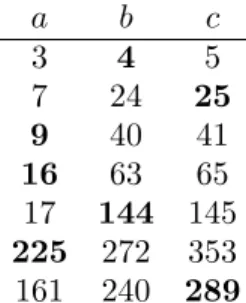
Many primitive Pythagorean triples have just one term a square. See Table 1.
a b c
3 4 5
7 24 25
9 40 41
16 63 65
17 144 145
225 272 353
161 240 289
Table 1. Pythagorean triples with a square term
Corollary 3.13. The only m∈Z+ such that 1 + 2 + 3 +· · ·+m is a fourth power is 1. Proof. Since 1 + 2 + 3 +· · ·+m=m(m+ 1)/2, we are trying to solve m(m+ 1)/2 = n4. Clearing the denominator, m(m+ 1) = 2n4. Since m andm+ 1 are relatively prime,
{m, m+ 1}={x4,2y4}
for some positive integersxandy, which must be relatively prime. Thereforex4−2y4=±1. Rewrite asy4 = (x4∓1)/2 and square both sides followed by a little algebra to get
(3.9) y8±x4=
x4±1 2
2
The right side is an integer since x is odd from x4 = 2y4±1. Equation (3.9) expresses a sum or difference of positive fourth powers as a perfect square. Using Theorems 3.1 and 3.10, we see this is impossible for a sum, and for a difference the square must be 0, sox= 1
(sincex >0). Thereforem= 1.
Now we present consequences of Theorem 3.10 alone, paralleling the consequences of Theorem 3.1.
Corollary 3.14. Any rational solution to x4−y4 =z2 has y or z equal to 0.
Proof. Similar to Corollary 3.3.
Corollary 3.15. The only rational solutions to y2=x4−1 are (±1,0).
Proof. Similar to Corollary 3.4.
Corollary 3.16. The only rational solutions to 2y2 =x4+ 1are (±1,±1).
Proof. Squaring both sides, 4y4 =x8+ 2x4+ 1. Subtract 4x4 from both sides and divide by 4 to get y4−x4= ((x4−1)/2)2. Since x6= 0 in the original equation, we can divide by x4 to get (y/x)4−1 = ((x4−1)/2x2)2. By Corollary 3.15, (x4−1)/2x2 = 0, sox=±1 and
therefore y=±1.
Corollary 3.17. The integral solutions of x4+y4= 2z2 are (x,±x,±x2).
Proof. If y = 0 then x = z = 0 since √2 is irrational. If y 6= 0, then divide by y4 to get (x/y)4+ 1 = 2(z/y2)2. By Corollary 3.16, x/y = ±1 and z/y2 = ±1, soy =±x and
z=±y2 =±x2.
Corollary 3.18. The only rational solutions to y2=x3+ 4x are(0,0) and(2,±4). Proof. A bijection between solutions ofy2 =x3+ 4xwithx6= 0 and solutions ofv2 =u4−1 is given by
(x, y)7→
y 2x,
y2−8x 4x2
, (u, v)7→
2 u2−v,
4u u2−v
.
Any rational solution to v2 = u4 −1 has v = 0, so any rational solution to y2 = x3 + 4x hasx = 0 ory2 = 8x. The second case impliesx3 = 4x, sox=±2. Onlyx= 2 leads to a
solution, (x, y) = (2,±4).
Corollary 3.19. The only rational solutions to y2=x3−x are (0,0)and (±1,0).
Proof. This stands in relation to x4 −y4 = z2 in the same way thaty2 = x3+x does to x4+y4 =z2 in Corollary 3.8. Details are left to the reader as an exercise.
Remark 3.20. In the other direction, Corollary 3.19 implies Theorem 3.10. The argument is like that in Remark 3.9.
4. Equation with no rational function solution
There are many rational solutions tox2+y2 = 1, like (x, y) = (3/5,4/5) or (5/13,12/13). These solutions are nearly all described by a single parametric formula: x= 2t/(1 +t2) and y= (1−t2)/(1 +t2) for some t∈Q. Try t= 1/3, 1/4, and 1/5. Algebraically, we have an identity of rational functions
2t 1 +t2
2
+
1−t2 1 +t2
2
and specializing tto rational numbers gives rational solutions tox2+y2= 1.1
However, it is not true that rational solutions to other equations can always be fit into a parametric formula using rational functions. For example, the equation y2 =x3−2 has infinitely many rational solutions (two of them are (x, y) = (3,5) and (129/100,383/1000)), but there are no rational functions f(t) and g(t) inQ(t) such that g(t)2 =f(t)3−2 other than constant functions, which “parametrize” only one solution (so really do not provide a parametric formula at all). To prove negative results like this we will use descent on the degree in a hypothetical nonconstant solution.
Several times we will need the following lemma.
Lemma 4.1. If f(t) and g(t) in C[t]are relatively prime and f g= in C[t] thenf =
and g= in C[t].
Proof. By unique factoriatization, the multiplicity of any irreducible factor of f g is even. Since f and g are relatively prime, it follows that the multiplicity of any irreducible factor of f is even and likewise for g. Therefore f and g are squares up to a nonzero scaling factor. Every nonzero complex number is the square of a complex number, so f and g are
squares.
This lemma easily extends by induction on the number of terms to a product of any finite number of polynomials inC[t] that are pairwise relatively prime.
Theorem 4.2. For distinct complex numbers r, r0, r00, any solution to the equation y2 = (x−r)(x−r0)(x−r00) in rational functions x = f(t) and y = g(t) in C(t) is a constant solution: f(t) and g(t) are inC.
The example y2 =x3−2 that we discussed above is the special case where r, r0, and r00 are the three cube roots of 2.
Proof. Our argument is adapted from [2, pp. 75–76].
Assume there is a solution in rational functions: x = p1(t)/p2(t) and y = q1(t)/q2(t)
where p1(t), p2(t), q1(t), and q2(t) are polynomials in C[t]. Without loss of generality we
can assume (p1, p2) = 1 and (q1, q2) = 1 in C[t].
Substituting the formulas forx and y into the equationy2 = (x−r)(x−r0)(x−r00), we have
q12 q2 2
=
p1
p2
−r p1
p2
−r0 p1
p2
−r00
= (p1−rp2)(p1−r
0p
2)(p1−r00p2)
p3 2
, so after clearing denominators
(4.1) p32q12= (p1−rp2)(p1−r0p2)(p1−r00p2)q22.
Since (p1, p2) = 1, the factors p1−rp2,p1−r0p2, andp1−r00p2 are relatively prime to p2
(why?). Thus by (4.1), p32|q2
2. Since (q1, q2) = 1,q22|p32, sop32=cq22 for some nonzero c∈C.
Since c is a square in C, p32 is a square in C[t]. That implies p2 is a square by unique
factorization inC[t]. Write p2 =f22.
Substituting cq22 forp32 in (4.1) and cancellingq22 from both sides, cq12 = (p1−rp2)(p1−r0p2)(p1−r00p2). 1This method produces all the rational solutions tox2
+y2 = 1 except for (0,−1), but we will not show that here.
The factors on the right side are pairwise relatively prime since (p1, p2) = 1 (why?) and the
numbersr, r0, andr00 are distinct, so by an extension of Lemma 4.1 to a product of three terms,p1−rp2,p1−r0p2, and p1−r00p2 are all squares inC[t]. Sincep2 =f22,
p1−rf22=, p1−r0f22=, p1−r00f22 =.
Writing the first equation as p1−rf22=f12, the second and third equations become
(4.2) f12−(r0−r)f22 =, f12−(r00−r)f22=,
wherer0−r and r00−r are nonzero and distinct. We want to showf1 andf2 are constant.
Now we set up our descent statement, based on (4.2): we will show for all distinctaand bin Cthat relatively prime polynomialsg1 and g2 in C[t] that satisfy
(4.3) g12−ag22 =, g21−bg22=
must both be constant. Note (4.2) is a special case of this.
Assume for some aand b that there is a solution (g1, g2) to (4.3) where g1 or g2 is not
constant. In (4.3), write a =c2 and b= d2 with c and din C. Since a6=b, c 6=±d. We can rewrite (4.3) as
(4.4) (g1+cg2)(g1−cg2) =, (g1+dg2)(g1−dg2) =.
A common factor of g1 +cg2 and g1−cg2 is a factor of both g1 and g2 (why?), so it is
constant since (g1, g2) = 1. Therefore the factors on the left side of the first equation in
(4.4) are relatively prime, and the product of the factors is a square, so by Lemma 4.1 (4.5) g1+cg2 =h21, g1−cg2 =h22,
where h1 and h2 are relatively prime. Adding and subtracting the equations in (4.5),
g1 = (h21+h22)/2 and g2 = (h21−h22)/(2c). Since g1 or g2 is not constant, h1 or h2 is not
constant.
Arguing in a similar way with the second equation in (4.4),
(4.6) g1+dg2 =, g1−dg2=.
Substituting the formulas forg1 and g2 in terms ofh1 and h2 into (4.6),
1 2
1 +d c
h21+1 2
1−d c
h22 =, 1 2
1−d c
h21+1 2
1 +d c
h22=. The numbers 1±d/care nonzero sincec6=±d, so we can divide by the coefficient ofh21:
h21+1−d/c 1 +d/ch
2
2 =, h21+
1 +d/c 1−d/ch
2 2 =.
Set a0 = −(1−d/c)/(1 +d/c) and b0 = −(1 +d/c)/(1−d/c) = 1/a0. Both a0 and b0 are nonzero, a0 6=b0, and
(4.7) h21−a0h22 =, h21−b0h22=.
From (4.5), 2 degh1 ≤max(degg1,degg2) and 2 degh2≤max(degg1,degg2). Therefore
(4.8) 0<max(degh1,degh2)≤
1
2max(degg1,degg2).
We can now repeat the argument leading from (4.3) to (4.7) withh1, h2, a0, b0 in place of
g1, g2, a, b. Each repetition leads to a new version of (4.8) where the maximum degree in
the new solution is positive and smaller than the maximum degree in the previous solution. By descent this leads to a contradiction (positive degrees can’t strictly drop forever), so any
solution to (4.3) in relatively prime polynomialsg1andg2must be a constant solution. What
this tells us in (4.2) is that f1 and f2 are both constant, sop1 =f12+rf22 and p2 =f22 are
constant. That makesx=p1/p2constant, so the equationy2 = (x−r)(x−r0)(x−r00) implies
thaty2 = (q1/q2)2 is constant. Therefore the rational functiony =q1/q2 is constant. Corollary 4.3. Let F(x) be a polynomial with coefficients in C of degree 3 or 4 that has distinct roots. If x andy in C(t) satisfy y2=F(x) then x∈Cand y∈C.
Proof. First suppose F(x) has degree 3. In factored form F(x) = c(x−r)(x−r0)(x−r00) where the rootsr,r0, and r00 are distinct andc6= 0.2 In C,c is a square, so the equation (4.9) y2=c(x−r)(x−r0)(x−r00)
can be scaled to Y2 = (x−r)(x−r0)(x−r00) where Y = y/√c. If there is a solution to (4.9) wherex, y∈C(t) thenY ∈C(t). By Theorem 4.2, x∈Cand Y ∈C, so y∈C.
Next supposeF(x) has degree 4 with distinct roots r,r0,r00, and r000. In factored form F(x) =c(x−r)(x−r0)(x−r00)(x−r000),
wherec6= 0. Suppose we can solve
(4.10) y2 =c(x−r)(x−r0)(x−r00)(x−r000)
where x, y ∈ C(t). The roots of F are distinct, so without loss of generality x 6= r000. Dividing through (4.10) by (x−r000)4,
y2
(x−r000)4 = c
x−r x−r000
x−r0 x−r000
x−r00 x−r000
= c
1 +r
000−r
x−r000 1 +
r00−r
x−r000 1 +
r0−r x−r000
. SetX = 1/(x−r000) andY =y/(x−r000)2, soX and Y are in C(t). Then
Y2=c(1 + (r000−r)X)(1 + (r000−r0)X)(1 + (r000−r00)X),
where the right side is cubic inXwith distinct roots. By the cubic case we already discussed, X∈Cand Y ∈C, so x∈Cand y∈C.
5. Sums of two squares
We have used descent to prove “negative” theorems, which say certain equations have no (or very few) solutions of a certain type. Fermat’s initial applications of descent had this flavor.3 He later found descent could be used to prove “positive” theorems like this.
Theorem 5.1. For a prime p, if −1 ≡ modp then we can write p as a sum of two squares: p=x2+y2 for some x and y in Z.
Proof. Write −1 ≡ s2modp. Since s2 ≡ (−s)2 modp we can take 1 ≤ s ≤ p/2, so s2+ 1 =pdwith d∈Z. Sinces2+ 1≤p2/4 + 1< p2, we have 0< d < p. So a multiple of p is a sum of two squares and the multiplying factordis less thanp. If d= 1 we are done.
2The difference between this case and Theorem 4.2 is that we now allow a leading coefficient besides 1. 3Almost none of Fermat’s proofs are known in detail, but he did include in letters that statements of some propositions that he established with descent.
If d > 1, we will show that pd0 is a sum of two squares for some integer d0 such that 0 < d0 < d. Then repeating the argument, by descent eventually we must reach d= 1, so p·1 =p is a sum of two squares.
To make our descent step recursive, generalize the specific equation pd=s2+ 1 to
pk=x2+y2
where 0< k < p. (Fork=dthis holds withx=sandy = 1, so such an equation does exist for some choice of k.) Ifk >1, we want to produce another equation of this form where k is smaller. Reduce xand y modulok: x≡r modkand y≡r0 modk, where|r|,|r0| ≤k/2. Squaring and adding,
r2+r02≡x2+y2≡0 modk, so
r2+r02=k`
for integer`≥0. Let’s showr orr0 is not 0, so` >0. Ifr= 0 andr0= 0 then k|x andk|y, sok2 dividesx2+y2 =kp, so k|p, but this is not true since 0< k < pand pis prime. Now let’s bound`from above. From the bounds on |r|and |r0|,
k`=r2+r02≤ k
2
4 + k2
4 =
k2 2 < k
2,
so 0< ` < k. We will showp` is a sum of two squares. Since
(pk)(k`) = (x2+y2)(r2+r02) = (x2+y2)(r02+r2) = (xr0−yr)2+ (xr+yr0)2. Modulo k, xr0 −yr ≡ xy−yx ≡ 0 and xr+yr0 ≡ r2+r02 ≡ 0. Therefore xr0 −yr and xr+yr0 are multiples of k, so we can write
pk2`= (ka)2+ (kb)2
for some positive integersaandb. Dividing byk2,p`=a2+b2. This completes our descent
step, since 0< ` < k.
Remark 5.2. Fermat’s own proof by descent of Theorem 5.1 was based on counterexamples: assuming some odd p with −1 ≡ modp is not a sum of two squares, Fermat said he could show there has to be a smaller prime with the same property, and thus by descent we eventually will obtain that 5 is not a sum of two squares, but it is, so we have a contradiction.
6. Markoff’s equation
The Markoff equation, introduced by Markoff in 1880, is x2+y2+z2 = 3xyz.
One solution is (1,1,1). Markoff’s insight about this equation is that we can bring 3xyzto the left side to let us interpretx as a root of the quadratic polynomial
T2−(3yz)T + (y2+z2) = 0.
To find the second root of this equation (besides x), we bypass the quadratic formula and think about relations between roots and coefficients. Letting the other root be r, our polynomial is (T −x)(T −r) = T2 −(x +r)T +xr. Therefore x +r = 3yz, so r = 3yz−x. We have obtained from one solution (x, y, z) of Markoff’s equation a second solution: (3yz−x, y, z). Interchanging the roles ofx,y, andz, we similarly get the additional solutions (x,3xz−y, z) and (x, y,3xy−z). From (1,1,1) we can successively generate, for
instance, (2,1,1), (2,1,5), and (2,29,5). Markoff proved that all the solutions in positive integers to his equation can be produced in this way from (1,1,1). His proof, which uses descent, can be found in [4].
We want to use descent for a different purpose, also taken from [4]. We will prove a theorem of Frobenius and Hurwitz that shows the special role of 3 as a coefficient on the right side of Markoff’s equation.
Theorem 6.1. For any positive integerkother than1or3, the equationx2+y2+z2=kxyz
has no integral solution except (0,0,0).
Proof. First we will treat the casek >3, returning later to k= 2.
Supposea, b, and csatisfya2+b2+c2=kabc. If any ofa,b, or c is 0 then the equation says the sum of the squares of the other two is 0, soa,b, andc are all 0. Thus, assuming (a, b, c) 6= (0,0,0) means a, b, and c are all nonzero. At least one of them is positive (otherwise the right side of the equation is negative). The other two are both positive or both negative, and in the negative case we can change their signs to get a solution where all are positive. So without loss of generality a,b, and c are all positive.
The numbers a,b, and c are distinct. To show this, we argue by contradiction. Suppose (without loss of generality) thata=b. Then 2a2+c2 =ka2c, soa2(kc−2) =c2. Therefore kc−2 is a rational square, hence an integral square. Write kc−2 = d2 with d ≥ 1, so kc= 2 +d2. Therefore 2a2+c2= (2 +d2)a2, soc2 =d2a2, soc=da. Now d2 =kc−2 = k(da)−2, so 2 =d(ka−d), which means d|2, so dis 1 or 2. In either case we getka= 3, which contradictsk >3.
Without loss of generality, saya > b > c ≥1. The triple (kbc−a, b, c) is also a solution tox2+y2+z2 =kxyz, andkbc−ais positive sincea(kbc−a) =b2+c2 anda >0. Which
coordinate in (kbc−a, b, c) is maximal? We know b > c by design. Is kbc−a > b or is b > kbc−a? We answer this by looking at the polynomial f(x) = x2−(kbc)x+b2+c2. The roots of f(x) area andkbc−a, and
f(b) = 2b2+c2−kb2c≤2b2+c2−kb2<3b2−kb2 = (3−k)b2 <0.
The region wheref is negative is between its two roots. Thusblies betweenaandkbc−a. Since b < a we must havekbc−a < b, so
0<max(kbc−a, b, c) =b < a= max(a, b, c),
Repeating this construction, by descent we get a contradiction, so the equationa2+b2+c2= kabchas only (0,0,0) as an integer solution whenk >3.
Now we look at k = 2. Suppose a2 +b2+c2 = 2abc with integers a, b, and c. Since a2+b2+c2 is even, a,b, andcare not all odd. If exactly 1 of them is even then reducing both sides of the equation modulo 4 gives 2 ≡ 0 mod 4, a contradiction. If exactly 2 are even then reducing modulo 2 gives 1≡0 mod 2, another contradiction. Thereforea,b, and c are all even. Write a = 2a0, b = 2b0, and c = 2c0, so a02 +b02 +c02 = 4a0b0c0. This is the case k = 4, which we have already shown has no integral solution except (0,0,0), so
(a, b, c) = (2a0,2b0,2c0) = (0,0,0).
Why isk= 1 not considered in Theorem 6.1? Looking at the equationx2+y2+z2=xyz modulo 3 shows x, y, and z are all multiples of 3 (check!). Writing x = 3x0, y = 3y0, and z = 3z0 yields x02 +y02+z02 = 3x0y0z0, so any integral solution to x2 +y2 +z2 = xyz is simply 3 times an integral solution of Markoff’s equation.
Appendix A. Areas of Right Triangles
We saw in Section 3 that Fermat’s Last Theorem for exponent 4 is a consequence of x4+y4 =z2 having no solution in positive integers. Here we will explain the background that led Fermat to this equation, which has nothing to do with Fermat’s Last Theorem. Fermat was thinking about the following problems concerning areas of right triangles:
(1) Can a right triangle with integer side lengths have the same area as a square with integer side lengths?
(2) Can a right triangle with integer side lengths have twice the area of a square with integer side lengths?
Algebraically, if (a, b, c) is a Pythagorean triple we are asking if (1/2)abcan be a perfect square or twice a perfect square.
The first question is connected with x4−y4 =z2 and the second question is connected
with x4 +y4 = z2. This is explained in Table 2. The first column shows how to turn a Pythagorean triple (a, b, c) such that (1/2)ab is a perfect square into a positive integer solution of x4 −y4 = z2. In the second column we turn such a solution (x, y, z) into a Pythagorean triple (a, b, c) such that (1/2)ab is a perfect square. In the next two columns we turn Pythagorean triples (a, b, c) with (1/2)abbeing twice a perfect square into positive integer solutions of x4+y4 =z2 and vice versa. Note din the fourth column is an integer sincex ory must be even (otherwisez2≡2 mod 4, which is impossible)
a2+b2 =c2, x4−y4=z2 a2+b2=c2, x4+y4 =z2
1
2ab=d2
1
2ab= 2d2
x=c a=z2 x=b a=x2
y= 2d b= 2x2y2 y= 2d b=y2 z=|a2−b2| c=x4+y4 z=bc c=z
d=xyz d=xy/2
Table 2.
The transformations we wrote down in the table from (a, b, c) to (x, y, z) and back again are not inverses to each other, but they at least show the existence of an integral right triangle having a certain kind of area is equivalent to the existence of a positive integer solution to a certain equation.
We showed by descent in Theorems 3.1 and 3.10 that x4±y4 = z2 has no solution in
positive integers, so there are no integral right triangles whose area is a perfect square or twice a perfect square.
Appendix B. Another descent with sums of two squares
We will prove a theorem by descent where rational solvability of an equation implies integral solvability.
Theorem B.1. Let n∈Z+. If n is a sum of two rational squares then it is a sum of two integral squares.
This is saying: if n = x2+y2 has a solution in fractions then it also has a solution in integers.
Example B.2. We have 193 = (933/101)2+ (1048/101)2 = (83/109)2+ (1512/109)2 and 193 = 72+ 122.
Proof. Our descent argument is taken from [5, App. II, Chap. III], and the main idea goes back to L. Aubry (1912).
Suppose n = r2
1 +r22 with fractions r1 and r2. If r1 and r2 are in Z, we’re done, so
we assume at least one of them is not in Z. Write the ri’s with a common denominator: r1 = a1/b and r2 = a2/b, where the a1, a2, and b are in Z and b > 1. We want to
write n=r021 +r202 where r10 and r02 are fractions with a common denominator less thanb. Repeating this enough times, we will eventually get a common denominator of 1, meaning we have writtennas a sum of integral squares.
The point (r1, r2) lies on the circlex2+y2 =n. Pick a nearbyZ-point in the plane: choose
k1andk2inZsuch that|ri−ki| ≤1/2. Sincer1andr2 are not both inZ, (r1, r2)6= (k1, k2),
so there is a line through these two points. This line meets the circlex2+y2 =nin the point (r1, r2). We will show this line meets the circle in a second point with rational coordinates
having a smaller common denominator than b (a common denominator of the coordinates of the point (r1, r2)).
First let’s check the line through (r1, r2) and (k1, k2) meets x2 +y2 = n in a second
point. We argue by contradiction. If the line only meets the circle at (r1, r2) then the line
is tangent to the circle at (r1, r2), so the three points (r1, r2), (k1, k2), and (0,0) are the
vertices of a right triangle (a tangent line to a point on a circle is always perpendicular to the line connecting the origin to the point of tangency). Then the Pythagorean theorem tells us
k21+k22 = (r21+r22) + ((k1−r1)2+ (k2−r2)2) =n+ ((k1−r1)2+ (k2−r2)2).
Both k12+k22 and nare integers, so (k1−r1)2+ (k2−r2)2 is an integer. However,|k1−r1|
and |k2−r2|are both less than 1/2, so 0≤(k1−r1)2+ (k2−r2)2≤(1/2)2+ (1/2)2 = 1/2.
Then the only way (k1 −r1)2 + (k2 −r2)2 could be an integer is if it is 0, which forces
r1 = k1 and r2 = k2. However, we are supposing r1 and r2 are not both integers, so we
have a contradiction.
Now let’s look more closely at the algebraic formula for the squared distance between (r1, r2) and (k1, k2). This number, which is positive, equals
(r1−k1)2+ (r2−k2)2 = a1
b −k1
2
+
a2
b −k2
2
=
a1
b
2
+
a2
b
2
−2(a1k1+a2k2)
b +k
2 1+k22
= n−2(a1k1+a2k2)
b +k
2 1+k22
= n+k21+k22−2(a1k1+a2k2)
b .
We can write this fraction in the formb0/b, where
b0:=b(n+k12+k22)−2(a1k1+a2k2)∈Z
and
(r1−k1)2+ (r2−k2)2 =
b0
b =⇒(a1−bk1)
2+ (a
2−bk2)2=bb0.
We will show the line through (r1, r2) and (k1, k2) meets x2+y2 = n in a rational point
(1/2)2+ (1/2)2= 1/2, we have 0< b0/b≤1/2, so 0< b0 ≤ b
2 < b.
The line through (r1, r2) and (k1, k2) can be described parametrically by
(B.1) L(t) = (k1+ (r1−k1)t, k2+ (r2−k2)t).
This meets x2+y2 =n att= 1 (L(1) = (r1, r2)). Where else does it meet the circle? To
find out, we solve for tin
n = (k1+ (r1−k1)t)2+ (k2+ (r2−k2)t)2
= k12+ 2k1(r1−k1)t+ (r1−k1)2t2+k22+ 2k2(r2−k2)t+ (r2−k2)2t2
= k12+k22+ 2(k1r1−k12+k2r2−k22)t+ ((r1−k1)2+ (r2−k2)2)t2
= k12+k22+ 2(k1r1+k2r2−(k21+k22))t+ ((r1−k1)2+ (r2−k2)2)t2
= k12+k22+2(a1k1+a2k2)−2b(k
2 1 +k22)
b t+
(a1−bk1)2+ (a2−bk2)2
b2 t
2.
Using the definition of b0 to rewrite the coefficients oft and t2, we have n = k12+k22+b(n+k
2
1+k22)−b0−2b(k12+k22)
b t+
b0 bt
2
= k12+k22+
n−(k21+k22)−b
0
b
t+b
0
bt
2.
Bringing all terms to the right side, 0 = b
0
bt
2+
n−(k12+k22)−b
0
b
t+k12+k22−n.
This has a root att= 1 (becauseL(1) is on the circle, but it can also be seen algebraically), so we know t−1 is a factor on the right, leading to
0 = (t−1)
b0
bt+n−(k
2 1+k22)
.
Thus the second point of intersection of the lineL(t) with the circlex2+y2 =nis at
t= b(k
2
1+k22−n)
b0 .
Feeding this value oftinto (B.1), and writing ri asai/b, we get the point L
b(k12+k22−n) b0
=
k1+
(a1−bk1)(k12+k22−n)
b0 , k2+
(a2−bk2)(k12+k22−n)
b0
, which shows this second point of intersection of the line and circle is a rational point and b0 is a common denominator for its coordinates. We noted earlier that 0< b0 ≤b/2< b, so the common denominator for this new rational point on x2 +y2 =n is smaller than that
for (r1, r2), so we are done.
The proof of Theorem B.1 works for a sum of three squares, using lines and spheres in three dimensions. That is, an integer that is a sum of three rational squares is also a sum of three integral squares. The only change to be made in the proof is the following: now we
have |ai/b−ki| ≤1/2 for i= 1,2,3, and (a1/b−k1)2+ (a2/b−k2)2+ (a3/b−k3)2 ≤3/4
denominator b0 ≤(3/4)b, which is still less than b, which means everything still works in the proof when it is done for sums of three squares.
It is a theorem of Lagrange (1770) that every positive integer is a sum of four squares. This is called the four-square theorem and it suggests an analogue of Theorem B.1 for four squares is pointless. But historically it went the other way: Euler (1751) was able to prove every positive integer is a sum of four rational squares and could not figure out how to use this to prove every positive integer is a sum of four integral squares. After Lagrange’s proof of the four-square theorem, Euler realized how he could make a descent argument work and thereby deduce Lagrange’s integral four-square theorem from his own rational four-square theorem.
Theorem B.1 is no longer true if we replace sums of two squares by slightly different algebraic expressions. For example, the equation x2+ 82y2 = 2 has no integral solutions, but it has the rational solution (x, y) = (4/7,1/7). The equation x3 +y3 = 13 has no integral solutions but it has the rational solution (x, y) = (7/3,2/3).
References
[1] J. W. S. Cassels,Lectures on Elliptic Curves, Cambridge Univ. Press, Cambridge, 1991. [2] H. Clemens,A Scrapbook of Complex Curve Theory, 2nd ed., Amer. Math. Soc., 2003.
[3] D. Kalman, R. Mena, and S. Shahriari, “Variations on an Irrational Theme – Geometry, Dynamics, Algebra,” Math. Mag.70(1997), 93–104.
[4] M. G. Krein, “Markov’s Diophantine Equation,” pp. 121–126 inKvant Selecta: Algebra and Analysis, I
(S. Tabachnikov, ed.), Amer. Math. Soc., Providence, 1991.
[5] A. Weil, Number Theory: An Approach Through History from Hammurapi to Legendre, Birkh¨auser, Boston, 1984.