Typed Lua: An Optional Type System for Lua
André Murbach Maidl
PUC-Rio Rio de Janeiro, Brazil
[email protected]
Fabio Mascarenhas
UFRJRio de Janeiro, Brazil
[email protected]
Roberto Ierusalimschy
PUC-RioRio de Janeiro, Brazil
[email protected]
ABSTRACT
Dynamically typed languages trade flexibility and ease of use for safety, while statically typed languages prioritize the early detection of bugs, and provide a better framework for structure large programs. The idea of optional typing is to combine the two approaches in the same language: the pro-grammer can begin development with dynamic types, and migrate to static types as the program matures. The chal-lenge is designing a type system that feels natural to the programmer that is used to programming in a dynamic lan-guage.
This paper presents the initial design of Typed Lua, an optionally-typed extension of the Lua scripting language. Lua is an imperative scripting language with first class func-tions and lightweight metaprogramming mechanisms. The design of Typed Lua’s type system has a novel combination of features that preserves some of the idioms that Lua pro-grammers are used to, while bringing static type safety to them. We show how the major features of the type system type these idioms with some examples, and discuss some of the design issues we faced.
Categories and Subject Descriptors
D.3.1 [Programming Languages]: Formal Definitions and Theory—Semantics; F.3.3 [Logics and Meanings of Pro-grams]: Studies of Program Constructs—Type structure
Keywords
Lua programming language, type systems, optional typing, gradual typing
1.
INTRODUCTION
Dynamically typed languages such as Lua avoid static types in favor of runtimetype tags that classify the values they compute, and their implementations use these tags to
Permission to make digital or hard copies of all or part of this work for per-sonal or classroom use is granted without fee provided that copies are not made or distributed for profit or commercial advantage and that copies bear this notice and the full citation on the first page. Copyrights for components of this work owned by others than the author(s) must be honored. Abstract-ing with credit is permitted. To copy otherwise, or republish, to post on servers or to redistribute to lists, requires prior specific permission and/or a fee. Request permissions from [email protected].
Dyla’14, June 09-11 2014, Edinburgh, United Kingdom
Copyright is held by the owner/author(s). Publication rights licensed to ACM.
ACM 978-1-4503-2916-3/14/06 ...$15.00
http://dx.doi.org/10.1145/2617548.2617553.
perform runtime (or dynamic) checking and guarantee that only valid operations are performed [21].
The absence of static types means that programmers do not need to bother about abstracting types that might re-quire a complex type system and type checker to validate, leading to simpler and more flexible languages and imple-mentations. But this absence may also hide bugs that will be caught only after deployment if programmers do not prop-erly test their code.
In contrast, static type checking helps programmers de-tect many bugs during the development phase. Static types also provide a conceptual framework that helps program-mers define modules and interfaces that can be combined to structure the development of large programs.
The early error detection and better program structure afforded by static type checking can lead programmers to migrate their code from a dynamically typed to a statically typed language, once their simple scripts become complex programs [28]. As this migration involves languages with different syntax and semantics, it requires a complete rewrite of existing programs instead of incremental evolution from dynamic to static types.
Ideally, programming languages should offer programmers the option to choose between static and dynamic typing: optional type systems [7] and gradual typing [22] are two approaches that offer programmers the option to use type annotations where static typing is needed, incrementally mi-grating a system from dynamic to static types. The differ-ence between these two approaches is the way they treat runtime semantics: while optional type systems do not affect the runtime semantics, gradual typing uses runtime checks to ensure that dynamically typed code does not violate the invariants of statically typed code.
This paper presents the initial design of Typed Lua: an optional type system for Lua that is complex enough to pre-serve some of the idioms that Lua programmers are already used to, while adding new constructs that help programmers structure Lua programs.
Lua is a small imperative scripting language with first-class functions (with proper lexical scoping) where the main data structure is thetable, an associative array that can play the part of arrays, records, maps, objects, etc. with syntac-tic sugar and metaprogramming through operator overload-ing built into the language. Unlike other scriptoverload-ing languages, Lua has very limited coercion among different data types.
The primary use of Lua has always been as an embedded language for configuration and extension of other applica-tions. Lua prefers to provide mechanisms instead of fixed
policies for structuring programs, and even features such as a module system and object orientation are a matter of con-vention instead of built into the language. The result is a fragmented ecosystem of libraries, and different ideas among Lua programmers on how they should use the language fea-tures and how they should structure programs.
The lack of standard policies is a challenge for the design of a static type system for the Lua language. The design of Typed Lua is informed by a (mostly automated) survey of Lua idioms used in a large corpus of Lua libraries, instead of relying just on the semantics of the language.
Typed Lua allows statically typed Lua code to coexist and interact with dynamically typed code. The Typed Lua com-piler warns the programmer about type errors, but always generates Lua code that runs in unmodified Lua implemen-tations. The programmer can enjoy some of the benefits of static types even without converting existing Lua modules to Typed Lua: a dynamically typed module can export a statically typed interface, and statically typed users of the module will have their use of the module checked by the compiler.
Unlike gradual type systems, Typed Lua does not insert runtime checks between dynamically and statically typed parts of the program. Unlike some optional type systems, the statically typed subset of Typed Lua is sound by design, so a later version of the Typed Lua compiler can swicth to gradual instead of just optional typing.
We cover the main parts of the design, along with how they relate to Lua, in Sections 2 through 6. Section 7 reviews related work on mixing static and dynamic typing in the same language. Finally, Section 8 gives some concluding remarks and future extensions for Typed Lua.
2.
ATOMIC TYPES AND FUNCTIONS
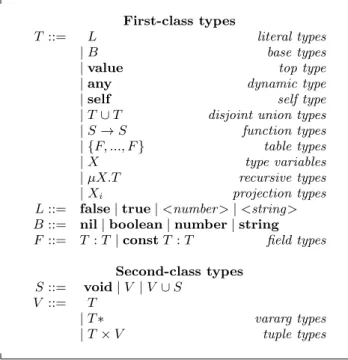
Lua values can have one of eighttags:nil,boolean,number, string,function,table,userdata, andthread. In this section, we will see how Typed Lua assigns types to values of the first five.Figure 1 gives the abstract syntax of Typed Lua types. Onlyfirst-class typescorrespond to actual Lua values; second-class types correspond to expression lists, and Typed Lua uses them to type multiple assignment and function appli-cation.
Types are ordered by a subtype relationship, where any first-class type is a subtype ofvalue. The rest of the sub-type relationship is standard: union sub-types are supersub-types of their parts,number,boolean, andstringare supertypes of their respective literal types, function types are related by contravariance on the input part and covariance in the output part, table types have width subtyping, with depth subtyping onconstfields, tuple and vararg types are covari-ant.
Thedynamic typeanyallows dynamically typed code to interoperate with statically typed code; it is a subtype of
value, but neither a supertype nor a subtype of any other type. We relate any to other types with the consistency and consistent- subtype relationships used by gradual type systems [22, 23]. In practice, we can pass a value of the dynamic type anytime we want a value of some other type, and can pass any value where a value of the dynamic type is expected, but these operations are tracked by the type system, and the programmer can choose to be warned about them.
Type Language
First-class types
T ::= L literal types
|B base types
|value top type
|any dynamic type
|self self type
|T∪T disjoint union types
|S→S function types
| {F, ..., F} table types
|X type variables
|µX.T recursive types
|Xi projection types
L::= false|true|<number>|<string> B::= nil|boolean|number|string
F ::= T :T |constT :T field types
Second-class types
S::= void|V |V ∪S V ::= T
|T∗ vararg types
|T×V tuple types
Figure 1: Abstract syntax of Typed Lua types
Typed Lua allows optional type annotations in variable function declarations. It assigns the dynamic type to any parameter that does not have a type annotation, but as-signs more precise types to unannotated variables, based on the type of the expression that gives the initial value of the variable.
In the following example, we use type annotations in a function declaration but do not use type annotations in the declaration of a local variable:
local function factorial(n: number): number if n == 0 then
return 1 else
return n * factorial(n - 1) end
end
local x = 5
print(factorial(x))
The compiler assigns the typenumberto the local vari-ablex, and this example compiles without warnings. Typed Lua allows programmers to combine annotated code with unannotated code, as we show in the following example:
local function abs(n: number) if n < 0 then
return -n else
return n end end
local function distance(x, y) return abs(x - y)
end
parameters ofdistancebecause they do not have type an-notations. Subtracting a value of type any from another also yields a value of typeany(Lua has operator overload-ing, so the minus operation is not guaranteed to return a number in this case), but consistent subtyping lets us pass a value of typeanyto a function that expects anumber.
Even though the return types of both absanddistance
are not given, the compiler is able to infer a return type of number to both functions, as they are local and not recursive.
Lua has first-class functions, but they have some peculiar-ities. First, the number of arguments passed to a function does not need to match the function’s arity; Lua silently drops extra arguments after evaluating them, or passesnil
in place of any missing arguments. Second, functions can return any number of values, and the number of values re-turned may not be statically known. Third, Lua also has multiple assignment, and the semantics of argument passing match those of multiple assignment (or vice-versa); calling a function is like doing a multiple assignment where the left side is the parameter list and the right side is the argument list.
Typed Lua uses second-class types to encode the pecu-liarities of argument passing, multiple returns, and multiple assignment. We call them second-class because these types do not correspond to actual values and cannot be assigned to variables or parameters: they are an artifact of the inter-action between the type system and the semantics of Lua.
As we can see in Figure 1, a second-class type in Typed Lua can be a tuple of first-class types optionally ending in a variadic type, or a union of these tuples. A variadic type
T∗is a generator for a sequence of values of typeT ∪nil. Unions of tuples play an important part in functions that are overloaded on the return type, together withprojection types. Both are explained in the next section.
In its default mode of operation, Typed Lua always adds a variadic tail to the parts of a function type if none is specified, to match the semantics of Lua function calls. In the examples above, the types of factorial and abs are actuallynumber×value∗ →number×nil∗, and the type ofdistanceisany×any×value∗ →number×nil∗.
If we callabs with extra arguments, Typed Lua silently ignores them, as the type signature letsabsreceive any num-ber of extra arguments. If we callabs in the right side of an assignment to more than one lvalue, Typed Lua checks if the first lvalue has a type consistent withnumber, and any other lvalues need to have a type consistent withnil.
There is an optional stricter mode of operation where Typed Lua does not give variadic tails to the parts of a function type unless the programmer explictly declares it, and so will also check all function calls for arity mismatch.
A variadic type can only appear in the tail position of a tu-ple, because Lua takes only the first value of any expression that appears in an expression list that is not in tail posi-tion. The following example shows the interaction between multiple returns and expression lists:
local function multiple() return 2, "foo"
end
local function sum(x: number, y: number) return x + y
end
local x, y, z = multiple(), multiple()
print(sum(multiple(), multiple())
Functionmultipleisvalue∗ →number×string×nil∗, andsumisnumber×number×value∗ →number×nil∗. In the right side of the multiple assignment, only the first value produced by the first call to multiple gets used, so the type of the right side isnumber×number×string×
nil∗, and the types assigned tox,y, andzare respectively
number, number, andstring. This also means that the call to sum compiles without errors, as the first two com-ponents of the tuple are consistent with the types of the parameters, and the other components are consistent with
value.
3.
UNIONS
Typed Lua uses union types to encode some common Lua idioms: optional values, overloading based on the tags of input parameters, and overloading on the return type of the functions.
Optional values are unions of some type andnil, and are so common that Typed Lua uses the t? syntax for these unions. They appear any time a function has optional pa-rameters, and any time the program reads a value from an array or map.
local function message(name: string, greeting: string?) local greeting = greeting or "Hello " return greeting .. name
end
print(message("Lua")) print(message("Lua", "Hi"))
In this example, the second parameter is optional but, in the first line of the function, we declare a new variable that is guaranteed to have typestring instead ofstring∪nil. In Lua, any value exceptnilandfalseare “truthy”, so the short-circuiting or operator is a common way of giving a default value to an optional parameter. Typed Lua encodes this idiom with a typing rule: if the left side oforhas type
T∪niland the right side has typeT then theorexpression has typeT.
Declaring a newgreetingvariable that shadows the pa-rameter is not necessary:
local function message(name: string, greeting: string?) greeting = greeting or "Hello "
return greeting .. name end
Typed Lua lets the assignmentx=xorechange the type ofxfromt∪niltot, as long as the type ofeis a subtype of
t,xis local to the current function, and it is not assigned in another function. The change only affects the type ofxin the remainder of the current scope. In the case ofgreeting, the assignment on line three changes its type tostring.
Overloaded functions use thetypefunction to inspect the tag of their parameters, and perform different actions de-pending on what those tags are. The simplest case overloads on just a single parameter:
s2: string|number) if type(s2) == "string" then
return s1 .. s2 else
-- string.rep: (string, number) -> string return string.rep(s1, s2)
end end
Typed Lua has a small set of type predicates that, when used over a local variable in a condition, constrain the type of that variable. The function above uses thetype(x) == "string"predicate which constrains the type ofxfromT∪
stringtostringwhen the predicate is true andT otherwise. This is a simplified form offlow typing[13, 30]. As withor, the variable must be local to the function, and cannot be assigned to in another function.
The type predicates can only discriminate based on tags, so they are limited on the kinds of unions that they can dis-criminate. It is possible to discriminate a union that com-bines a table type with a base type, or a table type with a function type, or a two base types, but it is not possible to discriminate between two different function types.
Functions that overload their return types to signal the occurrence of errors are another common Lua idiom. In this idiom, a function returns its normal set of return values in case of success but, if anything fails, returnsnilas the first value, followed by an error message or other data describing the error, as in the following example:
local function idiv(d1: number, d2: number): (number, number)|(nil, string)
if d2 == 0 then
return nil, "division by zero" else
local r = d1 % d2 local q = (d1 - r)/d2 return q, r
end end
There is also special syntax for this idiom: we could an-notate the return type ofidivwith(number, number)? to denote the same union1.
The full type ofidivisnumber×number×value∗ →
(number×number×nil∗)∪(nil×string×nil∗). A typical client of this function would use it as follows:
local q, r = idiv(n1, n2)
-- q is number|nil, r is number|string if q then
-- q and r are numbers else
-- r is a string end
When Typed Lua encounters a union of tuples in the right side of an declaration, it stores the the union in a special type environment with a fresh name and assignsprojection types to the variables in the left side of the declaration. If the type variable isX, variableqgets type X1 and variabler gets typeX2.
1The parentheses are always necessary here: number? is
number|nil, while(number)? is(number)|(nil, string).
If we need to check a projection type against some other type, we take the union of the corresponding component in each tuple. But if a variable with a projection type appears in a type predicate, the predicate discriminates against all tuples in the union. In the example above,Xis (number×
number×nil∗)∪(nil×string×nil∗) outside of the if
statement, butnumber×number×nil∗in thethenblock andnil×string×nil∗in theelseblock.
Notice that we could also discriminate r using type(r) == "number" as our predicate, with the same result. The first form is more succinct, and more idiomatic. We can also use projection types to write overloaded functions where the type of a parameter depends on the type of another parameter.
Assigning to a variable with a projection type is forbidden, unless the union has been discriminated down to a single tuple, Unrestricted assignment to these variables would be unsound, as it could break the dependency relation between the types in each tuple that is part of the union.
Currently, a limitation of our overloading mechanisms is that the return type cannot depend on the input types; we cannot write a function that is guaranteed to return a num-ber if passed a numnum-ber and guaranteed to return a string if passed a string, for example. While intersection types provide a way to express the type of such a function as
number → number∩string → string, more sophisti-cated flow typing is needed to actually check that a function has this type, and we are still working on this problem.
4.
TABLES AND INTERFACES
Tables are the main mechanism that Lua has to build data structures. They are associative arrays where any value (except nil) can be a key, but with language support for efficiently using tables as tuples, arrays (dense or sparse), records, modules, and objects. In this section, we show how Typed Lua encodes tables as arrays, records, tuples, and plain maps in its type system.
Typed Lua uses the same framework to represent the dif-ferent uses that a Lua table has: table types. A table type
{t1 :u1, . . . , tn :un}represents a map from values of type
ti to values of typeui.
The concrete syntax of Typed Lua has syntax for common table types. One syntax defines table types for maps: it is written{ t: u }, and maps to the table type{t:u}. This table type represents a map that maps values of type t to values of type u. Another syntax defines table types for arrays: it is written { t }, and is equivalent to the table type {number:t}. A third syntax defines table types for records: it is written { s1: t1, ..., sn: tn }, where each si is a literal number, string, or boolean, and maps
to the table type {s1 :t1, ..., sn :tn}, where eachsi is the
corresponding literal type.
The example below shows how we can define a map from strings to numbers; the dot syntax for field access in Lua is actually syntactic sugar for indexing a table with a string literal:
local t: { string: number } = { foo = 1 } local x: number = t.foo -- x gets 1 local y: number = t["bar"] -- runtime error
When accessing a map, there is always the possibility that the key is not there. In Lua, accessing a non-existing key
returnsnil. Typed Lua is stricter, and raises a runtime error in this case. To get a map with the behavior of standard Lua tables, the programmer can use an union:
local t: { string: number? } = { foo = 1 } local x: number = t.foo -- compile error local y: number = t.bar or 0 -- y gets 0 local z: number? = t["bar"] -- z gets nil
Now the Typed Lua compiler will complain about the as-signment on line two. The following example shows how we can declare an array:
local days: { string } = { "Sunday", "Monday", "Tuesday", "Wednesday", "Thursday",
"Friday", "Saturday" }
local x = days[1] -- x gets "Sunday" local y = days[8] -- runtime error
Notice that we have the same strictness with missing ele-ments, unless the type of the elements hasnilas a possible value.
While this runtime check is an instance where the seman-tics of a Typed Lua program deviates from the semanseman-tics of plain Lua, the alternatives would be to make all arrays and maps have an element type that includesnil, and ei-ther make the programmer narrow the type withoror anif
statement, making using the elements more incovenient, or makenil a subtype of every type, reducing the amount of type safety in the system. Notice that this does not change the semantics of dynamically typed programs, as the run-time checks are only added when the table has a strict static type.
If we want to declare a tuple, we can leave the variable declaration unannotated and let Typed Lua assign a more specific table type to the variable. If we remove the an-notation in the previous example, the compiler assigns the following table type todays:
{1 :string, 2 :string, 3 :string, 4 :string,
5 :string, 6 :string, 7 :string}
This type is not a subtype of{number:string}, nor is
{number:string}a subtype of{number:string∪nil}, because in both cases the subtype relationship would be unsound. In the first case, a table type with the same fields as the type above, plus 8 : number, is a subtype of the table type above, so would also be a subtype of
{number:string}, which is clearly unsound. In the sec-ond case, covariance in the type of mutable fields is also unsound, for the same reason as the unsoundness of array covariance.
While the record type above, {number : string}, and
{number : string∪nil} are disjoint, all three types are valid for the table constructed in the example. Typed Lua actually assigns different types to a table constructor expres-sion depending on the context where it is used.
Finally, the next example shows how we can declare a record:
local person: { "firstname": string, "lastname": string } = { firstname = "Lou", lastname = "Reed" }
We could leave the type annotation out, and Typed Lua would assign the same type toperson.
As records get bigger, and types of record fields get more complicated, writing table types can be unwieldy, so Typed Lua hasinterfacesas syntactic sugar for record types:
local interface Person firstname: string lastname: string end
The declaration above declaresPerson as an alias to the record type {“firstname”: string, “lastname”: string} in the remainder of the current scope. We can now usePerson
in type declarations:
local function greet(person: Person) return "Hello, " .. person.firstname ..
" " .. person.lastname end
local user1 = { firstname = "Lewis", middlename = "Allan", lastname = "Reed" } local user2 = { firstname = "Lou" } local user3 = { lastname = "Reed",
firstname = "Lou" } local user4 = { "Lou", "Reed" }
print(greeter(user1)) -- Hello, Lewis Reed print(greeter(user2)) -- Error
print(greeter(user3)) -- Hello, Lou Reed print(greeter(user4)) -- Error
If our record type has fields that can benil, we need to use an explicit type declaration when declaring a variable of this record type, as the following example shows:
local interface Person firstname: string middlename: string? lastname: string end
local user1: Person = { firstname = "Lewis", middlename = "Allan", lastname = "Reed" } local user2: Person = { lastname = "Reed",
firstname = "Lou" }
We need an explicit type declaration because neither of the types that the Typed Lua compiler assigns to the ta-ble constructors above is a subtype of{“firstname”: string, “middlename”: string∪nil, “lastname”: string}, the type thatPersondescribes.
We can also use interfaces to define recursive types:
local interface Element info: number
next: Element? end
It is common in Lua programs to build a record incre-mentally, starting with an empty table, as in the following example:
local person = {} person.firstname = "Lou" person.lastname = "Reed"
Ideally, we want the type ofpersonto change as the table gets built, from {}to {“firstname”: string} and finally to
{“firstname”: string, “lastname”: string}. This is tricker than the type change introduced by assignment that we saw in Section 2.2, as what is changing is not just the type of the variableperson but the type of the value thatperson
points to. This is safe in the example above, but not in the example below:
local bogus = { firstname = 1 } local person: {} = bogus person.firstname = "Lou" person.lastname = "Reed"
The assignment on line two is perfectly legal, as the type ofbogusis a subtype of{}. But changing the type ofperson
would be unsound: person.firstnameis now astring, but
bogus.firstnameis still typed as a number. We do not even need to declare a type for aliasing to be a problem:
local person = {} local bogus = person bogus.firstname = 1 person.firstname = "Lou" person.lastname = "Reed"
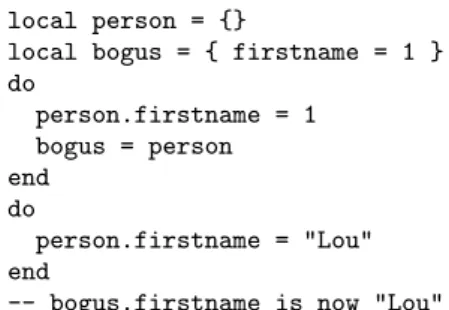
Taken individually, the changes to the type of the two variables look fine, but aliasing makes one of them unsound. The location of the change also matters, as the next example shows:
local person = {}
local bogus = { firstname = 1 } do
person.firstname = 1 bogus = person end
do
person.firstname = "Lou" end
-- bogus.firstname is now "Lou"
The initial type ofperson in all of these examples is{}, but theoriginof this type judgment matters on whether it is sound to allow a change to the type ofpersonor not, even if the change is always towards a subtype of the current type. Typed Lua tags a variable with a table type as eitheropen orclosed. If a variable gets its type from a table constructor then it is open, otherwise it is always closed. The type of an open variable may change by field assignment, subject to three restrictions: the variable must be local to the cur-rent block, the new type must be a subtype of the old type, and the variable cannot have been assigned to in another function.
An variable with an open table type may be aliased, but these aliases are not open. Any mutation on these aliases is not a problem, as the type of the original reference can only change towards a subtype. For mutable fields this means that the type of the field cannot change once it is added to the type of the table.
Using a variable with an open type can also trigger a type change, if the type of the missing fields hasnilas a possible value. This lets the programmer incrementally create an instance of an interface with an optional type:
local interface Person firstname: string middlename: string? lastname: string end
local user = {} user.firstname = "Lou" user.lastname = "Reed" local person: Person = user
Table types are the foundation for modules and objects in Typed Lua. Type changes triggered by field assignment are also an important part of Typed Lua’s support for the idiomatic definition of Lua modules, which are the subject of the next section.
5.
MODULES
Lua’s module system, like other parts of the language, is a matter of convention. When Lua first needs to load a module, it executes the module’s source file as a function; the value that this function returns is the module, and Lua caches it for future loads. While a module can be any Lua value, most modules are tables where the fields of the table are functions and other values that the module exports.
The modules that we surveyed build this table using three distinct styles. In the first style, the module’s source file ends with areturnstatement that uses a table constructor with the exported members. In the second style, the module declares an empty table in the beginning of its source file, adds exported members to this table throughout the module, and returns this table at the end.
These two styles are straightforward for Typed Lua, which can just take the type of the first value that the module returns and use it as the type of the module.
In the third style, which has been deprecated in the cur-rent version of Lua, a module begins with a call to the
modulefunction. This function installs a fresh table as the global environment for the rest of the module, so any assign-ments to global variables are field assignassign-ments to this table. Themodulefunction also sets an_Mfield in this table as a circular reference to the table itself, so the module can end withreturn _M, but this explicit return is not necessary.
While this style has been deprecated, our survey indicated that around a third of Lua modules in a popular module repository still use this style, so Typed Lua also supports this style: it treats accesses to global variables as field ac-cesses to an open table in the top-level scope.
6.
OBJECTS AND CLASSES
Lua’s built-in support for object-oriented programming is minimal. The basic mechanism is the: syntactic sugar for method calls and method declarations. The Lua compiler translatesobj:method(args)to an operation that evaluates
obj, looks for a field named “method” in the result, then calls it with the result of evaluating obj as the first argument, followed by the result of evaluating the argument list in the original expression.
We can use table types and theself typeto represent ob-jects, and Typed Lua has syntactic sugar to make defining these types easier:
interface Shape x, y: number
const move: (dx: number, dy: number) => () end
The double arrow in the type of the two methods is syn-tactic sugar for having a first parameter namedself with type self. The const qualifier is necessary for covariance in the types of the methods, and to make subtyping among object types work.
While: is syntactic sugar in plain Lua, Typed Lua uses it to type-check method calls, to bind any ocurrence of the
selftype in the type of the method to the receiver. Indexing a method but not immediately calling it with the correct receiver is a compile-time error.
There is still the matter of how to construct a value with the object type above. The following example shows one way:
local shape = { x = 0, y = 0 } const function shape:move(dx: number,
dy: number) self.x = self.x + dx
self.y = self.y + dy end
The: syntactic sugar that the example uses also comes from Lua, and assigns a function to the field with a first parameter namedself, plus any other parameters. Typed Lua adds theconstannotation, and gives typeself to the implicit parameterself.
Lua has a mechanism for Self-like (or JavaScript-like) del-egation of missing fields in a table. Aftersetmetatable(t1, { __index = t2 }), Lua looks up int2any missing fields of
t1. Lua programmers often use this mechanism to simulate classes, as in the following example:
local Shape = { x = 0, y = 0 }
const function Shape:new(x: number, y: number) local s = setmetatable({},
{ __index = self }) s.x = x
s.y = y return s end
const function Shape:move(dx: number, dy: number) self.x = self.x + dx
self.y = self.y + dy end
local shape1 = Shape:new(0, 5)
local shape2: Shape = Shape:new(10, 10)
In the last line of the example, notice how we can refer toShapein the type annotation, as a shortcut to the table type that Typed Lua has assigned to this variable.
Typed Lua assigns the typeself×number×number×
value∗ →self×nil∗tonew. In asetmetatableexpression, if the typet1 of the first operand is a supertype of the type
t2of the second operand’s index field, it changes the type of the first operand to t2, so the local variable s has the same type asself.
We can also use setmetatableto simulate single inheri-tance, assetmetatableon a table constructor assigned to a fresh local variable gives this variable an open type, which lets us add new methods and override existing ones:
local Circle = setmetatable({},
{ __index = Shape }) Circle.radius = 0
const function Circle:new(x: number, y: number, radius: value) local c = setmetatable(Shape:new(x, y),
{ __index = self }) c.radius = tonumber(radius)
return c end
const function Circle:area()
return math.pi * self.radius * self.radius end
In the first line of the redefinition ofnew, notice how we can callShape’s constructor inside the overridden construc-tor. A limitation of this class system is that the overridden constructor must be a subtype of the original constructor, so the type ofradiushas to be very permissive.
If we erase all type andconstannotations, the two exam-ples above are valid Lua code, with the same semantics as the Typed Lua code.
The current version of Typed Lua does not have a poly-morphic type system, so programmers currently cannot hide the calls tosetmetatablebehind nicer abstractions, as some Lua libraries do. A few Lua programs also use other features ofsetmetatablewhich are currently not typeable, such as operator overloading.
7.
RELATED WORK
Common LISP introduced optional type annotations in the early eighties [25], but they were optimization hints to the compiler instead of types for static checking. These an-notations were unsafe, and could crash the program when wrong.
Abadi et al. [1] used tagged pairs and explicit injection and projection operations (coercions) to embed dynamic typing in the simply-typed lambda calculus. Dynamically-typed values had a Dynamicstatic type. Thatte [27] removes the necessity of explicit coercions with a system that automati-cally inserts coercions and checks them for correctness.
Soft typing [9] starts with a dynamically-typed language, and layers a static type system with a sophisticated global type inference algorithm on top, to try to find errors in pro-grams without needing to rewrite them. In cases where an error may or may not be present, it warns the programmer and inserts a runtime check. One problem with the soft typing approach was the complexity of the inferred types, leading to errors that were difficult to understand and fix.
While the goal of soft typing is catching errors,dynamic typing [14] is another approach for optimizing dynamically-typed programs. First the program is translated to a pro-gram that uses a Dynamic type and explicit coercions and runtime checks, then a static analysis removes some of these coercions and checks.
Instead of trying to add static checking to a dynamic language, Findler and Felleisen [10] enhances the dynamic checks with the possibility ofcontractsthat give assertions about the input and output of (possibly higher-order) func-tions. In case of higher-order functions, the actual failing check can be far away from the actual source of the error, so contracts can also add blame annotationsto values as a
way to trace failures back to the source.
Strongtalk [8, 6] is an optionally-typed version of Smalltalk. It has a polymorphic structural type system that program-mers can use to annotate Smalltalk programs, but type an-notations can be left out; unannotated terms are dynami-cally typed, and can be cast to any static type. The inter-action of the dynamic type with the rest of the type system is unsound, so Strongtalk uses the dynamically-checked se-mantics of Smalltalk when executing programs, even if the programs are statically typed.
Pluggable type systems [7] generalize the idea of Strongtalk, to have type systems that can be layered on top of a dy-namic language without influencing its runtime semantics. These systems can be unsound in themselves, or in their in-teraction with the dynamically typed part of the language, without sacrificing runtime safety, as the semantics of the language catch any runtime errors caused by an unsound type system.
Dart [12] and TypeScript [18] are two recent examples of languages with optional type systems in this style. Dart is an object-oriented language with a semantics that is similar to Smalltalk’s, while TypeScript is an object-oriented exten-sion of JavaScript. Dart has a nominal type system, while TypeScript has a structural one, but both type systems are designed on purpose with unsound parts (such as covariant arrays in case of Dart, and covariant function return types in case of TypeScript) to increase programmer convenience. The interaction of statically and dynamically typed code is also unsound.
Tobin-Hochstadt and Felleisen [28] shows how programs in the untyped lambda calculus can be incrementally trans-lated to the simply typed lambda calculus, using contracts to guarantee that the untyped part cannot cause errors in the typed part, as a model on how scripts in a dynamically typed language can be incrementally translated to a stati-cally typed language. This approach has been realized in the Typed Scheme (later Typed Racket) language [29, 30].
Gradual typing [22] combines the optional type annota-tions of optional and pluggable type systems with higher-order contracts. The gradual type system is the simply typed lambda calculus enriched with adynamic type?, where a value with the dynamic type can assume any type, and vice-versa. A dynamic value that assumes a static type gen-erates a runtime check for a first-order value, or a wrapper for a higher-order value. A static value that assumes the dynamic type is tagged. The whole system is sound: any runtime errors in a well-typed program must happen in the dynamic parts.
While both gradual typing and the approach of [28] have the goal of having a sound interaction of dynamically and statically typed code, they differ in the granularity, with the gradual typing providing a finer-grained transition from dynamically typed to statically typed code.
Gradual typing has been combined with subtyping in a simple object calculus Siek and Taha [23], with a nominal, polymorphic type system Ina and Igarashi [16], with a row polymorphism Takikawa et al. [26], and with the polymor-phic lambda calculus Ahmed et al. [2]. Gradual typing also adopted blame tracking from higher-order contracts Siek and Wadler [24?], Wadler and Findler [31].
While Typed Racket is the first fully-featured program-ming language with a sound mixture of dynamic and static typing, Gradualtalk [3] is the first fully-featured language
with a fine-grained gradual type system. In Gradualtalk’s case, the extra runtime checks needed by gradual typing im-pose a big runtime cost [4], and the programmer has the option of turning off these checks, and downgrading Gradu-altalk to an optional type system.
Grace Black et al. [5] is an object-oriented language with optional typing. Grace is not an dynamically typed language that has been extended with an optional type system, but a language that has been designed from the ground up to have both static and dynamic typing. Homer et al. [15] explores some useful patterns that derive from Grace’s use of objects as modules and its brand of optional structural typing, which can also be expressed with Typed Lua’s modules as tables.
The main feature of Typed Racket’s type system is occur-rence typing[30], where the type of a variable can be refined through tests using predicates that check the runtime type of the variable. As these types of checks are common in other languages, but ocurrence typing is not sound in the presence of mutation, related systems have appeared [13, 32, 20].
Tidal Lock [11] is a prototype of another optional type system for Lua. Compared with Typed Lua, Tidal Lock has richer record types, and a more robust system of incremen-tal evolution of these record types, but it lacks unions and support for expressing objects and classes.
8.
CONCLUSION
This paper presented the initial design of Typed Lua, an optional type system for the Lua scripting language. While Lua shares several characteristics with other dynamic lan-guages such as JavaScript, so Typed Lua’s type system has several parts in common with optional and gradual type sys-tems for dynamic languages, Lua also has some uncommon features.
These language features demanded features in the type system that are not present in the type systems of these other languages: functions with flexible arity and their in-teraction with multiple assignment, functions that are over-loaded on the number of values they return, and how to support the idiomatic way of handling their return values, and incremental evolution of record and object types.
Typed Lua is a work in progress: while the design cov-ers most of the Lua language as it is actually used by Lua programmers, there are missing parts. A major omission of the current version is the lack of polymorphic function and table types, which will be present in the next version. The
setmetatableprimitive that we briefly saw in Section 6 has several other uses that are currently outside of the scope of the type system: operator overloading, proxies, changing the behavior of built-in types, multiple inheritance, etc. Fi-nally, Lua has one-shot delimited continuations [17] in the form ofcouroutines[19], which are also currently ignored by the type system.
Unlike some of the other optional type systems, the type system of Typed Lua does not have deliberately unsound parts, but we still do not have proofs that the novel parts of our type system are sound.
Finally, while we our survey of Lua modules gives some confidence that the design of Typed Lua is useful for the majority of Lua programs, we have to validate the design by using Typed Lua to to type a representative sample of Lua modules.
References
[1] M. Abadi, L. Cardelli, B. Pierce, and G. Plotkin. Dy-namic typing in a statically-typed language. In Proceed-ings of the 16th ACM SIGPLAN-SIGACT Symposium on Principles of Programming Languages, POPL ’89, pages 213–227, New York, NY, USA, 1989. ACM. [2] A. Ahmed, R. B. Findler, J. G. Siek, and P. Wadler.
Blame for all. InProceedings of the 38th Annual ACM SIGPLAN-SIGACT Symposium on Principles of Pro-gramming Languages, POPL ’11, pages 201–214, New York, NY, USA, 2011. ACM.
[3] E. Allende, O. Calla´u, J. Fabry, E. Tanter, and´ M. Denker. Gradual typing for Smalltalk. Science of Computer Programming, Aug. 2013.
[4] E. Allende, J. Fabry, and E. Tanter. Cast insertion strategies for gradually-typed objects. In Proceedings of the 9th Symposium on Dynamic Languages, DLS ’13, pages 27–36, New York, NY, USA, 2013. ACM. [5] A. P. Black, K. B. Bruce, M. Homer, J. Noble,
A. Ruskin, and R. Yannow. Seeking Grace: A new object-oriented language for novices. InProceedings of the 44th ACM Technical Symposium on Computer Sci-ence Education, SIGCSE ’13, pages 129–134, New York, NY, USA, 2013. ACM.
[6] G. Bracha. The Strongtalk type system for Smalltalk. In Proceedings of the Workshop on Extending the Smalltalk Language, OOPSLA, 1996.
[7] G. Bracha. Pluggable type systems. InProceedings of the Workshop on Revival of Dynamic Languages, OOP-SLA, October 2004.
[8] G. Bracha and D. Griswold. Strongtalk: Typecheck-ing Smalltalk in a production environment. In Pro-ceedings of the Eighth Annual Conference on Object-Oriented Programming Systems, Languages, and Appli-cations, OOPSLA ’93, pages 215–230, New York, NY, USA, 1993. ACM.
[9] R. Cartwright and M. Fagan. Soft typing. In Proceed-ings of the ACM SIGPLAN 1991 Conference on Pro-gramming Language Design and Implementation, PLDI ’91, pages 278–292, New York, NY, USA, 1991. ACM. [10] R. B. Findler and M. Felleisen. Contracts for
higher-order functions. InProceedings of the 7th ACM SIG-PLAN International Conference on Functional Pro-gramming, ICFP ’02, pages 48–59, New York, NY, USA, 2002. ACM.
[11] F. Fleutot. Tidal Lock: Gradual static typing for Lua. https://github.com/fab13n/metalua/tree/ tilo/src/tilo, 2013. [Visited on Februrary 2014]. [12] Google. Dart. https://www.dartlang.org/, 2011.
[Visited on February 2014].
[13] A. Guha, C. Saftoiu, and S. Krishnamurthi. Typing local control and state using flow analysis. In Pro-ceedings of the 20th European Conference on Program-ming Languages and Systems: Part of the Joint Euro-pean Conferences on Theory and Practice of Software,
ESOP’11/ETAPS’11, pages 256–275, Berlin, Heidel-berg, 2011. Springer-Verlag. ISBN 978-3-642-19717-8. URL http://dl.acm.org/citation.cfm?id=1987211. 1987225.
[14] F. Henglein. Dynamic typing: Syntax and proof the-ory. Science of Computer Programming, 22(3):197–230, June 1994.
[15] M. Homer, K. B. Bruce, J. Noble, and A. P. Black. Modules as gradually-typed objects. InProceedings of the 7th Workshop on Dynamic Languages and Applica-tions, DYLA ’13, pages 1:1–1:8, New York, NY, USA, 2013. ACM.
[16] L. Ina and A. Igarashi. Gradual typing for gener-ics. In Proceedings of the 2011 ACM International Conference on Object Oriented Programming Systems Languages and Applications, OOPSLA ’11, pages 609–
624, New York, NY, USA, 2011. ACM. ISBN
978-1-4503-0940-0. doi: 10.1145/2048066.2048114. URL
http://doi.acm.org/10.1145/2048066.2048114. [17] R. P. James and A. Sabry. Yield: Mainstream
de-limited continuations. InFirst International Workshop on the Theory and Practice of Delimited Continuations (TPDC 2011), page 20, 2011.
[18] Microsoft. TypeScript. http://www.typescriptlang. org/, 2012. [Visited on Februrary 2014].
[19] A. L. D. Moura and R. Ierusalimschy. Revisiting coroutines. ACM Trans. Program. Lang. Syst., 31(2): 6:1–6:31, Feb. 2009. ISSN 0164-0925. doi: 10.1145/ 1462166.1462167. URLhttp://doi.acm.org/10.1145/ 1462166.1462167.
[20] D. J. Pearce. A calculus for constraint-based flow typ-ing. In Proceedings of the 15th Workshop on Formal Techniques for Java-like Programs, FTfJP ’13, pages 7:1–7:7, New York, NY, USA, 2013. ACM. ISBN 978-1-4503-2042-9. doi: 10.1145/2489804.2489810. URL
http://doi.acm.org/10.1145/2489804.2489810. [21] B. C. Pierce. Types and Programming Languages. MIT
Press, Cambridge, MA, USA, 2002. ISBN 0-262-16209-1.
[22] J. G. Siek and W. Taha. Gradual typing for functional languages. In Scheme and Functional Programming Workshop, pages 81–92, September 2006.
[23] J. G. Siek and W. Taha. Gradual typing for objects. In Proceedings of the 21st European Conference on Object-Oriented Programming, ECOOP’07, pages 2–27, Berlin, Heidelberg, 2007. Springer-Verlag.
[24] J. G. Siek and P. Wadler. Threesomes, with and with-out blame. In Proceedings of the 37th Annual ACM SIGPLAN-SIGACT Symposium on Principles of Pro-gramming Languages, POPL ’10, pages 365–376, New York, NY, USA, 2010. ACM.
[25] G. L. Steele, Jr. An overview of Common LISP. In Proceedings of the 1982 ACM Symposium on LISP and Functional Programming, LFP ’82, pages 98–107, New York, NY, USA, 1982. ACM.
[26] A. Takikawa, T. S. Strickland, C. Dimoulas, S. Tobin-Hochstadt, and M. Felleisen. Gradual typing for first-class first-classes. InProceedings of the ACM International Conference on Object Oriented Programming Systems Languages and Applications, OOPSLA ’12, pages 793– 810, New York, NY, USA, 2012. ACM. ISBN 978-1-4503-1561-6. doi: 10.1145/2384616.2384674. URL
http://doi.acm.org/10.1145/2384616.2384674. [27] S. Thatte. Quasi-static typing. InProceedings of the
17th ACM SIGPLAN-SIGACT Symposium on Princi-ples of Programming Languages, POPL ’90, pages 367– 381, New York, NY, USA, 1990. ACM.
[28] S. Tobin-Hochstadt and M. Felleisen. Interlanguage migration: From scripts to programs. In Compan-ion to the 21st ACM SIGPLAN Symposium on Object-oriented Programming Systems, Languages, and Appli-cations, OOPSLA ’06, pages 964–974, New York, NY, USA, 2006. ACM.
[29] S. Tobin-Hochstadt and M. Felleisen. The design and implementation of Typed Scheme. In Proceedings of the 35th Annual ACM SIGPLAN-SIGACT Symposium on Principles of Programming Languages, POPL ’08, pages 395–406, New York, NY, USA, 2008. ACM. [30] S. Tobin-Hochstadt and M. Felleisen. Logical types
for untyped languages. In Proceedings of the 15th ACM SIGPLAN International Conference on Func-tional Programming, ICFP ’10, pages 117–128, New York, NY, USA, 2010. ACM. ISBN 978-1-60558-794-3. doi: 10.1145/186354978-1-60558-794-3.1863561. URL http://doi. acm.org/10.1145/1863543.1863561.
[31] P. Wadler and R. B. Findler. Well-typed programs can’t be blamed. InProceedings of the 18th European Sympo-sium on Programming Languages and Systems: Held As Part of the Joint European Conferences on Theory and Practice of Software, ETAPS 2009, ESOP ’09, pages 1–16, Berlin, Heidelberg, 2009. Springer-Verlag. [32] J. Winther. Guarded type promotion: Eliminating
redundant casts in java. In Proceedings of the 13th Workshop on Formal Techniques for Java-Like Pro-grams, FTfJP ’11, pages 6:1–6:8, New York, NY, USA, 2011. ACM. ISBN 978-1-4503-0893-9. doi: 10.1145/ 2076674.2076680. URLhttp://doi.acm.org/10.1145/ 2076674.2076680.