ISSN 1479-4403 85 ©Academic Conferences Ltd Reference this paper as:
Bo-Kristensen, M, Ankerstjerne, N. O, Wulff, C, and Schelde, H. “Mobile City and Language Guides - New Links Between Formal and Informal Learning Environments” Electronic Journal of e-Learning Volume 7 Issue 2 2009, (pp85 - 92), available online at www.ejel.org
Mobile City and Language Guides - New Links Between
Formal and Informal Learning Environments
Mads Bo-Kristensen¹, Niels Ole Ankerstjerne¹, Chresteria Neutzsky-Wulff² and
Herluf Schelde³
¹Resource Centre for Integration, Vejle, Denmark
²University of Aarhus, Denmark
³Lærdansk, Aarhus, Denmark
[email protected][email protected] [email protected]
Abstract: One of the major challenges in second and foreign language education, is to create links between formal and informal learning environments. Mobile City and Language Guides present examples of theoretical and practical reflections on such links. This paper presents and discusses the first considerations of Mobile City and Language Guides in language centres, upper secondary schools and universities. The core concept of Mobile City and Language Guides is geotagging. Geographical locations can be geotagged either through GPS or by marking positions directly in, e.g., Google Earth or Google Maps. Students or teachers can add various kinds of information to geotags: Photos, audio, text, movies, links, vocabulary and various language tasks. This allows the student, in self-defined learning contexts, to down- and upload location-based materials with his or her mobile phone, for immediate or later processing. More and more students are able to afford mobile phones with multimedia and broadband Internet. The potentials of user-generated mobile- and web-based content are increasing. In these years, the internet is moving from the so-called Web 1.0 to the more user-centered Web 2.0, i.e. Weblogs, YouTube, Google Maps, MySpace, FlickR, etc. In an educational context, Web 2.0 represents an interesting development of the relatively monologue Web 1.0, where traditional homepages often only allow minimal interaction with the site content. This paper investigates the opportunities that Mobile City and Language Guides seem to give second and foreign language students to learn from informal, location-based, experience-based and authentic materials; and discusses how language centres, upper secondary education and universities can involve informal learning contexts through student use of mobiles with broadband and Internet technology supporting second and foreign learning. Mobile City and Language Guides is only of several possible mobile and Internet-based language educational scenarios. The challenge for the future, therefore, is to develop and implement new, meaningful and exciting scenarios that strengthen the linkages between formal and informal learning environments.
Keywords: second and foreign language education, formal and informal learning, broadband mobile technology, web 2.0, geotagging
1. Introduction
More and more teenage and adult language students own state-of-the art mobile phones. These are phones with sound and video recording possibilities, usually with broadband access to the Internet. On the average, mobile phone users change telephone models every 18th month. This is also the average period it takes to effect improvements on the mobile phones’ function.
Language students use the mobile phone in their daily life – both as students and as ordinary citizens (Chen 2007). They use their mobile phones to they take photos of friends and the places they visit. They send photos as MMS to their contacts or send them to their own Internet site. They are able to download and play media files such as music or short films. They can access the Internet and check their emails. Moreover, they can search for a variety of services on the Internet. If they wish to locate a street, they can, for example use “Google maps” which can be downloaded in their phones. Aside from data transport, most of the popular mobile phone services are offered for free. In Denmark, many young people give up their stationary Internet connections, and prefer to send and receive data traffic solely on their mobile phones. In short, the Internet has moved from being “stationary” to being “mobile” (Alby 2008a).
At present, we see a movement from Web1.0 to the more user-oriented Web 2.0 (Alby 2008b). Here, one finds a large variety of ways to organise content and interaction, which breaks away from the
one-way communicating Web 1.0. Instead of heavy websites, we now see an enormous proliferation of blogs, mobile blogs (moblogs) or video blogs (vidblogs). These represent a simpler way to develop websites, while opening up for two-way communication on the content. Web 2.0 provides new ways of commonly creating and sharing information and knowledge via the so-called “social software,” such as Wikis, FlickR, FaceBook, YouTube, Google Earth, Google Maps and so on.
These Internet applications can be accessed both from a computer and a mobile phone, and thus offer fantastic possibilities to learn a foreign or a second language.
One of the big challenges for both foreign and second language learning is how IT can mediate or create connections between the teaching’s formal and daily (or “reality’s”) more informal learning environment (Bo-Kristensen 2004a). In foreign language learning, it is important to create a connection between, for example, the teaching of French and reality as reflected in the environment where French is being used. The same applies to second language learning. Luckily for the second language student, his/her environment outside the classroom provides language inputs and possibilities to use the language.
The challenge therefore in both foreign and second language learning is to identify effective ways of using IT to acquire relevant and authentic language in teaching and the student’s learning (Bo-Kristensen 2004b) In this connection, we pose the question:
How can the mobile phones’ and the Internet’s new developments create the link between formal and informal learning environments in language teaching?
2. Approach
To answer this question, we will first present a cognitive constructive view of foreign and second language acquisition. We will implement this view in a series of language activities, and discuss how these activities can be used in foreign and second language teaching, which continues to search for, and create better links between formal and informal learning environments.
We will also introduce the concept, geotagging, wherein one puts tags in Google Earth or Google Maps. With geotagging, one can mark or put visual representation on areas and landmarks in a given geographic area. These are the areas of the informal learning environment with which language learning would like to connect. Tags can contain everything from text over photos and film, to tasks. Language students can make their own tags and routes, or they can retrieve information, knowledge and tasks through the tags that the teacher or others have made.
In this paper, presentour concept for mobile-based learning called”Mobile City and Language Guides”. This draws upon the experiences of, and the possibilities that the Web 2,0 offers. We present concrete examples of geotagging and the cognitive-based language activities that have been developed earlier. This gives us the possibility to show how the development of mobile phones and the Internet can be used to create exciting and useful links between formal and informal learning environments in foreign and second language teaching.
After the summary, presenta perspective on how broadband Internet, mobile phones and Web 2.0 applications can become an everyday reality at language centers, upper secondary schools and universities. Finally, we concludet that “Mobile City and Language Guides” is only one among several possible mobile and Internet-based language educational scenarios.
3. Links between formal and informal learning environments
To find out how broadband mobiles and web 2.0-mediated links between the formal and informal foreign and second language learning environment can be presented and organized, we should first identify which language activities to focus on. We know that these language activities should be developed using the knowledge on how language is acquired as starting point.(Bo-Kristensen 2006). Language students learn alone. They also learn together with others, and they learn the knowledge and skills that are meaningful for them (Illeris 2008). This applies to language, and to all other possible subjects. The individual perspective is referred to in second and foreign language learning research as cognitive (Ellis 2008). Learning is collaborative and situational when adults learn together with others (Wenger 1999). Learning uses the existential perspective when the focus is on ”meaning”
Mads Bo-Kristensen, et al
in learning (Jarvis 2004). It is an art to both separate and blend these three perspectives – so they demonstrate how adults learn.
For many teachers, the cognitive perspective is the flagship of educational reflections in second and foreign language learning. What are the cognitive processes that provide the foundation for language learning? The answer to this provides an insight on how learning activities and their possible organization in formal and informal settings should look like.
Second language learning research has different models in which to understand cognitive learning processes. Several models are offered: information- and system theory-based, hermeneutically- and phenomenologically-based models (Bo-Kristensen 2004c). These models have 3 central processes in common:
̇ Prior knowledge ̇ Attention ̇ Use
The concept of prior knowledge concerns the experiences, the knowledge and the accomplishments on which language students base their learning. The concept of attention is drawn from the research on perceptions and consciousness and is a prerequisite for language learning (Schmidt 2001). To learn a language requires that one notices the language’s phenomena, so one can store it in his/her short-term memory. Finally, use is a concept that also comes from memory research and shows that we know how to precisely use acquired language such that it would be possible to adapt and store it for later use – in long-term memory.
The question now is: how can these cognitive processes be implemented in concrete language activities. We will use the activities to create the necessary links between the formal and informal learning environment. We point out three types of activities:
̇ Pre-activities ̇ Main activities ̇ Post-activities
In “Pre-activities”, the language student’s experiences, knowledge and accomplishments are being mobilised. When a student becomes aware of what he/she already knows, it will be simpler and more rewarding to start with the main activity, which will give the student the possibility to acquire new knowledge. This new acquisition of knowledge occurs during an activitythat focuses on drawing his/her attention to new phenomena in the language. It is only the student who can say what is new. However, lessons can be designed in a way that the student has the best possibility to notice the new aspects of the target language.
The main activity cannot be endless. There is a limit on how much new knowledge on language the student can absorb. Finally – to ensure that the new knowledge is stored – the student has to go through another activity. This activity, which will ensure that the new knowledge is stored in the student’s long-term memory, demands that the student uses this new knowledge. This “post-activity” may have many different forms and content. The important thing is that the student is able to use the new language phenomena so he/she acquires cognitive “ownership” of them.
We see these three types of activities often in formal learning, e.g., in language teaching’s listening and reading disciplines (Richards & Rodgers 2001). But how can these cognitive and constructivist-substantiated activities be used in organising good and affective links between the formal and informal learning environments?
We present as an example the teaching of a second language: We propose that pre-activities are introduced in the formal learning environment. With this approach, the teacher creates activities designed to utilise the student’s experiences, knowledge and accomplishments. If the example for a class is conversational grammar, the teacher should ensure that the student is aware of his/her prior knowledge about the conversation’s structure and special idiomatic expressions, while the student is allowed to acquire knowledge on how a specific conversation is carried out in the target language. This way, the student is able to prepare himself/herself to interact in the informal learning
environment, where he/she will be able to experience the language phenomena in a “real” conversation.
Activities that focus on authentic conversational grammar are addressed in the “main activities”. These activities are ideal in the informal learning environment, where newly acquired knowledge is tested in the student’s own conversations.
It is possible to introduce these activities’ post-processing or use of the new language in a more formal learning framework. For example, one can use in the classroom, specific phenomena, such as the conversation’s listening positions and phenomena in the activities, in the classroom.
In this chapter, we have shown both the language activities and the acquisition theory in order consider how language learning can create links between the students’ formal and informal learning environments. The following is a short presentation of the possibilities that geotagging offers.
4. Geotagging
Geotagging is described as the activity where one puts tags either via GPS or by marking directly in i.e., Google Earth (Fig. 1) or Google Maps (Fig. 2). What interests us in geotagging is the possibility it offers to mark or put visual representations in places and landmarks in a given geographic area. They can be areas that function as informal learning environment in which foreign and second language education wishes to create links.
Geotagging covers the following:
̇ A geotag describes longitude and latitude, which is connected to a specific object, e.g., text, a photo, a video clip or a language task (see e.g. Nunan 2004).
̇ Geotagging is a collective description that refers to the connection of information with a specific geographic point, such that the information can be searched in a map database system or via GPS.
Figure: 1: Google Earth
One can access maps and tags from his/her PC or mobile phone. It is also possible to make one’s own tags via the mobile or PC. This way, one can preserve and eventually share one’s experiences from the town and its language to others. Language students can make their own tags and routes, or they can get information, knowledge and tasks via tags from the teacher or others who have posted them. The purpose of connecting information with a geographic location is to provide the possibility to build a bridge between the virtual universe and the physical worlds. Thus, IT systems support and
Mads Bo-Kristensen, et al
promote interaction between the experiences and activities that one meets in the physical world. This can be used to seek support from the IT system, e.g., to focus attention to the language in the informal environment.
5. Mobile city and language guides
The Mobile City and Language Guides will enable the student to create learning connections between the classroom (formal environment) and the informal environment, where the language is spoken. How does one create these relationships?
The following is a classic model to organise activities in and outside the classroom: ̇ Pre-activities: The student prepares for the main activities in the classroom. ̇ Main activities: The student undertakes the given activities outside the classrom.
̇ Post-activities: The student goes back to the classroom and completes the assigned activities. This model follows the cognitive approach (See Section 3) We use the model as basis in considering how the Mobile City and Language Guides can help the student create meaningful relations between the formal and informal learning processes. We use as an example, second language education. One of the greatest challenges here is how the student learns to adapt in his/her everyday conversations, e.g., with his/her neighbour, a caretaker in the children’s day care centre or a shop assistant. It can also be everyday conversation at the workplace -- with colleagues at the cafeteria, with the boss, or with a customer. These conversations happen at different places in the geographic areas the student finds himself/herself. One can imagine where these areas can be found at a Google map an geotags with information on the specific conversational situation. Much of this later.
To make the example as concrete as possible, we will show how one expresses oneself and show that one is listening in the context of a Danish conversation.
The question is: How do Mobile City og Sprog Guides help the student to become a better listener in daliy conversations in the target language? The listener expresses himself/herself in small comments, questions and nonverbal expressions on the subject that the speaker undertakes in the conversation. (Bo-Kristensen 2004c).
The knowledge that are taught in the pre-activities is how does one listenin a Danish everyday conversation. This can be done by presenting some short film clips of everyday conversation that illustrate what a listener can say and do in a conversation in Danish. The students are given a list of the listening expressions. They will be asked to, among others, compare the expressions with their own language. This way, the pre-activities give prior knowledge which can be used when the student is in his/her own informal learning environment in expressing the language phenomenon.
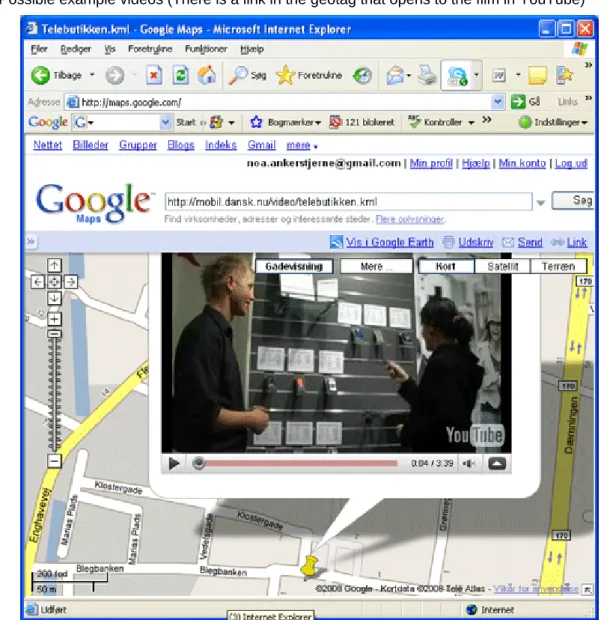
The teacher introduces Google Maps to the students, where some places in town are marked (geotagged), where conversations can, for example, occur. A link is provided, and when one clicks on the tags, one can watch an example of the conversation in YouTube. Likewise, there is also a summary of the conversation and a list of the listening expressions at the geotags.
In the tag, the students are asked to use their own mobile phones when they start a Danish conversation that they experience daily. They should focus their attention on and document at least two conversations they encounter. They can use their mobile phones for the following:
̇ Take a photo of the person/persons they converse with;
̇ Upload the photos at a system that enables them to put geotags on the photos (Some mobile phones have built-in GPS, wherein geotagging can be made directly from the phone);
̇ Audio record their conversation; ̇ Video record their conversation;
̇ Record – or get a native to record –listening expression/s that he/she has noticed. The students are provided the following assistance:
̇ The mobile phone’s camera and sound/video recorder. ̇ Google Mobile Map with tags and relevant wordlists and links.
̇ Possible example videos (There is a link in the geotag that opens to the film in YouTube)
Fig. 2: A Google map geotag with an embedded conversation from a language student’s informal learning environment
The students can present their collection of their research of the target language during and after the exercise. This post-activity can be combined with other activities. After processing the experience at the classroom, the student can go back to the informal learning environment with new questions and research. They may be encouraged to make their own maps with tags containing conversation, expressions and relevant observations.
6. Conclusion and perspectives
Mobile City and Language Guides is a language learning concept that can help second and foreign language learning by creating a better link between the teaching’s formal and “reality’s” informal learning environment. In this paper, we have shown how new technological developments in mobile phones and the Internet can be used to create exciting and useful links between these environments. A question that one can ask right now is: How can broadband Internet mobile phones and Web 2.0 applications become a reality and the daily life at the language schools, upper secondary schools and universities?
The answer to the question is training for teachers. But we are not so sure that this is enough. Other supporting initiatives must be undertaken if a learning concept such as the Mobile City and Language Guides will be a reality in a practical everyday teaching and learning. Perhaps, the answer can be found, at a higher level, at the institutions’ own concrete IT culture and vision on how technology (in this case broadband mobile phones and Web 2.0) should be incorporated in teaching. In our
Mads Bo-Kristensen, et al
experience, this culture starts to seriously develop when it has the support of the institution’s Board, management and teaching staff.
Finally, Mobile City and Language Guides is only one among several possible mobile and Internet-based language educational scenarios. Therefore, a future challenge is to develop not only the concept of Mobile City and Language Guides but a great deal of other meaningful and exciting scenarios that can strengthen the linkages between formal and informal learning environments.
References
Alby,T.(2008a) Das Mobile Web. Munich: Hanser Fachbuch Alby, T. (2008b) Web 2.0. Munich: Hanser Fachbuch
Bo-Kristensen, M. (2006) “Content Development in Adult Second Language E-learning”, in: Remenyi, D. (ed.) Proceedings of the International Conference on e-Learning, University of Quebec at Montreal, Canada, 22-23 June 2006. UK: Reading, pp. 22-23 – 30
Bo-Kristensen, M. (2004a) Multimediedidaktik i andetsprog for voksne – bidrag til andetsprogsdidaktisk forankring af undervisningens multimediedidaktik, Copenhagen, DPU. (ph.d.-dissertation)
Bo-Kristensen, M. (2004b) “A Proposal for a Multimedia Didactics in CALT and CALL”, in CALL for The Nordic Languages – Tools and Methods for Computer Assisted Language Learning, Peter Juel Henrichsen (Ed). Copenhagen Studies in Language, 30. Copenhagen: Samfundslitteratur, pp189-197
Bo-Kristensen, M. (2004c) ”Multimediedidaktik i andetsprog for voksne – bidrag til andetsprogsdidaktisk forankring af undervisningens multimediedidaktik”, Copenhagen, DPU (Ph.d. thesis)
Chen, Y. (2007) "Extending Family to School Life: College Students’ Use of Mobile Phone" Paper presented at the annual meeting of the International Communication Association, TBA, San Francisco, CA, May 23, 2007 Ellis, R. (2008) The Study of Second Language Acquisition. Oxford: Oxford University Press (2nd Edition) lleris, K. (2007) How we learn. London/New York: Routledge
Jarvis, P. (2004) Adult education and lifelong learning: Theory and practice. London: Routledge Falmer. Nunan, D. (2004) Task-based Language Teaching. Cambridge: Cambridge University Press
Richards, J.C. and T. S. Rodgers. (2001) Approaches and Methods in Language Teaching, Cambridge, Cambridge University Press. (2nd edition).
Sharples, M. (Ed., 2007). Big issues in mobile learning: Report of a workshop by the Kaleidoscope Network of Excellence Mobile Learning Initiative. Nottingham, UK: University of Nottingham, Learning Sciences Research Institute.
Schmidt, R. (2001). „Attention“. In: P. Robinson (Ed.), Cognition and second language instruction (pp. 3-32). Cambridge: Cambridge University Press.
Wenger, E. (1999) Communities of Practice: Learning, Meaning, and Identity. Cambridge:Cambridge University Press.
ISSN 1479-4403 93 ©Academic Conferences Ltd Reference this paper as:
Bouchard, P. “Some Factors to Consider When Designing Semi-Autonomous Learning Environments” Electronic Journal of e-Learning Volume 7 Issue 2 2009, (pp93 - 100 ), available online at www.ejel.org
Some Factors to Consider When Designing
Semi-Autonomous Learning Environments
Paul Bouchard
Concordia University, Montreal, Canada
[email protected]Abstract: This research aims to answer the question, “in what ways do mediated learning environments support or hinder learner autonomy?”
Learner autonomy has been identified as one important factor in the success of mediated learning environments. The central aspect of learner autonomy is the control that the learner exercises over the various aspects of learning, beginning with the decision to learn or not to learn. But as Candy (1995) points out, there are several areas where learner-control can be exercised.
The first are the motivational-intentional forces that drive the learner to apply some determination (or “vigour”) to the act of learning. They are the conative functions of learning and include learner intiative, motivation and personal involvement. They are often associated with life goals that are independent of the actual learning goals pursued within the strict confines of the learning environment (Long, 1994).
The second area of learner-control is the one comprising the “nuts-and-bolts” of the act of learning, such as defining learning goals, deciding on a learning sequence, choosing a workable pacing of learning activities, and selecting learning resources (Hrimech & Bouchard, 1998). These are the algorithmic aspects of learning, and in traditional schooling, they are the sole responsibility of the teacher. In mediated learning environments, it can be shared between the platform and the actual learner.
Just a few years ago, learner control was necessarily limited to these two sets of features, conative and algorithmic. Today however, with the proliferation of educational offerings in both the private and public sector, as well as the developments in educational technology, two other aspects of the learning environment emerge as important areas where learner-control can be exercised.
The semiotic dimension of learner-control includes the symbolic platforms used to convey information and meaning, for example web “pages”, hypertext, video/audio multimedia, animation, each of these bringing with them their own specific set of possibilities and limitations for autonomy in learning.
And then again, all learning environments exist in their own distinct economic sphere where decisions about whether, what and how to learn are made on the basis of cost-benefit, opportunity cost, and extrinsic market value.
We will examine the implications of each of these areas of learner-control, and share our analysis of a series of interviews with cyber-learners, based on this framework of conative, algorithmic, semiotic and economic factors. Keywords: self-directed learning, learner autonomy, educational policy, international development.
1. More or less autonomy?
Early attempts at defining features of Distance Education have stumbled upon an interesting conundrum. Some authors (Kegan, 1986; Perraton, 1983), pointed out that printed material mailed to a distant location increased pressure on the learners to set their own schedule and to work around deadlines imposed by the teaching institution. This feature, juxtaposed to the fact that distance education shows one of the highest drop-out rates among all educational environments, led to the supposition that distance learning requires some higher degree of learner autonomy than traditional classroom instruction. Indeed, lack of autonomy was considered the main reason why students failed or discontinued their programs.
Another feature of Distance Education was identified as the constraint imposed on institutions to produce a standard learning program that will be followed by all learners in the same sequence, usually within a set of prescribed deadlines (Holmberg, 1986). This institutional standardization, inevitably, is then passed on to the learner. In this respect, distance learning environments can be said to constrain the expression of autonomy among learners and instructors alike, at least when
compared with traditional environments where components of the program may be modified in response to learner feedback or other considerations.
The question of whether a specific learning environment will support or hinder the expression of autonomy is an important one for educators. Contemporary literature in adult education has focused on learner self-direction as a core value associated with the notion of facilitation, rather than the dispensation of learning (Knowles 1980; Long, 1992). The point here is not to retrace the steps that led to the emergence of learner-autonomy as a strongly held value among adult educators, but merely to situate our study within its context. It is our view that the quality of any learning environment is to a significant extent dependent on the degree to which that environment acknowledges the need to support learner self-direction.
Several authors have attempted, with varying results, to define self-direction in learning. One of the most influential works in this area, Candy (1991) summarizes self-direction in these terms:
Being able to pursue a learning goal with equal vigour and determination without being adversely affected by external factors including the increase or decrease of rewards for pursuing or attaining the goal (…)
Conceiving of goals, policies and plans independently of pressures to do so, or not do so. (p. 41)
And further:
Being aware of alternative choices, both as to learning strategies and to interpretations or value positions being expressed, and making reasoned choices about the route to follow in accordance with personally significant ideas and purposes.
(p. 62)
Interestingly, these quotes point to very different aspects of learner autonomy, the central one being the control that the learner exercises over the various aspects of learning, beginning with the decision to learn or not to learn. But as Candy points out, there are other specific areas where learner-control can be exercised.
2. Pedagogical vs. psychological
The question, then, is to investigate the “areas” of learner control. How many are there? How do they intersect with the specific features of D. E. environments? What are their implications for adult learning?
According to Long (1982), the first area includes the motivational-intentional forces that drive the learner to apply some determination (or “vigour”) to the act of learning. What Huey Long called the ‘psychological’ aspects of learner autonomy will be referred to here as the conative functions of learning. They are the foundation of learner intiative, motivation and personal involvement. Most often, adult learners harbour life-goals that are related, but distinct from the actual learning goals (e.g. career advancement, good parenting or better health), as part of the conative baggage they carry. Other possible drives include the pleasure one derives from the act of learning in itself, and the satisfaction obtained from becoming part of a particular culture of knowledge (Houle, 1961).
The second set of elements identified by Long (1982) as a subset of learner autonomy were the “pedagogical” aspects of learning. These involve the control over the “nuts-and-bolts” of the act of learning, such as defining learning goals, deciding on a learning sequence, choosing a workable pacing of learning activities, and selecting learning resources (Hrimech & Bouchard, 1998). These elements can be grouped under the more precise heading of algorithmic aspects of learning. In traditional learning environments, most of the algorithms are the responsibility of a teacher or a teaching institution. Learning goals, student workload and methods of evaluation are usually stipulated at the outset and little participation in their formulation is expected from the learner. Any derogation from this approach entails devolving to the learner, on top of the expected “learning tasks”, at least some of the “teaching tasks” normally reserved for the instructor. In this sense, we can say that autonomy is directly related to the number and magnitude of the “teaching tasks” that are appropriated by the learner (Tough, 1965). Most mediated learning environments require such
Paul Bouchard
participation from learners, albeit to different degrees and with varying results as will be described below.
2.1 Emerging dimensions
Just a few years ago, learner control was necessarily limited to these two sets of features, conative and algorithmic. After deciding whether, what, and how to learn, one had covered all areas where it was conceivably possible to exercise some degree of learner autonomy. Now with the proliferation of learning environments that include mediated instruction materials, exponentially available learning resources, new means of communication, and a marketplace literally exploding with learning opportunities, two other components of learning emerge as possible areas where learner control may be exercised – or impeded. We have namely identified the semiotic dimension learning, and the emerging economics of the knowledge marketplace.
Until recently, the prevalent medium for encoding, storing and disseminating knowledge was to provide access to print materials through libraries, mail-order programs, or custom-printed resources. Today, learning materials include rather diverse media which may share very few features with printed text. For example hypertext, asynchronous messaging and electronic whiteboards each possess their own set of codes and behaviors that are inconsistent with the linear quality of print. Furthermore, the manner in which each new medium is utilized by instructors and learners varies to some extent, leading to further diversification in the perception of their semantic possibilities (Garrison, 2000). For example, hypertext can be used as a way to link course materials to outside resources, or as an inherent part of the material to be learned, or then again as non-compulsory enrichment to the basic text such as illustrations or diagrams to be viewed when needed. From the learner’s perspective, hypertext can be perceived as a convenient way to store and retrieve information, or as a bothersome irritant leading to feelings of frustration in the presence of overwhelming amounts of poorly organized data. Because each environment offers its own set of communication pragmatics and its own approach to using them, we can say that the semiotic choices made by designers and instructors are an integral part of the learner’s experience, and as such offer opportunities to enhance or deter learner autonomy.
Learning is no longer the reserved province of traditional institutions such as schools or colleges. Indeed, it is now acknowledged that universities find themselves in direct competition not only with each other, but with a multitude of offerings from a thriving marketplace (Moore& Kearsley, 1996). Today an important component of any learning environment is the perceived economic value of its knowledge in the marketplace, either as an asset for finding employment or as a means of production in the knowledge economy. Based on this consideration, learners must not only decide why and what to learn, but also where to learn it and who to learn it from. This decision will surely be based on factors like individual preference for a proposed learning environment, but ultimately the choice will rest on the perceived cost-benefit and opportunity cost which are generated by each alternative. In this context, we can observe that the economics of learning are emerging as an important component of learning environments.
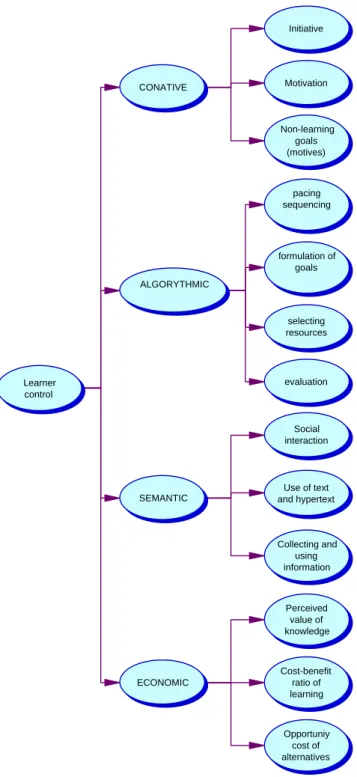
The diagram in Figure 1 illustrates how learner autonomy can be divided in four areas of learner control: conative, algorithmic, semantic and economic. One useful feature of this representation is that it makes it possible to explore learner perceptions within different learning environments, while retaining a constant framework for analysis.
Learner control
CONATIVE
ALGORYTHMIC
Initiative
Motivation
Non-learning goals (motives)
pacing sequencing
formulation of goals
selecting resources
evaluation
SEMANTIC
Social interaction
Use of text and hypertext
Collecting and using information
ECONOMIC
Perceived value of knowledge
Cost-benefit ratio of learning
Opportuniy cost of alternatives
Figure 1: Areas of learner autonomy
3. Methodology
Open-ended interviews were conducted with 13 adult students registered in on-line courses in Psychology, Finance, Education, and Political Science. Questions were formulated to explore the four areas of learner autonomy, using everyday terminology familiar to the students.
The research question to be explored using this method was, more specifically,
“In what ways do mediated learning environments hinder or support the emergence and expression of learner autonomy?”
The questions asked the informants were not as formally wordedl. We conducted semi-guided interviews generally purported to get some feedback from the students on their learning experience in on-line university courses. Interviews were taped, transcribed, coded and analysed using standard content analysis techniques. Coding was done by grouping units of meaning under tentative
Paul Bouchard
headings, and then combining the headings under generic titles using an emergent design method. The factors that determined the students’ perception of each learning environment were categorized as: Interaction; Structure; Value; Context; and Media.
4. Findings
One of the first things that became apparent during the interviews was the diversity in the likes and dislikes of individuals concerning the various components of the learning environments. All courses were designed using online course materials, a messaging device and a textbook. Some used hyperlinks to other web-based resources, and none included classroom or face-to-face meetings. The individual preferences were polarized around the use of media, the course structure and the value of course content. Predictably, about half of the students said it took some effort to prevent inertia when facing the prospect of doing tasks online, in the absence of an imposed schedule.
4.1 Interaction
The portion of the course grade allotted for participation in on-line discussion groups varied between 0% and 40%. In the groups where there was less pressure to ‘participate’, students felt that the interaction was more meaningful and that they were more in ‘control’ of the environment. From the students’ responses, it appears that instructors did not attach any weighting to the quality or tone of the interactions. Some students felt that the imposition of online discussion was superfluous, but nevertheless felt their learning was validated when read by others. Some students felt uncomfortable at the idea that the instructor had access to the messages, which prompted the use of alternative means of communication between students – private email and telephone conversations. In one instance, the instructor’s failure to moderate a somewhat incendiary discussion on Middle-East politics dissuaded other students from participating. Interaction also occurred between students and TAs, technicians and, more rarely, professors. Students enrolled in a full-year course reported the growth of a sense of learning community around the 4th month of interaction, while single-term students did not. Posting messages to a discussion group was perceived as less threatening, and therefore more accessible, than voicing comments in a classroom. One student complained that there is no real connection to others when talking on-line – “you never get to ‘know’ anyone”. This finding supports the notion that the conative aspects of learner autonomy in D. E. environments need to be further analyzed to include the subsets that are specifically linked to the characteristics of the environment itself. For example, while social interaction has been found to be one important factor in the motivation of learners, the type of interaction provided by chat-groups, e-mail and moodles need to be further explored.
4.2 Structure
A few students who had a personal interest in their course topic spontaneously searched for alternative learning resources but overall, this was not a prevalent practice. All courses except one had set very specific objectives, thereby circumventing student participation in their formulation. When a learning goal was stated in general terms, mature students more readily established links with their own experiences and interests. Evaluation was done in much the same way as in classroom environments, participation in discussion groups being graded in lieu of attendance. Overall, students had difficulty evaluating their own learning, stating instead that they earned their grade simply by conforming to the course-work requirements. Students with poor performance tended to blame the “lack of clarity” of the course objectives.
Students admitted readily that they chose an on-line course because of the flexibility it afforded in their schedule. However, some found the prescribed pacing too slow, while others found it somewhat daunting, especially when assigned weekly readings – thus, scheduling became more of a problem than anticipated. The requirement to participate in online discussions was perceived as additional workload that would have been less demanding in classroom interaction. The detailed program structure found in all but one of the on-line courses was perceived to make the learning tasks more manageable, as they were relieved of any ambiguity.
This finding points to the importance of some important algorithmic features that are inextricably woven into the design of each D. E. learning environment. In most cases, we found that desgn features tended to reduce learner autonomy in very serious ways. Setting unalterable objectives, leaving all evaluation activities to the instructor, setting the same sequence of learning for all students independently of their individual needs or characteristics, all of the have detrimental effects on learner
autonomy. In fact, this is the area where the most severe weaknesses were found in the designs we studied. Since there is no inherent reason why D. E. packages should limit autonomy so much, we need to ask ourselveswhy designers tend to appropriate for themselves such excessive control over the environment.
4.3 Value
Students can be placed in two groups according to the criteria they used to establish the value of their learning. The first group derived their estimation from the potential usefulness of their newly acquired knowledge in some immediate area of their lives, either by providing tools for better understanding world issues or financial matters, or by developing skills that apply to family relationships or the workplace. The second group was typically concerned with completing a university degree and selecting eligible courses for their anticipated convenience or easy workload. Interestingly, several students admitted opting for on-line courses assuming – wrongly they soon discovered – that they would entail a flexible schedule and a less demanding productivity. Some of the derived benefits were discovered as learning occurred throughout the courses. Others were identified as unanticipated spin-offs, such as developing better writing or computer skills. One student pointed out that his workplace offered a similar course package, featuring a better design and a lower cost, but that it could not be credited towards his university degree.
As in many institutions, the actual per-credit cost to the student is considerably higher for the on-line version of a course. Students generally accepted this fact with some resignation, but could not explain the disparity. One student realized too late that he could have learned independently, at a much lower cost, everything that he learned in his course. Two other students acknowledged that they had chosen the institutional avenue in order to access the university’s sophisticated computer labs. In light of these findings, we can say that the economics of D. E. are often poorly understood by institutional designers. In some instances, the cost associated with learning is in reality the hidden cost of giving institutional credit for learning that could have occurred anywhere. This gives rise to unnecessary duplication of courses that are offered in non-credit organizations (e.g. the workplace), or to the practice of granting dubious legitimacy for learning that otherwise could have been entirely self-directed, and therefore considerably less costly.
4.4 Context
Students were asked about the reasons they decided to enrol in their course, and why they chose the on-line version of the course. Factors such as desire to understand family issues, or the wish to improve work performance were mentioned by mature and non-degree students only. Reasons for choosing the on-line version of the course were mostly linked to personal, family and work situations. Somewhat ironically, the same factors were identified as barriers to achievement in the on-line course. The institutional context also was perceived to play a role, beginning with the fact that two versions of the course were offered by the institution, that the on-line version was higher priced but available, and that the absence of in-class meetings seem to motivate the instructors to increase student workload.
4.5 Media
In a previous study (Bouchard & Kalman, 1998), low computer literacy was identified as a barrier to distance learning. Here, students all had achieved reasonable competency at using computers. Some difficulties were encountered however with the consistency of access to the online environment. There were frequent system crashes and technical help was not always available. From the delivery point of view, the emphasis was placed on completing course assignments and little attention was paid to students’ efforts to learn how to navigate within the system and outside. Some features of the courseware were used routinely, such as messaging and on-line exams, while others were rarely or not used (file transfer, self-corrected testing, live chat, transfer of images or animated gif files, etc). This particular finding points to another area of concern for D. E. designers. There is a tendency to use technology and systems that are available, rather than those that are appropriate. This is attributable to a common management error that consists of making decisions based on past investments rather than future returns. As often happens with adult learners, they end up making their own decisions, and choosing for themselves how they will learn. This is the self-appropriation of the semiotic aspect of learning that is made possible when more than one technology is available.
Paul Bouchard
5. Discussion
The purpose of this study was to obtain from the learner’s perspective some indication of the factors that encourage or deter from the development of self-direction in mediated learning environments. In light of the data collected, it is possible to make some recommendations that relate to the conative, algorithmic, semantic and economic dimensions of learner autonomy. Further analysis will allow us to produce a more detailed classification, but for now we will limit ourselves to a number of recommendations that are supported by our data. This information should be useful for planners who value, beyond the conformity to academic standards, the capacity for self-direction as a central goal of education.
First, it should be noted that students embark in on-line courses with various expectations, ranging from fairly reasonable to confused. Efforts should be made towards correcting the most common misunderstandings, such as the expectation that on-line courses are easy, require less time and demand less participation – before enrolment. Some allowance should be made at the beginning of a session for learning the navigation and software tools that will be used during the term. Whenever possible, face-to-face meetings or other devices seeking to personalize the learning environment should be planned in order to reduce feelings of alienation (an important conative aspect of learning). Online discussions should be structured around guidelines and clear criteria should be set to evaluate the quality, rather than quantity, of participation. Instructors should attend to online discussions but refrain from acting as one of the participants. Students’ work can be validated by peers through feedback given on short warm-up assignments. Students can be encouraged to explore alternative sources of documentation outside the confines of the on-line device, and to establish links with their own personal areas of interest. Reasons for pricing on-line courses in a higher bracket should be made public by the institution, or that practice should be discontinued. Opportunities to learn similar contents in other, less costly venues, should be made available to learners (thereby improving economic flexibility). Planners should be aware of the added time constraints imposed by on-line participation in discussion groups, testing and other interactions. Students can be encouraged to explore the possibilities offered by the institutional and other software packages, and not limit themselves to those functions used by the instructor.
On-line and other mediated learning environments offer much potential for supporting the development of self-directed learning skills, and can also be powerful deterrents. Realizing the potential – and reducing the deterrents – are possible if educational planners consider the importance of these two criteria when making instructional design decisions.
6. References
Bouchard, P. and Kalman, L. (1998). Distance education and Learner Autonomy: Some theoretical implications. Proceedings of the Canadian Association for the Study of Adult Education conference. University of Ottawa. Candy, Philip (1991). Self-Direction for lifelong learning. San Francisco: Jossey Bass.
Crooks, S. M., Klein, J. D. & Dwyer, H. (1996). Effects of Cooperative Learning and Learner-Control Modes in Computer-Based Instruction. Journal of research on computing in education, V.29, 109-121.
Garrison, R. (2000) Theoretical challenges for distance education in the 21st century: A shift from structural to transactional issues. International Review of Research in Open And Distance Learning, V (1).
Holmberg, B. (1977). “Tutoring distance students”. Epistolodidactica, 7, 4-15.
Houle, Cirylle O. (1961). The Inquiring Mind, Madison: the University of Wisconsin press.
Hrimech, M. and Bouchard, P. (1998). Spontaneous learning strategies in the natural setting: Learning to use computers. In Huey B. Long and Associates (eds): Developing Paradigms for Self-Directed Learning. Oklahoma Research Center, University of Oklahoma.
Keegan, Desmond (1983; 1996). The foundations of distance education. London : Croom Helm.
Knowles, M.S. (1980). The Modern Practice of Adult Education. Chicago: Associated Press, Follet Publishing Company.
Long, Huey B. (1992). Philosophical, Psychological and Practical Justifications for Studying Self-Directed Learning. In Huey B. Long & Associates (eds): Self-Directed Learning: Application and Research. Oklahoma Research Center, University of Oklahoma.
Moore, M. G. et Kearsley, G. (1996). Distance education : A systems view. Boston: Wadsworth Publishing Company.
Tough, Allen M. (1965). The Teaching Tasks Performed by Adult Self-Teachers. Doctoral Dissertation. Chicago University, Ill.
ISSN 1479-4403 101 ©Academic Conferences Ltd Reference this paper as:
Charles, M, Bustard, D, and Black, M. “Game Inspired Tool Support for e-Learning Processes” Electronic Journal of e-Learning Volume 7 Issue 2 2009, (pp101 - 110), available online at www.ejel.org
Game Inspired Tool Support for e-Learning Processes
Marie-Thérèse Charles, David Bustard and Michaela Black
University of Ulster, Coleraine, Northern Ireland
[email protected][email protected] [email protected]
Abstract: Student engagement is crucial to the success of e-learning but is often difficult to achieve in practice. One significant factor is the quality of the learning content; also important, however, is the suitability of the process through which that material is studied. In recent years much research has been devoted to improving e-learning content but considerably less attention given to enhancing the associated e-e-learning process. This paper focuses on that process, considering in particular how student engagement might be improved using techniques common in digital games. The work is motivated by a belief that, with careful design, e-learning systems may be able to achieve the levels of engagement expected of digital games. In general, such games succeed by entertaining players, building on their natural curiosity and competitiveness to encourage them to continue to play. This paper supports a belief that by adopting some of the engagement techniques used in games, e-learning can become equally successful. In particular, the paper considers how the e-learning process might become a form of game that helps sustain continued study. Factors affecting engagement and elements of digital games that make them engaging are identified. A proposal for improving engagement is then outlined. The approach is to encourage student involvement by rewarding desirable behaviour, including the completion of optional challenges, and giving regular feedback on performance, measured against others in the same class. Feedback is provided through a web-based tool. The paper describes an exploratory assessment of both the tool and approach through action research. Results for two linked university modules teaching software development are presented. The results so far are very encouraging in that student engagement and performance have increased, especially at the weaker end of the class. Limitations of the approach are also outlined, together with an indication of future research plans.
Keywords: e-learning, digital games, engagement, feedback, action research
1. Introduction
In essence, engagement is the measure of a student’s participation in a learning task. Skinner and Belmont (1993) explain this more fully by suggesting that those engaged “...show sustained behavioural involvement in learning activities accompanied by a positive emotional tone. They select tasks at the border of their competencies, initiate action when given the opportunity, and exert intense effort and concentration in the implementation of learning tasks; they show generally positive emotions during ongoing action, including enthusiasm, optimism, curiosity, and interest”.
As might be expected, engagement is strongly related to achievement and dropout rates (Astin 1993, Harrison 2006, Trotter and Roberts 2006). Dropouts in e-learning are a particular concern, involving many complex issues (Martinez 2003, Tyler-Smith 2006). With a growing use of technology at all levels of education, leading to a blended approach to learning, the importance of improving engagement in e-learning has increased. The purpose of this paper is to consider how techniques used in computer games might be used to improve such engagement.
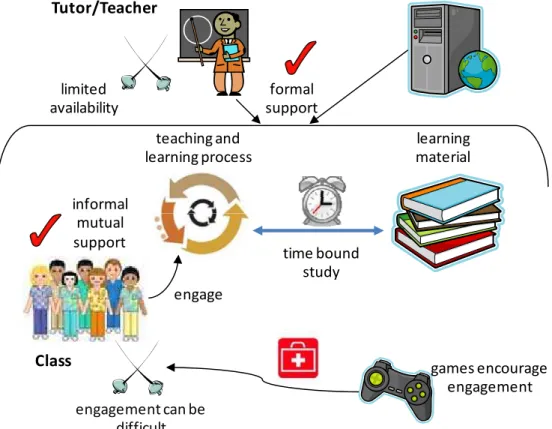
The overall situation is summarised graphically in Figure 1 as a rich picture (Lewis 1992). Rich pictures, often used in Soft Systems Methodology (Checkland 1999), help build and document a shared understanding of a situation of concern. The diagram in this case shows a class of students studying material through engagement in a structured teaching and learning process—which typically has to be covered to a schedule to meet assessment constraints. The process is supported formally by one or more teachers and/or tutors, together with computers connected to the internet. There is also informal support for the learning process from others in the same class group. The ticks emphasise the positive benefits to the process from these sources of support. On the negative side, the crossed swords identify two areas of concern: one is the limited availability of teachers/tutors and the other is the difficulty that students experience in engaging with the learning process. In the bottom section of the diagram it is suggested that the difficulty with engagement might be helped by adopting ideas from computer games.
Class
Tutor/Teacher
teaching and learning process
formal support
learning material limited
availability
engagement can be difficult
time bound study
games encourage engagement informal
mutual support
engage
Figure 1: Rich picture of games supported blended learning
Computer games are known to be highly engaging. The inherent rule-bound structure of a game immerses a player in a temporary world in which challenges build up skills and knowledge to help achieve specific goals. As this is essentially a learning process (Gee 2005, Prensky 2006), many believe that games ideas could be used in e-learning to improve engagement (Cordova and Lepper 1996, Jonassen and Land 2000, Ricci et al. 1996, Squire and Jenkins 2004). That is the motivation for the work described in this paper.
Games ideas can be used in both the learning process and the design of learning materials. Work in this area has tended to focus on learning content (McFarlane et al. 2002) but the learning process is equally important. Indeed, improvements to the process can be more influential because, by being largely independent of content, such ideas can be used in a wide range of contexts. Section 2 of this paper examines engagement in the teaching and learning process in more detail and identifies the engaging aspects of games that might support that process. Section 3 then outlines the design of a process game. Experiences with using this process and associated tool are discussed in Section 4. Plans for further development of the approach are indicated in the conclusions.
2. Supporting engagement with games techniques
This section examines the factors associated with engagement as a first step towards identifying improvement. One well established model of the constituent elements of engagement is that developed for the National Survey of Student Engagement (NSSE), which began in 2000. The purpose of the survey is to gather information annually on engagement across four-year colleges and universities in the USA and Canada. In 2000, 276 institutions were involved, rising each year to 774 in 2008. The rationale for their work (NSSE 2008) is that “...the time and energy students devote to educationally purposeful activities is the single best predictor of their learning and personal development... [so] those institutions that more fully engage their students in the variety of activities that contribute to valued outcomes of college can claim to be of higher quality compared with other colleges and universities where students are less engaged”.
NSSE currently bases its engagement benchmark on five main indicators, assessed through 42 questions. The indicators are:
̇ Level of Academic Challenge, as “challenging intellectual and creative work is central to student learning and collegiate quality. Colleges and universities promote high levels of student
Marie-Thérèse Charles et al
achievement by emphasizing the importance of academic effort and setting high expectations for student performance”.
̇ Active and Collaborative Learning, as “students learn more when they are intensely involved in their education and are asked to think about and apply what they are learning in different settings. Collaborating with others in solving problems or mastering difficult material prepares students to deal with the messy, unscripted problems they will encounter daily during and after college”. ̇ Student Interaction with Faculty, as “students see first-hand how experts think about and solve
practical problems by interacting with faculty members inside and outside the classroom. As a result, their teachers become role models, mentors, and guides for continuous, life-long learning”. ̇ Enriching Educational Experiences, as “complementary learning opportunities inside and outside
the classroom augment the academic program”.
̇ Supportive Campus Environment, as “students perform better and are more satisfied at colleges that are committed to their success and cultivate positive working and social relations among different groups on campus”.
These factors cover both technical and personal development, across a full educational programme, and include wide interaction with the environment. Other researchers have identified more detailed factors, some of which elaborate or complement the points above, including:
̇ Challenging tasks: tasks should continually and appropriately challenge students to stimulate engaged learning. If a task is too simple it becomes boring and if too difficult, can be frustrating. Tasks must increase in difficulty as students improve to ensure they stay engaged in the process (Quinn 2005, Wang and Kang 2006).
̇ Affiliation with others: the learning task requires collaboration amongst students. Collaboration is perceived to promote engaged learning experiences (Allen 2003, Schlechty 1997, Wang and Kang 2006).
̇ Identity and roles: being a member of a community has a strong motivational influence on an individual’s identity with their peers, and much research emphasises the importance of the social factors of learning engagement (Rosenberg 2001).
̇ Focused goals: students should be aware of or discover which outcomes they need to achieve. This can be accomplished by defining a clear set of compelling goals that relate to the learning objectives (Quinn 2005). Also, allowing students to set their own goals could help increase motivation and further immerse them in the learning process (Wang and Kang 2006).
̇ Protection from adverse consequences: students should receive feedback on their work throughout the process, which informs them of their progress towards the learning goals (Allen 2003, Schlechty 1997, Wang and Kang 2006).
̇ Clear and compelling standards: the standards for assessing performance should be clear and are important to students (Schlechty 1997).
̇ Authenticity: the work should be significant and relevant to the lives of students and something with which they can identify (Allen 2003, Rosenberg 2001, Wang and Kang 2006).
̇ Affirmation of progress: student performance should be observed by persons other than the teacher as this public review helps add meaning to the completed tasks (Schlechty 1997).
̇ Choice: students should be provided with choice in the ways of doing the work and the methods of presentation. Choice increases engagement by giving the student control over their learning experiences (Wang and Kang 2006).
This list can be further refined by identifying key elements of game design that promote an effective learning experience (Cordova 1996, Garris et al. 2002, Malone and Lepper 1987, Rieber 1996). A significant overlap is to be expected but considering the factors from a different perspective helps clarify their meaning and give insights into how improved engagement might be achieved.
̇ Fun: This is an essential engagement factor in games but isn’t typically given much prominence in education. Anyone directly involved, however, knows of the positive impact that ‘fun’ can have on engagement. Koster (2004) goes further and argues that "fun is just another word for learning", implying that effective learning is inherently enjoyable.
̇ Conflict: This is an alternative way to think about ‘challenge’ in education. Conflict is an intrinsic element in game systems and occurs routinely as a player pursues goals. Some goals may be
achieved with ease while others require a higher level of skill that has to be developed (Salen and Zimmerman 2003). The struggle of players to complete these goals, either in opposition or collaboratively, encourages engagement by building on their natural competitive drive.
̇ Structure: The ‘rule bound’, ‘goal oriented’ structure of games contributes to an engaging experience (Bjork and Holopainen 2005, Gee 2005, Rabin 2005, diSessa 2000). As in education, goals, sub-goals and required levels of achievement need to be clear, relevant and appropriate. ̇ Identity: A player usually has a visual representation of themselves within a game system. Gee
(2003) describes this as a “projective visual identity”. This may be selected by the player or personally developed by them. Gee (2003) suggests this identity deepens personal investment in the game and encourages players to interact and engage to a greater extent through the projected character. Currently, there is no directly equivalent mechanism in education but students do develop specific role within a peer group.
̇ Feedback: As in education, feedback in games is important in providing players with timely and relevant information on their progress towards goals and identifying their level of achievement so far. Progress within the game will often be summarised in a map, and achievement indicated though ongoing game statistics, measuring attributes such as player skill, strength and health. ̇ Social: When players interact within a game environment there is social interaction at two levels:
(i) internally, though interaction of game characters; and (ii) externally, as the players communicate to exchange information, share experiences, or compete to make progress with the game (Salen and Zimmerman 2003). Much educational and social research highlights the importance of such social interactions in the learning process (Rudd et al. 2006).
The next section, building on these aspects of game design that promote engagement, outlines an approach to the development of a process game that is intended to improve engagement in a programme of study. In principle, the approach should be relevant to study at any academic level but the initial focus and subsequent experimental work described is in third level education.
3. The teaching and learning process game
The most obvious difference between the list of relevant engagement factors in education and the one for games, as outlined in Section 2, is the absence of ‘fun’ in the education list. One obvious way to improve engagement, therefore, is to introduce a game into the general teaching and learning process. What is less obvious, however, is the form that such a game should take to ensure that it is played with sufficient enthusiasm to enhance student performance. Potentially, for example, the game might be resented by the students, and ignored. Because of this concern, it was decided to approach the design of the game cautiously, in stages. In the first stage, the focus was on group work, with the expectation that groups would be more likely than individuals to take part in a game. As a further safeguard, the game was presented as an ‘experiment’, with participation made optional and ample opportunity given for critical feedback.
The general strategy was to create a game in which points were offered for desirable behaviour, which would include, for example, attendance at lectures, lab classes and tutorials. Desirable behaviour is obviously important for student success but interesting optional challenges are also necessary. Examples here include answering questions in tutorials, asking questions in lectures and making a presentation to the class on a relevant technical topic.
Groups were allowed to give themselves names to establish a game identity, and feedback was provided each week through an update of group scores. As an ‘affirmation of progress’ these scores were displayed openly on a plasma display in a public area.
The group approach was sufficiently successful to move confidently to the second stage of introducing engagement strategies from games, namely to encourage students individually. For this stage, a feedback tool was developed to present each student with an ongoing report of their performance. The results from these experiments are described in the next section.
4. Experience with the teaching and learning engagement game
Experimental use of the engagement game focused on two consecutive first year Java programming modules: Software Development 1 (COM158C1) and Software Development 2 (COM164C2). Both ran for 12 weeks, in consecutive seminars from September to December 2007 and January to May 2008, respectively. The modules operated identically in 2006-07, without the game, so direct
Marie-Thérèse Charles et al
comparisons of student behaviour and performance could be made. Students were briefed about the game at the beginning of the year and all chose to participate.
4.1 Semester 1: the process game with groups
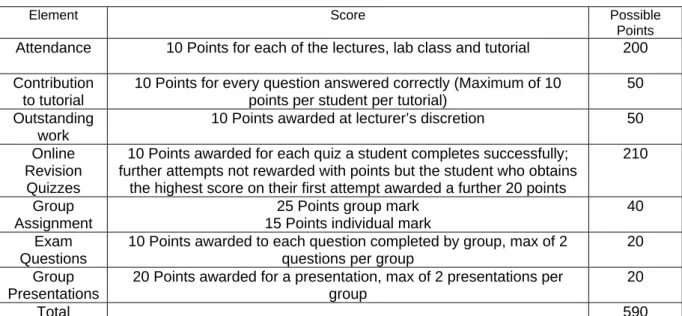
In the first semester, the experiment was designed around relatively large groups of students. Specifically, 64 students were allocated to 8 groups, selected to have a reasonably even distribution of ability, based on entry level qualifications. The main objective of the first experiment was to see if the students would participate in the game and, if so, determine the impact on both their behaviour and academic performance. The semester was divided into two halves: a simple introductory game ran from weeks 1-5, which helped familiarise the students with the various elements of the game, as summarised in Table 1. These were introduced as the rules of the game. The game leader board was reset during week 6 and the game continued throughout the remaining 5 weeks of the semester. Table 1: Rules for game 1
Element Score Possible
Points Attendance 10 Points for each of the lectures, lab class and tutorial 200 Contribution
to tutorial
10 Points for every question answered correctly (Maximum of 10 points per student per tutorial)
50 Outstanding
work
10 Points awarded at lecturer’s discretion 50 Online
Revision Quizzes
10 Points awarded for each quiz a student completes successfully; further attempts not rewarded with points but the student who obtains
the highest score on their first attempt awarded a further 20 points
210
Group Assignment
25 Points group mark 15 Points individual mark
40 Exam
Questions
10 Points awarded to each question completed by group, max of 2 questions per group
20 Group
Presentations
20 Points awarded for a presentation, max of 2 presentations per group
20
Total 590 Different levels of challenge were identified, closely linked to keys skills that would benefit the
students. Students could chose to do nothing beyond normal module activity and still earn some points, or select more demanding tasks, which might enhance their skills while gaining higher points for their group. For this experiment, feedback was presented weekly, showing the breakdown of group points, as indicted in Figures 2. This information was accessible through each student’s virtual learning environment and was also displayed publicly.
Figure 2: Graph of gamer points and the breakdown
The groups and their interaction with the game were observed in class. Some groups, like the Radioactive Squadron, were slow to engage but as the game neared the end of the semester put in