Published online: 29.09.2013 --- © jbm 2013
--- O. Pekkarinen
Lappeenranta University of Technology, LUT School of Industrial Engineering and Management, Finland e-mail: [email protected]
R.T. Salminen
Lappeenranta University of Technology, LUT School of Industrial Engineering and Management, Finland e-mail: [email protected]
Developing industrial solution offerings: a framework and
management guidelines
Olli Pekkarinen · Risto T. Salminen
Abstract: An offering describes the elements through which a company can provide value for its customers. In the present study, we focus on an industrial solution provider’s offering and its formulation by reviewing the solution business, services marketing, and project business literature, as well as conducting a case study. Based on our results, we propose a dynamic industrial solution offering (DISO) with two special characteristics that comprise dynamism and completeness. Furthermore, we propose a framework for DISO that contains three components that comprise relational, financial, and performance. We also present evidence for a new service category within industrial solution business: services supporting mutual action. An industrial solution business addresses collaboration with customers, and we regard this aspect as an element in the dynamic industrial solution offering. Finally, we found three main managerial issues to help build solution mindset that comprise collaboration with customers, organization-wide customer orientation, and effective service-driven organization.
Keywords: Industrial solution · Offering · Solution business · Manufacturing industry · Case study
Introduction
Manufacturing industry has changed its business model dramatically in the 21st century. In the current market, manufacturers are driven to provide more comprehensive offerings, meaning the elements through which a company can provide value for its customers, which go beyond the traditional goods with throw in services thinking (Ulaga and Reinartz 2011). In a nutshell, this is often achieved by providing capacity and availability instead of fixed priced machinery. This type of business is often termed the provision of solutions, whereby goods and services are uniquely bundled to address a particular customer need (e.g., Sawhney 2006). We define these business-to-business manufacturers as industrial companies; thus excluding, for example, financial companies.
From incidental merchandise, services have become the core of industrial companies’ offerings with long lasting service agreements over the life-cycles of their goods. This change is driven both by the need for providers to grow and gain competitive advantage and by increased customer demand that is caused by customers’ sourcing strategies (Agndal et al. 2007), as well as outsourcing trends and core business focuses. The three key drivers for industrial companies’ service strategies are outsourcing trends, saturation of the installed base, and commoditization in goods markets (e.g., Reinartz and Ulaga 2008). Thus, industrial companies are focusing their efforts on providing bundled offerings of goods and services, described as different types of solution (e.g., Brady et al. 2005), which are delivered through relational processes with customers (Tuli et al. 2007), by using solution-driven business models (Storbacka 2011). In the management of marketing activities, this can be regarded as closer customer relationships (Penttinen and Palmer 2007), service-dominant logic (Vargo and Lusch 2008), and collaboration in solving customers’ problems (Cova and Salle 2008).
Although industrial companies acknowledge the importance of services, they struggle with the management of their solution offerings. Gaining profit by delivering complex solutions has proved to be quite a challenge (Tuli et al. 2007). Thus, re-constructing an offering when adopting a solution provider strategy can be problematic. The mindset of employees might be focused on specifications of their goods and price margins with almost zero customer collaboration in the development of new features (e.g., Cornet et al. 2000). Product managers focus on long maintenance intervals while service managers try to sell regular maintenance, which delivers mixed signals to customers. In addition to the sales personnel, the whole organization needs to understand the new, more service-based, business model and have a common mindset to enable coherent collaboration with customers (Ryynänen et al. 2012). In addition to their mindsets, solution providers are struggling to find a balance between unique offerings to changing customer needs (e.g., Prahalad and Ramaswamy 2004) and more standardized service operations. It seems to be challenging to construct a solution offering in a manner that supports the core business instead of being a burden. Several authors (e.g., Lefaix-Durand and Kozak 2010; Neely 2009) have pointed out the insufficient understanding on customer
perception of value. Hence, customer value components have to be understood (Klanac 2013).
To understand customers’ needs and values, solution providers need to engage in close relationships with their customers. Tuli et al. (2007) regard solutions as relational processes between suppliers and customers. The solution-based business model (Storbacka 2011) changes a firm's offering from one based on selling goods with particular specifications to providing solutions that include several service elements which are co-created with customers. Industrial companies need to learn how to combine various elements into routines and methods of operation in the form of solution offerings (Davies et al. 2007). However, despite the growing literature base on business-to-business services and services in the context of solution business, Ulaga and Reinartz (2011) acknowledge a need for better categorization of services from a business perspective. Wikner and Andersson (2004) offer a more traditional conceptualization for a solution offering by including the elements of goods, services, and price versus benefits and sacrifices. Brax and Jonsson (2009) divided the solution offering structure into four components that comprise installed base, solution system platform, information offerings, and service components, which then are adapted and applied in customer specific conditions as a bundle or a customer solution. However, more context specific solution frameworks are called for (e.g., Nordin and Kowalkowski 2010), therefore, we argue that there is a gap for comprehensive conceptualization of a solution offering that includes different elements beyond traditional goods/services, especially in the context of industrial companies.
We focus on an examination of the development and role of various elements in an industrial solution provider’s offering, henceforth termed industrial solution offering, by addressing the following research questions: 1) What are the special characteristics of an industrial solution offering?; 2) What types of element should be included in an industrial solution offering?; 3) How should an industrial solution offering be managed?
The results contribute to the solution offering literature (e.g., Brax and Jonsson 2009; Nordin and Kowalkowski 2010) by identifying industrial companies’ solution offering elements. By introducing categorized building blocks, our study will also help industrial managers to build value-adding customer-oriented industrial solution offerings. The study begins with an introduction to the relevant literature on the topics of solution business and the concept of offering in Chapters 2 and 3 respectively. Chapter 4 clarifies the research design issues. Our empirical case evidence and derived findings are presented in Chapter 5. Finally, Chapter 6 delivers answers to the research questions, and proposes avenues for future research.
Solution business and industrial companies – industrial solutions
Service-dominant logic (Vargo and Lusch 2004) has challenged traditional goods-dominant logic in the marketing literature with close cooperation relationships between supplier and customer (Lusch and Vargo 2006). This has led manufacturing companies to transform from goods to solution business, which has recently received increasing academic interest (Brax and Jonsson 2009; Davies et al. 2006; Jacob and
Ulaga 2008; Kindström et al. 2012; Salonen 2011). The extant literature contains several overlapping concepts that are employed to describe solution oriented business. These include integrated solutions (Brady et al. 2005), customer solutions (Tuli et al. 2007), value added solutions (Matthyssens and Vandenbempt 2008), servitization of manufacturing (Baines et al. 2009), product-service systems (Meier et al. 2010), performance based contracting (Hypko et al. 2010), and hybrid offerings (Ulaga and Reinartz 2011). The definition of a solution often includes customization and integration of goods and services to address a customer’s business needs (e.g., Sawhney 2006).
In solution business, companies should focus on their customers’ businesses by identifying their customers’ latent needs (Matthing et al. 2004). Customers’ sourcing of services has evolved to be more value-focused (Agndal et al. 2007). However, customers tend to have a different perception of value than suppliers (Lefaix-Durand and Kozak 2010). Furthermore, Tuli et al. (2007) acknowledge a disparity between the perceptions of both parties, and suggests that suppliers do not understand to the required degree their customers’ business environments. Based on their findings, Tuli et al. (2007) propose a four phase relational solution process model: 1) customer requirements definition; 2) customization and integration of goods and/or services; 3) their deployment; 4) post deployment customer support. The model has been tested (Naudé et al. 2009) with the importance of relational aspects found to be accurate. Payne et al.(2008) define the relational processes as encounters which must aim to help a customer utilize better both its own and its supplier’s resources. By understanding the relational nature of solutions, suppliers are able to deliver more effective solutions at profitable prices (Tuli et al. 2007). Through collaboration, a key characteristic in solution business, both supplier and customer co-create the solution and, thus, the customer value. Furthermore, solutions often provide cash flow over a long period of time due to fixed service agreements. In sum, we employ in our study the concept of industrial solutions that we define as follows: An industrial solution is an ongoing relational process to satisfy a customer’s particular business or operational requirements.
The concept of offering in the solution business context
Ulaga and Reinartz (2011) argue that services need to be better categorized from a business perspective. Services are taking the leading role in creating customer perceived value, but there are only a few studies that examine which types of service are included in industrial solutions. There is evidence that services form the most important aspect of solutions as companies outsource production and the largest proportion of in-house activity is shifting towards service components (Davies et al. 2007). With this in mind, our focus is mainly on the service aspects of industrial solutions. In the following, we first draw from several literature streams to map the concept of offering in general, and then identify relevant elements for an industrial solution offering.
Offering concept
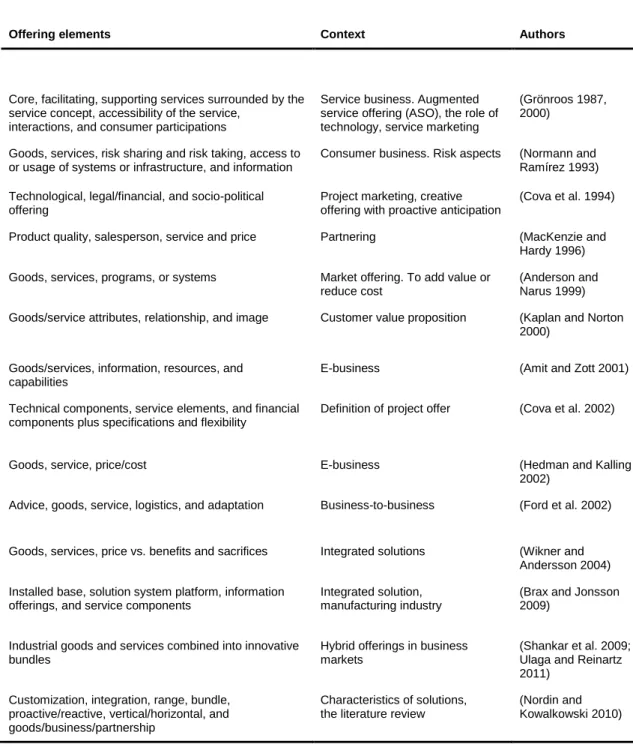
An offering comprises the elements through which a company can provide value for its customers. Examination of the various definitions for the concept of offering indicates that most authors agree on the obvious role of goods and services in an offering. However, depending on the context, there are a number of opinions regarding other elements of an offering that authors have suggested, such as technology, information, capabilities, financial elements, quality, benefits and sacrifices, risk sharing, and even brand image, to be included in an offering (see Table 1).
Table 1: Different concepts of an offering gathered from the literature
Offering elements Context Authors
Core, facilitating, supporting services surrounded by the service concept, accessibility of the service,
interactions, and consumer participations
Service business. Augmented service offering (ASO), the role of technology, service marketing
(Grönroos 1987, 2000)
Goods, services, risk sharing and risk taking, access to or usage of systems or infrastructure, and information
Consumer business. Risk aspects (Normann and Ramírez 1993) Technological, legal/financial, and socio-political
offering
Project marketing, creative offering with proactive anticipation
(Cova et al. 1994)
Product quality, salesperson, service and price Partnering (MacKenzie and Hardy 1996) Goods, services, programs, or systems Market offering. To add value or
reduce cost
(Anderson and Narus 1999) Goods/service attributes, relationship, and image Customer value proposition (Kaplan and Norton
2000)
Goods/services, information, resources, and capabilities
E-business (Amit and Zott 2001)
Technical components, service elements, and financial components plus specifications and flexibility
Definition of project offer (Cova et al. 2002)
Goods, service, price/cost E-business (Hedman and Kalling 2002)
Advice, goods, service, logistics, and adaptation Business-to-business (Ford et al. 2002)
Goods, services, price vs. benefits and sacrifices Integrated solutions (Wikner and Andersson 2004) Installed base, solution system platform, information
offerings, and service components
Integrated solution, manufacturing industry
(Brax and Jonsson 2009)
Industrial goods and services combined into innovative bundles
Hybrid offerings in business markets
(Shankar et al. 2009; Ulaga and Reinartz 2011)
Customization, integration, range, bundle, proactive/reactive, vertical/horizontal, and goods/business/partnership
Characteristics of solutions, the literature review
(Nordin and Kowalkowski 2010)
Offering in industrial solution business
The development and management of industrial solution offerings creates challenges for traditional industrial suppliers for three main reasons. First, suppliers are accustomed to tendering for customers’ contracts within strict specifications. Frequently, this only leads to price competition between capable suppliers without determining the most valuable approach to satisfying a customer’s need. Second, suppliers are not accustomed to adapting their offerings to create new solutions for customers. A supplier organization often has strictly defined internal roles, and collaboration between departments is not necessarily at a level capable of providing customized solutions (Ryynänen et al. 2012). Third, suppliers are not accustomed to collaborating with their customers at the level required to co-create something totally unique – an industrial solution (e.g., Tuli et al. 2007). Penttinen and Palmer (2007) suggest that, as companies are moving from basic offerings to more complex solutions, the form of buyer-seller interaction also changes from transactional to a relational relationship.
A supplier has to understand various customer value components when improving its offerings (Klanac 2013). Customer value has been categorized as having three value-drivers that comprise product-based, service-based, and relationship-based value (Eggert et al. 2006; Lapierre 2000). Hence, an industrial solution offering should communicate value for the customer through each of these components. Industrial solutions are often based mainly on specific technology/ies and, traditionally, the role of goods has been significant. However, while the goods are often a necessity, they rarely form the key competitive advantage. Ford et al. (2002, p.122) state that goods have no intrinsic value but are only a solution to a problem. It is the variety of services that differentiates business-to-business offerings (e.g., Ford et al. 2002; Stremersch et al. 2001).
Mainly due to their intangible nature, it is difficult to universally classify services. Boyt and Harvey (1997, p.294) noted the existence of many studies that attempt to classify services; however, “classification of industrial services has not received the same level of attention as has the categorization of consumer services.” Although this notion is somewhat aged, the situation has remained the same (Ulaga and Reinartz 2011). In project business, there are numerous types of service implemented in various phases of a project life-cycle (Artto et al. 2008) that also apply to solutions. Artto et al. (2008) characterize project business services into before, during, or after delivery, according to the phase in which the service is employed. Van der Valk (2008) identifies four types of service on the basis of how the services are employed by a customer that comprise consumption, instrumental, semi-manufactured, and component services. These classifications are not built on the extensive relationship perspective but on goods-centric logic. However, Boyt and Harvey (1997) classify industrial services in three categories according to the extent of buyer-seller interaction. These categories are elementary service (e.g., telephone service), intermediate service (e.g., repair services), and intricate services (e.g., consulting). Although this classification includes the buyer-seller interaction, the complexity of solution business requires a more extensive relationship perspective.
Ulaga and Reinartz (2011) classified industrial services for hybrid offerings by employing two dimensions: service recipient (good or process) and the nature of value proposition (input- or output-based). They recognized four types of service: Product life-cycle services (PLS), Process support services (PSS), Asset efficiency services (AES), and Process delegation services (PDS). PLSs and PSSs are individually performed services while AES and PDS are combinations of different service elements (Ulaga and Reinartz 2011). For this reason, we are interested in the PLS and PSS categories. Oriented to the supplier’s goods, PLS refers to services that help a customer to operate and maintain the supplier’s machinery. Conversely, PSS orients to the customer’s process by helping customers improve their business processes. Again, being relatively close to solution marketing, we reviewed also project marketing literature. Mathieu (2001) introduced two service categories within project business: service supporting the supplier’s product (SSP) and service supporting the client’s action in relation to the supplier’s product (SSC). All of these categories concern the supplier and customer. However, complex industrial solution business involves often a network of actors. For this reason, Cova and Salle (2008) introduced an offering element termed services supporting the customer network action (SSCN). This category is less coherent and often polymorphous in nature. However, in networked offerings the supplier might need to provide services to third parties which justify the existence of SCCN.
The elements of goods- and service-based customer value have been discussed above. We also touched upon the third value-driver category: relationship-based value. When marketing full-service offerings, the two most important attributes for the buyer are total costs and performance (Stremersch et al. 2001). Customers are interested in, for example, how productive the solution is going to be – in process industries, customers usually demand a set of different test periods before the actual guarantee period commences. Although the solution might well surpass the customer’s expectations, there is always a risk that something does not go as planned. Normann and Ramirez (1993) have included risk sharing and risk taking as a part of their offering concept. In complex environments such as project or solution business, risks are “inherent to any offering” (Normann 2001). While the management of risks is essential in project business, it also needs to be involved in an industrial solution offering.
Finally, the extent of a solution business offering is found to vary depending on the customer (e.g., Penttinen and Palmer 2007). This can be described as the continuum of completeness of an offering (Penttinen and Palmer 2007), whereby completeness is a concept to describe the extent to which a customer’s problems/process are solved/controlled by the solution provider. Penttinen and Palmer (2007) also noted a continuum in the supplier-customer interactions from transactional to relational. In addition, it is worth mentioning that the needs of customers often evolve over time (see e.g., Burns et al. 2010)
Although solution business is described as a process (Tuli et al. 2007), we argue that an industrial solution offering still contains the elements needed to provide the customer the desired outcome. Based on our review of various offering concepts found in the extant literature, we propose that an industrial solution offering isanentity comprising customized goods, services, collaboration, and finance needed to fulfill the industrial solution. Next, we use our empirical evidence from two industrial companies that provide process technologies to complete our framework. We argue that by presenting a set of building blocks based on the extant literature and our empirical findings, and arguing their relevance in the solution business field, we can propose a comprehensive perspective on an industrial solution offering.
Research design
To gain an understanding on the relatively unexplored concept of an industrial solution offering, we adopted a classic case study approach (Dyer Jr. and Wilkins 1991; Yin 2009) by focusing in-depth on two case companies. The research problem, the formulation of an industrial solution offering, is a complex contemporary phenomenon that is best studied in its real-life context by the case study method (Yin 2009). Case study also provides the opportunity to move between data and theory to gain novel insights on the problem (Eisenhardt and Graebner 2007; Eisenhardt 1989). According to Yin (2009), the selection of cases is critical in case study research, and the cases are selected because they are unusually revelatory, extreme exemplars, or opportunities for unusual research access. Dubois and Araujo (2007) claim that case selection is the most important methodological decision. We employed theoretical sampling (Eisenhardt and Graebner 2007) to carefully select the case companies. As the focal phenomenon in our research is the formulation and management of an industrial solution offering, it was important to find two case companies which are actually adopting a solution provider strategy. We employed literal replication, whereby cases are selected so that they predict similar results (Yin 2009). We revised the criteria employed by Kindström and Kowalkowski (2009) and selected three criteria for the selection of our case companies: 1) the company needed to have substantial manufacturing and solution business capabilities; 2) the company needed to have recently invested in its service development; 3) that aiming at customer solutions has been a strategic-level decision. Based on these criteria, we selected two case companies which operate in the same kind of business setting but differ to a large extent in size. The primary method for gathering the empirical data was open-ended interviews (Silverman 2006). To select appropriate interviewees (Halinen and Törnroos 2005), we used the snowballing technique (Biernacki and Waldorf 1981) by focusing on candidates with extensive experience on the service interface within the company.
We had a preconception on our case companies based on their participation in our then academic research project. However, this project provided us with exceptional access to real-life practicing management (cf. Gephart 2004). We began the present study with a review of the literature on offerings. When a preliminary understanding
had been obtained, we formulated a research interview framework that addressed the following issues: 1) the case company’s role as a solution provider; 2) the development and creation of the case company’s offering over time; 3) the role of services in an offering creation; 4) cooperation with customers in the offering creation phase. We used this interview framework with four interviewees from the first case company (spring 2008). We then analyzed the four interviews and decided to enhance our review of the literature according to our new empirical insights on the topic. After this, we continued to the second case company and conducted six interviews with more precise questions regarding cooperation with customers (spring 2009).
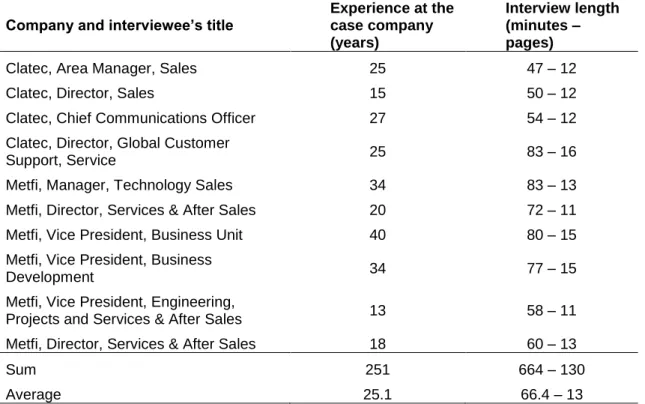
The interviewees from both companies had extensive work experience in their companies, and dealt with customers and company development on a daily basis (see Table 2). Many of the interviewees have also switched positions within their company and thus acquired experience and different perspectives on the organization. This was more pronounced at case company Clatec, where, for example, the chief communications officer has been in charge of many different sales areas and where, as the area manager, also held positions within production. This ensured that the interviewees had a comprehensive perspective on their business. Finally, having conducted ten interviews and gathered extensive secondary data, we were able to begin analyzing our data as a whole. Each interview was tape recorded and transcribed very carefully and field notes were written during the interviews.
Table 2: Interview description
Company and interviewee’s title
Experience at the case company (years)
Interview length (minutes – pages)
Clatec, Area Manager, Sales 25 47 – 12
Clatec, Director, Sales 15 50 – 12
Clatec, Chief Communications Officer 27 54 – 12
Clatec, Director, Global Customer
Support, Service 25 83 – 16
Metfi, Manager, Technology Sales 34 83 – 13
Metfi, Director, Services & After Sales 20 72 – 11
Metfi, Vice President, Business Unit 40 80 – 15
Metfi, Vice President, Business
Development 34 77 – 15
Metfi, Vice President, Engineering,
Projects and Services & After Sales 13 58 – 11
Metfi, Director, Services & After Sales 18 60 – 13
Sum 251 664 – 130
Average 25.1 66.4 – 13
The data were analyzed by employing qualitative content analysis (Silverman 2006), first by focusing on single companies to understand their offering development and then with a cross-case analysis to create the industrial solution offering
framework. While the main empirical insights were derived from the interviews, secondary data enabled us to fill the blank areas and better understand the business environment. We used personal notes written by the project researchers during two focus group interviews, two company specific workshops, and two seminars, as well as archive material and company documents (e.g., newsletters, market research reports, annual reports, CEO presentations, a company history book, circulars, brochures, web pages, and trade media articles). Also, during the research process, we used our research project access to companies to throw ideas at managers and gain their valuable feedback on the study topics. As such, we were able to employ multiple sources of data, which are typical of a case study approach (Eisenhardt 1989; Yin 2009).
Industrial solution offering
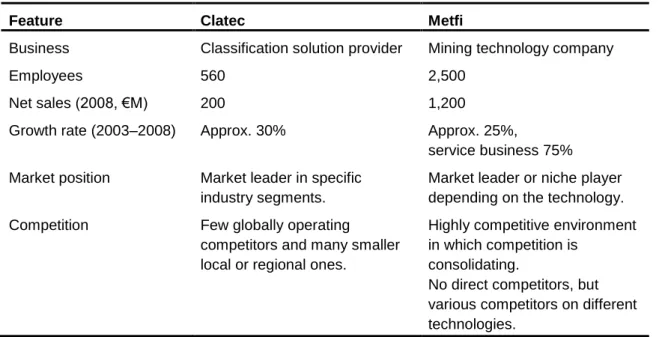
In this chapter, we review the empirical case material that addresses the development and current state of the case companies’ offerings. Finally, we propose a framework for an industrial solution offering. We begin by describing the case companies’ businesses. The main features of both case companies are shown in Table 3.
Table 3: Case company description
Feature Clatec Metfi
Business Classification solution provider Mining technology company
Employees 560 2,500
Net sales (2008, €M) 200 1,200
Growth rate (2003–2008) Approx. 30% Approx. 25%,
service business 75% Market position Market leader in specific
industry segments.
Market leader or niche player depending on the technology. Competition Few globally operating
competitors and many smaller local or regional ones.
Highly competitive environment in which competition is
consolidating.
No direct competitors, but various competitors on different technologies.
Clatec is a classification solution provider which operates in global mining and chemical markets. With its roots in the 1960s, Clatec is a world leader in its niche business area. The company fulfills our criteria for case selection. It has recently adopted a solution provider strategy, and significantly increased the role of service elements in its business model. Solution offering is an essential part of the company’s core activities. It has actively developed its offering to being a full service solution provider in every phase of its customers’ business cycles.
Metfi is a mining technology company which delivers process technologies worldwide. The company’s roots are established in the 1910s. Metfi offers technologies that address the whole chain of processing ores into pure metals. The company is divided into three divisions, each of which concentrates on a particular part of the process chain. Metfi’s annual service business growth rate, 75 per cent, is due to the minor role that service has historically played in the company, and its top-level efforts to substantially develop service business. Metfi’s sales vary from mere technology packages and equipment deliveries to large turnkey deliveries. Thus, Metfi also satisfies our case criteria.
Offering history and development in Clatec
Clatec’s technology, especially in more complex applications, is top class and included basic after sales services as part of its offering from the outset. Soon the company added the planning of auxiliary equipment (e.g., pumps) to its offering, although not all of its deliveries include these auxiliaries. With spare parts and know-how, the company has been able to participate in its customers’ processes after completion of machine delivery projects. The need for this after sales service, which has helped maintain customer relationships and collaboration, came from both the case company and its customers.
In the two industries in which Clatec operates, each customer’s process materials are unique. Hence, Clatec’s most important service has been the ability to test its equipment with its customer’s actual process material. In the process technology industry, customers are highly concerned with the results and reliability of their processes. Tests enable Clatec to fine-tune the process machine, and also its customer’s realization of what to expect from the machine after installation.
Clatec advocates lifetime value through long customer relationships in the form of service contracts. The typical life-cycle of Clatec’s solutions is from 15 to 25 years, and the manufactured goods are only a small portion of the lifetime costs of the investment. Clatec’s first operation contract began in a newly industrialized country. The customer corporation has nine sites, five of which are now operated by Clatec. Despite its customer’s, especially site-level managers’, doubts, Clatec managed to negotiate a pilot operation contract with corporate-level supply chain management. After seeing the results, the customer is now considering outsourcing more of its sites to Clatec. A large factor in this success has been mutual agreement and will. The case began with complete refurbishment of the application machinery utilizing original equipment manufacturer (OEM) spare parts. The operating staff was replaced, and the new personnel trained to meet the higher standards. One of the managers said:
“We fully upgraded the operating staff, which meant new local employees; nobody from the original operators was hired. The new employees were then fully trained and they receive partial bonuses based on the actual operating costs and reliability.”
Also, the machines were updated with optimized operating parameters and regular maintenance. The regular cleaning and inspection of the machines improved the
process results. The most notable change is among the operating staff. As the service manager enthusiastically said:
“The change in labor force has led to the fact that in case of a breakdown in the process, instead of doing nothing like the old operators the new operating staff now runs to fix the problem … Whenever we visit the site, the new operators have always kept the machinery in excellent condition by painting and cleaning it regularly. You even can read from their eyes how proud they are of the installation.”
In its progression to a solution based company, the next step from operating and maintenance service is to the so-called build-own-operate-transfer (BOOT, see Pekkarinen et al. 2012) contract, whereby the supplier plans, finances, builds, owns, operates, and, after a specified period, transfers the system to the funding entity. Various BOOT options have been planned by Clatec. However, the magnitude of the financial aspects and risks that relate to this type of business remain challenging for a relatively small supplier.
Although Clatec has always included basic service elements in its offering, the main emphasis has long been on its advanced technologies and goods. Partly due to separated sales and service functions, a part of the sales force still struggles to communicate effectively the service-based offering. Through acquisitions, in-house research and development, and organic growth, Clatec is now focused on becoming a solution provider. While the company retains many characteristics of a traditional equipment manufacturer, it aims increasingly to transform itself into a solution provider. Clatec’s technological knowledge provides it with a unique position to understand its customers’ classification processes. The company has also been developing various service offerings for quite some time. In a recent sales case, Clatec offered to establish a service agency near to the prospect customer if the deal was accepted. Top management has focused the company’s strategic priority on more demanding customer solutions.
Clatec’s current offering
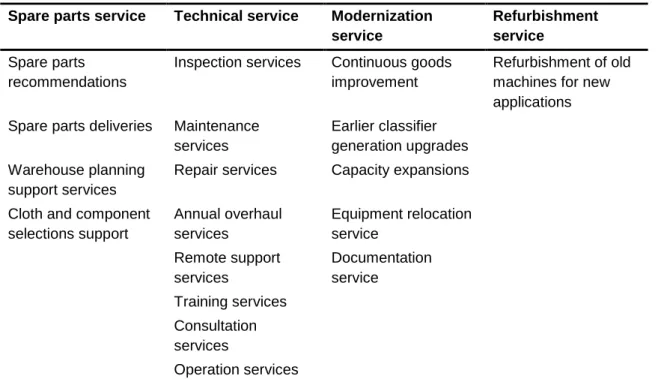
Currently, Clatec has divided its services (see Table 4 ) into four dimensions that comprise spare parts, technical, modernization, and refurbishment services (labeled by Clatec). Based on our analysis of the data, we can draw two notions from Clatec’s solution offering. First, although its technical service includes operation and maintenance service contracts, which can be considered complex services, the simplest mode of service comprising the delivery of spare parts is most profitable for the case company. Second, it seems that Clatec wants to emphasize process support services (PSS), as the majority of the services listed in Table 4 relate to the customer’s process in general.
Table 4: Clatec’s current service portfolio
With regard to the extent of deliveries, as a minimum, Clatec only delivers standard main process machinery. At the other end of its offering continuum is a full service BOOT contract, which is constructed in close cooperation with the customer. Usually the deliveries fall somewhere between the extremes, which comprise the main classification machinery and added service elements, such as a maintenance contract. Thus, the offering must also be adaptive. As one interviewee stated:
“The business has to be adjusted according the customer needs. Certain customers buy standard goods without any consultative selling process … In more advanced machinery solutions, the consultative selling process and collaboration is heavily present.”
Clatec also has services that support the customer network action (SSCN). In some customer cases, Clatec enters into a dialogue with environmental legislation authorities to gain a better position in the tendering phase or to make the investment possible at all. Clatec serves its customers by delivering evidence which proves that its solutions can outperform the regulations in terms of, for example, energy saving and the handling of hazardous materials. In future, Clatec expects that tightening environmental legislation will increase the demand for such services. Furthermore, Clatec delivers services that benefit both itself and the customer in a long-term relationship. The Clatec case provides evidence of this type of service:
“We added to our offering that if the deal is closed, we will establish a service depot near by the customer site with local trained staff to maintain the installation … This would not have been added if the deal was small and, furthermore, if the deal breaks we will not establish the depot in that location … This will help the customer to perform better with shorter maintenance breaks … For us, this helps in closing the deal, but also in organizing the services needed and perhaps in opening up new markets.”
Currently, Clatec is involved in a couple of operation contracts, whereby the company is responsible for a classification plant. In many cases, the operating
Spare parts service Technical service Modernization service
Refurbishment service
Spare parts recommendations
Inspection services Continuous goods improvement
Refurbishment of old machines for new applications Spare parts deliveries Maintenance
services
Earlier classifier generation upgrades Warehouse planning
support services
Repair services Capacity expansions Cloth and component
selections support
Annual overhaul services
Equipment relocation service
Remote support services
Documentation service
Training services Consultation services
agreements have led to improved performance and reliability, with lowered operating costs. These operation agreements also exclude (usually local) third party maintenance companies. Clatec would like to increase the number of operation agreements; however, currently there are shortages in the available local workforce.
Offering history and development in Metfi
Metfi has been a traditional technology supplier with strong technological capabilities for decades. At the same time, Metfi has somewhat neglected its service business potential. Its strong market position and technology leadership are based partly on several company acquisitions. Aided by its own research facilities, Metfi has extensively developed its technologies since the 1930s. This has secured its competitive advantage in technological skills. Metfi’s various acquisitions have also provided support for the development of its offering.
Metfi has put effort into developing technologies instead of manufacturing its own equipment, and began selling technology licenses to other mining companies in the 1950s. At that time, the offering included licenses and also some types of basic engineering and design schemes. These basic licensing contracts no longer exist. Later, Metfi developed its own proprietary equipment and offered technology transfers in addition to simply supplying equipment. Usually the technology transfer package contains know-how in the form of the license, basic design schemes, proprietary equipment, supervision, and startup support. The offerings are normally modular in nature; the key point being that the concept design comes from Metfi. Depending on the division and technology, there might be various equipment alternatives from which to choose.
The customer’s role in the offering development is not distinct. Every interviewee raised the importance of knowing the customer process and listening to the customer, but omitted to explain the customer’s role. Nonetheless, solving the problems and challenges faced by customers with the help of Metfi’s own research will gradually develop Metfi’s offering. Another issue is that usually the raw materials for which the equipment must be tailored differ from customer to customer. This dissimilarity forces Metfi to offer customized solutions according to each customer’s characteristics. It also means that customers contact Metfi at quite an early stage in their investment projects, which provides time for co-creation of the offerings. A comment by an interviewee describes differences in customer needs:
“The problems occur in customer’s process and then it is our duty to find the solution and do it so that it can be copied through several customers using the same process equipment.”
Currently, the most central parts of Metfi’s services business comprise shutdown maintenance services, plant and equipment maintenance, and component services. However, in specific parts of the organization, service contracts are perceived as a secondary source of revenue, and often the price only covers the costs. Offering spare
and wear part packages within the project contract for one product line has come closest to the provision of service contracts. As stated by an interviewee:
“When I joined the team in 2006, we made a list of all spare and wear parts we could think of, and the customer bought it, the whole list, when he bought the solution ... We know, that whenever a customer buys some equipment, he always has five to ten per cent budget for spares. But if you do not sell the whole package at once, the money will be gone in a year or two.”
In addition to the customer’s opinion and raw material characteristics, the customer’s own know-how also influences its behavior and needs. Customers with multiple sites and long experience are keen to acquire only the minimum delivery from Metfi. At the other extreme, newcomers such as junior companies are keen to obtain different types of supervision and maintenance services. There are profitable ongoing service contracts, which can vary from two or three years in length to continuous deals. Usually, these include predefined visits to the site and basic maintenance. Alongside the closer customer relationship, a major benefit is that Metfi can anticipate its customer’s needs and offer, for example, modernization services. However, a conservative opinion in some customer industries has been against entering into service contracts. As an interviewee stated:
“Traditionally the industry has been conservative and the customers have not seen the benefits from outsourced service … Previously when Metfi’s parent company had their own production facilities, the customers contacted these units directly and that was considered (good will) service … Currently, we have a few customer support contracts, which run on their own in terms of profit, but can open up new technology deals if a customer need is noticed.”
Similar to Clatec, Metfi also has always possessed service elements in its offering, namely design services, while the main emphasis has long been on its advanced technologies. The development path seems to follow that of Clatec in some key aspects such as acquisitions, in-house research, and organic growth. Metfi has long perceived its goods as solutions; however, in comparison to the solution business concept, the focus seems to have been on closing single deals instead of focusing on relationships. Recently, the company has set ambitious growth targets for service, which forms a clear need to develop its solution offering. Currently, while delivery sizes have grown, the direction is more to product life-cycle models, including service contracts. Optimization services and environmental updates are the top priority among Metfi’s customers, while outsourcing of maintenance also has become more common.
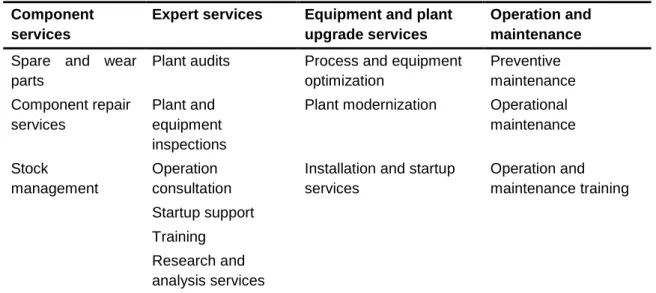
Metfi’s current offering composition
Metfi’s three divisions focus on different customer industries. In general, the first division concentrates on equipment sales, the second specializes in technology transfer, and the third has extensive know-how in lump sum turnkey projects. Metfi has categorized its service portfolio under the following four labels (see Table 5): component services, expert services, equipment and plant upgrade services, and operation and maintenance. From these, spare parts and modernizations are the most important sources of revenue. Similar to the Clatec case, the majority of the listed services can be described as process support services (PSS) that relate to the
customer’s process in general; however, there are some differences. According to the interviewees, the utilization of this service portfolio depends heavily on the division, and thus, the markets. For example, a recent acquisition of a maintenance-specialized service company has strengthened the potential for offering maintenance contracts to one division’s customers. In another division, seven service structures have been developed.
There are also services recognizable in the Metfi case that support customer network action (SSCN). Junior customer companies with no notable business history can utilize Metfi’s reputation as a well-known supplier when they need to convince financiers of their project’s viability. Thus, Metfi indirectly influences its customer’s network by agreeing to participate in a particular “letter of understanding” document. Furthermore, every three years, Metfi holds specially organized conferences for its customers, at which they can share information with Metfi regarding their business challenges. These conferences provide Metfi with accurate insights on possible development needs faced by its customers in everyday operations. In addition to the development needs, Metfi can also identify rumors concerning new actors and projects in the industry during informal conversations. The forum also helps to sell new technology to existing customers because of other customers’ self-presented success stories, thereby offering information on technological possibilities for customers, and benefiting both Metfi and its customers. The importance of these conferences was emphasized by an interviewee:
“The conferences are a good forum; our customers meet each other and chat about their problems, and this is sometimes a good thing because once a customer realizes he is having a problem, we can offer him a solution.”
Table 5: Metfi’s current service portfolio
A topical issue in Metfi’s agenda was the commercialization of service concepts to enhance and widen its offering. Taking account of Metfi’s customer industries, a solution cannot be predefined and structured from goods designed at its headquarters.
Component services
Expert services Equipment and plant upgrade services
Operation and maintenance
Spare and wear parts
Plant audits Process and equipment optimization
Preventive maintenance Component repair
services
Plant and equipment inspections
Plant modernization Operational maintenance Stock
management
Operation consultation
Installation and startup services
Operation and maintenance training Startup support
Training Research and analysis services
However, there must be particular, readily specified but flexible service structures. The final offer, or solution, is then co-created with a customer on the basis of these structures to match specific customer needs. An interviewee provided an apt metaphor:
”It is like when you are coaching children in sport, everyone is unique and you have to address your directions accordingly. The same goes for organizations and geographical areas.”
One of the main factors that slows down the development of services might be the mindsets of Metfi’s employees. The service organization is divided into the three divisions, which have some communication differences. For example, the idea of product life-cycle management has been understood rather differently:
“It is hard to understand or concretize what the product life-cycle means … I once asked my colleagues what is the life-cycle in our business. The answers related merely to the delivery and startup phases of the project … No one thought of the possibilities of long-term contracts.”
This reflects the old manner of regarding technology as the focal offering element. Similar to its customers, some of Metfi’s own personnel also think that technology is their key competitive advantage, and that services are not worth developing:
“Why do we need it (service business) now, we have not needed it before?”
Nowadays, lump sum turnkey projects also form part of Metfi’s offering. These are heavily networked projects, in which Metfi takes the lead and supplies core equipment. The size of the average deal has grown significantly, which can be attributed to the numerous consolidations being experienced by its customers. As with Clatec, there have been some enquiries concerning even more comprehensive solutions with a heavy financial focus; for example, full service BOOT projects. However, instead of developing BOOT projects, Metfi perceives growth opportunities especially by developing comprehensive service agreements, improving production efficiency and spare parts deliveries, modernizing work, training, and researching and testing services together with their customers. However, a challenge remains for Metfi as the majority of its customers are not accustomed to purchasing service contracts. Next, we proceed to draw the case evidence together and propose an industrial solution offering framework for solution providers.
Case synthesis
Our synthesis of the offering analysis on both case companies is presented in Table 6. It can be seen that, while the case companies differ from each other, and quite substantially in terms of size, the cases demonstrate many similarities. However, it seems that the smaller and more agile Clatec has had more short term success in becoming a solution provider. Clatec also has a more extensive background concerning service elements, and thus its employees have a particular service mindset that is partly lacking from the personnel at Metfi.
Table 6: A comparison between the case companies’ development from goods-driven to solution
business
Feature CLATEC METFI
Company setup Focus on classification by employing various technics with a separate service organization. Two different customer industries: mining and chemical.
Three different divisions, each with a service function. Customers from mining industry with different positions in the value chain.
Sales process Up to two years. Consultative approach to find the best solutions for customers. Unified image throughout the company to customers.
Up to three years. Delivers information on new possibilities regarding a customer’s processes.
Contract values €2–3 million each. €3–300 million each. Reasons behind
solution development
Long service traditions; customer demand for service contracts; company set service growth targets.
Recent huge growth in service; strategic choice by the company, solving customers’ problems and challenges.
Customer role in solution
development
Usually closely with customers, mainly customer-driven. New types of service developed in collaboration with customers.
Depending heavily on the customer, mainly company-driven. New types of service developed in collaboration with customers.
Solution completeness
Delivers wide range from plain machinery to BOOT solutions.
Fulfills different needs, ranging from solely delivering goods to solutions.
Goods elements Some alternative technologies, mainly adapting for each customer.
Several alternative technologies from which to choose.
Service elements
Delivers 19 basic service elements (PLS+PSS). Unique testing, whereby the technology is tested with customer’s material. Environmental-related
services that affect the customer’s network (SSCN). Mutual benefits from service depot agreements.
Offers 15 basic service elements
(PLS+PSS). Consultancy service, whereby company experts are provided to customers to analyze and develop further their
processes. A role as a trusted supplier to influence customer’s network (SSCN). Holds conferences at which mutual learning is emphasized.
Financial elements
Normal pricing. Benefit and risk sharing has a minor role, usually emphasizing risk sharing. BOOT model under consideration.
Normal pricing. Benefit and risk sharing has a minor role, difficulties in guiding
customers’ mind sets towards benefit sharing
Relational elements
Depends on the customer, from transactional to collaborative relationships. Reactive vs. proactive approach depends on the customer.
Depends on the customer, from
transactional to collaborative relationships. Moving from reactive to proactive approach.
During our analysis, we were able to recognize two main issues regarding the development of an industrial solution offering. First, the case companies face a relatively heterogenic customer base in respect of their willingness to acquire complete
industrial solutions. Customers have a variety of needs; however, according to our evidence, this is also a customer’s mindset issue. While some customers are demanding transactional offerings, others are willing to build a deep relationship and develop the offering together with the supplier. Although demand for fully operated solutions is steadily rising, not all customers are willing to relinquish control of their operations to an industrial solution provider. Thus, there seems to be a demand for various levels of completeness as well as customer/supplier integration in an industrial solution offering. Second, it seems that customers’ needs are constantly evolving; therefore, suppliers need to be flexible in their operations, especially with regard to their service elements. An equipment provider can no longer trust somewhat static technological advantages to continually win in the ever-tightening business environment. New methods of operation have to be developed constantly, which means that suppliers must be able to flexibly adjust their offerings. This synthesis leads us to propose a new framework for industrial solution offerings.
Dynamic industrial solution offering framework
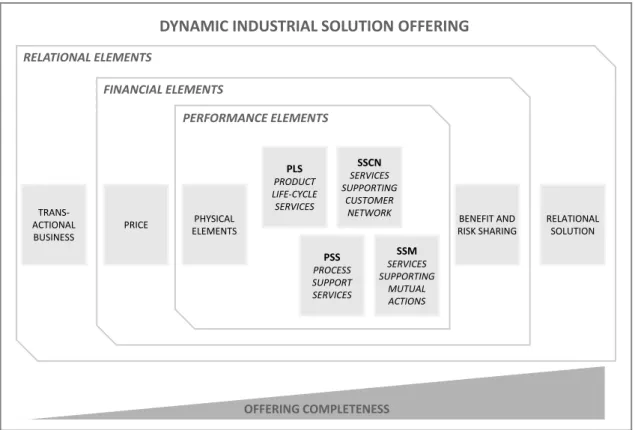
Based on our empirical evidence, we propose a framework for a dynamic industrial solution offering (DISO) in the context of an industrial solution business, depicted in Fig. 1. We argue that an industrial solution offering has two special characteristics: dynamism and completeness. First, the dynamic nature of the offering is derived from the ability for change within an offering. In industrial solution business, customers’ problems are the main driver for the offering development. Our empirical cases have shown that, to provide additional value for the customer, an industrial solution provider needs to adapt to each customer case individually, which means that the offering also needs to be adaptive; that is, dynamic. Second, it is important to include the offering completeness in our framework. Completeness describes the extent to which a customer’s problems/process are solved/controlled by the solution provider (Penttinen and Palmer 2007). The less complete (usually transactional) solutions include merely standardized goods and supporting services (PLS, PSS), which require less collaboration between the supplier and its customer. At the other extreme, companies are providing relational solutions to their customers, whereby a supplier takes responsibility of a particular process of its customer and, therefore, the completeness of an offering is at a high level. For example, Clatec plans to provide its customers with full-service BOOT contracts, which can be seen as a complete relational industrial offering. In these contracts, Clatec will take responsibility for planning, financing, building, owning, and operating its customer’s classifier plant. Currently, the magnitude of the financial aspects and risks that relate to this type of business remain a challenge for a relatively small supplier. Being a considerably larger company, Metfi might possess adequate resources for BOOT contracts. However, the development of Metfi’s whole service ideology is still in too early a phase.
In addition to characteristics of dynamism and completeness, the proposed
dynamic industrial solution offering framework comprises three elements: relational, financial, and performance (i.e., goods and services). Based on the evidence, we propose relational elements to be part of the offering. By relational elements we mean
supplier/customer collaboration that, in the case companies, differs from pure transactional deals to relational collaborative partnerships. At the other extreme, an industrial solution provider might need the tools to service a customer in a purely transactional way. For example, some customers order products from catalogues with only minimal supplier collaboration. Alternatively, and in accordance with the relational solution perspective, a supplier has to have methods for more collaborative customer interface. Hence, we propose that in a relational solution, both customer and supplier co-create the offering, whereas with some other customers, suppliers deliver transactional business.
Fig. 1:Framework for a dynamic industrial solution offering (DISO) based on the case evidence and modified elements from the extant literature (Cova and Salle 2008; Normann and Ramírez 1993; Penttinen and Palmer 2007; Ulaga and Reinartz 2011)
With regard to the financial aspects, we argue that financial issues are in the central of industrial solution business. For example, the demand for BOOT business model that Clatec has been developing has derived from smaller customers that possess enough natural resources for mining operations but does not have the needed funding to invest on a large scale factory. In our framework, we included two financial elements. First, every solution has a price. Price is a more decisive factor when the solution concerns simple goods or goods/service combinations. The more a supplier participates in its customer’s process, the more complete the offering and the greater the need for alternative financial arrangements. Here, an interesting issue is whether or not to share risks and benefits. When Clatec takes responsibility for the operation of a particular customer’s classifier plant, the pricing is usually arranged in
PHYSICAL ELEMENTS
BENEFIT AND RISK SHARING PRICE
TRANS-ACTIONAL BUSINESS
DYNAMIC INDUSTRIAL SOLUTION OFFERING RELATIONAL ELEMENTS
RELATIONAL SOLUTION
OFFERING COMPLETENESS PLS
PRODUCT LIFE-CYCLE SERVICES
SSCN
SERVICES SUPPORTING
CUSTOMER NETWORK
SSM
SERVICES SUPPORTING
MUTUAL ACTIONS
PSS
PROCESS SUPPORT SERVICES
FINANCIAL ELEMENTS
accordance with a dollar per ton principle. Here, the benefit and risk sharing element can be utilized by setting specific targets for process outcomes in conjunction with the customer. Depending on the process outcome, the supplier might receive an agreed share as a bonus or participate in potential realized risks. Our case evidence also supports this element in the Metfi case; however, considering their current offering, the time has not yet arrived for these conversations. The inability to calculate the upper and lower limits, and capacity in manpower, are two critical aspects of such deals. Furthermore, customers have not been ready to adapt to such a different logic of earnings.
Performance elements are those that develop the performance of a solution, comprising both goods and services. Goods are the machinery included in the industrial solution offering, usually proprietary and auxiliary equipment. Services can be divided further into four categories, of which the first three are recognized in the extant literature. The simplest services are product life-cycle services (PLS, see Ulaga and Reinartz 2011), which relate closely to the goods. In the case companies, PLS are, for example, spare parts, maintenance, and installation services. These types of service are standard in nature and are applied very often as a component of deliveries. More sophisticated process support services (PSS, see Ulaga and Reinartz 2011) include, for example, employee training and consultation services, and demand more collaboration during the offering creation and customer relationship. Further examples of PLS and PSS services can be found in Table 4 and Table 5. The services that focus on a customer’s network are termed services supporting the customer network action (SSCN, see Cova and Salle 2008). We found evidence of this in both case companies: environmental-related services from Clatec and a type of certificates of trust given by Metfi to junior companies.
As a new service element, we have recognized a fourth service category: services supporting mutual action (SSM). We propose that SSM’s include supplier actions that will benefit both supplier and customer in a long-term relationship. Examples of these include service depot agreements (Clatec) and industry wide conferences (Metfi). In the service depot case, the company agreed to establish a service depot near the customer if the customer accepted their offer, which happened. Thus, Clatec gained access to new markets surrounding the newly established service depot, and the customer reduced downtime in cases of sudden breakdown. In the case of Metfi, the organized conferences provide a venue for networking with its customers. The benefits for Metfi are mainly based on knowledge they receive concerning various customer problems and possible future investments, while the customers can learn both from their peers and new technologies presented by Metfi and other customers. We see that the service elements presented in the literature have mainly focused customer benefits but, considering the relational nature of industrial solutions, we put forward the fourth element, SSM, to complement the categorization of different service elements by focusing on mutual benefits to both customer and supplier.
Conclusions
Our study shows that the provision of industrial solutions is not an easy task for industrial companies that have worked for years with a fundamentally different goods-oriented mindset. However, it is evident that the case companies are willing to invest and change their modes of operation to provide industrial solutions. The results of our study contribute to the solution offering literature (e.g., Brax and Jonsson 2009; Nordin and Kowalkowski 2010) by formulating an industrial solution offering and developing its management within industrial companies. In the following, our research questions are revisited. We conclude our study with managerial implications, limitations of the study, and directions for future research.
Our first research question was “What are the special characteristics of an industrial solution offering?” Based on our analysis, an industrial solution offering has two special characteristics that need to be assimilated by the supplier: dynamism and completeness. First, we learnt that the nature of an industrial solution business offering is largely dynamic and agile. Solution providers must have the ability to seek and grasp new business opportunities provided by their customers’ businesses. For this reason, we termed our framework “dynamic industrial solution offering”. While the core idea in solution business is to offer specific customized solutions, the supplier must be able to adapt to an ever growing mass of different customer needs, by adding the needed new elements to the offering ad hoc.
Second, the offering needs to be adaptive regarding to how complete it is for each customer. Our exploratory results, as well as the extant literature (Penttinen and Palmer 2007), support the existence of a continuum from less to more complete solutions, depending on the customer’s need and will. The more a supplier takes control and responsibility over a customer’s process, the more complete the offering. As such, it is important that a solution supplier is able to serve both ends of the continuum, again, depending on its customer’s characteristics. For these two reasons, the offering itself should have a basic set of building blocks that can be employed to create a customized solution for a variety of customer needs. Next, we will describe these building blocks in more detail.
The second research question was “What types of element should be included in an industrial solution offering?” Based on the literature and insights derived from our case evidence, we propose that our dynamic industrial solution offering (DISO) comprises three elements: relational, financial, and performance (i.e., goods and services). First, the relational element addresses the extent of collaboration with customers. A solution provider can adopt either a transactional role (i.e., usually goods-based, low offering completeness) or a collaborative role (i.e., controlling customers’ processes, high offering completeness) in the creation of a solution. The relational element dictates that an industrial solution provider needs to be organized so that it can serve both a transactional-type customers as well as partnership-type customers.