Sharif University of Technology
Scientia IranicaTransactions B: Mechanical Engineering www.scientiairanica.com
Flow shop scheduling based on a novel cooling
temperature driven simulated annealing algorithm
R.-M. Chen
a;and F.E. Sandnes
ba. Department of Computer Science and Information Engineering, National Chin-Yi University of Technology, No.57, Sec. 2, Zhongshan Rd., Taiping Dist., Taichung 41170, Taiwan, R.O.C.
b. Oslo and Akershus University College of Applied Sciences, P.O. Box 4, St. Olavs plass, N-0130 Oslo, Norway. Received 22 May 2014; received in revised form 31 October 2014; accepted 5 January 2015
KEYWORDS Permutation Flow Shop Problem (PFSP); Scheduling; Local search; Simulated Annealing (SA);
Simple Insertion with Steady Simulated Annealing (SI-SSA).
Abstract. The Permutation Flow Shop Problem (PFSP) has been applied to many types of problems. The PFSP is an NP-hard permutation sequencing scheduling problem. A local search with simulated annealing scheme involving two phases is proposed in this investigation for solving PFSP. First, for lowering computation complexity, a simple insertion local search is applied to generate the solution of the PFSP. Second, two non-decreasing cooling temperature driven Simulated Annealing (SA), namely, steady SA and reheating SA are employed to maintain successive exploration or exploitation in the solution space. The steady SA maintains the same temperature and keeps the same search behavior and thereby allows the neighbors of the worse solutions to be explored, consequently increasing the chances of nding better solutions, while the reheating SA increases the temperature and exploration ability. The most important feature of the proposed method is its simple implementation and low computation time complexity. Experimental results are compared with other state-of-the-art algorithms and reveal that the proposed simple insertion with steady SA (SI-SSA) method is able to eciently yield the best permutation schedules.
© 2015 Sharif University of Technology. All rights reserved.
1. Introduction
There are many classes of real-world scheduling problems, such as job-shop scheduling, open-shop scheduling, Flow Shop Problem (FSP), task assign-ment scheduling, real-time scheduling, etc. Generally, scheduling problems involve the allocation of resources (such as machines or processors) to execute a set of activities (such as processes or tasks) satisfying given constraints and optimizing given criteria. Processes or tasks usually have time constraints, such as ready time, execution time, precedence, and deadline. Scheduling
*. Corresponding author. Tel.: +886 4 2392 4505; Fax: +886 4 2391 7426
E-mail addresses: [email protected] (R.-M. Chen); [email protected] (F.E. Sandnes)
algorithms must determine a schedule for a set of processes that satises the prerequisite constraints; FSP is one of these and is currently the focus of much research since it can be used for nding near optimal solutions to many real-world optimization problems. FSP can be dened as the problem of assigning a set of independent jobs to run on a set of machines. Each job requires a given xed, non-negative processing time on every machine. In this study, we focus on the Permutation Flow Shop Problem (PFSP), a special case of FSP, where the processing order of jobs always is the same on every machine, that is, all jobs follow the same machine order in the shop starting from the rst machine and nishing on the last machine. PFSP applications can be found in a large number of real world environments, including manufacturing, maintenance, and
warehous-ing operations, as well as in healthcare. Flowshop scheduling is common in cyclic scheduling of a no-wait production line, where multiple parts enter and leave the line during a cycle. For example, a multi-degree cyclic scheduling of a permutation owshop with two robots was investigated by Che and Chu [1]. MPEG-4 macroblock decoding is an application of a permutation owshop problem for synchronization in a co-processor system while implementing tasks with low turnaround time [2]. Maintenance and production are two functions in various industries which act on the same resources. In another study [3], a complex joint production and maintenance scheduling problem in permutation owshop were also investigated. The PFSP has been conrmed to be NP-hard (Taillard) [4]. Its solution search space comprises n! permutations. Hence, nding the optimal solution to PFSP problems with exact algorithms is not feasible in reasonable time. Instead, many approximation algorithms and heuristics have been studied to reveal near optimal solution with less eort, such as the slope-index-based heuristic [5], the CDS heuristic [6], the NEH algorithm [7], etc. However, all these schemes require a substantial amount of computational eort to nd solutions that usually are far from optimal. To eciently obtain high quality solutions, many meta-heuristics have been introduced for solving PFSP; in particular Genetic Algorithms (GA) [8-10], Sim-ulated Annealing (SA) [11], Tabu Search (TS) [12], Ant Colony Optimization (ACO) [13,14], Articial Bee Colony (ABC) [15], Particle Swarm Optimization (PSO) [16,17], etc. Furthermore, meta-heuristics are often combined with local search; for example GA mutation [18], ACO with pheromone mutation [19], construction phase in Iterated Greedy (IG) heuris-tic [20], and so forth. Other approaches include linear programming relaxation to handle specic job-lists in a bidirectional ow-shop [21] and priority rules embedded in the heuristics for solving the sequence dependent setup time ow-shop problem [22].
Many of these meta-heuristics provide quite ac-ceptable and close to optimal solutions. However, they are often either very complex to implement or suer from excessive computational complexity. In some cases, the complexity of the algorithms means that independent implementations are unlikely to capture the intended eectiveness and eciency. Moreover, other approaches exploit PFSP-specic features such that the schemes do not generalize to other owshop variants. Consequently, in 2007, Ruiz and Stutzle proposed the Iterated Greedy (IG) [20] to provide a simple iterated greedy local search based on the NEHT heuristic [7] to simplify implementation and reduce computational complexity. Still, destruction and construction phases are still needed for each IG iteration. During the destruction phase, d randomly
chosen jobs are removed from the permutation; d jobs are then inserted back to nish a complete permutation based on the NEHT heuristic during the construction phase. However, the complexity of NEHT is still O(n2m) which is time consuming for large instances.
After IG phases, a simulated annealing-like acceptance criterion with a constant temperature based on Osman and Potts (1989) is applied. The constant temperature follows the suggestion of Osman and Potts [23] and depends on the particular instances in the OR-Library to be solved.
This study proposes a Simple Insertion with the Steady Simulated Annealing (SI-SSA) scheme to re-duce computational complexity and simplify im-plementation; as such, this method still generalizes to other ow-shop variants. SI-SSA includes two steps: a simple insertion local search, and SA with a novel temperature cooling schedule. The insertion local search is easy to integrate into trajectory meta-heuristics, such as simulated annealing, tabu search, and others. Intrinsically, simulated annealing is a memory-less operation. Additionally, the acceptance criterion of the hill climbing in simulated annealing is modied by adjusting the temperature schedule to reduce the turbulence of the acceptance probability for PFSP based on energy deviation instead of energy dierence. Furthermore, a threshold for excluding undesired solutions is also incorporated. The accep-tance criterion is the key factor of simulated annealing, which enables it to escape from local minima. As for the cooling in the simulated annealing approach, two non-decreasing temperature control mechanisms are employed to provide an opportunity for continuous exploration or exploitation; they are named reheating SA and steady SA, respectively. The reheating SA increases exploration search ability, and the steady SA enhances exploitation search ability. Analysis of the search behavior corresponding to these two cooling schemes is also provided.
This article is organized as follows: Section 2 introduces the problem denition. Section 3 introduces simulated annealing. Section 4 presents the details of the SI-SSA scheme for solving PFSP. In Section 5, the eectiveness and eciency of SI-SSA is demonstrated and the results are analyzed and compared to those of other state-of-the-art schemes. Finally, Section 6 makes the conclusions.
2. Problem denition
A well-known scheduling problem with a background in industrial manufacture is the Flow Shop Problem (FSP) [4]. In this study, the Permutation Flow Shop Problem (PFSP) in which the jobs' sequence on every machine is the same, is addressed. The PFSP can be dened as follows:
There are n independent jobs (N = f1; :::; ng) and m independent machines (M = f1; :::; mg) in the production system. All n jobs have to be run on m machines in the same order. Assuming that the set-up times of all jobs are included in the jobs' processing time.
Each job j(j 2 N) must be processed on m machines, i.e. each job consists of m sub-jobs, oj;k
(k = 1; :::; m). Meanwhile, each job j requires dierent processing times pj;i on dierent machines
i(i 2 M). Moreover, any executing job is not preemptive.
PFSP requires all jobs to be processed with the same processing order = f(1); :::; (n)g from the rst machine to the last machine. The permutation presents the solution to the PFSP and (r) indicates the rth order processing job.
Obtaining the minimum makespan is the commonly dened objective of the PFSP. The minimization of the makespan is highly aected by the permutation .
For example, given 3 jobs, there are 3! possible permutations; the objective is to nd the permutation that yields the shortest makespan.
3. The simulated annealing algorithm
The well-known Simulated Annealing (SA) trajectory meta-heuristic was rst introduced by Kirk patrick et al. [24]. An important characteristic of SA is to provide the capability of escaping from local optima. It is restated that allowing a neighborhood moving step with a worse solution quality was designed. Movements to worse neighborhoods oer a mechanism of diver-sication search through hill climbing. However, the worse movement in SA is determined by an acceptance criterion which is relevant to a probability called acceptance probability. A key component in SA is its cooling scheduling, which controls the acceptance probability. Typically, the temperature decreases over time, and thus the acceptance probability decreases over time. It is restated that higher acceptance probability in the early stage and lower acceptance probability in the latter stage have been implemented in SA. The rationale of this design is to provide the diversication search ability at the beginning and to give intensi5cation search ability in later stages.
The conventional SA iterates until a termination condition is met. At iteration t, four steps are conducted:
Neighborhood search: A candidate solution St' from
the neighborhoods of St is generated. There are
many local search schemes suggested to generate the candidate solution St'.
Energy evaluation: The energy related to the solu-tion St' is evaluated, wherein E(St') is denoted as
an energy function, and the variance of energy E is also obtained.
Acceptance criterion: The acceptance criterion is applied; if the variance of energy E is less than zero, the St would be replaced by St'. Otherwise,
St' with worse quality can be accepted with an
ac-ceptance probability P . The acac-ceptance probability P (St; St',Tt) is dened in Eq. (1):
P (St; St0; Tt) = e E=Tt= e E(S0t) E(St)Tt : (1)
Here Tt is the cooling temperature of the tth
iteration; it and the acceptance probability decrease over time. A worse solution is accepted when a randomly generated probability r is smaller than the determined acceptance probability (r < P ).
Cooling strategies: The temperature decrement rule follows an exponential cooling scheme with cooling rate, , as listed in Eq. (2):
Tt+1= Tt ; 2 [0; 1]: (2)
4. Simple Insertion with Steady Simulated Annealing (SI-SSA)
This section outlines the details of the proposed SI-SSA approach. The procedures of SI-SI-SSA are provided rst. Then, all steps in the procedures are presented and described in the following sections.
4.1. The Simple Insertion with Steady
Simulated Annealing Algorithm (SI-SSA) The pseudo-code of the proposed Simple Insertion with Steady Simulated Annealing (SI-SSA) for PFSP is summarized in Figure 1.
4.2. Insertion local search
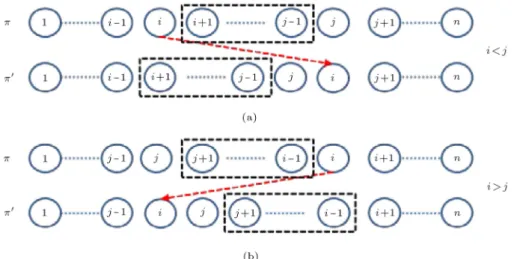
Many local search strategies for PFSP have been studied and combined with meta-heuristics, especially for trajectory meta-heuristics. The local search is one way to implement the neighborhood search, and the suggested insertion local search is easy to implement. Suppose an existing job processing order is denoted by the permutation . The insertion operation removes the job at the ith position in , and then inserts it in the jth position, where i 6= j, and i; j are randomly generated [25].
Once a permutation is obtained as a PFSP solution, in the case of i < j, the = f(1); :::; (i 1); (i); (i + 1); :::; (j 1); (j); (j + 1); :::; (n)g is the permutation before insertion local search is applied. The new permutation 0 = f(1); :::; (i
1); (i + 1); :::; (j 1); (j); (i); (j + 1); :::; (n)g can be obtained after applying insertion. And, in the
Figure 1. The pseudo-code of the proposed Simple Insertion with Steady Simulated Annealing (SI-SSA).
Figure 2. Insertion operations for the cases of (a) i < j, and (b) i > j.
case of i > j, the permutation before insertion is = f(1); :::; (j 1); (j); (j + 1); :::; (i 1); (i); (i + 1); :::; (n)g; after insertion, the new permutation is 0 = f(1); :::; (j 1); (i); (j); (j + 1); :::; (i
1); (i + 1); :::; (n)g. Figure 2 shows an example of a permutation before insertion local search is applied, and two permutations 0 after insertion local search
is performed from . The operation of this simple insertion local search is listed in step 1.1 of Figure 1. The insertion operation schematic diagram is shown in Figure 2.
4.3. Non-decreasing temperature control
In several modied adaptive simulated annealing strategies, the temperature is not always decreasing, but is controlled by certain schemes, such as in [19] which uses a constant temperature. Some studies also employ reheating, such as Azizi and Zolfaghari [26] in which the temperature was not associated with the it-eration. In this study, two non-decreasing temperature controlling schemes for stage of t + 1 are applied; the rst temperature control scheme applied in SA is a heating temperature control dened in Eq. (3). This scheme is called reheating SA herein as indicated in the right part of the step 1.5 in the Figure 1.
Tt+1=
8 < :
Tt a; St= S0t
Tt (1 + ); otherwise
(3)
The rationale of this control is inspired by Azizi and Zolfaghari [26]. In [26], a reheating mechanism was pro-posed, but the temperature control was not associated with the iteration. This simple reheating mechanism, associated with iteration to increase the search ability may be preferable for the following reasons. The acceptance probability is increased due to heating, and, thus, the exploration area is expanded, i.e. expanding the search pace. Notably, too wide a search range resembles a random walk; therefore, a small value is suggested for preventing a fully random search. It is restated that movement toward too worse a solution is prohibited. The other temperature controlling scheme, used in SA, is a named steady temperature control (see Eq. (4)), and is called steady SA in this work as indicated in the left part of the step 1.5 in the Figure 1.,
Tt+1=
8 < :
Tt a; St= St0
Tt; otherwise
(4)
The intent of this design is that once a candidate solution is not accepted (going uphill), that is, St <
S0
t, then the temperature is maintained and hence
the P is kept at a higher value. It is restated that subsequent exploration ability is preserved for nding a lower makespan solution from high makespan solution neighbors. Otherwise, the temperature is decreased accordingly for further exploitation. These two non-decreasing temperature control mechanisms focus on facilitating enough exploration ability during the solu-tion search. The acceptance probability used in this study is based on relative energy change rel = E = E(S0
t) E(St)=E(St) [27] as indicated in Eq. (5):
P (St; St0; Tt) = e rel E=Tt: (5)
5. Experimental results
To evaluate the eectiveness of the proposed simple insertion simulated annealing algorithm, the following simulation instances from the Taillard benchmark [28] were tested. Taillard generated a set of FSP schedul-ing problems with dierent combinations of jobs (n) and machines (m), n 2 f20; 50; 100; 200; 500g and m 2 f5; 10; 20g, and there are 10 instances for each problem size. The processing time of each job is distributed uniformly in the interval [1,99]. This test suite is available from http://mistic.heig-vd.ch/taillard/ and http://people.brunel.ac.uk/ mas-tjjb/jeb/o rlib/les/owshop2.txt. Before comparing the performance of the proposed SI-SSA with other schemes, the eciency of the proposed non-decreasing temperature control mechanisms (steady SA and re-heating SA) was rst evaluated. The comparison crite-rion is computed as the Relative Percentage Deviation (RPD) as follows:
RPD = MinsolBestBestsol
sol 100%; (6)
where Minsol represents the shortest makespan of the
best solution obtained from the best trial of a specic algorithm and Bestsol is the makespan of the optimal
solution or known upper bound provided by Taillard's instances. To be more objective, the Average Relative Percentage Deviation (ARPD) is applied as dened in [20].
ARPD =XT
i=1
Minsoli Bestsol
Bestsol 100%
=T; (7)
where Minsoli is the makespan of a solution given by
any of the T repetitions of the compared algorithms. The parameter settings of this simulation are: T0= 1,
= 0:99 and = 0:001. There are two comparison bases commonly used, namely, the Taillard benchmark upper bound data published in 2004 and 2006. The eciency comparison between the proposed steady and
Table 1. Comparison between steady SA, reheating SA and conventional SA-ARPD (Taillard 2004 upper bound data [29]).
n=m SA Reheating SA Steady SA
20/5 0.095 0.202 0.089
20/10 0.601 0.459 0.247
20/20 0.548 0.660 0.159
50/5 0.038 0.021 0.025
50/10 0.432 1.853 0.376
50/20 1.511 4.411 1.453
100/5 -0.016 -0.011 -0.014
100/10 0.433 0.479 0.414
100/20 1.110 2.069 1.041
200/10 0.296 0.370 0.349
200/20 1.138 2.785 1.122
500/20 1.029 1.531 1.108
Average 0.601 1.236 0.531
Table 2. Comparison between steady SA, reheating SA and conventional SA-ARPD (Taillard 2006 upper bound data [30]).
n=m SA Reheating SA Steady SA
20/5 0.144 0.251 0.138
20/10 0.608 0.467 0.255
20/20 0.553 0.664 0.164
50/5 0.038 0.021 0.025
50/10 0.914 2.343 0.858
50/20 2.088 5.004 2.030
100/5 0.030 0.034 0.032
100/10 0.479 0.525 0.460
100/20 2.147 3.115 2.077
200/10 0.321 0.395 0.374
200/20 2.192 3.856 2.176
500/20 1.362 1.865 1.441
Average 0.906 1.545 0.836
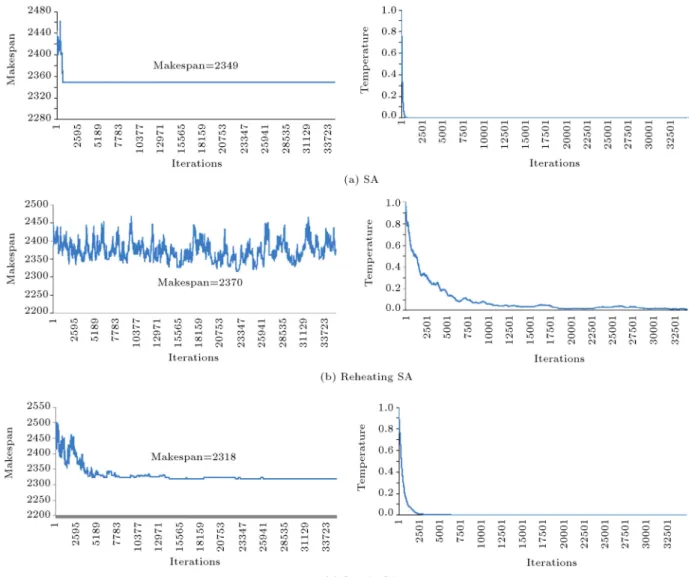
reheating SAs with the conventional SA is based on both benchmark data as displayed in Tables 1 and 2. Experiments were on the basis of 100000 solutions generated. Five test runs (T = 5) were conducted to calculate ARPD for fair comparison as dened in [20]. According to the simulation results, the suggested SI-SSA with steady SA yielded the smallest RPDs (0.531% and 0.836%) compared to the other two temperature controlling schemes. It is restated that the performance of the proposed SI-SSA with steady SA is better than the other two SAs. Moreover, the makespan and temperature evolution of these three SAs (conventional SA, reheating SA and steady SA) are displayed in Figure 3; the tests were conducted
Figure 3. Makespan and SA temperature evolutions for the cases of (a) conventional SA, (b) reheating SA, and (c) steady SA.
on tai20 20 1 (20/20 case, instance 1) with 100,000 iterations; Figure 3 only shows temperature changes for the rst 35,500 iterations.
The conventional SA temperature quickly drops to 0, and, therefore, the acceptance probability of escaping from the local optimal for searching the neigh-borhoods is zero, that is, it quickly becomes unable to search the neighborhood to nd better solutions. Although the reheating SA does not quickly cool, the temperature increases which cause the acceptance probability of escaping from local minimum remains high, and this does bias the search behavior toward a wider range. On the other hand, the steady SA maintains the same temperature, keeping the same search behavior and allowing the exploration of the neighbors with worse solutions, and therefore increases the possibility of nding better solutions. Figure 3 displays the simulation results on Tai 20 20 1 (20/20 case, instance 1). Figure 3(a) shows that the con-ventional SA algorithm is trapped on local optimal
(makespan=2349) since acceptance probability is al-most zero all the time due to the temperature quickly dropping to zero. Figure 3(b) indicates that the reheating SA algorithm randomly walks about the solution space due to its high acceptance probability owing to the increased temperature; hence, it is unable to nd good solutions (makespan=2370). Nevertheless, Figure 3(c) demonstrates that the steady SA algorithm provides an adequate exploration search ability in the neighborhood since the acceptance probability is maintained so as to have high opportunity to obtain the best solution (makespan=2318).
Therefore, the corresponding search behavior of the temperature changing process is compliant with the scheduling results of Tables 1 and 2.
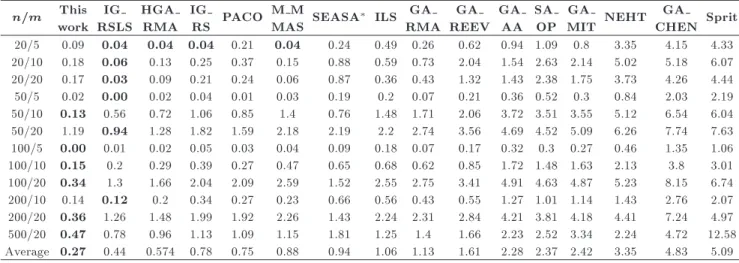
Comparing the top state-of-the-art algorithms listed in [20], the termination condition was based on computation time. The comparison was made by using Taillard's 2004 bench-mark. Each problem instance was repeated for ve independent trials (T = 5),
Table 3. Comparison of dierent algorithms in [20] on the basis of Taillard 2004 upper bound data-ARPD (%).
n=m This work
IG RSLS
HGA RMA
IG
RS PACO M MMAS SEASA ILS GARMA GA REEV
GA AA
SA OP
GA
MIT NEHT
GA
CHEN Sprit 20/5 0.09 0.04 0.04 0.04 0.21 0.04 0.24 0.49 0.26 0.62 0.94 1.09 0.8 3.35 4.15 4.33 20/10 0.18 0.06 0.13 0.25 0.37 0.15 0.88 0.59 0.73 2.04 1.54 2.63 2.14 5.02 5.18 6.07 20/20 0.17 0.03 0.09 0.21 0.24 0.06 0.87 0.36 0.43 1.32 1.43 2.38 1.75 3.73 4.26 4.44 50/5 0.02 0.00 0.02 0.04 0.01 0.03 0.19 0.2 0.07 0.21 0.36 0.52 0.3 0.84 2.03 2.19 50/10 0.13 0.56 0.72 1.06 0.85 1.4 0.76 1.48 1.71 2.06 3.72 3.51 3.55 5.12 6.54 6.04 50/20 1.19 0.94 1.28 1.82 1.59 2.18 2.19 2.2 2.74 3.56 4.69 4.52 5.09 6.26 7.74 7.63 100/5 0.00 0.01 0.02 0.05 0.03 0.04 0.09 0.18 0.07 0.17 0.32 0.3 0.27 0.46 1.35 1.06 100/10 0.15 0.2 0.29 0.39 0.27 0.47 0.65 0.68 0.62 0.85 1.72 1.48 1.63 2.13 3.8 3.01 100/20 0.34 1.3 1.66 2.04 2.09 2.59 1.52 2.55 2.75 3.41 4.91 4.63 4.87 5.23 8.15 6.74 200/10 0.14 0.12 0.2 0.34 0.27 0.23 0.66 0.56 0.43 0.55 1.27 1.01 1.14 1.43 2.76 2.07 200/20 0.36 1.26 1.48 1.99 1.92 2.26 1.43 2.24 2.31 2.84 4.21 3.81 4.18 4.41 7.24 4.97 500/20 0.47 0.78 0.96 1.13 1.09 1.15 1.81 1.25 1.4 1.66 2.23 2.52 3.34 2.24 4.72 12.58 Average 0.27 0.44 0.574 0.78 0.75 0.88 0.94 1.06 1.13 1.61 2.28 2.37 2.42 3.35 4.83 5.09
SEASA (Chen et al. 2014 [27])
Table 4. Simulation results on the basis of Taillard 2006 upper bound data-ARPD (%).
n=m 20/5 20/10 20/20 50/5 50/10 50/20 100/5 100/10 100/20 200/10 200/20 500/20 Avg ARPD 0.13 0.18 0.16 0.02 0.59 1.74 0.02 0.21 1.38 0.16 1.41 0.81 0.57
Table 5. RPD(%) interval and Incr lb on the basis of Taillard 2006 upper bound data [30].
m=m Min RPD ARPD Max RPD RPD Incr lb%
20/5 0.08 0.13 0.14 0.06 2.56
20/10 0.05 0.18 0.37 0.32 9.58
20/20 0.08 0.16 0.27 0.20 20.76
50/5 0.00 0.02 0.04 0.04 0.83
50/10 0.50 0.59 0.67 0.17 2.76
50/20 1.44 1.74 2.01 0.57 10.79
100/5 0.02 0.02 0.03 0.00 1.10
100/10 0.12 0.21 0.33 0.21 1.01
100/20 1.22 1.38 1.56 0.34 5.34
200/10 0.08 0.16 0.24 0.16 0.83
200/20 1.27 1.41 1.50 0.24 3.00
500/20 0.75 0.81 0.87 0.12 1.23
Average 0.47 0.57 0.67 0.20 4.98
rather than using the best trial; the average of the ve trials was chosen and all the 10 instances for every problem case (n=m; n jobs/m machines) were calculated. The termination condition (on the basis of computation time) in [20] was \n (m=2) 60", and the algorithm ran on an Athlon XP 1600 + (1400 MHz) system. The proposed scheme ran on a core i7 (3.4 GHz) PC. Therefore, the computation time of this work was \n (m=2) 60 (1:4=3:4)". The simulation results are listed in Table 3. The SI-SSA has the smallest average ARPD 0.27%; it ranks 1st compared to the other algorithms. More-over, the test on the latest upper bound in Tail-lard's 2006 benchmark was also conducted, and the simulation results are displayed in Table 4. The yielded ARPDs by the SI-SSA are less than 1.19%
(50/20 case in Table 3) and 1.74% (50/20 case in Table 4) for Taillard 2004 and 2006 benchmark upper bounds, respectively. Simulation results indicate that the performance of the proposed SI-SSA is excellent and competitive on the basis of its generated solution quality.
Since the upper bound changes over time, the per-centage increases of the makespan above the minimal lower bound (Incr lb%) are also provided in addition to the average deviation (ARPD). As displayed in Table 5, the average Incr lb% is only 4.98%. Furthermore, the stability of the proposed scheme was also inspected. The ARPD intervals (ARPD=Max ARPD - Min ARPD) are shown in Table 5. The maximum ARPD interval is 0.57%. Hence, the SI-SSA scheme is considered stable.
6. Conclusions
A strategy named Simple Insertion Simulated Anneal-ing with Steady SA (SI-SSA) is suggested. In SISA, a simple insertion local search is applied to generate the solution of the PFSP to lower computation complexity. Meanwhile, two non-decreasing cooling temperature driven Simulated Annealing (SA), named steady SA and reheating SA, are employed to maintain successive exploration or exploitation in the solution space to increase the chance of nding better solutions. The advantages of the proposed SI-SSA algorithm can be summarized as follows:
This scheme is easy to implement since only a simple insertion local search is applied. Simple insertion local search used for constructing PFSP solutions reduces the time-complexity to O(n) and only one parameter () is required for simulated annealing.
The steady SA maintains a constant temperature, keeping the same search behavior, and thus allows the exploration of the neighbors with worse so-lutions, thereby increasing the chances of nding better solutions so as to escape from local minima.
The SI-SSA scheme outperforms many complex meta-heuristics; the averaged ARPD is only 0.27%, ranking it the 1st as shown in Table 1.
The maximum ARPDs are less than 1.19% and 1.74% (for the 50/20 case) on the basis of Taillard's 2004 and the latest 2006 upper bounds as shown in Tables 1 and 2.
The maximum RPD interval (RPD) is only 0.57% as shown in Table 3, indicating that SI-SSA is a stable algorithm for solving PFSP class problems. Meanwhile, the average Incr lb% is only 4.98%.
Acknowledgments
This work was partly supported by the Ministry of Sci-ence and Technology, Taiwan, under Contract MOST 103-2221-E-167-009.
Conict of interests
The authors declare that this manuscript has no any conict of interests with other people or institutions.
References
1. Che, A. and Chu, C. \Multi-degree cyclic scheduling of two robots in a no-wait owshop", IEEE Transactions on Automation Science and Engineering, 2(2), pp. 173-183 (2005).
2. Boutellier, J., Bhattacharyya, S.S. and Silven, O. \Low-overhead run-time scheduling for ne-grained ac-celeration of signal processing systems", IEEE
Work-shop on Signal Processing Systems, Shanghai, China, pp. 457-462 (2007).
3. Benbouzid-Sitayeb, F., Varnier, C. and Zerhouni, N. \Proposition of new genetic operator for solving joint production and maintenance scheduling: Application to the ow shop problem", International Confer-ence on Service Systems and Service Management, 1, Troyes, France, pp. 607-613 (2006).
4. Taillard, E. \Some ecient heuristic methods for the ow shop sequencing problem", European Journal of Operational Research, 47, pp. 65-74 (1990).
5. Palmer, D.S. \Sequencing jobs through a multistage process in the minimum total time: A quick method of obtaining a near-optimum", Operational Research Quarterly, 16, pp. 101-107 (1965).
6. Campbell, H.G., Dudek, R.A. and Smith, M.L. \A heuristic algorithm for the n-job, m-machine sequenc-ing problem", Management Science, 16, pp. B630-B637 (1970).
7. Nawaz, M., Enscore, E.E. and Ham, I. \A heuristic al-gorithm for the m-machine, n-job owshop sequencing problem", OMEGA, International Journal of Manage-ment Science, 11, pp. 91-95 (1983).
8. Tseng, L.Y. and Lin, Y.T. \A genetic local search algo-rithm for minimizing total owtime in the permutation ow-shop scheduling problem", Int. J. Production Economics, 127, pp. 121-128 (2010).
9. Xu, X., Xu, Z.H. and Gu, X.S. \An asynchronous genetic local search algorithm for the permutation owshop scheduling problem with total owtime min-imization", Expert Systems with Applications, 38, pp. 7970-7979 (2011).
10. Chen, S.H., Chang, P.C., Cheng, T.C.E. and Zhang, Q.F. \A Self-guided genetic algorithm for permutation ow-shop scheduling problems", Computers & Opera-tions Research, 39, pp. 1450-1457 (2012).
11. Javadian, N., Mozdgir, A., Kouhi, E.G., Qajar, D. and Shiraqai, M.E. \Solving assembly owshop scheduling problem with parallel machines using variable neigh-borhood search", International Conference on Com-puters & Industrial Engineering, CIE 2009, Troyes, France, pp. 102-107 (2009).
12. Liu, S., Cui, J.H. and Li, Y. \Heuristic-tabu algorithm for hybrid owshop scheduling with limited waiting time", International Symposium on Computational Intelligence and Design, ISCID '08, 2, Wuhan, China, pp. 233-237 (2008).
13. Ahmadizar, F. \A new ant colony algorithm for makespan minimization in permutation ow shops", Computers and Industrial Engineering, 63(2), pp. 355-361 (2012).
14. Chen, R.M., Lo, S.T., Wu, C.L. and Lin, T.H. \An eective ant colony optimization-based algorithm for ow shop scheduling", IEEE Conference on Soft Com-puting in Industrial Applications, SMCia '08, Muroran, Japan, pp. 101-106 (2008).
15. Tasgetiren, M.F., Pan, Q.K., Suganthan, P.N. and Chen, H.L. \A discrete articial bee colony algorithm for the total owtime minimization in permutation ow shops", Information Sciences, 181, pp. 3459-3475 (2011).
16. Tang, L. and Wang, X. \An improved particle swarm optimization algorithm for the hybrid owshop scheduling to minimize total weighted completion time in process industry", IEEE Transactions on Control Systems Technology, 18(6), pp. 1-12 (2009).
17. Wang, X. and Tang, L. \A discrete particle swarm optimization algorithm with self-adaptive diversity control for the permutation owshop problem with blocking", Applied Soft Computing, 12, pp. 652-662 (2012).
18. Murata, T., Ishibuchi, H. and Gen, M. \Neighbor-hood structures for genetic local search algorithms", International Conference on Knowledge-Based Intelli-gent Electronic Systems, KES '98, 2, Adelaide, South Australia, pp. 256-263 (1998).
19. Song, X.M., Wang, K. and Xiao, Y. \An improved ant colony optimization and its applications in ow-shop problems", International Conference on Compu-tational Intelligence and Software Engineering, CiSE 2009, Wuhan, China, pp. 1-4 (2009).
20. Ruiz, R. and Stutzle, T. \A simple and eective iterated greedy algorithm for the permutation owshop scheduling problem", European Journal of Operational Research, 177, pp. 2033-2049 (2007).
21. Zhao, Z.Y.J., Lau, H.C. and Ge, S.S. \Integrated resource allocation and scheduling in a bidirectional owshop with multimachine and COS constraints", IEEE Transactions on Systems, Man, and Cybernetics, Part C: Applications and Reviews, 39(2), pp. 190-200 (2009).
22. Dong, X., Huang, H.K. and Chen, P. \Study on heuristics for the permutation owshop with sequence dependent setup times", IEEE International Confer-ence on Information Reuse & Integration, IRI '09, Las Vegas, Nevada, USA, pp. 417-421 (2009).
23. Osman, I. and Potts, C. \Simulated annealing for permutation ow-shop scheduling", OMEGA, Inter-national Journal of Management Science, 17(6), pp. 551-557 (1989).
24. Kirkpatrick, S., Gelatt, C.D. and Vecchi, M.P. \Opti-mization by simulated annealing", Science, 220(4598), pp. 671-680 (1983).
25. Stutzle, T. \An ant approach to the ow shop prob-lem", The Sixth European Congress on Intelligent Techniques and Soft Computing (EUFIT'98), 3, Verlag Mainz, Aachen, Germany, pp. 1560-1564 (1998).
26. Azizi, N. and Zolfaghari, S. \Adaptive tempera-ture control for simulated annealing: A comparative study", Computers & Operations Research, 31, pp. 2439-2451 (2004).
27. Chen, R.M. and Hsieh, F.R. \An exchange local search heuristic based scheme for permutation ow shop problems", Applied Mathematics & Information Sciences, 8, pp. 209-215 (2014).
28. Taillard, E. \Benchmarks for basic scheduling prob-lems", European Journal of Operational Research, 64, pp. 278-285 (1993).
29. Scheduling instances (2004).
http://mistic.heig-vd.ch/taillard/problemes.dir/ordonnancement.dir/ ordonnancement.html
30. Benchmarks for ow-shop.
http://www.li.fr/ liefooga/benchmarks/benchmarks
Biographies
Ruey-Maw Chen received the BS, MS and PhD de-grees in Engineering Science from the National Cheng Kung University of Taiwan ROC in 1983, 1985 and 2000, respectively. From 1985 to 1994, he was a senior engineer on avionics system design at Chung Shan Institute of Science and Technology (CSIST). Dr. Chen was a networking engineer at Chinyi Institute of Technology during 1994 to 2002. Since 2002, he has been with the Department of Computer Science and Information Engineering, National Chinyi University of Technology (NCUT), where he is an associate pro-fessor. His research interests include meta-heuristics, scheduling optimization with applications, scheduling in the cloud, and computer networks.
Frode Eika Sandnes received a BSc degree in Com-puter Science from the University of Newcastle upon Tyne, U.K., and a PhD in Computer Science from the University of Reading, U.K. He is currently protector for Research and internationalization at Oslo and Aker-shus University College of Applied Sciences in Norway and a Professor in the Institute of Computer Science, Faculty of Technology, Art and Design. His research interests include human computer interaction. Dr. Sandnes has been instrumental in the establishment of the rst master specialization in Norway that addresses assistive technologies. He is an editorial member of several journals.
![Table 1. Comparison between steady SA, reheating SA and conventional SA-ARPD (Taillard 2004 upper bound data [29])](https://thumb-us.123doks.com/thumbv2/123dok_us/8385069.2227851/5.892.481.814.201.502/table-comparison-steady-reheating-conventional-arpd-taillard-upper.webp)