Sharif University of Technology
Scientia IranicaTransactions B: Mechanical Engineering www.scientiairanica.com
Numerical study of mixed convection in the annulus
between eccentric rotating cylinders
A. Abedini, A.B. Rahimi
and A. Kianifar
Faculty of Engineering, Ferdowsi University of Mashhad, Mashhad, P.O. Box 91775-1111, Iran. Received 8 October 2012; received in revised form 21 September 2013; accepted 5 March 2014
KEYWORDS Mixed convection; Bipolar-coordinate system;
Annulus;
Constant angular velocity.
Abstract. Mixed convection of air with Prandtl number of 0.7 in eccentric horizontal annuli with isothermal wall conditions was numerically investigated. The inner cylinder was at a higher temperature and the inner and outer cylinders rotate either clockwise or counter-clockwise at a constant angular velocity. The eects of parameters such as the eccentricity of the axes, the Rayleigh number and rotation direction were studied. The two-dimensional Navier-Stokes and energy equations were numerically solved in an orthogonal grid by employing a nite-volume method based on the SIMPLE algorithm. This orthogonality was achieved by employing a cylindrical bipolar coordinate system. Use of this coordinate system has the privileges of orthogonal coordinate and simplicity of computing dierent uxes involved. Mean and local heat transfer results were obtained. The physics of the ow and the heat transfer is revealed by the streamlines and the isotherms obtained from the numerical solutions. Flow and heat transfer are inuenced by the orientation and eccentricity of the inner cylinder. The present numerical results are in good agreement with the results of others for pure natural convection.
© 2014 Sharif University of Technology. All rights reserved.
1. Introduction
Mixed convection in the annulus between two cylin-ders has attracted attention because of its engineering applications such as mixtures, thermal energy storage systems, electrical components cooling, double pipe heat exchangers designed for chemical processes, food industries, and nuclear reactors. Kuehn and Gold-stein [1,2] give an overview for concentric and eccentric annuli. They measured the heat transfer coecients in air and water for natural convection in concentric and eccentric horizontal annuli. Their experimental data are commonly used to validate most of the recent numerical studies. Later, Macleod and Bishop [3] per-formed several measurements of overall heat transfer
*. Corresponding author. Tel: +98 511-8805018
E-mail addresses: ahad [email protected] (A. Abedini); [email protected] (A.B. Rahimi); a [email protected] (A. Kianifar)
rates and proles of the time-averaged and uctuating temperature eld for fully turbulent natural convec-tion. In some applications to increase the heat transfer rate, ns are used in the axial direction. Chai and Patankar [4], Desrayaud et al. [5], Patankar et al. [6], and Rustum and Soliman [7] investigated the eect of ns attached on the inner and outer cylinders on the uid ow and heat transfer in annuli by analyzing the result obtained from the numerical solution of the two-dimensional and steady-state governing equations. Shahraki [8] demonstrated the eect of temperature-dependent properties on the streamlines and tempera-ture distributions in a concentric annulus. The varying viscosity had the strongest eect on the ow eld while the thermal conductivity had the strongest eect on temperature proles. Dyko et al. [9] presented numerical and experimental buoyancy driven ow in an annulus between two horizontal coaxial cylinders at Rayleigh numbers exceeding the critical value depend-ing on radius ratio. Alawadhi [10] studied the natural
convection ow in a horizontal annulus enclosure with a transversely oscillating inner cylinder numerically. Natural convection of a micro-polar uid in an eccentric annulus enclosure was studied by Char and Lee [11]. An unsteady natural convection in a horizontal annulus was investigated by Mizushima et al. [12]. Instability analyses for natural convection in horizontal annuli have been extensively addressed in the literature. Petrone et al. [13] numerically studied the linear insta-bility of two-dimensional natural convection in air-lled horizontal annuli, and a map of possible ow patterns was established. Numerical results of the turbulent ow in a two-dimensional domain were presented by Farouk and Guceri [14]. In their work, the natural convection was considered in the annulus between two horizontal concentric cylinders. The stream-vorticity equation was discretized by nite dierence techniques and turbulence was modeled by the " approach for Rayleigh numbers above 105. The work by Char and Hsu [15] on turbulence modeling of natural convection in cylindrical horizontal annuli proposed a comparison of the dierent turbulence models, suggesting a better modeling practice. According to this paper, the non-linear model gives better results especially at higher Ra numbers. Padilla et al. [16] investigated laminar and unsteady natural convection at low Rayleigh number in a concentric annulus. Vafai and Ettefagh [17] per-formed a three-dimensional buoyancy-driven ow simu-lation in a closed horizontal annulus. They furnished a detailed analysis of the three-dimensional ow and tem-perature eld. A comparative analysis of the Finite-Element (FEM) and Finite-Dierence (FDM) Methods for solving the buoyancy-driven ow in two and three-dimensional annulus was done by Vafai and Desai [18]. By the time of their study, the computer memory saving was a must and the authors recommended the FEM in order to obtain fairly good results employing less computational resources. However, despite more expenses, the FDM was more suitable when a more detailed ow and temperature eld information were needed. Numerical investigations of three-dimensional natural convection ow were accomplished by Yeh [19]. Lee [20] treated this problem over a good range of Rayleigh numbers allowing for both horizontal and vertical eccentricities of the inner cylinder. It was concluded that the mean Nusselt number increased with the Rayleigh number at a given angular velocity and decreased with the rotation speed while all other parameters being kept constant. Mixed convection of air between two horizontal concentric cylinders with a cooled rotating outer cylinder has been investigated by Yoo [21]. He categorized the ow eld into three regions by the number of eddies formed in the concentric annulus (no, one and two eddy). Fusegi et al. [22] did not consider eccentric cases but treated the problem for both high and low values of the Froude number,
, which expresses the relative magnitude of buoyancy versus rotation eects. Choudhury and Karki [23] stud-ied this problem with the eccentricity along the vertical line. They concluded that the eccentricity introduces additional non-uniformity in the ow and temperature elds. Habib and Negm [24] numerically investigated the fully developed laminar mixed convection in hor-izontal concentric annuli for the case of non-uniform circumferential heating. Two heating conditions were explored, one in which the top half of the inner surface of the inner cylinder is uniformly heated while the bottom half is kept insulated, and the other in which the heated and the insulated surfaces were reversed. It was found that the bottom heating arrangement gives rise to a vigorous secondary ow, resulting in average Nusselt numbers much higher than those of pure forced convection. Nobari and Asgharian [25] investigated the three dimensional mixed convection in the vertical annulus using bipolar coordinate system, numerically. Most works for mixed convection problems in rotating systems have been performed for the ows in cylindrical annuli with vertical axe. Relatively few studies, how-ever, have been done for the case of horizontal annuli. In most of the numerical studies on buoyancy driven ow in a horizontal annulus, the ow is assumed to be invariant in the axial direction, leading to a two-dimensional approach of the problem. However, in practical applications, the viscous shearing eects at the end walls could lead to erroneous results. Desai and Vafai [26] and Lee [27,28] with suciently long annulus and a range of limited parameters showed that there exists a core region with a certain Reynolds number, which can be approximated by a two-dimensional model.
Most heat transfer studies on the laminar mixed convection problem have been carried out using a stag-gered grid arrangement and stream function-vorticity, vorticity-velocity or primitive variables formulations based on the nite dierence or nite element methods with the inner cylinder rotating. Lee et al. [29] used a generalized dierential-integral quadrature discretiza-tion technique to solve a mixed convecdiscretiza-tion problem inside horizontal eccentric annuli in a body-tted coor-dinate system. In their study, they found out that the net circulation decreases and approaches zero with the rise of the Rayleigh number and it reaches its minimum value with high eccentricity when the inclination angle of eccentricity is . Also authors Guj and Stella [30], Abu-Sitta et al. [31], Gakpe and Watkins [32], Mirza and Soliman [33] did experimental and numerical studies for investigating geometry, boundary condition, uid properties, steady and unsteady eects in a concentric and eccentric annulus.
The present work deals with the ow and mixed convection in a horizontal eccentric annulus whose inner and outer walls are kept at hot and cold
temper-ature (Th, Tc), respectively. Here, the two-dimensional
full Navier-Stokes equations along with energy equa-tion are solved in an orthogonal-structured grid of bipolar coordinate system employing a nite-volume method based on the SIMPLE algorithm. The bipolar coordinate system is a powerful tool for generating orthogonal grids, and implementation of boundary condition for eccentric problems is very simple in this manner. The only diculties in bipolar coordinate sys-tem are growing up the equations, so that discretizing operation is time consuming. The solution of the full Navier-Stokes equations, using nite-volume method in the bipolar coordinate system for eccentric annulus, is carried out for the rst time in this work.
2. Mathematical modelling
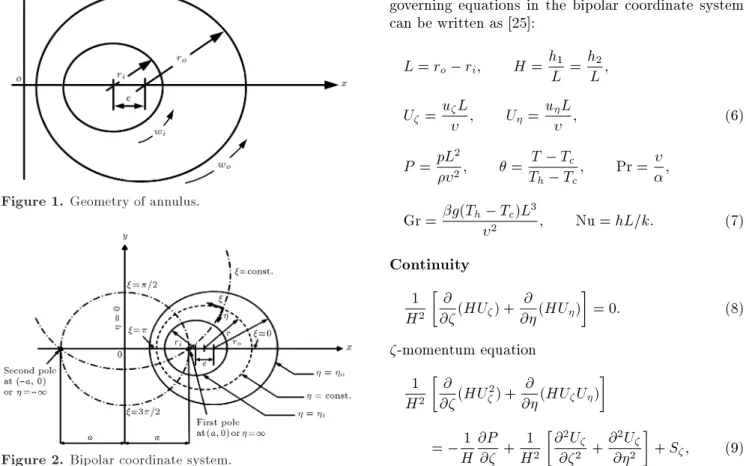
The geometry of the annulus is illustrated in Figure 1. The inner and outer cylinders are kept at hot and cold temperature (Th, Tc), respectively. Both of the
cylinders can rotate alone or simultaneously with a constant angular velocity. The continuity, momentum and energy equations, that describe the processes, are written in bipolar coordinate system for convenience. The two directions involved (, ) are shown in Fig-ure 2. The key featFig-ure of this coordinate system is
Figure 1. Geometry of annulus.
Figure 2. Bipolar coordinate system.
the orthogonality of the generated grid and its tness to the physical domain which reduces the numerical errors stems from ux computing [25].
The transformation relations between the bipolar and Cartesian coordinate systems are as follows [25]:
E = r e
o ri; N =
ri
ro; (1)
i = cosh 1((N(1 + E2) + (1 E2))=(2NE)); (2)
o= cosh 1((N(1 E2) + (1 + E2))=(2E)); (3)
a = risinh(i); (4)
x = cosh cos a sinh ; y =cosh cos a sin ; (5)
where varies from 0 to 2 and varies over the range of 1 to 1. As illustrated in Figure 2, the loci of the constant lines are a set of circles whose centers are located on the x axis at the points (acot(); 0) and the loci of the constant lines are circles whose radii are a= sin() centered at the point (0; cot()) on the y axis. Constant circles are utilized to generate eccentric cylinders, and the values of = iand = o
represent the inner and outer cylinders, respectively. Assuming Newtonian incompressible uid in the presence of gravity, neglecting the radiation and viscous dissipation and using Boussinesqu approximation, the governing equations in the bipolar coordinate system can be written as [25]:
L = ro ri; H = hL1 =hL2;
U = uL; U= uL; (6)
P = pL22; = TT Tc
h Tc; Pr =
;
Gr = g(Th2Tc)L3; Nu = hL=k: (7)
Continuity 1
H2
@
@(HU) + @ @(HU)
= 0: (8)
-momentum equation 1
H2
@
@(HU2) +@@ (HUU)
= H1 @P@ +H12
@2U
@2 +
@2U
@2
S =H12@H@ U2 H12
@H
@UU+ 2 H4 @H @ @H @ U + 2 H3 @H @ @U @ 2 H4 @H @ 2 U
+H13@@2H2U+H13@ 2H
@2U
2 H3 @H @ @U @ sinh sin
cosh cos cos
+1 cosh cos cosh cos sin ! Grx: (10) -momentum equation 1 H2 @
@(HUU) + @ @(HU2)
= H1 @P@ +H12
@2U
@2 +
@2U
@2
+ S; (11)
S=H12@H@ U2 H12
@H
@ UU+ 2 H4 @H @ @H @U
+H23@H@ @U@ H24
@H @
2
U
+H13@@2H2 U+H13@ 2H
@2U
2 H3 @H @ @U @
+ 1 cosh cos cosh cos cos
sinh sin cosh cos sin
! Grx: (12) Energy equation 1 H2 @
@(HU)+ @
@(HU)
=PrH1 2
@2
@2+
@2
@2
: (13) The dimensionless boundary conditions are:
= i! = 1; U= 0; U = Re; (14)
= o! = 0; U = 0; U = Reo: (15)
Note that the kinematic viscosity has been used here to non-dimensionalize the velocity components. In this way the dimensionless velocity is changed to the Reynolds number which can be used for better interpretation of the results.
For eccentric annulus with rotating cylinders, the displacement of the inner cylinder introduces a throat region of the annulus which presents an obstruction to an otherwise free ow. The location and the size of the throat area, i.e. the orientation of the inner cylinder and the eccentricity, are the most critical factors in the analysis of eccentric conguration. Here, by changing the direction of gravity force () we could model the eect of the eccentricity location, whereas the grid is xed and the component of buoyancy force in the bipolar coordinate system is computed. These components can be seen in the S and S which are
multiplied by Grx. The details of the computational procedures have been presented in [34] where the scale factors and unit vectors are:
h1= h2= cosh cos a ; (16)
h1^e = @x@^ex+@y@^ey; (17)
h2^e= @x@^ex+@y@^ey; (18)
^e = cosh cos sinh sin ^ex 1 cosh cos cosh cos ^ey; (19)
^e= 1 cosh cos cosh cos ^ex cosh cos sinh sin ^ey: (20)
The distribution of the heat ux along the solid walls is examined through computing the local Nusselt number along the inner and outer cylinders:
Nui() = @@ =i
; Nuo() = @@ = o: (21)
The average inner and outer Nusselt numbers are given by:
Nui= 21
Z 2
0 Nui()d;
Nu0=21
Z 2
0 Nuo()d: (22)
3. Numerical procedure
The nite-volume method, based on SIMPLE algo-rithm developed by Patankar [35], was used to solve the governing equations in the cylindrical bipolar system. Using this coordinate system has the privileges of or-thogonal property and simplicity of computing dierent uxes involved. This procedure in the present geometry was carried out for the rst time in this study to the best of our knowledge. An easy method to generate the
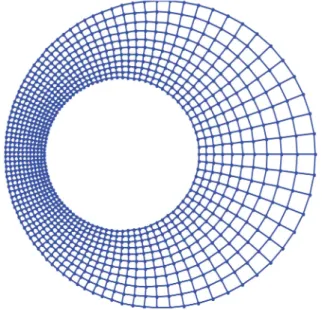
Figure 3. Physical grid.
Table 1. Grid independency (Ra = 1000, Re = 20, E = 0:1).
Cells Nu Deviation (%)
2000 1.5213 0
1000 1.5238 0.16
500 1.5311 0.4
grid is to divide all of the intervals into equal segments. If m and n represent the number of segments in and directions, respectively, then:
= = 2m =i no: (23) In this manner, a uniform computational grid is ob-tained and numerical errors will be reduced. Because of the interdependency between the dimensions of the physical grid and the scale factor (h), which itself is a function of and , the corresponding physical grid will be highly smooth. The physical grid is shown in Figure 3.
The number of grids was checked. The deviations between the results obtained for dierent numbers of cells are shown in Table 1. Most of the runs considered here were done with 1000 cells. For high Rayleigh and Reynolds numbers (till 2 104 and 200, respectively)
grid independency was checked too and was shown that using 1000 cells has reasonable accuracy (below 1%). A staggered grid was used to discretize the equations using power-law scheme. Face values were estimated by power law scheme for having realistic results. Since the source terms in and momentum equations are functions of the dependent variable, they have to be linearized with the central dierence method. The alternating direction (implicit scheme) was used for generating system of algebraic equations; the resulting
Figure 4. Comparison of results: (a) Streamlines and (b) isotherms; Ra = 5:3 103, Pr = 0:7, E = 0:5,
= 2ri
ro ri = 1:47.
tri-diagonal matrix was solved by a tri-diagonal matrix algorithm solver [36]. Here, the maximum error for the residuals was set to be of order of O(10 5) for
momentum and continuity equations. Also this value for energy equation was set to O(10 8). It was
shown that 3000 iterations were enough for all of the investigated values [35].
As it was stated in the Introduction, the steady-state solution can be extracted in the stable and unstable mode depending on eective parameters and the initial guesses. This work was done with the stability assumption, and validation was done with previous experimental and numerical works as follows. The result of the present numerical work was veried against the experimental and numerical work of Kuehn and Goldstein [2], Guj and Stella [30], Abu-Sitta et al. [31] under pure natural-convection heat transfer cases. The ndings of these comparisons were displayed in terms of streamlines, temperature contours and Nusselt number. As can be seen from Figures 4 and 5, the comparisons display excellent agreement between the tree studies.
4. Results and discussions
The overall objective of the current investigation was to explore the characteristics of the steady laminar mixed convection heat transfer in an eccentric annulus. All the results presented here were for 2ri=L = 2, where
L is the gap width. Prandtl number throughout the paper was a constant and equal to 0.7 while Rayleigh number varied from 103to 2104. Both of the cylinders
can rotate alone or simultaneously with a specic ve-locity for having mixed convection phenomenon. Note that positive sign is for counter clock-wise rotation and negative sign corresponds to clock-wise rotation.
Figure 5. Comparison of results; Ra = 5 105, Pr = 0:7, E = 0:623, = 2ri
ro ri = 1:2.
Figure 6. Eccentricity eect on forced convection (Reo = 100).
Results shown here are in the form of streamline and isotherm temperature which can be used for analyzing heat transfer and ow characteristics.
Streamlines with variation in eccentricity for pure forced convection are shown in Figure 6. Without eccentricity and concentric annulus, there is an ana-lytical solution for the problem and the streamlines are concentric circles, but, as shown in this gure, increasing the amount of eccentricity produced an eddy in right hand of the annulus. This phenomenon can be explained by centrifugal forces. In the concentric case and at any radial position the centrifugal forces transmit from the same point which is the center of the cylinder while in the eccentric case they transmit from the center of a dierent circle. Confrontation between these forces which have dierent magnitude and trace causes eddy production in the right hand side of the annulus.
Eccentricity has considerable eect on Nusselt
Table 2. Mean Nusselt number on the inner cylinder for selected eccentricities.
E 0.0 0.1 0.2 0.3 0.6
Nu 1.4427 1.4553 1.4941 1.5619 2.0000
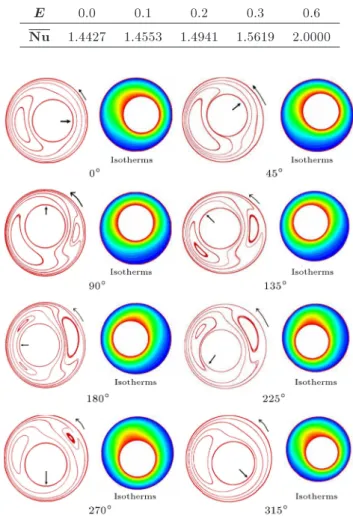
Figure 7. Streamlines and isotherms under dierent locations of eccentricity (Ra = 1000, Reo= +20, E = 0:3).
number. Mean Nusselt number on the inner cylinder for above conguration is show in Table 2. As shown, by increasing the eccentricity from 0.1 to 0.6, the Nusselt number increases from 1.4553 to 2.0000
The orientation eect of eccentricity along with rotation of the outer cylinder with Reynolds number of +20 and Rayleigh number equal to 1000 is shown in Figure 7. As mentioned before, Rayleigh and Reynolds numbers are selected in a way that mixed convection phenomenon exists.
This idea can be checked by Richardson number as well which is dened by Gr=Re2 and used for
com-paring between natural and forced convection prob-lems [37]. The angles in counter clockwise direction given in the gures are related to the location of the throat area. In the case of 0 (throat area position
is in the right side) only one eddy was generated at the left side. As throat position varied, another eddy was created in the right hand side, while in the left side, eddy was extended. In approximately 180, the
left side eddy was divided into two parts and we can see three eddies in the annulus, simultaneously. This
Figure 8. Location eect of eccentricity on local Nusselt number.
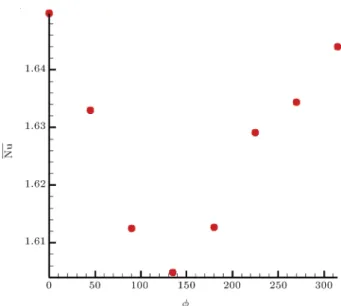
Figure 9. Location eect of eccentricity on mean Nusselt number.
phenomenon did not exist in the case of concentric annulus where in [21] mixed convection was categorized based on the number of eddies and the maximum of eddies was reported two in the concentric case. With the increase of the angle, the same pattern was repeated. The existence of the above mentioned eddies, which come in dierent numbers and positions, and are not the same in dierent situations, had considerable eect on the temperature distribution and heat transfer parameters. As can be seen, in all of the temperature contour cases, there is a maximum point, but the orientation of the larger eddy and direction of the ow rotation have direct eect on the place of this maximum point. This eect has been shown in Figures 8 and 9 in a better way. In Figure 8 the eect of the location of the throat area on the local Nusselt number is shown. This location not only changes the value of the maximum temperature but also has a considerable eect on the maximum magnitude of the Nusselt number. The greatest value of the Nusselt number in outer cylinder was observed in the case of 270 and its position and
value were 20and 3.52, respectively, while these values
Figure 10. Streamlines and isotherms under dierent values of horizontal eccentricity (Ra = 1000, Rei= +20).
were 2.65 and 0 in the case of 90, and for the inner
cylinder.
In Figure 9, the eect of the location of the throat area on the mean Nusselt number is shown. Maximum and minimum values were 1.645 and 1.6048 and they were in the case of 0and 135, respectively. Also these
values were compared with concentric case whose value is 1.5195.
Eccentricity eect when the inner cylinder rotates with dimensionless velocity (Rei = +20) and Rayleigh
number is assumed 1000 is shown in Figure 10. The eccentricity is horizontal and considered at 180. For
these conditions the forced convection ow was pro-duced only by the inner cylinder. The eccentricity did not have a considerable eect on ow pattern, where one eddy was generated in all the cases and by increase of this eccentricity the eddy grew larger. Yet heat transfer characteristic experienced noticeable changes, where isotherms changed from concentric form to an eccentric form with a maximum temperature in the upper half. Eect of the eccentricity on the
Table 3. Mean Nusselt number.
E 0.01 0.1 0.3 0.5 0.6 0.8 0.9 0.95
Nu 1.5159 1.5336 1.6416 1.8501 2.0129 2.6537 3.5632 3.5633
Figure 11. Streamlines and isotherms under dierent values of horizontal eccentricity (Ra = 1000, Reo= +20).
Table 4. Mean Nusselt number.
E 0.01 0.1 0.3 0.5 0.6 0.8
Nu 1.5188 1.5238 1.6127 1.8159 1.9785 2.6173
mean Nusselt number is shown in Table 3. Nusselt number increases from 1.5159 for E = 0:01 to 2.6537 for E = 0:8.
Eect of the increase of the eccentricity, when Ra = 1000 and the outer cylinder was rotating with a constant velocity of Re = +20, is shown in Figure 11. The condition applied here was similar to prior case, however, the dierence was that the outer cylinder ro-tated and the results were completely dierent. When the eccentricity is small, one eddy can be seen in the left side while another one is in threshold of generating. With the increase of the eccentricity and because of the unbalanced centrifugal forces, the right hand eddy was produced and the left hand one was divided in a way that three independent eddies were generated at large values of eccentricity. These eddies causes high velocity gradients and considerable changes of heat transfer characteristics, such as isotherms and Nusselt number. The mean Nusselt number which changed from 1.5188 for E = 0:01 to 2.6173 for E = 0:8 is shown in Table 4. Results under dierent kinds of rotation are pre-sented in Figure 12. Rayleigh number and horizontal eccentricity were 1000 and 0.3, respectively. Both of the cylinders were rotating by Re = 10. First case is related to the counter clock-wise rotating of the
cylin-Figure 12. Streamlines and isotherms under dierent kind of rotations (Ra = 1000, Rei= 10, Reo= 10, E = 0:3).
ders. Rotation of both cylinders amplied velocity in the left-hand side and deleted eddy. In the second case, in which the outer and the inner cylinders were rotating counter clock-wise and clock-wise, respectively, the left hand side eddy was amplied. On the other hand, the eccentricity aects the eddy on the left-hand side, and after breaking it in two, the individual eddies were seen the same as before. The third case is related to the inner counter wise and the outer clock-wise rotation of the cylinders. As it was mentioned above, here one large eddy was made in the right, and a small one in the left. In the last case, both of the cylinders were rotating clock-wise. Because of the reinforcement eect of rotating in the same direction, the left eddy was deleted completely and the right one got smaller. If the cylinders' velocity was increased, this one could be deleted, too. In the above cases, rotation of the cylinders in dierent directions did not have signicant eects on the isotherms. This result was shown by mean Nusselt number at the inner and the outer cylinders in Figure 13.
When Rayleigh increases, natural convection or buoyancy force eect is increased. Here, Rayleigh's eect is investigated. The horizontal eccentricity (E) is supposed to be 0.3 when the outer cylinder is rotating by Reo= +20. When Rayleigh is increased, buoyancy
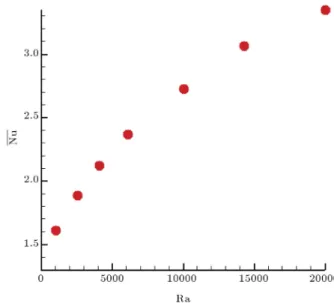
forces increase and uid near the inner cylinder can move as the velocity increases. As shown in Figure 14, at low Rayleigh number, three eddies could be seen simultaneously, where two of them were in the left and one was in the right. As Ra increased, the two eddies in the left were combined as they got wider, but the right one stayed almost the same. Increasing Ra caused considerable increase in the Nusselt number. Mean Nusselt number versus Rayleigh number is shown in
Figure 13. Local Nusselt number under dierent kinds of rotations.
Figure 14. Streamlines and isotherms under dierent Rayleigh numbers (E = 0:3, Re0= 20).
Figure 15. As can be seen, increasing Ra from 103 to
2104doubled the Nusselt number. Too much increase
in Ra value caused cancellation of force convection and made ow pattern approach to natural convection unless if the cylinder's velocity was increased.
5. Conclusions
In the present study, the ow and heat transfer in horizontal eccentric annuli with rotating cylinders with constant angular velocities were investigated. Govern-ing equations in the bipolar coordinate system were derived and solved by the nite volume method based on the SIMPLE algorithm. The overall and local heat transfer results were obtained from the numerically predicted temperature distributions. The main results and conclusions are as follows:
The ow and heat transfer in eccentric conguration were strongly inuenced by the orientation and eccentricity of the inner cylinder.
Figure 15. Mean Nusselt number versus Rayleigh number.
The throat area presented an obstruction to an otherwise free ow, where not only the uid ow was changed, but the temperature distribution and the local heat transfer coecient were also aected.
It was seen that the mean Nusselt number was increased with the increase of the eccentricity.
Dierent kinds of rotation (clockwise and counter-clockwise) had strong eect on the ow and the heat transfer characteristics.
Nomenclature
a (m) Location of the positive pole of the bipolar coordinate system, risinh(i)
or rosinh(o)
e (m) Eccentricity
E Dimensionless eccentricity g ms2 Acceleration of gravity h Convection coecient
h1 (m); h2 (m) Coordinate transformation scale
factors, a=(cosh cos ) H Dimensionless coordinate
transformation factor k Conduction coecient
L (m) Gap width of the annulus, ro ri
m Number of grids in direction n Number of grids in direction N Radius ratio (ri=ro)
Nu Nusselt number = hL=k
Nui; Nuo Local Nusselt numbers at the inner and
outer cylinders, respectively, dened by Eq. (21)
Nu Mean Nusselt number dened by Eq. (22)
Pr Prandtl number,
Ra Rayleigh number based on the gap width, g(Th Tc)L3
Gr Grashof number, g(Th Tc)L3
2
ri; ro (m) Radius of the inner and outer cylinders,
respectively
Rei; Reo Dimensionless velocity or Reynolds
number at the inner and outer cylinders, respectively, uL
S Source term in momentum equations p (Pa) Pressure
P Dimensionless pressure T (K) Temperature
Th; Tc (K) Temperatures at the inner and outer
cylinders, respectively
u; u (m/s) Velocity component in the and
directions respectively
U; U Dimensionless velocity component in
the and directions respectively x; y (m) Coordinate variables in the cartesian
coordinate system
; Coordinate variables in the bipolar coordinate system
i; o Values of on the inner and outer
cylinders, respectively
Dimensionless temperature, T Tc
Th Tc
m2
s
Kinematic viscosity
(K 1) Coecient of thermal expansion
m2
s
Thermal diusivity
(radian) Direction of buoyancy force
Ratio of inner cylinder diameter to gap width (Di=L)
References
1. Kuehn, T.H. and Goldstein, R.J. \An
experimen-tal and theoretical study of natural convection in the annulus between horizontal concentric cylinders", Journal of Fluid Mechanics, pp. 695-719 (1976).
2. Kuehn, T. and Goldstein, R. \An experimental study of natural convection heat transfer in concentric and eccentric horizontal cylindrical annuli", J. Heat Trans-fer, 100, pp. 635-640 (1978).
3. Macleod, A.E. and Bishop, E.H. \Turbulent natural convection of gases in horizontal cylindrical annuli at cryogenic temperatures", International Journal of Heat and Mass Transfer, 32, pp. 1967-1978 (1989).
4. Chai, J.C. and Patankar, S.V. \Laminar natural con-vection in internally nned horizontal annuli", Numer-ical Heat Transfer, Part A, 24, pp. 67-87 (1993).
5. Desrayaud, G., Lauriat, G. and Cadiou, P. \Thermo convective instabilities in a narrow horizontal air-lled annulus", Int. J. Heat Fluid Flow, 21, pp. 65-73 (2000).
6. Patankar, S.V., Ivanovic, M. and Sparrow, E.M.
\Analysis of turbulent ow and heat transfer in inter-nally nned tubes and annuli", J. Heat Transfer, 101, pp. 29-37 (1979).
7. Rustum, I.M. and Soliman, H.M. \Numerical analysis of laminar mixed convection in horizintal internally nned tubes", International Journal of Heat and Mass Transfer, 33, pp. 1485-1496 (1990).
8. Shahraki, F. \Modeling of buoyancy-driven ow and
heat transfer for air in a horizontal annulus: Eects of vertical eccentricity and temperature-dependent prop-erties", Num. Heat Transfer, 42, pp. 603-621 (2002).
9. Dyko, M., Vafai, K. and Mojtabi, A. \A numerical
and experimental investigation of stability of natural convective ows within a horizontal annulus", J. Fluid Mech., 381, pp. 27-61 (1999).
10. Alawadhi, E.M. \Natural convection ow in a
hori-zontal annulus with an oscillating inner cylinder using Lagrangian-Eulerian kinematics", Computers and Flu-ids, 37, pp. 1253-1261 (2008).
11. Char, M. and Lee, G. \Maximum density eect on nat-ural convection of micro polar uid between horizontal eccentric cylinders", Int. J. Eng. Science, 36, pp. 157-69 (1998).
12. Mizushima, J., Hayashi, S. and Adachi, T. \Transi-tions of natural convection in a horizontal annulus", International Journal of Heat and Mass Transfer, 44, pp. 1249-1257 (2001).
13. Petrone, G., Chenier, E. and Lauriat, G. \Stability of free convection in air lled horizontal annuli: inuence
of the radius ratio", International Journal of Heat and Mass Transfer, 47, pp. 3889-3907 (2004).
14. Farouk, B. and Guceri, S.I. \Laminar and turbulent natural convection in the annulus between horizontal concentric cylinders", Journal of Heat Transfer, 104, pp. 631-636 (1982).
15. Char, M. and Hsu, Y.H. \Comparative analysis of lin-ear and nonlinlin-ear low-Reynolds- number eddy viscosity models to turbulent natural convection in horizontal cylindrical annuli", Numerical Heat Transfer, 33, pp. 191-206 (1998).
16. Padilla, E.L., Campregher, M.R. and Silveira-Neto, A. \Numerical analysis of the natural convection in horizontal annuli at low and moderate", Thermal Engineering J., 5(02), pp. 58-65 (2006).
17. Vafai, K. and Ettefagh, J. \An investigation of tran-sient three-dimensional buoyancy-driven ow and heat transfer in a closed horizontal annulus", International Journal of Heat and Mass Transfer, 34, pp. 2555-2570 (1991).
18. Vafai, K. and Desai, C.P. \Comparative analysis of the nite-element and nite-dierence methods for simulation of buoyancy-induced ow and heat transfer in closed and open ended annular cavities", Numerical Heat Transfer, 23, pp. 35-59 (1993).
19. Yeh, C. \Numerical investigation of the
three-dimensional natural convection inside horizontal con-centric annulus with specic wall temperature or heat ux", International Journal of Heat and Mass Trans-fer, 42, pp. 775-84 (2002).
20. Lee, T.S. \Numerical computation of uid convection with air enclosed between the annuli of eccentric heated horizontal rotating cylinders", Int. J. Comput. Fluids, 1(3), pp. 355-368 (1992).
21. Yoo, J.S. \Mixed convection of air between two hori-zontal concentric cylinders with a cooled rotating outer cylinder", International Journal of Heat and Mass Transfer, 41(2), pp. 293-302 (1998).
22. Fusegi, T., Farouk, B. and Enneth, S.B. \Mixed
convection ows within a horizontal concentric annulus with a heated rotating inner cylinder", Num. Heat Transfer, 9, pp. 591-604 (1986).
23. Choudhury, D. and Karki, K.C. \Laminar mixed
convection in a horizontal eccentric annulus", Num. Heat Transfer, 22, pp. 87-108 (1992).
24. Habib, M.A. and Negm, A.A. \Laminar mixed convec-tion in horizontal concentric annuli with non-uniform circumferential heating", Heat and Mass Transfer, 37, pp. 427-435 (2001).
25. Nobary, M.R.H. and Asgarian, A. \A numerical inves-tigation of ow and mixed convection inside a vertical eccentric annulus", Numerical Heat Transfer, Part A, 55, pp. 77-99 (2009).
26. Desai, C.P. and Vafai, K. \An investigation and
comparative analysis of two- and three-dimensional turbulent natural convection in a horizontal annulus",
International Journal of Heat and Mass Transfer, 37, pp. 2475-2504 (1994).
27. Lee, T.S. \Numerical computation of uid convection with air enclosed between the annuli of eccentric heated horizontal rotating cylinders", Int. J. Comput. Fluids, 1(3), pp. 355-368 (1992).
28. Lee, T.S. \Numerical studies of mixed recirculatory ow in annuli of stationary and rotating horizontal cylinders with dierent radius ratios", Int. J. Num. Methods Heat Fluid Flow, 4, pp. 561-573 (1994).
29. Lee, T.S., Hu, G.S. and Shu, C. \Application of GDQ method for study of mixed convection in horizontal eccentric annuli", International Journal of Computa-tional Fluid Dynamics, 18(1), pp. 71-79 (2004).
30. Guj, G. and Stella, F. \Natural convection in hori-zontal eccentric annuli: numerical study", Num. Heat Transfer, 27, pp. 89-105 (1995).
31. Abu-Sitta, N.H., Khanafer, K., Vafai, K. and Al-Amiri, A.M. \combined forced and natural convection heat transfer in horizontally counterrotating eccentric and concentric cylinders", Numerical Heat Transfer, Part A, 51, pp. 1167-1186 (2007).
32. Glakpe, E.K. and Watkins, J. \Eect of mixed bound-ary condition on natural convection in concentric and eccentric annular enclosure", AIAA Paper, pp. 1587-1591 (1987).
33. Mirza, S. and Soliman, H.M. \The inuence of internal ns on mixed convection inside horizontal tubes", Int. Commun. Heat Mass Transfer, 12, pp. 191-200 (1985).
34. Currie, I.G., Fundamental Mechanics of Fluids,
McGraw-Hill, New York (1993-1994).
35. Patankar, S.V., Numerical Heat Transfer and Fluid Flow, McGraw-Hill, New York (1980).
36. Press, W.H., Flannery, B.P., Teukolsky, S.A., and Vet-terling, W.T. Numerical Recipes the Art of Scientic Computing, Cambridge University Press, Cambridge (1986).
37. Incropera, F.P. and De Witt, D.A., Introduction to Heat Transfer, Third Edn., John Willy & Sons, New York (1996).
Biographies
Ahad Abedini was born in Tabriz, Iran, in 1982. He received his BS degree from Technical University of Shahrood in 2007, MS degree from Khajeh Nasir University in 2009, and PhD degree from Ferdowsi University of Mashhad in 2013, all in Mechanical Engineering. He is currently assistant professor in Department of Mechanical Engineering in Azad Uni-versity of Semnan.
Iran, in 1951. He received his BS degree in Mechanical Engineering from Tehran Polytechnic in 1974 and his PhD degree in Mechanical Engineering from University of Akron, Ohio, U.S.A. in 1986. He has been professor in the Department of Mechanical Engineering at Fer-dowsi University of Mashhad since 2001. His teaching and research interests include heat transfer and uid dynamics, continuum mechanics, applied mathematics and singular perturbation.
Ali Kianifar was born in Mashhad, Iran in 1955. He received his BS degree in Mechanical Engineering from Thames Polytechnic, England in 1980 and PhD degree in Mechanical Engineering from Strathclyde University, U.K. in 1987. He has been Associate Professor in the Department of Mechanical Engineering at Ferdowsi University of Mashhad since 2009. His teaching and research interests include energy conversion, heat and mass transfer.