
ACTIVATION ENERGY FOR THE PYROLYSIS OF POLYMER
WASTES
J. A. Al-Furhood,
[a]F. D. Alsewailem,
[b]* and L. A. Almutabaqani
[a]Keywords: pyrolysis, polystyrene (PS), high density polyethylene (HDPE), polyethyleneterephthalate (PET), activation energy, degradation
Pyrolysis of virgin and discarded polystyrene, polyethylene, and polyethyleneterephthalate was done by the means of thermo-gravimetric technique. Activation energy was measured by fitting the experimental data to the nth order model. Results have shown that discarded
polymers had less activation energy values than those of the virgin polymers. Consequently, energy required for the pyrolysis of discarded polymers must be much less than what is required for virgin polymers. The nth order model has been modified by introducing a new factor
which is called degradation index, di. The degradation index, di, accounts for the degradation history of the material. di ranges from 0 to 1
and when it approaches 0 it implies that degradation is anticipated to be severe. When di approaches 1 it implies that polymeric material is
virgin. The approach given by current research, i.e. accounting for actual activation energy for discarded polymers, may be crucial for saving energy when recycling plastics materials by pyrolysis.
*Corresponding Author Tel: +966-1-4813522 Fax: +966-1-4813670
E-Mail: [email protected]
[a] Chemistry Department, College of Science, Princes Norah Bint Abdulrahman University, P.O.Box 84428 Riyadh 11671, Saudi Arabia
[b] Petrochemicals Research Institute, King Abdulaziz City for Science and Technology (Kacst), P.O.Box 6086 Riyadh 11442, Saudi Arabia
Introduction
In quest to resolve polymeric waste problem, researchers have been attempting to find efficient, scientific, and technological sound solutions to reduce amounts of polymeric waste that end up in landfills. Pyrolysis is one of the methods of recycling polymeric waste into value added products such as lubricants, liquid fuels, and combustible gases. Pyrolysis is an endothermic process where polymers , mainly in form of plastics, are subject to enormous heat in the absence of oxygen. During the course of pyrolysis reaction, polymeric materials can undergo chemical decomposition which leads to the formation of small molecules. Temperature, pressure, and heating time are the most important parameters that control the pyrolysis reaction. Catalysts and solvents may be used to increase the rate of reaction and decrease the operating temperature of the pyrolysis process. At relatively high temperature, e.g. greater than 600 ºC, gases with low molecular weight such as methane can evolve while at lower temperature range, e.g. less than 400 ºC, and when the pressure inside the pyrolysis reactor increases, materials may decompose to viscous fluids and carbon black. Various polymers may be recycled by the means of pyrolysis; high density polyethylene (HDPE), polystyrene (PS), and polyethyleneterephthalate (PET), polypropylene (PP), and polyvinyl chloride (PVC) to name some. However some of these polymers such as HDPE wastes require very high temperature in order to efficiently recycle them by pyrolysis, and in spite of this fact some unwanted by products such as the low quality wax may be produced.1,2 Dynamic thermo gravimetric analysis
(TGA) is a suitable technique to study the thermal degradation of polymers and determine the kinetic parameters such as activation energy, reaction order, and frequency factor.
Several models are available in the literature for studying the kinetics of pyrolysis for polymers.3-9 The origin of these mathematical models was based on a multiplication of two fundamental relations; Arrhenius equation and mass loss function; i.e.:
where α is the fraction of mass loss. K(T), and F(α) are
given by the following relations respectively:
where A0 (min-1) is Arrhenius equation constant or the frequency factor, E is the activation energy (kJ mol-1), and n is the order of reaction.
Several researches have been conducted in the past to calculate the activation energy of the pyrolysis for most of commodity polymers such as HDPE, PS, and PET using thermal techniques.10-16 Despite the relatively adequate available publications that dealt with calculating activation energy for polymers, most of the studies used virgin polymers and less attention has been made to quantitatively determine activation energy for discarded polymers. Most
( ) ( ) (1)
d
k T F dt
( ) 0 (2)
E RT k T A e
( ) (1 )n (3)
importantly and to the best knowledge of the authors of this research, no single study has done a comparative investigation of the activation energy of virgin and discarded polymers. Discarded polymers are susceptible to different kinds of degradations. One form of degradation that may occur in recycled polymers is the thermo-oxidative degradation where polymeric materials are exposed to harsh weather including high temperature and humidity.17
Hypothesis and model development
Because pyrolysis process consumes high energy for converting plastic wastes, the aim of this work was to calculate the activation energies (using nth order kinetic model) of the discarded polymers and compare them with those of the virgin polymers in order to provide adequate energy needed for the pyrolysis of recycling process. It is fairly logic to postulate that discarded plastics which were subject to some kinds of degradation may not require as high energy as that needed to pyrolysis virgin plastics. Therefore it might be necessary that nth order model be modified by introducing a factor that accounts for degradation effect.
Combining equations 1 to 3 and taking the linear form would lead to the following relation
Rearranging Equation 4 after introducing heating rate, β = dT/dt, gives us the following relation
However, activation energy, E in Equation 5 needs to be modified in order to be utilized for discarded plastics. Equation 5 may then be rewritten as
where Eact is the actual activation energy and equals di × E, where di , degradation index, is a correction factor which indicates the degradation history of the plastic material. This factor, di, may be quantitatively correlated to some forms of detection of degradation in polymeric materials such as reduction in molecular weight or carbonyl group index in Fourier transform infrared (FT-IR). di may range from 0 to 1, and when di=1, Eact = E which is the activation energy for virgin material.
Materials and methods
Materials used
Polymers tested in this study were categorized into the following groups:
Group I was the virgin polymers; high density polyethylene (HDPE), general purpose polystyrene (PS), and polyethyleneterephthalate (PET). All these polymers were supplied in pellet form by Saudi basic industries corporation (SABIC) in Saudi Arabia. Throughout the text of this research, materials of this group will be referred as HDPE-V, PS-V, and PET-V.
Group II was the virgin polymers that used in group I after subjected to sunlight during summer period for three months in open air where the average temperature was about 46.5° C and average humidity was 35.13%. Throughout the text of this research, materials of this group will be referred as HDPE-D1, PS-D1, and PET-D1.
Group III was some discarded polymer articles of the same kind of those used in group I with unknown degradation history. Samples; in form of bottles, dishes and cutlery, were collected from remote areas near Riyadh, Saudi Arabia where the environment is extremely harsh. Throughout the text of this research, materials of this group will be referred as HDPE-D2, PS-D2, and PET-D2.
Sample preparation and testing
All materials used in this study, i.e. groups I to III, were ground into small particles ~ less than 0.5 mm in size using a plastic granulator type IKA MF 10 equipped with a sieve of size 0.5 mm. Degradation assessment was done by using a Bruker Alpha FTIR. Pyrolysis of all samples was carried out by a Perkin-Elmer thermo-gravimetric analyzer (TGA) type TGA-7. Samples ranging from 10-15 μg were heated inside the TGA furnace from 25º C to 700º C under a continuous purging of helium.
Results and discussions
FTIR degradation analysis
It is important to clarify in the beginning of this section that the aim of current study was not to discuss in extensive details the FTIR analyses of the virgin and discarded polymeric materials used by this study. This has already been investigated thoroughly in the past. The objective of presenting FTIR results here was rather to prove the occurrence of degradation for the polymers of interest. Figures 1-3 show the FTIR spectra for all materials used in this study. One can see that there is a clear contrast in the absorption capacities of the main bands for the virgin polymers in comparison with those of the discarded polymers. The contrast is more pronounced when comparing virgin polymers, i.e. group I, with discarded polymers in group III where the polymeric materials were believed to be subjected to harsh degradation environment.
act
ln ln(1 ) ln (6)
0
E d
n A
dT RT
0
lnd lnA E nln(1 ) (4)
dt RT
ln d nln(1 ) lnA0 E (5)
dT RT
Figure 1. FTIR spectra showing the absorption by virgin and discarded HDPE samples
Figure 2. FTIR spectra showing the absorption by virgin and discarded PS samples.
Figure 3. FTIR spectra showing the absorption by virgin and discarded PET samples
.
It is also clear to notice that in the polyolefin's polymers, i.e. HDPE and PS, where the polymerization is done by addition or chain growth mechanism the absorption of infra red light is greater for discarded materials, i.e. HDPE-D1, HDPE-D2, PS-D1, and PS-D2. The prolonged exposure to sever temperature and sunlight may develop new chemical bonds within polymer chain in the presence of oxygen where some chemical groups such as the carbonyl may be present. This interpretation is consistent with that of other studies reported in the literature.18,19 In contrast, the condensation or step growth polymer, i.e. PET, shows
opposite FTIR behaviour in comparison with that of HDPE and PS. Here as seen in Figure 3, absorption capacities of main bands in PET tend to decrease upon increasing degradation history. Here one can conclude that the increase or decrease in capacities of FTIR absorption for the main bands of polymers used by this study with the virgin ones as references indicated the occurrence of degradation.
Pyrolysis analysis
The data of weight loss versus pyrolysis temperature as done by TGA were manipulated to get corresponding data needed to plot 1/T versus ln (βdα /dT) – n ln(1-α) as given in Equation 5. Heating rate β = 10º C/min and n=1 were used for all calculations related to such data. Figure 4 shows the relationship between ln[(βdα/dT)/(1-α)] and the reciprocal temperature for the experimental data of pyrolysis of virgin and discarded polystyrene.
Figure 4. 1/T vs. ln [(βdα /dT)/ (1-α)] for virgin and discarded PS. Solid lines show the fitting of experimental data to linear models.
Solid lines represent fitting of the experimental data to suitable linear models where activation energies, E, and frequency factors, A0, may be easily calculated. These values, E and A0 are tabulated in Table 1.
Table 1. Values of activation energies and frequency factors for virgin and discarded PS.
R²
Frequency fac-tor lnA0, min-1
Activation energy,
E, kJ mol-1
Material
0.9909 20.353
116.86 PS-V
0.9972 19.383
106.93 PS-D1
0.9889 18.957
103.14 PS-D2
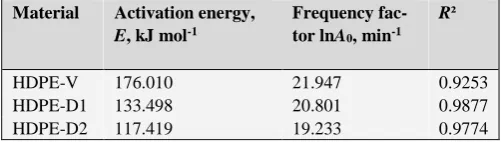
Similarly Figures 5-6 and Tables 2-3 show the relationship between ln [(βdα/dT)/(1-α)] and 1/T and values of E and A0 for HDPE and PET respectively.
Table 2. Values of activation energies and frequency factors for virgin and discarded HDPE.
R²
Frequency fac- tor lnA0, min-1
Activation energy,
E, kJ mol-1
Material
0.9253 21.947
176.010 HDPE-V
0.9877 20.801
133.498 HDPE-D1
0.9774 19.233
Table 3. Values of activation energies and frequency factors for virgin and discarded PET.
R² Frequency fac-tor, lnA0, min-1
Activation energy, E, kJ mol-1
Material
0.9784 37.366
235.62 PET-V
0.9624 34.97
207.51 PET-D1
0.9821 20.42
113.96 PET-D2
Tables 1-3 clearly show that the values of activation energy tend to decrease when the material has a degradation history. This is clearly seen in the group III materials were it is anticipated that degradation history was extremely severe.
Figure 5. 1/T vs. ln[(βdα/dT)/(1-α)] for virgin and discarded HDPE. Solid lines show the fitting of experimental data to linear models.
Figure 6. 1/T vs. ln[(βdα/dT)/(1-α)] for virgin and discarded PET. Solid lines show the fitting of experimental data to linear models.
With the exception of PET-D2 in Table 3, A0 has an average value of 19 min-1 for PS, 20 min-1 for HDPE, and 36 min-1 for PET. This suggests that when discarded polymers are to be processed by pyrolysis, the activation energy must be less than that of the virgin polymers of same kinds. This may imply that energy can be saved when processing discarded polymers by pyrolysis. This is also supported by the TGA scans (not shown here) of virgin and degraded polymers of same type were degraded polymers tended to decompose at lower temperature values. Activation energy E is an important parameter in the nth
order relation that is routinely used to fit TGA data. The reduction in activation energy for the discarded polymers in comparison with that of the virgin ones is proportionally related to the degradation history of the material. Here, as given in Equation 6, the degradation index di , suggested by current study represents the degradation history of the material. The calculation of di for all materials used in this study is given in Table 4.
Table 4. Degradation index calculations
Degradation index, di
Activation energy
E, kJ mol-1
Material
1 116.86
PS-V
0.92 106.93
PS-D1
0.88 103.14
PS-D2
1 176.01
HDPE-V
0.76 133.498
HDPE-D1
0.67 117.419
HDPE-D2
1 235.62
PET-V
0.88 207.51
PET-D1
0.48 113.96
PET-D2
This degradation index may be correlated to some quantitative measurements that asses the degradation in polymeric materials such as the reduction in molecular weight or area under the curves of FTIR spectra. By knowing di, one may be able to estimate, using equation 6, the actual activation energy needed to pyrolysis discarded polymers. The modified correlation, equation 6, which is suggested by authors of current study, allows calculating actual activation energy which is required to pyrolysis discarded polymers by introducing a new factor, i.e. di ranging from 0 to 1 that accounts for degradation history. This strategy is crucial in saving energy by providing only actual activation energy for the pyrolysis of discarded polymers. The reader now should realize that pyrolysis of discarded polymers would require less activation energy than that of the virgin polymers, therefore one needs to calculate actual activation energy for such materials and hence overall energy may be saved.
Conclusions
Since the pyrolysis of discarded polymers would require less activation energy than that of the virgin polymers, one needs to calculate actual activation energy for such materials and hence overall energy may be saved. A new factor, di, which is called degradation index, has been suggested by authors of current study as a correction factor in the nth order relation. This new correction factor accounts for degradation history of polymeric materials. The new term, actual activation energy (Eact), introduced by this study was used to modify nth order model as given in equation 6. E
act = di × E where di may vary from 0 to 1 depending on the degradation history of the material. When di = 1, Eact = E which is the activation energy for virgin material.
Acknowledgments
References
1Scheirs, J., Kaminsky, W., Feedstock Recycling and Pyrolysis of
Waste Plastics: Converting Waste Plastics into Diesel and Other Fuels, John Wiley, UK, 2006.
2Vasile, C., Pakdel, H., Mihai, B., Onu, P., Darie, H., Ciocalteu, S.,
J. Anal. Appl. Pyrol., 2001, 57, 287-303.
3Kissinger, H. E., Anal. Chem., 1957, 29, 1702-1706.
4Flynn, J. H., Wall, L. A., J. Polym. Sci. Part B: Polym. Lett., 1966,
4, 323 -328.
5Friedman, H. L., J. Polym. Sci. Part C, 1965, 6, 183-195.
6Van Krevelen, D. W., Heerden, C. V., Huntjens, F. J., Fuel,1951,
30, 253.
7Coats, A. W., Redfern, J. P., J. Polym. Sci. Part B: Polym. Lett.,
1965, 3, 917-920.
8Reich, L., J. Polym. Sci. Part B: Polym. Lett., 1964, 2, 621-623. 9Reich, L., J. Polym. Sci. Part B: Polym. Lett., 1965, 3, 231-234. 10Urzendowski, S. R., Guenther, A. H., J. Therm. Anal. Calorim.,
1971, 4, 179-395.
11Jenekhe, S. A. , Lin, J. W., Sun, B., Thermochim. Acta., 1983, 61,
287-299.
12Ravanetti, G. P., Zini, M., Thermochim. Acta.,1992, 207, 53-64. 13Park, J. W., Oh, S. C., Lee, H. P., Kim, H. T., Yoo, K. O., Polym.
Degrad. Stab., 2000, 67, 535-540.
14Lee, S. Y., Yoon, J. H., Kim, J. R., Park, D. W., Polym. Degrad.
Stab., 2001, 74, 297-305.
15Saha, B., Ghoshal, A. K., Chem. Eng. J.,2005, 111, 39-43. 16Yuan, X., Li, C., Guan, G., Xiao, Y., Zhang, D., Polym. Degrad.
Stab., 2008, 93, 466-475.
17Alsewailem, F. D., Int. J. Polym. Mat., 2009, 58, 77-86.
18Parres, F., Sanchez, L., Balart, R., Lopez, J., J. Anal. Appl. Pyrol.,
2007, 78, 250-256.
19Han, S. O., Lee, D. W., Han, O. H., Polym. Degrad. Stab., 1999,
63, 237-243.
Received: 06.11.2013.
![Figure 5. 1/T vs. ln[(βdα/dT)/(1-α)] for virgin and discarded HDPE. Solid lines show the fitting of experimental data to linear models](https://thumb-us.123doks.com/thumbv2/123dok_us/7834659.2089804/4.595.48.257.232.393/figure-virgin-discarded-solid-fitting-experimental-linear-models.webp)
