Volume 46– No.21, May 2012
VANET based Multi-Hop Communication Network for
Improving MAC Layer Fairness
Dr.S.S.Dorle Electronics Engineering Department, G.H.Raisoni
College of Engineering, Nagpur, India [email protected]
ABSTRACT
The IEEE 802.11 is a standard for wireless LANS and wireless
multi-hop adhoc networks.But the fact is that the performance of IEEE 802.11 drops dramatically in terms of throughput and delay as the network traffic goes up particularly when the station reaches to the saturation state. IEEE 802.11 supports two modes of operation: Distributed Coordination Function (DCF) and Point Coordination Function (PCF).This paper presents the unfairness of IEEE 802.11 protocol when deployed in multi-hop networks scenario. The basic method to access IEEE 802.11 MAC Layer is DCF mode and it is based on CSMA/CA. In this paper we have shown that by the use of simple distributed algorithm that can be placed in this case to approximate ideal scheduler like round robin so as to provide the fair access to all flows in the network. So from the results of simulation it is clear that this approach proves to be best on the fairness standard. In addition by reducing the number of collisions we have also increased the throughput.
Keywords
Multi-hop networks, DCF, Throughput, and CSMA/CA.
1.
INTRODUCTION
From the past decade there has been increasing demand for variety of applications such as multimedia applications, voice over IP and video conferencing.Those are running on the Broadband Internet Services. There has been increasing demand all time for the real time steady flow traffic to help the multimedia applications in a better manner. The wireless network can be used as the replacement of wired network or it can be an extension to the wired network [1]. Basically there are two types of wireless network topologies: WLANS and ad
hoc network. WLANS offer Broadband Internet Services with
the transmission rate up to 54 Mb/s and above in various environments such as airports, homes etc.Plenty of these kinds of modern services can be delivered through the deployment of with wireless access capability with the fixed network. There are large numbers of advantages of wireless communication medium, but it also presents some new real challenges like nature of the broadcast media and increase bit error rate [2]. These applications require high guarantee of quality in terms of network parameter such as loss rate or throughput, end-to-end delay. The IEEE 802.11 MAC protocol has been as the standard of protocol for the Wireless Local Area Networks (WLANS).It is also known as Carrier
Sense Multiple Access with Collision Avoidance (CSMA/CA) protocol. The CSMA protocol tries to prevent the station from simultaneous transmission with other stations. It does this asking the station first to listen before it tries to transmit the data. The important feature of CSMA protocol is that they are
simple in implementation point of view. The performance of the CSMA drops down to the performance of ALOHA in presence of the hidden terminals. The IEEE 802.11 protocol is most commonly deployed MAC protocol for the wireless communication devices [4]. And it is widely implemented in wireless simulation packages for the wireless multi-hop adhoc networks. Each station senses the channel before the start of transmission. When it finds the channel idle for predetermined time then the station starts its transmission along with the data to be transmitted which includes the Request To Send(RTS) ,Clear To Send (CTS) and Acknowledgement(ACK).But there many serious problems which are encountered in the upper protocol layers in IEEE 802.11 in the wireless networks. Because of the heavy network traffic then there are serious collisions in the network which greatly increases the packet delay in the network. These packets may be dropped due the MAC layer contention or by the heavy overflow in the network. This loss of packets may adversely affect the TCP window and adaptation andnetworking routing maintenance. Which is the high layer networking scheme. The TCP is not very stable and also has poor throughput [7]. This is because of TCP is not able to recognize the congestion and link failure. Moreover the TCP connection from one hop adjacent neighbor can capture the entire bandwidth. As the multiple flows try to race for the media, but in the mean time the sub-flows also contend with each other of the same flow so it a problematic situation. And it increases the sub-flow contention and due to which the original flow suffers. Which in turn results in packet building queues at different points in the network so it raises their jitter and end-to-end delay. So this points us to the matterof fair access to media by all the nodes [8]. So fair bandwidth allocation among different nodes or flows of multi-hop wireless networks is absolutely necessary otherwise the functionality of whole network is hampered greatly. This paper presents a distributed linear algorithm that almost exacts the preemptive round-robin scheduler to gain total fairness of the complete network. According to our approach in a network each node is responsible for gathering and holding the information about the sub-flows which are contending for the media.
2.
CSMA/CA
Carrier Sense Multiple Access (CSMA) is a probabilistic Media Access Control (MAC) protocol in which a node does the verification of the absence of other traffic on the channel before transmitting on a shared transmission medium for the communication, such as an electrical bus, or a band of the electromagnetic spectrum in the communication medium. Carrier Sense elaborates that a transmitter uses feedback from
S. S. Dorle
Department of Electronics Engineering, G.H.Raisoni College of Engineering,
Nagpur, India
M. B. Chakole
Department of Electronics & Telecommunication
Engineering,YCCE, Nagpur ,India
P. H. Rangaree
Department of Electronics Engineering, G.H.Raisoni
College of Engineering, Nagpur, India
D. P. Choudhari
Department of Electronics Engineering, G.H.Raisoni College of Engineering,
Volume 46– No.21, May 2012 a receiver that detects a carrier wave before trying to send on
the communication medium. Which means it tries to detect the existence of an encoded signal before attempting the transmission. The station waits for the transmission which is in progress to finish before starting its own transmission if it is senses the carrier. Multiple Access explains the fact that the multiple stations can send and receive on the medium at a time. So when transmissions are done by one node then it is generally received by all other stations using the communication medium. In the CSMA/CA scheme as soon as a node receives a packet which is to be sent over the channel it first checks to be sure that the channel is clear which means no other node is transmitting over the medium at the time.
Figure 1. CSMA/CA Scheme
As shown in figure 1 if the channel is clear, then packet is sent. If the channel is not clear which means some other node is transmitting the data , the node waits for a random amount of time and then checks again to see that if the channel is cleared or not. This period of time is called as the backoff factor, and is down counted by a backoff counter. When the backoff counter reaches zero if the channel is clear, then the node transmits the packet. On the other hand if the channel is the backoff factor is set again, and this process is repeated again. The important difference between the wireless LAN and the MAC protocol is the impossibility to detect collisions over the communication channel. With the receiving and sending stations immediately next to each other, a station is
unable to see any signal but its own which it has transmitted. As a result, the complete packet will be sent on the channel before the incorrect checksum indicates that a collision has occurred. It is therefore prime importance that the number of collisions should be limited to the absolute minimum value. This is only possible by a protocol called Carrier Sense Multiple Access with Collisions Avoidance. The aim is to prevent collisions at the time when they are most likely to occur. So all nodes are forced to wait for a random number of timeslots and then need to sense the medium again, before transmission of the data. If the station senses the medium as busy, then the client waits until it again becomes free. Thus, the possibility of two stations starting to send simultaneously at a time is very much reduced.
3.
DCF
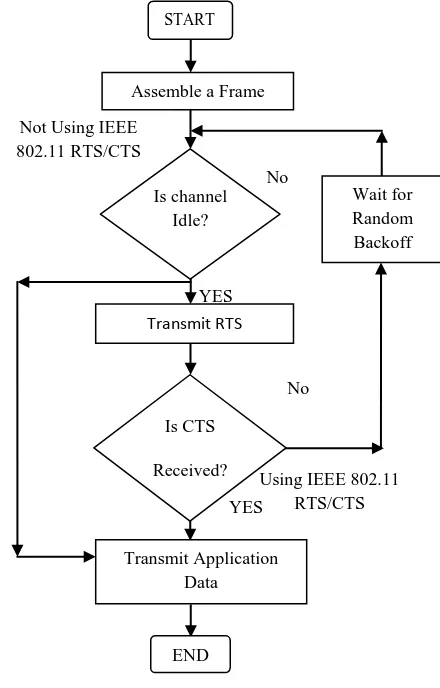
[image:2.595.47.267.225.569.2]IEEE 802.11 specifications define two forms of the MAC layer. These are Point Coordination Function (PCF) and Distributed Coordination Function (DCF). PCF is not used in wireless adhoc networks only the DCF is used in wireless adhoc networks for the communication.DCF protocol uses the principle of Carrier Sense Multiple Access with Collision Avoidance (CSMA/CA) technique for its operation.PCF is used as an option which is to help the data frames that are time-bounded. How the how the sharing of medium is done among the different stations is explained by DCF protocol in IEEE 802.11 standard. DCF is based on CSMA/CA and it has basic access method and optional channel access method along with CTS and RTS exchanged scheme.
Figure 2. The CSMA/CA mechanism
the transmission. Now in such condition it completely depends upon the response of the receiver R1 whether S1 be
able to acquire the medium or not. From figure 2 & 3 for station to transmit it should first sense the channel whether it is busy or idle state of the medium. If the medium is busy then station should differ its transmission for a time interval equal to DCF Inter-Frame Space (DIFS). After this DIFS idle time the station should generate a random backoff interval for additional time interval before transmitting of the packet on the medium. The random backoff interval is chosen in the range (0,W-1). This (W-1) value is called as the contention Window (CW).It is in the range CWmin and CWmax and is
determined by the characteristics of physical layer. YES
No
Transmit Application Data Not Using IEEE
802.11 RTS/CTS
Exchange
Assemble a Frame
Transmit RTS
END
START
No
Wait for Random Backoff Time
Using IEEE 802.11 RTS/CTS
Exchange Is channel
Idle?
YES Is CTS
Volume 46– No.21, May 2012
ACK Source
CTS
DIFS DIFS
Destination
Other
RTS
SIF S
Defer Access
DATA SIFS
CW
SIFS
[image:3.595.54.289.58.206.2]Backoff after differ
Figure 3. CSMA/CA with CTS/RTS Mechanism
Random Backoff counter is decremented.When the medium is sensed as idle and it is again activated when channel is sensed idle for period for then DIFS.The station starts its transmission only when backoff time is zero. The MAC parameters like CWmin, DIFS, CWmax, SIFS, and Slot Time all are dependent on the Physical Layer. DIFS duration can be calculated by the using following method:
DIFS = SIFS + (2 * Slot time)
4.
RELATED WORK
Bharghavan pointed the work by addressing the fairness problem in [17]. In this paper, they pointed the deficiencies of binary exponential backoff (BEB) and proposed a different backoff algorithm called Multiplicative Increase and Linear Decrease (MILD). Additionally, a "per stream" concept was introduced which accords a channel capacity to individual streams instead of stations. However, the backoff scheme used in MACAW works only when congestion is homogeneous, which unfortunately is not necessarily the case in multi-hop wireless networks. Solution for a fair MAC in multi-hop environments, each node collects some contention information and accordingly decides its mode of contention: aggressive, normal or restrictive. However the considered topologies are essentially manifestations of single-hop communication.
Our observations from the survey are that there has been some research on the fairness in the single-hop wireless networks, but the multi-hop fairness is rarely taken into consideration in the literature. And also most approaches depend on overhearing ongoing transmissions for the information of sharing. When the hop count exceeds three we can easily observe that this mechanism starts failing.
5.
UNFAIRNESS AND ITS EFFECTS
In this section we will explore the causes of unfairness and its adverse effect in multi-hop enviorment.The traffic is of Constant Bit Rate (CBR) and is large enough to occupy the entire channel capacity for single flow. For single-hop flow we have used the F (S1, R1) between the nodes S1 and R1.Alsothere is a problem of asymmetrical information problem among the different nodes. The sender who is within the range of receiver of some other flow is having more information
regarding the contention of the medium then the other senders.
5.1 UNFAIRNESS SCENARIO-I
As discussed earlier it is not fair in terms of the information possessing and it is termed as the asymmetrical information problem in IEEE 802.11 and it finally results in long term unfairness. As shown in figure 4 when the sender S1 finishes
Figure 4. Unfairness Scenario-I
medium only when R1 responds with CTS before S2 begins to
send RTS.Otherwise S2 will win the contention even it sends
RTS later than S1 does. So this is unfair from S1 point of view.
5.2 UNFAIRNESS SCENARIO-II
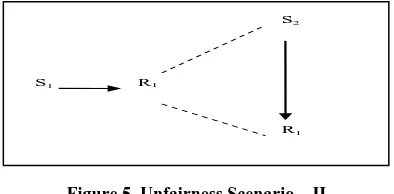
Now let us discuss the situation where the packets belonging to flow S2 is transmitted as shown in figure 5. And it is
difficult for S1 to guess when this transmission will come to
end. So therefore in this case the S1 will contend futilely and
it will keep on increasing CW.This is again an unfair situation for S1 .So it means that in every transmission regarding flow
S1 or flow S2 the S1 will be unfairly treated always. It‟s a short
[image:3.595.330.527.465.562.2]term fairness sub-flows of a particular flow of the network. If sub-flow is starved it naturally leads to bottleneck of the flow itself. Short term fairness leads to delay and jitter at MAC layer. This degrades the performance of the network. It also affects the TCP.For example when the facing such unfairness fails to deliver the packet the MAC layer discards it and conveys this to the routing protocol.
Figure 5. Unfairness Scenario – II
The routing protocol may misinterpret this discarding of packet as the breakage of link and starts a new route discovery process even if the link is available. Moreover the new route discovery adds congestion and unfairness to the media. So in such situations the flow may face prolonged starvation. Because of the short term fairness at MAC level the multi-hop flows suffer severely when considered in terms of fairness, QoS and throughput.
6.
PROPOSED PROTOCOL
The purpose of our proposed protocol is to provide equal access to the medium for all flows without the degradation of throughput as shown in figure 6.To achieve this we have proposed a distributed algorithm that approximates a round-robin scheduler. So as the part of its bookkeeping each node as explained below should maintain three lists PExt, PSen, PRec.
R1 S1
Fig. 5 Unfairness Scenario - I
S1 R1
R1
S1 R1
S2
Volume 46– No.21, May 2012 PExt: This list will maintain the IDs of active sub-flows of
which the node is not a participant node. So this information will relate the external contention.
[image:4.595.55.276.111.236.2]
Figure 6. Scenario I: Two 5-hop flows
PSen: This list will maintain the list of IDs of active sub-flows
for which the node is acting as a sender node.
PRec: This list will maintain the list of IDs of active sub-flows
for which the node is acting as a receiver node.
[image:4.595.322.540.388.519.2]By incorporating receiver corporation we proposed the mechanism called receiver feedback which will solve the problem of active sub flows that are in the transmission range of receiver also affect the transmission of sub-flow.
Table 1. Active Sub-Flow List at Node 6, For Scenario I
PExt PSen PRec
0-1 7 5
1-2
7-8
The sender of particular flow is informed about the contention at the receiver through the acknowledgement. This can be expressed in equation 1 as shown below
N = PExt + PSen + PRec - PSR (1)
Where PSR represents the sub-flows in which the
corresponding node that requires cooperation is a sender node. And „N‟ is the sum of number of active sub-flows in which node is not taking any part.
7.
SCHEDULING ALGORTIHM RULES
We define the set of rules that the sender node must follow for contending an idle medium. In our approach the sender decides whether to contend for the medium or not depending upon the depending upon the information collected at the sender and receiver active sub-flow.
RULE 1: When the node receives an ACK packet then mode of flow is recomputed. If node is in restricted mode then duration needs to be recomputed.
RULE 2: The other nodes should start contending for the medium after overhearing the ACK packet provided that they are not in restrictive mode.
RULE 3: If the node has successfully transmitted the packets then it should be in the restrictive mode thus restricting itself from contention.
RULE 4: If the node is the recipient of ACK frame then it should necessarily compute its mode of contention.
8.
MATHEMATICAL APPROACH
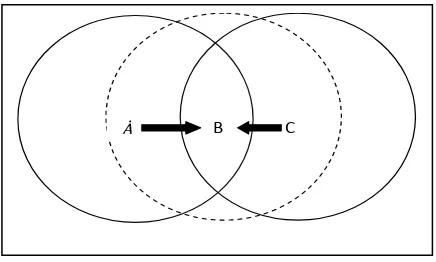
As shown in the figure 7 station A can have the communicate with station B also station B can communicate with station C, but station A cannot communicate with station C .For example A may sense channel as clear for transmission to station B but station C may be transmitting to station B.This situation comes into picture because of presence of the hidden terminals present in the network. The protocol described above gives the alerts station A that the station B is busy so it must wait till station B becomes ready to accept packet transmitted by station A. So for our calculations of fairness we have used the sliding window method. The advantage of the sliding window method is that it gives a quantitative measure of fairness over a wide range of time frames.
Figure 7. Hidden Terminal caused by simultaneous transmission from A and C to B
In this way the short term and long term fairness can be illustrated together. The sliding window method computes for every window size and the average fairness for every window of a given size. To compute the fairness for each window we should have some QoS for each of the connection. If each of the connection has similar measurement of QoS then we can say that the system is fair and if the measurements are different then we would say that the system is unfair. We have label each measure of QoS γi for each connection i. For
calculating the fairness of given window size W we have to compute the ratios of packet arrivals from each connection over that window. Let N be the total number of connections competing for the network resources. Let γi be the fraction of
packets from connection i that arrived during the window. The Jains Index is used to compute the fairness provided by the protocols. It is the standard traditional measure of network
2
0 1 3 4
5 6
+
7 8 9
[image:4.595.50.288.405.500.2]Volume 46– No.21, May 2012 fairness. The simulation results are computed over the
throughput, QoS parameters like delay and jitter, fairness. The Jains index is as follows
N N
Fj = (Σ γi )2 / ( N Σ γ2i ) (2)
i=1 i=1
The utilization is considered in terms of packets transmitted by that flow. The results of throughput are in Kbps where as jitter and delay are in seconds. Absolute fairness is achieved when Fj = 1 and absolute fairness is achieved when Fj = 1/N.
To compute the fairness index for the given size of window w.We first begin with the left edge of the window matched with the left edge of the packet streams. We then successively move the window towards the right and calculate the fairness index for the ensuing window positions. Then repeating this procedure for each window size yields both short and long term fairness index of the protocols.
9.
RESULT & DISCUSSION
[image:5.595.315.537.343.484.2]In Scenario-I as shown in figure 8 we have considered two 7-hops parallel flows. The simulation result of fairness is as shown in figure 9. The fairness index tells whether the user is receiving a fair share of system resources.
Figure 8. Scenario-I: Two 7- hop flows
The simulation result for 802.11 protocol is shown by the dashed line where as the simulation result for proposed protocol is shown by red colored line. So as shown in the figure 9 the fairness index of 802.11 is low in comparison with the fairness index of proposed protocol.
Figure 9. Fairness index for scenario-I
which can be seen from figure 9 that when the fairness index shown by red colored line of proposed protocol is close to unity at the simulation of 14 sec at that instant the fairness index of 802.11 protocol is not very close to unity as shown by dashed line in the graph. This ensures that every user of the system is getting fair share of bandwidth of the system.
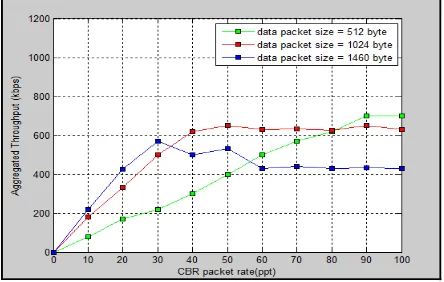
As shown in figure 9 the fairness of 802.11 is relatively high but it is the contention of the sub flow that causes the low throughput. The proposed protocol uses the spatial reuse to provide an overall throughput jump up to 50%.The throughput results of 802.11 protocol and proposed protocol are shown in Table 1. Figure 10 as shows the response of Throughput versus packet rate for the different data packet size. When the packet size is 512 byte as shown by red colored line in figure 10 the throughput of 700bps is achieved at the CBR packet rate (ppt) of 90 which is relatively good. For the data packet size of 1024 byte as shown by red colored line in figure 10 the throughput of 620bps is achieved at the CBRpacket rate (ppt) of 50. Also for the data packet size of 1460 byte as shown by blue colored line in figure 10 the throughput of 600bps is achieved at the CBRpacket rate (ppt) of 30 which is relatively high.
Figure 10. Throughput versus CBR packet rate
So the figure 10 gives the comparison of throughput for the various data packet sizes. So it is clear from the above discussion that we have improved throughput for the different packet sizes.
Table 2. Throughput Results for Scenario I
Throughput Proposed
Protocol
802.11
F(0-7) 58.21 39.46
F(8-15) 59.81 40.01
Total 118.02 79.47
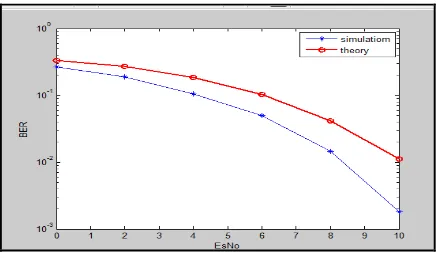
The figure 11 our proposed protocol in terms Bit Error Rate and Noise EsNo.So our simulation result shows reduced Bit Error Rate.
Proposed Protocol
0 1 2 3 4 5 6 7
8 9 10 11 12 13 14 15
[image:5.595.55.290.346.430.2] [image:5.595.55.257.532.711.2]Volume 46– No.21, May 2012
Figure 11. Bit Error Rate Vs EsNo
10.
CONCLUSION
In this paper we analyze the unfairness of IEEE 802.11, in case it is extended for multi-hop networks. The effectiveness of RTS/CTS handshake in terms of resolving such kind of interference is also explored. Thereafter we demonstrate how a simple, distributed algorithm can be put in place to approximate an ideal scheduler like round-robin and provide fair access to all the flows. Our simulation results clearly show that such an approach outscores the existing standard on fairness grounds. Additionally we also gain in terms of
throughput by reducing the number of collisions. In this paper
we have find the various reasons for the unfairness being caused and we have proposed a solution for achieving the global fairness and for providing end-to-end QoS in the multi-hop network scenario. The proposed protocol uses the spatial reuse to provide an overall throughput jump up to 50%. So our proposed protocol has shown the better results in terms of throughput. Our basic idea is to entrust each node having the information about the active sub-flows in its contention region. The sender and the receiver of a subflow combine their contention information for estimating the possible conflict of subflow in future. Our protocol allows nodes that are using the channel to remove from contention and give the fair chance to the node which under used the medium.
11.
REFERENCES
[1] H. Su and X. Zhang,“Clustering-based multichannel MAC protocols for QoS provisioning over vehicular ad hoc networks,” IEEE Transactions on Vehicular Technology, vol. 56, no. 6 Part 1, pp. 3309–3323, 2007.
[2] “Ieee 802.11: Wireless lan medium access control (mac) and physical layer (phy) specifications,” http://standards.ieee.org/getieee802/download/802.11-2007.pdf.
[3] Q. Zhao, L. Tong, A. Swami and Y. Chen, Decentralized Cognitive MAC for Opportunistic Spectrum Access in Ad Hoc Networks: A POMDP Framework, IEEE Journal on Selected Areas in Communications,Vol. 25, No. 3, Apr. 2007.
[4] M. Gast, 802.11 wireless networks: the definitive guide. O‟Reilly Media, 2005.
[5] F. Yu and S. Biswas, “A self-organizing MAC protocol for DSRC based vehicular ad hoc networks,” in 27th International Conference on Distributed Computing
Systems Workshops, 2007. ICDCSW‟07, 2007,pp. 88– 88.
[6] Q. Zhao, L. Tong, A. Swami and Y. Chen, Decentralized Cognitive MAC for Opportunistic
Spectrum Access in Ad Hoc Networks: A POMDP Framework, IEEE Journal on Selected Areas in C o m mu n i c a t i o n s , Vol. 25, No. 3, Apr. 2007.
[7] H. Su and X. Zhang, Cross-layered based MAC opportunistic pro- tocols for QoS provisionings over cognitive radio wireless networks, IEEE Journal on Selected Areas in Communications, Vol. 26, No. 1, pp. 118-129, Jan. 2008.
[8] Mohammad Hossein Manshaei, Gion Reto Cantieni, Chadi Barakat, and Thierry Turletti,Performance Analysis of the IEEE 802.11 MAC and Physical Layer Protocol Institute National de Recherche en Informatique Automatique (INRIA) 2004 route des Lucioles, Sophia-Antipolis, France 06902
[9] MV S Deekshitulu and Sukumar Nandi,Atanu Roy Chowdhury,Improving MAC Layer Fairness in Multi-Hop 802.11 Networks Engineering, Software Engineering and Technology Labs Indian Institute of Technology, Guwahati, Infosys Technologies Ltd North-Guwahati- 780139, Assam, India. Bangalore- 560100, India.
[10]F. Akyildiz, W. -Y. Lee, M. C. Vuran and S. Mohanty, NeXt gen- eration/dynamic spectrum access/cognitive radio wireless networks: a survey, Computer Networks 50 (2006), pp. 2127-2159.
[11]J. Jia, Q. Zhang and X. Shen, HC-MAC: A hardware constrained cognitive MAC for efficient spectrum management, IEEE Journal on Selected Areas in Communications, Vol. 26, No. 1, pp. 106-117, Jan.
[12]V. Kanodia, C.Li, A. Sabharwal, B. Sadeghi, E. Knightly, "Ordered Packet Scheduling in Wireless Ad Hoc Networks: Mechanisms and Performance Analysis", In Proc. of MOBIHOC, June 9-11 2002.
[13]R. Kahn, "Advances in Packet Radio Technology", Proceedings of the IEEE, 66(11):1468-1496, 1978.
[14]Chakrabarthi S., Mishra A., "QoS issues in ad hoc wireless networks", communications magzine, IEEE, volume 39, issue 2, Feb 2001, pp.142-148.
[15]Navid Nikaein, Christian Bonnet, "A glance at quality of service models in mobile ad hoc networks", in: Proceedings of DNAC 2002: 16thConference of New Architectures for Communications, Paris, France, 2002.
[16]Dmitri D., Perkins, Herman D. Hughes, "A survey on quality of service support in wireless ad hoc networks", Journal of Wireless Communication and Mobile Computing (WCMC), 2 (5) (2002) 503-513.