International Journal Advances in Social Science and Humanities
Available online at: www.ijassh.com
RESEARCH ARTICLE
Touitou Mohammed &Boudeghdegh Ahmed|June. 2014 | Vol.2 | Issue 6|35-48 35
Wage Inequality and Growth Economics in Algeria Analysis by CGEM
Touitou Mohammed
1*,
Boudeghdegh Ahmed
2High National School of Applied Economics and Statistics (EX: INPS), 11 Rue DoudouMokhtar, Ben Aknoun, Algiers, Algeria.
*Corresponding author-Email: [email protected]
Abstract
This article is devoted to the case of Algeria, and is based on a computable general equilibrium model with four sectors model: agriculture, urban private sector (readable simplification industry), the commercial and public sector and the informal sector. The labor market is segmented between skilled and unskilled workers. Our model is a modified version model of AGENOR et al. [1]. This is based on empirical studies conducted by the World Bank and the International Labor Office, and has been designed to adapt to the peculiarities of countries Middle East - North Africa. However, in our article, the model of AGENOR et al. was modified in two main ways. The first change was to model endogenously the wages paid to unskilled industrial workers. The second change was to remove any function of elasticities CES-CET. The model thus created was the subject of various simulations. In particular, we applied the shocks on the level of exogenous wage (agricultural wage, minimum wage, wage of skilled industrial workers).Our results show that in Algeria, growth underpinned by the low level of wages. This is the case regardless of the sector concerned. Thus, the will to increase the lowest wages is potentially unfavourable to growth. Only the will to increase the minimum wage can do exception.
Keywords: Algeria, CGEM, Economic growth, Labor market.
Introduction
If economic growth and improved standards of living are two consensual objectives of development plans, remains unanswered the question of the relationship between growth, poverty reduction and inequality."Dissemination" of growth between different sectors of an economy can be seen as the key factor to ensure the economic and social development of a country [2].However, this design can be challenged, considering that growth, while creating wealth is insufficient to reduce poverty and inequality [3,4].However, this design may be calling into question, if considering that growth, although creative wealth is insufficient to reduce poverty and inequality [3,4].
The discussion is based primarily on the indicator to measure poverty and inequality. Under the assumption of a distribution of income remains more or less constant within each country, growth is a key factor in poverty reduction [5,6],measured by the "per capita income" indicator. However, this indicator is not always satisfactory: if growth only benefits individuals placed in the upper part of the income distribution, the "per capita income"
indicator increase, but the number of people living below the poverty line will remain constant or be reduced more slowly than the rate of growth. Another part of the debate is based on the definition of "pro-poor growth."Should we consider that there is inequality reduction if growth benefits proportionately more disadvantaged groups or is it necessary that disadvantaged groups benefit more from growth in absolute
terms?.Also raises the question of the
appropriateness of a measure of inequality in purely monetary terms. Should we not it adds a consideration of qualitative variables, or non-monetary, such as health and education?
Touitou Mohammed &Boudeghdegh Ahmed|June. 2014 | Vol.2 | Issue 6|35-48 36 The notion of "poverty trap" is used, including the
World Bank, to expose how poverty and income inequality may affect economic activity. Non-poor households, due to a shock such as a fall in wages, will use their savings (or borrow) as reduce its consumption to regain its initial income level. The impact on wages therefore has only minimal and transient effects on income. Conversely, following a cut in pay, a poor household will try to maintain its level of consumption, and for this purpose, is strongly encouraged to make liquid capital. Thus for example, a poor farmer may be forced to sell some of his cattle, which deprives him of future income, and will hamper its activity without warranty recovers its capital.
We took the example of a loss of monetary capital, but it is also possible to present the case of a loss of human capital. Following a fall in wages, poor households may be forced to withdraw his (her) child (ren) from school to benefit from labor and an additional income.
As the process described by the "poverty trap" based initially on a reduced income, we propose to analyze the effects of lower wage on Algerian growth. For this purpose, we use a computable general equilibrium model, which is a modified version model of Agenor et al. [1].
We present first the issue of wages in Algeria, after that we present our modified version. Then we will justify in more detail the changes made. The last part of the article will present the results of simulations of shocks on Algerian wages.
The Issue of Wages in Algeria
How the wealth created was distributed? We will try to answer the following by analyzing macroeconomic indicators most highly correlated with the standard of living of the population. This note aims to present some thoughts about the issue of wage and purchasing power in Algeria.
In the absence of recent data on wage levels in Algeria in recent years - the last salary survey conducted by the National Office of Statistics (NOS) for enterprises that have been carried out in 2004 - the issue of wages will understood through the analysis of the levels and trends of aggregates and macro-economic indicators with strong correlations with wages.
The main aggregate is to be used as the Gross Domestic Product (GDP). Analysis of the share of wages in gross domestic product (GDP) is indeed a universal way of studying real wages.
Other equally important and correlated with wage indicators, such as gross national disposable
income, individual final consumption of
households, will also be used.
Compared Evolution of GDP, Disposable
Gross National Income and Individual
Household Final Consumption in Algeria
It is observed from the data in Table 3 below, that during the decade of (1995 to 2004).GDP and Gross National Income Available (GNIA) increased very rapidly in Algeria. In 2004, Algeria in the value of GDP expressed in a currency, the U.S. $ is of the order of 85 billion U.S. $. The corresponding growth rates indicate that in ten years, the wealth produced has tripled in Algeria (306%).Individual final consumption of households (IFCH) has more than doubled in Algeria with a rate of 212%. We note that it is in Algeria the households have benefited least from the increased wealth created. Indeed, the final consumption of households in 1995 accounted for only 55.6% of GDP in Algeria. In 2004, ten years later, it decreased by 17% with a share of 38.5% of GDP.
Table 1: Compared evolution ofGDP, GNIA and IFCH (Values in millions of DZD)
1995 2000 2004 2004/1995 2004/2000
GDP 2,004,994.7 4,123,513.9 6,126,668.3 306% 149%
GNIA 1 877 457,5 3 753 594,7 5,712,585.4 304% 152%
IFCH 1 114 808,8 1 714 188,0 2,357,978.7 212% 138%
% GNIA /GDP 93,6% 91,0% 93,2%
% IFCH /GDP 55,6% 41,6% 38,5%
% IFCH / GNIA 59,4% 45,7% 41,3%
Sources: salary survey conducted by the Algerian National Office of Statistics (ANOS) 2004.
GDP and its Uses
Table no. 4 gives the uses of GDP or in other
Touitou Mohammed &Boudeghdegh Ahmed|June. 2014 | Vol.2 | Issue 6|35-48 37 through the net operating surplus and
depreciation of its equipment (Consumption Fund fixed), the State through indirect taxes net of
subsidies, finally, Households across the Compensation of employees.
Table 2: The uses of GDP(Values in millions of DZD)
1995 2000 2004
GDP 2,004,994.7 4,123,513.9 6,126,668.3
Ratios
% Net operating surplus/GDP 45% 54% 55%
%Indirect taxes net of subsidies/GDP 19% 18% 18%
%Consumption of Fixed Fund/GDP 7% 6% 7%
%global payroll/GDP 28% 21% 20%
Sources: Salary survey conducted by the Algerian National Office of Statistics (ANOS) 2004.
It is clear from the examination of these data, between 1995 and 2004, that the share of the depreciation and indirect taxes in GDP remained stable, respectively, of the order of 7% and 18% of GDP.Against the share by the Company as net operating surplus estimated at about 3,380 billion dinars in 2004 increased 10% going from 45% of GDP in 1995 to 55% of GDP in 2004 while in the same period, payroll, estimated in 2004 to nearly 1,245 billion dinars, only 20% of GDP is 8% less than in 1995.
The declining share of the global payroll in GDP of 8% between 1995 and 2004 reflects both the decline in the share of payroll productive branches passing respectively 15.6% of GDP to 10 6% of GDP a decrease of 5%, and lower payroll Administration that goes below 10% of GDP in 2004 against 12.7% in 1995, a decrease of 3.4% . It should be noted that the salaries of agents of administration represent 96% of the payroll of non-productive branches.
Table 3: Evolution of the wage bill (W.B) by Branches (Values in millions of DZD)
1995 2000 2004
GDP 2,004,994.7 4,123,513.9 6,126,668.3
Ratios
%global payroll/the GDP 28% 21% 20%
Whose %W.B. productive branches/the GDP 19% 18% 18%
Whose %W.B. non-productive branches/the GDP 7% 6% 7%
%W.B. Administrations public /the GDP 28% 21% 20%
Sources: Salary survey conducted by the Algerian National Office of Statistics (ANOS) 2004.
Methodology and Data
The initial model was created by Agenor et al. [1] for the World Bank, and has also been used by researchers not belonging to this institution: Bchir et al. [7] and, Bibi and Chatti [8].
This model focuses on the characteristics of labor markets in Southern and Eastern Mediterranean Countries (SEMC).There are four sectors: agriculture, urban private sector (readable simplification industry), informal sector and "government" sector, covering public activities and services. The model retains the existence of a segmented labor market between skilled and unskilled workers. It is based on empirical data and studies from the World Bank and the International Labor Office, and is intended to describe the situation of a country "type" of the zone Middle East - North Africa.
However, it has proved necessary to modify the model in two main ways: We first remove any
function of elasticities CES-CET, because they can be in originally bias (reversion factor intensity preventing verification of HOS theorem, erroneous measure of well-being and impact effects from trade liberalization), and based on an assumption sometimes overly simplistic: the constancy of the elasticities of substitution and transformation [9].
Touitou Mohammed &Boudeghdegh Ahmed|June. 2014 | Vol.2 | Issue 6|35-48 38 the wages paid to unskilled industrial workers
can be considered as an endogenous variable was not presented as a feature of all countries in the region, only Tunisia and Egypt being concerned. Once selected equations to change, we sought data allowing estimating the model. They cover the period 1999-20021,and come from the World Bank (World Development Indicators, 2008 African Development Indicators 2001), IMF (IFS database), the Algerian National Office of Statistics (NOS), National Economic and Social Council (NESC) and the Central Bank of Algeria. In the model, the unit of currency is the dollar, except as regards the variables FLpd and FLgd denominated in Algerian dinars. The meaning of abbreviations is attached.
Equations 5 to 10, 12 to 14, 16 to 19, 28 to 33, 40, and 43 to 45, are extracted from the model AGENOR et al., and are some of them changed. And the equations used may be justified.
The Justification of Equations Used
We detail the part of the model dedicated to the labor market, and the equations with our major changes. Explanations focus on specific aspects: activities sectors, labor market segmentation, qualifications, unemployment, labor demand, wages of unskilled industrial workers, labor supply, intersectoral migration, wages in the
informal sector, elimination of functions
elasticities CES-CET.
The Activity Sectors
As in the model of AGENOR et al. we change, four sectors are retained: agriculture, urban private sector, the informal sector, and the "government" sector, which includes commercial activities and / or public. For simplification, the private urban
sector represents the industry. Such
simplification was present in the original model, although, as pointed out by the FAO [10], it is not possible to completely assimilate urban private sector and industry. Similarly, agriculture and activities in rural areas are not perfect substitutes.
A large part of the model is devoted to the Algerian labor market.
1For subsequent years, different assumptions have been made
regarding the evolution of variables. When the available data permit, we regressed the variables on their past values, assuming that the equations obtained allow predicting the future level of variables. When the available data do not allow making such equations, we calculated over the period 1999-2002, average annual growth rate. These were then used to calculate the level of future variables. The resulting data allow, for the period 1999-2009, confirm all trends in Tunisia on the evolution of labor, GDP, value added, and the budget deficit.
Segmentation of the Labor Market
To describe the Algerian economy, we must remember the existence of a segmented labor market, including skilled workers and others without qualifications. Specifically, individuals with a high school diploma or higher were retained as qualified. Persons holding a degree elementary or without qualifications were considered unqualified. The data come from surveys population-employment by the Algerian National Office of Statistics (NOS).
Qualifications
Agricultural labor is assumed without
qualification. Such an assumption was already present in the model of AGENOR et al. [1].Private urban sector and the government sector employ skilled or unskilled. The government sector is seen as the employer of "last resort." This explains why this sector is the largest employer, especially for those qualified. The unskilled population engaged in the government sector follows a deterministic process as it is a function of its past value.
Unemployment
To account for the strong state intervention in the
labor market, the assumption of no
unemployment in the public sector is retained in our model, the creation of public jobs with the main purpose to absorb supply work "surplus." This hypothesis was also present in the model of Agenor et al. By cons, there is unemployment of agricultural workers. It can be measured by the difference between Ur (t) (active agricultural population) UAd (t) of (request unskilled agricultural workers).
Similarly, in urban areas, some unskilled workers are unemployed, unable to fit into the urban private sector, and refusing a public or informal
employment. The number of unskilled
unemployment in the urban formal sector is presented in accounting. It is equal to the labor unskilled in the formal urban sector, fewer unskilled workers working in the government sector or private urban.
The number of unskilled unemployed in the urban formal sector and the number of unskilled unemployed in private urban are equivalent. Indeed, the sector g, which includes commercial and public employment, is not supposed to be unemployed.
Touitou Mohammed &Boudeghdegh Ahmed|June. 2014 | Vol.2 | Issue 6|35-48 39 accounting, labor demand is explained by
economic functions.
Labor Demand
The demand for unskilled agricultural workers depends on the economic state of the sector and the cost represented by the wages of an unskilled worker2. The economic state of the agricultural sector is measured by wealth creation, which is to say by the sector's value added. It is, in our equation, expressed in relative terms, as divided by the wage of an agricultural worker. The ratio is calculated for the period t-1, and explains the demand for agricultural workers in year t. This time lag can be explained if we consider that hiring in period t is not possible for a company, if it has previously created enough relative wealth. At first glance, this lag is not retained in the demand equation in the private non- skilled urban sector. Explicitly, this application depends solely on a cost criterion. Are taken into account the wages of skilled and unskilled workers, the cost of capital, as well as taxes and subsidies on wages. Such an assumption was also present in the model of AGENOR et al. [1].
Salary of Unskilled Industrial Workers
The salary assigned to unskilled workers in the private sector urban Algerian was not modeled endogenously by AGENOR et al. We propose to do, and consider, in our model, that wage is an increasing function of the minimum wage, of the economic state of the sector (represented by value added), and decreasing the supply of labor-'unskilled work sent to private urban sector.Determinants of wages paid to unskilled industrial workers were selected to refine further the Algerian context. The wages paid depending in particular the behavior of contractors, the value added was chosen as a determinant of wages: if the economic state of the sector (represented by value added) is good, the funds available to the contractor increase, and make possible the payment of a higher salary. However, as explained in neoclassical analysis, the salary also depends on the labor supply addressed to the sector. This justifies the choice of supply labor unskilled as a determinant of wages. Moreover, in practice, the abundance of labor supply is an argument to play for lower wages.
Yet Keynesian analysis highlights that there may be rigidities from disrupting the regulation of markets described by the neo-classical. In this
2Agenor et al. evoked all importance of wage in regulation of the
agricultural labor market.
case, the salary is only partially explained by labor supply. Among rigidities disturbing the functioning of the market, it is possible to mention the bad expectations of entrepreneurs when the future economic activity. To correct these expectations, the State must send clear signals to contractors, to encourage them to invest and grow their business. The rise of activity encourages hiring, labor demand therefore increases. Consequently, the wages paid by firms’ increases. Among the clear signals to contractors, it is possible to include the minimum wage. If it increases, contractors can anticipate an increase in consumption, and therefore an increase in activity for their businesses. It should follow an increase in the demand for labor and higher wages paid by contractors. Thus, the minimum wage is seen as a promise of consumption or as an expense to reduce it remains warranted among the variables explaining the salary. Furthermore, the evolutionary analysis emphasizes that "the
environment", represented by economic
conditions, legislative, etc. Influences on business activity. This belief is also present in some works of sociologists such as Durkheim (1975). The evolutionary analysis, like sociology, therefore justifies the choice to introduce legislation as an explanatory variable, via the minimum wage. Accordingly, our equation is dealing with sociology as well as the major theoretical economic.
The existence of endogenous wage helps explain why contractors of private urban sector do not directly take into account the economic situation of their sector in their demand function for labor. Decreasing due to a decline in value added, the wage paid is "buffer", and allows mitigate negative shocks known by private urban sector.
Touitou Mohammed &Boudeghdegh Ahmed|June. 2014 | Vol.2 | Issue 6|35-48 40 possible to proceed in the same way for the sector
p, but we preferred to replace wage by labor supply. This allows introducing into the analysis the idea that the supply of unskilled labor, especially the number of unemployed in the sector at the period (t-1), affects the wage paid for the period (t). This model assumes that the salary is flexible, and is a decreasing function of the offer unskilled labor addressed to sector. It was apparently more logical to accept the job offer from the period (t) rather than the period (t-1), but this caused a problem of implicitness in some equations. To solve the problem, we used the supply of unskilled labor in the period (t-1). This choice is justified, considering that past value of a variable is one of the best predictors of this variable3.
Labor Supply
In the model, labor supply can be presented so accountantor explained by economic criteria, according to the chosen sector. Thus, the supply of agricultural labor is equal to the active rural population, less migrant labor4. On the supply of unskilled labor in the formal sector, it is a function of past values, on the request of unskilled labor in the urban private sector, on unskilled population engaged in the tertiary sector, on wages in the informal sector andonthe wages paid to unskilled workers in the private urban sector5. To complete the description of the Algerian labor market, the model takes into account a migration through the variable MIG (t).
Migration Inter Sectoral
The variable (MIG) has negative, values because departures to urban areas are lower than the returns to rural areas. The migration equation is a synthesis between the Harris-TODARO hypothesis (migration based on the weighted wage gap), and the hypothesis, according to the Economics of Networks, at a certain stage, migration dynamics of their own (the role of MIG (t- 1)). Presented in the migration equation, the expected rural wage depends on past price levels
3This principle establishes the causality test of GRANGER. In
addition, the supply of unskilled either deterministic or stochastic variable, its past level is the best predictor of the variable. In the case of a deterministic variable, this last value,however, must be introduced into a function. This is the case in our model (Equation 15).
4This specification can be justified. In the supply equation of
agricultural labor, the growth rate of the labor of farm labor (Gr (t)) was estimated after passing the variable - MIG (t-1) on the left side of the equation (7). Gr (t) corresponds to the growth rate would have known agricultural labor in the absence of internal migration. The growth rate we get is "corrected" compared to the rate given by FAO, it corresponds to the growth rate of labor given of migration.
5Our demand equation of unskilled labor in the formal sector shows
that present in the model of AGENOR et al. (2003). However we replace the minimum wage by the wages paid to unskilled workers.
and wages in rural areas. The urban wage is said early, because it takes into account the level of price; it is also weighted by the probability of finding a job. For an unskilled worker, the probability of finding a job is a function of jobs the previous period. Assumingthat migrants have imperfect knowledge of the urban labor market; the expected urban wage is based on the minimum wage and the probability of finding urban employment for an unskilled worker. If market knowledge is perfect, the probability of finding a job is not changed; by against, the urban wage is no longer based on the minimum wage, but on the wage paid. The assumption of perfect knowledge of the market was selected before performing simulations of exogenous shocks on wages. Among these is the salary received in the informal sector.
Wage in the Informal Sector
The salary received in the informal sector is taken as exogenous in our model. By definition, the informal sector is characterized by high flexibility in the number of workers, but also working conditions, compensation and value added. In the model AGENOR et al. [1],value added explained the informal wage. However, as this sector value added is difficult to quantify, the level of informal wage in our model was chosen so that the equation of early urban wage (Ewu)6 is satisfied. The level chosen was then subjected to various shocks, upward or downward.
In addition to changing some equations devoted to the labor market, we have also removed the functions elasticities CES-CET present in the model AGENOR et al.
Deleting Functions Elasticities CES-CET
It is possible to present the equation of function elasticity CES:𝑍=∅ 𝑑𝑋−𝑝 −1𝑝 , with ∅a scale parameter, d a
distribution parameter, p a substitution parameter, knowing that: 𝑝=1−𝜎𝜎 , 𝜎 elasticity of
substitution.
These functions can be to originally of bias (reversion factor intensity preventing verification of HOS theorem, measure erroneous of well-being and impact effects from trade liberalization), and based on an assumption sometimes overly simplified: the constancy of the elasticities of substitution and transformation [9, 11].
6𝐸 𝑤𝑢=
Touitou Mohammed &Boudeghdegh Ahmed|June. 2014 | Vol.2 | Issue 6|35-48 41 For we overcome the problems arising from these
elasticities, we resorted to accounting equations and modeled variables according to their deterministic or stochastic nature.
Thus, GDP is presented in a purely accounting way, since it is equal to the sum of value added and net indirect taxes.
As for value added, they are measured in relative terms, because they are divided by the number of workers. This model does not mean that only workers engaged in value added. It allows cons of introducing flexible working through the number of workers7.
The value added is not modeled linearly in CGE models, we considered that the value added at period (t), depends on the value added to the period (t-1), not weighted by a coefficient but by an exponent. The value of the exponent depends on the stochastic or deterministic nature of value added8.
These choices allow modeling not favor any theoretical economic mainstream. The evolution of value added due to a shock on wages will depend on the size chosen for the exhibitors. Or, these exponents were calculated from the empirical data observed in Algeria.
The model is therefore proposed to remain as close as possible to the Algerian reality, removing all functions elasticities CES-CET. For this purpose, we used a particular accounting approach, which could lead to a loss of coherence of the model, and non-compliance equilibrium conditions. Thus, an accounting way, GDP can be expressed in terms of supply, or in terms of demand. In the approach in terms of supply, GDP is the sum of value added and net indirect taxes. This is the approach we have chosen in the equation (1). For the approach in terms of demand, GDP is equal to final consumption plus gross capital formation, plus exports minus imports.Or, domestic savings as we have shown in equation (38) ensures that this approach in terms of demand included in the model. This allows the consistency of our model in terms of the production supply and demand for goods by value are equal in the studied economy.
7The writing values added relatively, by dividing by the number of
workers in the sector, does not necessarily mean that the added values for the next period will decrease due to an increase in the number of workers. The evolution of value added depends indeed exhibitors, obtained by calibration.
8The exponent is equal to 1 if the variable is stochastic and equal to 1
in case of deterministic process.
The GDP equation does not separate the price and volume of production. However, the primary
objective of models Computable General
Equilibrium (CGE) that following the Walrasian theory is to study how markets adjust following a shock on prices. Not always separate the price effects of volume effects; we're getting a little of this optical, like the EGC inspired neo-structuralism models.
The model thus created was the subject of various simulations. We will present and comment the results of the impact exerted on the level of exogenous wages.
The Simulation of Shock on Exogenous
Wages
Wage levels were selected based on data
presented by the World Bank (World
Development Indicators, 2008).
As regards the non-skilled workers, the wage in the industrial sector is higher than the wages in the informal and agricultural sectors. So there are inequalities in remuneration by sector, between workers with the same skill levels.
Wage levels were then subjected to simulated shocks. These were applied to the level of exogenous wage (agricultural wage, minimum wage, wage of skilled industrial workers), according to the following protocol research.
Scenario 1 tests the impact effects of a shock than 3% (down) on the agricultural wage Wa. Scenario 2 takes back the scenario 1, and adds the assumption that the minimum wage increases of 5% Wm. This increase corresponds to the average annual increase known that salary.
Finally, Scenario 3 takes back scenario 2, and adds the assumption of an impact of 5% on Ws. All shocks were applied in 1999, the first year of our estimation model.
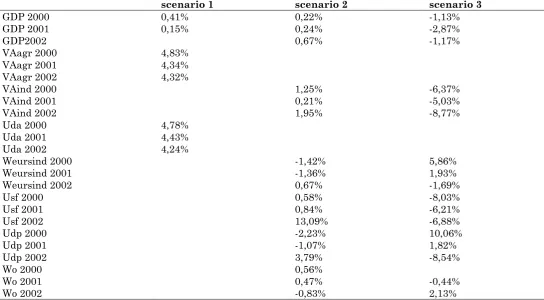
Table.4 outlines how the GDP, value added and labor adjust due to changes simulated on wages.
Analysis and Discussion of Results
Touitou Mohammed &Boudeghdegh Ahmed|June. 2014 | Vol.2 | Issue 6|35-48 42
Table 4: The consequences of a shock on Algerians wages
scenario 1 scenario 2 scenario 3
GDP 2000 0,41% 0,22% -1,13%
GDP 2001 0,15% 0,24% -2,87%
GDP2002 0,67% -1,17%
VAagr 2000 4,83%
VAagr 2001 4,34%
VAagr 2002 4,32%
VAind 2000 1,25% -6,37%
VAind 2001 0,21% -5,03%
VAind 2002 1,95% -8,77%
Uda 2000 4,78%
Uda 2001 4,43%
Uda 2002 4,24%
Weursind 2000 -1,42% 5,86%
Weursind 2001 -1,36% 1,93%
Weursind 2002 0,67% -1,69%
Usf 2000 0,58% -8,03%
Usf 2001 0,84% -6,21%
Usf 2002 13,09% -6,88%
Udp 2000 -2,23% 10,06%
Udp 2001 -1,07% 1,82%
Udp 2002 3,79% -8,54%
Wo 2000 0,56%
Wo 2001 0,47% -0,44%
Wo 2002 -0,83% 2,13%
Source: Calculating of the authors from the simulation of GAMS
1 and the results of Scenario 3 are expressed in terms of the level of variables in scenario 2.
We first comment on the results of these scenarios for growth. Scenario 1 adopts the assumption of a decline in agricultural wages. The results show that this decrease promotes the increase of GDP, where the GDP know the high increase by 0,67% in 2002. Growth is negatively related to Ws (salary of urban skilled workers)So that the note from the above table those through all the growth rates are negative. Conversely, growth is favored by the increase of Wm (minimum wage allocated to unskilled workers in the private urban sector). With the exception of the latter case, lower wages thus prove conducive to growth in Algeria. In our model, this growth is due to the reallocation of labor resulting fluctuations of wages.
Thus, by calculating the growth rate of labor throughout the period 1999-2002, it is possible to observe that the decline in agricultural wage (Wa) is a source of increased demand for workers in this sector,where Uda knew an increase estimated at 4,78% in 2000. By cons, if one thinks back on the whole period, the increase in the minimum wage Wm, unlike the rising wages of skilled workers, does not discourage the demand for industrial workers ( decrease by 1,42% in 2000). The evolution of this demand can be explained by the variation in wage Wo allocated to unskilled persons working in the private urban
sector. This salary decreases when Wm increases, and increases with Ws.
Thus, an increase of Wm or decrease in Ws cause a decrease in the wages paid to unskilled workers in the industrial sector, which encourages demand for these workers. Existing negative relationship between minimum wages Wm and salary Wo paid to unskilled industrial workers may seem paradoxical, that is why we will describe, using simulations of shocks realized how Wo fits due to a change Wm.
As a first step, increase of the minimum wage causes an increase in the wages paid to unskilled industrial workers. This increase in salary resulting in industry, a decline in demand for unskilled workers. However, migration to the industrial sector increased as migrants' decision was based on the observation of wages at a time when it had increased. Labor (unemployment) at the disposal of industrial entrepreneurs therefore increases due to migration but also because of lower demand for industrial workers.
Touitou Mohammed &Boudeghdegh Ahmed|June. 2014 | Vol.2 | Issue 6|35-48 43 migration but also because of lower demand for
industrial workers.
This abundance of labor unskilled seeking employment fact lowers wage Wo paid in the industry. Reduced wages favors then hiring unskilled industrial workers. This increases the probability of finding a job in the industrial sector; Migration to industry therefore continues, despite the decline of wages paid. This results is obtained when is retaining the assumption of perfect information for migrants: they know that the salary is a negative function of labor supply, but nonetheless decided to migrate due to the increased likelihood of finding a job in the private urban sector.
The negative relationship existing between Wm and Wo carries another teaching: in Algeria, the abundance of labor available to business leaders in the industrial sector plays a key role on the level of wages paid to unskilled workers in the private urban sector. Thus, any reduction of industrial unemployment resulting from such a job in the informal sector contributes to increase the wages Wmpaid to unskilled industrial workers. It is also possible to consider that in Algeria, whatever the sector of activity concerned, the wage paid is seen as a burden rather than reduce consumption as a promise.
Thus, the increase in the minimum wage Wm, increasing labor unskilled available to business leaders in the industry sector, allows them to pay a lower wage Wo to the previous period. This lower wage Wo proves favorable to the growth and increase in industrial value added9.
Regarding the agricultural wage, Scenario 1 shows that the decrease promotes growth, but essentially only one year after the wage has fallen. As decreases in wages in the private urban sector, the results of scenarios 2 and 3 shows that the gains in terms of growth are fairly evenly distributed over time. Therefore promote growth through lower wages is a potential source of more constraints for agricultural workers that for workers in the industrial sector.
The result of growth based in particular on the low wages10, asthe result of growthmore binding
9There is therefore a bi-univocal relation between wages Wo and
industrial value added. This is one of the variables explaining the wage Wo. In turn, a variation of Wo will exert impact effects on the number of workers involved and the industrial value added.
10The model that we realized highlights one of the sources of growth
in Algeria: the low level of wages. The economic history of Algeria could invalidate this result. Note, however, that if other sources of
for agricultural workers, were obtained by modeling the values added depending on their deterministic or stochastic nature. GDP is expressed in a purely accounting form. This is also the case of the supply of agricultural labor. On the supply of unskilled labor addressed to the urban formal sector work, it is based on economic criteria, but the answer of this offer to a shock depends on the wage Wo Exhibitor bf (t). Or, it is calculated from the observed data in Algeria. This is also the case for the coefficients governing the evolution of sectoral demands for labor.
These choices allow us to not favour any economic way of thought. Consequently, our results are obtained from remaining closer to the Algerian reality equations. The model performed equally respects the different proportions observed in the Algerian labor market (number of workers in each sector, share of skilled and unskilled workers in the various sectors).
Conclusion
Shocks exerted on our model show that in Algeria, low wages is one of the sources of growth. This is the case regardless of the sector concerned. The desire to reduce inequality by increasing wages in the agricultural sector, this would bring the wage paid to unskilled workers in the industrial sector. Such a comparison would be against by unfavourable to agricultural value added, as well as growth in Algeria.
As for wages paid to unskilled industrial workers (Wo), it is influenced by the particular legal context. This influence is apparently paradoxical, since the increase in the minimum industrial wage (Wm) helps to reduce the wages paid to unskilled sector. However, this result can be explained logically: the minimum wage increase is accompanied by an increase in the supply of unskilled labor addressed to industrial sector. Or, this increase in available labor favours lower wage in the sector. It is possible to draw several conclusions from this result.
First, any employment in the informal sector, which would lower the workforce available to of industrial Heads business, chipped the result of negative link between wages Wm and Wo.
Second, policies to increase the minimum wage (industrial) reduce pay inequality between unskilled workers. As this reduction in inequality
Touitou Mohammed &Boudeghdegh Ahmed|June. 2014 | Vol.2 | Issue 6|35-48 44 is decreasing the wage in the industrial sector, it
is favourable to the sector's value added, as well as growth in Algeria.
In addition, as our present model, the reduction of wages paid to unskilled industrial accompanied by internal migration and encourage the hiring of workers from the agricultural sector. Like that, despite its decline, the salary Wo paid to unskilled
industrial sector remains above the agricultural wage, it is possible to consider that migrants engaged in the industrial sector have reduced inequality, based on the increased income. This increase of revenue is accompanied by an increase in GDP, confirming the relevance of the concept of "poverty trap" for a category of workers: the agricultural Migrant engaged in the industrial sector.
References
1. Agenor PA et al (2003) Labor market reforms,
growth, and unemployment in Labor-exporting MENA Countries, Working Papers, The World Bank, Washington, 65 p. Published in 2007 in the journal newspaper of Policy Modelling. 27(2).
2. Lewis WA (1954) Economic development with
unlimited supplies of labour, Manchester School of Economics and Social Studies. 22:139-91
3. Atkinson A, Brandolini A (2004) Global world
inequality : absolute, relative or intermediate ?, Paper prepared for the 28th General Conference of the International Association for Research in Income and Wealth, Cork, Ireland, August 22-28.
4. Milanovic B (2005) Worlds apart: international and
global inequality 1950-2000, Princeton, N.J., Princeton University Press.
5. Dollar D, Kraay A (2001) Spreading the wealth,
Foreign Affairs, 81.
6. Bourguignon F (2004) The
Poverty-Growth-Inequality Triangle, Working Document of the World Bank.
7. Bchir H et al (2005) Trade, employment and wages
in Tunisia: an integrated and dynamic CGE model″, Rapport FEMISE n°FEM2-02-21-29, 48 p.
8. Bibi S, Chatti R (2006) Trade liberalization and the
dynamics of poverty in Tunisia: a layered CGE micro simulation analysis, MPIA Working Paper.
9. Brechet T (1999) SPOT: an applied general
equilibrium model of the Belgian economy, Working Paper 5-99, Federal Planning Bureau, Brussels. p.102.
10. FAO (1999) Report urban agriculture
andperi-urban, 15th session of the Committee of Agriculture (COAG), Rome 25-29.
11. Hertel T.et al (2004) How confident can we be in
CGE-based assessments of free trade agreements? NBER Working Paper. n° 10477.
12. Milanovic B (2005) Worlds apart: international and
global inequality 1950-2000, Princeton, N.J., Princeton University Press.
13. Nabli M (1997) The Fiscal Dimension of the
European-Mediterranean Challenge, World Bank, Manuscript
14. Devarajan S.et al(1993), Policy lessons from a
simple, open-economy model, World Bank.
15. Berthomieu C, Bonetto F (2005) Analysis of public
Touitou Mohammed &Boudeghdegh Ahmed|June. 2014 | Vol.2 | Issue 6|35-48 45
Appendix
The Model Equations
Production
𝐺𝐷𝑃 𝑡 = 𝑉𝐴𝑎𝑔𝑟(𝑡)+𝑉𝐴𝑖𝑛𝑑(𝑡)+𝑉𝐴𝑔𝑜𝑢𝑣(𝑡)+𝐴𝑚𝑜𝑢𝑖𝑛𝑑𝑡𝑎𝑥(𝑡) (1)𝑉𝐴𝑖𝑛𝑑(𝑡) 𝑊𝑂𝑅𝑆𝑖𝑛𝑑(𝑡) = 𝑉𝐴𝑖𝑛𝑑(𝑡−1) 𝑊𝑂𝑅𝑆𝑖𝑛𝑑(𝑡−1) 𝑏(𝑡) (2)
𝑉𝐴𝑎𝑔𝑟(𝑡) 𝑈𝑎𝑑(𝑡) = 𝑉𝐴𝑎𝑔𝑟(𝑡−1) 𝑈𝑎𝑑(𝑡−1) 𝐶(𝑡) (3)
𝑉𝐴𝑔𝑜𝑢𝑣(𝑡) 𝑊𝑂𝑅𝑆𝑔𝑜𝑢𝑣(𝑡) = 𝑉𝐴𝑔𝑜𝑢𝑣(𝑡−1) 𝑊𝑂𝑅𝑆𝑔𝑜𝑢𝑣(𝑡−1) 𝑑(𝑡) (4)
Employment
𝑊𝑂𝑅𝑆𝑖𝑛𝑑(𝑡) =𝑈𝑝𝑑 𝑡 +𝑆𝑝𝑑 𝑡 (5)𝑊𝑂𝑅𝑆𝑔𝑜𝑢𝑣(𝑡)=𝑈𝑔 𝑡 +𝑈𝑔 𝑡 (6)
𝑈𝑟 𝑡 =𝑈𝑟 𝑡 −1 1 +𝑈𝑟 𝑡 − 𝑀𝐼𝐺 𝑡 −1 (7)
𝑈𝑎𝑑 𝑡 = 𝑉𝐴𝑎𝑔𝑟(𝑡 −1) 𝑊𝑎(𝑡 −1) 𝑐(𝑡) (8)
𝑈𝑁𝐸𝑀𝑃𝐿𝑂𝑌𝐸𝐷𝑎𝑔𝑟 𝑡 =𝑈𝑟 𝑡 − 𝑈𝐴𝑑 𝑡 (9)
𝑈𝑓𝑠(𝑡) 𝑈𝑓𝑠(𝑡 −1)= 𝑈𝑝𝑑(𝑡 −1) 𝑈𝑓𝑠 𝑡 −1 − 𝑈𝑔(𝑡 −1) 𝑊0(𝑡 −1) 𝑊𝑖(𝑡 −1) 𝑏𝑓(𝑡) (10)
𝑈𝑝𝑑 𝑡 = 𝐶𝐾(𝑡)+𝑊𝑆(𝑡)− 𝐺𝑅𝐴𝑁𝑇𝑆 𝑡 +𝑇𝐴𝑋𝑆𝑡 𝑊0(𝑡)− 𝐺𝑅𝐴𝑁𝑇𝑈 𝑡 +𝑇𝐴𝑋𝑈(𝑡) 𝑓(𝑡) (11)
𝑈𝑔 𝑡 =𝐺𝑢𝑔𝑈𝑔 𝑡 −1 (12)
𝑈𝑁𝐸𝑀𝑃𝐿𝑂𝑌𝐸𝐷𝑈 𝑡 =𝑈𝑓𝑠(𝑡)− 𝑈𝑔 𝑡 +𝑈𝑝 𝑡 𝑑 (13)
𝑈𝑁𝐸𝑀𝑃𝐿𝑂𝑌𝐸𝐷𝑃 𝑡 =𝑈𝑁𝐸𝑀𝑃𝐿𝑂𝑌𝐸𝐷𝑈 𝑡 (14)
𝑊0 𝑡 = 𝑊𝑚 𝑡 + 𝑉𝐴𝑖𝑛𝑑 𝑡 −1 𝑈𝑓𝑠 𝑡 −1 − 𝑈 𝑔 𝑡 −1 𝑐𝑜𝑒𝑓 𝑡 (15)
Touitou Mohammed &Boudeghdegh Ahmed|June. 2014 | Vol.2 | Issue 6|35-48 46
𝐸𝑊0 𝑡 = 𝜑𝑢𝑊𝑚 𝑡 −1 + (1− 𝜑𝑢)𝑊𝑖(𝑡 −1) 𝑃𝑈𝑅𝐵(𝑡 −1) ( 𝒊𝒏𝒔𝒊𝒕𝒖𝒂𝒕𝒊𝒐𝒏𝒔𝒐𝒇𝒊𝒎𝒑𝒆𝒓𝒇𝒆𝒄𝒕𝒊𝒏𝒇𝒐𝒓𝒎𝒂𝒕𝒊𝒐𝒏) (17)
𝐸𝑊𝑢 𝑡 = 𝜑𝑢𝑊0 𝑡 −1 + (1− 𝜑𝑢)𝑊𝑖(𝑡 −1) 𝑃𝑈𝑅𝐵(𝑡 −1) ( 𝒊𝒏𝒔𝒊𝒕𝒖𝒂𝒕𝒊𝒐𝒏𝒔𝒐𝒇𝒑𝒆𝒓𝒇𝒆𝒄𝒕𝒊𝒏𝒇𝒐𝒓𝒎𝒂𝒕𝒊𝒐𝒏)11 (17′)
𝜑𝑢 = 𝑈𝑝𝑑(𝑡 −1) 𝑈𝑓𝑠 𝑡 −1 − 𝑈𝑔(𝑡 −1) (18)
𝐸𝑤𝑎 𝑡 = 𝑊𝑎(𝑡 −1) 𝑃𝑟(𝑡 −1) (19)
Trade
𝑋𝑖𝑛𝑑 𝑡 − 𝑋𝑖𝑛𝑑 𝑡 −1 = 12153150,685 𝑃𝑚𝑜𝑛𝑑𝑎𝑟𝑚 𝑡−1 − 𝑃𝑚𝑜𝑛𝑑𝑎𝑟𝑚 𝑡−2 + 149314328,9292 +𝑅𝑒𝑠𝑖𝑑𝑢𝑒1 𝑡 (20)𝑋𝑎𝑔𝑟 𝑡 − 𝑋𝑎𝑔𝑟 𝑡 −1 =−0,43 𝑋𝑎𝑔𝑟 𝑡−1 − 𝑋𝑎𝑔𝑟 𝑡−2 +𝑅𝑒𝑠𝑖𝑑𝑢𝑒2 𝑡 (21)
𝑀𝑎𝑔𝑟 𝑡 − 𝑀𝑎𝑔𝑟 𝑡 −1 = −0,38 𝑀𝑎𝑔𝑟 𝑡−1 − 𝑀𝑎𝑔𝑟 𝑡−2 + 8280057,19 𝑃𝑚𝑜𝑛𝑑𝑎𝑟𝑚 𝑡−1 − 𝑃𝑚𝑜𝑛𝑑𝑎𝑟𝑚 𝑡−2 +𝑅𝑒𝑠𝑖𝑑𝑢𝑒3(𝑡) (22) 𝑉𝑀𝑎𝑔𝑟 𝑡 − 𝑉𝑀𝑎𝑔𝑟 𝑡 −1 = −0,3794 𝑉𝑀𝑎𝑔𝑟 𝑡−1 − 𝑉𝑀𝑎𝑔𝑟 𝑡−2 + 794292207,6443 𝑃𝑚𝑜𝑛𝑑𝑎𝑟𝑚 𝑡−1 − 𝑃𝑚𝑜𝑛𝑑𝑎𝑟𝑚 𝑡−2 +𝑅𝑒𝑠𝑖𝑑𝑢𝑒4(𝑡) (23)
𝑀(𝑡)=𝑀𝑎𝑔𝑟(𝑡)+𝑀𝑖𝑛𝑑(𝑡)+𝑀𝑔𝑜𝑢𝑣(𝑡) (24)
𝑋(𝑡) =𝑋𝑎𝑔𝑟(𝑡)+𝑋𝑖𝑛𝑑(𝑡)+𝑋𝑔𝑜𝑢𝑣(𝑡) (25)
Price
𝑃𝑥𝑖𝑛𝑑𝑎𝑙𝑔𝑡𝑜𝑡 𝑡 − 𝑃𝑥𝑖𝑛𝑑𝑎𝑙𝑔𝑡𝑜𝑡 𝑡−1 = 0,0134 𝑃𝑚𝑜𝑛𝑑𝑎𝑟𝑚 𝑡−1 − 𝑃𝑚𝑜𝑛𝑑𝑎𝑟𝑚 𝑡−2 + 0,1016 +𝑅𝑒𝑠𝑖𝑑𝑢𝑒5 𝑡 (26)𝑃𝑀𝑎𝑔𝑟 𝑡 − 𝑃𝑀𝑎𝑔𝑟 𝑡 −1 = 0,00013015 𝑃𝑚𝑜𝑛𝑑𝑎𝑟𝑚 𝑡−1 − 𝑃𝑚𝑜𝑛𝑑𝑎𝑟𝑚 𝑡−2 +𝑅𝑒𝑠𝑖𝑑𝑢𝑒6 𝑡 (27)
𝑃𝑟 𝑡 =𝑔 𝑡 𝑊𝑎 𝑡 (28)
𝑃𝑢𝑟𝑏 𝑡 = 𝑡 𝑊0 𝑡 (29)
Revenue
𝑃𝑅𝑂𝐹𝑎 𝑡 =𝑉𝐴𝑎𝑔𝑟 𝑡 − 𝑊0 𝑡 𝑈𝑎𝑑 𝑡 (30)𝑃𝑅𝑂𝐹𝑜𝑓𝑓𝑖𝑐𝑎𝑖𝑙𝑝 𝑡 = 𝑉𝐴𝑖𝑛𝑑 𝑡 − 1 +𝑝𝑡𝑎𝑥𝑢 𝑡 𝑊0 𝑡 − 𝐺𝑔𝑟𝑎𝑛𝑡𝑢 𝑡 𝑈𝑝 𝑡 𝑑 − 1 +𝑝𝑡𝑎𝑥𝑠 𝑡 𝑊𝑠 𝑡 − 𝐺𝑔𝑟𝑎𝑛𝑡𝑠 𝑡 𝑆𝑝 𝑡 𝑑 (31)
𝑌𝐹𝑎 𝑡 =𝑃𝑅𝑂𝐹𝑎 𝑡 (32)
𝑌𝐹𝑝𝑜𝑓𝑓𝑖𝑐𝑎𝑖𝑙 𝑡 = 1− 𝐸𝑛𝑡𝑎𝑥 𝑡 𝑃𝑅𝑂𝐹𝑎 𝑡 − 𝐼𝑅 𝑡 𝐸𝑅 𝑡 𝐹𝑃𝑝𝑑 𝑡 −1 (33)
𝑌𝑛𝑎𝑡 𝑡 =𝐺𝐷𝑃 𝑡 − 𝐼 𝑡 𝐺𝐷𝑃 𝑡 (34)
𝑌𝑆𝑡𝑎𝑡 𝑡 = 2,308068𝐶𝐺 𝑡 (35)
𝑌𝑛𝑎𝑡𝑑 𝑡 =𝑌𝑎𝑡𝑑 𝑡 − 𝑇𝐶 𝑡 (36)
𝑌 𝑡 =𝑌𝑛𝑎𝑡𝑑 𝑡 − 𝑌𝑆𝑡𝑎𝑡 𝑡 (37)
Consumption, Investment, Saving
Touitou Mohammed &Boudeghdegh Ahmed|June. 2014 | Vol.2 | Issue 6|35-48 47
𝐺𝐷𝑆 𝑡 =−𝐼 𝑡 𝐷𝐺𝑃 𝑡 − 𝑇𝐶 𝑡 +𝑋 𝑡 − 𝑀 𝑡 +𝐺𝐹𝐶 𝑡 (38)
𝐸𝑒𝑡𝑟 𝑡 =𝐹𝐷𝐼 𝑡 + 𝐹𝐿 𝑡 − 𝐹𝐿 𝑡−1 (39)
𝐹𝐿 𝑡 =𝐹𝐿𝐺 𝑡 +𝐹𝐿𝑃 𝑡 (40)
𝐶𝑓𝑖𝑛𝑎𝑙 𝑡 =𝑌𝑛𝑎𝑡𝑑 𝑡 − 𝐷𝐺𝑆 𝑡 (41)
𝐹𝐷𝐼 𝑡 = 𝑃𝑝𝑟𝑜𝑡𝑒𝑐𝑀𝑖𝑑𝑒 𝑡 𝑇𝐴𝑋𝑅𝐸𝑉 𝑡 ×𝑗+ 𝐺𝑅𝐴𝑁𝑇𝑢 𝑡 𝑊0 𝑡 +𝑇𝐴𝑋𝑢 𝑡 +𝐶𝐾 𝑡 𝐾 𝑡 /𝑎𝑑𝑚𝑖𝑛 (42)
𝐼𝑁𝑉 𝑡 =𝐺𝐷𝑆 𝑡 +𝐹𝐷𝐼 𝑡 − 𝐶𝐷𝐸𝐹 𝑡 +𝐸𝑅 𝑡 𝐹𝐿𝑝𝑑 𝑡 − 𝐹𝐿𝑝𝑑 𝑡−1 +𝐹𝐿𝑔𝑑 𝑡 − 𝐹𝐿𝑔𝑑 𝑡−1 (43)
Gouvernement
𝐶𝐷𝐸𝐹 𝑡 =𝑇𝐴𝑋𝑅𝐸𝑉 𝑡 − 𝑇𝑅 𝑡 𝑊𝑠𝑔 𝑡 𝑆𝑔 𝑡 𝑠 − 𝐺𝑅𝐴𝑁𝑇𝑢 𝑡 𝑈𝑝𝑑 𝑡 − 𝐺𝑅𝐴𝑁𝑇𝑠 𝑡 𝑆𝑝𝑑 𝑡 −𝐴𝑆 𝑡 − 𝑁𝐺 𝑡 − 𝐼𝐹𝐺 𝑡 𝐸𝑅 𝑡 𝐹𝐿𝑔𝑑 𝑡 −1 (44)𝑇𝐴𝑋𝑅𝐸𝑉 𝑡 = 𝑀 𝑡 𝑃𝑟𝑜𝑡𝑒𝑐𝑀 𝑡 + 𝑃𝑇𝐴𝑋𝑢 𝑡 𝑊0𝑈𝑝 𝑡 𝑑 + 𝑃𝑇𝐴𝑋𝑠 𝑡 𝑊𝑠𝑆𝑝 𝑡 𝑑 + 𝑖𝑛𝑑𝑡𝑎𝑥 𝑡 𝐺𝐷𝑃 𝑡 − 𝑀𝑜𝑛𝑡𝑖𝑛𝑑𝑡𝑎𝑥 𝑡 +𝑒𝑛𝑡𝑎𝑥 𝑡 𝑃𝑅𝑂𝐹𝑜𝑓𝑓𝑖𝑐𝑖𝑎𝑙𝑝 𝑡 +𝑖𝑛𝑐𝑜𝑚𝑒𝑡𝑎𝑥 𝑡 𝑌 𝑡 (45)
𝑆 𝑡 = 𝐺𝑅𝐴𝑁𝑇𝑢 𝑡 𝑈𝑝𝑑 𝑡 + 𝐺𝑅𝐴𝑁𝑇𝑠 𝑡 𝑆𝑝𝑑 𝑡 +𝐴𝑆 𝑡 (46)
Balance of Payments
𝐶𝑈𝑅𝐵𝐴𝐿 𝑡 =𝑋 𝑡 − 𝑀 𝑡 − 𝑅𝑎𝑡𝑒𝑅𝑒𝑛𝐹𝐷𝐼 𝑡 ×𝐼𝐷𝐹 𝑡 +𝑅𝐸𝑀𝐼𝑇 𝑡 (47)𝐵𝐴𝐿𝐶𝑃 𝑡 =𝐼𝑅 𝑡 𝐹𝑃𝐿 𝑡−1 +𝐼𝐹𝑔 𝑡 𝐹𝐿𝐺 𝑡−1 +𝐹𝐿 𝑡 − 𝐹𝐿 𝑡−1 +𝑑𝑒𝑙𝑡𝑎𝐹𝐿 𝑡 (48)
𝑑𝑒𝑙𝑡𝑎𝐹𝐿 𝑡 =−𝐼𝑅 𝑡 𝐹𝑃𝐿 𝑡−1 − 𝐼𝐹𝑔 𝑡 𝐹𝐿𝐺 𝑡−1 − 𝐹𝐿 𝑡 +𝐹𝐿 𝑡−1 − 𝐹𝐷𝐼 𝑡 − 𝐶𝑈𝑅𝐵𝐴𝐿 𝑡 (49)
Money
𝑀𝑠 𝒕 =𝑀𝑑 𝒕 (50) 𝑀𝑑 𝒕 =𝛼 𝒕 𝑌 𝒕 (51)Exogenous variables
AS (t) grants except those devoted to employment in the sector p CG (t) consumption of central government
Ck (t) cost of capital Entax (t) tax rate on profits
ER (t) exchange rate (dollar amount given against a dinar) FLg (t) paid to the tertiary sector foreign loans (IN DOLLARS) FLgd (t) paid to the tertiary sector foreign loans (in dinars) Flp (t) paid to private urban sector foreign loans (IN DOLLARS) Flpd (t) paid to private urban sector foreign loans (in dinars) GCF (t) Gross capital formation (Algerian domestic investment) G (t) growth rate of the rural population
IFG (t) interest rates on foreign loans to the tertiary sector Incometax (t) tax rate of household income
Indtax (t) rates of indirect taxation IR (t) interest rate
Mgouv (t) value of tertiary Algerian imports Mind (t) value of Algerian industrial imports MontIndtax (t) amount of indirect taxes NG (t) Total government current expenditure
Pmondarm (t) world prices of agricultural commodities (index) ProtecM (t) rate of tariff protection on imports Algerian
ProtecMIDE (t) share of tax revenue from the protection on imports PTAXs (t) tax rate of nominal wages (skilled workers)
PTAXu (t) tax rate on nominal minimum wage Re (t) share of informal income invested
Remit (t) amounts paid by Algerians living abroad Residue1 (t) residue devoted to equation Xind Residue2 (t) residue devoted to equationXagr Residue3 (tresidue devoted to equationMagr Residue4 (t) residue devoted to equationVMagr Residue5 (tresidue devoted to equationPxindtuntot Residue6 (t) residue devoted to equation Magr Sdp (t) skilled workers in the private urban sector Sg (t) skilled workers in the tertiary sector GRANTs (t) Grantgiven byskilled worker GRANTu (t) Grant given by unskilled worker RateRemFDI (t) rate of pay FDI
Touitou Mohammed &Boudeghdegh Ahmed|June. 2014 | Vol.2 | Issue 6|35-48 48
TC (t) current transfers
TRWsgSeg (t) transfers more payroll service sector Usf (t) offer unskilled labor in the formal urban sector Usr (t) active agricultural population occupied Wa (t) nominal wage in the agricultural sector Wi (t) the nominal wage in the informal sector Wm (t) minimum nominal wage
Ws (t) nominal wage of skilled workers private urban sector Xgouv (t) value of tertiary Algerian exports
Endogenous variables
BALCAP (t) Algerian Balance capital
CURBAL (t) Current Balance of Algeria
CDEF (t) current public budget deficit in Algeria Cfinale (t) final consumption in Algeria
unemployedagr (t) Number of unemployed unskilled agricultural
unemployedp (t) Number of unskilled unemployed in the private urban sector unemployedu (t) Number of unskilled unemployed in the urban formal sector deltaFL (t) Interventions from balance-of-payments (in dollars)
DumPxagrtun (t) agricultural Prices of Algeria X (dummy) Eetr (t) Foreign Savings
Ewa (t) expected real wage of unskilled workers in the Algerian agricultural sector Ewu (t) expected real wage of unskilled workers in the private urban sector FL (t) Loans from Abroad
GDS (t) Gross domestic savings FDI (t) Direct Investment from Abroad INV (t) Investment
M (t) Value of Algerian total imports
Magr (t) Value of Algerianagricultural imports Md (t) Demand for money
MIG (t) migrant population (internal migration)
Ms (t) Money supply
Phiu (t) Probability of finding a job in the unskilled sector p GDP (t) Gross Domestic Product of Algeria
PMagr (t) Prices of agricultural imports from Algeria PR (t) Price level in rural areas
PROFA (t) Profit made by the agricultural sector PROFofficialp (t) Profit made by private urban sector PURB (t) level of prices in the urban
Pxindtuntot (t) Price of Algerian industrial exports S (t) Amount of grants
TAXREV (t) Total amount of taxes collected in Algeria
Uda (t) Application of unskilled labor in the Algerian agricultural sector Udp (t) Application of unskilled labor in private urban in Algeria Ug (t) unskilled workers in the tertiary sector
UNEMPagr (t) Number of unemployed unskilled agricultural UNEMPp (t) unskilled workers in private urban in Algeria UNEMPu Unemployed (t) Number of unskilled urban unemployed Ur (t) agricultural labor force
Usf (t) offer unskilled labor in the formal urban sector Usp (t) offer unskilled labor in private urban
VAagr (t) Algerian agricultural value added VAgouv (t) Algerian tertiary Value added VAind (t) Algerian industrial added value VMagr (t) Volume of Algerian agricultural imports WEURSgouv (t) involved in the tertiary sector
WEURSindAlgerian Workers (t) workers engaged in the Algerian industry Wo (t) Salary unskilled urban private sector Tunisian
X (t) Value of Algerian total exports
Xagr (t) Value of Algerianagricultural exports Xind (t) value of Algerian industrial exports YState (t) Revenue of Government
YFa (t) Incomeof enterprises from agricultural YFpofficial (t) contractors income urban private Yh (t) household income
Ynat (t) Gross National Income