e-ISSN: 2278-067X, p-ISSN: 2278-800X, www.ijerd.com
Volume 11, Issue 07 (July 2015), PP.43-49
Performance Evaluation of Ant Colony Optimization Based
Rendezvous Leach Using For Mobile Sink Based WSNs
Annu Ghotra
1, Neetika Soni
21Department of Electronics Engineering, GNDU, RcLadhewali Jalandhar, (India)
2Assistant Professor, Department of Electronics Engineering, GNDU, RcLadhewali Jalandhar, (India)
Abstract:-Wireless sensor networks are becoming popular in real world applications. In WSNs, energy utilization has found to be the major interesting part of research due to its characteristics of the resource-constrained and battery-aware sensors. Sensor nodes show the negative properties due to which it exploit the network to gain its higher peak value. So it will becoming necessary to collect all the important information from various nodes and then transferring it in an optimized manner which further helps in reducing the energy consumption by nodes. Ant Colony Optimization is used in optimizing the network lifetime. In this paper, Inter-cluster Ant Colony Optimization algorithm has been used along with rendezvous nodes for transferring the data packets in the wireless sensor network. The improvement has been made in order to reduce the efforts wasted in routing the data packets sent by the nodes which lie very close to each other in a densely deployed network.
Keywords:-ACO, WSN, clustering, Rendezvous points, Mobile Sink
I.
INTRODUCTION
WSN consists of a huge number of nodes which may be tightly or arbitrarily deployed in an area in which they have an interest. There is Base Stations (BS) situated to sensing area. The base station having a major function in WSN as sink send queries to nodes while nodes sense the asked queries and send the sensed information in a joint way reverse to the Base station. The base station also serves as an entrance for outer surface system i.e. Internet. So the collection of information and send only relevant data to the customer via internet is done by the Base station.As it is known nodes have little batteries which are hard to modify or recharge. So to follow such structural design (having a smaller amount transfer and concentrated communication space) to raise power saving. There is the positive structural design like flat network architecture and hierarchical network architecture.The layered Architecture is derived for the wireless sensor network when it is needed to increase the power or energy of sensor nodes in both multi-hop and single-hop networks. The design mainly consists of a base station and sensors scattered in the field. The layers of sensor nodes around the base station constitutes nodes that are in a single hop count to the base station, while nodes that are farther away can be multiple hop count to the base station depending on the size of the network. The earliest protocols which are used to complete the implementation of the layered architecture is the UNPF (Unified Network Protocol Framework). UNPF is designed for multi-hop infrastructure network architecture. The UNPF protocol is defined in the sense that it combines three different protocol structures: the network organization, medium access control (MAC) and the routing protocol to achieve the objectives of a robust protocol.
II.
CLUSTERING
A. Clustering Objectives
Various objectives have been pursued by different literature in designing clustering architecture for WSN. Most objectives are set to meet the application constraints. This section presents three main objectives that are relevant to the focus of this paper
(i) Maximizing network Lifetime
Unlike in cellular networks, where mobile gadgets (e.g. phones) can easily be recharged constantly after battery drainage, thus power management in these networks remains a secondary issue. However, WSN is heavily constrained in this regard, apart from being infrastructure-less system their battery power is very limited. Most of the sensor nodes are equipped with the minimal power source. Thus, power efficiency will continue to be of growing concern and will remain one of the main design objectives of WSN. In order to cope with energy management in WSN, clustering scheme has been pursued, to extend network lifetime and help ease the burden of each node transmitting directly to BS as in conventional protocols like Direct Transmission. When some nodes which are having less energy in the WSN then aim is to provide the energy to that nodes before they declared to be fully dead nodes.
(ii)Fault-tolerance
The failure of a sensor node should have a minimal elect on the overall network system. The fact that sensor nodes will be deployed in harsh environmental conditions, there is tendency that some nodes may fail or be physically damaged. Some clustering techniques have been proposed to address the problem of node failure by using proxy cluster-heads, in the event of failure of the original elected cluster-head or have minimal power for transmission. Some other literature have employed adaptive clustering scheme, to deal with node failures such as rotating the cluster-head. Tolerate node failure is one of the other design goals of clustering protocols.
(iii)Load balancing
Load balancing technique could be another design goal of clustering schemes. It is always necessary not to overburden the cluster-heads as this may deplete their energies faster. So, it is important to have even distribution of nodes in each cluster. Especially in cases where cluster-heads are performing data aggregation or other signal processing task, and uneven characterization can extend the latency or communication delay to the base station.
B. Cluster Properties
(i)Cluster Count: Cluster heads are prearranged in some of the approaches. So, the numbers of clusters are fixed. Cluster head selection algorithms usually choose randomly cluster heads from the deployed sensors which result into variation in number of clusters.
(ii)Intra-cluster topology: Some of the clustering schemes are based on direct communication between a sensor and its selected cluster head, but sometimes multi-hop sensor-to-cluster head connectivity is necessary.
(iii)Connectivity of cluster head to base station: Cluster heads transmit the aggregated data to the base station either directly or indirectly with the help of other cluster head nodes. So it means there is a probability of existing a direct link or a multi-hop link.
C. Cluster Head Selection Criteria
(i) Initial energy: To select the initial energy cluster head is an important parameter. When any algorithm starts it usually considers the initial energy.
(ii)Residual energy:In this the cluster head selection is based on the energy left behind in the sensors after completion of some rounds.
(iii) The average energy of the network: It is used as the reference energy for each node and each node should be on in the current round in order to keep the network alive [2].
III.
RELATED WORK
Ahlawat et al. [2013] has discussed a latest approach to advance network life span. The writer has suggested choosing a secondary cluster head as a resulting cluster head which will job in case Cluster head would expire .writer has explained that how secondary cluster head would be chosen. According to the writer, these criteria could be less space between sensor nodes, highest residual power in sensor nodes, and lowest amount power loss. So according to write the cluster head would on no account expire. There are secondary Cluster Head which will substitute the lifeless cluster. Simulation results show that this new approach raise life span in contrast of the conventional approaches [6].
Beiranvand et al.[2013] In this paper they have analyzed and proposed a new enhancement in LEACH named I-LEACH, An Improvement has been done by considering basically three factors; Residual Energy in nodes, Distance from base station and Number of neighboring nodes. A node has been considered as head node if it has optimum value for discussed three factors i.e. have more residual energy as compared to average energy of network, more neighbors than average neighbors for a node calculated in network and node having less distance from base station as comparison to node’s average distance from BS in network. Reduction in energy consumption and prolongation in network lifetime has been observed [7].
G.Jayaseelan et al.[2013] This paper depends on the cluster-based scheme that extends High Energy First (HEF) clustering algorithm that enables the multi-hop transmissions among the clusters by selecting the sending and receiving nodes. The results has calculated by taking efficiency and reliability. The proposed cooperative MIMO scheme prolongs the network lifetime with 75% of nodes remaining alive when compared to LEACH protocol. HEF algorithm proved that the network lifetime can be efficiently prolonged by using fuzzy variables (concentration, energy and density). Providing trustworthy system behavior with a guaranteed hard network lifetime is a challenging task to safety critical and highly-reliable WSN applications [8].
Khalid Hussain et al.[2013] In this, the cluster is supervised by a leader called Cluster Head (CH). The purpose of CH is to maintain the list of assign nodes and to communicate with other cluster heads. CH election is a vital process in the cluster-based networks. some of the parameters are used for selecting the node as a cluster head such as location, mobility, battery, throughput etc. Many techniques are used for choosing the cluster head have been proposed by researchers, mainly focusing on the parameters. All the intra-cluster traffic must pass through the CH; therefore it must have a capability to handle maximum packets [9].
ReetikaMunjal et al. [2012] This paper study the problems with LEACH protocol and presents improved ideas in order to select the cluster head node. The main problem with the LEACH is the random selection of cluster heads. There is a probability that cluster heads formed are unbalanced and they may remain in one part of a network making some part of a network unreachable [10].
Zhang D. Et al.[2012] In this paper the researchers have been concentrated mainly on the nodes those are away from base station and have been elected as cluster head, these node’s energy has fallen very rapidly, so overcome it a new model has been proposed in which three factors have been discussed i.e. energy of each node at particular instance of time, number of time a node has been selected as cluster head and distance between the node and base station. By considering these parameters, threshold have been changed to enhance the network lifetime. NEWLEACH protocol has been proposed which has introduced a new concept of optimum factor by considering the residual energy of nodes, no of times node to be chosen as a cluster head node and the distances between nodes and base station [11].
Kashaf et al. [2012] has explained the protocol for three level of heterogeneity in a WSN. According to writer threshold, is the main parameter while selecting the cluster head. So he proposes a latest approach which is helpful in time dangerous application means sensor nodes would pass on information only when there is great transform in the sensed worth. This latest approach has two features as at heterogeneity three levels and communication consumes more power than sensing and it is done just when a specific threshold is reached. In this approach, three types of nodes with different power levels are assumed. These are advanced nodes, which have power level better than all extra sensor nodes, intermediate sensor nodes with power in among normal and advanced sensor nodes while remaining sensor nodes are normal nodes. Writer has also implicit two kinds of Threshold values named Hard Threshold and Soft Threshold.. Hence decreases the needless communication. According to the writer, due to heterogeneity in power, power dissipation is reduced and raises number of alive sensor nodes in contrast of the dead sensor node [12].
IV.
PROPOSED METHODOLOGY
Following are the various steps required to successfully simulate the proposed algorithm. 1. First of all initialize WSN with their respective characteristics.
2. For each node I repeats the following steps
3.If given node has energy more than 0 that means it is alive node only then repeat upcoming steps else move back to step 2.
4. Select node as a CH if it holds the properties of improved node waiting based cluster head selection. 5. Now association of the nodes will be done with their nearest CHs.
6. Evaluate energy dissipation and move to 2 step.
Fig 1: Flowchart of the proposed methodology
INITIALIZE WSN
FOR EACH SENSOR NODE I
IF NODE(I). ENERGY > 0
SELECT NODE AS CH BASED ON WAITING BASED T(N) FUNCTION
ASSOCIATE MEMBER NODES WITH THEIR RESPECTIVE CHS USING ANT COLONY
OPTIMIZATION
UPDATE REMAINING ENERGY OF EACH NODE (I)
COUNT DEAD NODES YES NO
IS ANY DEAD NODE
YES NO
V.
EXPERIMENTAL SET-UP
The proposed algorithm for low energy consumption of nodes in wireless sensor network has been simulated using MATLAB. During simulation an assumption has been made that the system and the channel used are ideal with no attenuation and no channel noise. All the factors that can degrade the system performance are ignored. Various parameters used for the simulation are given in Table I . These parameters are standard values used as benchmark for WSNs.
TABLE I. Experimental Setup
Parameter Value
Area(x,y) 100,100
Base station(x,y) 100,100
Nodes(n) 1000
Probability(p) 0.1
Initial Energy(Eo) 0.01
Transmitter energy 50nJ/bit
receiver energy 50nJ/bit
Free space(amplifier) 10nj/bit/m2
Multipath(amplifier) 0.0013pJ/bit/m4
an (energy factor between normal and advanced nodes)
1
Maximum lifetime 200
Message size 4000 bits
m (fraction of advanced nodes) 0.1
Effective Data aggregation 5nJ/bit/signal
VI.
SIMULATION
A. First Node, Half Node and Last Node Dead Evaluation
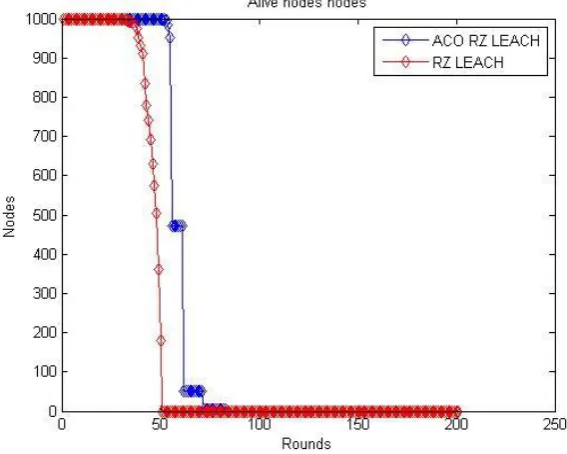
Figure below is showing the comparison of existing protocol and the proposed technique by varying the number of nodes from n=100 to 1000 with respect to total number of rounds. X-axis is representing number of rounds. Y-axis is representing the number of nodes. It has been clearly shown in Fig.2 that the overall number of rounds in case of proposed technique are quite more than that of the existing protocol. Thus proposed technique outperforms over the existing protocol.
B. AverageRemaining Energy
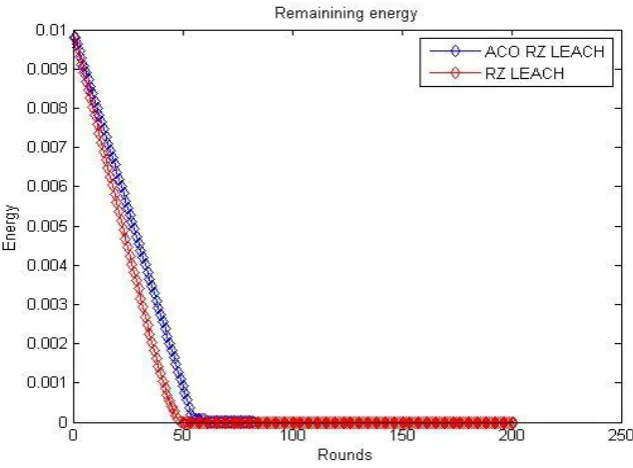
Figure below is showing the comparison of existing protocol and the proposed technique by varying the number of nodes from n=100 to 1000 with respect to total number of rounds. Y-axis is representing the energy in joules. X-axis is representing the number of rounds. The remaining energy in proposed technique is 0.0027 whereas in the existing technique the remaining energy is 0.0011. Hence the results in Fig 3 shows that the average remaining energy of proposed technique is more than existing technique.
Fig 3. Average Remaining Energy of 1000 nodes in existing RZ Leach and proposed ACO RZ Leach
C. Average Throughput
Throughput is the data transmission rate at which channel capacity are used to transmit a data. Figure belowis showing the comparison of proposed technique and the existing protocol technique by varying the number of nodes from n=100 to 1000 with respect to total number of packets sent to BS. X-axis is representing number of rounds. Y-axis is representing the total number of packets sent to BS.
Fig 4.has been clearly shown that the overall number of packets sent to BS in case of proposed technique are quite more than that of the existing protocol. Thus proposed technique outperforms over the existing protocol
VII.
CONCLUSION
In this paper, Inter-cluster Ant Colony Optimization algorithm has been used along with rendezvous nodes for transferring the data packets in the wireless sensor network. The improvement has been made in order to reduce the efforts wasted in routing the data packets sent by the nodes which lies very close to each other in a densely deployed network. The overall goal is to find the effectiveness of the rendezvous nodes based LEACH when ACO inter-cluster data aggregation is applied on it. The proposed technique has been designed and implemented in the MATLAB using data analysis toolbox. The comparative analysis has clearly shown the effectiveness of the proposed technique over the available one.
REFERENCES
[1]. Peng, J., Chengdong, W., Yunzhou, Z. and Fei, C., “A Low-Energy Adaptive Clustering Routing
Protocol of Wireless Sensor Networks”, Published in IEEE International Conference on Wireless Communication , pp. 1-4, 2011.
[2]. K.Ramesh and Dr. K.Somasundaram , “A Comparative Study Of Cluster Head Selection Algorithms In
Wireless Sensor Networks”, Published in International Journal of Computer Science & Engineering , vol.2, no.4, 2011.
[3]. Mottaghi, Saeid, and Mohammad , " Optimizing the LEACH clustering algorithm along with mobile
sink and rendezvous nodes", Published in AEU-International Journal of Electronics and Communications, vol. 69, no. 2, pp: 507-514, 2015.
[4]. Javaid, Nadeem, S. N. Mohammad, K. Latif, U. Qasim, Z. A. Khan, and M. A. Khan, "HEER: hybrid
energy efficient reactive protocol for wireless sensor networks", Published in IEEE InternationalConference in Electronics, Communications and Photonics, pp. 1-4., 2013.
[5]. Ahlawat, A.and Malik, V, “An Extended Vice-Cluster Selection Approach To Improve V LEACH
Protocol In WSN”, Published in third IEEE International Conference on Advanced Computing & Communication Technologies, pp.236-240, 2013.
[6]. Beiranvand, Z., Patooghy, A. and Fazeli M., “I-LEACH: An Efficient Routing Algorithm to Improve
Performance & to Reduce Energy Consumption in Wireless Sensor Networks”, Published in 5th IEEE International Conference on Information and Knowledge Technology, pp. 13-18, 2013.
[7]. G.Jayaseelan, S.K.Rajalaxmi, “Hard network lifetime wireless sensor networks with high energy”,
Published in International Journal of Engineering Science and Technology, vol. 5, no.03, 2013.
[8]. Khalid Hussain, Abdul Hanan Abdullah, Khalid M. Awan, FarazAhsan and AkhtabHussain,“Cluster
Head Election Schemes for WSN and MANET: A Survey”, Published in World Applied Sciences Journal ,vol .23, no. 5, pp: 611-620, 2013.
[9]. ReetikaMunjal, Bhavneesh Malik, “Approach for Improvement in LEACH Protocol for Wireless
Sensor Network”, Published in Second IEEE International Conference on Advanced Computing & Communication Technologies, pp.517-521, 2012.
[10]. Chen, G., Zhang, X., Yu, J. and Wang, M., “An improved LEACH algorithm based on heterogeneous
energy of nodes in wireless sensor networks”, Published in IEEE International Conference on Computing, Measurement, Control and Sensor Network, pp. 101-104, 2012.
[11]. Kashaf, A., Javaid, N., Khan, Z. and Khan, “TSEP: Threshold-Sensitive Stable Election Protocol For
WSNs”, Published in IEEE 10th International Conference on Frontiers of Information Technology, pp.164-168, 2012.
[12]. Meenakshi Sharma and Anil Kumar Shaw, “Transmission Time and Throughput analysis of EEE