CORROSION BEHAVIOUR OF 18 CARAT GOLD IN RINGER
SOLUTIONS IN THE PRESENCE OF SODIUM CHLORIDE AND
GLUCOSE
S. Agiladevi
[a,b]*and S. Rajendran
[b,c]Keywords: 18 Carat gold; electrochemical studies; Ringer solutions; corrosion;
This work aims at studying the electrochemical behaviour of metals like 18 carat gold in presence of Simulated Ringer’s Solution and Lactated Ringer’s Solution in presence of 100 ppm of NaCl and also 100 ppm of glucose are used to simulate the body fluids. The behaviour of the metal was monitored by polarization study and electrochemical impedance spectroscopy (EIS). All the experiments were carried out at a constant temperature of 37 °C. From these studies, it was concluded that the avoid of excess of NaCl and also glucose in both Ringer solutions in medicinal uses.
* Corresponding Authors
E-Mail: [email protected]
[a] Department of Chemistry, K S R Institute for Engineering and Technology, Tiruchengode 637 215, India
[b] Research and Development Center, Bharathiar University, Coimbatore, India
[c] Corrosion Research Centre, Department of Chemistry, St. Antony’s College for Arts and Science for Women, Thamaraipadi, Dindigul 624005, India
INTRODUCTION
Surface properties and anti-corrosion characteristics are the most important material characteristics determining the biofunctionality of all implant materials. 18 Carat gold has been a valuable biomaterial for manufacturing implants due to its unique properties such as shape memory effect, super elasticity and good mechanical properties.1-4 Many devices such as stent, orthodontic wires and root canal files have been used clinically.2-5
Ringer's analysis of the influence of blood constituents on contraction of the frog heart (1882-1885) pioneered general development of artificial extracellular media for maintenance of living material during in vitro physiological studies. "Ringer's solutions" are thus defined here as those designed to substitute for the blood plasma, hemolymph, or other extracellular fluids of any species with respect to variables such as ionic concentrations, pH, and osmotic pressure. Media described in the literature as "physiological salines" and "balanced salt solutions" are included here under the general Ringer's heading. Mimicry of native conditions is achieved in varying degrees by the many different Ringer's formulations.Ringer's solutions are typically intended for relatively short-term maintenance of living material, not for its growth or extended culture. In this respect they differ from cell, tissue, and organ culture media, which are more complex and beyond the scope of this Compendium.
Since Na+ is normally the principal extracellular ion, sodium chloride is the major component of most Ringer's solutions. Some formulations have relatively few additional
ingredients but are nevertheless more complex than most "buffered salines", consisting principally of sodium chloride and a pH buffer, presented Ions such as Na+, K+, Ca2+, and Mg2+ are critical for many functions. Researchers initiating work are urged to select physiological solutions carefully for the particular species to be studied, and to consider developing new ones based on analysis of the natural extracellular medium. Many Ringer's solutions,6-8 are the product of empirical testing for retention of the activity being studied. Thus, in addition to being used directly, recipes provided here can serve as a starting point for improved formulations.
The Electrochemical impedance spectroscopy (EIS) is a relatively modern technique widely extended in several scientific fields. The EIS consists on a non-destructive technique when working under equilibrium conditions (free corrosion potential or open circuit potential), particularly sensible to small changes in the system that allows to characterize material properties and electrochemical systems even in low conductive media.
The impedance method consists in measuring the response of an electrode to a sinusoidal potential modulation of small amplitude (typically 5-10 mV) at different frequencies. The alternative current (AC) modulation is superimposed either onto an applied anodic potential or cathodic potential or onto the corrosion potential.9,10
EXPERIMENTAL
Materials and methods
Corrosion resistance of 18 Carat Gold in Ringer’s Solution and lactated Ringer solution has been investigated by polarization study and AC impedance measurements. All measurements were performed at 37±1 °C. Ringer’s Solution was composed of 6.0 g L-1 NaCl, 0.075 g L-1 KCl, 0.1 g L-1 CaCl
2 and 0.1 g L-1 NaHCO3. The lactated Ringer solution comprised of 6.0 g L-1 NaCl, 0.3 g L-1 KCl, 0.2 g L-1 CaCl
The 18 carat gold was composed of 75 % gold and 25 % copper.
AC impedance measurements
H and CH electrochemical workstation impedance analyzer model CHI 660 was used to record AC impedance measurements. A three-electrode cell assembly was used. The working electrode was the studied metal. A saturated calomel electrode (SCE) was the reference electrode and platinum the counter electrode.13,14 The real part (Z’) of the cell impedance was measured in ohms for various frequencies. The change transfer resistance (Rt) and double layer capacitance (Cdl ) values were calculated
Rt = (Rs + Rt) – Rs (1)
where Rs = solution resistance, and
Cdl =1/2πRtfmax,
where fmax = maximum frequency.
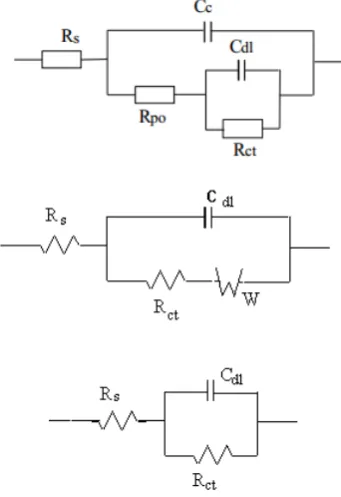
The equivalent circuit diagram for such system is shown in Figure 1.
Figure 1. Equivalent circuit for a failed coating. Cc - The capacitance of the intact coating, Rpo - pore resistance, Rct - charge transfer resistance, Rs - solution resistance, Cdl - double layer capacitance, W - Warburg diffusion resistance.
RESULTS AND DISCUSSION
Corrosion resistance of 18 carat gold in simulated Ringer’s solution and lactated Ringer’s solution has been measured by polarization study and AC impedance spectra13,15-33
An increase in corrosion resistance results in increase in
LPR value, decrease in corrosion current, increase in charge transfer resistance, increase in impedance value and decrease in Cdl value.
Polarization study
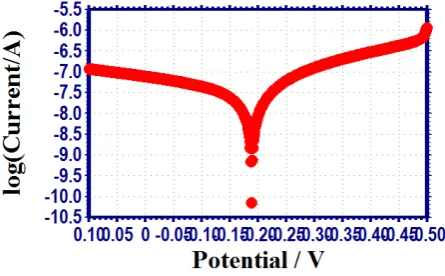
In the polarization study, shown in Figure 2 to 7, the corrosion parameters like corrosion potential (Ecorr), Tafel slopes (bc=cathodic, ba=anodic), LPR (linear polarization resistance) value and corrosion current were measured. They are given in Table 1.
Figure 2. Polarisation curve of 18 carat gold immersed in Simulated Ringer’s Solution.
Figure 3. Polarisation curve of 18 carat gold immersed in Simulated Ringer’s Solution + 100 ppm of NaCl.
Figure 5. Polarisation curve of 18carat gold immersed in Lactated Ringer’s Solution.
Figure 6. Polarisation curve of 18carat gold immersed in Lactated Ringer’s Solution + 100 ppm NaCl.
Figure 7. Polarisation curve of 18 carat gold immersed in Lactated Ringer’s Solution + 100 ppm glucose.
Ringer’s Solution
Influence of 100 ppm of NaCl
It can be seen from the Table 1, that the corrosion resistance of 18 carat gold decreases in presence of 100 ppm of NaCl. In the presence of NaCl, LPR value decreases from 7361238 to 4472869 ohm cm2. The corrosion current increases from 5.44×10⁻⁹ to 2.657×10⁻⁸ A cm-2.
Influence of 100 ppm of glucose
Similarly, the corrosion resistance of 18 carat gold decreases in presence of 100 ppm of glucose. In the presence of glucose, LPR value decreases from 7361238 to 1540062 ohm cm2.The corrosion current increases from 9.584×10⁻⁹ to 2.657×10⁻⁸ A cm-2.
Lactated Ringer’s Solution Influence of 100 ppm of NaCl
It is observed from the Table 1, that the corrosion resistance of 18 carat gold decreases in presence of 100 ppm of NaCl, the corrosion resistance decreases. In the presence of NaCl, LPR value decreases from 5028338 ohmcm2 to 1873424 ohmcm2. The corrosion current increases from 3.605 x 10⁻⁹ A cm-2 to 2.467 x 10⁻⁸ A cm-2.
Influence of 100 ppm of glucose
Similarly, the corrosion resistance of 18 carat gold decreases in presence of 100 ppm of glucose. In the presence of glucose, LPR value decreases from 5028338 to 1403355 ohmcm2.The corrosion current increases from 7.625 × 10⁻⁹ to 2.467 × 10⁻⁸ A cm-2.
AC impedance spectra
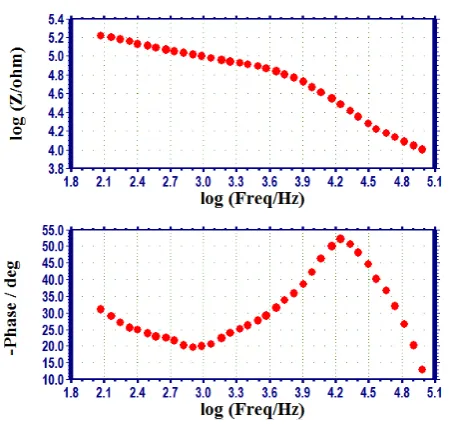
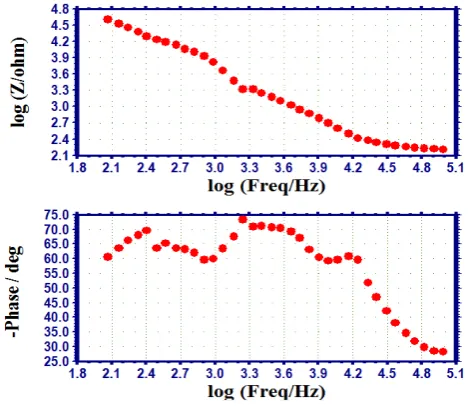
The instrument polarization study was used to record AC impedance spectra also are shown in Figure 8 to 13. Corrosion parameters such as charge transfer resistance (Rt), double layer capacitance (Cdl), Impedance are measured. They are given in Table 2.
Ringer’s solution
Influence of 100 ppm of NaCl
It is noted from the Table 2, that the corrosion resistance of 18 carat gold decreases in the presence of 100 ppm of NaCl, the Rt value decreases from 537220 to 139115 ohm cm2. C
dl value increases from 9.493×10⁻¹² to 3.666×1 0-11 F cm-2. The impedance value decreases from 5.775 to 5.247.
Influence of 100 ppm of glucose
Similarly, the corrosion resistance of 18 carat gold decreases in the presence of 100 ppm.of glucose, the Rt value decreases from 537220 to 9430 ohm cm2. C
Table 1. Polarization study of the study of corrosion of 18-carat gold.
System Ecorr, mV vs
SCE bdecadec, mV -1 bdecadea, mV -1 LPR, Ω cm
2 Icorr, A cm-2
Ringer’s solution -319 169 202 7361238 2.657X10⁻⁸
Ringer’s solution+100 ppm NaCl -389 179 220 4472869 5.442X10⁻⁹
Ringer’s solution+100 ppm Glucose -88 167 215 1540062 9.584 X10⁻⁹
Lactate Ringer’s solution -160 141 235 5028338 2.467 X10⁻⁸
Lactate Ringer’s solution+100 ppm NaCl -211 171 279 1873424 3.605 X10⁻⁹ Lactate Ringer’s solution+100 ppm Glucose -189 165 394 1403355 7.625 X10⁻⁹
Figure 8. AC impedance spectra of 18 carat gold immersed in simulated Ringer’s solution.
Figure 9. AC impedance spectra of 18 carat gold immersed in simulated Ringer’s solution +100 ppm of NaCl.
Figure 10. AC impedance spectra of 18 carat gold immersed in simulated Ringer’s solution +100 ppm of glucose.
Figure 12. AC impedance spectra of 18 carat gold immersed in Lactated Ringer’s Solution + 100 ppm of NaCl.
Figure 13. AC impedance spectra of 18 carat gold immersed in Lactated Ringer’s Solution + 100 ppm of glucose.
Lactated Ringer’s Solution Influence of 100 ppm of NaCl
It is observed from the Table 2, that the corrosion resistance of 18 carat gold decreases in the presence of 100 ppm of NaCl, the Rt value decreases from 27920 to 19990 ohm cm2. C
dl value increases from 1.827×10⁻¹¹ to 2.551 × 10⁻¹⁰ F cm-2. The impedance value decreases from 4.792 to 4.769.
Influence of 100 ppm of glucose
Similarly, the corrosion resistance of 18 carat gold decreases in the presence of 100 ppm.of glucose, the Rt value decreases from 27920 to 17550 ohm cm2. C
dl value increases from 1.827×10⁻¹¹ to 5.569×10⁻⁹ F cm-2. The impedance value decreases from 4.792 to 4.679.
From this, it is inferred that the corrosion resistance of 18 carat gold in Lactated Ringer’s solution decreases in presences of 100 ppm of NaCl and also 100 ppm of glucose.
Table 2. Corrosion parameters as determined by AC Impedance.
System Rt Cdl Impedance
Ringer’s solution 537220 9.493×10⁻¹² 5.775 Ringer’s solution
+100 ppm NaCl 139115 3.666×10
-11 5.247
Ringer’s solution
+100 ppm glucose 9430 5.408×10
-10 4.430
Lactate Ringer’s
solution 27920 1.827×10
-11 4.792
Lactate Ringer’s solution +100 ppm NaCl
19990 2.551×10⁻¹⁰ 4.769
Lactate Ringer’s solution +100 ppm glucose
17550 5.569×10⁻⁹ 4.679
CONCLUSION
The corrosion resistance of 18 carat gold in Ringer’s solution and in lactated Ringer’s solution has been evaluated by polarization study and AC impedance spectra. The influence of 100 ppm of NaCl and also of 100 ppm of glucose on the corrosion resistance of 18 carat gold has also been investigated. This study leads to the following conclusions.
Corrosion resistance of 18 carat gold in Ringer’s and lactated Ringer’s solutions decreases in presence of 100 ppm of NaCl and also of 100 ppm of glucose. This is confirmed by polarization study and AC impedance spectra. It implies, care must be taken to avoid excess of NaCl and also glucose in Ringer’s and also in lactated Ringer’s solution.
ACKNOWLEDGEMENT
The authors are thankful to the Managements of their institutions and to St, Joseph’s Research and Community Development Trust, Dindigul for their help and encouragement.
REFERENCES
1Kamachimudali, U., Sridhar, T. M., Raj, B., Corrosion of
bioimplants, Sadhana., 2001, 28, 601.
https://doi.org/10.1007/BF02706450
2Duerig, T. W., The Use of Superelasticity in Modern Medicine, MRS Bull., 2002, 27,101. https://doi.org/10.1557/mrs2002.44 3Shabalovskaya, S. A., Surface, corrosion and biocompatibility
aspects of Nitinol as an implant material, Int. Mater. Rev.,
2001, 46, 233.https://doi.org/10.1006/plas.2001.1555
4Duerig, T. W., Pelton, A., Stockel, D., An overview of nitinol
medical applications, Mater. Sci. Eng.,1999, 149, 273-275.
5Duerig, T. W., Tolomeo, D. E., Wholey, M., An overview of
superelastic stent design, Min. Invas. Therap. Allied Technol.,
2000, 9, 235. https://doi.org/10.3109/13645700009169654 6Kumar, S., Narayanan, T. S. N. S., Electrochemical
characterization of β-Ti alloy in Ringer's solution for implant application, J. Alloy Compd., 2009, 479, 699.
https://doi.org/10.1016/j.jallcom.2009.01.036
7Kumar, S., Narayanan, T. S. N. S., Raman, S. G. S., Seshadri, S.
K., Fretting corrosion behaviour of thermally oxidized CP-Ti in Ringer’s solution, Corros. Sci., 2012, 52, 711.
https://doi.org/10.1016/j.corsci.2009.10.029
8Kumar, S. K., Narayanan, T. S. N., S., Raman, S. G. S., Seshadri,
S. K., Thermal oxidation of Ti6Al4V alloy: Microstructural and electrochemical characterization, Mater. Chem. Phys.,
2010, 119, 327.
https://doi.org/10.1016/j.matchemphys.2009.09.007
9Carlos, C. V., Munoz, A. I., Electrochemical Aspects in
Biomedical Alloy Characterization, Trends Mater. Sci., 2011,
13,307-513.
10Conway, B. E., Bockris, J., White, R. E., Edts, Modern Aspects of Electrochemistry, Kluwer Academic/Plenum Press Publishers, New York, 1999, 32, 143-248.
11https://www.bbraun.ph/.
12Raykhtsaum, G., Agarwal, D. P., The color of gold, Gold Technol., 1997, 10, 26.
13Shyamala Devi, B., Rajendran, S., Corrosion inhibition by
trisodium citrate (TSC) – Zn2+ system, Eur. Chem. Bull.,
2012, 1, 150-157. http://dx.doi.org/10.17628/ecb.2012.1.150-157.
14Rajendran, S., Uma, V., Krishnaveni, A., Jeyasundari, J.,
Shyamaladevi, B., Manivannan, M., Corrosion behavior of metals in artificial saliva in presence of D-Glucose, Arab. J. Sci. Eng., 2009, 34,147-158.
15Florence, J. F., Rajendran, S., Srinivasan, K. N., Effect of henna
(Lawsonia inermis) extract on electrodeposition of nickel from Watt's bath, Electroplating Finish., 2012, 31, 1-4.
16Sribharathy, V., Rajendran, S., Corrosion inhibition by green
inhibitor: sodium metavanadate-spirulina system, Chem. Sci. Rev. Lett., 2012, 1, 25-29.
17Tamilselvi, S., Murugaraj, R., Rajendran, N., Electrochemical
impedance spectroscopic studies of titanium and its alloys in saline medium, Mater. Corros., 2007, 58,113-120.
https://doi.org/10.1002/maco.200603979
18Rajendran, S., Anuradha, K., Kavipriya, K., Krishnaveni, A.,
Thangakani, J. A.,Inhibition of corrosion of carbon steel in sea water by sodium molybdate-Zn2+ system, Eur. Chem. Bull., 2012, 1, 503-510.
http://dx.doi.org/10.17628/ecb.2012.1.503-510.
19Anbarasi, C. M., Rajendran, S., Investigation of the inhibitive
effect of octanesulfonic acid - zinc-ion system on corrosion of carbon steel, Chem. Eng. Commun., 2012, 199, 1596-1609.
https://doi.org/10.1080/00986445.2012.672498
20Sribharathy, V. G., Rajendran, S., Corrosion inhibition of carbon
steel by sodium metavanadate, J. Electrochem. Sci. Eng,
2012, 2, 121-131. doi: 10.5599/jese.2012.0014.
21Rajendran, S., Sribharathy, V., Krishnaveni, A., Jeyasundari, J.,
Sathiyabama, J., Muthumegala, T. S., Manivannan, M., Inhibition effect of self assembled films formed by adipic acid molecules on carbon steel surface, Zastita Materijala,
2011, 52, 163-172.
22Liu, K. M., Wu, S. L., Chu., P. K., Chung, C. Y., Chu, C. L.,
Yeung, K. W. K., Lu, W. W., Cheung, K. M. C., Luk, K. D. K., Effects of water plasma immersion ion implantation on surface electrochemical behavior of NiTi shape memory alloys in simulated body fluids, Appl. Surf. Sci., 2007, 253,
3154-3159. https://doi.org/10.1016/j.apsusc.2006.07.008
23Wan, P., Ren, Y., Zhang, B., Yang, K., Effect of nitrogen on
biocorrosion behavior of high nitrogen nickel-free stainless steel in different simulated body fluids, Mater. Sci. Eng. C,
2012, 32, 510-516.
https://doi.org/10.1016/j.msec.2011.12.002
24Thangam, Y. Y., Kalanithi, M., Anbarasi, C. M., Rajendran, S.,
Inhibition of corrosion of carbon steel in a dam water by sodium molybdate - Zn2+ system, Arab. J. Sci. Eng., 2009, 34,
49-60.
25Kanimozhi, S. A., Rajendran, S., Inhibitive properties of sodium
tungstate-Zn2+ system and its synergism with HEDP, Int. J. Electrochem. Sci., 2009, 4, 353-368.
26Sathiyabama, J., S. Rajendran, S., Jeyasundari, J., Shyamaladevi,
B., The effect of Zn2+ ion in promoting inhibitive property of
phenolphthalein, J. Eng. Sci. Tech., 2010, 3, 27-31.
https://doi.org/10.25103/jestr.031.05
27Johnsirani, V., Rajendran, S., Sathiyabama, J., Muthumegala, T.
S., Krishnaveni, A., Beevi, N. H., Bulg. Chem. Commun.,
2012, 44, 41-51.
28Nithya, A., Rajendran, S., Corrosion Inhibition Effect of Carbon
Steel in Sea Water by L-Arginine-Zn2+ System, Bulg. Chem. Commun., 2010, 42, 119-125.
29Anthony, N., Sherine, H. B., Rajendran, S., Investigation of the
inhibiting effect of CMC - Zn 2 + system in the corrosion of carbon steel in neutral chloride solution, Arab. J. Sci. Eng.,
2010, 35, 41-53.
30Johnsirani, V., Sathiyabama, J., Rajendran, S., Prabha, A. S.,
Inhibitory Mechanism of Carbon Steel Corrosion in Sea Water by an Aqueous Extract of Henna Leaves, Int. Scholar.
Res. Noices, 2012, 10, 1-9.
https://doi.org/10.5402/2012/574321
31Tamilselvi, S., Rajendran, N., Electrochemical studies on the
stability and corrosion resistance of Ti-5Al-2Nb-1Ta alloy for biomedical applications, Trends Biomater. Artificial Organs, 2006, 20, 1-5.
32Sangeetha, M., Rajendran, S., Sathiyabama, J., Prabhakar, P.,
Eco friendly extract of banana peel as corrosion inhibitor for carbon steel in sea water, J. Nat. Prod. Plant Resour., 2012, 2, 601-610.
33Rajendran, S., Thangavelu, C., Venkatesh, T., Study of
Synergistic effect of diethylene triamine penta (methylene phosphonic acid) and adipic acid on the inhibition of corrosion of alkaline aluminium, Der Chemica Sinica., 2012,
3, 1475-1485.