705
© 2016 by the Serbian Biological Society
Articles published in the Archives of Biological Sciences will be Open-Access articles distributed under a Creative Commons Attribution-NonCommercial-NoDerivatives 4.0 International License.
SMALL-SCALE VARIATIONS IN LEAF SHAPE UNDER ANTHROPOGENIC
DISTURBANCE IN DIOECIOUS FOREST FORB
MERCURIALIS PERENNIS
:
A GEOMETRIC MORPHOMETRIC EXAMINATION
Vukica Vujić, Luka Rubinjoni, Sara Selaković and Dragana Cvetković*
Faculty of Biology, University of Belgrade, Belgrade, Serbia
*Corresponding author: [email protected]
Received: November 11, 2015; Revised: December 16, 2015; Accepted: December 16, 2015; Published online: January 21, 2016
Abstract: Plants are exposed to increasing levels of diverse human activities that have profound effects on their overall mor-phology and, specifically, on leaf mormor-phology. Anthropogenic disturbances in urban and suburban forest recreational sites are attracting growing research interest. To explore the persisting recreational impact on leaf shape and size, we conducted a field study on the dioecious forb Mercurialis perennis L. (Euphorbiaceae), typical for undisturbed understory communities. We selected adjacent sites in a suburban forest, which experience contrasting regimes of disturbance by human trampling under otherwise concordant natural conditions. Patterns of leaf shape and size variation and putative sex-specific response to disturbance were analyzed using a geometric morphometric approach. In addition to leaf-level data, plant height, inter-node and leaf number were analyzed to explore the same response at the whole-plant level. The results show significant variations associated with disturbance at both levels: plants growing under a heavy disturbance regime had shorter stems with a greater number of wider and shorter leaves. Significant differences between sites were also found for leaf size, with larger leaves observed in an undisturbed site. The effects of sex and sex x site interaction on leaf size and shape were non-significant, pointing to the absence of sexual dimorphism and sex-specific response to disturbance. Contrary to leaf shape and size, all three analyzed shoot traits showed highly significant sexual dimorphism, with male plants being higher and having higher leaf and internode count.
Key words:leaf morphology; geometric morphometrics; anthropogenic stress; trampling; sexual dimorphism
INTRODUCTION
In their natural habitats, plants are exposed to a wide range of natural and anthropogenic stress factors. Changes in environmental conditions over differ-ent time and space scales are greatly affected and promoted by human activities. In the process of adapting to natural stress conditions, various strat-egies, life histories and mechanisms have evolved. However, plants are often exposed to anthropogenic disturbances that impose new adaptive challenges, e.g. pollution [1, 2] or intensive land use [3]. Timber harvest, land-use practices, road runoff, grazing and trampling have a massive impact on plant commu-nity composition, population dynamics, but also on the physiology, growth, development and morphol-ogy of plants [3-6].
Disturbance resulting from outdoor recreation has adverse effects on natural habitats and
alterations in life history traits and the reproductive patterns of understory species [6-12]. Traits related to plant tolerance and morphological responses to disturbance, at the vegetation and individual species levels, have been a focus of a number of studies ([6], and references therein).
Plant tolerance represents a combination of re-sistance, defined as withstanding disturbance with-out effective damage, and resilience, defined as re-covering from effective damage [13]. The resistance of plant growth forms to disturbance by trampling follows a general order, in which grasses and oth-er graminoids are the most resistant, followed by shrubs, ferns and forbs, which are the least resistant [14]. Graminoid life forms are considered trampling-resistant because they possess narrow leaves and flexible, horizontally branching stems. By contrast, forbs are more likely to be damaged because they have vertical stems bearing broader and larger leaves [13,15]. Besides the plant form, trampling resistance is dependent on climatic zones and vegetation types [14]. Alpine vegetation is considered to be resistant to mechanical stress, whilst montane vegetation, es-pecially understory species, seems to be less capable of dealing with trampling [14,16]. Generally, the ground vegetation of temperate forests is considered to be trampling-sensitive [15].
The resistance and resilience of plants is strongly related to their morphological traits; specifically, leaf traits are considered to be one of the key morpholog-ical factors contributing to plant tolerance to tram-pling [6]. In the last few decades, geometric mor-phometrics (GM) has been commonly employed in morphological studies for resolving questions in a variety of research areas [17]. In assessing quantita-tive shape variation, even on a very small scale, GM methods have proved to be efficient and statistically powerful [18]. Although GM was primarily applied to animal taxa [19,20], its use in plant research has increased rapidly; recently, the interest has focused on analyzing the shape variation of leaves, both sim-ple and compound [18, 21, 22].
Dog’s mercury, Mercurialis perennis L. (Euphor-biaceae), is a forest forb and a typical member of un-disturbed understory communities, but it can also be found in habitats under different levels of
anthropo-genic disturbance [23]. Species of the genus Mercu-rialis are known for a great variety of life histories and sexual systems, and dioecious M. perennis has proven to be a valuable model system for studying patterns of sex ratio variation and sexual dimorphism [24-27]. Sexual dimorphism (SD), as one of the signifi-cant sources of phenotypic variation, has received considerable research attention, although, tradition-ally, much more in animals than in plants. In gender dimorphic plant species, male and female individu-als are under different selection pressures [28,29], re-sulting in diverging resource economy and reproduc-tive allocation. Different reactions to environmental conditions can lead to spatially divergent niches [28] or sex-specific biotic interactions [30]. Since promi-nent SD in plant size was demonstrated previously in M. perennis [25], the question to address was the putative presence of intersexual differences and sex-specific reactions to disturbance expressed through variations in leaf shape.
In the present study, we analyzed variations in leaf shape and size of M. perennis plants from two adja-cent sites in a suburban forest experiencing contrast-ing levels of anthropogenic impact. The aim was to investigate and quantify the effects of human-induced disturbance, with focus on human trampling. Patterns of leaf shape variation and possible sex-specific pat-terns in response to disturbance were analyzed using a geometric morphometric approach. We hypoth-esized that the effects of anthropogenic disturbance were reflected in leaf shape change, even on a small spatial scale. In addition to leaf-level data, we analyzed data on shoot traits (plant height, leaf and internode number) to explore the response to disturbance at the whole-plant level. We also aimed to explore the pres-ence of sexual dimorphism in the analyzed traits.
MATERIALS AND METHODS Study species
perennis populations naturally occur in both lowland and montane habitats [25], growing under different light and temperature regimes, as well as under dif-ferent levels of anthropogenic disturbance.
Study sites
The study sites are located on the slopes of Mt. Avala, a nature protected area and a popular recreation zone on the outskirts of Belgrade, Serbia. For this study we selected two adjacent sites in a hilly mixed beech for-est with sessile oak and hornbeam (Fagetum submon-tanum mixtum sensu [31]), on free draining calcar-eous soil, experiencing contrasting levels of anthro-pogenic disturbance under otherwise concordant natural conditions. The study area is characterized by warm summers, under a moderate continental climate with an average annual temperature of 9.2°C and average annual precipitation of 712.6 mm [32]. The altitude of the localities is 452 m above sea level.
The first site (N 44°41’38’’ E 20°30’47’’) is a rest area by the road with frequent traffic, due to the vi-cinity of monuments and tourist attractions (Avala tower). Visitors picnic and barbeque on the site. Fre-quent trampling has resulted in heavily compacted soil and extremely reduced tall herb vegetation cov-erage, with Mercurialis perennis persisting and form-ing patches under the beech canopy. The second lo-cation (N 44°41’38’’, E 20°30’49’’) is in the forest, by an unfrequented path, and accessible only on foot. A steep creek separates the site from the rest area, re-sulting in a sharp contrast in the level of disturbance by human activities without a clear break in the un-derstory vegetation. The site represents residues of a once heavily managed forest, which is currently in the advanced phases of secondary succession. The understory vegetation, consisting mainly of herba-ceous species with M. perennis forming dense stands, develops towards an original relict forest in undis-turbed conditions. Therefore, hereinafter this site will be referred to as “undisturbed”.
Sampling procedure and analyses
The plants were sampled in April 2013; 60 individu-als (30 female and 30 male) were sampled from the undisturbed habitat and 59 individuals (29 female
and 30 male) from the disturbed habitat. Plant height (the length of the stem from ground level to the tip of the plant), number of leaves and number of inter-nodes were determined on fresh material. The plants were then herbarized and the leaves separated from the stems. Leaves were scanned using a Hewlett-Packard ScanJet G4010 (600 dpi resolution, JPEG format), with the abaxial side facing the scanner. The scans of the first pair of fully developed leaves were further processed; overall, 238 leaves from 119 plants were included in the analysis.
For analysis of leaf shape, the programs MakeFan and CoordGen from the IMP6 package [33] were employed. MakeFan was used to construct the fan on each leaf, based on two landmarks: on the base and tip of the leaf, with 10 radial guidelines (Fig. 1). To provide information about leaf shape, which is essential for geometric morphometrics [34], ten semilandmarks were positioned using TpsDig soft-ware [35]. For each leaf, the size information was calibrated by acquiring two additional points from the scanned ruler. The CoordGen6f program was used to calculate centroid size (CS) and Procrustes coordinates.
The analysis of two-dimensional landmark data was performed using MorphoJ software [36]. The extraction of information about size and shape of the leaves [37,38] was carried out using generalized Pro-crustes analysis (GPA). To minimize artifacts of the herbarization process that could skew the results, the symmetric component of shape variation was used in further analysis [19].
To explore variations in leaf size, analysis of vari-ance (ANOVA) was carried out, with centroid size as the dependent variable and site and sex as indepen-dent variables; both site and sex were fixed factors. Multivariate analysis of variance (MANOVA) was used to establish differences in leaf shape, with shape variables (Procrustes coordinates) as dependent vari-ables; independent variables were site and sex. Shape and size variations were analyzed after averaging the values obtained for leaves relative to the plant.
Principal component analysis (PCA) was car-ried out to examine the main patterns of leaf shape variation and visualize differences in shape among the analyzed groups. The Procrustes distance be-tween the mean shapes of leaves from the disturbed and undisturbed sites was computed as a measure of shape difference. We investigated whether the shape changes were associated with variation in leaf size us-ing multivariate regression of Procrustes coordinates onto log centroid size [39]. Visualization of the rela-tionship between shape variables and centroid size was performed by plotting a shape score against log centroid size. A permutation test with 10000 itera-tions was used to calculate the statistical significance of the relationship between the shape variables and centroid size [40]. Further analysis was performed on the residual variance of shape.
At the whole-plant level, the effects of site and sex were explored using ANOVA for plant height. For number of leaves and number of internodes, customary transformations did not improve the fit of these variables to the assumptions for the above analysis, and the Mann-Whitney-Wilcoxon test was applied. Statistical analyses were carried out using the package Statistica 8.0 (StatSoft Inc., Tulsa, OK, USA) and MorphoJ [36]; the graphs were made in MorphoJ and R 3.0.2 [41].
RESULTS
The difference in centroid size of leaves between the disturbed and undisturbed sites was highly sig-nificant (F1,115=14.97, p<0.001), but the effects of sex (F1,115=0.19, p=0.6618) and site x sex interaction (F1,115=0.18, p=0.6747) were nonsignificant. The dif-ference between sites remained significant after con-trolling for plant height (F1,114=5.52, p=0.0205), with
leaves from the undisturbed habitat being larger than those from the disturbed habitat (Fig. 2).
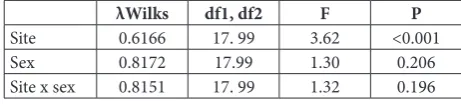
MANOVA of shape variables (Procrustes coordi-nates) showed a highly significant difference in leaf shape between the sites. On the other hand, differ-ences between sexes, as well as the interaction effect, were nonsignificant (Table 1).
Overall variation in leaf shape at both sites was ex-plained by principal component analysis (PCA). The first principal component (PC1) explained 80.72% of the total variance, with the first two PCs accounting for 96.12% of the total variance. The thin-plate spline deformation grids along the axes visualize general differences in leaf shape (Fig. 3); the main feature as-sociated with PC1 is change in the elongation of leaf. The leaves from the disturbed habitat were broader and shorter compared to the more elongated leaves from the undisturbed habitat. Procrustes distance, the measure of magnitude of shape differences, was 0.0377 (p<0.001 based on a permutation test).
Shape variation also included the effect of allom-etry. Multivariate regression of Procrustes coordinates onto log centroid size showed that the allometric ef-fect was significant (p=0.0055, based on a permutation test), and that size accounted for 5.2% of leaf shape variation (Fig. 4). Thus, additional analysis was per-Table 1. Multivariate analysis of variance (MANOVA) for shape variables (Procrustes coordinates).
λWilks df1, df2 F P
Site 0.6166 17. 99 3.62 <0.001
Sex 0.8172 17.99 1.30 0.206
Site x sex 0.8151 17. 99 1.32 0.196
formed on size-corrected shape variables. The differ-ence in residual variance of shape between the sites was significant (F8,108=2.15, p=0.0373), but sex and site x sex interaction effects were nonsignificant (F8,108=1.15, p=0.3366; F8,108=1.40, p=0.2045, respectively).
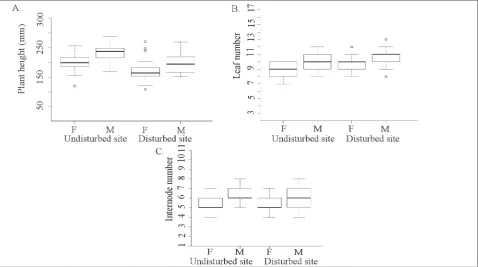
Plant height was significantly different between the disturbed and undisturbed habitats (F1,115=33.62, p<0.001) as well as between the sexes (F1,115=21.32, p<0.001). Plants from the undisturbed habitat were higher than plants from the disturbed habitat, and males from both sites were higher compared to fe-males. Site x sex interaction was not significant (F1,115=0.12, p=0.7344) (Fig. 5A). Leaf number per plant differed significantly between sites (Z = 2.84, p=0.0045) and between sexes (Z = 4.19, p<0.001). Plants from the disturbed habitat had more leaves. This was also the case with males from both habitats (Fig. 5B). In addition, the relationship of leaf CS with leaf number per plant was explored and found to be nonsignificant (F1,117=0.61, p=0.4365). The effect of sex on internode number was significant (Z = 5.16, p<0.001); males had more internodes than females in both habitats (Fig. 5C). However, there was no sig-nificant difference between the disturbed and undis-turbed sites (Z = 0.99, p=0.3240).
Fig. 5. Boxplots of (A) plant height, (B) leaf number and (C) internode number of male (M) and female (F) plants from disturbed and undisturbed sites (median, the first and third quartiles, range and outliers).
Fig. 3. Principal component analysis (PCA) showing leaf shape variation. Deformation grids along the first (PC1) and second (PC2) axes demonstrate shape changes.
DISCUSSION
We found significant differences in leaf size and shape of M. perennis plants growing under contrast-ing disturbance regimes (disturbed vs. undisturbed). Previous studies pointed to leaf size as one of the key morphological traits contributing to plant tolerance to trampling [6,42]. A reduction in leaf elongation pro-portional to duration of trampling has been demon-strated in many species with different types of growth form [42]. The decrease in leaf size as the intensity and frequency of disturbance increase represents the adap-tive response, since it provides a plant with a greater chance of escaping injury as smaller leaves may be less affected by trampling [43,44]. Our field study showed that leaves from the heavily disturbed site were sig-nificantly smaller compared to leaves from the undis-turbed site. These findings are in accordance with the results of experimental studies dealing with the effects of trampling on herbaceous species [6,42-44].
Regarding shape change, the picture is more com-plex. Previous reports focusing on traditional measure-ments for depicting shape changes, such as leaf blade length, leaf length and width (including leaf blade length to leaf width and length ratios) [44], pointed to different trends of change in leaf shape due to tram-pling. Depending on growth form, a plant’s response to different frequencies of mechanical stress may result in narrower and more flexible leaf morphology, or in the production of shorter and rounder leaves [44,45]. Our survey showed that in M. perennis, a broadleaved forb typical of understory communities, disturbance by trampling modifies leaf shape. The difference in shape between the sites with opposing disturbance regimes was highly significant, with leaves from the disturbed site being broader and shorter. It has been suggested that in trampling-prone areas, under unpredictable mechanical stress, narrow leaves are favored mainly in rosette-type plants, while in plants with other growth forms the opposite trend can be found [44].
When studying morphological variation, estima-tion of the allometric effect is a necessary step. We have investigated the influence of allometry (defined as the dependence of shape on size [17]) on the ob-served leaf shape variation by performing allometric regression of Procrustes coordinates on centroid size. The results revealed that overall leaf shape
variation significantly influenced allometry. To de-termine if the observed differences in shape between the sites could be attributed only to difference in size, or whether there is an effect of disturbance on shape itself, we analyzed the residual shape variance. The site effect remained statistically significant, thus con-firming the effect of disturbance on leaf shape.
In addition to leaf-level traits, we analyzed plant height, leaf and internode number to explore the re-sponse to disturbance at the whole-plant level. In our survey, individual plants from the disturbed site were shorter in stem and had a higher number of leaves compared to their counterparts from the undisturbed site. Mechanical stress has an array of impacts on dif-ferent plant growth forms; at the morphological level, plant height was found to be the most sensitive indica-tor of the adverse effects of trampling [42]. The only exceptions can be found in some species adapted to heavily trampled habitats by having tough and resis-tant organs [46]. However, in the majority of plants, especially those with more vulnerable organs, erect stems and broad leaves, trampling causes a severe de-crease in height [8,11,46,47]. It has been suggested that trampling may affect taller and shorter plant species in a similar fashion, but nonetheless the relative reduc-tion in plant size was greater when tall plants were subjected to disturbance of various intensities [42]. Even less destructive mechanical stimuli can have a profound effect on height – it was shown that touch stimulation led to a significant reduction in inflores-cence elongation in Arabidopsis [48]. Disturbance by human trampling significantly decreased shoot height of the forest herb Anemone nemorosa [11].
Our results are in line with these findings. We also found that the difference in internode number be-tween plants from the disturbed and undisturbed sites was not significant, demonstrating that the reduction in height was due to the reduction in internode length, not their number. Strategies of dealing with stress in-clude the stress-induced morphogenic response de-scribed by Potters et al. [49]. At the organismal level, responses associated with various stressors, including mechanical disturbance, can be manifested as stem elongation inhibition and growth redistribution.
mechanical stress, plants often suffer a significant reduction in the number of leaves depending on growth form, anatomical characteristics of leaves, etc. [42]. However, trampling can also result in an increased number of leaves per plant, as was found in Plantago asiatica [44,50].
It has to be noted, however, that the observed differences are not the consequences of trampling alone. In natural populations under the given distur-bance regimes, other environmental conditions, both anthropogenic and natural (e.g. air pollution, light conditions), can additionally influence the analyzed traits [6]. However, in the present study, given the close proximity and similarity of the analyzed sites, we have focused on trampling, since the difference in trampling regime was the most striking one. Distur-bance by trampling affects plants directly (through mechanical stress) and indirectly (e.g. through soil compaction and reduced presence of tall herbs) [6,11]; thus, both kinds of effects contributed to the observed responses to disturbance.
One interesting point is the relationship between the number of leaves and their size, since previous studies postulated the existence of a fundamental trade-off between these traits in angiosperms in gen-eral, and at the within-species level, in natural popu-lations of herbaceous species [51]. Although in our study no significant relation between leaf number and size was revealed, this finding should be taken with caution, since centroid size was the only mea-sure of leaf size used in the analyses, and only the first pair of fully developed leaves was included.
Another question we have addressed in this study is the putative presence of sexual dimorphism in analyzed traits. It was reported that M. perennis
displays sexual dimorphism in both plant size [25] and leaf size [52], but no previous study attempted to explore and quantify SD in leaf shape in this species. We found prominent sexual dimorphism in all three analyzed shoot traits – height, internode num-ber and leaf numnum-ber, contrary to leaf shape and size. The pattern of male M. perennis being higher than that of females in both sites, typical for lowland habi-tats [25], was confirmed. Plants from the disturbed site were generally lower, but the lack of site x sex interaction indicates no sex-specific response to
an-thropogenic disturbance. Internode number and leaf number were alsosignificantly higher in male plants. Although intersexual differences have been ex-plored in a variety of plant traits, data on SD in leaf size and shape are still limited. In the present study, we found that leaf centroid size was similar in both sexes. Thus, we did not confirm the previous report that in M. perennis males have smaller leaves than females [52]. Regarding leaf shape, it was reported that in male M. perennis the leaves were also nar-rower compared to female leaves [23,52]. Based on this, it was expected to find significant intersexual differences in this trait. However, this was not the case, and we found no significant difference in shape between male and female leaves. Thus, our results indicate that, with respect to leaf shape and size, the sexes responded to disturbance in a similar manner.
This study is, to our knowledge, the first to ex-plore a potential link between anthropogenic distur-bance and morphological responses in leaf shape (in-cluding the putative sex-specific response) in a natu-ral population, using a GM approach. This approach proved to be efficient in detecting quantitative shape variation on a small spatial scale. We have demon-strated the existence of patterns of leaf shape and size variation strongly associated with disturbance. A similar response was also found at the whole-plant level in the analyzed shoot traits. The results presented here are of interest for further investigat-ing of the anthropogenic influences on mechanisms that determine leaf shape in light of environmental constraints. Our study contributes to some impor-tant issues concerning the growing pressure of hu-man activities on suburban forest fragments and the response patterns of forest forbs to various forms of anthropogenic disturbance.
Acknowledgments: The authors thank Christian Peter Klingen-berg and Danijela Miljković for helpful comments on parts of this manuscript. This study was supported by the Ministry of Education, Science and Technological Development of the Re-public of Serbia, Grant No. 173025.
Authors’ contributions: All authors contributed to sample col-lection, data analysis and manuscript preparation; V.V. preformed material scanning and landmark digitalization, S.S. and L.R. mate-rial scanning, D.C. wrote the final version of manuscript.
REFERENCES
1. Honour SL, Bell JNB, Ashenden TW, Cape JN, Power SA. Responses of herbaceous plants to urban air pollution: effects on growth, phenology and leaf surface characteristics. Envi-ron Pollut. 2009;157:1279-86.
2. Vujić V, Avramov S, Tarasjev A, Barišić Klisarić N, Živković U, Miljković D. The effects of traffic-related air pollution on the flower morphology of Iris pumila -comparison of a pol-luted city area and the unpolpol-luted Deliblato Sands (nature reserve). Appl Ecol Env. 2015;13:405-15.
3. Guirado M, Pino J, Rodà F. Understorey plant species rich-ness and composition in metropolitan forest archipelagos: effects of forest size, adjacent land use and distance to the edge. Global Ecol Biogeogr. 2006;15:50e62.
4. Kutiel P, Zhevelev Y. Recreational use impact on soil and vegetation at picnic sites in Aleppo pine forests on Mount Carmel, Israel. Isr J Plant Sci. 2001;49:49-56.
5. Amrein D, Rusterholz HP, Baur B. Disturbance of suburban
Fagus forests by recreational activities: effects on soil charac-teristics, above-ground vegetation and seed bank. Appl Veg Sci. 2005;8:175-82.
6. Bernhardt-Römermann M, Gray A, Vanbergen AJ, Berges L, Bohner A, Brooker RW, De Bruyn L, De Cinti B, Dirn-böck T, Grandin U, Hester AJ, Kanka R, Klotz S, Loucou-garay G, Lundin L, Matteucci G, Mészáros I, Oláh V, Preda E, Prévosto B, Pykälä J, Schmidt W, Taylor ME, Vadineanu A, Waldmann T, Stadler J. Functional traits and local envi-ronment predict vegetation responses to disturbance: a pan-European multi-site experiment. J Ecol.2011;99:777-87. 7. Pescott OL, Stewart GB. Assessing the impact of human
trampling on vegetation: a systematic review and meta-analysis of experimental evidence. PeerJ. 2014;2:e360. DOI: 10.7717/peerj.360
8. Kissling M, Hegetschweiler KT, Rusterholz HP, Baur B. Short-term and long-term effects of human trampling on above-ground vegetation, soil density, soil organic matter and soil microbial processes in suburban beech forests. Appl Soil Ecol. 2009;42:303-14.
9. Hamberg L, Malmivaara-Lämsä M, Lehvävirta S, O’Hara RB, Kotze DJ. Quantifying the effects of trampling and habitat edges on forest understory vegetation - a field experiment. J Environ Manage. 2010;91:1811-20.
10. Malmivaara-Lämsä M, Hamberg L, Löfström I, Vanha-Majamaa I, Niemelä J. Trampling tolerance of understorey vegetation in different hemiboreal urban forest site types in Finland. Urban Ecosyst. 2008;11:1-16.
11. Rusterholz HP, Kissling M, Baur B. Disturbances by human trampling alter the performance, sexual reproduction and genetic diversity in a clonal woodland herb. Perspect Plant Ecol. 2009;11:17-29.
12. Oral D, Ozcan M, Gökbulak F, Efe A, Hizal A. Response of understory vegetation to exclosure in a heavily compacted forest recreational site. J Environ Biol. 2013;34:811-7. 13. Yorks TJ, West NE, Mueller RJ, Warren SD. Toleration of
traffic by vegetation: life form conclusions and summary extracts from a comprehensive data base. Environ Manage. 1997;21:121-31.
14. Hill R, Pickering C. Differences in resistance of three sub-tropical vegetation types to experimental trampling. J Envi-ron Manage. 2009;90:1305-12.
15. Liddle MJ. Recreation Ecology. London, UK: Chapman & Hall;1997.
16. Cole DN. Impacts of hiking and camping on soils and vegetation: a review. In: Buckley R, editor. Environmental Impacts of Ecotourism. Wallingford, UK: CABI Publishing; 2004. p. 41-60.
17. Klingenberg CP. Evolution and development of shape: integrat-ing quantitative approaches. Nat Rev Genet. 2010;11:623-35. 18. Viscosi V, Cardini A. Leaf Morphology, Taxonomy and Geo-metric MorphoGeo-metrics: A Simplified Protocol for Beginners. PloS One. 2011;6:e25630.
19. Klingenberg CP, Barluenga M, Meyer A. Shape analysis of symmetric structures: quantifying variation among individu-als and asymmetry. Evolution. 2002;56:1909-20.
20. Jojić V, Nenadović J, Blagojević J, Paunović M, Cvetković D, Vujošević M. Phenetic relationships among four Apodemus
species (Rodentia, Muridae) inferred from skull variation. Zool Anz. 2012;251:26-37.
21. Viscosi V, Fortini P, Slice DE, Loy A, Blasi C. Geometric morphometric analyzes of leaf variation in four oak spe-cies of the subgenus Quercus (Fagaceae). Plant Biosyst. 2009;143:575-87.
22. Klingenberg CP, Duttke S, Whelan S, Kim M. Developmental plasticity, morphological variation and evolvability: a mul-tilevel analysis of morphometric integration in the shape of compound leaves. J Evol Biol. 2012;25:115-29.
23. Jefferson GR. Biological Flora of the British Isles: Mercurialis perennis L. J Ecol. 2008;96:386-412.
24. Wade KM. Experimental studies on the distribution of the sexes of Mercurialis perennis L. III. Transplanted populations under light screens. New Phytol. 1981;87:447-55.
25. Cvetković D, Jovanović V. Altitudinal variation of the sex ratio and segregation by gender in the dioecious plant Mer-curialis perennis L. (Euphorbiaceae) in Serbia. Arch Biol Sci. 2007;59:193-8.
26. Vandepitte K, Honnay O, De Meyer T, Jacquemyn H, Roldán-Ruiz I. Patterns of sex ratio variation and genetic diversity in the dioecious forest perennial Mercurialis peren-nis. Plant Ecol. 2010;206:105-14.
27. Vandepitte K, Roldán-Ruiz I, Leus L, Jacquemyn H, Hon-nay O. Canopy closure shapes clonal diversity and fine-scale genetic structure in the dioecious understorey perennial
Mercurialis perennis. J Ecol. 2009;97:404-14.
28. Sánchez-Vilas J, Pannell JR. Differential niche modification by males and females of a dioecious herb: extending the Jack Sprat effect. J Evol Biol. 2010;23:2262-6.
29. Barrett SC, Hough J. Sexual dimorphism in flowering plants. J ExpBot. 2013;64:67-82.
30. Cornelissen T, Stiling P. Sex-biased herbivory: a meta-anal-ysis of the effects of gender on plant-herbivore interactions. Oikos. 2005;111:488-500.
32. Jovović N, editor. Predeo izuzetnih odlika „Avala“ - predlog za zaštitu. (Landscape of exceptional characteristics “Avala” - a proposal for protection). Belgrade, Serbia: Institute for nature conservation of Serbia; 2004. p. 14-6.
33. Sheets HD. IMP - Integrated Morphometrics Package. Buf-falo, USA: Department of Physics, Canisius College; 2003. Available: http://www3.canisius.edu/~sheets/morphsoft.html 34. Zelditch ML, Swiderski DL, Sheets HD, Fink WL.
Geomet-ric morphometGeomet-rics for biologists: a primer. New York, USA: Elsevier; 2004.
35. Rohlf FJ. TpsDig, Version 2.12. Department of Ecology and Evolution. New York, USA: SUNY at Stony Brook; 2008. Available: http://life.bio.sunysb.edu/morph/
36. Klingenberg CP. MORPHOJ: an integrated software pack-age for geometric morphometrics. Mol Ecol Resour. 2011;11:353-7.
37. Dryden IL, Mardia KV. Statistical Shape Analysis. New York, USA: John Wiley and Sons; 1998.
38. Rohlf FJ. Shape statistics: Procrustes superimpositions and tangent spaces. J Class. 1999;16:197-223.
39. Monteiro LR. Multivariate regression models and geometric morphometrics: the search for causal factors in the analysis of shape. Syst Biol. 1999;48:192-9.
40. Good P. Permutation tests: a practical guide to resampling methods for testing hypotheses. New York, USA: Springer; 2000.
41. R Core Team. “R: a language and environment for statisti-cal computing.” Vienna, Austria: R Foundation for Statististatisti-cal Computing; 2013. Available: http://www.R-project.org 42. Sun D, Liddle MJ. Plant morphological characteristics
and resistance to simulated trampling. Environ Manage. 1993;17:511-21.
43. Meerts P, Vekemans R. Phenotypic plasticity as related to trampling within a natural population of Polygonum avicu-lare subsp. aequale. Acta Oecol. 1991;12:203-12.
44. Sunohara Y, Ikeda H. Effects of trampling and ethephon on leaf morphology in trampling-tolerant Plantago asiatica and
Eleusine indica. Weed Res. 2003;43:155-62.
45. Grabherr G. Damage to vegetation by recreation in the Aus-trian and German Alps. In: Bayfield N, Barrow GC, editors. The Ecological Impact of Outdoor Recreation on Mountain Areas in Europe and North America. Ashford, UK: Wye Col-lege; 1985. p.74-91.
46. Kobayashi T, Ikeda H, Hori Y. Growth analysis and repro-ductive allocation of Japanese forbs and grasses in relation to organ toughness under trampling. Plant Biol. 1999;1:445-52. 47. Roovers P, Verheyen K, Hermy M, Gulinck H. Experimental
trampling and vegetation recovery in some forest and heath-land communities. Appl Veg Sci. 2004;7:111-8.
48. Braam J. In touch: plant responses to mechanical stimuli. New Phytol. 2005;165:373-89.
49. Potters G, Pasternak TP, Guisez Y, Palme KJ, Jansen MAK. Stress-induced morphogenic responses: growing out of trou-ble? Trends Plant Sci. 2007;12:98-105.
50. Sunohara Y, Ikeda H, Tsukagoshi S, Murata Y, Sakurai N, Noma Y. Effects of trampling on morphology and ethylene production in Asiatic plantain. Weed Sci. 2002; 50:479-84. 51. Scott SL, Aarssen LW. Within-species leaf size-number
trade-offs in herbaceous angiosperms. Botany. 2012;90:223-35. 52. Lloyd GD, Webb CJ. Secondary sex characters in plants. Bot