ISSN-L: 2501 - 1235 Available on-line at: www.oapub.org/edu
doi: 10.5281/zenodo.2579377 Volume 5 │ Issue 6 │ 2019
IS THERE A CORRELATION
BETWEEN PRESEASON PHYSICAL TESTING AND
HIGH SCHOOL SOFTBALL PLAYER ABILITY?
Wood, E.1,2,
DeBeliso, M.1i
1Southern Utah University,
Cedar City, UT, USA
2Dover Plains High School,
Dover Plains, NY, USA
Abstract:
In the sport of softball, player ability is assumed to be in part attributed to speed, strength, and agility. As such, a preseason battery of physical performance tests may provide coaches information that may aid in the development of a softball player’s ability. However, information regarding the relationship between basic physical
performance tests and player ability is limited. Purpose: To compare a preseason
battery of performance tests (speed, strength, and agility) with in-season player
performance outcomes to determine if a meaningful relationship existed. Methods:
Fifteen varsity level high school female softball players (age: 16.1±1.4 yrs, height: 163.1±5.9 cms, mass: 64.8±8.6 kgs completed a preseason battery of performance tests 8-weeks prior to the season. Tests were performed across two sessions, separated by 48 hours to minimize the effects of fatigue. On day one, the athletes completed strength assessment consisting of the one-repetition maximum bench press (1RM BP) and the 1RM back squat (SQ). On day two, the athletes completed 3 trials of the agility (T-Test) and 3 trials of sprint speed (18.3m) assessments with the best score of the three trials used for analysis. Following the completion of the season, the head coach ranked the athletes on a 0-5 scale in batting average, fielding percentage, runs batted in (RBI), and on base percentage (OBP) accumulating a player ability score (PAS) between 0-20. Pearson correlation coefficients (r) were then calculated between the physical
performance scores and the PASs. Results: The correlations were as follows: 1RM BP
and PAS (r=0.23), 1RM SQ and PAS (r=0.26), T-Test and PAS (r=-0.41), & 18.3 meter
sprint and PAS (r=-0.54). Conclusion: Within the parameters of this study, the
relationship between preseason physical performance measures and player ability ranges from low to moderate. As such, coaches should prioritize sport specific skills
activities followed by physical conditioning exercise in order to improve player ability in this population.
Keywords: preseason battery test, strength, speed, agility, player ability, softball
1. Introduction
A preseason battery is defined as a set of tests that are grouped together and administered for a particular position or sport (Gutowski, 2011). The purpose of a preseason testing battery is to test sport-specific skills and physiological demands required of the sport. The preseason testing battery provides baseline data for coaches and athletes, but also suggests the overall athleticism of the athlete (Gutowski, 2011). The aim of a preseason testing battery should be to test sport-specific physiological and biomechanical status of the athlete prior to in-season competition. A typical battery assesses maximal aerobic power, muscular strength, speed, and agility (Gutowski, 2011). The batteries are typically performed over 2 to 7 days, depending on the sport, with non-fatiguing tests performed first on each day (Gutowski, 2011). In creating a battery test, it is essential to perform a needs analysis to identify biomechanical and physiological requirements of the sport (Turner, 2011). Many professional sports such as the National Football League (NFL) and National Basketball Association (NBA) use battery testing in the form of a combine to acquire baseline information such as speed, power, strength, and agility, in hopes that these scores will correlate to overall performance (Read, 2014).
A 2011 study focusing on using preseason battery testing as an assessment of fitness in soccer players found that in adult soccer, aerobic and anaerobic capacities such as speed, strength, and power were all variables that significantly influence the success of individual players as well as their teams. The study concluded that in youth
soccer, these same variables were identified and regarded as “highly trainable” (Turner,
2011). The authors noted that preseason battery testing in youth soccer is a growing body of research, but noted that regardless of age, field-based specific testing assessments of aerobic fitness correlated highly to distance covered and sprint speed during a match. As a word of caution, the authors noted that when working with younger athletes, it is essential that the coaching staff be aware of the growth and maturation process, in which can greatly affect outcomes. In some cases, an athlete who matures faster may experience greater performance outcomes, or on the contrary may see decreases in performance while adapting to their new stature (Turner, 2011).
Ability is defined as the quality of being able to do something, especially the physical or mental power to do something (Ryckman, 1993). Whereas physical ability is
defined as the ability to perform a physical act in regards to sport, an athlete’s ability is
Preseason battery testing has recently been more frequently studied (Gutkowski, 2011). The exact correlation between preseason battery testing, and in-season player ability outcomes has yet to be defined. In order to more specifically define the correlation between these two variables, performance testing should be completed
during the preseason across a battery of tests that correlate to the player’s specific sport
(Gutkowski, 2011), and then compared to the player’s ability scored in-season.
Much of the current research today involves how to prepare a preseason physical testing battery, and the baseline results that are given upon completion of the preseason testing battery for the coach and the athlete (Gutowski, 2011). Recent research on preseason battery testing has focused primarily on men’s lacrosse as well as men’s soccer (Turner, 2011). In addition, research has found that in order for a preseason testing battery to be beneficial to the athlete and coach, tests must incorporate sport-specific movements required during competition. There is not a great amount of research that focuses on the preseason testing battery and the correlation that it has with in-season performance. Many studies measure the adequacy of the testing battery but none that compare the testing battery to in-season outcomes (Gutowski, 2011). Due to the lack of research pertaining to preseason battery testing in regards to female athletes, and more specifically softball players, the current study aimed to analyze the correlation of preseason physical battery testing on high school aged, female softball players and there in-season outcomes. The outcomes for this study were chosen based upon their relative correlation to a successful in-season performance. The players were rated based upon their batting average, on-base percentage, runs batted in, and fielding percentage. These outcomes were specifically chosen as they are a good measure of a
softball player’s success. The tests used for preseason measures included one-repetition
maximum (1RM) back squat (BS) for lower body strength, 1RM maximum bench press (BP) for upper body strength, the T-test for agility, and the 18.2 meter sprint for speed. These four measurements are sport-specific and may be good predictors of a player’s in-season ability.
It was hypothesized that preseason physical battery testing scores would meaningfully correlate with in-season player performance outcomes.
2. Methods
2.1 Participants
athlete could choose to withdraw from the study at any point in time without negative consequence.
2.2 Instruments and Apparatus
The study testing was conducted at Dover Plains High School in Dover Plains, NY. A standard 20kg barbell was used for both strength tests, 1RM SQ and 1RM BP. For both speed and agility tests, a standard stopwatch was used to record time, and cones used to mark the required distances as described below.
2.3 Procedures
The athletes performed the physical battery testing on two separate days with 48 hours of rest in-between sessions to avoid fatigue. Each athlete was instructed prior to each assessment on proper technique for each assessment. The same administrator was present during each assessment allowing for proper and consistent evaluation across testing sessions. On day one, athletes completed their strength measures (1RM SQ and 1RM BP), with 3 minute rests between sets, and 10-minute rest between upper and lower body testing.
On day two, athletes completed agility (T-test) and speed testing (18.3 m sprint). Following proper instruction on how to perform each test and proper form, each athlete was allowed a practice trial for each test in order to become familiar with the protocol of each test. These practice trials were performed at submaximal efforts to avoid fatigue. All subjects were given the opportunity to ask questions of the examiner, or if they needed further explanation about a test or proper form. The examiner only offered feedback if a correction in technique was necessary, or if a test was being performed incorrectly. Subjects were given a 5-minute rest period between the practice trial and the first recorded test trial. Each athlete completed 3 trials, with two minutes of rest between trials. Athletes were allowed to decline the practice trial and proceed to the recorded test trials.
Prior to the physical preseason battery testing sessions, the athletes participated in a dynamic warm-up (WU). The WU was approximately 15 minutes long and included a 5-minute jog followed by calisthenics exercises including high knees, butt kicks, lunges, karaoke, and side shuffling. An additional five minutes were provided for the players to individually perform self-selected mobility stretches.
2.4 Coaches Ranking of Player Ability
Following the completion of the season, coaches ranked the athlete’s player ability on a
0-5 scale in batting average, fielding percentage, runs batted in (RBI), and on base
percentage (OBP). Players accumulated a score between 0-20 based on the coach’s
Figure 1: Preparing for an in season pitch (courtesy of Southern Utah University Athletics)
2.5 Strength Tests
The 1RM is one of the most common tests that claim to measure strength (Verdiik, 2009). Skeletal muscle strength is often determined to evaluate the adaptive response to an exercise intervention program (Verdijk, 2009). To assess for strength a 1RM BP and BS were used to measure upper and lower body strength. Prior to 1RM testing, each athlete was instructed to warm up progressively with 5 repetitions at 40% 1RM, 4 repetitions at 50% 1RM, 3 repetitions at 70% 1RM, 2 repetitions at 85% 1RM, followed by 1 repetition at 100% 1RM. Weight was added in a linear progression to determine the maximal load. Each athlete was allowed up to 4 attempts, with 3 minutes of rest provided between each set, the best score from the 4 attempts was recorded. For both the BP and BS a standard 20 kg barbell was used. For BP, athletes were instructed to lower the bar all the way to their chest and then press the load vertically until arms were fully extended (Brzycki, 1993). For the BS, the barbell was positioned on the upper-back across the trapezius muscle. The athletes were instructed to squat to a depth where the thigh was parallel with the floor followed by extending up through the hips and knees to lift the load to an erect standing position. The test was truncated once the athlete reached the point in which the weight could no longer be lifted (or lifted with proper technique).
2.6 Agility Test
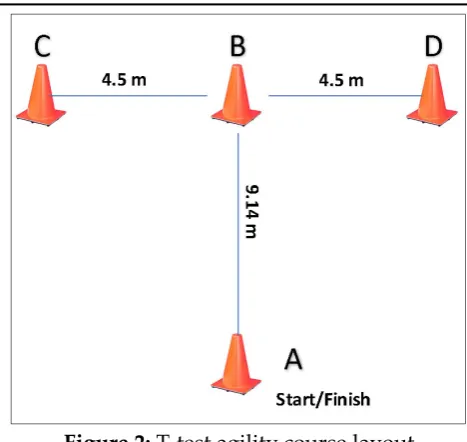
The T-Test is one of the most common tests to measure player agility (Paule, 2000). The T-Test measures four different directional agility parameters such as front, back, and lateral movements as well as incorporating side shuffles to the right and left as well as a forward sprint, and back peddling movements. For the purpose of this study agility, testing was completed on the gymnasium hard wood floors. Four cones were set up in
Figure 2: T-test agility course layout
To begin the test, the athlete began at Cone “A”. From Cone “A”, the athlete sprinted forward to Cone “B”. From Cone “B” the athlete side shuffled to the left to
Cone “C” covering a distance of 4.57 m. From Cone “C”, the athlete side shuffled to the
right 9.14 m to Cone “D”. From Cone “D”, the athlete side shuffled to the left to Cone
“B”. From Cone “B” the athlete back pedaled through Cone “A”. The time from start to
finish was recorded by a hand-held stop watch (Paule, 2000). Each athlete completed the test three times with two minutes of rest between trials. The best of three trials was used for subsequent analysis. It has been documented that the T-Test has a very high intraclass reliability coefficient of r=0.98 across three trials (Paule, 2000).
2.7 Speed Test
A valid assessment of speed is a timed short distance sprint typically repeated three times, with the best time used (Impellizzeri, 2008). For the purpose of this study an 18.3 m sprint was used as it is equivalent to 60 feet, the distance from home plate to first
base. Athletes began at cone “A” and sprinted 18.3 m forward through Cone “B” where
their time was recorded by a hand-held stop watch. Each athlete completed three trails with two minutes of rest between trials. The best of three trials was used for subsequent analysis. In team sports players often have to repeat sequences of short, explosive efforts, such as sprints, often times with changes in direction (Buchheit, 2010). Repeated sprint ability has been shown to be associated to actual match performance and competitive level of play (Impellizzeri, Rampinini, & Castagna 2008). The National Strength and Conditioning Association considers short sprints as a reliable assessment of maximal running speed (Haff & Triplett, 2016).
2.8 Statistical Analysis
The preseason variables in this study were strength, speed, and agility, measured by 1RM BP, 1RM SQ, the T-Test, and the 18.3 m sprint. The post season variable was the
correlation coefficients (PCC or r) with significance achieved at α≤0.05. PCC’s greater
than or equal to r≥0.80 and that were significant (p≤0.05) were considered indicative of
predictive validity (Safrit, 1995).
3. Results
There were 15 high school female softball players between the ages of 14 and 18 years that participated in this study. Preseason testing scores were taken and later compared to a postseason PAS completed by the coach. All participants completed the study and their results have been recorded, reported, and analyzed below. Descriptive participant information can be found in Table 1 which summarizes the mean and standard deviations of all participants.
Table 1: Participant descriptive information
N Age
(years)
Height (cms)
Mass (kgs)
15 16.1±1.4 163.1±5.9 64.8±8.6
Participant mean and standard deviations for descriptive information.
Table 2: Participant Test Scores
PAS BS
(kgs)
BP (kgs)
18.3 m Sprint (seconds)
T-test (seconds)
N=15 12.3±8.0 46.5±9.5 33.9±9.2 3.8±0.5 11.5±1.7
PCC
w/PAS 1.0 0.26 0.23 -0.54* -0.41
Participant mean and standard deviations for descriptive information. PCC-Pearson Correlation Coefficient (r). BS-back squat. BP-bench press. *significant p<0.05.
Table 2 above provides the PCC’s between the PAS and dependent variables. Of the
four preseason tests the 18.3 m sprint was the only test having a meaningful and significant relationship with PAS (r= -0.54; p=0.04).
4. Discussion
Normative data regarding the test battery scores recorded in the current study for high school softball players was not readily available. However, Haff and Triplett (2016) referenced normative data for collegiate softball players and collegiate female athletes. Although collegiate athletes are typically further developed physically and at a higher skill level than that of high school softball players, the normative data provided a general perspective regarding the test battery scores recorded in the current study. Comparing the assessment scores in the current study to the collegiate softball normative values is as follows: the 1RM BS was 46.5±9.5 kgs (20th percentile) and the
1RM BP was 33.9±9.2 kgs (20th percentile). The T-Test scores were 11.5±1.7 seconds
which is slower than the average of 10.94±0.60 seconds for female collegiate athletes. The 18.3 m sprint scores were 3.8±0.5 seconds which is slower than the average of 20 meter sprint times of 3.38±0.17 seconds for college women soccer players.
Much of the current research involves the preparation of a preseason physical testing battery and its importance but none comparing the results of preseason battery testing to player ability. The current study attempted to fill the aforementioned void in the literature. Research has found that in order for a preseason testing battery to be beneficial to the athlete and coach, tests must incorporate sport-specific movements required during competition (Gutowski & Rosene, 2011). Research by Impellizzeri, Rampinini, and Castagana (2008) examined the reliability of repeated sprint testing and its ability to differentiate training-induced changes across different levels of competition. The results of Impellizzeri et al. (2008) study proved that repeated shuttle-sprint ability was a valid and reliable measure in examining training-induced changes
when working with professional athletes, but wasn’t accurate with amateur athletes
(Impellizzeri, Rampinini, & Castagna 2008). Further, regarding the usefulness of repeated sprint ability to monitor the progression of an athlete, the authors estimated
that improvements of 2.6% have to be detected to attain an “almost certain beneficial”
increase in performance (Imprellizzeri, Rampinini, & Castagna 2008). Gutowski and Rosene (2011) found that there was a significant correlation between the improvement in one fitness test and improvements in other fitness tests. More specifically, the study found that an improvement in the BP had the greatest influence with respect to improvements in other fitness testing.
concluded that decision accuracy as well as decision time are major components of a
softball player’s offensive as well as defensive game (Gabbett et al., 2007).
Research by Read et al. (2014) aimed to determine physiological requirements of
men’s collegiate basketball so that suitable testing approaches could be identified
allowing coaches to efficiently/optimally assess player ability (Read et al., 2014). It was noted that there is a clear variation in both physical and physiological assessment methods across a range of physical components such as strength, speed, power, endurance, agility, and flexibility previously implemented to assess elite basketball ability. The authors indicated that in order to be successful in basketball at the elite level, a player must possess a number of physical attributes such as muscular power, aerobic power, speed, and agility (Read et al., 2014). Based upon the evidence of these attributes, the researchers developed a testing battery to determine the physical abilities of basketball players. In doing so, they determined that the order of testing, least fatiguing to most fatiguing would ensure optimal testing outcomes. Included in the battery was 1RM BS, 1RM BP, repeated sprint ability, jump ability, and lateral abilities of changes of direction (Read et al., 2014). Consistent with Read et al. (2014) study, the current research methodology of preseason battery testing was structured in the same format with least fatiguing to most fatiguing assessments in order to ensure the most accurate testing outcomes.
Gutowksi and Rosene (2011) aimed to present a preseason testing battery that would accurately assess the physiological and biomechanical strength and conditioning
demands of men’s collegiate lacrosse. They noted that success in the sport would
require the athletes to exert high-intensity, fast-paced, full-contact bouts of exertion integrated with coordination of ball and stick handling. The authors noted that Lacrosse players need to possess a skill set that includes speed, agility, strength, and endurance. For the purpose of their study, the Lacrosse players were assessed for maximal aerobic power, muscular strength, speed and agility across three testing days. Gutowski and Rosene (2011) indicated that the implementation of a testing battery in team programs is essential in that it helps monitor and evaluate not only a single player, but an entire team’s skill and fitness progression. The authors concluded that in order for testing batteries to be useful, they must meet the specific demands that are required by the sport. Each physical assessment chosen for battery testing should explicitly simulate a biomechanical stress that the athlete would encounter in a game (Gutowski & Rosene, 2011), which may prove difficult to simulate. Further, the authors stated that to successfully establish a fitness testing battery, it must take on a balanced approach to meet all the physical demands of the sport (Gutowski & Rosene, 2011). Similarly, the current research methodology also structured the preseason battery testing in a balanced approach attempting to encompass all of the physical demands of softball to
accurately represent or predict the player’s in season performance.
usefulness of video-based perceptual training to determine decision accuracy and decision time. The researchers stated that success in the game of softball was highly dependent on anticipation, decision making skills, the ability to recognize advanced cues, and the ability to recognize patterns to extract relevant and pertinent information from their external environment. Based on their research, they concluded that video-based perceptual training led to improved decision accuracy and decision time (Gabbett et al., 2007). Based on the results of Gabbett et al. (2007) study it would appear that the inclusion of a coordination aspect to the battery tests used in the current study would provide a more accurate prediction of the PAS.
There were three primary limitations to this study. The main limitation was due to the size of an average softball team. As such the sample size in the current study was limited. This scenario exemplifies the challenge related to conducting applied research with intact teams and the associated low participant samples. In addition to the smaller sample size, accounting for the lack of playing time, or inability to compete due to injury were not accounted for and perhaps impacted the results of the study. The second limitation is potential bias from the coach. Although parameters were set in helping guide an overall PAS, eliminating the personal bias of the coach was hard to account for. Specifically in the current study, a confirmation bias of the coach is hard to account for as the coach may or may not have had preexisting beliefs or ideas on how a player should be performing. Finally, a third limitation was the experience of the athletes. Some athletes came into season already conditioned from playing in travel leagues, while others were starting training for the very first time. This could have altered the rankings of the preseason battery testing assessment scores.
4.1 Future Recommendations
Due to availability, only females aged 14-18 years participated in the current study. Research including males and females at the collegiate and professional level may also prove useful as preseason battery testing is often performed at the collegiate and professional level. In addition, with the enhancement of a more sensitive PAS scoring system (meaning that a greater number of performance factors are included such as slugging percentage or quality at bats) more accurate associations between preseason battery testing and in season performance may be identified. Finally, incorporating a coordination assessment component into the battery test itself may prove to be meaningful, as outcome measures such as fielding percentage and batting average are
highly dependent on a player’s ability to anticipate and make decisions (Gabbett et al.,
2007).
4.2 Practical Applications
Based upon the findings of the current study (a moderate relationship between sprint speed and in-season player ability), a heavier focus can be placed upon implementing
speed development to improve the high school softball player’s overall in-season player
designing and implementing a preseason practice, the main focus should be on skills that are demanded of the sport. Although physical conditioning is beneficial to all athletes across all sports, with high school softball in particular, a greater emphasis on sport specific skill development during preseason may prove to enhance in season play to a greater degree than physical conditioning.
References
Beekhuizen, K.S., Davis, M.D., Kolber, M.J., & Cheng, M.S. (2009). Test-retest ability and minimal detectable change of the hexagon agility test. Journal of Strength and Conditioning Research, 23(7), 2167-2171.
Brzycki, M. (1993). Strength testing predicting a one-repetition maximum from repetitions to-fatigue. Journal of Physical Education, Recreation, & Dance, 64(1), 88-90
Buchheit, M., Spencer, M., & Ahmaidi, S. (2010). Reliability, usefulness, and validity of a
repeated sprint and jump ability test. International Journal of Sport Physiology and
Performance, 5(1), 3-17.
Chiwaridzo, M., Ferguson, G.D., & Bouwein, C.M. (2016). A Systematic review protocol investigating tests or physical or physiological qualities and game-specific skills commonly used in rugby and related sports and their psychometric properties.
Systemic Reviews, 5(22), 1-9.
Dillon, P.A., Kempton, T., Ryan, S., Hocking, J., & Coults, A.J. (2017). Interchange rotation factors and player characteristics influence physical and technical
performance in professional Australian Rules football. Journal of Science and
Medicine in Sport, 30(1),1862-1871.
Easton, R., & Evans, H.J. (2009). The validity of submaximal ratings of perceived
exertion to predict one repetition maximum. Journal of Sports Science and Medicine,
1(8), 567-573.
Gabbett, T., Rubinoff, M., Thorburn, L., & Farrow, D. (2007). Testing and training anticipation skills in softball fielders. International Journal of Sports Science & Coaching, 2(1), 15-20.
Guex, K., Daucourt, C., & Borloz, S. (2015). Validity and reliability of maximal-strength assessment of knee flexors and extensors using elastic bands. Journal of Sport Rehabilitation 24(2), 151-155.
Gutowski, A.E., & Rosene, J.M. (2011). Preseason performance testing battery for men’s
lacrosse. Strength and Conditioning Journal, 33(2), 16-22.
Haff, G.G, Triplett, N.T. (2016). Essentials of Strength Training and Conditioning. 4th ed.
Champaign, IL: Human Kinetics; 2016: 295-316
Julio, U.F., Panissa, V.L., Esteves, J.V., Curry, R.L., Agostinho, M.F., & Franchini, E.
(2017). Energy system contributions to simulated judo matches. International
Journal of Sports Psychology & Performance, 12(5), 676-678.
Laios, A., Theodorakis, N., & Gargalianos, D. (2003). The importance of internal and
external motivation factors in physical education and sport. International Journal
of Physical Education, 40(1), 21-26.
McCulloch, P.C., & Bach, B.R. (2007). Injuries in men’s lacrosse. Orthopedics, 30(1), 29-34. Paule, K., Madole, K., Garhammer, J., Lacourse, M., & Rozenek, R. (2000). Reliability and validity of the t-test as a measure of agility, leg power, and leg
speed in college-aged men and women. Journal of Strength and Conditioning
Research, 14(4), 443-450.
Pyne, D.B., Saunders, P.U., Montgomery, P.G., Hewitt, A.J., & Sheehan, K. (2008).
Relationships between repeated sprint-testing, speed, and endurance. Journal of
Strength and Conditioning Research, 22(5), 1633-1637.
Rampnini, E., Bishop, D., Marcora, S.M., Ferrari, B.D., Sassi, R., & Impellizzeri, F.M. (2008). Validity of simple field tests as indicators of match-related physical
performance in top level professional soccer players. International Journal of Sports
Medicine, 28(1), 228-235.
Read, P.J., Hughes, J., Stewart, P., Chavda, S., Bishop, C., Edwards, M., & Turner A.N. (2014). A needs analysis and field-based testing battery for basketball. Strength and Conditioning Journal, 36(3), 13-20.
Ryckman, R.M., & Hamel, J. (1993). Perceived physical ability of differences in the sport participation motives of young athletes. International Journal of Sport Psychology, 24(3), 270-283.
Safrit, M.J., & Wood, T.M., 1995, Introduction to measurement in physical education and exercise (3rd Ed.). St. Louis, MO: Mosby.
Turner, A., Walker, S., Stembridge, M., Coneyworth, P., Reed, G., Birdsey, L., Barter, P., & Moody, J. (2011). A Testing battery for the assessment of fitness in soccer players. Strength and Conditioning Journal, 33(5), 29-39.
Verdijk, L.B., Loon, L.V., Meijer, K., & Savelberg, H.H. (2009). One-repetition maximum strength test represents a valid means to assess leg strength in vivo in humans.
Creative Commons licensing terms