© 2019 by the Serbian Biological Society How to cite this article: Anjum N, Chandra R. Endophytic bacteria of 27 Catharanthus roseus as an alternative source of Vindoline and application
of response surface methodology to enhance its production. Arch Biol Sci. 2019;71(1):27-38
Endophytic bacteria of
Catharanthus roseus
as an alternative source of vindoline and
application of response surface methodology to enhance its production
Nawed Anjum and Ramesh Chandra*
Department of Bio-Engineering, Birla Institute of Technology, Mesra, Ranchi, Jharkhand, India
*Corresponding author: [email protected]
Received: August 2, 2018; Revised: September 19, 2018; Accepted: September 20, 2018; Published online: October 2, 2018
Abstract: The requirement for novel, cost-effective pharmaceutical compounds is growing. We screened endophytic bacteria of Catharanthus roseus for the production of vinca alkaloids. Vindoline-producing endophytic bacteria was identified as
Microbacterium sp. Vindoline was purified and characterized using column chromatography, TLC, HPLC and electrospray ionization mass spectrometry. The subsequent aim of this study was to design a cost-efficient media that can maximize
vin-doline production from Microbacterium sp. Initial optimization of the nutritional requirement and of the process parameters
were carried out by monothetic analysis. Key factors obtained were optimized by the central composite design of response surface methodology. This model was also validated by repeating the experiment under the optimized conditions, which resulted in maximum production of 82 μg/L (predicted response was 76.21 μg/L). Reliability of the experiments was con-firmed by ANOVA analysis, regression coefficient, prediction vs actual chart and a 3D response plot, which determined the fit of the model. This study should serve as a reference point for the use of statistical techniques in bacterial systems for production of bioactive, anticancer compounds by plant endophytes.
Keywords: endophyte; alkaloid; vindoline; monothetic; response surface technology
INTRODUCTION
Endophytes are microorganisms such as bacteria and fungi that spend either all or part of their lifespan inside the healthy tissues of a living plant without causing dis-ease [1,2]. We are familiar with the fact that endophytic microorganisms can be exploited in agriculture, medi-cine and industry as they are promising, less explored and useful sources of novel, natural, bioactive products such as antibacterial, antifungal, antiviral, antitumor, antioxidant, antiinflammatory, immunosuppressive drugs and many related compounds [3,4].
Catharanthus roseus belongs to the family Apocy-naceae and it is an important medicinal plant being a vital source of alkaloids. Itcan be called an important herbal drug because different parts of the plant are used for treating various diseases such as cancer, diabetes, hypertension and menstrual disorders [5]. Widely used alkaloids such as vindoline, vinblastine, vincristine, ajmalicine and serpentine have been isolated from different parts of C. roseus [6]. The terpenoid indole
alkaloids vincristine and vinblastine, derived from the coupling of vindoline and catharanthine monomers, are used in the treatment of Hodgkin’s disease and acute leukemia [7]. Various anticancer drugs, such as those derived from natural products, target microtubules in growing cancerous cells and induce cell death by blocking mitosis at metaphase/anaphase transition. Vincristine has anti-angiogenesis activity, manifesting as disrupted intracellular transport and decreased tumor blood flowviainterference with microtubule formation and mitotic spindle dynamics [8,9]. Vinblastine sup-presses treadmilling and affects the dynamic instability of microtubules by inducing a conformational change in tubulin, forming harmful vinblastine-tubulin spiral oligomers and paracrystals [10].
Since the discovery of the terpenoid indole alkaloids as antitumor drugs in the 1970s, aerial parts of C. roseus
obtain 1 g of these compounds [12]. The second problem is its high price, which ranges from $1 million to $3 million per kg due to the limitations associated with extraction and production protocols [13]. One way to positively meet the demands of the industry is to look for a potential precursor of the anticancer drugs, such as vindoline, in organisms excluding plants. Microorgan-isms have several advantages over plants and animals. Microbes can be easily cultured and maintained, and they can be produced in large-scale fermentation pro-cesses, which make them a possible alternative source of important bioactive metabolites [14]. The endophytic fungi, Talaromyces radicus, Eutypella spp. and Fusarium
isolated from C. roseus have been reported to produce vincristine and vinblastine [6,15,16].
Statistical optimization techniques such as response surface methodology (RSM) are generally used to study responses after simultaneous variation of several factors [17]. The most popular response surface statistical ex-perimental designs are the Box-Behnken design (BBD), central composite design (CCD) and Plackett-Burman design (PBD) [18,19]. The aim of this study was to explore the bacterial endophytes of C. roseus for the production of alkaloids and to optimize the nutritional requirement of isolated endophytes in orderto enhance the production of the desired compound. The optimum nutritional requirements for enhanced vindoline and biomass production, employing economical carbon and nitrogen sources, were determined. Consequently, this article should serve as an innovative reference point in endophytic biology, as it provides information con-cerning the culture condition of Microbacterium sp., providing useful information for the pharmaceutical industry, which is yet to be discussed in the literature. This should aid the drug discovery program since this article is the first report on the production and optimi-zation of media components for vindoline production by endophytic bacteria.
MATERIALS AND METHODS
Chemicals and instrumentation
The nutrient, tryptic soya and Luria Bertani (LB) broths were obtained from Hi-media, Mumbai, India. The solvents used in the study (ethanol, chloroform, ethyl acetate, methanol and ammonia) were obtained from
Merck, Germany. The standard vindoline was obtained from Sigma-Aldrich Co. USA. DNA sequencing was performed using Veriti® 99 well Thermal Cycler (Model No. 9902). Thin-layer chromatography was performed using silica gel plates Merck 60 F254. A Waters (Milford, MA, USA) HPLC was used for chromatographic sepa-ration and peak purification. Electrospray ionization mass spectroscopy (Thermo Fisher Scientific, USA) was performed in order to determine the molecular weight and fragmentation patterns of ions. Optimi-zation studies were performed statically using design expert 10.0 (Stat-Ease Inc., Minneapolis, MN, USA) software. Chemical structure was drawn with Chem Draw software (PerkinElmer, USA).
Isolation and identification of endophytic bacteria
The isolation procedures of endophytic bacteria from different parts of Catharanthus roseus and the character-ization of the isolated endophytic bacteria were discussed and published in our earlier work [4]. Identification of the vindoline-producing endophytic bacteria was performed by culture, morphological and molecular approaches. The bacterium was grown in nutrient agar media to study the culture and morphological characters. Total genomic DNA was extracted, and UV-Vis spectrophotometer was used to determine the concentration by measuring the absorbance at 260 nm. The quality of the DNA was evaluated by 1.2% agarose gel electrophoresis. Isolated DNA was amplified using the Veriti® 99-well thermal cycler (Model No. 9902)
Screening and extraction of vindoline
Preliminary studies on the production of vinca alkaloids were carried out in 3 liquid culture media. Among the media tested, the production of vinca alkaloids was established in significant quantities in one medium. Hence, further studies were carried out for the produc-tion and isolaproduc-tion of the alkaloids using the described medium. Microbacterium sp. isolated from C. roseus
was cultured in 500 mL nutrient broth (NB) medium, pH 7.0. In order to screen the isolates for the produc-tion of various bioactive compounds, shake flasks were inoculated with 50 μL of inoculum and suspension cultures were established at 37°C at 160 rpm in an orbital shaker incubator (REMI CIS 24 BL) for 45 h. After incubation, the culture broth of the bacterium species was centrifuged at 7000 xg for 15 min at 4°C to obtain the cell-free supernatant. The supernatant was collected and used for extraction of the alkaloids. For the extraction process of alkaloids, a recognized methodology involving acid and base extraction has been proposed [20,21]. However, the extraction method was slightly modified from the earlier published work. The pH of the supernatant was adjusted to 2.0 with 0.1 M HCl and extracted with 100 mL of petroleum ether. Two phases were placed in a separating funnel and allowed to stabilize. The petroleum ether layer was removed to eliminate lipophilic molecules. The lower aqueous layer was transferred to a conical flask and treated with 25% ammonium hydroxide to adjust the pH to about 8.5, and an equal volume of ethyl acetate was used for extraction. After extraction, two phases were separated using a separating funnel, and the ethyl acetate layer was dried in a rotatory evaporator and col-lected in 2 mL of methanol to obtain the alkaloid-rich fraction [22]. The alkaloid-rich extract was subjected to phytochemical analysis using Mayer’s and Wagner’s reagents for the detection of alkaloids [23].
Purification of bacterial vindoline
Bacterial vindoline was purified using silica gel column chromatography. The slurry was made using silica gel (60-120 mesh size, length x diameter 50 cm x 2 cm) and chloroform. It was slowly charged into column side walls to avoid cavitation and the bottom valve was opened while charging. The flow rate was fixed per column height and diameter. The chloroform
was eluted up to the level of packing. The methanolic extract, i.e. the alkaloid-rich fraction, was charged at the top of packing. Non-adsorbing cotton was placed immediately to avoid bed disruption. The column was eluted with a gradient of chloroform: methanol.
Thin-layer chromatography (TLC) analysis
The alkaloid-rich extract, column chromatography-purified vindoline and standard vindoline were sub-jected to TLC analysis. TLC was performed according to the method described in [24] on silica gel plates (Merck 60 F254) with minor changes. We modified the ratio of ethyl acetate:methanol:25% ammonia as the solvent system. The TLC chamber was saturated with solvent systems of different polarity and ratios. Forty µL of crude ethyl acetate extract, 20 µl of purified vindoline and 10 µl of standard vindoline were spotted on the TLC plate just 1 cm above the edge of the plate. The TLC plates were dipped in a saturated chamber in such a way that the applied spot remained above the solvent level and the plates were allowed to develop. When the solvent front reached the desired level, the TLC plates were taken out and allowed to air dry. The chromatogram was developed by observing the plates at 254 nm. The retention factor (Rf) value of each band was obtained as the ratio of distance travelled by the solute to that of the solvent front.
High performance liquid chromatography (HPLC) analysis
the mobile phase was water and methanol. A constant flow rate of 1 mL/min was maintained during analysis and detection was performed at 210 nm. The column temperature was maintained at 25oC. The sample
in-jection volume was 20 μL. Vindoline was identified by comparing the UV spectra and retention time of the sample with the reference vindoline.
Electrospray ionization mass spectrometry analysis
The molecular masses and fragmentation patterns of purified and standard vindoline were determined by mass-spectrometric analysis. From accurate mass values, elemental compositions were calculated using Xcalibur 2.0.7. software. Initially, the samples were dissolved in HPLC-grade methanol and filtered using a 13-mm nylon syringe filter of 0.22-µm pore size. The vindoline-rich extract, purified vindoline and the standard vindoline were analyzed using the Linear Ion Trap Mass Spectrometer (Thermo Fisher Scientific, USA) by direct infusion in ESI positive ion mode, with 5 kV capillary voltage. The mass range in the ESI-MS experiments used for the detection of vindoline was 100-500 m/z. Multiple mass spectrometry (MS/MS) studies were performed to obtain the fragmentation pattern of the sample and standard vindoline under the same conditions [25].
Selection of the medium and optimization of parameters
NB, tryptic soya broth and LB broth media were selected based on previous works related to endophytes [26,27]. The growth curves of bacteria were analyzed in the three different media by measuring the absorbance at 600 nm at different time intervals. The optimum growth condition was determined by employing five different temperatures ranges (28oC-45oC), six
differ-ent pH values (5-8), and incubation in an incubator shaker for 45 h at five different rpm values (80-240). The quantity of the constituents of the selected medium, i.e. NB (peptone, yeast extract, beef extract and sodium chloride), was optimized to increase the production of vindoline using one factor. The selected bacterial cultures were inoculated into the respective media and incubated at 33°C in an orbital shaker incubator (REMI CIS 24 BL) at 160 rpm for 45 h, and their respective biomass and vindoline production were quantified
and the one producing the best results was chosen for further optimization. After analyzing the results, we decided to use additional carbon and nitrogen sources to further enhance the bacterial biomass and vindoline production.
Optimization of the medium using various carbon and nitrogen sources using a monofactorial search
Different carbon sources such as dextrose, fructose, galactose, sucrose, lactose, maltose, starch, glycerol and citric acid were used at a concentration of 1% in the basal media. After selecting the best carbon source, its concentration was optimized, and the best concentration was used in the next process. Various nitrogen sources such as glycine, urea, sodium nitrate, potassium nitrate, ammonium nitrate, asparagine, soybean meal and tryptone were used at concentrations containing the same equivalent weight of nitrogen at 0.5% in the medium containing the already optimized carbon source at a concentration of 1%. The cultures were then screened for their respective biomass and vindoline production. The optimized carbon and nitrogen source that produced the best results was selected for further optimization.
Response surface methodology
RSM is an empirical technique that aids in deter-mining the relationships between a group of precise experimental factors and the responses thus obtained according to diverse criteria. To achieve a more realistic model, previous information and an understanding of the process variables under analysis are essential. Based on the result obtained after one-factor-at-a-time-approach, the time, temperature, pH, tryptone and dextrose concentrations were found to be key variables for vindoline production. The central com-posite rotatable design (CCRD) of RSM was employed in the present study involving four different factors. The experimental design was applied after selecting a range of each variable (maximum and the minimum). Each of the parameters was coded at three levels: -1, 0 and +1. For the optimization RSM study, four indepen-dent variables, pH (6.0-7.0), temperature (28-37oC),
experimental design consisted of a total of 25 trials with varying condition. The optimization experiments were done in 100-mL Erlenmeyer flasks on a rotary shaker incubator at the already optimized condition and were quantified using a spectrophotometer.
Statistical analysis
The statistical and graphical analysis of the obtained result was done using Design Expert 10.0 (Stat-Ease Inc., Minneapolis, MN, USA) software. The Microsoft Office data analysis tool pack was used to obtain graphs in which the error bars denote standard errors. Once the experiments were completed, the coefficient of the polynomial was calculated, and Student’s t-test was used to determine the significance of each coefficient [18]. Model terms were selected or rejected on the basis of the Student’s t-value and its significance. To evaluate the optimum yield of vindoline, three-dimensional plots were obtained based on the effect of the levels of four parameters and their interactions. The hump in the 3D plots was used to study the interactions between the parameters and the optimum concentrations of each parameter with respect to the desired response.
RESULTS
Isolation of endophytic bacteria from C. roseus
Nine different endophytic bacteria were isolated and purified from the stem, leaves and roots of C. roseus, as published earlier [4].
Screening, extraction and partial purification of vindoline
A creamy precipitate in Mayer’s reagent and a brown-ish precipitate in Wagner’s reagent were observed in one bacterial extract, which is a positive result for the production of alkaloids from endophytic bacteria. Specific acid-base extraction is required for the recov-ery of alkaloids. The amount of vindoline production was studied during changes in the pH from 2-10. As the pH was increased, the production vindoline was also increased up to pH 8, with a further increase in pH leading to a decreased production of vindoline. Column chromatography was used for the purifica-tion of vindoline. Twelve samples were collected at different time intervals from each of seven different mobile phases ranging from 2:8 to 8:2 ratios of solvent (chloroform:methanol). Vindoline was successfully separated as a pure compound in the third fraction with a 7:3 chloroform:methanol ratio.
Identification of endophytic bacteria
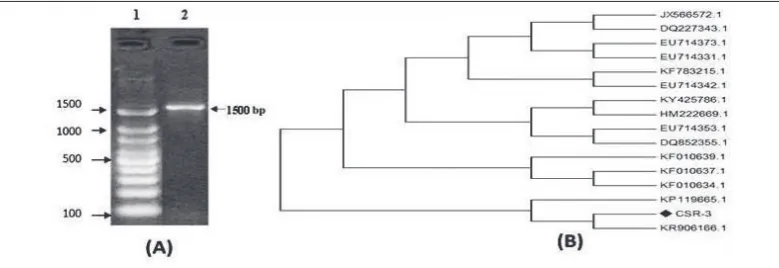
The bacterial strain CSR-3 exhibiting a positive result for the production of vindoline was identified using culture, morphological and molecular approaches. A single band of 1500 bp was observed in agarose gel electrophoresis, as shown in Fig. 1A. The bacterium was assigned to a genus based on a 99-100% similar-ity index. The culture CSR-3 showed similarsimilar-ity with
Microbacterium sp. HBUM178514 based on nucleotide homology and phylogenetic analysis, as shown in Fig. 1B. The evolutionary distances were computed using
the Jukes-Cantor method [28], and are in the units of the number of base substitutions per site. Evolutionary analyses were conducted in MEGA5 [29]. The sequenced nucleotide was submitted to NCBI GenBank database and they provided the GenBank accession number as MF924391.
Thin-layer chromatography (TLC) analysis
A new method for the separation of vindoline in a silica gel TLC plate was developed after op-timizing the mobile phase with a solvent system of ethyl acetate:methanol:ammonia (6:0.3:0.1). Distinct bands were observed when exposed to UV light (254 nm). The result of TLC analysis is presented in Fig. 2.
HPLC analysis
A novel method for HPLC analysis has been developed using a PDA detector to evaluate the peak purity and retention time of the com-pound. The optimum mobile phase composition was achieved using method III, with water and methanol in linear gradient mode and an in-creasing methanol concentration from 20%-80% during 20 min. Fig. 3 depicts the HPLC profile
Fig. 2. TLC analysis. Lane A – standard vindoline with an Rf value of 0.35; lane B – ethyl acetate extract having with an Rf value of 0.36; lane C – puri-fied vindoline with an Rf value of 0.37 with the optimized mobile phase containing ethyl acetate:methanol:ammonia (6:0.3:0.1) as a solvent system.
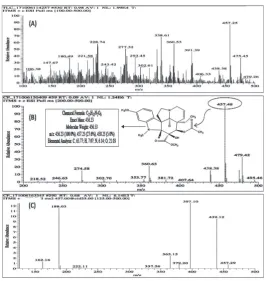
Fig. 3. HPLC analysis. A – Standard vindoline with a single peak at a retention time of 13.17 min. B – Bacterial purified vindoline with a single peak at a retention time of 12.93 min. C – Overall peak of both standard and purified vindoline.
of standard vindoline (Fig. 3A), having a single peak at a retention time of 13.17 min; purified vindoline (Fig. 3B) has a single peak at a retention time of 12.93 min; the overall peak of both standard and purified vindoline is presented in Fig. 3C.
Electrospray ionization mass spectrometry (ESI/MS) analysis
The positive-mode ESI/MS yield of the respective major ions [M+H]+ at m/z 457 was similar to the molecular
weight of vindoline in the bacterial alkaloid-rich extract (Fig. 4A), and to purified vindoline (Fig. 4B) under the conditions described in the experimental section. The MS/MS fragmentation pattern of the purified vindoline also matched exactly with the molecular structure of
vindoline, with ions at m/z 438, 397, 188 and 162, respectively (Fig. 4C).
Selection of medium and optimization of its composition and parameters
The biomass and vindoline quantity produced by
Microbacterium sp. was analyzed in NB, tryptic soya and LB broth media. It was cultured in the 3 media for 45 h, with all other parameters being constant. We found that Microbacterium
sp. spends a maximum of 9 h in lag phase when cultured in the NB medium as compared to 15 and 12 h in the tryptic soya broth medium and LB broth media, respectively. The optimum growth of bacteria was observed in NB medium by measuring the OD at 600 nm at regular in-tervals. After optimization, we observed that 33°C provided the best result but the amount of biomass was maximum at 37°C. Both the amount and yield of vindoline were maximum (29.23 μg/L) at pH 6.5, 33°C and 160 rpm. Af-ter optimizing the components of the selected medium, the yield and quantity of vindoline were maximum in the medium containing 0.3% yeast extract, 0.1% beef extract, 0.4% peptone and 0.6% NaCl, with 32.09 μg/L vindoline and optimum biomass of 2.96 g/L.
Optimization of media using various carbon and nitrogen source employing a monofactorial search
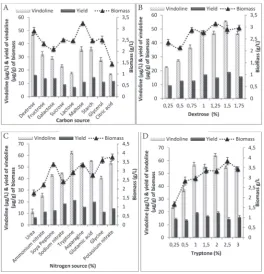
Different carbon sources were screened for enhanced production of vindoline in the cultures, and for their effect on the bacterial biomass. Experiments were performed in triplicates and results are shown as mean±standard error (SE) in Fig. 5(A) and (B); a statistically significant higher biomass was produced by maltose followed by dextrose, while the yield of vindoline was highest in media containing dextrose followed by starch and maltose. Dextrose was chosen as the best carbon source producing around 47 μg/L of vindoline at a biomass of 2.8 g/L. Dextrose was used at a different concentration from 0.25-1.75% and maximum yield of vindoline was found to be 55 µg/L at 1.5% dextrose concentration.
Different nitrogen sources were screened for en-hanced production of vindoline in the culture and their effect on the growth of biomass, with the results presented as the mean±SE in Fig. 5C and D. The sta-tistically significant highest biomass and vindoline were produced by tryptone, followed by glutamic acid, while urea produced the lowest amount of vindoline and biomass. Tryptone was chosen as the optimum nitrogen source, and after further optimization, it was found that 2% tryptone yields an optimum con-centration of vindoline at 65 μg/L and around 3.5 g/L bacterial biomass, as presented in Fig. 6B.
Response surface and statistical analysis for optimizing the yield of vindoline
The use of statistical experimental design methods such as RSM for optimization can reduce process variability, overall cost and enhance product yields [19]. RSM is not yet used for the optimization of media components
Fig. 6. Response surface predicted vs actual plot for optimizing the yield of vindoline. Plots of predicted vs actual concentrations of vindoline (μg/L) produced from Microbacterium sp. The pre-dicted value is in reasonable agreement with the actual value of vindoline, which indicates that the model is in good agreement with the predicted and actual responses.
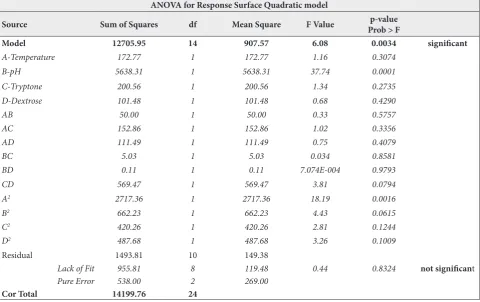
Table 1. Analysis of variance (ANOVA) for the response surface quadratic model. The current model with an F-value of 6.08 suggests the model was statistically significant. The values of Prob>F fewer than 0.05 specifies that the model terms are significant. The Lack of Fit F-value of 0.44 implies the lack of fit is not significant relative to the pure error.
ANOVA for Response Surface Quadratic model
Source Sum of Squares df Mean Square F Value Prob > Fp-value
Model 12705.95 14 907.57 6.08 0.0034 significant
A-Temperature 172.77 1 172.77 1.16 0.3074
B-pH 5638.31 1 5638.31 37.74 0.0001
C-Tryptone 200.56 1 200.56 1.34 0.2735
D-Dextrose 101.48 1 101.48 0.68 0.4290
AB 50.00 1 50.00 0.33 0.5757
AC 152.86 1 152.86 1.02 0.3356
AD 111.49 1 111.49 0.75 0.4079
BC 5.03 1 5.03 0.034 0.8581
BD 0.11 1 0.11 7.074E-004 0.9793
CD 569.47 1 569.47 3.81 0.0794
A2 2717.36 1 2717.36 18.19 0.0016
B2 662.23 1 662.23 4.43 0.0615
C2 420.26 1 420.26 2.81 0.1244
D2 487.68 1 487.68 3.26 0.1009
Residual 1493.81 10 149.38
Lack of Fit 955.81 8 119.48 0.44 0.8324 not significant
Pure Error 538.00 2 269.00
Cor Total 14199.76 24
for vindoline production by endophytes. Analysis of variance (ANOVA) helped us to study the statistical significance of the quadratic model and as per the qua-dratic model, the mean value of vindoline was found to be 38.36 μg/L, having a standard deviation of 12.22. The statistical significance of the model was checked by the F-test and ANOVA of the response (Table 1). The current model, with an F-value of 6.08, suggests that the model and the regression were statistically significant. There is only a 0.34% possibility that an F-value this large could arise due to noise. The F-values of “Prob>F” less than 0.05 specifies that the model terms are significant. The “Lack of Fit F-value” of 0.44 implies that the lack of fit is not significant relative to the pure error. A non-significant lack of fit is desirable; hence we consider the model to be fit. The acceptability of the model was also checked by the determination of the regression coefficient. In this work, the value of the Rsquare 0.8948 specified that only 0.10% of the entire variable was not described by the model. The value of adjusted R2 and predicted R2 is also high to support a
high significance of the model. The difference between the value of Adj R-square (0.7475) and pred R-Square (0.5515) is less than 0.2. This also revealed that the predicted R2 of 0.7475 is in reasonable agreement with
the adjusted R2 of 0.5515 and indicates a good accuracy
and credibility of the experiments [18]. The actual and predicted yields of vindoline by the model equation obtained in the experiments are given in Fig. 6.
Response surface plot and interaction among nutrient
To evaluate the relationship between the test variables and response, the fitted polynomial equation was separately expressed as 3D-response surfaces curves. The response surface plot provides an easy and con-venient way to represent the effect of the significant variables, their interaction in the response variable and their optimum levels. The variations in the yields of vindoline from the response surface as a function of varying factors, the temperature, pH, dextrose and tryptone concentrations (obtained through analysis of variance) are shown in Fig. 7A-D. From the response surface plot, it can be seen that both high pH and temperature adversely affected vindoline yield, sug-gesting that a pH around 6.5 and temperature of 33°C are required to produce vindoline at an optimum level. The yield of vindoline is optimum at the intermediate
concentration of tryptone and temperature, as per the experimental design. It is understood that that the yield of vindoline is lower at low temperature and low dextrose concentration, and that after increasing the concentration of dextrose from 1% to 1.5% and the temperature from 28 to 33°C, the vindoline yield increases from 40 to 65 μg/L. It was also observed that when increasing the concentration of dextrose while at the same time decreasing the concentration of tryptone, the yield of vindoline decreases. Hence, we can say that dextrose at a concentration of 1.5% and tryptone at a concentration of 2% are the required quantities for the production of 82 μg/L vindoline by
Microbacterium sp.
DISCUSSION
Every bacterium has its own requirements, and its growth curve depends on both the physical and chemi-cal nature of its surroundings. For working with
phytic bacteria, complex media having high amounts of undefined nutrients are usually chosen over a defined medium having significantly fixed amounts of nutrients [30]. Eevers et al. [31] used tryptic soy agar medium for growing endophytic bacteria and optimization of the isolation process. Gupta et al. [32] also used nutrient agar media and successfully isolated Bacillus subtilis
and Stenotrophomonas maltophilia from the root and leaves of Prosopis cineraria. Kumar et al. [33] used eight different media to optimize vinca alkaloid produc-tion from Fusarium solani isolated from C. roseus. In another study, vinca medium-1 was optimized for the production of vinblastine and vincristine, respectively, from an endophytic fungus Fusarium oxysporum
isolated from C. roseus [15]. Although the selection of an appropriate growth medium is crucial for the isolation and maintenance of endophytes, a compara-tive study of different nutrient media types needs to be performed. The complex media that were selected for the present study contained tryptone, soytone, beef extract, yeast extract and NaCl. The media used for the growth of endophytes provided a rich environment, albeit one that was very dissimilar to the atmosphere inside the plant. There are reports on the isolation of fungal endophytes from C. roseus but there are only a few reports on the isolation of endophytic bacteria and optimization of the components of nutrient agar medium. Yeast extract has been reported as biotic elicitor; it has been recognized as a signaling element in enriching indole alkaloids in various protoplast-derived tissues and plantlets of C. roseus [34]. But yeast extract is mainly known to provide carbon and nitrogen to the bacteria, and such elicitation activities for the production of useful secondary metabolites has not been studied yet in endophytes.
There is no such work on the production of vin-doline from bacterial endophytes. Vinvin-doline content was enhanced by 229-403% when Curvularia sp. and
Choanephora infundibulifera were inoculated into healthy non-infected, endophyte-free plants of C. roseus. In endophyte-inoculated plants of C. roseus
the expression of the terpenoid indole alkaloid (TIA)-pathway genes was upregulated [35]. The endophytic fungus T. radicus is reported to produce vinblastine and vincristine, and its production has been optimized in nine different liquid media [6]. In earlier studies, statistical optimization techniques have been suc-cessfully used in the optimization of media for vinca
alkaloid production from endophytes, such as the optimized production of vinblastine (70 μg/L) and vincristine (670 μg/L) by T. radicus isolated from C. roseus [6]. An endophytic fungus Fusarium oxysporum
isolated from C. roseus was also reported to produce vinblastine (76 µg/L) and vincristine (67 µg/L) after optimization [15].
Phytochemical analysis is generally carried out in the extracts of plants but very few reports are available on endophytes. In a study of endophytes, phytochemical analysis of ethyl acetate extracts of C. gloeosporioides
isolated from Plumeria acuminata showed the presence of alkaloids [23]. Alkaloids have also been detected in endophytes isolated from Salvadora oleoides, Ta-bebuia argentea, Pinus roxburghii and Urospermum picroides by phytochemical analysis [36]. Verma et al. [37] studied vinblastine and catharanthine yields as a function of pH and similar results were obtained, which is to be expected because vindoline, vinblastine and catharanthine have a similar nature as they belong to the group of terpenoid indole alkaloids. In earlier studies, HPLC analysis of the secondary metabolite profiles of C. roseus gave a similar result in which the retention time of vindoline was found to be 13.5 min. The mobile phase used was a mixture of phosphate buffer and acetonitrile with a linear gradient solvent system from 80:20 (v/v) to 20:80 (v/v) in 20 min [38]. In another study, the retention time of vindoline was found to be 13.22 min after optimization of the mo-bile phase of acetonitrile and 0.1 M phosphate buffer containing 0.5% glacial acetic acid, 21:79 (v/v) [39]. Kumar et al. [33] also used TLC and ESI/MS to con-firm the production of vincristine and vinblastine by an endophytic fungus Fusarium solani isolated from
C. roseus.
The cost of growth media accounts for 25-35% of the total cost of metabolite production, hence the concentrations of factors such as carbon and nitrogen sources is of prime importance, as is the case here when information on the growth requirements of an important strain are lacking. After selecting a suitable medium for the optimum production of vindoline by
with different additional carbon and nitrogen sources using a “one-factor-at-a-time-approach”. Although the “one-factor-at-a-time approach” is frequently used for optimization studies, it is unsuitable for multifactor optimization and it also neglects the complex interac-tion among various parameters used in the study. The inadequacy of the “one-factor-at-a-time” method can be overcome by using a potent and suitable statistical experimental design tool such as RSM, which can reduce the process unevenness and explain the inter-actions between the different variables [40].
We believe that this study will serve as a reference point for the use of the statistical techniques in bacterial systems and vital research in this area. Also, it should offer researchers flexibility for selecting improved conditions, such as optimum carbon and nitrogen sources, pH, rpm and temperature. The production of vindoline by Microbacterium sp. was detected by TLC, HPLC and ESI/MS. The current work provides evidence that the information about themolecular mass of a compound can be obtained by direct-injection ESI-MS and MS/MS fragmentation patterns, which provide specific structural information for its iden-tification. Secondly, the use of the response surface methodology for media optimization successfully increased vindoline production from 29 μg to 82 μg per L of bacterial culture and also assisted in the iden-tification of the most significant and optimal nutrient levels. In order to authenticate the suitability of the model equations, experiments were repeated twice at the predicted optimum conditions. The mean values of the predicted responses and the experimental data displayed a worthy correlation between the predicted and experimental yield of vindoline, specifying a good fit of the model. The reliability of the experiments is supported by the ANOVA table, regression coefficient, and response surface 3D plot, which concluded the model could be considered to fit.
Funding: We gratefully acknowledge the university grants commis-sion (Maulana Azad National Fellowship) India for the financial support to the first author (Nawed Anjum).
Acknowledgments: The authors are sincerely grateful to the Department of Bioengineering, Central Instrumentation Facil-ity – BIT, Mesra, Ranchi for providing the laboratory facilities. Author contributions: RC provided the intellectual input, research designs and approved the protocols for the current research work.
NA is the research scholar who performed the research. RC and NA both participated in the analysis and interpretation of data, and revision of the final manuscript
Conflict of interest disclosure: The authors have no conflict of interest in the publication of this research article.
REFERENCES
1. Tan RX, Zou WX. Endophytes: a rich source of functional metabolites. Nat Prod Rep. 2001;18(4):448-59.
2. Gunatilaka AL. Natural products from plant-associated microorganisms: distribution, structural diversity, bio-activity, and implications of their occurrence. J Nat Prod. 2006;69(3):509-26.
3. Strobel G, Daisy B. Bioprospecting for microbial endo-phytes and their natural products. Microbiol Mol Biol Rev. 2003;67(4):491-502.
4. Anjum N, Chandra R. Endophytic bacteria: optimization of isolation procedure from various medicinal plants and their preliminary characterization. Asian J Pharm Clin Res. 2015;8:233-8.
5. Hisiger S, Jolicoeur M. Analysis of Catharanthus roseus alka-loids by HPLC. Phytochem Rev. 2007;6(2-3):207-34. 6. Palem PP, Kuriakose GC, Jayabaskaran C. An endophytic
fungus, Talaromyces radicus, isolated from Catharanthus roseus, produces vincristine and vinblastine, which induce apoptotic cell death. PloS One. 2015;10(12):e0144476. 7. Noble RL. The discovery of the vinca
alkaloids—che-motherapeutic agents against cancer. Biochem Cell Biol. 1990;68(12):1344-51.
8. Dumontet C, Jordan MA. Microtubule-binding agents: a dynamic field of cancer therapeutics. Nat Rev Drug Discov. 2010;9(10):790.
9. Fanale D, Bronte G, Passiglia F, Calo V, Castiglia M, Di Piazza F, Barraco N, Cangemi A, Catarella MT, Insalaco L, Listi A. Stabilizing versus destabilizing the microtubules: a double-edge sword for an effective cancer treatment option?. Anal Cell Pathol. 2015;2015.
10. Jordan MA. Mechanism of action of antitumor drugs that interact with microtubules and tubulin. Curr Med Chem Anticancer Agents. 2002;2(1):1-7.
11. O’Keefe BR, Mahady GB, Gills JJ, Beecher CW, Schilling AB. Stable vindoline production in transformed cell cultures of
Catharanthus roseus. J Nat Prod. 1997;60(3):261-4. 12. Barrales-Cureño HJ. Pharmacological applications and in
vitro biotechnological production of anticancer alkaloids of Catharanthus roseus. Biotecnol Apl. 2015;32(1):1101-10. 13. Verpoorte R, Van Der Heijden R, Schripsema J, Hoge JH,
Ten Hoopen HJ. Plant cell biotechnology for the produc-tion of alkaloids: present status and prospects. J Nat Prod. 1993;56(2):186-207.
14. Anjum N, Pandey VK, Chandra Anjum R. Exploitation of endophytic fungus as a potential source of biofuel. Carbon-Sci Tech. 2016;8:255-562.
vincris-tine from endophytic fungus Fusarium oxysporum isolated from Catharanthus roseus. PloS One. 2013;16;8(9):e71805. 16. Kuriakose GC, Palem PP, Jayabaskaran C. Fungal
vincris-tine from Eutypella spp-CrP14 isolated from Catharanthus roseus induces apoptosis in human squamous carcinoma cell line-A431. BMC Complement Altern Med. 2016;16(1):302. 17. Li P, Xu L, Mou Y, Shan T, Mao Z, Lu S, Peng Y, Zhou L.
Medium optimization for exopolysaccharide production in liquid culture of endophytic fungus Berkleasmium sp. Dzf12. Int J Mol Sci. 2012;13(9):11411-26.
18. Maddox IS, Richert SH. Use of response surface methodol-ogy for the rapid optimization of microbiological media. J Appl Bacteriol. 1977;43(2):197-204.
19. Kanmani P, Karthik S, Aravind J, Kumaresan K. The use of response surface methodology as a statistical tool for media optimization in lipase production from the dairy effluent isolate Fusarium solani. ISRN Biotechnol. 2012;22:2013. 20. Shams K, Nazif N, Azim N, Shafeek K, Missiry M, Ismail
S, Nasr M. Isolation and characterization of antineoplastic alkaloids from Catharanthus roseus l. Don. cultivated in Egypt. Afr J Tradit Complement Altern Med. 2009;6(2). 21. Aslam J, Mujib A, Sharma MP. Influence of freezing and
non-freezing temperature on somatic embryogenesis and vinblastine production in Catharanthus roseus (L.) G. Don. Acta Physiol Plant. 2011;33(2):473-80.
22. Chandrasekaran N, Vanitha M, Kaavyalakshmi M. Extrac-tion of vindoline from Catharanthus roseus and instrumental model of automatic column chromatography by using PLC. Int J Chemtech Res. 2014;6(9):4216-24.
23. Ramesha A, Srinivas C. Antimicrobial activity and phyto-chemical analysis of crude extracts of endophytic fungi iso-lated from Plumeria acuminata L. and Plumeria obtusifolia
L. Eur J Exp Biol. 2014;4(2):35-43.
24. Magagula NL, Mohanlall V, Odhav B. Optimized thin layer chromatographic method for screening pharmaceutically valuable alkaloids of Catharanthus roseus (Madagascar Peri-winkle). I J Sciences. 2012;1:1-20.
25. Zhou H, Tai Y, Sun C, Pan Y. Rapid identification of vinca alkaloids by direct‐injection electrospray ionisation tandem mass spectrometry and confirmation by high‐performance liquid chromatography–mass spectrometry. Phytochem Anal. 2005;6(5):328-33.
26. Zinniel DK, Lambrecht P, Harris NB, Feng Z, Kuczmarski D, Higley P, Ishimaru CA, Arunakumari A, Barletta RG, Vidaver AK. Isolation and characterization of endophytic colonizing bacteria from agronomic crops and prairie plants. Appl Environ Microbiol. 2002;68(5):2198-208.
27. Muzzamal H, Sarwar R, Sajid I, Hasnain S. Isolation, iden-tification and screening of endophytic bacteria antagonistic to biofilm formers. Pak J Zool. 2012;44(1).
28. Kimura M. A simple method for estimating evolutionary rates of base substitutions through comparative studies of nucleotide sequences. J Mol Evol. 1980;16(2):111-20.
29. Tamura K, Peterson D, Peterson N, Stecher G, Nei M, Kumar S. MEGA5: molecular evolutionary genetics analysis using maximum likelihood, evolutionary distance, and maximum parsimony methods. Mol Biol Evol. 2011;28(10):2731-9. 30. Hottes AK, Meewan M, Yang D, Arana N, Romero P,
McAd-ams HH, Stephens C. Transcriptional profiling of Caulo-bacter crescentus during growth on complex and minimal media. J Bacteriol. 2004;186(5):1448-61.
31. Eevers N, Gielen M, Sánchez‐López A, Jaspers S, White JC, Vangronsveld J, Weyens N. Optimization of isolation and cultivation of bacterial endophytes through addition of plant extract to nutrient media. Microb Biotechnol. 2015;8(4):707-15.
32. Gupta RM, Kale PS, Rathi ML. Isolation, characterization and identification of endophytic bacteria by 16S rRNA par-tial sequencing technique from roots and leaves of Prosopis cineraria plant. Asian J Plant Sci Res. 2015;5(6):36-43. 33. Kumar A, Abnave P, Ahmad A. Cultural, morphological
and molecular characterization of vinca alkaloids producing endophytic fungus Fusarium solani isolated from Catharan-thus roseus. Int J Bot Res. 2013;3(2):2277-4815.
34. Maqsood M, Abdul M. Yeast extract elicitation increases vinblastine and vincristine yield in protoplast derived tissues and plantlets in Catharanthus roseus. Rev Bras Farmacogn. 2017;27(5):549-56.
35. Pandey SS, Singh S, Babu CV, Shanker K, Srivastava NK, Shukla AK, Kalra A. Fungal endophytes of Catharanthus roseus enhance vindoline content by modulating structural and regulatory genes related to terpenoid indole alkaloid biosynthesis. Sci Rep. 2016;6:26583.
36. Li E, Jiang L, Guo L, Zhang H, Che Y. Pestalachlorides A–C, antifungal metabolites from the plant endophytic fungus
Pestalotiopsis adusta. Bioorg Med Chem. 2008;16(17):7894-9. 37. Verma A, Laakso I, Seppänen-Laakso T, Huhtikangas A,
Riekkola ML. A simplified procedure for indole alkaloid extraction from Catharanthus roseus combined with a semi-synthetic production process for vinblastine. Molecules. 2007;12:1307-15.
38. Renault JH, Nuzillard JM, Le Crouérour G, Thepenier P, Zeches-Hanrot M, Le Men-Olivier L. Isolation of indole alkaloids from Catharanthus roseus by centrifugal partition chromatography in the pH-zone refining mode. J Chro-matogr A. 1999;849(2):421-31.
39. Gupta MM, Singh DV, Tripathi AK, Pandey R, Verma RK, Singh S, Shasany AK, Khanuja SP. Simultaneous determina-tion of vincristine, vinblastine, catharanthine, and vindoline in leaves of Catharanthus roseus by high-performance liquid chromatography. J Chromatogr Sci. 2005;43(9):450-3. 40. Mu W, Chen C, Li X, Zhang T, Jiang B. Optimization of