Volume 40 (2011)
Proceedings of the
4th International Workshop on Petri Nets and Graph
Transformation
(PNGT 2010)
Formalization of Petri Nets with Individual Tokens
as Basis for DPO Net Transformations
Tony Modica, Karsten Gabriel, Kathrin Hoffmann
21 pages
Guest Editors: Claudia Ermel, Kathrin Hoffmann
Managing Editors: Tiziana Margaria, Julia Padberg, Gabriele Taentzer
Formalization of Petri Nets with Individual Tokens
as Basis for DPO Net Transformations
Tony Modica1, Karsten Gabriel2, Kathrin Hoffmann3∗
Integrated Graduate Program Human-Centric Communication (H-C3), Technische Universit¨at Berlin, Germany
Fraunhofer Institute for Open Communication Systems (FOKUS), Berlin, Germany
Hochschule f¨ur Angewandte Wissenschaften, Hamburg, Germany
Abstract: Reconfigurable place/transition systems are Petri nets with initial mark-ings and a set of rules which allow the modification of the net structure during run-time. They have been successfully used in different areas like mobile ad-hoc net-works. In most of these applications the modification of net markings during runtime is an important issue. This requires the analysis of the interaction between firing and rule-based modification. For place/transition systems this analysis has been started explicitly without using the general theory ofM-adhesive transformation systems, because firing cannot be expressed by rule-based transformations for P/T systems in this framework. This problem is solved in this paper using the new approach of P/T nets with individual tokens. In our main results we show that on one hand this new approach allows to express firing by transformation via suitable transition rules. On the other hand transformations of P/T nets with individual tokens can be shown to be an instance ofM-adhesive transformation systems, such that several well-known results, like the local Church-Rosser theorem, can be applied. This avoids a sepa-rate conflict analysis of token firing and transformations. Moreover, we compare the behavior of P/T nets with individual tokens with that of classical P/T nets. Our new approach is also motivated and demonstrated by a network scenario modeling a distributed communication system.
Keywords: Petri net transformation, reconfigurable place/transition systems, Petri nets with individual tokens, collective token approach, network scenario
1
Introduction
Petri nets are one of the main formalisms to describe and analyze concurrent processes. They have been a promising candidate for formal extensions on the one hand, but on the other hand
∗ This work has been partly funded by the research project forMA
also for integrations with different formal techniques to capture more complex aspects.
A theory of rule-based transformation based on double pushout (DPO) graph transformation [EEPT06] is available for place/transition (P/T) systems, i. e. P/T nets with an initial marking. This transformation of P/T systems changing their net structure has been successfully used for modeling adaptive workflows and mobile ad-hoc networks in [HME05,BDHM06].
P/T systems have been shown to form a weak adhesive high-level replacement (HLR) category with the class of all marking-strict morphisms [PEHP08]. This allows us to apply all the results for weak adhesive HLR transformation systems concerning the local Church-Rosser theorem, parallelism, and concurrency of transformations as shown in [EEPT06] also to transformation systems of P/T systems. In this paper, we use the notion of M-adhesive category [EGH10] which is short for vertical weak adhesive HLR category. InM-adhesive categories Van Kampen (VK) squares only need to satisfy the vertical VK-property, i. e. the VK-property has to hold for cubes where the vertical morphisms are inM. In contrast, for a weak adhesive HLR categories it is required that the VK-property does also hold for cubes, where the horizontal morphisms are inM. However, as shown in [EGH10] all the main results of [EEPT06] are still valid for M-adhesive categories.
The concept of Petri systems leads to a categoryPTSyswith morphisms allowing to increase the number of tokens on corresponding places. Unfortunately, (PTSys,Min j) with the class
Min jof all injective morphisms is notM-adhesive in contrast to(PTSys,Mstrict), whereMstrict
is the class of injective morphisms where the number of tokens on corresponding places is equal [Pra08]. Using marking-strict morphisms, we can not formulate adequate transformation rules for P/T systems that change markings. This is inconvenient because marking-changing rules are essential to express token firing by transformation via suitable transition rules and for modeling communication systems and platforms with Petri nets, especially for realizing multicasting of data tokens in high-level nets [BEE+09].
To overcome this restriction, we present a new Petri net formalism, called “place/transition nets with individual tokens” or short PTI nets, together with a rule-based transformation ap-proach. The difference between PTI nets and P/T systems concerns the representation of net markings: for the new individual approach, we propose a net’s marking as a set of individuals instead of a (collective) sum of a monoid. The formal definition of nets with individual tokens still follows the concept “Petri nets are monoids” from [MM90].
The paper is structured as follows: Section 2introduces PTI nets, their firing behavior, and rule-based transformation of PTI nets based on graph transformation with double pushouts. We demonstrate that the new concept of P/T nets with individual tokens is compatible with the con-cept of P/T systems using a construction that maps PTI nets to corresponding P/T systems. For this purpose we define an equivalence relation on the class of PTI nets, such that the equiva-lence classes are in one-to-one correspondence to the P/T systems. Moreover, we show that the construction preserves and reflects the firing behavior. As a running example, we demonstrate a simple network model that can be reconfigured by rule applications that add new clients to the network.
givenM-adhesive category of PTI nets. Then, we demonstrate the equivalence of firing steps with corresponding transition firing rules. The second main result shows that token firing can be expressed by rule-based transformation based on suitable transition rules, leading to a local Church-Rosser theorem for rule applications and firing steps.
In the concludingSection 4, we give an outlook on algebraic high-level nets with individual tokens for modeling especially highly dynamic structures and complex behavior in the area of communication platforms in an adequate way.
2
P/T Nets with Individual Tokens
In this section we introduce our new concept of P/T nets with individual tokens (PTI nets) and compare it to the classical concept of P/T systems with initial markings. Furthermore, we define a rule-based transformation of PTI nets in the sense of rule-based graph transformation [EEPT06]. As an example, we demonstrate a simple model of a distributed reconfigurable network.
2.1 P/T Nets with Individual Tokens and their Relationship to P/T Systems
The notion of nets with individual tokens was mentioned first in [Rei85] where it was used to describe “tokens that can be identified as individual objects”. The main contribution of that article was the definition of markings as multisets of distinguished elements rather than amounts of indistinguishable black tokens. In the end, individual tokens in that context is a synonym for what by now is known as data tokens in high-level nets.
Further, there is the notion of token individuality that has been coined in [GP95] as “individual token interpretation” of firing steps, which entitles the definition of processes from [GR83]. Un-der the individual approach, firing sequences consiUn-der not only the number and value of tokens (as in the collective approach) but also their history of tokens. In [vG05], the author investi-gates the collective/individual dichotomy of firing steps and the expressive power of the different firing rules w. r. t. labeled transition step systems. [BMMS99] formalizes the individual token interpretation of firing steps categorically with a functorial individual firing semantics.
We try to combine aspects of both approaches dealing with individual tokens. On the one hand, we need a concept of individual tokens on the syntactical level of Petri systems like in [Rei85] in order to gain benefits for the transformation of marked Petri nets. With such individual tokens, rules can match specific tokens which allows us to formulate rules for manipulating markings freely without necessarily changing the net’s structure as in the categoryPTSysof P/T systems, i. e. P/T nets with collective markings (cf. [EHP+07]). On the other hand, we need individual “black” tokens like in [GP95] without presuming different data values for the tokens, because we also want to have low-level Petri nets with individual tokens.
For this purpose, we introduce the new notion of place/transition nets with individual tokens (PTI nets), their firing behavior, and application of PTI transformation rules.
Definition 1(Place/Transition Nets with Individual Tokens (PTI)) We define a marked P/T net with individual tokens, short PTI net, asNI= (PN,I,m), where
monoid overP,
• Iis the finite set of individual tokens ofNI, and
• m:I→Pis the marking function, assigning the individual tokens to the places.
Further, we denote the environment of a transitiont∈T as
ENV(t) ={p∈P|pre(t)(p)6=0∨post(t)(p)6=0} ⊆P
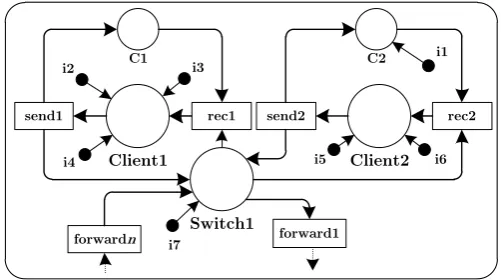
Example1 (Place/Transition Nets with Individual Tokens) Figure 1shows an example of a PTI net modeling a simple network which consists of several clients. These clients can communicate with each other only indirectly via switches by sending or receiving data packages represented by black tokens. If a client wants to send data to another client which is connected to a different switch then it first has to send the data to the switch to which it is connected. The switch can then forward the data to the respective other switch which sends the data to the addressee. Each client Clientxhas a complement place Cxwhich represents the free data capacity of this client. The net has a marking of individual tokensI={i1, . . . ,i7}. The individual tokens are mapped to the corresponding places by a marking functionmwithm(i1) =C2, m(i2) =m(i3) =m(i4) =
Client1,m(i5) =m(i6) =Client2andm(i7) =Switch1.
Client1 Client2
send1 rec1 send2 rec2
Switch1
C1 C2 i1
i5 i6
i7
i2 i3
i4
forward1 forwardn
Figure 1: PTI net(SimpleNetwork,I,m)
Every P/T net with individual tokens corresponds to a P/T system in the collective approach as defined in [EHP+07]. The following constructionCollflattens a PTI net to a P/T system with collective marking by forgetting the individuality of token elements.
Definition 2(Collective Construction for PTI Nets) Given a PTI netNI= (PN,I,m), we define
Coll(NI) = (PN,µ)whereµ=∑i∈Im(i)∈PPN⊕.
Note that we can denote the collective marking alternatively as the sum with explicit coeffi-cientsµ=∑p∈PPN|m
−1(p)| ·p.
we show that for every collective P/T system there is at least one corresponding PTI net. This allows us to show that our individual approach and the collective approach are compatible with each other, in the sense that the classPTSys of all P/T systems corresponds bijectively to the quotientPTINets/≈ where all equivalent PTI nets are identified.
Definition 3 (Equivalence of PTI Nets) We call two PTI nets NI = (PN,I,m) and NI0 = (PN0,I0,m0) equivalent and write NI ≈NI0, if PN=PN0 and there exists a bijective function
f:I→I0withm0◦f=m.
Note that because bijective functions are closed under composition and inversion, ≈ is an equivalence relation.
Lemma 1(Collective Equality and Equivalence) For any two PTI nets NI = (PN,I,m) and NI0= (PN0,I0,m0)hold the equivalence
Coll(NI) =Coll(NI0)⇔NI≈NI0
Proof. We assumeColl(NI) = (PN,µ),Coll(NI0) = (PN0,µ0), and thatPis the set of places of PN(and also ofPN’).
“⇒”: FromColl(NI) =Coll(NI0) we getPN=PN0 and∑i∈Im(i) =µ =µ0=∑i∈I0m0(i). We
construct a bijection f:I→I0compatible withmandm0.
Choose for each placep∈Pan arbitrary bijection fp:m−1(p)→m0−1(p)between the subsets
of tokens of I and I0 that are mapped to p by m and m0, respectively. Such bijections exist because from theµ=µ0we get by the equality of their coefficients for allp∈Pthat|m−1(p)|=
|m0−1(p)|. Consider the function f:I →I0 with f(x) = fp(x) forx∈m−1(p), which is
well-defined becauseI=S
p∈Pm−1(p),I0= S
p∈Pm0−1(p)and the preimage subsets ofmandm0 are
disjoint. Moreover, f is bijective and for all p∈P and all x∈m−1(p) we have m0◦f(x) =
m0(fp(x)) =p=m(x)from which we concludeNI≈NI0.
“⇐”: FromNI ≈NI0, we getPN=PN0 and bijective f: I→I0 withm0◦f =m. We have to show thatµ =µ0:
µ =
∑
i∈I
m(i) =
∑
i∈I
m0◦f(i) =
∑
p∈P
|(m0◦f)−1(p)| ·pf=bij.
∑
p∈P
|m0−1(p)| ·p=
∑
i∈I0
m0(i) =µ0.
Lemma 2(Collis surjective) For every P/T system(PN,µ), there is a PTI net NI with Coll(NI) =
(PN,µ).
Proof. LetPbe the set of places ofPN. For µ=∑p∈Pλp·p, consider for each p∈Pa setIp
ofλpelements with allIpbeing mutually disjoint. We chooseNI= (PN,I,m)withI= S
p∈PIp
and m: I → P with m(x) = p for x∈Ip. Hence, Coll(NI) = (PN,µˆ) with ˆµ =∑i∈Im(i) = ∑p∈P∑i∈Ipm(i) =∑p∈Pλp·p=µ.
Theorem 1 The quotient PTINets/≈ of the class of all PTI nets by their equivalence relation
PTINets
n &&
Coll //
PTSys
PTINets/≈
i
9
9
Proof. Consider the functioni:PTINets/≈→PTSyswithi([NI]≈) =Coll(NI). Note thati◦n=
Coll, wherenis the natural function mapping a PTI net to its equivalence class. ByLemma 1, we get thatiis well-defined and injective because all PTI nets in the same equivalence class have the same collective construction to which only elements of this particular equivalence class are mapped byCollandi, respectively. ByLemma 2,iis also surjective and hence bijective.
2.2 Firing of P/T Nets with Individual Tokens
Now, we define firing steps of transitions in PTI nets. Due to the fact that the tokens have identities, we have to consider a possible firing step in the context of a specific selection of tokens because there may be several valid firing steps for a transition under a particular marking.
Definition 4 (Firing of PTI Nets) A transitiont ∈T in a PTI net NI = (P,T,pre,post,I,m) is
enabledunder atoken selection(M,m,N,n), where • M⊆I,mis the token mapping ofNI,
• Nis a set with(I\M)∩N=/0,n:N→Pis a function,
if it meets thetoken selection condition ∑ i∈M
m(i) =pre(t)∧ ∑
i∈N
n(i) =post(t)
If an enabled transitiontfires, the follower marking(I0,m0)is given by
I0= (I\M)∪N, m0:I0→Pwithm0(x) =
(
m(x), x∈I\M n(x), x∈N
leading toNI0= (P,T,pre,post,I0,m0)as the new PTI net in thefiring step NIi−t−,→S NI0 viaS=
(M,m,N,n).
Remark 1 (Token Selection) The purpose of the token selection is to specify exactly which tokens should be consumed and produced in the firing step. Thus,M⊆I selects the individual tokens to be consumed, and N contains the set of individual tokens to be produced. Clearly,
(I\M)∩N=/0must hold because it is impossible to add an individual token to a net that already contains this token. mandnrelate the tokens to their carrying places. It would be sufficient to consider just the restrictionm|Mhere or to infer it from the net but as a compromise on symmetry and readability we denotemin the token selection.
Example2 (Firing of PTI Nets) Consider again the PTI net(SimpleNetwork,I,m)inFigure 1. We want to fire the transitionsend2to send one data package fromClient2to the switch. Even though we have only black tokens, we have to choose which of the tokens on the placeClient2
the tokeni6. So we have a token selection S= (M,m,N,n) withM={i6}, m(i6) =Client2,
N={i8,i9},n(i8) =C2andn(i9) =Switch1.
Now,send2is enabled under selectionSbecause there is
m(i6) =Client2=pre(send2) and n(i8)⊕n(i9) =C2⊕Switch1=post(send2)
which means that it meets the token selection condition. Hence, there is a firing step
(SimpleNetwork,I,m)i−send2−−−−,→S (SimpleNetwork,I0,m0)
withI0={i1,i2,i3,i4,i5,i7,i8,i9}and a mappingm0of the individuals to places as derived from
mandn.
We can show that the firing behavior of our individual approach is compatible with the well-known firing behavior of the collective approach since a firing step in one representation implies a firing step in the respective other one.
Theorem 2(Collpreserves and reflects Firing Behavior)
1. Given a PTI net NI with transition t∈TNIenabled under token selection S= (M,m,N,n)with
firing step NI−it−,→S NI0, then t is enabled in Coll(NI)with firing step Coll(NI)−i→t Coll(NI0). 2. Vice versa, given an enabled transition t in Coll(NI)with Coll(NI)−→it (PN0,µ0), there exists a token selection S= (M,m,N,n)such that t is enabled in NI under S with firing step NIi−t−,→S NI0 and Coll(NI0) = (PN0,µ0).
Proof. AssumeNI= (P,T,pre,post,I,m)andColl(NI) = (P,T,pre,post,µ).
1. Transitiontis enabled inColl(NI)underµbecausepre(t)tenabled= ∑i∈Mm(i) M⊆I
≤ ∑i∈Im(i) =µ.
Firing changes just the markings, so we have NI0 = (P,T,pre,post,I0,m0) andColl(NI0) = (P,T,pre,post,µ0). We show thatµ0is the marking resulting from firingtinColl(NI).
µ pre(t)⊕post(t)
=
∑
i∈I
m(i)
∑
i∈M
m(i)⊕
∑
i∈N
n(i) (def.Coll,tenabled inNIunderS)
=
∑
i∈I\M
m(i)⊕
∑
i∈N
n(i) =
∑
i∈(I\M)]N
m0(i) (def.m0as inDefinition 4)
=
∑
i∈I0
m0(i) =µ0 (defs.CollandI0as inDefinition 4)
2. Because transition t is enabled in Coll(NI) and we have pre(t) ≤µ =∑i∈Im(i), we can
choose for each p∈Pa subsetMp⊆m−1(p)such that|Mp|=pre(t)(p). Note thatm(x) =p
forx∈Mp. Similarly, we choose for each p∈Pa setNpsuch that|Np|=post(t)(p)and allNp
being mutually disjoint and disjoint toI\S p∈PMp.
Consider the selectionS= (M,m,N,n)withM=S
p∈PMp,N= S
p∈PNp, and functionn:N→
post. For the firing step NIi−t−,→S NI0, we have NI0 = (P,T,pre,post,I0,m0) according to Def-inition 4 and PN0= (P,T,pre,post) because firing changes the marking, only. We show for
Coll(NI0) = (PN0,µˆ) that µ0 = µˆ. The arguments are analogous to the ones for the
equa-tions for item 1.µ0=µ pre(t)⊕post(t) =∑i∈Im(i) ∑i∈Mm(i)⊕∑i∈Nn(i) =∑i∈I\Mm(i)⊕ ∑i∈Nn(i) =∑i∈(I\M)]Nm0(i) =∑i∈I0m0(i) =µˆ.
Corollary 1(Equivalent Firing Behavior) Given PTI nets NI1≈NI2and a firing step NI1i−
t,S
−→
NI01. Then there is a corresponding firing step NI2−i
t,S0
−−→NI02with NI01≈NI02.
Proof. By Lemma 1 we haveColl(NI1) = (PN,µ) =Coll(NI2) and by Theorem 2 there is
a firing step (PN,µ)i−→t (PN,µ0) =Coll(NI0
1), implying a reflected step NI2−it,S 0
−−→ NI02 with
Coll(NI02) = (PN,µ0) =Coll(NI01). Hence, byLemma 1there isNI01≈NI02.
2.3 Transformation of P/T Nets with Individual Tokens
The structure of a P/T system can be changed by the application of transformation rules using the double pushout (DPO) approach (see [EEPT06]). For the definition of transformation rules for PTI nets we need the following definition of PTI net morphisms.
Definition 5(PTI Net Morphisms and CategoryPTINets) Given two PTI nets
NIi= (Pi,Ti,prei,posti,Ii,mi),i∈ {1,2}, a PTI net morphism is a triple of functions f = (fP:
P1 →P2,fT :T1 →T2,fI :I1 →I2):NI1 →NI2, such that the following diagrams commute
(componentwise for pre and post domains):
T1
fT
pre1 //
=
post1
/
/P1⊕
fP⊕
I1
fI
m1 //
=
P1
fP
T2
pre2 //
post2
/
/P2⊕ I2 m2 //P2
or, explicitly, that fP⊕◦pre1=pre2◦fT,fP⊕◦post1=post2◦fT,and fP◦m1=m2◦fI.
The categoryPTINetsconsists of all PTI nets as objects with all PTI net morphisms.
Remark2 (Choice of PTI morphisms) We are aware that there exist several different reasonable definitions of morphisms for P/T nets in the algebraic representation with monoids of [MM90]. Although the P/T morphisms from [EEPT06], on which our PTI morphisms are based, are re-stricted in contrast to more general definitions of P/T morphisms, e. g. consisting of arbitrary monoid homomorphisms for the component on place monoids and partial functions for the tran-sition components, we chose the current definition. For our simple PTI morphisms consisting of total functions, pushouts simply can be constructed componentwise, leading toM-adhesive categories with a class M of injective morphisms. This is no longer valid for more general morphisms as mentioned above.
In [MGE+10], we show that PTI morphisms with injective token component preserve firing steps. For a token-injective morphism f :NI1→NI2, and a firing step (t,S) inNI1 is is not possible to canonically construct a selectionS0 such that (fT(t),S0) is a firing step inNI2, but
may also exist in I2\ fT(MS) so that the subset of conflicting tokens in NS has to be replaced isomorphically such thatNSbecomes disjoint toI2\fT(MS). Up to a suitable renaming of these conflicting individual tokens, token-injective PTI morphisms are simulations of firing behavior.
Definition 6 (PTI Transformation Rules) A PTI transformation rule is a span of injective
PTINetsmorphismsρ= (L←l K→r R).
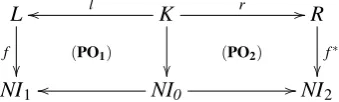
Definition 7(PTI Transformation) Given a PTI transformation ruleρ= (L←l K→r R) and a PTI netNI1with a PTI net morphism f :L→NI1, called the match, a direct PTI net
transforma-tionNI1=ρ,=⇒f NI2fromNI1 to the PTI netNI2 is given by the following double-pushout (DPO) diagram in the categoryPTINets:
L
f
(PO1)
K
(PO2)
l
o
o
r //
R
f∗
NI1 oo NI0 //NI2
The application of a rule with a given match following the DPO approach means that we compute first a pushout complement to obtain pushout (PO1) and then the pushout (PO2) in
PTINets. Note that pushouts and therefore the result of a rule application are unique only up to isomorphism. Intuitively, everything that is matched from the left-hand sideLthat does not have a preimage in the interfaceKis deleted leading to a context netNI0. Then the right-hand sideR
is glued to the contextNI0along the interfaceKleading to the resultNI2of the transformation.
Remark 3 (Construction of Pushouts and Pushout Complements) Pushouts in the category
PTINets can be constructed componentwise in PTNets and Sets, where the marking func-tion of the pushout PTI net is induced by the pushout of the token sets. Since(PTNets,M1)
and(Sets,M2)with classes M1 of injective P/T net morphisms andM2of injective functions
areM-adhesive categories (see [EEPT06]) they have unique pushout complements along M -morphisms. Thus, alsoPTINetshas unique pushout complements along injective morphisms.
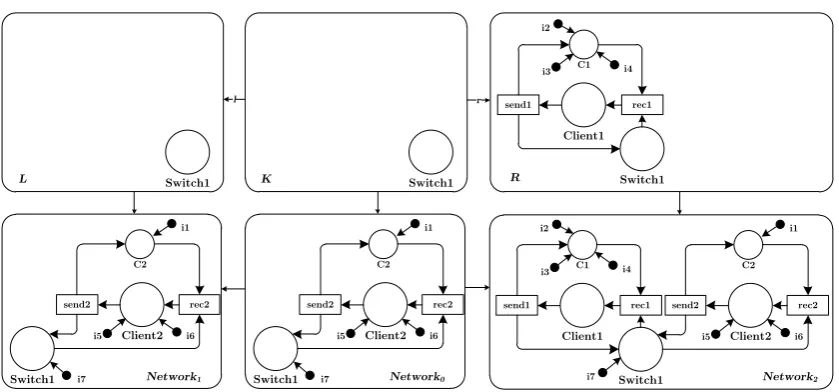
Example3 (Transformation of PTI Nets) Figure 2shows the application of a PTI rulenewClient
which connects a new client with a data capacity of three tokens to an existing switch. For simplicity reasons all morphisms in the DPO diagram are inclusions. The left-hand sideL of the rule is matched to a PTI netNetwork1 which already contains one Client. Since the rule is
non-deleting we obtain a context netNetwork0which equals the original network. The result of
the transformation is a new PTI netNetwork2 where the new client has been connected to the switch.
3
Main Results for P/T Nets with Individual Tokens
Switch1
Client1 Client2
send1 rec1 send2 rec2
Switch1
C1 C2
i6 i5
i2
l r
K R
Network0 Network2
i3 i4
i1
i7 Client1
send1 rec1
Switch1 C1
i2
i3 i4
Client2
send2 rec2
Switch1
C2
i6 i5
i1
i7 Switch1
L
Network1
Client2
send2 rec2
Switch1
C2
i6 i5
i1
i7
Figure 2: PTI transformationNetwork1
newClient
=⇒ Network2
weak adhesive HLR systems are also valid forM-adhesive transformation systems [EGH10], which are a generalization that has been triggered by [Hei10].
3.1 P/T Nets with Individual Tokens asM-adhesive Category
In this paper, we use the notion ofM-adhesive category [EGH10] which is short for vertical weak adhesive HLR category. InM-adhesive categories Van Kampen (VK) squares only need to satisfy the vertical VK-property, i. e. the VK-property has to hold for cubes where the vertical morphisms are inM. In contrast, for a weak adhesive HLR categories it is required that the VK-property does also hold for cubes, where the horizontal morphisms are inM. However, as shown in [EGH10] all the main results of [EEPT06] are still valid forM-adhesive categories.
Theorem 3(PTINetsisM-adhesive) The category(PTINets,Min j)is anM-adhesive
cate-gory whereMin j={f ∈MorPTINets| fP,fT,fI injective}.
Proof (Idea). We already know from [EEPT06] that the category of P/T nets (without markings)
(PTNets,M0)is weak adhesive HLR and hence alsoM-adhesive with M0 being the class of all injective Petri net morphisms. We construct a comma category over(PTNets,M0)and an individual marking functor such that this comma category is isomorphic to theM-category of PTI nets with possibly infinite tokens sets and the classMin j of injective PTI net morphisms.
From a construction theorem in [Pra08] follows that this comma category isM-adhesive. A more detailed proof can be found in [MGE+10].
Finally, the full subcategoryPTINetsof PTI nets with finite token sets isM-adhesive as well for the class Min j. This is guaranteed by another construction theorem from [Pra08], as the
inclusion functor fromSetsfintoSetspreserves pushouts and pullbacks.
[EEPT06] to transformations of PTI nets, e. g. the theorems about independent rule applications (Local Church-Rosser), concurrent rule applications, and local confluence of transformation sys-tems.
M-adhesive transformation systems guarantee unique results of rule applications (up to iso-morphisms). Note that morphisms ofPTSysrules have to be marking-strict in order to obtain an M-adhesivePTSystransformation system [PEHP08]. This requirement is not necessary for an M-adhesivePTINetstransformation system, allowing us to simulate the firing behavior of PTI nets with direct transformations as we show inSubsection 3.3.
3.2 Gluing Condition for P/T Nets with Individual Tokens
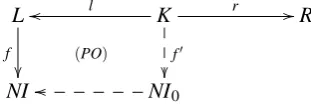
In order to be able to decide whether a rule is applicable at a certain match, we formulate a gluing condition for PTI nets, such that there exists a pushout complement of the left rule morphism and the match if (and only if) they fulfill the gluing condition.
Definition 8(Gluing Condition inPTINets) Given a PTI ruleρ= (L←l K→r R), a PTI netNI
and a PTI morphism f:L→NI(see the left part ofFigure 3), we define the set of identification points (i. e. all elements inLthat are mapped non-injectively by f)IP=IPP∪IPT∪IPI with
• IPP={x∈PL| ∃x06=x: fP(x) = fP(x0)},
• IPT ={x∈TL| ∃x06=x: fT(x) = fT(x0)},
• IPI={x∈IL| ∃x06=x: fI(x) = fI(x0)},
the set of dangling points (i. e. all places inLthat would leave a dangling arc, if deleted)DP=
DPT∪DPIwith
• DPT={p∈PL| ∃t∈TNI\fT(TL): fP(p)∈ENV(t)},
• DPI={p∈PL| ∃i∈INI\fI(IL): fP(p) =mNI(i)},
and the set of gluing points (i. e. all elements inL that have a preimage inK) GP=lP(PK)∪
lT(TK)∪lI(IK).
We say thatρ and f satisfy the gluing condition ifIP∪DP⊆GP
For the following theorem, we consider theM-adhesive category(PTINets,M)whose mor-phism classM contains all injective morphisms.
Theorem 4(Gluing Condition for PTI Transformation) Given a PTI ruleρ = (L←l K→r R)
with l,r ∈M and a match f: L→NI into a PTI net NI = (N,I,m:I →PNI). The rule ρ is applicable on match f , i. e. there exists a (unique up to isomorphisms) pushout complement NI0 in the diagram inFigure 3, iffρand f satisfy the gluing condition inPTINets.
L
f
(PO)
K
l
o
o
f0
r //
R
NI oo NI0
Figure 3: Diagram of a mached rule and the possible pushout complement
Example4 (Gluing Condition) Consider the transformation ruledeleteClientfor PTINets de-picted inFigure 4 and an inclusion match f into the PTI net (SimpleNetwork,I,m) shown in
Figure 1. The ruledeleteClientand match f do not satisfy the gluing condition because due to the fact that the individualsi2,i3andi4are not matched by the rule, the placeClient1is a dan-gling point and therefore it should have a preimage in the interfaceK of the rule (i. e. it should be a gluing point) in order to satisfy the gluing condition. Since this is not the case the rule is not applicable with the given match.
Switch1 Switch1
Client1
send1 rec1
Switch1
C1
l r
L K R
Figure 4: Transformation ruledeleteClientfor PTI nets
In contrast, the PTI transformation rulenewClientshown inFigure 2together with the match described inExample 3satisfies the gluing condition, because since the match is injective there are no identification points, and the only dangling pointSwitch1is a gluing point. Therefore the rulenewClientcan be applied with the given match.
3.3 Correspondence of Transition Firing and Rule Applications
An interesting aspect of the possibility to formulate marking-changing rules inPTINetsis that rules can simulate firing steps of transitions. We give a construction for transition rules that simulate a firing step of some transition under a specific token selection and show that firing of a transition corresponds to an application of a transition rule and vice versa.
Definition 9(PTI Transition Rules) We define thetransition rule for a transition t∈T of a PTI netNI= (P,T,pre,post,I,m), enabled under a token selectionS= (M,m,N,n), as the rule
ρ(t,S) = (Lt l
←Kt
r
→Rt)with
• the common fixed net structurePNt= (Pt,{t},pret,postt), wherePt =ENV(t),pret(t) =
pre(t)andpostt(t) =post(t),
• Kt = (PNt,/0,id/0),
• Rt= (PNt,N,nt:N→Pt), withnt(x) =n(x),
• l,rbeing the obvious inclusions on the rule nets.
Example5 (Simulation of Firing Behavior by Rule-Based Transformation) Consider again the firing of the transitionsend2inExample 2. The firing step can be simulated by application of the transition ruleρ(send2,S) shown inFigure 5 to the PTI net(SimpleNetwork,I,m)inFigure 1
leading to the same result.
!
!
l r
Client2
send2
C2
L
Switch1
i6
Client2
send2
C2
K
Switch1 Client2
send2
C2
R i8
Switch1
i9
Figure 5: Transition ruleρ(send2,S)
Theorem 5 (Correspondence between Firing Steps and Direct DPO Transformations of PTI Nets)
1. Each firing step NI−it−,→S NI0 via token selection S= (M,m,N,n) corresponds to an induced direct transformation NI=ρ====(t,S),⇒f NI0via the transition ruleρ(t,S), where the match f :Lρ(t,S)→
NI is an inclusion.
2. Each direct transformation NI=ρ====(t,S),⇒f NI1via some transition ruleρ(t,S)with t∈TNI, token
selection S= (M,m,N,n), and injective match f :Lρ(t,S)→NI, implies that the transition fT(t)
is enabled in NI under some token selectionS with firing step NI¯ −i−−−−fT(t),→S¯ NI∗such that NI∗∼=NI1. Proof. In the following letNI= (PN,I,m),NI0= (PN0,I0,m0), andNIi= (PNi,Ii,mi).
Part 1. Consider the DPO diagram inFigure 6with inclusionsdandd0, i. e.PN=PN0=PN1.
L= (PNt,M,mt) f
(PO)
K= (PNt,/0,/0)
(PO)
? _
l
o
o
r //
R= (PNt,N,nt) f∗
NI= (PN,I,m) NI0= (PN0,I0,m0)
d
o
o
d0
/
/NI1= (PN1,I1,m1)
Figure 6: DPO transformation diagram inPTINetsforρ(t,S)applied toNI
This diagram exists byTheorem 4because there are no identification points (f is injective) and all dangling points are gluing points (lP=idPt, i. e. no places are deleted). Because pushouts
inPTINetscan be constructed componentwise for the net and the token components, we have
I0=I\MandI1=I0](N\/0)as in the DPO diagram of theSetscomponents inFigure 7. By
Form1as induced morphism for the pushout objectI1follows that
M
fI
(PO)
/0
(PO)
? _
o
o
//N
fI∗
nt ! ! I m * * I0 ? _ dI o
o
d0I
/
/
m0=m◦dI
!
!
I1
m1 Pt
fP∗=fP
PPN
id PPN
Figure 7: DPO diagram inSetsfor the token components inFigure 6
m1(x) =
(
m0(x) =m(x)forx∈I\M nt(x) =n(x)forx∈N
henceI1=I0,m1=m0according toDefinition 4and thereforeNI1=NI0. This proves the
exis-tence of the direct transformationNI=ρ====(t,S),⇒f NI0.
Part 2. Given a direct transformationNI=====ρ(t,S),⇒f NI1 as in the DPO diagrams in Figure 6and Figure 7, there is also a direct transformation NI=ρ====(t,S),⇒f NI with NI= (PN,(I\fI(M)) +N)
given by the componentwise DPOs inFigure 8aby standard category theory andFigure 8bby construction of pushout complements and pushouts inSets(see [EEPT06]) where we choose the injection ¯dI0 to be an inclusion. Then there isNI∼=NI1by uniqueness of pushouts and pushout
complements inPTINets.
PNt
(fP,fT)
PNt id
o
o id //
PNt
(f¯P,f¯T)
PN
(PO)
PN
id
o
o
id //PN
(PO)
(a) DPO inPTNets
M fI /0 ? _ o
o //
N ¯ fI nt $ $ I m ( (
(PO)
I\fI(M)
¯ m0 ? _ ¯ dI o
o d¯10
/
/(I\fI(M)) +N
¯
m1 $$
(PO)
Pt
¯
fP=fP
PPN
id PPN
(b) DPO inSets
Figure 8: Componentwise DPO diagrams inPTNetsandSets
Then fT(t)∈TNIis enabled under a token selection ¯S= (M¯,m¯,N¯,n¯)with ¯M= fI(M), ¯m=m,
¯
N= f¯I(N)and ¯n=m¯1|N¯ if
1. ¯M⊆I, 2. ¯n: ¯N→PPN, 3.(I\M¯)∩N¯ = /0, and
4. ∑ i∈M¯
¯
m(i) =preNI(fT(t)) 5. ∑ i∈N¯
¯
Items 1 and 2 hold by construction via image and restriction. Item 3 follows from the fact that the coproduct(I\M¯) +Nis a disjoint union inSetsand ¯N=f¯I(N)is exactly the part of that set
which is not inI\M¯. It remains to show items 4 and 5:
∑
i∈M¯
¯
m(i) =
∑
i∈fI(M)
¯
m(i)
=
∑
i∈M
m◦fI(i) (fIinj.,m¯ =m)
=
∑
i∈M
fP◦mt(i) (f PTINets-morphism)
=fP⊕
∑
i∈M
mt(i) =fP⊕
∑
i∈Mm(i) (∀i∈M:mt(i) =m(i)by def. ofρ(t,S))
=fP⊕◦prePNt(t) (tenabled underSinLρ(t,S))
=preNI◦fT(t) (f PTINets-morphism)
and analogously,
∑
i∈N¯
¯
n(i) =
∑
i∈f¯I(N)
¯
n(i)
=
∑
i∈N
¯
m1◦f¯I(i) (f¯Iinj.,n¯=m¯1|f¯I(N))
=
∑
i∈N
fP◦nt(i) (f¯= (f¯P,f¯T,f¯I)PTINets-morphism,f¯P= fP)
=fP⊕
∑
i∈N
nt(i) = fP⊕
∑
i∈Nn(i) (∀i∈N:nt(i) =n(i)by def. ofρ(t,S))
=fP⊕◦postPNt(t) (tenabled underSinLρ(t,S))
=postNI◦fT(t) (f PTINets-morphism)
So we have that fT(t)is enabled under ¯Sand we obtain a firing stepNIi− fT(t),S¯
−−−−→NI∗ whereNI∗
has the same net partPNand the follower marking(I∗,m∗)withI∗= (I\M¯)∪N¯ and
m∗(x) =
( ¯
m(x) =m(x) =m¯1(x)|I\M¯ , ifx∈I\M¯;
¯
n(x) =m¯1(x)|N¯ , ifx∈N¯.
Now, by the fact that ¯dI0 is an inclusion we have
I∗= (I\M¯)∪N¯ = (I\fI(M))∪f¯I(N) = (I\fI(M)) +N
and the marking functionm∗:I∗→PPN maps the individuals exactly like ¯m1:(I\fI(M)) +N→
PPN. So we haveNI∗=NIand henceNI∗∼=NI1.
This allows us to use the transition rules for analysis in PTI transformation systems as presented in the next subsection.
A generalization of Petri nets to graph grammars is presented in [CM95] such that transitions correspond to rules and firing steps to rule applications. This approach uses an encoding of transitions as graph rules similar toDefinition 9and the transition productions of [Kre81] with the difference that they contain only the individual tokens as typed graph nodes where the types represent the places marked by the tokens. The authors of [CM95] mention a subtle mismatch of the encoding as a conceptual problem, i. e. that the indistinguishable tokens of the multiset marking in the actual net are more abstract than the tokens with distinguishable individuals in the graph representation. Because of several possible matches for the individuals, there are different transformations representing the same unique firing step of a transition and there are many grammars representing the same net.
Although both constructions have inspired the transition rules in this paper, it is not our ambi-tion to formalize a strict simulaambi-tion relaambi-tion between a PTI net’s behavior and an – in some sense – equivalent (net) grammar. We rather use the correspondence result of Theorem 5 to relate arbitrary net transformation steps with firing steps as we show in the next section.
3.4 Independence of Token-Firing and Rule Application
For P/T systems, [EHP+07] defines parallel and sequential independence of a transformation step and a firing step and proves results that are similar to the Local Church-Rosser Theorem of [EEPT06], which relates sequential and parallel independence of rule applications.
As we have shown inTheorem 5we are able to express the firing of PTI nets by application of transition rules. This allows us to immediately use the results forM-adhesive transformation systems [EEPT06,EGH10] for the analysis of the independence of firing steps and rule applica-tions. We obtain a notion of parallel independence of a rule application and a firing step for PTI nets by relying on the definition of these properties for the corresponding transition rule.
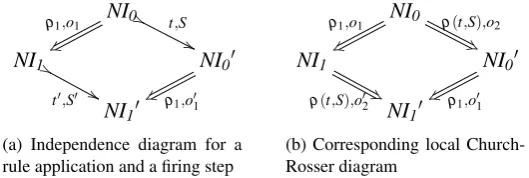
Definition 10(Parallel Independence of Rule Applications and Firing Steps) A transformation stepNI0
ρ1,o1
=⇒NI1and a firing stepNI0i− t,S
−→NI00(see the top ofFigure 9a) are parallel independent
iff the rule applications(ρ1,o1)and(ρ(t,S),o2)are parallel independent (seeFigure 9b), where
(ρ(t,S),o2)is defined according to item 1 ofTheorem 5.
NI0
ρ1,o1
s
{
'
' t,S
'
'
NI1&&
t0,S0 &&
NI00
ρ1,o01
s
{
NI10
(a) Independence diagram for a rule application and a firing step
NI0
ρ1,o1
s
{ ρ(
t,S),o2
#
+
NI1
ρ(t,S),o02 "*
NI00
ρ1,o01
s
{
NI10
(b) Corresponding local Church-Rosser diagram
Remark4 (Sequential Independence of Rule Applications and Firing Steps) Analogously to the parallel independence it is possible to define the sequential independence of rule applications and firing steps by defining thatNI0=
ρ1
=⇒NI1−i
t,S
−→NI2 respectivelyNI0i−
t,S
−→NI1=
ρ1
=⇒NI2 are
sequen-tially independent iffNI0=
ρ1
=⇒NI1=
ρ(t,S)
===⇒NI2respectivelyNI0=
ρ(t,S)
===⇒NI1=
ρ1
=⇒NI2are sequentially
independent.
Now, we can transfer the relations that the Local Church-Rosser Theorem states between par-allel and sequentially independent rule applications to parpar-allel and sequentially independent rule applications and firing steps. With this result, we have a criterion to decide for rule applications and firing steps whether they can occur independently in any order with the same result.
Theorem 6(Local Church Rosser for Rule Applications and Firing Steps) Given a direct trans-formation NI0ρ=1⇒,o1NI1 and a firing step NI0i−t−,→S NI0
0 that are parallel independent (see the top
ofFigure 9a), then there exists a transition t0∈T1enabled under some token selection S0leading
to NI1i−
t0,S0
−−→NI01and a direct transformation NI00ρ1,o 0 1
=⇒NI01.
Proof. Parallel independence of (ρ1,o1) and (t,S) by Definition 10 means that (ρ1,o1) and
(ρ(t,S),o2)are parallel independent rule applications. This implies by Theorem 5.12 in [EEPT06]
that there are sequentially independent transformationsNI0=
ρ1,o1
==⇒NI1=
ρ(t,S),o02
====⇒NI10 andNI0=
ρ(t,S),o2
====⇒
NI00 =ρ1,o
0 1
==⇒NI10 as depicted inFigure 9b. The matcho20 is given by the compositiono02=g1◦i2
wherei2witho2=f1◦i2is given by the parallel independence of the rules (cf. Theorem 5.12 in [EEPT06]).
R1 n1 K1 r1 o o
l1 //L1
o1
i1
'
'
Lρ(t,S)
o2 } } i2 x x
Kρ(t,S)
l2
o
o
r2 //Rρ(t,S)
n2
NI1oo g1 C1 f1 //NI0 oo f2 C2 g2 //NI00
Now, injectivity of o2 implies injectivity ofi2, and injectivity ofr1 implies injectivity of g1
becauseM-morphisms are closed under pushouts. So we have thato02=g1◦i2is injective and
thus by item 2 ofTheorem 5we have thatt0=o20,T(t)is enabled under some token selectionS0
with firing stepNI1i−t 0,S0
−−→NI1∗such thatNI1∗∼=NI10.
Remark5 Due to the fact that a rule sequenceNI1=
ρ1
=⇒NI2=
ρ2
=⇒NI3is sequentially independent
iff NI1
ρ1−1
⇐ NI2=
ρ2
=⇒NI3 are parallel independent, the theorem above can be easily extended to
cover also the analogous statement for sequentially independent firing and rule application. This argumentation has similarly been used in [EHP+07].
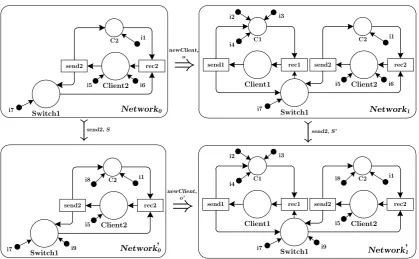
Example6 (Independence of Rule Application and Firing Step) Consider the PTINetNetwork0
in the top-left corner of Figure 10. We can add a new client Client1 by applying the rule
Client1 Client2 send1 rec1 send2 rec2
Switch1
C1 C2 i1
i5 i6
i7 i2 i3
i4
Client1 Client2 send1 rec1 send2 rec2
Switch1
C1 C2 i1
i5
i9 i7
i8 Client2
send2 rec2
Switch1
C2 i1
i5 i6
i7
Client2 send2 rec2
Switch1
C2 i1
i5
i9 i7
i8
Network0 Network1
Network'1
Network'0
)
newClient, o
)
newClient, o'
½
send2, S
½
send2, S'
i2 i3
i4
Figure 10: Independent application ofnewClientand firing ofsend2
4
Conclusion and Future Work
In this paper, we have presented place/transition nets with individual tokens (PTI nets) together with a rule-based transformation by instantiation ofM-adhesive transformation systems. The individual token approach of PTI nets overcomes some technical restrictions of reconfigurable P/T systems and provides an appropriate representation of marking-changing rules.
As a main result, we have shown that the category of PTI nets together with the class of all injective morphisms form anM-adhesive category, where the framework ofM-adhesive cate-gories is a slight generalization of weak adhesive high-level replacement (HLR) catecate-gories. This allows us to use the analysis results for weak adhesive HLR systems from [EEPT06] for PTI transformation systems, and we obtain a necessary and sufficient gluing condition for the ap-plication of PTI transformation rules. Moreover, we have shown that firing steps in PTI nets are equivalent to applications of special transformation rules, called transition rules, simulating a firing step by changing the marking of the places in the environment of the fired transition accordingly. With this correspondence of firing steps and rule applications, we are able to define the notions of parallel and sequential independence of a PTI firing step and a rule application by using the definitions of independence for rule applications from [EEPT06]. This allows to show a local Church-Rosser result for rule application and token firing based on the corresponding re-sults inM-adhesive categories and is the basis for further conflict analysis based on critical pairs.
on rule-based transformations of algebraic high-level nets from [PER95]. For AHLI nets we obtain similar results as for PTI nets. That is, (AHLINets,M) with the class of all injective morphisms with isomorphic data part is anM-adhesive category. Moreover, we have a sufficient and necessary gluing condition for the applicability of AHLI rules, and it is also possible to express the firing of AHLI nets by application of AHLI transition rules.
We employ AHLI nets in our modeling case study for Skype in [HM10] for realizing mul-ticasting to transmit specific data between groups of Skype clients by marking-changing rules according to [BEE+09]. In that case study, we use the algebraic data type part in order to repre-sent the clients’ identities and the communicated data.
Due to the categorical characterization of independence in this paper in contrast to [EHP+07], the results only rely on the correspondence as stated inTheorem 5. Therefore, the Local Church-Rosser Theorem for AHLI rule applications and firing steps can be shown completely analo-gously because of the correspondence between the firing of AHLI nets and the application of AHLI transition rules [MGE+10]. Moreover, it is possible to transfer similar results for transfor-mations like the theorems for concurrency and local confluence based on critical pairs [EEPT06] to transformations mixed with firing steps of P/T and AHL nets with individual tokens.
In [EHL10], the results of [EEPT06] concerning parallel and concurrent rules have been lifted to transformation systems with nested application conditions (see also [HP09]). The additional property forM-adhesive categories that is needed for these results is a suitableE-M factor-ization (and binary coproducts which we already have by cocompleteness). One possibility to achieve this requirement is the restriction to finite PTI and AHLI nets, because as shown in [BEGG10], the restriction of anM-adhesive category to all its finite objects has extremalE-M factorizations.
Another powerful concept is the amalgamation of rules (with application conditions) over a bundle of matches [GEH10] which can be used to realize multicasting of data tokens in high-level nets [BEE+09]. In order to instantiate the results in that article to our Petri net categories we need to show that they have so-called effective pushouts.
Acknowledgements: We thank the reviewers and the members of the TFS research group at TU Berlin for their thorough reviews and highly appreciate the comments and suggestions, which significantly contributed to improving the paper’s quality.
References
[BDHM06] P. Bottoni, F. De Rosa, K. Hoffmann, M. Mecella. Applying Algebraic Approaches for Modeling Workflows and their Transformations in Mobile Networks.Journal of Mobile Information Systems2(1):51–76, 2006.
VL/HCC 2009, Corvallis, OR, USA, 20-24 September 2009, Proceedings. Pp. 47– 50. IEEE, 2009.
[BEGG10] B. Braatz, H. Ehrig, K. Gabriel, U. Golas. Finitary M-Adhesive Categories. In Ehrig et al. (eds.), Proceedings of Intern. Conf. on Graph Transformation ( ICGT’ 10). LNCS 6372, pp. 234–249. Springer, 2010.
[BMMS99] R. Bruni, J. Meseguer, U. Montanari, V. Sassone. Functorial Semantics for Petri Nets under the Individual Token Philosophy. In Category Theory and Computer Science, CTCS ’99.ENTCS 29. Elsevier, 1999.
[CM95] A. Corradini, U. Montanari. Specification of Concurrent Systems: From Petri Nets to Graph Grammars. In Hommel (ed.), Proc. Workshop on Quality of Communication-Based Systems, Berlin, Germany. Kluwer Academic Publishers, 1995.
[EEPT06] H. Ehrig, K. Ehrig, U. Prange, G. Taentzer. Fundamentals of Algebraic Graph Transformation. EATCS Monographs in Theoretical Computer Science. Springer Verlag, 2006.
[EGH10] H. Ehrig, U. Golas, F. Hermann. Categorical Frameworks for Graph Transforma-tions and HLR Systems based on the DPO Approach. Bull. EATCS102:111–121, 2010.
[EHL10] H. Ehrig, A. Habel, L. Lambers. Parallelism and Concurrency Theorems for Rules with Nested Application Conditions. Electr. Communications of the EASST 26, 2010.
[EHP+07] H. Ehrig, K. Hoffmann, J. Padberg, U. Prange, C. Ermel. Independence of Net Transformations and Token Firing in Reconfigurable Place/Transition Systems. In Kleijn and Yakovlev (eds.),Proc. of 28th International Conference on Application and Theory of Petri Nets and Other Models of Concurrency. LNCS 4546, pp. 104– 123. Springer, 2007.
[GEH10] U. Golas, H. Ehrig, A. Habel. Multi-Amalgamation in Adhesive Categories. In Ehrig et al. (eds.),Proceedings of Intern. Conf. on Graph Transformation ( ICGT’ 10). LNCS 6372, pp. 346–361. Springer, 2010.
[vG05] R. J. van Glabbeek. The individual and collective token interpretations of Petri nets. In Proceedings CONCUR 2005, 16 th International Conference on Concurrency Theory. Pp. 323–337. Springer-Verlag, London, UK, 2005.
[GP95] R. J. van Glabbeek, G. D. Plotkin. Configuration Structures. InLICS ’95: Proceed-ings of the 10th Annual IEEE Symposium on Logic in Computer Science. P. 199. IEEE Computer Society, Washington, DC, USA, 1995.
[Hei10] T. Heindel. Hereditary pushouts reconsidered. In Proceedings of the 5th interna-tional conference on Graph transformations. ICGT’10, pp. 250–265. Springer-Verlag, Berlin, Heidelberg, 2010.
http://portal.acm.org/citation.cfm?id=1928162.1928184
[HM10] K. Hoffmann, T. Modica. Formal Modeling and Analysis of Flexible Processes us-ing Reconfigurable Systems. In Ermel et al. (eds.), Proc. Int. Coll. on Graph and Model Transformation (GraMoT 2010). Volume 30. European Association of Soft-ware Science and Technology, 2010.
[HME05] K. Hoffmann, T. Mossakowski, H. Ehrig. High-Level Nets with Nets and Rules as Tokens. InProc. of 26th Intern. Conf. on Application and Theory of Petri Nets and other Models of Concurrency. LNCS 3536, pp. 268–288. Springer, 2005.
[HP09] A. Habel, K.-H. Pennemann. Correctness of high-level transformation systems rel-ative to nested conditions.Mathematical Structures in Computer Science19:1–52, 2009.
[Kre81] H.-J. Kreowski. A Comparison between Petri Nets and Graph Grammars. In
5th International Workshop on Graph-Theoretic Concepts in Computer Science. LNCS 100, pp. 1–19. Springer, 1981.
[LS04] S. Lack, P. Soboci´nski. Adhesive Categories. InProc. FOSSACS 2004. LNCS 2987, pp. 273–288. Springer, 2004.
[MGE+10] T. Modica, K. Gabriel, H. Ehrig, K. Hoffmann, S. Shareef, C. Ermel, U. Golas, F. Hermann, E. Biermann. Low- and High-Level Petri Nets with Individual Tokens. Technical report 2009/13, Fakult¨at IV - Elektrotechnik und Informatik – Technische Universit¨at Berlin, 2010.
[MM90] J. Meseguer, U. Montanari. Petri Nets are Monoids.Information and Computation
88(2):105–155, 1990.
[PEHP08] U. Prange, H. Ehrig, K. Hoffman, J. Padberg. Transformations in Reconfigurable Place/Transition Systems. In Degano et al. (eds.),Concurrency, Graphs and Mod-els: Essays Dedicated to Ugo Montanari on the Occasion of His 65th Birthday. LNCS 5065, pp. 96–113. Springer, 2008.
[PER95] J. Padberg, H. Ehrig, L. Ribeiro. Algebraic High-Level Net Transformation Sys-tems.Mathematical Structures in Computer Science5:217–256, 1995.
[Pra08] U. Prange. Towards Algebraic High-Level Systems as Weak Adhesive HLR Cate-gories. In Ehrig et al. (eds.),Proc. Workshop of Applied and Computational Cate-gory Theory (ACCAT) at ETAPS 2007. Electronic Notes in Theoretical Computer Science 203 / 6, pp. 67–88. Elsevier, Amsterdam, 2008.
[Rei85] W. Reisig. Petri Nets with Individual Tokens. Theoretical Computer Science