© 2019 by the Serbian Biological Society How to cite this article: Glušac J, Isaschar-Ovdat S, Fishman A, Kukavica B. Partial 293 characterization of bean and maize root peroxidases and their ability to crosslink
potato protein. Arch Biol Sci. 2019;71(2):293-303.
Partial characterization of bean and maize root peroxidases and their ability to crosslink
potato protein
Jovana Glušac1,2, Sivan Isaschar-Ovdat1, Ayelet Fishman1 and Biljana Kukavica2,*
1Department of Biotechnology and Food Engineering, Technion-Israel Institute of Technology, Haifa 3200003, Israel
2Faculty of Natural Science and Mathematics, University of Banja Luka, Bosnia and Herzegovina
*Corresponding author: [email protected]
Received: October 16, 2018; Revised: January 1, 2019; Accepted: February 18, 2019; Published online: March 4, 2019
Abstract: Two fractions of Class III peroxidases (POX; EC 1.11.1.7), soluble and ionically bound to the cell wall, were par-tially purified from bean and maize roots and characterized. According to the measured Km, both the soluble and ionically bound to the cell wall fractions of POX had high affinity for H2O2 and the high specificity for caffeic acid. Approximate molecular weights of POX in their tertiary (native) structure were determined by modified sodium dodecyl sulfate (SDS) polyacrylamide gel electrophoresis (PAGE). Proteomic analysis resolved the identity and pI of different enzyme bands. The ability of maize and bean soluble peroxidase to crosslink native potato proteins was evaluated. The results obtained by SDS-PAGE showed that both POX enzymes were capable of crosslinking potato protein, in particular patatin, a globular protein, with and without the presence of H2O2. To investigate the possible role of phenolic compounds in facilitating crosslinking, commercial horseradish peroxidase (HRP) with/without the addition of caffeic acid was used to crosslink potato protein. Information provided here could be useful for the purification of POX from maize and bean roots and for examination of protein-protein interactions.
Keywords: soluble peroxidase; ionic cell wall-bound peroxidase; bean and maize root; potato protein; protein crosslinking; phenolic compounds
Abbreviations: cPOX – covalent bound peroxidase; iPOX – ionically cell wall-bound peroxidase; iPOXb – ionically cell wall-bound bean peroxidase; iPOXc – ionically cell wall-bound maize peroxidase; sPOX – soluble peroxidase; sPOXb – soluble bean peroxidase; sPOXc – soluble maize peroxidase
INTRODUCTION
Peroxidases (POX; EC 1.11.1.7) are monomeric gly-cosylated hemoproteins and a subclass of oxidoreduc-tases that catalyze the oxidation of different substrates using hydrogen peroxide [1, 2]. At all stages of plant development, from germination to aging, peroxidases participate in a broad range of plant physiological processes (lignification, suberization, auxin catabo-lism, antioxidative reactions) [2-6]. Plants possess a large number of peroxidase isoenzymes differing in molecular weight, thermal stability, pH optimum, substrate specificity and physiological role [2, 6-8]. Plant peroxidases are localized intracellularly (vacu-oles and cytoplasm) and extracellularly (apoplast and cell wall) [9-11]. In addition, membrane-bound plant peroxidases were found and described [12].
Intracel-lular and apoplastic peroxidases are either soluble or bound to the cell wall via covalent (covalently bound POX, cPOX) or electrostatic (ionically bound POX, iPOX) forces [2, 11]. The POXs are capable of oxidiz-ing a broad range of organic compounds, includoxidiz-ing phenols, aromatic amines, indoles and sulfonates, us-ing hydrogen peroxide as the oxidant [13]. It has been shown that the kinetics of peroxidase enzymes involve several consecutive reactions and several enzyme states according to the Chance-George mechanism [14-16]. In addition to utilizing H2O2 for oxidative cross-linking of wall components, class III POX also possess the capacity to produce H2O2 via one-electron reduction of oxygen, thereby oxidizing NAD(P)H, ascorbate or auxin in vitro in the presence of trace amounts of
[17-19]. Another source of H2O2 for POXin vacuoles
and apoplastcan be from the process of autooxidation
of phenolic compounds [9].
Enzymatic crosslinking of proteins results in modifications of their mechanical and functional properties as a result of the introduction of intra- and intermolecular covalent bonds in the protein network. Different oxidative enzymes such as laccase, tyrosinase and peroxidase have been used to crosslink mainly food proteins [20-22]. These oxidative enzymes are known to induce oxidation and crosslinks on tyrosine, cysteine or tryptophan residues [22, 23]. A recent study has highlighted the importance of tyrosine lo-cation in tyrosinase-mediated crosslinking of soy glycinin-derived peptides [24]. It has been shown that horseradish POX could induce crosslinking of some proteins in the presence of hydrogen peroxide and a low molecular weight hydrogen donor such as ferulic acid [25, 26]; the enzyme has been used to crosslink whey proteins and caseins [21, 22, 27]. Potato protein was recently reported to undergo crosslinking with tyrosinase from a bacterial source [28].
In the present study, POX was used to examine the ability to crosslink potato protein with a different type of an oxidoreductase. In this context, the aim of the work was partial purification of soluble and ionically cell wall-bound POX enzymes from maize and bean roots, and determination of their ability to crosslink potato protein. The role of phenolic compounds in potato protein crosslinking was also investigated and discussed.
MATERIALS AND METHODS
Plant materials and growth conditions
Bean (Phaseolus vulgaris L.) and maize (Zea mays L.) seeds were washed under tap water and germinated at 18°C in the dark for 3 days. Seedlings were then placed in tap water, which was changed after a week and grown hydroponically for 14 days in a growth chamber with a photoperiod of 16h/8h (light/dark-ness) at 24°C and 18°C. Irradiance of 80 µmol·m–1s–1
was provided by white fluorescent tubes. After two weeks, the roots were stored at -18°C until analysis.
Peroxidase purification
The roots were cut and placed in sodium phosphate buffer (SPB) [100 mM SPB pH 6.4, 1 mM phenyl-methylsulphonyl fluoride (PMSF)] at 4ºC and im-mediately homogenized in a blender for 3 min (at a ratio of 1:3=plant:buffer). The homogenate was filtered through four layers of cloth and centrifuged at 17000 x g for 20 min. The obtained supernatant was further used for purification of soluble POX, while the pellet with cell wall fragments was used in further steps for purification of iPOX.
Protein precipitation from the supernatant was carried out at 70% (NH4)2SO4 saturation. The mixtures were incubated for 2 h at 4°C. The recovered precipi-tates were centrifuged at 17000 x g for 20 min at 4°C and suspended in SPB, followed by dialysis against SPB to remove salt. The dialysate was concentrated 20-fold using ultrafiltration through regenerated cellulose filters with a MW cut-off of 3 kDa (Amicon Ultra-4 Centrifugal Filter Device) and used for analysis of the soluble POX fraction (sPOX), from bean root (sPOXb) and from maize root (sPOXc). The pellet with cell wall fragments was washed four times in 100 mM SPB (pH 6.4). To extract the ionically bound protein fraction, the pellet was suspended in 1M NaCl, incubated for 1 h at 4ºC, and then centrifuged at 17000 x g for 20 min. The obtained supernatant was dialyzed against SPB for 24 h, concentrated about 20-fold using an Amicon Ultra-4 Centrifugal Filter Device and used for analysis of (iPOX) from bean root (iPOXb) and from maize root (iPOXc).
Peroxidase activity
The sPOX and iPOX activities of bean and maize were measured spectrophotometrically in a reaction mixture consisting of 100 mM SPB pH 6.4, 0.01 M pyrogallol and aliquots (2 μL) of soluble or ionically cell wall-bound fractions. The reaction was started by the addition of 3.3 mM H2O2 and the increase in absorbance at 430 nm was followed. Peroxidase activ-ity was calculated using the extinction coefficient for purpurogallin (ε=12 mM–1cm–1) [29].
Oxidation of hydroxycinnamic acids (p-coumaric,
3.3 mM H2O2 and 0.04 mM p-coumaric acid, or 4mM chlorogenic or caffeic acid in 100 mM SPB (pH 6.4). The increase in absorbance was followed at 410 nm for CGA and caffeic acid, and the decrease at 286 nm for p-coumaric acid [30]. Km was determined for pyrogallol at a concentration ranging from 0.33-10 mM, and for H2O2 in the range from 0.083-6.67 mM. Protein concen-trations were determined according to Bradford [31].
Modified SDS-PAGE
Modified SDS-PAGE at a final concentration of 0.1% (w/v) SDS in all solutions and gels was used to sepa-rate peroxidase isoforms [12]. Samples were diluted in loading buffer to a final concentration of 50 mM Tris-HCl (pH 6.8), 0.1% (w/v) SDS, 10% (w/v) glycerol and 0.002% (w/v) bromophenol blue, without reducing compounds, and loaded onto the gels without heating. POX isoforms remained active after separation on the gel by staining with 1 mM 3,3-diaminobenzidine
(DAB) and 0.03% H2O2 in 100 mM SPB pH 6.4. This
enabled determination of the apparent molecular weights of peroxidase isoforms with a preserved ter-tiary structure, using molecular weight standards (Broad Range, Bio-Rad, Munich, Germany)
accord-ing to Laemmli [32]. The Rf values of POX isoforms
were determined on the scanned gel by the program Image Master Total Lab TL 120 software (Nonlinear Dynamics Ltd., Durham, USA).
Enzymatic crosslinking of potato protein
Potato protein (1%) was suspended in 100 mM SPB (pH 6.4) and stirred for 30 min at ambient tempera-ture. The crosslinking reaction was carried out with soluble potato protein and the addition of sPOX or iPOX fractions from bean and maize. sPOX or iPOX were added at a 1:25 enzyme to protein ratio, while the non-crosslinked samples were treated similarly but without enzyme addition. Every 5 min, 2 μL of a 50 mM H2O2 solution was added to the reaction mixture of crosslinked and non-crosslinked samples [21], and a control without addition of H2O2 to the reaction
mixturewas used.The same crosslinking reaction was
carried out with commercial horseradish peroxidase (HRP) (Sigma-Aldrich, Steinheim, Germany) and the addition of 2 mM caffeic acid [33], followed by gradual addition of H2O2. The reaction mixtures were incubated
at 37°C with shaking at 250 rpm in an incubator shaker (TU-400 Orbital Shaker Incubator, MRC, Holon) for 5 h. Samples were taken at various time points (0, 60, 180 and 300 min, respectively) and the reaction was stopped by directly mixing the reaction mixture with electrophoresis sample buffer (x4) at a 1:1 ratio (v/v). The samples were analyzed by SDS-PAGE.
SDS-PAGE analysis
Electrophoresis was performed on a discontinuous buffered system [32] using a 15% separation gel and a 4% stacking gel. The samples were heated for 10 min at 95°C after addition of sample buffer (4x), 1:1 (v/v). Samples were mixed with reducing (5% β-mercaptoethanol) sam-ple buffer. The gels were stained with 0.25% Coomassie brilliant blue (R-250) in 50% ethanol and 10% acetic acid and destained in 10% acetic acid [methanol:acetic acid:water, 20:10:70 (v/v/v)].
In-gel proteolysis and mass spectrometry analysis
databases (Uniprot). Peptide- and protein-level false discovery rates (FDRs) were filtered to 1% using the target-decoy strategy.
Statistical analysis
All experiments were conducted in triplicate, and the results are expressed as the mean±standard devia-tion. The data were subjected to analysis of variance (ANOVA), and the means were compared by the Holm-Sidak test (SigmaPlot 11.0, Systat Software, Inc., USA). The level of significance was set at P<0.05.
RESULTS
Peroxidase purification and relative molecular weight
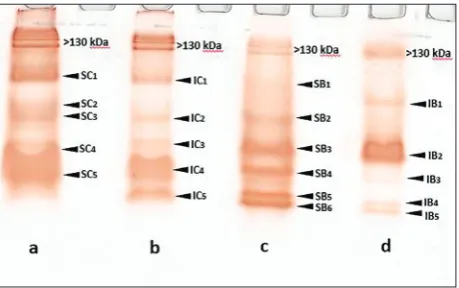
The soluble and ionically bound fractions of POX were partly purified from maize and bean roots and charac-terized. SDS-PAGE with a low SDS concentration and gel staining with 3,3-diaminobenzidine (DAB) revealed the presence of isoforms at a wide range of molecular weights (Fig. 1). Common peroxidase isoforms of about 45 and 38 kDa were present in all isolates as well as isoforms with molecular weights higher than 130 kDa. In Fig.1 it can be seen that isoforms with molecular weights around 50 and 78 kDa were present in all POX fractions except in bean iPOX. A 35 kDa isoform was observed in maize iPOX and in bean iPOX and sPOX, while the soluble and bound bean POXs had an isoform of about 36 kDa. A ~55 kDa isoform was observed in maize sPOX, and a ~57 kDa isoform was detected in bean iPOX.
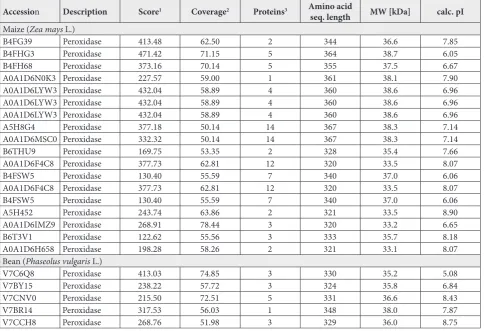
The results of liquid chromatography-mass spec-trometry/mass spectrometry (LC-MS/MS) presented on Table 1 confirmed the presence of the maize sPOX isoform with a molecular weight of 38 kDa (pI 6.05, 6.96, 7.14 and 7.9), as well as the presence of bean sPOX isoforms with molecular weights of 35 kDa (pI 5.08 and 6.84), 36 (pI 8.43 and 8.75) and 38 kDa (pI 7.87).
Peroxidase activity and kinetic studies
The Km values for all enzymes for pyrogallol were de-termined in the presence of 3.3 mM H2O2, while the
values for H2O2 were determined in the presence of 3.3 mM pyrogallol as substrate (Table 2). For pyrogallol,
Km values were in the millimolar range for all POX
except for sPOXc. According to the Km, all fractions exhibited a lower affinity for pyrogallol than for H2O2, especially bean POX. The maize iPOX fraction had a 1.5-fold lower affinity for pyrogallol compared to the sPOX fraction. Bean sPOX and iPOX had about 4-fold lower affinity for pyrogallol than maize sPOX/iPOX. For H2O2 as a substrate, the Km did not differ between the soluble and bound fractions. Three-fold higher af-finity was found for the maize and bean ionic fractions compared to the soluble fractions in the presence of
H2O2. Bean POX (soluble and bound) had lower
af-finity (higher Km) for both substrates than maize POX under the investigated conditions (Table 2).
The activities of different POX crude enzymes were determined with several substrates in addition to pyrogallol. Higher peroxidase activity was detected in ionically bound bean fractions compared to soluble bean fractions, while the opposite trend was observed for maize POX, independent of the used substrate (Table 3). The highest peroxidase activity of the soluble and bound bean POX and ionically bound maize was observed with caffeic acid as a substrate, while for the
soluble maize POX, pyrogallol was the best substrate. The lowest activity for soluble bean and maize POX was measured with p-coumaric acid as a substrate. The lowest activity for iPOXb was with chlorogenic acid as a substrate, while for iPOXc it was with p-coumaric acid.
Crosslinking of potato protein catalyzed by peroxidase
The ability of maize and bean sPOX to crosslink potato protein was examined using SDS-PAGE analysis which demonstrated the formation of high-molecular-weight
Table 1. List of soluble POX from maize and bean root extracts detected by LC-MS/MS.
Accession Description Score1 Coverage2 Proteins3 Amino acid
seq. length MW [kDa] calc. pI
Maize (Zea mays L.)
B4FG39 Peroxidase 413.48 62.50 2 344 36.6 7.85
B4FHG3 Peroxidase 471.42 71.15 5 364 38.7 6.05
B4FH68 Peroxidase 373.16 70.14 5 355 37.5 6.67
A0A1D6N0K3 Peroxidase 227.57 59.00 1 361 38.1 7.90
A0A1D6LYW3 Peroxidase 432.04 58.89 4 360 38.6 6.96
A0A1D6LYW3 Peroxidase 432.04 58.89 4 360 38.6 6.96
A0A1D6LYW3 Peroxidase 432.04 58.89 4 360 38.6 6.96
A5H8G4 Peroxidase 377.18 50.14 14 367 38.3 7.14
A0A1D6MSC0 Peroxidase 332.32 50.14 14 367 38.3 7.14
B6THU9 Peroxidase 169.75 53.35 2 328 35.4 7.66
A0A1D6F4C8 Peroxidase 377.73 62.81 12 320 33.5 8.07
B4FSW5 Peroxidase 130.40 55.59 7 340 37.0 6.06
A0A1D6F4C8 Peroxidase 377.73 62.81 12 320 33.5 8.07
B4FSW5 Peroxidase 130.40 55.59 7 340 37.0 6.06
A5H452 Peroxidase 243.74 63.86 2 321 33.5 8.90
A0A1D6IMZ9 Peroxidase 268.91 78.44 3 320 33.2 6.65
B6T3V1 Peroxidase 122.62 55.56 3 333 35.7 8.18
A0A1D6H658 Peroxidase 198.28 58.26 2 321 33.1 8.07
Bean (Phaseolus vulgaris L.)
V7C6Q8 Peroxidase 413.03 74.85 3 330 35.2 5.08
V7BY15 Peroxidase 238.22 57.72 3 324 35.8 6.84
V7CNV0 Peroxidase 215.50 72.51 5 331 36.6 8.43
V7BR14 Peroxidase 317.53 56.03 1 348 38.0 7.87
V7CCH8 Peroxidase 268.76 51.98 3 329 36.0 8.75
1Score – displays the protein score, which is the sum of the scores of the individual peptides. 2Coverage – displays the percentage of the protein sequence covered by identified peptides. 3Proteins – displays the number of identified proteins in the protein group of a master protein.
Table 3. POX activities of soluble bean (sPOXb) and maize (sPOXc) root peroxidase and ionically bound bean (iPOXb) and maize (iPOXc) root peroxidase for different substrates.
POX activity (μmol mg–1 protein min–1)
Substrate sPOXb iPOXb sPOXc iPOXc
Pyrogallol 34.84 ± 8.17a 108.99 ± 0.75b 73.19 ± 5.70c 10.41 ± 1.55d p-CA 10.72 ± 0.38a 116.94 ± 30.70b 6.41 ± 1.65c 2.14 ± 0.53d CGA 15.06 ± 1.18a 77.94 ± 9.66b 12.10 ± 0.96c 4.62 ± 0.32d CA 67.50 ± 5.33a 240.88 ± 49.69b 56.79 ± 8.99a 19.11 ± 1.44c
Peroxidase activities were determined by absorbance change at 430 nm for 6.67 mM pyrogallol (PG), at 286 nm for 0.04 mM p-coumaric acid (p-CA), and at 410 nm for 4 mM chlorogenic (CGA) and caffeic (CA) acid.
a, b, c, d, e – comparison was made between the same substrates and different POX; different letters indicate significant differences at p<0.05 according to the t-test.
Table 2. Kmvalues of soluble bean (sPOXb) and maize (sPOXc) root peroxidase and ionically cell wall-bound bean (iPOXb) and maize (iPOXc) root peroxidase for pyrogallol in the presence of 3.3 mM H2O2. Km values for H2O2 were obtained with 3.3 mM pyrogallol as a substrate.
Km (mM)
Substrate sPOXb iPOXb sPOXc iPOXc
H2O2 0.339 ± 0.009a 0.111 ± 0.008b 0.319 ± 0.020a 0.110 ± 0.030b
Pyrogallol 4.371 ± 0.110c 4.076 ± 0.120c 0.833 ± 0.02d 1.319 ± 0.110e
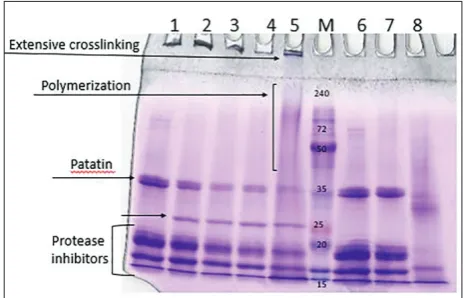
fragments after 60 min from the addition of bean and maize sPOX, followed by a concomitant decline of the protein monomer bands, especially patatin (Figs. 2 and 3).
The globular potato protein patatin was crosslinked with maize and bean sPOX after the addition of H2O2. The activity observed in the absence of H2O2 could be due to the presence of other enzymes in the crude enzyme extract. Formation of a new protein band at about 25 kDa was observed after 1 h of incubation with both maize and bean sPOX. Figs. 2 and 3 show
crosslinking with maize and bean sPOX and H2O2,
however the same pattern on the SDS-PAGE gel was
observed even without H2O2. The ability of maize
and bean iPOX to crosslink potato protein was ex-amined and the results revealed a weaker crosslinking ability of iPOX as compared to sPOX. This could be explained by the lower amount of phenols present in iPOX crude enzyme extract, which is in accordance with the higher Km and substrate specificity (Tables 2 and 3) as well as with the results obtained after SDS-PAGE analysis (Fig. 1).
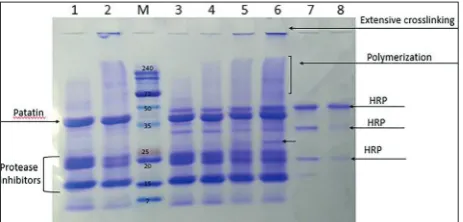
To compare the abilities of maize and bean sPOX to crosslink potato protein, as well as the role of phenolic mediators, HRP was used to crosslink po-tato protein with (Fig. 4) or without (Fig. 5) caffeic acid . Crosslinking of potato protein with HRP and gradual addition of H2O2 (Fig. 4) led to polymeriza-tion after 3 h of incubapolymeriza-tion, but with a less significant decrease in the patatin band, as observed in the case of maize and bean sPOX (Figs. 2 and 3). When caf-feic acid was added, extended polymerization was observed, followed by the formation of a new band (slightly above 25 kDa) after 3 h of incubation, but without the decline in patatin band intensity (Fig. 5). Self-polymerization of HRP was evident in the presence of caffeic acid, as well as the formation of high-molecular-weight polymer bands of potato protein that were not capable of entering the stack-ing gel (Fig. 5). In addition, pigmented formations at the end of the incubation time were observed in dispersions with caffeic acid and non-crosslinked potato protein, crosslinked potato protein, as well as in HRP with caffeic acid samples (Supplementary Fig. S1D). The suspension with HRP and without caffeic acid remained unchanged (Supplementary Fig. S1C). When crosslinking was performed without
a phenolic mediator, insignificant pigmentation was observed only in the crosslinked suspension, and was followed by precipitation of the crosslinked products (Supplementary Fig. S1A,B).
DISCUSSION
The aim of the present research was to isolate and partially characterize POX from maize and bean roots. The crude extract rich with soluble and ioni-cally bound POX showed differences in the number of POX isoforms and in the molecular weights of the isoforms. A high molecular weight fraction (130 kDa) was found in all bean and maize fractions, as
Fig. 2. SDS-PAGE patterns of bean sPOX-polymerized potato protein. M – molecular weight markers; lanes 1-5 – potato protein with sPOX and 50 mM H2O2 at 0, 60, 300 min and 12h, respectively; lanes 6-7 – potato protein without bean sPOX at 0 and 300 min, respectively; lane 8 – bean sPOX extract.
previously shown for maize cell wall POX fractions [34, 35]. High-molecular-weight proteins were also detected among peroxidases tightly bound to the plasma membrane of maize roots and other soluble plant POX, and were ascribed to oligomeric forms of 63 kDa units [12, 36]. With the exception of the 78 kDa band, typical isoforms in the range of 28-60 kDa [34] were identified in all maize and bean fractions. Differences in the molecular weight of POX enzymes could be due to differences in amino acid sequence or the degree of glycosylation [37, 38]. Maize peroxi-dase, ionically bound to the cell wall with a molecular weight of 45 kDa was described and considered as a monomer [35]; the soluble bean POX with the same molecular weight was also previously described [39]. The amino acid sequence length of bean and maize sPOX obtained by LC-MS/MS was in the range of
305-370, which is the recorded length of polypeptide chains of secretory peroxidase class III [37].
Examination of the effect of pyrogallol concentra-tion on enzymatic activity showed that enzyme activity increased with increasing concentrations of pyrogallol and that it followed typical Michaelis-Menten kinetics with Km values similar for bean soluble and ionically bound POX. Higher affinities for all POX fractions were observed when H2O2 was usedas a substrate. Even in the same plant, different isoforms of peroxidase showed
variations in Km values between soluble peroxidase
and cell wall-bound peroxidase [40]. Low Km values
for substrates indicate high affinity for the active site of enzymes. Thus, variations in Km values for the same substrate may depend on subtle variations in the tertiary structure of the active site. Also, according to differ-ences in kinetic parameters between solubilized and ionically bound enzymes, it can be assumed that binding of peroxidase to the cell wall results in conformational changes that influence its substrate affinity [35]. Thus, association with cell walls increased enzyme affinity for H2O2, suggesting increased accessibility of the enzymes to the substrate [35]. The higher peroxidase activity in ionically bound bean POX compared to soluble bean fractions also pointed to increased accessibility of the iPOX to different phenolic substrates. When caffeic acid was used as a substrate, compared to chlorogenic acid, pyrogallol and p-coumaric acid, the activities of soluble and ionic maize and bean POX fractions, were the highest. The difference in substrate affinity could be explained as a consequence of substrate structure, and probably each substrate binds differently to the active center of soluble and ionic POX from maize and bean. Furthermore, covalent, ionic and apoplastic POX from pea had the highest affinity with caffeic acid as a substrate [11]. It was shown that naturally occur-ring phenolic compounds could be substrates for cell wall-bound and apoplastic peroxidases [9, 41-43]. The monolignols, ferulic and p-coumaric acid esters were substrates for the peroxidase responsible for the process of lignification and crosslinking of cell wall polymeric constituents in grasses [44].
Crosslinking by peroxidase has different and im-portant applications, with the main aim of improv-ing protein functional properties in such a way so as to enhance the final product, comprised of the
Fig. 5. SDS-PAGE patterns of HRP-crosslinked potato protein with caffeic acid (2 mM). M - molecular weight markers, lanes 1-2 – potato protein with caffeic acid, but without HRP at 0 and 300 min, respectively; lanes 3-6 – potato protein with HRP and caffeic acid at 0, 60, 180 min and 300 min, respectively; lanes 7-8 – HRP with caffeic acid at 0 and 300 min, respectively.
crosslinked protein. To date, it has been reported that peroxidase-mediated crosslinking was successfully used to produce protein nanoparticles of controlled size and mesostructure [45], to produce α-lactalbumin nanoparticles with increased foam stability [46], to create food emulsions with improved stability [47], to create physical hydrogels made of proteins [48], and to decrease peanut allergy [49].
In nature, enzymes from the oxidoreductases fam-ily, such as laccases, peroxidases and tyrosinases, are not used for protein crosslinking and only initiate the first chemical reaction, forming a reactive species that spontaneously polymerizes with other functional groups, leading to covalent crosslinks [20]. Further-more, while the enzyme showed good crosslinking ability on proteins with a low degree of complexity, such as casein, proteins with a well-folded and complex structure were not crosslinked and required the addi-tion of a small-molecular-weight molecule (phenol or caffeic acid) as a mediator [20]. The results obtained herein showed that the globular potato protein patatin was crosslinked with maize and bean sPOX with and without the addition of H2O2. Additionally, protease inhibitors were also crosslinked and the formation of a new band around 25 kDa was observed on SDS-PAGE. Polymerization without H2O2 can be the consequence of the presence of other oxidizing enzymes in the crude enzyme extract comprising the soluble fraction of bean and maize. It can be assumed that peroxidases pro-duce H2O2 in the presence of a reducing agent [17, 45, 46] in a sufficient quantity to initiate polymerization. Furthermore, a gradual supply of H2O2 could improve enzyme efficiency and oligomerization due to changes in the surrounding conditions which affect protein conformation [47]. Certain proteins can polymerize to some extent in the presence of H2O2 alone [22]; however, no polymerization was observed when potato protein and H2O2 were mixed. In addition, when bacterial
ty-rosinase from Bacillus megaterium (TyrBm) was used
to crosslink potato protein, it was found that patatin was a poor substrate, while protease inhibitors with a molecular weight of ~20 kDa were rapidly crosslinked by TyrBm [28]. Among ionically and soluble bean and maize POX fractions, the highest specificity was found when caffeic acid was used as a substrate, as compared
to pyrogallol, p-coumaric acid and CGA. This could
explain crosslinking in the absence of H2O2, which in turn could be generated through the oxidative
previously reported that introducing a phenolic me-diator in the crosslinking of soy glycinin mediated by tyrosinase led to the formation of undesired products in the form of large crosslinked complexes and dark pigmentation of crosslinked dispersions [33].
Considering the possible presence of phenolic compounds in the crude enzyme extract, sPOX from maize and bean roots were capable of facilitating cross-linking by the oxidized phenolic molecule and an amine residue in the globular potato patatin protein. However, in the absence of phenolic mediators, sPOX hydroxylated the peptide-bound tyrosine residue to the reactive quinone and created a reactive group for potato protein crosslinking.
CONCLUSION
The presented results support the use of a cheap source of peroxidase for enzymatic protein crosslinking and for modulating the functional properties of protein matrices. For the first time it has been shown that crude enzyme extracts of soluble peroxidase from maize and bean roots were capable of crosslinking the globular potato protein patatin. The crosslinking is most likely facilitated by the presence of phenolic compounds in the crude enzyme extract. Information provided here could be useful for further research into the structure of patatin via crosslinking catalyzed by partially purified peroxidases from maize and bean roots. In addition, the same modification using crude enzyme extracts could be useful for potential applica-tions in food structuring.
Acknowledgments: This work was supported by the Israel Sci-ence Foundation founded by the Israel Academy of SciSci-ences and Humanities, Grant Number 419/15. J.G. is grateful to the Ministry of Education and Culture of the Republic of Srpska (B&H) for their support.
Author contributions: JG designed the research, performed the experiments and drafted the manuscript; SI-O helped in analyz-ing the results; AF assisted in interpretanalyz-ing the results and draftanalyz-ing the manuscript, BK conceived and supervised the entire study and contributed to the interpretation of the results and writing of the manuscript.
Conflict of interest disclosure: The authors declare that there is no conflict of interest.
REFERENCES
1. Hiraga S, Sasaki K, Ito H, Ohashi Y, Matsui H. A large family of class III plant peroxidases. Plant Cell Physiol. 2001;42(5):462-8.
2. Veljović Jovanović S, Kukavica B, Vidović M, Morina F, Menckhoff L. Class III Peroxidases: Functions, localization and redox regulation of isoenzymes. In: Gupta DK, Palma JM, Corpas FJ, editors. Antioxidants and antioxidant enzymes in higher plants. Cham: Springer International Publishing; 2018. p. 269-300.
3. Passardi F, Tognolli M, De Meyer M, Penel C, Dunand C. Two cell wall associated peroxidases from Arabidopsis influence root elongation. Planta. 2006;223(5):965-74.
4. Movahed N, Pastore C, Cellini A, Allegro G, Valentini G, Zenoni S, Cavallini E, D’Inca E, Tornielli GB, Filippetti I. The grapevine VviPrx31 peroxidase as a candidate gene involved in anthocyanin degradation in ripening berries under high temperature. J Plant Res. 2016;129(3):513-26.
5. Welinder KG, Justesen AF, Kjaersgard IV, Jensen RB, Ras-mussen SK, Jespersen HM, Duroux L. Structural diversity and transcription of class III peroxidases from Arabidopsis thaliana. Eur J Biochem. 2002;269(24):6063-81.
6. Passardi F, Cosio C, Penel C, Dunand C. Peroxidases have more functions than a Swiss army knife. Plant Cell Rep. 2005;24(5):255-65.
7. Passardi F, Longet D, Penel C, Dunand C. The class III peroxi-dase multigenic family in rice and its evolution in land plants. Phytochemistry. 2004;65(13):1879-93.
8. Onsa GH, bin Saari N, Selamat J, Bakar J. Purification and characterization of membrane-bound peroxidases from Metroxylon sagu. Food Chem. 2004;85(3):365-76.
9. Takahama U. Oxidation of vacuolar and apoplastic phenolic substrates by peroxidase: Physiological significance of the oxidation reactions. Phytochem Rev. 2004;3(1):207-19. 10. Ferreres F, Figueiredo R, Bettencourt S, Carqueijeiro I,
Oliveira J, Gil-Izquierdo A, Pereira DM, Valentao P, Andrade PB, Duarte P, Barcelo AR, Sottomayor M. Identification of phenolic compounds in isolated vacuoles of the medicinal plant Catharanthus roseus and their interaction with vacu-olar class III peroxidase: an H(2)O(2) affair? J Exp Bot. 2011;62(8):2841-54.
11. Kukavica BM, Veljović-Jovanović SD, Menckhoff L, Luthje S. Cell wall-bound cationic and anionic class III isoperoxidases of pea root: biochemical characterization and function in root growth. J Exp Bot. 2012;63(12):4631-45.
12. Mika A, Luthje S. Properties of guaiacol peroxidase activities isolated from corn root plasma membranes. Plant Physiol. 2003;132(3):1489-98.
13. Gray JS, Montgomery R. Purification and characterization of a peroxidase from corn steep water. J Agric Food Chem. 2003;51(6):1592-601.
14. Chance B. The properties of the enzyme-substrate com-pounds of horseradish peroxidase and peroxides; the reaction of complex II with ascorbic acid. Arch Biochem. 1949;24(2):389.
horseradish peroxidase. 2. Formation and decomposition. Biochem J. 1953;55(2):220-30.
16. George P. The chemical nature of the second hydrogen per-oxide compound formed by cytochrome c peroxidase and horseradish peroxidase. I. Titration with reducing agents. Biochem J. 1953;54(2):267-76.
17. Kukavica BM, Mojovic M, Vuccinic Z, Maksimovic V, Taka-hama U, Jovanovic SV. Generation of hydroxyl radical in isolated pea root cell wall, and the role of cell wall-bound peroxidase, Mn-SOD and phenolics in their production. Plant Cell Physiol. 2009;50(2):304-17.
18. Schopfer P, Liszkay A, Bechtold M, Frahry G, Wagner A. Evi-dence that hydroxyl radicals mediate auxin-induced exten-sion growth. Planta. 2002;214(6):821-8.
19. Liszkay A, Kenk B, Schopfer P. Evidence for the involvement of cell wall peroxidase in the generation of hydroxyl radicals mediating extension growth. Planta. 2003;217(4):658-67. 20. Isaschar-Ovdat S, Fishman A. Crosslinking of food proteins
mediated by oxidative enzymes – A review. Trends Food Sci Technol. 2018;72:134-43.
21. Dhayal SK, Sforza S, Wierenga PA, Gruppen H. Peroxidase induced oligo-tyrosine cross-links during polymerization of alpha-lactalbumin. Biochim Biophys Acta. 2015;12(10):15. 22. Færgemand M, Otte J, Qvist KB. Cross-Linking of whey
proteins by enzymatic oxidation. J Agric Food Chem. 1998;46(4):1326-33.
23. Buchert J, Ercili Cura D, Ma H, Gasparetti C, Monogioudi E, Faccio G, Mattinen M, Boer H, Partanen R, Selinheimo E, Lantto R, Kruus K. Crosslinking food proteins for improved functionality. Annu Rev Food Sci Technol. 2010;1:113-38. 24. Isaschar-Ovdat S, Fishman A. Mechanistic insights into
tyros-inase-mediated crosslinking of soy glycinin derived peptides. Food Chem. 2017;232:587-94.
25. Oudgenoeg G, Dirksen E, Ingemann S, Hilhorst R, Gruppen H, Boeriu CG, Piersma SR, van Berkel WJH, Laane C, Vora-gen AGJ. Horseradish peroxidase-catalyzed oligomerization of ferulic acid on a template of a tyrosine-containing tripep-tide. J Biol Chem. 2002;277(24):21332-40.
26. Oudgenoeg G, Hilhorst R, Piersma SR, Boeriu CG, Gruppen H, Hessing M, Voragen AG, Laane C. Peroxidase-mediated cross-linking of a tyrosine-containing peptide with ferulic acid. J Agric Food Chem. 2001;49(5):2503-10.
27. Saricay Y, Wierenga PA, de Vries R. Changes in protein con-formation and surface hydrophobicity upon peroxidase-cat-alyzed cross-linking of apo-alpha-lactalbumin. J Agric Food Chem. 2014;62(38):9345-52.
28. Glusac J, Isaschar-Ovdat S, Kukavica B, Fishman A. Oil-in-water emulsions stabilized by tyrosinase-crosslinked potato protein. Food Res Int. 2017;100:407-15.
29. Chance B, Maehly AC. Assay of catalases and peroxidases. In: Colowick SP, Kaplan NO, editors. Methods in Enzymol-ogy. New York: Academic Press; 1955. p. 764-75.
30. Bestwick CS, Brown IR, Mansfield JW. Localized changes in peroxidase activity accompany hydrogen peroxide generation during the development of a nonhost hypersensitive reaction in lettuce. Plant Physiol. 1998;118(3):1067-78.
31. Bradford MM. A rapid and sensitive method for the quantita-tion of microgram quantities of protein utilizing the principle of protein-dye binding. Anal Biochem. 1976;72(1–2):248-54.
32. Laemmli UK. Cleavage of structural proteins during the assembly of the head of bacteriophage T4. Nature. 1970;227(5259):680-5.
33. Isaschar-Ovdat S, Rosenberg M, Lesmes U, Fishman A. Char-acterization of oil-in-water emulsions stabilized by tyrosi-nase-crosslinked soy glycinin. Food Hydrocoll. 2015;43:493-500.
34. Hiraga S, Sasaki K, Ito H, Ohashi Y, Matsui H. A large family of class III plant peroxidases. Plant Cell Physiol. 2001;42(5):462-8.
35. Hadži-Tašković Šukalović V, Vuletić M, Marković K, Cvetic Antić T, Vučinić Ž. Comparative biochemical characterization of peroxidases (class III) tightly bound to the maize root cell walls and modulation of the enzyme properties as a result of covalent binding. Protoplasma. 2015;252(1):335-43. 36. Mika A, Boenisch MJ, Hopff D, Luthje S. Membrane-bound
guaiacol peroxidases from maize (Zea mays L.) roots are regulated by methyl jasmonate, salicylic acid, and pathogen elicitors. J Exp Bot. 2010;61(3):831-41.
37. Welinder K. Superfamily of plant, fungal and bacterial per-oxidases. Curr Opin Struct Biol. 1992;2(3):388-93.
38. Mika A, Buck F, Luthje S. Membrane-bound class III per-oxidases: identification, biochemical properties and sequence analysis of isoenzymes purified from maize (Zea mays L.) roots. J Proteomics. 2008;71(4):412-24.
39. Köktepe T, Altın S, Tohma H, Gülçin İ, Köksal E. Purifica-tion, characterization and selected inhibition properties of peroxidase from haricot bean (Phaseolus vulgaris L.). Int J Food Prop. 2017;20(sup2):1944-53.
40. Hamed RR, Maharem TM, Abel Fatah MM, Ataya FS. Puri-fication of peroxidase isoenzymes from turnip roots. Phyto-chemistry. 1998;48(8):1291-4.
41. Šukalović VH-T, Vuletić M, Vučinić Ž. The role of p-cou-maric acid in oxidative and peroxidative cycle of the ioni-cally bound peroxidase of the maize root cell wall. Plant Sci. 2005;168(4):931-8.
42. Šukalović VH-T, Vuletić M, Vučinić Ž. Plasma membrane-bound phenolic peroxidase of maize roots: in vitro regu-lation of activity with NADH and ascorbate. Plant Sci. 2003;165(6):1429-35.
43. Dragišić Maksimović J, Maksimović V, Živanović B, Hadži-Tašković Šukalović V, Vuletić M. Peroxidase activity and phe-nolic compounds content in maize root and leaf apoplast, and their association with growth. Plant Sci. 2008;175(5):656-62. 44. Ralph J, Bunzel M, Marita JM, Hatfield RD, Lu F, Kim H,
Schatz PF, Grabber JH, Steinhart H. Peroxidase-dependent cross-linking reactions of p-hydroxycinnamates in plant cell walls. Phytochem Rev. 2004;3(1):79-96.
45. Chen SX, Schopfer P. Hydroxyl-radical production in physi-ological reactions. A novel function of peroxidase. Euro J Biochem. 1999;260(3):726-35.
46. Elstner EF, Heupel A. Formation of hydrogen peroxide by isolated cell walls from horseradish (Armoracia lapathifolia Gilib.). Planta. 1976;130(2):175-80.
48. Halliwell B. Lignin synthesis: The generation of hydro-gen peroxide and superoxide by horseradish peroxidase and its stimulation by manganese (II) and phenols. Planta. 1978;140(1):81-8.
49. Jiang Y, Miles PW. Generation of H2O2 during enzymic oxida-tion of catechin. Phytochemistry. 1993;33(1):29-34.
50. Galeazzi L, Groppa G, Giunta S. Mueller-Hinton broth undergoes visible oxidative color changes in the presence of peroxidase and hydrogen peroxide. J Clin Microbiol. 1990;28(9):2145-7.
51. Chung S-Y, Kato Y, Champagne ET. Polyphenol oxidase/ caffeic acid may reduce the allergenic properties of peanut allergens. J Sci Food Agric. 2005;85(15):2631-7.
52. Heck T, Faccio G, Richter M, Thony-Meyer L. Enzyme-catalyzed protein crosslinking. Appl Microbiol Biotechnol. 2013;97(2):461-75.
53. Thalmann C, Lötzbeyer T. Enzymatic cross-linking of proteins with tyrosinase. Eur Food Res Technol. 2002;214(4):276-81. 54. Strauss G, Gibson SM. Plant phenolics as cross-linkers of
gelatin gels and gelatin-based coacervates for use as food ingredients. Food Hydrocoll. 2004;18(1):81-9.
55. Prodpran T, Benjakul S, Phatcharat S. Effect of phenolic com-pounds on protein cross-linking and properties of film from fish myofibrillar protein. Int J Biol Macromol. 2012;51(5):774-82.
Supplementary Data
Supplementary Table S1.