© 2019 by the Serbian Biological Society How to cite this article: Radak BĐ, Vlku AZ, Peškanov JM, Matevski VS, Anačkov 597 GT. Morphological characterization of three natural hybrid orchid taxa, new for
Serbia, Montenegro and North Macedonia. Arch Biol Sci. 2019;71(4):597-607.
Morphological characterization of three natural hybrid orchid taxa, new for Serbia,
Montenegro and North Macedonia
Boris Đ. Radak1,*, Aleksa Z. Vlku1, Jovan M. Peškanov1, Vlado S. Matevski2,3 and Goran T. Anačkov1
1Department of Biology and Ecology, Faculty of Sciences, University of Novi Sad, Trg Dositeja Obradovića 2, 21000 Novi
Sad, Serbia
2Institute of Biology, Faculty of Natural Sciences and Mathematics, Ss Cyril and Methodius University in Skopje,
Arhimedova 3, 1000 Skopje, North Macedonia
3Macedonian Academy of Sciences and Arts, Bul. Krste Petkov Misirkov 2, 1000 Skopje, North Macedonia
*Corresponding author: [email protected]
Received: May 20, 2019; Revised: July 15, 2019; Accepted: July 18, 2019; Published online: July 24, 2019
Abstract: During floristic investigations of Serbia, Montenegro and North Macedonia from 2011-2018, orchid specimens
from the genus Anacamptis, possible hybrids, with characteristics intermediary to species already described for these coun-tries, were discovered. These specimens, together with all potential parent species, were subjected to morphometric analysis in order to determine their hybrid status and characters that distinguished hybrids from parent taxa. Taxonomic studies have included the processing of quantitative and qualitative characters. A total of 60 characters were analyzed, of which 45 quantitative and 15 qualitative. Analysis of quantitative and qualitative characters included 82 specimens – 60 parents and 22 hybrids. Statistical analyses included descriptive and discriminate statistics and multivariate analyses. Hybrid specimens in general had intermediate values of measured characters with different degrees of similarity with one of the parent species. On the other hand, they have higher mean values of some floral characters that may have an evolutionary potential. The possible taxonomic importance of hybrid characters is discussed. Results confirmed that the analyzed specimens are natural orchid hybrids (A. × parvifolia, A. × timbali and A. × gennarii) and represent new plant taxa for the flora of investigated countries.
Keywords:A. × parvifolia; A. × timbali; A. × gennarii; morphometry; multivariate analysis
INTRODUCTION
Interspecific natural hybridization among vascular plants is a common phenomenon and has played a significant role in their speciation [1,2]. Thus, it is re-garded as one of the leading mechanisms in plant evo-lution. It is likely that hybridization might be frequent among still divergent taxa and within the more recent and advanced angiosperms families, such as Orchidace-ae [3]. The main force in the evolution of OrchidaceOrchidace-ae is allopolyploid speciation viahybrid formation. This process is well documented for the Euro-Mediterranean genera Dactylorhiza Neck. ex Nevski, Spiranthes Rich. and Serapias L., but it does not seem to be involved in
Anacamptis Rich. speciation processes [4].
The genus Anacamptis,with eleven species, is widespread in Europe, western Asia, and North Africa
is, in most cases, restricted to the F1 generation, with a small number of hybrid offspring [11]. Genetic and/ or ethological barriers, mainly intrinsic postzygotic isolation, prevent the occurrence of extensive hy-bridization and introgression and maintain species boundaries among these orchids [9,11,12]. In many cases, hybrids have been consistently found when par-ent species are prespar-ent but are often restricted to a few plants, which is an indication of the efficiency of isola-tion mechanisms. Hybrid swarms have been detected, but are rare [7,13]. The mechanism by which pair of species produce hybrids in small numbers or in large numbers is still unclear [14]. In the case of hybrid swarm formation, the majority of hybrid specimens show morphological intermediacy between parents, but in some individuals, parental characters are ex-pressed in full [7].
Hybrid assessment in orchids has been carried out using several different criteria and techniques, such as assessing their morphology, distribution, crossing experiments, karyology, enzyme electrophoresis, vari-ous protein, and DNA characters [7,10,13-18]. How-ever, for most hybrid taxa from the genus Anacamptis, except original descriptions, detailed morphological studies that could be used for their morphological characterization and their positioning among other members of this genus in regional floras, is still lacking.
In this paper, three natural orchid hybrids from the genus Anacamptis were examined by employing morphological techniques. In two cases (A. × parvi-folia (Chaub.) H. Kretzschmar, Eccarius & H. Dietr. and A. × timbali (Velen.) H. Kretzschmar, Eccarius & H. Dietr.), one of the parent species is from Laxiflo-rae (Soó & G. Keller) H. Kretzschmar, Eccarius & H. Dietr. (A. laxiflora (Lam.) R. M. Bateman, Pridgeon & M. W. Chase and A. palustris (Jacq.) R. M. Bateman, Pridgeon & M. W. Chase, respectively) section, while the other one is from Coriophorae (Parl.) H. Kretzsch-mar, Eccarius & H. Dietr. (A. coriophora (L.) R. M. Bateman, Pridgeon & M. W. Chase subsp. fragrans
(Pollini) R. M. Bateman, Pridgeon & M. W. Chase and
A. coriophora (L.) R. M. Bateman, Pridgeon & M. W. Chase subsp. coriophora, respectively) section. The last one, A. × gennarii (Rchb. F.) H. Kretzschmar, Ec-carius & H. Dietr., is a hybrid of species from Moriones
(Parl.) H. Kretzschmar, Eccarius & H. Dietr. (A. morio
(L.) R. M. Bateman, Pridgeon & M. W. Chase subsp.
caucasica (K. Koch) H. Kretzschmar, Eccarius & H. Dietr.) and Papilionaceae (Parl.) H. Kretzschmar, Ec-carius & H. Dietr. (A. papilionacea (L.) R. M. Bateman, Pridgeon & M. W. Chase) sections. These hybrid taxa have not been registered for the area of Serbia, Mon-tenegro and North Macedonia [19-21]. Such hybrid individuals often go unnoticed by botanists and their characteristics are included in the range of variability of one of the parent species. Since these taxa are of great conservation importance, knowing the limits of their variability is crucial in the selection of conser-vation priorities, such as whether to protect parent, hybrid or both taxa [22-25]. Therefore, the main goal of this study was to provide a morphological descrip-tion of three hybrid orchid taxa new to three Central Balkan states and to explore patterns of variability of specific characters in the hybrids relative to the par-ent species.
MATERIALS AND METHODS
Plant material
During floristic investigations of Serbia, Montenegro and North Macedonia between 2011 and 2018, three hybrid orchid taxa (A. × parvifolia, A. × timbali and A.
× gennarii), new for the investigated countries, were registered. Identification of hybrid specimens and par-ent species was done according to Flora Europaea and selected orchid monographs [5,26-30]. The first orchid hybrid taxon, A. ×gennarii, was registered in North Macedonia in 2016 on the Pletvar Mountain Pass in the vicinity of the village of Pletvar. A. × parvifolia was reg-istered in Montenegro in 2011, in Ulcinj Long Beach. The third hybrid taxon A. × timbali was registered in the vicinity of the villages Hajdukovo and Bački Vino-gradi (N. Serbia) in a meadow alongside the road to the village Horgoš, in May 2018. For the purpose of morphometric analyses, 60 parent (10 of each parent species) and 22 hybrid specimens were sampled. Hy-brid specimens were collected as follows: A. × parvifolia
Morphology
Aboveground vegetative organs (stem and leaves) and inflorescence were measured with a caliper on the herbarized plant material. One flower per plant, together with the corresponding bract, was harvested from 1/3 to 1/2 of the distance from the base to the apex of the inflorescence in order to minimize the ef-fect of the substantial diminution in flower size along this axis [32]. The flowers were rehydrated by thermal treatment in an ethanol solution, dissected and then scanned and measured in the software Digimizer ver. 5.3.2. In order to delineate differences in morphologi-cal trait expression between parent and hybrid taxa, 60 characters were used. Character and measurement methodology was followed [15,33] with some modifi-cations as well as additions of new characters made by the authors of this study. These characters described stem and inflorescence (12), leaves (8), bract (8), ovary (2), labellum (15), spur (5), petals (4), lateral sepals (3), dorsal sepal (3). Of these characters, 45 were quantita-tive and 15 were qualitaquantita-tive. Quantitaquantita-tive characters can be divided into 33 morphometric, 4 meristic and 8 characters that represent indices calculated on the basis of proper linear morphometric characters.
Data analysis
Measurement data for individual plants were summa-rized in an Excel spreadsheet. Means, sample standard deviations and coefficients of variation were calculated for every morphometric character and morphometric index for each taxon (Supplementary Tables S1-S3). Meristic and qualitative characters and morphometric indices were not subjected to multivariate analyses. Meristic character values were presented for each ana-lyzed taxon (Supplementary Tables S1-S3) while char-acter states for 15 qualitative charchar-acters were grouped into seven plant parts and presented in order to de-scribe differences among parent and hybrid taxa (Table 5). Morphometric characters were analyzed by multi-variate methods using the software Statistica for Win-dows ver. 13.5. Statistical analyses included descriptive statistics, testing of statistical significance (ANOVA) and multivariate analyses (discriminant and principal component analysis) [34,35]. Characters that are not applicable to all taxa (lip median lobe base width; lip right lateral lobe width; lip right lateral lobe length;
length to the lip median lobe base and lip median lobe length), were excluded from the multivariate analyses. Also, the character “plant height” was excluded because of the extremely high values compared to other charac-ters. Two other characters (stem diameter 1 and stem diameter 2) were excluded in order to prevent possible collinearity between them, which can alter the results of the analyses. Thus, multivariate analyses were per-formed on 25 morphometric characters.
RESULTS
Geographical (location, latitude, longitude and eleva-tion), ecological (vegetation) and biological (pheno-phase) data for newly recorded hybrid orchid taxa, as well as for their parent species, for Serbia, Mon-tenegro, and North Macedonia, are given in Table 1.
Analysis of variance (ANOVA)
All analyzed morphometric characters show statisti-cally significant interpopulation variability (Table 2).
Comparative morphological analysis of hybrids and their parents
Compared to parent taxa, all three hybrid taxa have intermediate values for the largest number of investi-gated characters. Taxon A. × gennarii is intermediate for 28 of 36 characters, and A. × parvifolia and A. × timbali, for 31 and 32 of 41, respectively (Supple-mentary Tables S1-S3). The values of these characters in all three hybrids were closer to the parent species, which had larger dimensions. On the other hand, for several characters hybrid taxa had higher values than their parents: A. × parvifolia for six, and A. × gennarii
and A. × timbali for seven, or lower values for three, one and two characters, respectively (Supplementary Tables S1-S3). A. × gennarii and A. × timbali had four characters in the zone of increased variability (CV 30-50%) while A. × parvifolia had only one. The vast ma-jority of characters, in all investigated taxa, belong to a group of low variable (CV<10%) or moderately vari-able characters (CV 10-30%). Also, A. × timbali and
intermedi-ate number of characters with respect to parents, and more characters in the zone of increased variability than them (Supplementary Table S1-S3).
The higher values for the characters “number of flowers” and “number of other leaves” in A. laxiflora
represent the lower limit in the variability of these char-acters in its hybrid A. × parvifolia. Values for these two characters in hybrid specimens have a broad overlap-ping zone with the second parent, A. coriophora subsp.
fragrans, which has higher values (Table S2). A. × timbali
has a very similar variability pattern. The maximum number of leaves in A. palustris represents the lower value for this character in the hybrid, which has overlap-ping values for this character with A. coriophora, whose Table 1. Analyzed Anacamptis taxa: geographical, ecological and biological data of studied populations, number of sampled individuals, collector names and voucher numbers.
Taxon CN1 Locality2 Vegetation Phenophase Indiv.3 Coll./Date4 V5 A. coriophora
subsp. coriophora CorC HajdukovoSRB
N46°07’12.8” E19°53’31.7”
88 m a.s.l.
ass. Rhinantho
borbasii-Festucetum pratensis, drier areas full bloom 10
Radak B, Vlku A, 13.05.2018.
2-1456 A. palustris
subsp. palustris PalP Festucetum pratensis, wetter areasass. Rhinantho borbasii- beginning of flowering 10 2-1457
A. × timbali Timb Festucetum pratensis, drier areasass. Rhinantho borbasii- full bloom 9 2-1458
A. coriophora
subsp. fragrans CorF Ulcinj Long Beach
MNE N41°53’19.8” E19°18’25.7”
1 m a.s.l.
Onobrychis caput-galli
community full bloom 10
Radak B, 02.06.2012.
2-1459
A. laxiflora LaxL ass. Juncetum maritime-acuti full bloom 10 2-1460
A. × parvifolia Parv Onobrychis caput-galli community full bloom 3 2-1461
A. morio subsp.
caucasica MorC PletvarNM
N41°22’02.8” E21°39’24.2” 1008 m a.s.l.
ass. Astragalo-Helianthemetum marmorei
beginning of
flowering 10
Radak B, 19.05.2016.
2-1462
A. papilionacea PapP beginning of flowering 10 2-1463
A. × gennarii Genn full bloom 10 2-1464
1CN – code name
2SRB – Serbia; MNE – Montenegro; NM – North Macedonia 3Indiv. – number of sampled individuals
4Coll./Date – collector names/date 5V – voucher number, Herbarium BUNS
Table 2. Analysis of variance (ANOVA) for 33 morphometric characters. All morphometric characters show statistically sig-nificant interpopulation variability for p< 0.05.
Characters F p
Bract length 18.984 0.000000
Bract maximum width 50.018 0.000000
Bract width at the half-length 28.154 0.000000
Ovary length 30.513 0.000000
Ovary maximum length 32.514 0.000000
Spur length 25.168 0.000000
Spur width 21.108 0.000000
Lateral sepal length 15.514 0.000000
Lateral sepal width at the half-length 33.761 0.000000
Lateral sepal maximum width 25.930 0.000000
Petal length 56.089 0.000000
Petal width at the half-length 68.835 0.000000
Petal maximum width 73.961 0.000000
Dorsal sepal length 24.451 0.000000
Dorsal sepal width at the half-length 57.959 0.000000
Characters F p
Dorsal sepal maximum width 51.112 0.000000
Lip maximum width 61.037 0.000000
Lip median lobe base width 22.2205 0.000000
Lip right lateral lobe width 25.916 0.000000
Lip maximum length 57.446 0.000000
Lip right lateral lobe length 75.526 0.000000
Length to the lip median lobe base 88.785 0.000000
Lip median lobe length 19.188 0.000000
Length to the top of lip median lobe 47.396 0.000000
Stem length 12.250 0.000000
Plant height 19.386 0.000000
Stem diameter 1 3.8025 0.003067
Stem diameter 2 6.2291 0.000049
Stem diameter 3 4.6631 0.000672
Leaf length 31.2226 0.000000
Leaf maximum width 3.7502 0.003368
Inflorescence length 9.8085 0.000000
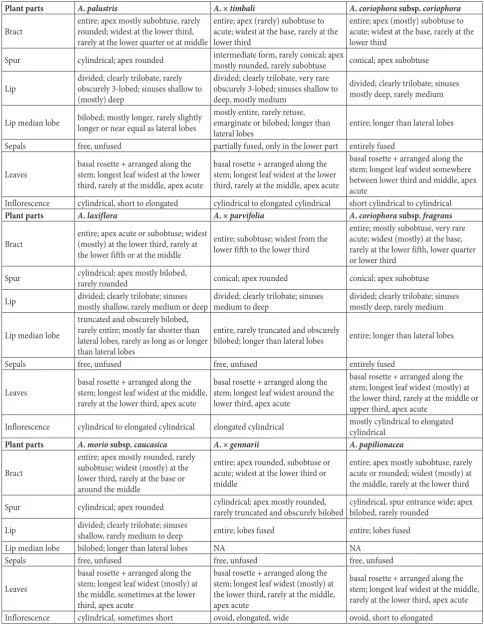
Table 5. Synopsis of 15 analyzed qualitative characters grouped into seven plant parts for all studied Anacamptis taxa.
Plant parts A. palustris A. × timbali A. coriophora subsp. coriophora
Bract entire; apex mostly subobtuse, rarely rounded; widest at the lower third, rarely at the lower quarter or at middle
entire; apex (rarely) subobtuse to acute; widest at the base, rarely at the lower third
entire; apex (mostly) subobtuse to acute; widest at the base, rarely at the lower third
Spur cylindrical; apex rounded intermediate form, rarely conical; apex mostly rounded, rarely subobtuse conical; apex subobtuse
Lip divided; clearly trilobate, rarely obscurely 3-lobed; sinuses shallow to (mostly) deep
divided; clearly trilobate, very rare obscurely 3-lobed; sinuses shallow to deep, mostly medium
divided; clearly trilobate; sinuses mostly deep, rarely medium
Lip median lobe bilobed; mostly longer, rarely slightly longer or near equal as lateral lobes mostly entire, rarely retuse, emarginate or bilobed; longer than
lateral lobes entire; longer than lateral lobes
Sepals free, unfused partially fused, only in the lower part entirely fused
Leaves basal rosette + arranged along the stem; longest leaf widest at the lower third, rarely at the middle, apex acute
basal rosette + arranged along the stem; longest leaf widest at the lower third, rarely at the middle, apex acute
basal rosette + arranged along the stem; longest leaf widest somewhere between lower third and middle, apex acute
Inflorescence cylindrical, short to elongated cylindrical to elongated cylindrical short cylindrical to cylindrical
Plant parts A. laxiflora A. × parvifolia A. coriophora subsp. fragrans
Bract entire; apex acute or subobtuse; widest (mostly) at the lower third, rarely at the lower fifth or at the middle
entire; subobtuse; widest from the lower fifth to the lower third
entire; mostly subobtuse, very rare acute; widest (mostly) at the base, rarely at the lower fifth, lower quarter or lower third
Spur cylindrical; apex mostly bilobed, rarely rounded conical; apex rounded conical; apex subobtuse
Lip divided; clearly trilobate; sinuses mostly shallow, rarely medium or deep divided; clearly trilobate; sinuses medium to deep divided; clearly trilobate; sinuses mostly deep, rarely medium
Lip median lobe
truncated and obscurely bilobed, rarely entire; mostly far shorter than lateral lobes, rarely as long as or longer than lateral lobes
entire, rarely truncated and obscurely
bilobed; longer than lateral lobes entire; longer than lateral lobes
Sepals free, unfused free, unfused entirely fused
Leaves basal rosette + arranged along the stem; longest leaf widest at the middle, rarely at the lower third, apex acute
basal rosette + arranged along the stem; longest leaf widest around the lower third, apex acute
basal rosette + arranged along the stem; longest leaf widest (mostly) at the lower third, rarely at the middle or upper third, apex acute
Inflorescence cylindrical to elongated cylindrical elongated cylindrical mostly cylindrical to elongated cylindrical
Plant parts A. morio subsp. caucasica A. × gennarii A. papilionacea
Bract
entire; apex mostly rounded, rarely subobtuse; widest (mostly) at the lower third, rarely at the base or around the middle
entire; apex rounded, subobtuse or acute; widest at the lower third or middle
entire; apex mostly subobtuse, rarely acute or rounded; widest (mostly) at the middle, rarely at the lower third
Spur cylindrical; apex rounded cylindrical; apex mostly rounded, rarely truncated and obscurely bilobed cylindrical, spur entrance wide; apex bilobed, rarely rounded
Lip divided; clearly trilobate; sinuses shallow, rarely medium to deep entire; lobes fused entire; lobes fused
Lip median lobe bilobed; longer than lateral lobes NA NA
Sepals free, unfused free, unfused free, unfused
Leaves
basal rosette + arranged along the stem; longest leaf widest (mostly) at the middle, sometimes at the lower third, apex acute
basal rosette + arranged along the stem; longest leaf widest (mostly) at the lower third, rarely at the middle, apex acute
basal rosette + arranged along the stem; longest leaf widest at the middle, rarely at the lower third, apex acute
values for this character are the highest. This hybrid is also characterized by the largest number of flowers as compared to the parents, but with a broad overlapping value with both of them (Supplementary Table S3).
Hybrid specimens often possess all or most of the qualitative character states taht exist in parent taxa, but with a different frequency (Table 5). Most of the observed qualitative characters are either uniform or have the same character states in all analyzed taxa. On the other hand, the spur shape in A. × gennarii (Fig. 1B) is the same as in the parent taxon A. morio subsp.
caucasica (Fig. 1A), but with larger dimensions, while the lip shape is very similar to that of another parent,
A. papilionacea (Fig. 1C), with hardly visible indica-tions of the existence of lobes. A. × parvifolia (Fig. 1E) resembles A. coriophora subsp. fragrans (Fig. 1F) in four qualitative characters (position of the broad-est part of the leaf, lip shape, spur shape and shape of spur apex). However, unlike this parent, which has completely or almost completely fused lateral and dorsal sepals, the hybrid and A. laxiflora (Fig. 1D) do not possess this character. A. × timbali (Fig. 1H) specimens often have an emarginated or bilobed lip median lobe, similar to those in A. palustris (Fig. 1G). The bracts in A. × timbali are the broadest at the base, similar to those in A. coriophora (Fig. 1I).
Principal component analysis
The results of principal component analysis (PCA) showed that the first two axes describe an very large proportion of the total sample variability (74.62%), which is a necessary prerequisite if the obtained
re-Fig. 1. Dissected flowers of nine analyzed Anacamptis taxa: A. mo-rio subsp. caucasica (A), A. × gen-narii (B), A. papilionacea (C), A. laxiflora (D), A. × parvifolia (E), A. coriophora subsp. fragrans (F), A. palustris (G), A. × timbali (H), A. coriophora subsp. coriophora (I). Scale bar represents a length of 10 mm.
Table 3. Principal component analysis (PCA) for 25 morphomet-ric characters from all analyzed taxa – factor coordinates of the variables for the two first principal axes and the eigenvalues of the correlation matrix.
Characters PCA 1 PCA 2
Bract length -0.740001 0.179525
Bract maximum width -0.857061 -0.279109
Bract width at the half-length -0.786219 -0.502231*
Ovary length -0.852340 0.017937
Ovary maximum length -0.879517 0.056911
Spur length -0.811822 0.173758
Spur width -0.466108 -0.484610*
Lateral sepal length -0.797060 -0.393942
Lateral sepal width at the half-length -0.919890* -0.130740
Lateral sepal maximum width -0.875975 -0.374895
Petal length -0.896842 -0.298925
Petal width at the half-length -0.897734 0.157522
Petal maximum width -0.908253* 0.152481
Dorsal sepal length -0.838034 -0.318910
Dorsal sepal width at the half-length -0.897033 0.245815
Dorsal sepal maximum width -0.918554* 0.185248
Lip maximum width -0.855229 0.295737
Lip maximum length -0.928592* -0.139717
Length to the top of lip median lobe -0.901324* -0.254950
Stem length -0.506598 0.595860*
Stem diameter 3 -0.640299 0.161736
Leaf length -0.442901 0.719315*
Leaf maximum width -0.651775 -0.071383
Inflorescence length -0.406877 0.735578*
Inflorescence width -0.625564 0.444371
Eigenvalue 15.561924 3.091899
% Total variance 62.247696 12.367597
Cumulative % variance 62.247696 74.615293
sults are to be used to interpret the boundaries of the morphological variability of the investigated taxa. The characters that contributed most to the variability of the total sample on the first axis (PCA 1, 62.25%), were lateral sepal width at the half-length, petal maximum width, dorsal sepal maximum width, lip maximum length and length to the top of the lip median lobe; on the second axis (PCA 2, 12.37%) they were the length of the longest leaf, inflorescence length, stem length, bract width at the half-length and spur width (Table 3). The first axis separates on its negative side representatives of the Laxiflorae (LaxL and PalP) and
Papilionaceae (PapP) sections from Moriones (MorC) and Coriophorae (CorC and CorF), which are on the positive side. The second axis separates species within the same sections. In the morphospace of the first two PCA axes, all three hybrid taxa occupy intermediate po-sitions between the corresponding parent taxa (Fig. 2).
Canonical discriminant analysis
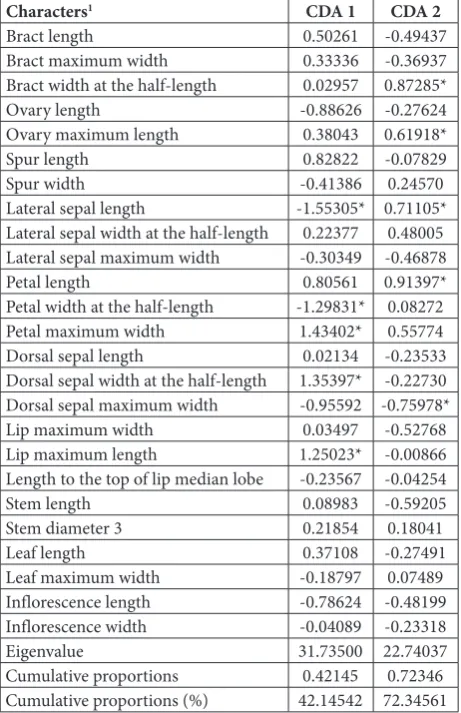
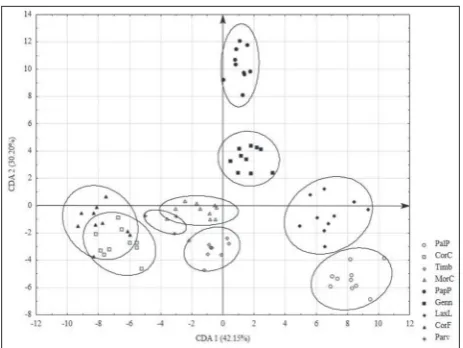
The first two axes defined more than 70% of the group discrimination (CDA 1, 42.15% and CDA 2, 30.20%). The characters that contributed most to the discrimi-nation on the first axis were lip maximum length, dorsal sepal width at the half-length, petal maximum width, petal width at the half-length and lateral sepal length, whereas on the second axis they were bract
width at the half-length, ovary maximum length, dorsal sepal maximum width, petal length and lateral sepal length (Table 4). As with the PCA, this analy-sis discriminated between members of the sections
Laxiflorae (LaxL and PalP) and Papilionaceae (PapP) along the positive side of the first axis, and Moriones
(MorC) and Coriophorae (CorC and CorF) on the negative side. On the second axis, A. papilionacea
(PapP) and A. ×gennarii (Genn) showed clear sepa-ration from all other taxa. Also, along the negative side of the same axis, the two subspecies of A. coriophora
(CorC and CorF) were separated, as well as the spe-cies from section Laxiflorae,A. laxiflora (LaxL), and
A. palustris (PalP). Hybrid taxa were positioned in the morphospace between their respective parents (Fig. 3). Fig. 2. Principal coordinate plot of the first two axes for 25
mor-phometric characters from all analyzed taxa (MorC – A. morio subsp. caucasica; Genn – A. × gennarii; PapP – A. papilionacea; LaxL – A. laxiflora; Parv – A. × parvifolia; CorF – A. coriophora subsp. fragrans; PalP – A. palustris; Timb – A. × timbali; CorC – A. coriophora subsp. coriophora).
Table 4. Canonical discriminant analysis (CDA) – standardized coefficients for canonical variables on the first two canonical axes, derived from discriminant function analysis on 25 morphometric characters from all analyzed taxa.
Characters1 CDA 1 CDA 2
Bract length 0.50261 -0.49437
Bract maximum width 0.33336 -0.36937
Bract width at the half-length 0.02957 0.87285*
Ovary length -0.88626 -0.27624
Ovary maximum length 0.38043 0.61918*
Spur length 0.82822 -0.07829
Spur width -0.41386 0.24570
Lateral sepal length -1.55305* 0.71105*
Lateral sepal width at the half-length 0.22377 0.48005
Lateral sepal maximum width -0.30349 -0.46878
Petal length 0.80561 0.91397*
Petal width at the half-length -1.29831* 0.08272
Petal maximum width 1.43402* 0.55774
Dorsal sepal length 0.02134 -0.23533
Dorsal sepal width at the half-length 1.35397* -0.22730
Dorsal sepal maximum width -0.95592 -0.75978*
Lip maximum width 0.03497 -0.52768
Lip maximum length 1.25023* -0.00866
Length to the top of lip median lobe -0.23567 -0.04254
Stem length 0.08983 -0.59205
Stem diameter 3 0.21854 0.18041
Leaf length 0.37108 -0.27491
Leaf maximum width -0.18797 0.07489
Inflorescence length -0.78624 -0.48199
Inflorescence width -0.04089 -0.23318
Eigenvalue 31.73500 22.74037
Cumulative proportions 0.42145 0.72346
Cumulative proportions (%) 42.14542 72.34561
DISCUSSION
All three newly registered hybrids for the region of Serbia (A. × timbali), Montenegro (A. × parvifolia) and North Macedonia (A. × gennarii) are known in botanical literature for some time [26-28], and there is plentiful evidence for their presence in Eu-rope [5,16,36-40]. Hybridization between the parent species that resulted in these hybrids reflected their similar geographical distribution, overlapping habitat preferences and similar periods of flowering, but also the degree of genetic similarity [18]. One of the parent taxa is A. morio subsp. caucasica. There is insufficient knowledge about the distribution of this subspecies in the Balkans [5], so this is the first confirmation of its presence in the area of North Macedonia in the last 80 years [41].
A. papilionacea and its hybrid, A. ×gennarii, are clearly separated from all the other analyzed taxa in the morphospace of both CDA axes, as confirmed by PCA, where a similar variability pattern was noted. This is the result of the specific floral morphology of these two taxa compared to all other analyzed – the absence of lip lobes. However, A. × gennarii inflores-cence has intermediate characteristics in relation to parents. It resembles in shape A. papilionacea (ovoid, elongated), but the hybrid inflorescence is wider, and together with the different appearance of hybrid
flow-ers (smaller in all floral parts, except the lips, which are wider), it has a diagnostic importance in relation to this parent taxon. Additionally, the leaves of both parents are the widest at the middle of the leaf blade, whereas they are on the lower third in the hybrid.
Hybridization between A. papilionacea and A. mo-rio, which results in the formation of A. × gennarii, is common and often results in the formation of hybrid swarms [5,30]. Hybrid specimens have wider inflores-cences with more flowers with wider lips compared to their parents. Since these are characters with po-tential evolutionary significance from the standpoint of pollinator attraction [42-44], it could be assumed that in this way the hybrid individuals become more susceptible to pollinators than the parent specimens. However, regardless of the wider inflorescence with a higher number of flowers, the proportion of inflo-rescence length in the overall length of hybrid plants is lower than in the species A. morio subsp. caucasica, and the inflorescence has a lower flower density than in the other parent, A. papilionacea. However, the wider lips present in hybrids potentially represent a larger landing surface for pollinator insects. It is clear that the hybrid specimens have the highest values of vegetative characters, such as stem length, plant height and one of the characters of stem diameter. They also have the largest number of leaves, but the size of leaves is of intermediate value. This may be a consequence of microecological differences in habitat, but also of differences in ontogeny; at the time when both parent taxa were just beginning to bloom, the hybrid speci-mens were already in full flower.
Hybrids A. × timbali and A. × parvifolia have dif-ferent pairs of parent species and subspecies, but all of them belong to two same sections: Laxiflorae (A.
palustris and A. laxiflora) and Coriophorae (A. co-riophora subsp. coriophora and A. coriophora subsp.
fragrans). In addition to these two hybrid taxa, sev-eral others that have parents from the same groups of species and a similar combination of parental char-acteristics have been described [5,18,28,45]. Based on the large number of described hybrids and high frequency of their occurrence in nature, the phylo-genetic similarity of these two groups was proposed [30]. The analyzed hybrid taxa were placed very close to each other in the morphospace of the first two dis-criminate axes, which indicates their morphological Fig. 3. Scatter plot of the first two canonical axes obtained by the
similarity in the general appearance of the flowers, or it may be indirectly a consequence of a similar pattern of inheritance of characters or a set of char-acters from parents to hybrid progeny; however, our analyses cannot confirm this. Both hybrid taxa have a wider spur and a larger inflorescence relative to the total plant height than their parent taxa. Such changes can potentially influence modifications in pollinator specificity and have an impact on the hypothetical evolutionary future of hybrids [18]. In addition, A. ×
parvifolia has a longer inflorescence than its parent taxa and A. × timbali has a larger number of flowers than its parents. All of these characters have potential importance in pollinator attraction, which could lead to the isolation of hybrid individuals from parents. However, in the case of both hybrids, parents from the Coriophorae group have twice as many flowers per cm of inflorescence length than the hybrid taxa, and A. coriophora subsp. fragrans has 50% more flow-ers than its respective hybrid A. × parvifolia, which undermines the importance of registered changes in hybrids. Unfortunately, the presence of nectar in the flowers of both hybrid taxa was not checked in the field. The existence of such a character in hybrids may be very significant, since the representatives of the
Coriophorae section are characterized by nectar pro-duction, and the Laxiflorae section are not.
The qualitative character that separates A. × parvi-folia from both parents is the position of the widest part of the bract. A. laxiflora bracts are widest at the lower third of their length, in A. coriophora subsp.
fragrans are widest at the base, whereas A. × parvifolia
has bracts that are widest somewhere between these two positions. Some A. × timbali specimens have a spur that is intermediate in shape and size in relation to those of the parents. However, this spur shape is not stabilized in the hybrids, as some hybrid individuals have spurs that are identical to those of A. coriophora.
A. palustris sepals are free, in A. coriophora they are entirely or almost entirely fused, while in A. × timbali
they are only partially fused.
Individuals of all the analyzed hybrid taxa grew in the immediate vicinity (up to 0.5 m) of one par-ent species, while others grew at a distance of several to up to several tens of meters. In the case of A. ×
gennarii hybrids, there was no difference in the habi-tat conditions between the place where the hybrid,
together with one of the parents (A. papilionacea) lived, with regard to other parent taxa. Both parent taxa, A. morio subsp. caucasica and A. papilionacea, as well as the hybrid, were observed in thermophilous grassland (ass. Astragalo-Helianthemetummarmorei) on dolomite limestone at 1008 m a.s.l. [46]. Various orchid species grew syntopically at the same locality, such as A. pyramidalis, A. laxiflora subsp. laxiflora, A.
coriophora subsp. coriophora, Cephalanthera damaso-nium, Neotineatridentata subsp. tridentata, Ophrys scolopax subsp. cornuta, O. sphegodes and Platanthera chlorantha.
On the other hand, two other hybrids were found exclusively among individuals of the taxon from the
Coriophorae section. Specimens of A. × parvifolia and those of the parent taxon A. coriophora subsp. fra-grans (about one hundred instances) lived on the fixed coastal dunes with herbaceous vegetation (Onobrychis caput-galli community). About 20 m away from the location of the hybrid specimens, the second parent,
A. laxiflora subsp. laxiflora, also a population of about 100 specimens, lived in a different habitat – Mediter-ranean salt meadows (ass. Juncetum maritime-acuti) [47]. Besides these three orchid taxa, specimens of
Serapiaslingua and Serapiasvomeracea, were also registered on this locality, with dozens of specimens.
Eight individuals of A. × timbali lived among spec-imens of A. coriophora subsp. coriophora, in meadow vegetation (ass. Rhinantho borbasii-Festucetum prat-ensis). The second parent (A. palustris subsp. palus-tris) lived nearby (a few meters away), in the same vegetation, but on places with higher groundwater levels. On this locality, only one other orchid species,
Orchis militaris subsp. militaris was registered, with only one specimen. All this indicates that despite some changes that took place in the morphology of the hy-brids, there were no key differences in their ecological preferences in relation to both parents. In addition to reproductive isolation, this is a prerequisite for their formation as separate evolutionary units, independent from parent taxa [48,49].
their recent clonal development from one or a few individuals. It can be assumed that all observed A. ×
timbali and A. × gennarii individuals are the products of only one hybridization event and that most of the hybrid individuals were formed by the clonal devel-opment of a few individuals that originated through hybridization of different parent species. This way of development and expansion of hybrid individuals was already recorded in other European orchids [3,18]. Considering the foregoing observation, the registered high morphological similarity among hybrid speci-mens was to be expected.
Funding: This research was conducted within Project No. 173030, funded by the Ministry of Education, Science and Technological Development of the Republic of Serbia.
Author contributions: BR designed the study, collected and per-formed the analysis of the plant material, perper-formed dissection and measurement of flowers, statistical analyses and wrote the manuscript. AV participated in field research and data collec-tion. JP performed measurements of vegetative plant organs and took part in data collection. VM reviewed the manuscript. GA supervised all activities and participated in field research, data analysis and manuscript preparation. All authors have revised and approved the final manuscript.
Conflict of interest disclosure: The authors declare no conflict of interest regarding the publication of this manuscript.
REFERENCES
1. Grant V. Plant speciation. 2nd ed. New York: Columbia Uni-versity Press; 1981. 563 p.
2. Abbott R, Albach D, Ansell S, Arntzen JW, Baird SJE, Bierne N, Boughman J, Brelsford A, Buerkle CA, Buggs R, Butlin RK, Dieckmann U, Eroukhmanoff F, Grill A, Cahan SH, Hermansen JS, Hewitt G, Hudson AG, Jiggins C, Jones J, Keller B, Marczewski T, Mallet J, Martinez-Rodriguez P, Möst M, Mullen S, Nichols R, Nolte AW, Parisod C, Pfennig K, Rice AM, Ritchie MG, Seifert B, Smadja CM, Stelkens R, Szymura JM, Väinölä R, Wolf JBW, Zinner D. Hybridization and speciation. J Evol Biol. 2013;26:229-46.
3. Pellegrino G, Bellusci F, Musacchio A. Morphological and molecular investigation of the parentage of Ophrys × cir-clarium (O. lutea × O. tarentina), a new hybrid orchid from Italy. Ann Bot Fennici. 2008;45:61-7.
4. Dafni A. Pollination in Orchis and related genera: evolu-tion from reward to decepevolu-tion. In: Arditti J, editor. Orchid Biology, Reviews and Perspectives. Ithaca-London: Cornell University Press; 1987. p. 79-104.
5. Kretzschmar H, Eccarius W, Dietrich H. The Orchid Genera Anacamptis, Orchis, Neotinea. 2nd ed. Bürgel: EchinoMedia Verlag Dr. Kerstin Ramm; 2007. 544 p.
6. Pridgeon AM, Cribb PJ, Chase MW, Rasmussen FN, editors. Genera Orchidacearum Vol 2. Oxford: Oxford University Press; 2012. 416 p.
7. Dafni A, Ivri Y. Pollination ecology of, and Hybridization between, Orchis coriophora L. and O. collina Sol. ex Russ. (Orchidaceae) in Israel. New Phytol. 1979;83:181-7. 8. Luca A, Bellusci F, Menale B, Musacchio A, Pellegrino G.
Orchis × colemanii hybridization: Molecular and morpho-logical evidence, seed set success, and evolutionary impor-tance. Flora. 2012;207:753-61.
9. Scopece G, Musacchio A, Widmer A, Cozzolino S. Pat-terns of reproductive isolation in Mediterranean deceptive orchids. Evolution. 2007;61:2623-42.
10. Cozzolino S, Aceto S, Caputo P, Menale B. Characterization of Orchis × dietrichiana Bogenh., a natural orchid hybrid. Plant Biosyst. 1998;132(1):71-6.
11. Scopece G, Widmer A, Cozzolino S. Evolution of Postzygotic Reproductive Isolation in a Guild of Deceptive Orchids. Am Nat. 2008;171(3):315-26.
12. Pellegrino G, Caputo P, Cozzolino S, Menale B, Musaccio A. Molecular characterization of a hybrid zone between Orchis mascula and O. pauciflora in Southern Italy. Biol Plant. 2000;43(1):13-8.
13. Arduino P, Verra F, Cianchi R, Rossi W, Corrias B, Bullini L. Genetic variation and natural hybridization between Orchis laxiflora and Orchis palustris (Orchidaceae). Pl Syst Evol. 1996;202:87-109.
14. Scacchi R, De Angelis G, Lanzara P. Allozyme variation among and within eleven Orchis species (fam. Orchidaceae), with special reference to hybridizing aptitude. Genetica. 1990;81:143-50.
15. Bateman RM, Farrington OS. A morphometric study of ×Orchiaceras bergonii (Nanteuil) Camus and its parents (Aceras anthropophorum (L.) Aiton. f. and Orchis simia Lamarck) in Kent. Watsonia. 1987;16:397-407.
16. D’Emerico S, Bianco P, Pignone D. Cytomorphologi-cal characterization of diploid and triploid individuals of Orchis × gennarii Reichenb. fil. (Orchidaceae). Caryologia. 1996;49(2):153-61.
17. Aceto S, Caputo P, Gaudio L. Molecular approach to the identification and characterization of natural hybrids between Orchis pauciflora Ten. and Orchis quadripunctata Cyr. ex Ten. (Orchidaceae). Bot Helv. 2000;110:31-9. 18. Bateman RM, Hollingsworth PM. Morphological and
Molecular Investigation of the Parentage and Maternity of Anacamptis × albuferensis (A. fragrans × A. robusta), a New Hybrid Orchid from Mallorca, Spain. Taxon. 2004;53(1):43-54.
19. Rohlena J. Conspectus Florae Montenegrinae. Preslia. 1942;20-21:1-506.
20. Pulević V. Građa za vaskularnu floru Crne Gore: Dopuna „Conspectus Florae Montenegrinae“ J. Rohlene. Podgorica: Republički Zavod za zaštitu prirode Crne Gore; 2005. 218 p. 21. Niketić M, Tomović G. Kritička lista vrsta vaskularne flore
Srbije 1. Lycopodiopsida, Polypodiopsida, Gnetopsida, Pinopsida i Liliopsida. Beograd: Srpska akademija nauka i umetnosti; 2018. 294 p.
orchids: Schould we protect the orchid hybrids or the orchid hybrid zones? Biol Cons. 2006;I(29):14-23.
23. Stronen AV, Paquet PC. Perspectives on the conservation of wild hybrids. Biol Cons. 2013;167:390-5.
24. Bohling JH. Strategies to address the conservation threats posed by hybridization and genetic introgression. Biol Cons. 2016;203:321-7.
25. Serra Laliga L, López Espinosa JA. Anacamptis × daf-nii nothosubsp. solanoi Serra & López Esp., nothosubsp. nov. (Orchidaceae), a new hybrid. An Jard Bot Madr. 2018;75(1):e065.2018.
26. Reichenbach HG. Icones Florae Germanicae et Helveticae Vol XIII-XIV. Lipsiae: sumptibus Friderici Hofmeister; 1850-1. 194 p.
27. Velenovský J. O některých posud v Čechách nepozoro-vaných míšencích rostlinných. Sitz-Ber Böhm Ges Wiss. 1882;1882:254-8.
28. Camus EG, Bergon P, Camus A. Monographie des Orchidées de l’Europe de l’Afrique septentrionale, de l’Asie mineure et des Provinces Russes transcaspiennes. Paris: Librairie Jacques Lechevalier; 1908. 552 p.
29. Soó R. Orchis L. In: Tutin TG, Heywood VH, Burges NA, Moore DM, Valentine DH, Walters SM, Webb DA, editors. Flora Europaea Vol V. Cambridge: Cambridge University Press; 1980. p. 333-7.
30. Delforge P. Orchids of Europe, North Africa and the Middle East. London: A&C Black Publishers Ltd; 2006. 640 p. 31. Thiers B. Index Herbariorum: a global directory of public
herbaria and associated staff [Internet]. New York: New York Botanical Garden. 1997 - [cited 2019 Jul 11]. Available from: http://sweetgum.nybg.org/science/ih/.
32. Bateman RM, Rudall PJ. Evolutionary and Morphometric Implications of Morphological Variation Among Flowers Within an Inflorescence: A Case-Study Using European Orchids. Ann Bot. 2006;98:975-93.
33. Götz P, Reinhard HR. Biostatistische Untersuchun-gen an europäischen Orchideen. Ber Schweiz Bot Ges. 1973;83(2):93-105.
34. Pielou EC. The interpretation of ecological data. A primer on classification and ordination. New York: Wiley; 1984. 288 p.
35. Manly BFJ. Multivariate Statistical Methods: A Primer. Lon-don: Chapman & Hall; 1986. 159 p.
36. Geiling O, Schultze G. Nachweis der Bastarde von Orchis coriophora × O. laxiflora Lam. ssp. palustris und O. cori-ophora × Anacamptis pyramidalis bei Dabas. Acta Bot Hung. 1974;20(3-4):243-8.
37. Del Prete C, Conte R. Studi sulla flora e vegetazione del Monte Pisano (Toscana Nord-Occidentale). 3 Orchidaceae. (Contributi alla conoscenza della Orchidaceae d’Italia. 5). Webbia. 1979;33:553-613.
38. Aceto S, Cozzolino S, Gaudio L, Nazzaro R, De Luca P. Pol-lination flow in hybrid formation between Orchis morio and Orchis papilionacea (Orchidaceae) in two different habitats. Int J Plant Sci. 1999;160(6):1153-6.
39. Dimopoulos P, Raus Th, Bergmeier E, Constantinidis Th, Iatrou G, Kokkini S, Strid A, Tzanoudakis D. Vascular plants of Greece: An annotated checklist. Berlin: Botanischer Gar-ten und Botanisches Museum Berlin-Dahlem; 2013. 372 p. 40. Rottensteiner WK. Exkursionsflora für Istrien. Klagenfurt:
Verlag des Naturwissenschaftlichen Vereins für Kärnten; 2014. 1014 p.
41. Hayek A. Prodromus Florae peninsulae Balcanicae. Dahlem bei Berlin: Verlag des Repertoriums; 1933. 472 p.
42. Conner JK, Rush S. Effects of flower size and number on pollinator visitation to wild radish, Raphanus raphanistrum. Oecologia. 1996;105:509-16.
43. Kawarasaki S, Hori Y. Effect of flower number on the pollinator attractiveness and the threshold plant size for flowering in Pertya triloba (Asteraceae). Plant Spec Biol. 1999;14:69-74.
44. Harder LD, Johnson SD. Darwin’s beautiful contrivances: evolutionary and functional evidence for floral adaptation. New Phytol. 2009;183:530-45.
45. Baumann H, Künkele S. Die wildwachsenden Orchideen Europas. Stuttgart: Kosmos; 1982. 432 p.
46. Matevski V, Čarni A, Ćušterevska R, Kostadinovski M, Mucina L. Syntaxonomy of the rocky grasslands on carbon-ate bedrocks in the west and southwest of the Republic of Macedonia. Appl Ecol Environ Res. 2015;13(4):1197-214. 47. Stešević D, Luković M, Caković D, Ružić N, Bubanja N, Šilc
U. Distribution of alien species along sand dune plant com-munities zonation. Period Biol. 2017;119(4):239-49. 48. Funk DJ, Nosil P, Etges WJ. Ecological divergence exhibits
consistently positive associations with reproductive isolation across disparate taxa. PNAS. 2006;103(9):3209-13. 49. Schluter D. Evidence for Ecological Speciation and Its
Alter-native. Science. 2009;323(6):737-41.
Supplementary Material