ISSN: 2278-3369
International Journal of Advances in Management and Economics
Available online at:
www.managementjournal.info
RESEARCH ARTICLE
The Effect of Manager’s Overconfidence on the Performance of Transnational
Mergers and Acquisitions-An Empirical Study based on China's State-Owned
Enterprises
Yang Xue-jun, Zhang Yong*
International Business School,Jinan University, Qianshan, Zhuhai, Guangdong, China.
*Corresponding Author: Email: [email protected]
Abstract :This paper selects A-share listed companies in Shanghai and Shenzhen from 2011 to 2016 as
samples, and studies the relationship between manager’s overconfidence and performance of cross-border M&A from the perspective of China's state-owned enterprises. The empirical results show that the overconfidence of managers has a significantly negative effect on the performance of M&A. According to the nature of ownership, the samples are divided into two groups: state-owned enterprises and non-state-owned enterprises. We find that the overconfidence of managers in the sample group of state-owned enterprises has a greater impact on the performance of cross-border M&A.
Keywords: Overconfidence of Managers, Performance of cross-border M&A, The state-owned Enterprises.
Article Received: 30 Sept. 2018 Revised: 05 October 2018 Accepted: 20 October 2018
Introduction
With the continuous promotion of "Going out" strategy and the proposal of "One Belt and One Road" strategy, Chinese enterprises have ushered in a new round of cross-border M&A boom. The number of cross-border mergers and acquisitions in China has also grown rapidly in recent years. According to Dealogic's cross-border M&A database, the number of Chinese enterprises' cross-border M&A increased from $1.49 billion in 2001 to $76.9 billion in 2017.
Therefore, the rapid growth of cross-border M&A of Chinese enterprises has become a hot topic in the academic circle. However, in
recent years, Chinese enterprises'
transnational mergers and acquisitions frequently fail due to the resistance of the host country, as well as the occurrence of poor management even after the success of mergers and acquisitions, so we will have
questions: what factors affect the
performance of enterprises' transnational
mergers and acquisitions? Most scholars mainly study the influencing factors of transnational M&A performance from the macro level and enterprise level, among
which institutional distance, cultural
differences and political connections have significant influence on the performance of enterprises after M&A, tested the impact of the system on the enterprise performance
after M&A through empirical analysis[1].
and acquisitions in 2000-2008 [2]. The research on the performance of M&A by political connections showed that the performance of cross-border M&A of state-owned enterprises is lower than that of non-state-owned enterprises due to the inefficiency of state-owned enterprises and
considerations of political purposes [3].
Although there has been a lot of literature on M&A performance, few studies have focused on the impact of decision-making subjects on the performance of enterprises after M&A. Therefore, this paper further studies the
relationship between managers'
overconfidence and the performance of enterprises' transnational M&A based on the
limited rationality and overconfidence
theories in behavioral economics.
Literature Review
The Performance of Cross-Border M&A
With the emergence of large multinational companies, a large number of scholars have conducted in-depth research on corporate overseas mergers and acquisitions. Some literatures are from merger motives and the impact of M&A on enterprise value and factors influencing the success of M&A to study the transnational mergers and acquisitions of enterprises [4-7].
On the one hand, it aims to acquire the patented technology of the merged enterprise and make up for the shortcoming of the company. Another aspect is to explore overseas markets and create an international marketing network. Existing literatures mainly study the impact of macro-level and enterprise-level factors on the performance of cross-border M & A. At the macro level, government support, high degree of cultural similarity and geographical advantage all have positive effects on the transnational direct investment of enterprises. Therefore, mergers and acquisitions in host countries with smaller cultural distance will result in better performance [1]. From the study of cross-border M&A cases in China, the
government's incentive policy and the nature of the enterprise ownership have much effect on the enterprise transnational merger and acquisition [8]. The systems of the host
country factors on enterprise
internationalization strategy implementation have significant regulatory role and indirect influence in the performance of cross-border M&A [9].
In terms of enterprise factors, the ownership structure of the target company, enterprise scale and the corporate strategy of diversified operation of the main acquirer have a significant impact on the shareholder value after the merger [5].Using event study on short term and long term performance of Chinese enterprises transnational M&A
research found that the state-owned
enterprise of M&A performance was
significantly higher than that of
non-state-owned enterprises, and growing enterprise M&A performance was superior to the value of the enterprise [3].
In addition, the characteristics and corporate governance of the main acquirer, selection of M&A targets, and methods of M & A transactions all have an impact on the long-term and short-term performance of cross-border M & A [10]. As for the factors affecting the cross-border M & A of enterprises, domestic and foreign scholars have reached a basically consistent view: the greater the difference in institutional distance, cultural distance and ownership structure of enterprises, the greater the difficulty of integration after the M & A of enterprises will be, which will ultimately reduce the performance of M&A. However, most scholars focus on the impact of objective factors on the performance of cross-border M&A while ignoring the impact of enterprise management as the decision-making subject.
Overconfidence and Merger &
Acquisition
with overconfidence tend to attribute success to an individual's ability and failure to objective factors. This is a common psychological feature of people, which is widely existed in all aspects of our life and management work [12]. Roll introduced overconfidence into enterprise business decisions in a pioneering way, and believed that the "arrogance" of managers would lead to overestimation of M&A returns and synergies in the process of enterprise merger and acquisition [13].
On the other hand, the manager's overconfidence will also lead to the overpaying of the main merger and acquisition companies, which will bring damage to the main merger and acquisition
companies. Because overconfidence of
managers is a subjective psychological state and lacks objective measures, there are few literatures on empirical test of overconfidence theory.
Malmendier and Tate took the panel data of Forbes 500 companies as the research sample, and used the portfolio of stocks and options held by managers of their companies as the agent variable of overconfidence to
explain the investment distortion
phenomenon and verify that managers would make excessive investment when enterprises have sufficient cash flow [14].Subsequently, Malmendier and Tate used the CEO's investment and media evaluation of the company as the measurement standard of overconfidence.
They found that overconfident managers overestimated the value of the target company, and thus carried out M&A activities that were detrimental to the value of the main acquirer, which further confirmed the "arrogance" hypothesis from the empirical
aspect [15]. Domestic scholars have also
conducted some research on overconfidence of managers, mainly using the relative salary and profit forecast of managers exceed the actual level to measure overconfidence of managers. Shi Yong-dong and Zhu
Guang-yan studied 948 M&A Companies and took the manager's relative salary as the measurement method of overconfidence.
They found that overconfident managers would initiate mergers more frequently compared with rational managers [16]. Ling Ye and Wang Ya-xing used earnings forecasts as indicators of overconfidence agent. They found that overconfidence managers of mergers and acquisitions investment was higher compared with the rational managers [17].
Theoretical Basis and Hypotheses
Overconfidence and Cross-Border M&A Performance
According to the related research results of most scholars on the performance of transnational mergers and acquisitions, the integration of enterprises after transnational mergers and acquisitions is an inevitable problem. The integration of enterprises after cross-border M&A will be affected by various factors, such as the institutional distance, cultural distance and geographical distance between the two countries, which will affect the integration difficulty after M&A [18].
We found that the common ground of these studies was the assumption of "rational man" in traditional economics. But research in
behavioral economics suggested that
managers were not "perfectly rational". Although most enterprise managers have good education background and rich management experience, they still have the possibility of "overconfidence" when making major business decisions. Hayward and Ham brick found that the media's evaluation of the
Brown and Sarma used the Logistic regression model to analyze the M & A enterprises in Australia from 1994 to 2003. They found that overconfident managers were easy to implement M&A activities, and their performance after M&A was low [20].
Although domestic scholars have conducted
certain research on the enterprise
performance of overconfidence of managers in domestic mergers and acquisitions, there is a great difference between the transnational and the domestic mergers and acquisitions of enterprises.
Cross-border M& A often exists between two different countries and two different enterprises, and there are significant differences in various aspects such as economy, politics, law and culture between different countries, which makes it more complicated for enterprises to conduct cross-border M & A. At present, some cases of cross-border M & A failure are often caused by underestimating the cost of M&A and the difficulty of integration after M & A. "Underestimating relevant risks" is just one of the manifestations of overconfidence.
In the process of transnational mergers and acquisitions, overconfident managers often feel that all merger information of enterprises is in their own hands, underestimate the uncertainty risk brought by culture and system, overestimate the synergies between enterprises after mergers and acquisitions. Finally, these would affect the performance of enterprises after mergers and acquisitions. Therefore, based on the above analysis, this paper proposes the first hypothesis:
H1: The overconfidence of managers has a significantly negative impact on the performance of cross-border M&A.
State-Owned Enterprises and the
Overconfidence of Managers
China's listed companies are divided into state-owned listed companies and private
listed companies according to the nature of ownership. Due to the different nature of ownership, the selection mechanism and
governance structure of state-owned
enterprises and private enterprises are very different. State-owned enterprises implement the administrative appointment system for managers, and enterprise managers are selected and appointed by the higher authorities [21]. However, private enterprise managers are greatly influenced by natural person shareholders and family factors.
As the state-owned enterprise is closely connected with the government, the enterprise is more likely to get government support and more convenient financing channel. Therefore, the managers of state-owned enterprises often underestimate the risks in mergers and acquisitions [22]. Therefore, this paper proposes the second hypothesis:
H: State-owned enterprises would strengthen the negative impact of overconfidence of
managers on the performance of
transnational mergers and acquisitions.
Data and Methods
Data
This paper studies the cross-border M&A by non-financial listed companies of Shanghai stock exchange and Shenzhen stock exchange. The samples of cross-border M&A from 2011 to 2016 are obtained from SDC database and CSMAR database. After removing the abnormal and missing data, a total of 152 effective cases of cross-border M&A are collected.
Variable Definition
The Performance of Transnational Mergers and Acquisitions
some scholars criticize that the financial data of listed companies may be distorted, the financial indicators contain enough profit information, and the data of listed companies will be reflected in the financial statements.
A large number of relevant literatures studied the change of business performance before and after M&A by using the total asset yield, operating margin, Tobin Q value, etc. [23-25]. Therefore, this paper refers to the research of Liu Bai and Liang Chao on the performance of transnational mergers and acquisitions of enterprises: to measure the long-term performance of mergers and acquisitions by taking three years as the time window, that is, from the end of the year before the company announced the merger to the end of the year after the announcement of the merger [26].
OPt =(trading profit / total assets )t+1 —(trading profit / total
assets)t-1
The Overconfidence of the Manager
As a kind of subjective psychological deviation, overconfidence is difficult to be measured directly. At present, researchers mostly adopt the proxy variable about overconfidence. Foreign scholars mainly measure the overconfidence of managers from the aspects of delaying the exercise of options or increasing their shares voluntarily. Malmendier & Tate judged that managers were overconfident in delaying the exercise of stock options, holding the options until one
year before the expiration date, or increasing the stock of the company [14]. However, due to the late implementation of the option incentive in China, the data of related companies in this respect is relatively few, so it is not suitable to use the option to measure the overconfidence of managers. In recent years, it is common to take the share holding status of enterprise managers as a measure of managers' overconfidence [14-27-29].
This paper can use the method of Malmendier & Tate for reference. When dividends such as performance stocks and red shares are excluded, the voluntary increase of stock ownership by managers within the year is
considered as overconfidence. The
overconfidence is recorded as 1, otherwise 0.
The State-Owned Enterprises
This paper introduces state-owned
enterprises as the moderator to study the
performance of transnational M&A.
According to the classification standard of CSAMA database, the acquired transnational M&A companies are divided into state-owned enterprises and non-state-owned enterprises during the sample period. The state-owned enterprises are recorded as 1, otherwise 0.
Control Variable
On the basis of referring to relevant scholars' researches, this paper introduces Size of Company, Capital Structure and Proportion of Independent Directors as the control variables. The relevant definitions and measurements of all variables in this paper are shown in Table 1.
Table 1: Variables Definition
Variable Name Symbol Variable Description
The Performance of M&A OP The change about trading profit to total assets [26] .
Overconfidence OC The voluntary increase of shareholding by managers is recorded as 1,
otherwise 0 [14- 27].
The state-owned Enterprises SOE The state-owned enterprises are recorded as 1, otherwise 0.
Size of Company SIZE The natural log of the total assets of the company in the previous year.
Capital Structure DB The ratio of total liabilities to total assets in the year prior to the
acquisition. Proportion of Independent
Directors
Construction of Regression Model
This paper uses multiple linear regression models to analyze the relationship between overconfidence (OC) and M&A performance (OP).The regression model is as follows:
OP =β0 + β1 OC +β2 SOE +β3 SOE*OC +β4 DB
+β5 SIZE +β6 DDR +ε
The Empirical Test
Descriptive Statistics of Sample Data
Table 1 shows the correlation coefficient between variables in this paper, and the maximum correlation coefficient is 0.574.The correlation coefficient between the dependent variable and the independent variable is -0.283, which indicates that there is a negative relationship between the manager's overconfidence and the performance of the enterprise's transnational mergers and acquisitions, which needs to be further tested by regression analysis in this paper.
Table 2: The Correlation’s Coefficient between Variables
OP OC SOE DB SIZE DDR
OP 1
OC -0.283*** 1
SOE -0.0770 -0.0380 1
DB 0.306*** 0.289*** 0.349*** 1
SIZE -0.0560 -0.0850 0.547*** 0.574*** 1
DDR 0.110 -0.0100 0.00300 0.0130 -0.0140 1
Standard errors in parentheses *** p<0.01, ** p<0.05, * p<0.1
Regression Test and Analysis
This paper uses STATA 12.0 for data
regression.
Table 3: Regression Results
(1) (2) (3) (4) (5)
VARIABLES Model 1 Model 2 Model 3 Model 4 Model 5
OC -0.0315*** -0.0314*** -0.0271*** -0.0271***
(0.00759) (0.00759) (0.00825) (0.00919)
SOE -0.00884 -0.000122
(0.00841) (0.0135)
SOE *OC -0.0135 -0.0133
(0.0100) (0.0161)
DB 0.111*** 0.106*** 0.107*** 0.105*** 0.105***
(0.0200) (0.0190) (0.0190) (0.0190) (0.0193)
SIZE -0.00758*** -0.00563*** -0.00462** -0.00416* -0.00416*
(0.00201) (0.00196) (0.00218) (0.00224) (0.00226)
DDR 0.0783 0.0794 0.0800 0.0807 0.0807
(0.0588) (0.0559) (0.0559) (0.0557) (0.0559)
Constant 0.0787 0.0563 0.0355 0.0234 0.0234
(0.0481) (0.0460) (0.0501) (0.0520) (0.0522)
Observations 152 152 152 152 152
R-squared 0.184 0.269 0.275 0.278 0.278
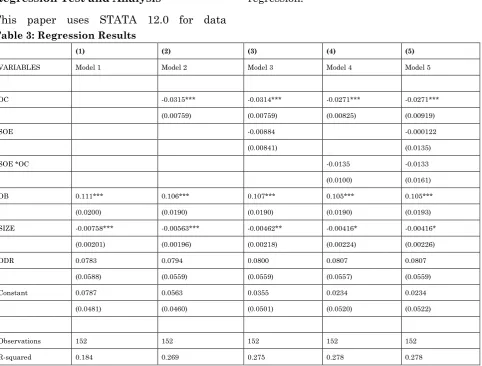
The regression results show that in model 1, which only contains control variables, the coefficient of capital structure is significantly positive, while the coefficient of company size is significantly negative. However, the coefficient of independent directors is not significant, and the R-squared is only 0.184. After the manager's overconfidence variable is introduced into model 2, the explanatory power of the model increased rapidly from 0.184 to 0.269, indicating that the manager's overconfidence has a better explanatory power for the performance of cross-border M&A.
At the same time, the coefficient of overconfidence of managers is significantly negative; indicating that overconfidence of managers can significantly reduce the performance of cross-border M&A of enterprises. Hypothesis 1 is supported. In the model 3 and model 4, we found that their coefficients were all negative, but they were not significant. Therefore, hypothesis 2 in this paper is not supported. However, after the introduction of these two variables, the
explanatory power of the model was changed from 0.269 to 0.275, indicating that the state-owned enterprise variables still have some explanatory power. This paper will give further detailed analysis in the robustness test part. Model 5 is the regression result of all explanatory variables and explained variables. Although the absolute value of the manager's overconfidence coefficient is smaller, it is still significant and the explanatory power of the model reaches 0.278.
Robustness Test
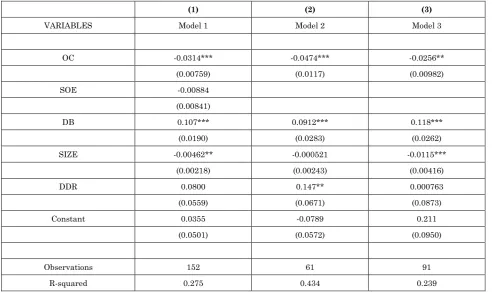
In order to verify the reliability of the regression results, the robustness test was performed. The regression was conducted by dividing samples collected between 2011 and 2016 into state-owned enterprises and non-state-owned enterprises according to the standards of CSMAR database. The results are shown in Table 4:
Table 4: Regression Results
(1) (2) (3)
VARIABLES Model 1 Model 2 Model 3
OC -0.0314*** -0.0474*** -0.0256**
(0.00759) (0.0117) (0.00982)
SOE -0.00884
(0.00841)
DB 0.107*** 0.0912*** 0.118***
(0.0190) (0.0283) (0.0262)
SIZE -0.00462** -0.000521 -0.0115***
(0.00218) (0.00243) (0.00416)
DDR 0.0800 0.147** 0.000763
(0.0559) (0.0671) (0.0873)
Constant 0.0355 -0.0789 0.211
(0.0501) (0.0572) (0.0950)
Observations 152 61 91
R-squared 0.275 0.434 0.239
Zhang Yong et. al. | Nov. -Dec. 2018 | Vol.7| Issue 6 |01-09 8
Model 1 is the regression result without grouping samples. In this paper, model 2 is compared with model 3. Model 2 and model 3 are the results after sample group regression. Among them, the samples in model 2 are state-owned enterprises, with a total of 61 samples. Model 3 is a non-state-owned enterprise with a total of 91 sample values.
Thecoefficient of manager’s overconfidence in
the model 2 are greater than model 3. The manager’s overconfidence in state-owned enterprises has a more significant impact on the performance of cross-border M&A. Hypothesis 2 is also supported.
Conclusion
This paper selects the transnational M&A samples of 152 non-financial listed companies of Shanghai stock exchange and Shenzhen stock exchange from 2011 to 2016, and studies the relationship between the overconfidence of managers and the performance of enterprises' transnational M&A. The empirical results show that the
overconfidence of managers has a
significantly negative effect on the
performance of M&A. According to the nature of ownership, the samples are divided into two groups: state-owned enterprises and non-state-owned enterprises. We find that the overconfidence of managers in the sample group of state-owned enterprises has a greater impact on the performance of cross-border M&A. However, due to the influence of sample data, this paper also has some deficiencies.
We only obtain 152 effective samples of cross-border M&A from the CSMAR database. Therefore, the regression results are not significant in verifying the moderating effect of state-owned enterprises on overconfidence and M&A performance. Therefore, the future research direction can refer to other literatures, relax the sample
selection interval, and select more
comprehensive indicators to measure the overconfidence of managers.
References
1. Yan Da-ying (2009) International experience, cultural
distance and the performance of overseas M&A of Chinese enterprises [J]. Economic Review, 1:83-92.
2. Zhu Qin, Liu Yao (2013) Empirical Analysis on
Influencing Factors of Financial Performance of Cross-border Mergers by China’s Listed Companies [J]. Journal of International Trade, 8:151-160.
3. Gu Lu-lu , Robert Reed (2011) Do Chinese Acquirers
Fail in Overseas M&As? [J]. Economic Research
Journal, 7:116-129.
4. Deng P (2009) why do Chinese Firms Tend to Acquire
Strategic Assets in International Expansion? [J]. Journal of World Business, 44 (1):74-84.
5. Aybar B, Ficici A (2009) Cross-border acquisitions and firm value: An analysis of emerging-market multinationals [J]. Journal of International Business Studies, 40(8) :1317-1338.
6. Dikova D, Sahib PR, Witteloostuijn AV (2010)
Cross-border Acquisition Abandonment and
Completion: The Effect of Institutional Differences and Organizational Learning in the International
Business Service Industry,1981-2001 [J]. Journal of
International Business Studies, 41 (2):223-245.
7. Erel I , Liao RC , Weisbach MS (2012)
Determinants of Cross-Border Mergers and
Acquisitions [J]. Journal of Finance, 67(3):1045-1082.
8. Morck R,Yeung B, Zhao M (2008) Perspectives on
China's Outward Foreign Direct Investment [J]. Journal of International Business Studies, 39(3): 337-350.
9. Zhang Jian-hong ,Zhou Chao-hong (2010) A Study
on Institutional Barriers of Chinese Companies Going Global [J]. Economic Research Journal, 6: 80-91.
10. Yu Peng-yi , Wang Man-si (2014) Empirical Research
on Factors Influencing the Performance of
Cross-national M&A of Domestic Listed Companies
[J]. Accounting Research, 3:64-70.
Overconfidence Compensation Contracts and Capital Budgeting [J]. Journal of Finance,66 (5):1735-1777.
12.Svenson O (1981) Are we all less risky and more
skillful than our fellow drivers? [J].Acta
Psychological, 47 (2):143-148.
13.Roll R (1986) The Hubris Hypothesis of Corporate Takeovers [J]. Journal of Business,59 (2):197-216.
14.Malmendier U,Tate G (2005) CEO Overconfidence
and Corporate Investment [J]. Journal of Finance,
60 (6):2261-2700.
15.Malmendier U, Tate G (2008) financial expertise of
directors [J]. Journal of Financial Economics, 88 (2):323-354.
16.Shi Yong-dong Zhu Guang-yin (2010) An Empirical
Study on the Relationship between Managerial
Overconfidence and Corporate Mergers and
Acquisitions [J].Chinese Review of Financial Studies, 2:73-82.
17.Ye Ling , Wang Ya-xing (2013) Managerial
Overconfidence, Investment and Enterprise
Performance--Empirical Evidence from Chinese A- share Listed Companies [J]. Journal of Shanxi Finance and Economics University, 1:116-124.
18.Yan Da-ying (2011) A Research on the Institutional Distance, International Experience and Chinese Overseas Acquisitions [J]. NanKai Economic Studies, 5:75-97.
19.Hayward, M, Hambrick, D (1997) Explaining the
premiums paid for large acquisitions: Evidence of CEO hubris [J]. Administrative Science Quarterly, 42(1): 103-127.
20.Brown R, Sarma N (2007) CEO Overconfidence,CEO
dominance and corporate acquisitions [J]. Journal of Economics and Business, 59 (5):358-379.
21.Xiao Ling (2006) Study on the Mechanism of Selection
and Appointment of Managers in China's State-owned Enterprises, University of International Business and Economics, MA.
22. Ge Hong-ling , Shan Zhuo (2015) Impact of
Managerial Overconfidence on M&A Decisions in
China's Listed Companies--Empirical Research Based on Comparative Perspective between State-owned Enterprises and Private Companies [J]. Journal of Bei Jing Technology and Business University, 30 (5):82-91.
23. Zollo M, Singh H (2004) deliberate learning in corporate acquisitions: post‐acquisition strategies and integration capability in U.S. bank mergers [J]. Strategic Management Journal, 25 (13):1233-1256
24. Wu Chao-peng, Wu Shi-nong , Zheng Fang-biao
(2008) A Theoretical and Empirical Study on Manager's Behavior and Performance of Serial Acquisitions [J]. Management World, 7:126-133.
25. Su Wei-dong, Xie Ling-hong (2011) Analysis of
Continuous M&A Behavior based on Time Interval [J]. Journal of Northwestern Polytechnic University (Social Sciences), 31 (1): 28-31.
26. Liu Bai , Liang Chao (2017) The Board’s
Overconfidence and the International M&A
Performance [J]. Business Management Journal, 12: 73-88.
27. Hao Ying, Liu Xing, Lin Chao-nan (2005) An
Empirical Research on the General Manager Overconfidence and Investment Decision for the Listed Companies [J]. Chinese Journal of Management Science, 13 (5): 142-148.
28. Rao Yu-lei, Wang Jian-xin (2010) CEO
Overconfidence, Board Structure and Firm
Performance [J]. Journal of Management Science, 23 (5): 2-13.
29. Zhu Lei ,Han Xue ,Wang Chun-yan (2016)
Ownership Structure,CEO Overconfidence and
Enterprise Innovation Performance--Empirical