Available online through
ISSN 2229 – 5046CONNECTED DOMINATION POLYNOMIAL OF A GRAPH
*Dhananjaya Murthy B. V.
Department of Mathematics, Nitte Meenakshi Institute of Technology, Yelahanka, Bangalore, India.
Deepak G.
Acharya Institute of Graduate Studies, Soldevanhalli, Achitnagar, Bangalore -107, India.
N. D. Soner
Department of Studies in Mathematics, University of Mysore, Mysore - 570 006, India.
(Received on: 08-10-13; Revised & Accepted on: 29-11-13)
ABSTRACT
L
et G = (V, E) be a simple connected graph of order n. A connected dominating set of G is a set S of vertices of G such that every vertex in V − S is adjacent to some vertex in S and the induced subgraph 〈S〉is connected. The connected domination number ϒc(G) is the minimum cardinality of a connected
dominating set of G. In this paper we introduce the connected domination polynomial of G. The connected domination polynomial of a connected graph G of order n is the polynomial Dc(G, x) =
( )
( )
∑
= nG
γ
i
i c
c
d
G,
i
x
,
where dc(G, i) is the number of connected dominating set of G of size i and ϒc(G) isthe connected domination number of G. We obtain some basic properties of the connected domination polynomial and compute this polynomial and its roots for some standard graphs.
Keywords: Connected dominating set, connected domination polynomial, connected domination roots.
Mathematics Subject Classification: 05C69.
1. INTRODUCTION
Throughout this paper we will consider only a simple connected graphs finite and undirected, without loops and multiple edges. As usual p = |V| and q = |E| denote the number of vertices and edges of a graph G, respectively. In general, we use 〈X〉 to denote the subgraph induced by the set of vertices X. N(v) and N[v] denote the open and closed neighbourhood of a vertex v, respectively. A set D of vertices in a graph G is a dominating set if every vertex in V−D is adjacent to some vertex in D. The domination number ϒ(G) is the minimum cardinality of a dominating set of G. For terminology and notations not specifically defined here we refer reader to [4]. For more details about domination number and its related parameters, we refer to [5], [7], and [9].
A dominating set S of G is called a connected dominating set if the induced subgraph 〈S〉 is connected. The minimum cardinality of a connected dominating set of G is called the connected domination number of G and is denoted by ϒc(G) [8].
A dominating set with cardinality ϒc(G) is called ϒc-set. We denote the family of dominating sets of a graph G with cardinality i by Dc(G, i).
Corresponding author: *Dhananjaya Murthy B. V.
Let G1 = (V1, E1) and G2 = (V2, E2) be two graphs. Then their union G = G1∪G2 is a graph with vertex set V = V1∪V2 and edge set E = E1∪E2. The join G = G1 + G2 of graphs G1 and G2 with disjoint vertex sets V1 and V2 and edge sets X1 and X2 is the graph union G1 ∪ G2 together with all the edges joining V1 and V2. A spider is a tree T with the property that the removal of all end paths of length two of T results in an isolated vertex, called the head of spider. For any real number x, x denotes the smallest integer greater than or equal to x, and x denotes the largest integer less than or equal to x.
The domination polynomial of a graph is introduced by Saeid Alikhani and Yee- hock Peng [1].
In this paper motivated by domination polynomial of a graph [1], we introduce the connected domination polynomial of G, we obtain some properties of the connected domination polynomial and compute this polynomial and its roots for some standard graphs.
2. CONNECTED DOMINATION POLYNOMIAL OF A GRAPH
Definition: 2.1 Let G be a connected graph of order n and let dc(G, i) denoted the number of connected dominated sets with cardinality i. Then the connected domination polynomial Dc(G, x) of G is defined as:
( )
∑
γ =
=
n) G ( i
i c
c
c
,
x
)
i,
G
(
d
x
,
G
D
where ϒc(G) is the connected domination number of G. The roots of the connected domination polynomial are called the connected domination roots of G and denoted by Z(Dc(G, X )).
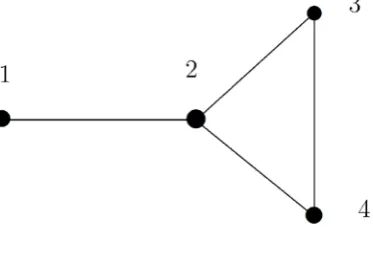
Example: 2.2 Let G be the graph in the Figure 1, V(G) = {1, 2, 3, 4}. Then the connected domination number is one and the connected dominating set of size two are {1, 2}, {2, 3}, {2, 4}, the connected dominating sets of size three are {1, 2, 3}, {1, 2, 4}, {2, 3, 4} and one connected dominating set of size four. Hence
Dc(G, x) = x(x3 + 3x2 + 3x + 1),
and the connected dominating roots of G are 0 and −1 with three multiplicities.
Figure 1: G Theorem: 2.3 For any path Pn on n ≥ 3 vertices,
Dc(Pn, x) = xn + 2xn−1 + xn−2 ,
and the connected dominating roots are 0 with multiplicity n – 2 and –1 with multiplicity 2.
Proof: Let G be path Pn with n ≥ 3 and let Pn = {v1, v2, ..., vn}. The connected domination number of Pn is n – 2 and there is only one connected domination set of order n − 2. That means dc (Pn, n – 2) = 1. Also there are only two connected dominating sets of order n–1 namely {v2, ..., vn} and {v1, v2 , ..., vn–1}.
Therefore dc(Pn, n − 1) = 2 and clearly there is only one connected dominating set of order n. Hence Dc(Pn, x) = xn + 2xn−1 + xn−2 and it is clear that the roots of the polynomial xn + 2xn−1 + xn−2 are 0 with
Theorem: 2.4 For any cycle Cn with n vertices,
Dc(Cn, x) = xn–2 (x2 + nx + n),
and the connected dominating roots are 0 with multiplicity (n – 2) and
,
2
n
4
n
n
+
2−
−
2
n
4
n
n
−
2−
−
Proof: Let G be a cycle Cn with n and let Cn = {v1, v2 , ..., vn, v1}. The connected domination number of Cn is n–2 and there are n possibilities for the connected dominating set of size (n – 2). That means dc(Cn, n – 2) = n.
Also there are only n connected dominating sets of order n–1 namely {v2, v3, ..., vn}, {v2 , v3 , v4, ..., vn},..., {v1, v2, v3, ..., vn−1}. Therefore dc(Cn, n – 1) = n and clearly there is only one connected dominating set of order n. Hence Dc(Cn, x) = xn + nxn−1 + nxn−2 = xn−2 (x2 + nx + n) and the roots of this polynomial are 0 with multiplicity n − 2 and
2
n
4
n
n
,
2
n
4
n
n
+
2−
−
−
2−
−
Theorem: 2.5 For any star graph K1, n with n + 1 vertices, where n ≥ 2, Dc(K1,n, x) = x(1 + x)n and the connected dominating roots are 0 and –1 with multiplicity n.
Proof: Let G be star graph of size n + 1 and n ≥ 2. By labeling the vertices of G as v0, v1, v2 , ...vn, where v0 is the vertex of degree n, then clearly there is only one connected dominating set of size one and there are n connected dominating set of size two namely {v0 , v1}, {v0, v2}, {v0, v3}, ..., {v0, vn}. Similarly for the connected dominating set of size three we need to select the vertex v0 and two vertices from the set of vertices {v1 , v2 , ...vn}.
That means there are
2
n
connected dominating sets. In general
dc(G, i) =
−
1
i
n
Hence
(
)
2 3 4 11, ,
2 3 2
....
2
3
1
...
2
3
n
c n
n
n
n
D K
x
x
nx
x
x
x
n
n
n
n
x
nx
x
x
x
n
+
= +
+
+
+
+
=
+
+
+
+ +
(
)
0
1
n
k
k
n
n
x
x
k
x
x
=
=
=
+
∑
Thus, the connected dominating roots are 0 and -1 with multiplicity n.
Theorem: 2.6 For any complete graph Kn of n vertices, Dc(Kn, x) = (1 + x)n– 1.
Proof: Let G be a complete graph Kn. Then for any 1 ≤ i ≤ n, it is easy to see that dc (Kn, i) =
i
n
.
(
)
(
)
, 1
2 3 4
0
...
2
3
4
1
1
1
n i c n i n n i i nn
D K x
x
i
n
n
n
n
nx
x
x
x
x
n
n
x
i
x
= =
=
=
+
+
+
+ +
=
−
=
+
−
∑
∑
Theorem: 2.7 Let G1 = (V1, E1) and G2 = (V2, E2) be two graphs of orders n1 and n2 respectively. Then Dc ((G1 + G2 ), x) = Dc(G1, x) + Dc(G2, x) + [
(
1
+
x
)
n1– 1] [(
1
+
x
)
n2− 1] .Proof: From the definition of (G1 + G2) if D1 be any connected dominating set of G1, then D1 is connected dominating set of (G1 + G2), similarly if D2 be any connected dominating set of G2, then D2 is connected dominating set of (G1 + G2) and also D1U D2 is connected dominating set of (G1 + G2),
then
(
)
(
1 2)
(
1)
(
2)
1 2 2 1 2 3
1 2 3 1 2 4 2 2 4
1 2 4 1 2 5 1 2
, , ,
1 1 1 1
2 1 1 3 2 2
3 1 1 4 2 3
c c c
D G G x D G x D G x
n n n n
x x
n n n n n n
x x x
n n n n n n
x x + = + + + + + + + + + 1 2 1 5
1 2 5 1 2 5
2 1
1 2
1 2 1 2
1 2
1 1 2 2 2 2
1
3 2 4 1
... ...
1 1
1 1
... ...
1 2 1 2
n n
n
x
n n n n
x x
n n
n n
x
n n n n
n n
n n n n
x x x x x
n + + + + + + + + − + − = + + + + + +
(
)
(
)
(
)
(
)
(
)
(
) (
)
(
)
2 1 2 1 2 2 1 2 1 2 1 2 1 1 1 2 , ,, , x
, , 1 1 1 1
n c c n n i i c c i i n n c c x n
D G x D G x
n n
D G x D G x x
i i
D G x D G x x x
= = + + = + + = + + + − + −
∑
∑
Corollary: 2.8 Let G be any wheel graph Wn with n vertices. Then
Dc(G, x) = x(1 + x)n –1 + xn –1 + (n – 1)xn−2 + (n – 1)xn − 3 .
Proof: It is known that Wn
≅
Cn – 1 + K1 and by using Theorem 2.7, we have Dc ((Cn−1 + K1), x) = Dc(Cn−1, x) + Dc(K1, x) + [(1+x)n–1 – 1] [(1+x)1 –1]
Also by using Theorems 2.4 and 2.6, we get
Dc ((Cn−1 + K1), x) = Dc(Cn−1, x) + Dc(K1, x) + [(1+x)n–1 –1] [(1+x)1 –1] = xn−1 + (n − 1)xn−2 + (n − 1)xn−3 + x + x [(1 + x)n−1 – 1]
Theorem: 2.9 Let G be any complete bipartite graph Km, n, where 1 < m ≤ n. Then Dc(G, x) = [(1 + x)m− 1] [(1 + x)n− 1]
Proof: If G is complete bipartite graph with partite sets V1 and V2, then any connected dominating set of G contains atleast one vertex from V1 and at least one vertex from V2 . So as in Theorem 2.7, we have
(
)
2 3 32 2
,
1
1
1
2
2
1
...
...
1
1
1
1
...
.
1
2
1
2
c
m n
m
m
n
m
n
m
n
D G x
x
x
x
m
n
m
n
x
m
n
n
m
m
m
m
n
n
x
x
x
x
x
m
+
=
+
+
+ +
+ +
+ −
+ −
=
+
+ +
+
+
(
)
(
)
1 1..
1
1
1
1 .
n m n i i i i m n
n
x
n
m
n
x
x
i
i
x
x
= =
+
=
=
+
−
+
−
∑
∑
Theorem: 2.10 For any connected graph G with n vertices, Dc(G ◦ K1, x) = (x2 + x)n
Proof: Let H = G ◦ K1. Then clearly ϒc(H) = n and it is easy to see that there are
i
n
possibilities toextend the connected dominating into connected dominating set of size n + i. Hence
(
)
(
x
x
)
.
x
k
n
x
)
x
k
n
(
x
)
x
...
x
2
n
x
1
n
1
(
x
x
...
x
2
n
x
1
n
x
x
,
H
D
n 2 k n 0 k n k n 0 k n n 2 n n 2 2 n 1 n n c+
=
=
=
+
+
+
+
=
+
+
+
+
=
∑
∑
= = + +Theorem: 2.11 For any connected graph G with n vertices, Dc(G ◦
K
m,
x) = xn(1 + x)mn.Proof: Let H = G ◦
K
m,
. Then clearly ϒc(H) = n and it is obvious that
i
mn
possibilities to extend the
(
)
( )(
1
x
)
.
x
x
i
mn
x
)
x
...
x
2
mn
x
1
mn
1
(
x
x
...
x
2
mn
x
1
mn
x
x
,
H
D
mn n i mn 1 i n mn 2 n 1 m n 2 n 1 n n c+
=
=
+
+
+
+
=
+
+
+
+
=
∑
= + + +A bi-star is a tree obtained from the graph K2 with two vertices u and v by attaching m pendant edges in u and n pendant edges in v and denoted by B(m, n).
Theorem: 2.12 Let G be a bi-star graph B(m, n) as in Figure 2. Then Dc(B(m, n), x) = x2(1 + x)m+n.
Figure 2:
Proof: Let G be a bi-star and with labeling as in Figure 2. Then ϒc(B(m, n)) = 2 namely the set {u, v} is the only unique minimum connected dominating set. Hence dc(B(m, n), ϒc) = 1, and it is obvious that any other connected dominating set must be contain the two vertices u and v. Hence there are
+
1
n
m
possibilities to extend the connected dominating into connected dominating set of size 3, and
there are
+
2
n
m
possibilities to extend the connected dominating into connected dominating set of
size 4. In general it is easy to see that there are
−
+
2
i
n
m
possibilities to extend the connected
dominating into connected dominating set of size i. Therefore
(
)
2 3 4 2( , ),
...
1
2
n m c
m
n
m
n
D B m n x
=
x
+
+
x
+
+
x
+ +
x
+ +
(
)
2 2 3
2
1
...
1
2
3
1
.
m n
m n
m
n
m
n
m
n
x
x
x
x
x
REFERENCES
[1] Saeid Alikhani and Yee-hock Peng, Introduction to domination polynomial of a graph, arXiv: 0905. 225 1 V 1 (2009).
[2] J. Bondy and U. Murthy, Graph Theory with applications, North Holland, New York, (1976).
[3] C. Godsil and G. Royle, Algebraic graph theory, vol. 207 of Graduate Texts in Mathematics, Springer-Verlag, New York, 2001.
[4] F. Harary, Graph theory, Addison-Wesley, Reading Mass (1969).
[5] T. W. Haynes, S. T. Hedetniemi and P. J. Slater, Fundamentals of domination in graphs, Marcel Dekker, Inc., New York (1998).
[6] S. R. Jayaram, Line domination in graphs, Graphs Combin. 3 (1987), 357- 363.
[7] E. Sampathkumar and P. S. Neeralagi, The neighbourhood number of a graph, Indian J. Pure and Appl. Math.16 (2) (1985) 126 - 132.
[8] E. Sampathkumar and H.B. Walikar, The connected domination number of a graph, J. Math. Phys. Sci., 13(1979), 607-613.
[9] H. B. Walikar, B. D. Acharya and E. Sampathkumar, Recent developments in the theory of domination in graphs, Mehta Research Institute, Alahabad, MRI Lecture Notes in Math. 1 (1979).