Author’s Note
This was a presentation at the CDC 8th Na-tional Biosafety Symposium, Atlanta, Georgia, 2004. Although this article presents an overview of security concepts and systems, you will still need a security expert, either from your own organization or outsourced to a full- or part-time contractor, to re-view the security plan for your facility. A security expert has the experience to help you implement a security program that covers all the elements of secu-rity and allows you to put the right components in place.
Our discussion begins by drawing you a mental picture of a probable threat element (PTE). Groups of PTE are located throughout the United States. It should be no surprise that they are plotting opera-tions against us all the time, even today. Consider this scenario: Field members of a terrorist organiza-tion meet in Baltimore in December 2002 for an initial meeting. Two of them are from New York City and two are from Fort Worth. Their mission? Steal biological material for a bioterror attack on the U.S. food supply. They meet again in March 2003 at the Black Angus restaurant in Atlanta to discuss tar-get selection. The men decide to conduct pre-selection operations at three locations: Centers for Disease Control and Prevention in Atlanta, the U.S. Army Medical Research Institute of Infectious Dis-eases (USAMRIID) in Fort Detrick, Maryland, and Plum Island Animal Disease Center in Long Island, New York. Surveillance on these targets is conducted
their operation. The criteria were to find a location that had poor lighting, weak CCTV cam-eras/systems, and an inconsistent access control sys-tem.
They began their surveillance of the CDC in April to June 2003. They recorded their observations and discovered that there were new alarm systems at the CDC and numerous high-tech television systems strategically located throughout the complex. The site is also patrolled regularly and there were barriers that could hinder movement. Their assessment was that the security components hindered the proposed operation and made it extremely difficult to con-tinue their pre-attack surveillance.
In July and August 2003, they conducted a sur-veillance of the USAMRIID. The tactical informa-tion collected revealed similar problems. A large number of uniformed personnel made them very nervous. It just so happened that during their sur-veillance the USAMRID was conducting an anti-terrorism threat exercise, which also made them nervous. Additional security measures made it even more obvious that this site was well protected. There were many lights and security structures. They used barriers during the exercise. There were consistent access control procedures, not only at the building but also in the streets leading up to the building. In addition, there was a visible use of guards and posts. Their assessment was that this location was too diffi-cult.
In August through September 2003, they con-ducted their surveillance on Plum Island. Here they
Applied Biosafety, 10(1) pp. 40-46 © ABSA 2005
Understanding Security Basics: A Tutorial
on Security Concepts and Technology
Richard Kibbey
Dec 2002
¾ Four members of HAMAS meet in Baltimore, MD
¾ 2 from NYC, NY
¾ 2 from Ft Worth, TX
Their mission: Steal biological materials that can be used in a bioterror attack on the US food supply
?
Figure 1
Hypothetical ScenarioNOTE: Map from the testimony of Steven Emerson 2/24/98 to the senate judiciary subcommittee on terrorism, technology and government information.
Figure 2
Hypothetical HeadlineNew Headlines
The CDC
announced today
that a major crisis
has developed in
the US beef
industry…
Major Outbreaks of Mad Cow Diseasesome windows left open overnight, alarms and door sensors not operational, and poor lighting, both in-terior and exin-terior to the facilities. The site also had inadequate and broken CCTV equipment and in-consistent access control procedures. As a result, the terrorists selected Plum Island as their target.
September through December 2003, they con-ducted their pre-attack surveillance. In this phase, they discovered a route of ingress based on good ter-rain and shadows and darkness for their approach. They also found a point of entry—a window in one of the buildings that they wanted to access that was left unlocked most evenings. After observing daily operations for a period of time, they selected their target. Note on the slides that they designated points on their maps where they were going to attack and what they were looking for.
Early in January 2004, they conducted their op-eration. One individual remained at the vehicle ap-proximately a half a mile from the site. The other three followed their attack plan and entered the building at a poorly lit window. They made their way to the laboratory and easily gained access by
bypass-ing door alarms by cuttbypass-ing a hole in the drywall. They located several vials of hoof and mouth virus and exited the same way they entered. The entire operation took less than 70 minutes and the where-abouts of the perpetrators and the missing virus is unknown—until…[Laughter] the CDC announced today that a major crisis has developed in the U.S. beef industry.
The situation I described is a hypothetical sce-nario, but it does have real world consequences if it should ever happen. In fact, the security deficiencies I discussed for the target location were identified in a recent assessment.
So, how do you avoid this at your facility? Well, hopefully, I’m going to give you at least a direction to go in to get the answers. Consult your trusty, local security expert. This guy may not look like he knows what he is doing, but a properly trained security ex-pert with experience can help you provide your facil-ity with a cost-effective and efficient securfacil-ity pro-gram. She or he can help you improve or develop a sound program, and here is how.
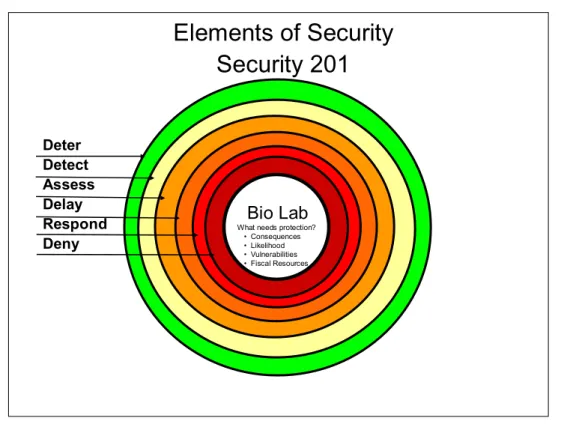
I look at a security system as having elements.
Figure 3
Rings of SecurityElements of Security
Security 201
Deter Detect Assess Delay Respond Deny Bio LabWhat needs protection? • Consequences • Likelihood • Vulnerabilities • Fiscal Resources
These are rings of security that go around the re-source you are trying to protect.
Each of these rings is an element of security. Each is supported by security equipment and secu-rity procedures that will either deter, detect, or sup-port defeating an adversary by being applied to one or more of the rings of security. These are the com-ponents of security. So remember: Comcom-ponents equal electronic equipment, procedures, and proc-esses, and elements are the rings. We are going to discuss those rings right now.
The rings are Deter, Detect, Assess, Delay, Re-spond, and Deny. Everything in security should ap-ply to one of those areas. If it does not, you are spending a lot of money without getting very much help. The first question to ask is “What needs pro-tection?” What do I have in my facility that needs a security system? Then, after you’ve figured out what it is you are trying to protect, you need to know how much of it there is. Is it a cold virus? Is it Ebola? Is it a hoof and mouth virus or something like that? The lower on the risk scale, the less equipment and so-phistication you need. The higher on the scale, the more security you are going to need. The amount of security you need will be determined by determining what your threat is, the vulnerabilities that exist in your facilities, the likelihood of an attack, and the consequences should an attack occur at your facility. • Deterrence is the prevention of action through a fear of unacceptable consequences, as viewed by the PTE. It is not a physical state. It is a psychological state that your security program gives a perception of, from the outside looking in. If the PTE perceives a risk of being caught, he will usually move on to another target just as in my scenario where they looked at two locations. One was too tough, so they went somewhere else. It’s unfortunate in our busi-ness that when we are dealing with deterrence we say, “Let’s keep them away from here” and you end up sending them somewhere else. But, if everybody is doing his or her part, you are going to make it very difficult for an adversary to be successful.
• Detection is the determination and transmission that an event has occurred. The use of technology increases the capability to detect. Ideally, you will detect as far away from the resource as possible. As-sessment is the analysis of an event by a person
di-rectly onsite or via technology—usually today a closed circuit television (CCTV) system. Assessment is nec-essary to determine the validity of an alarm and an appropriate response.
• Delay is the ability of physical or psychological barriers to restrict movement. The purpose of delay is to allow time for an appropriate response and to make it undesirable for the perpetrator to continue. • Response is the level of reaction required to counter an intrusion. Response forces range from unarmed security guards or staff to local police. At the high end there are dedicated armed response forces like you would expect to be around nuclear storage areas.
• Denial is the ability to oppose or negate the ef-fects of an overt or covert action. Denial is the final and last chance to defeat an adversary.
Now we are going to discuss the components of security. Components of security consist of equip-ment, policies, and procedures that support each of the previously discussed elements (rings of security). The components consist of clear zones, barriers, lighting, shrouds, locks, electronic security systems, access control systems, guard forces, and opera-tor/owner procedures.
• A clear zone is usually provides a 30-foot clear zone from the facility or object you want protected. It is void of trash receptacles, dumpsters, ashtrays, brushes, and other objects that could obscure a small bomb or provide cover to an adversary.
• Barriers are designed to restrict, deny, or chan-nel pedestrian or vehicular traffic, and in most cases, will do the same for potential adversaries. Barriers are not necessarily impenetrable but they do increase the probability of detecting people and vehicles or dissuading them from attempting to illegally access your location.
• Lighting is a significant deterrent to potential intruders. It enhances visibility for routine patrols and general staff and allows response units to have better visibility. Permanent lighting should provide adequate illumination to entry points, site perime-ters, pathways, and parking lots. And you can have lighting that is activated by sensors—motion sensors or line sensors—that will activate the lights when they are penetrated. These can be activated by timers or operated manually.
• Shrouds are an often-neglected component of security. They support deterrence and delay by pro-viding concealment from chance and direct surveil-lance. The purpose of a shroud is to limit visibility from unauthorized sources. It can be as simple as darkened windows or curtains or a more complex structure such as walls, coverings, and even shrub-bery.
• Locks come in many shapes and forms, from single hasp locks that you have at your house, to very complex systems. They include standard key locks, combination locks, cipher locks, card access control systems including swipe cards and proximity cards, seals, and biometrics. All of these can be tied into an electronic security system, if desired.
• Electronic security systems come in three fla-vors: access control, security surveillance, and intru-sion detection. Access control systems include de-vices designed to limit access to a site, building, room, and containers. They can be very complex systems with biometrics, exchange badge systems, and other electronic devices, or they can be a simple card swipe access system.
• Security surveillance: The most common sur-veillance system is the CCTV, which is offered with a variety of capabilities. This is one area that I would caution you on. You will have hundreds if not thou-sands of vendors telling you, “I’ve got the camera for you.” You need to be extremely cautious regarding what kind of system you buy. When choosing a CCTV system, consider the resolution and the im-age quality. Do you need color or black and white? Is pan/tilt/zoom capability what you want the camera to do for you? What type of transmission mode do you need? That includes fiber optics, coaxial cables, and wireless. Other considerations include light lev-els and weather.
• Intrusion detection systems (IDS) identify unau-thorized entry. Usually, they are connected to a monitoring system of some kind and fall into three general categories. (1) A local alarm system, which, when the IDS is breached, sounds an alarm for a local security officer or staff to respond to. (2) 24-hour central stations that are usually commercially operated. When they get an alarm, they contact the local police or a designated security service. (3)
Pro-within the facility. This system usually reports to an onsite security control center and response is pro-vided by an onsite security force or local law enforce-ment. Intrusion detection systems can be specific right down to a room or a container. They can be simple alarm systems such as ADT home alarms or more sophisticated systems that include CCTV, ac-cess verification, and other technology. Intrusion detection systems consist of sensors, which can be motion sensors, glass break sensors, and contact or beam sensors. Transmission components include coaxial cable, fiber optics, and wireless. Most IDS have an alerting system that usually terminates at some kind of monitoring function.
• Guard forces or response forces need to be con-sidered in your security system. There usually needs to be a good balance between the use of security technology and a properly trained security force or staff that has security response responsibilities. • Owner/Operator procedures are the one thing that you have complete control over and won’t have to spend very much money on to improve the secu-rity of your facility. This is all internal and consists of written procedures and processes that your organi-zation must follow. These procedures translate poli-cies into action for people responsible for carrying out those instructions. Security policies must be backed by well-defined procedures. The next two slides list several policies that you should have in writing at your facilities. In my scenario, I talked about leaving windows open. I worked in several areas in the military where we were supposed to lock up at night, and in the morning we’d come in and find windows wide open. It happens all too often. So as a minimum, I recommend that the following writ-ten procedures be implemented at your facility:
End of day security checks
Computer procedures. These are very important to keep your information secure and out of the eyes and hands of somebody who would want to do harm.
Access to restricted areas
Visitor and contractor procedures
Escort requirements
Property passes (removal equipment)
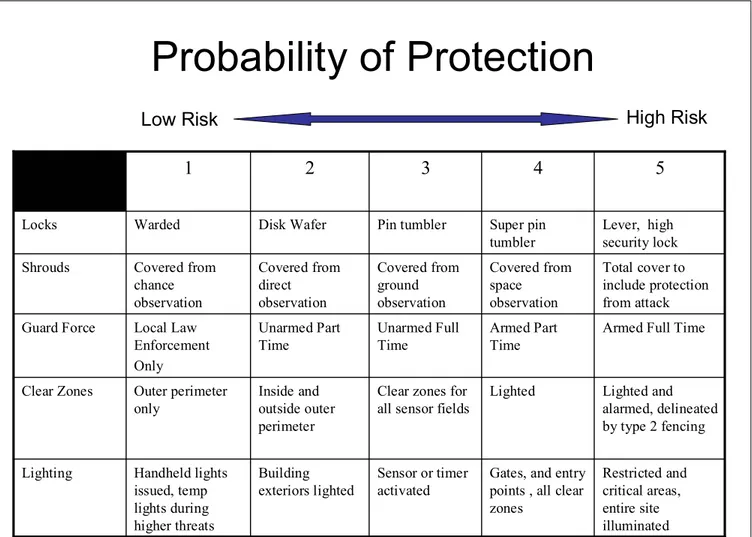
So far, we’ve looked at the six elements of secu-rity and numerous components of secusecu-rity. An effec-tive security system will incorporate a security-in-depth concept by employing some or all of the ele-ments of security. These must complement one an-other, be integrated, and work from the resource out to the perimeter of your facility. This will provide you with a solid program that mitigates the level of risk and the vulnerability of your facility. Figures 4 and 5 are a matrix of components and risk levels.
These simple matrices illustrate the components of security that you might consider implementing at various risk levels. Left to right, the security compo-nents become more complex. You can buy CCTV
cameras as cheap as $150 per camera, or you can buy them as expensively as several thousand dollars per camera. For a simple lab that has very little risk and very little consequence of losing sensitive resources, a simple ADT-style, commercial system is probably sufficient. When you get up to facilities that are do-ing weapons-grade bioresearch, you will need some-thing a lot more complex. The second slide has a few more examples covering some of the elements where you can start at the lower risk level and move your way up. The combination of security components that covered by the elements of security, constitute the level and depth of protection you have at your facility.
Probability of Protection
5
4
3
2
1
Walls/roof reinforced, Bollards, jersey barriers cabled Access control system w/biometrics CCTV w/pan,tilt, zoom Video motion detection, thermal tracking, IR capable Above ground Observation towers Total coverage by fixed CCTV Partial coverage by fixed CCTV Visual Assessment Tools Doors windows ballistic resistant, HVAC filtration capable Stand off distance delineated Structures
Barrier & fence system plan, ability to engage Fence w/cable Fence w/outrigger Berms, fence, wall Signs, simple fences, ditches, shrubbery Barriers
Dual line security systems, exchange badges, container access control Automated access control system Perimeter and asset alarms, ID checks Perimeter alarms Electronic Security Systems
Low Risk
High Risk
Figure 5
Probability of Protection
Lever, high security lock Super pin tumbler Pin tumbler Disk Wafer Warded Locks Total cover to include protection from attack Covered from space observation Covered from ground observation Covered from direct observation Covered from chance observation ShroudsGates, and entry points , all clear zones Lighted Armed Part Time
4
5
3
2
1
Restricted and critical areas, entire site illuminated Sensor or timer activated Building exteriors lighted Handheld lights issued, temp lights during higher threats Lighting Lighted and alarmed, delineated by type 2 fencing Clear zones forall sensor fields Inside and outside outer perimeter Outer perimeter only Clear Zones
Armed Full Time Unarmed Full Time Unarmed Part Time Local Law Enforcement Only Guard Force