159
PRELIMINARY RESULTS CONCERNING THE GENETIC VARIABILITY OF
SOME MUTANT LINES OF WHEAT EXPERIMENTED TO
ARDS CARACAL
Iancu Paula, Soare Marin, Bonea Dorina, Păniță Ovidiu University of Craiova, Faculty of Agronomy
Key words: wheat, mutant lines, genetic variability
ABSTRACT
In this work it is presented preliminary results on genetic variability of some mutant/recombinant lines of wheat obtained at NARDI Fundulea and experienced in ARDS Caracal, in a joint research project. Diversifying sources of useful genes by mutagenesis (physical and chemical) and distant hybridization works is one of the most important objectives that have worked in recent years to NARDI Fundulea.
To ARDS Caracal, 10 mutant/recombinant lines of autumn wheat, along their parental forms, were tested analyzing the genetic variability of production components, namely: plant height, no. of fertile tillers, ear length, number of spikelets/ear, no. grains/ spike, grain weight/spike and one thousand grain mass. The objective of this study was to assess the use of the morphological issues at level of genetic variability within a representative new sample of mutant wheat lines. It was observed through a large amount of variability guidelines: Ai- II 131 for reduced plant height, Ai- II 172 for number of spikelets/spike, Ai- II 201 for spike length, Ai- II 223 for grain yield and Bi- I 3 for number of fertile tillers, number of grain/spike, number of spikelets/spike, spike lenghth and grain yield.
Increased genetic variability in wheat mutant lines and, thus, broadening the genetic base, may lead to the identification of valuable genotypes for improvement in terms of productivity, plant height, resistance to lodging, etc. Therefore, identification of genetic diversity is a good tool for selecting these mutant lines in breeding programs.
INTRODUCTION
Wheat is the second most important crop; currently, about 95% of the wheat grown
worldwide is hexaploid bread wheat, with most of the remaining 5% being tetraploid durum
wheat. Breeding improvement of many agronomical traits requires genetic variation and these components of variation must be separable from nongenetic effects. Hence breeding wheat genotypes with diverse genetic base is a factor to achieve a level of self-sufficiency and sustainability (SauleKenzhebayevaa et al, 2014).
The use of physical mutagens, like X-rays, gamma and chemical mutagens for inducing variation, is well established. Over the past 70 years, more than 2500 varieties derived from mutagenesis programs have been released, as listed in the IAEA/FAO mutant variety database, including 205 wheat lines (http://wwwinfocris.iaea.org/MVD/). Mutagenesis is an important tool in crop improvement. Criteria for the estimation of genetic diversity can be different: morphological traits or molecular markers.
160
Using of biotechnological methods leads to increased of the genetic variability of breeding material and accelerating of genetic progress, especially regarding the agricultural plant productivity. From this point of view, by using agricultural biotechnology can be achieved new plants with agronomic characteristics improved, such as obtaining highly productive lines, resistant to diseases and extreme weather conditions (Bonciu E., 2012).
In Romania, the first researches on wheat were the ones of removed hybridization,
especially with related species of the genus Triticum, from which the useful genes transfer
can be achieved by direct hybridization with meiotic recombination between chromosomes of parental forms in F1 hybrids. The work protocols were improved by applying post-pollination treatments with hormones of auxin type and treatment with colchicine to double the number of chromosomes and getting the amphidiploid forms (Giura și colab., 2007).
MATERIALS AND METHODS
This investigation was carried out at the SCDA Caracal, during the growing season, 2015-2016. Sowing of experience was made in the first decade of October. The experiment was set up after randomized blocks method and it was applied standard technology from this crop. Type of soil was typical argiloiluvialcernosiom, with 3.18% humus content in the first layer.
10 wheat mutagenic lines from NARDIFundulea were used to establish the experimental materials for this investigation. For evaluation of morphological characters and genetic variability, plants were selected at random for 7 morphological characters measurements which influence yield, as follows: plant height (cm), no. of fertile tillers per plant, spike length (cm), no. of spikelets per spike, no. of grain per spike, grain yield per spike (g) and weight of 1000 grains (g) and grain yield (Kg/ha).
The obtained results were statistically calculated using analysis of variance method, respectively the LSD for significance levels of 5%, 1% and 0.1%.
RESEARCH RESULTS
Given that cereals (wheat, rice, maize, barley, oats, etc.) play an important role in human and animal nutrition, the general trend in all countries is to increase production of these plants.
Regarding wheat, because its economic importance, the basic trend is the increase of world production. The most efficient way to ensure this objective is to increase the average production per hectare, especially in countries where such production is low.
The evolution of average production per hectare in Romania is very varied, mainly because of limited opportunities to ensure optimal irrigation water, the high price and the purchase of adverse conditions in sowing dates, etc.,so that yields ranged from 3477 kg / ha (2004) to 1610 Kg/ha (2007) and 2659 Kg/ha (2012) (Matei, Gh., 2014).So, the average is satisfactory, although we have varieties with high yield potential.
The obtaining of varieties with high yield potential involves quite high difficulties. However, given the vast genetic diversity existing within the genus Triticum, the ability to amplify this variability by mutagenesis possibly using germplasm from genres related, cultivated and wild, there are prerequisites for creating such varieties, both using conventional methods and especially those of genetic engineering.
161
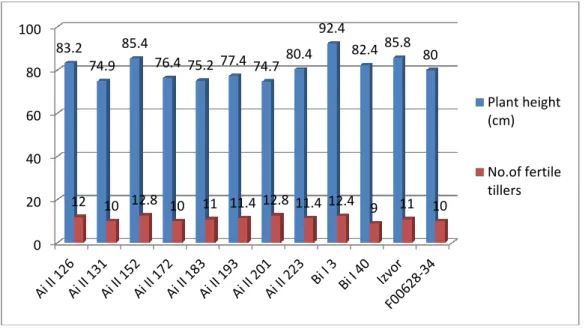
Similar results obtained BojanJocković and al., 2014 in an experience with 20 genotypes of winter wheat. The average was of 84.1cm and an amplitude variation of 67.7-114.2. They also said that plant height had a greatest direct negative effect on yield.
Number of fertile tillers varied from 9.0 (Bi I 40) to 12.8 (Ai II 152 and Ai II 201). Parental forms presented average values of 10 (F00628-34), respectively 11(Izvor) fertile tillers.
Fig. 1. Average data as concern plant height (cm) and no. of fertile tillers
Knowledge of the relationship between grain yield and yield components is very important for efficient yield breeding (Bojan Jocković, 2014).
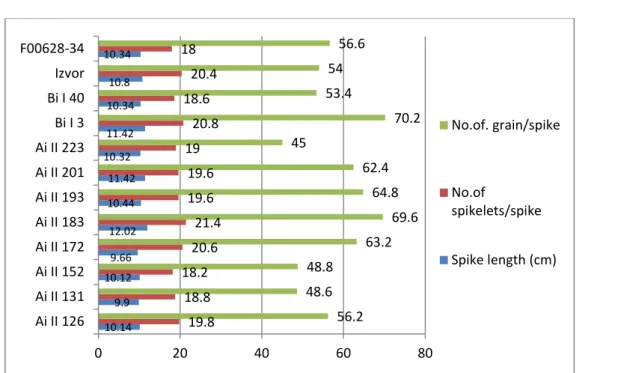
Number of grains/spike was determined after harvest in laboratory. Highest values registered line Bi I 3 (70.2) while the smallest values presented line Ai II 223 (45)(fig. 2). The amplitude of variation for this character in Bi I 3 line was of 59 – 82 and for Ai II 223 line between 31 – 54. Parental forms presented values of 54 grain/spike (Izvor) and 56.6 grain/spike (F00628-34). A significant number of grains/spike presented lines Ai II 183 (69.6) and Ai II 193 (64.8), respectively Ai II 172 (63.2).
Number of spikelets/spike varied in small limits, from 18.2 (Ai II 152) to 21.4 (Ai II 183). Parental forms registered values of 18 (F00268-34) and 20.4 (Izvor).
Spike length varied from 9.9 cm (Ai II 131) to 12.02 cm (Ai II 183). Remarkable values registered also lines such as: Ai II 210, Bi I 3 (11.42 cm) and Ai II 193 (10.44 cm). Laghari, K.A.at al., 2012 registered values between 11.6 cm to 14.8 cm for spike length.
Mandea, V., and al., 2016, sustain that wheat yield can be dissected into three sequentially developed components: number of ears/area, number of grains/ear and weight of individual grains expressed as weight of thousand kernels.
0 20 40 60 80 100
83.2 74.9
85.4
76.4 75.2 77.4 74.7 80.4 92.4
82.4 85.8 80
12 10 12.8 10 11 11.4 12.8 11.4 12.4 9 11 10
Plant height (cm)
162
Fig. 2. Average data as concern no. of grain/spike, no. of spikelets/spike and spike length
Grain weight per spike, weight of 1000 grains and grain yield per ha were determined in laboratory, after harvest. Grain yield/spike depended with number of grains/spike. So, this character presented values between 2.32 g (Ai II 152) and 3.54 g (Bi I 3). Parental forms registered values of 2.46 g (Izvor) and 3.07 g (F00628-34). There were identified some other lines with significant grain yield/spike such as: Ai II 183, Bi I 40 and Ai II 193 which outrun the values obtained by parental forms (fig. 3).
It is important to establish the relationship of each trait with the yield and its direct and indirect effects on yield (Hristov et al., 2011).
Better yield components and yield performance field trials of mutant lines in ARDS Caracal can promote the introduction of new genotypes in the region, released by the usage of modern technologies in the conditions of climate change which is the latest concern of the researchers for agricultural yield decreases.
Fig. 3. Average data as concern grain yield/spike (g) and weight of 1000 grains (g)
10.14 9.9 10.12 9.66 12.02 10.44 11.42 10.32 11.42 10.34 10.8 10.34 19.8 18.8 18.2 20.6 21.4 19.6 19.6 19 20.8 18.6 20.4 18 56.2 48.6 48.8 63.2 69.6 64.8 62.4 45 70.2 53.4 54 56.6
0 20 40 60 80
Ai II 126 Ai II 131 Ai II 152 Ai II 172 Ai II 183 Ai II 193 Ai II 201 Ai II 223 Bi I 3 Bi I 40 Izvor F00628-34
No.of. grain/spike
No.of
spikelets/spike
Spike length (cm)
2.56 2.52 2.32 2.93 3.39 3.08 2.93 2.41 3.54 3.09 2.46 3.07
50.34 49.92 44.92 42.86 48.32 42.06 38.06 49.72
54.16 57.2
39.22 49.86 0 10 20 30 40 50 60 70 Grain yield/spike (g)
163
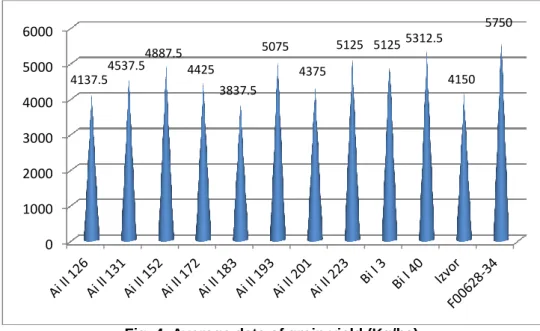
Grain yield varied in high limits. The smallest yield was found to Ai II 183 line (3837.5 Kg/ha). This line was followed by Ai II 126 line (4137.5 Kg/ha) and Ai II 172 (4425 Kg/ha). Highest yield was registered to Bi I 40 line (5312.5 Kg/ha). Other lines with important grain yield were: Ai II 223 and Bi I 3 (5125 Kg/ha) and Ai II 193 (5075 Kg/ha). Parental forms presented a grain yield of 4150 Kg/ha (Izvor) and 5750 Kg/ha (F00628-34).
In a similar experience with 12 wheat mutant lines, Laghari, K. A. et al., 2012, identified two mutant lines with grain yield of 5420 kg ha-1 (MASR-64) and 5380 kg ha-1 (MASR-6), comparative with one control and four other mutants (MASR-11, MASR-13, MASR-14 and MASR-22) with higher grain yield comparative with other control and the other lines with non- significant differences.
It is necessary further investigations to establish this yield performance because Săulescu, N. N. et al., 2012 sustain that DH mutant line might have good yield stability.
Fig. 4. Average data of grain yield (Kg/ha)
CONCLUSIONS
In the last years,mutagens have created alarge amount of geneticvariations in wheat and have played a significant role in plants breeding AT NARDI Fundulea.
The experienced lines behavior show that compared with parental forms, this new material is superior as concern some morphological issues: Ai- II 131 forreduced plant height, Ai- II 172 for number of spikelets/spike, Ai- II 201 for spike length, Ai- II 223 for grain yield, Bi- I 3 for number of fertile tillers, number of grains/spike, number of spikelets/spike, spike length and grain yield.
ACKNOWLEDGEMENT
This paper presents the results of the research project ADER 116/2015 - “The use
of biotechnological methods for increasing genetic variability of material to improve and accelerate genetic progress and stability in the level of yields for the main crops in the context of climate change” supported by Ministry of Agriculture and Rural Development
(2015-2018).
BIBLIOGRAPHY
Akfirat F.S. and Uncuoglu A.A., 2013.Genetic diversity of winter wheat (Triticum aestivum L.) revealed by SSR markers. Biochemical Genetics. 2013; 51: 223–229.
0 1000 2000 3000 4000 5000 6000
4137.5 4537.5 4887.5
4425 3837.5
5075
4375
5125 5125 5312.5
164
Bojan Jocković, Novica Mladenov, Nikola Hristov, Vladimir Aćin, Ivica Djalović 2014. Interrelationship of grain filling rate and other traits that affect the yield of wheat
(Triticum aestivum l.). NARDI Fundulea. Romanian Agricultural Research, No. 31, pp. 81-87. Print ISSN 1222-4227; Online ISSN 2067-5720.
Bonciu Elena,2012.Agricultural biotechnologies, balance factor for the sustainable development of the socio-economic system. Annales of the University of Craiova, Series Biology, Horticulture, Food Produce Processing Technology, Issue XVII (LIII), 2012/1, Ed. Universitaria, p.69-74. ISSN 1453-1275.
Giura A., Mihăilescu Alexandrina, Verzea M., Ittu Gh., 2007. Cercetări de
genetică efectuate la Fundulea. Ann. I.N.C.D.A. Fundulea, vol. LXXV, volum jubiliar.
Hristov, N., Mladenov, N., Kondić-Špika, A. Marjanović-Jeromela, A., Jocković, B., Jaćimović, G., 2011. Effect of environmental and genetic factors on the correlation and stability of grain yield components in wheat. Genetika, 43 (1): 141-152.
http://wwwinfocris.iaea.org/MVD/
Laghari, K.A., Sial, M. A., Arain, M. A., Khanzada, S. D. and Channa, S. A., 2012. Evaluation of stable wheat mutant lines for yield and yield associated traits. Pak. J. Agri., Agril. Engg., Vet. Sci., 28 (2): 124-130, ISSN 1023-1072.
Manjarrez-Sandoval, P., T.E. Carter, D.M. Webb and J.W. Burton, 1997.RFLP genetic similarity estimates and coefficient of parentage as genetic variance predictors for soybean yield. Crop Sci., 37: 698-703.
Mandea, V., Mustățea, P., Săulescu,N.N., 2016. Cultivar and environment effect on grain weight and size variation in winter wheat, grown in a semi-continental climate. Romanian Agricultural Research. NARDI Fundulea, Romania, No. 33, pp. 23-28. Print ISSN 1222-4227; Online ISSN 2067-5720.
Matei, Gh., 2014. Fitotehnie. Cereale și leguminoase. Vol. I., Ed. Sitech. Craiova. Saule Kenzhebayevaa, Svetlana Turashevaa, Gulina Doktyrbaya, Hermann Buerstmayrb, Saule Atabayevaa, Ravilya Alybaevaa, 2014.Screening of Mutant Wheat Lines to Resistance for Fusarium Head Blight and Using SSR Markers for Detecting DNA Polymorphism. International Conference on Agricultural and Biosystem Engineering. IERI Procedia 8 ( 2014 ) 66 – 76.