Epiphany: Vol. 4, No. 1, 2011 ISSN 1840-3719
Media as a Vaccine against Critical Thinking
Lejla Panjeta*
Abstract
Human communication is of a persuasive character, since the perspective to determine the difference between fact and opinion differ according to sociological and cultural backgrounds. Media sets the ground for building stereotypes by imposing the ideas to the recipients. It makes media a tool for persuasive communication thus producing the effects of what a vaccine injection might do to a human body. As language is one of the most used tools in media, this stealthy persuasion operates on a subtle “antigens” infiltrated in the context of the media text. “Mind vaccinating” recipients by media eventually can lead to stereotyped perceptions and produce prejudice. In this metaphor vaccine antigens offer a persuasive perspective on reality immune to other perspectives but that one that is imposed by media. If a recipient in the communication process understands the threat then the persuasive effects are lessened as is explained in inoculation theory. If the threat is candy wrapped in media content, as is done so by the demand of market and recipients themselves (and imposed by politics and corporation interest), then the threat is no longer understood as a threat by the recipient. The immune system is vaccinated and protected from the disease of free thinking. The disease represents a reality that is not shape shifted by someone else. Shape shifted reality is distributed through the vaccines. Media being the vaccine makes it a powerful tool in the persuasive strategy for shape shifting the reality based on framed and reframed facts and opinions of the majority in democratized media. Media is consciously or unconsciously shape shifting the reality, which makes it a tool of persuasion.
Keywords: Media, propaganda, persuasion, vaccine and shape shifting realty
Introduction
This article will evaluate inoculation theory (McGuire, 1961) according to which human communication and the ability to critically think can be manipulated with the metaphor of the media as the human mind vaccine. The main argument is that the media is a vaccine for the human mind and it contradicts the original inoculation theory that presents the human brain as capable of fighting propaganda. If the content is not clearly of a persuasive character, it will have contradictory effects. The character of media as a conveyer of messages generates consciously or unconsciously a “shape shifting” of the reality, thus influencing the presented truth, which therefore makes it a tool of persuasion.
Human communication is intended to be persuasive. The perspective to determine the difference between fact and opinion differs according to sociological and cultural backgrounds. Media sets the ground for building stereotypes by imposing ideas on the consumers. So, media as a tool for persuasive communication can produce the same effect as that of a vaccine on a human body. This persuasion operates subtly as “antigens” infiltrate the media. “Mind vaccinating” consumers by media can eventually lead to stereotyped perceptions and produce prejudice. In this metaphor, vaccine antigens are viewed as a persuasive perspective on reality, immune to other perspectives but that one which is imposed by the media. If a consumer in the communication process understands the threat, then the persuasive effects are lessened as is explained by inoculation theory. But if the threat is “candy wrapped” in media content, as is done so by the demand of market and consumers themselves (and imposed by politics and/or corporate interests), then the threat is no longer understood by the consumer.
reality is distributed through the corporate media vaccines, according to their current position of interest.
The article poses the following questions as a starting point for the discussion: What are the methods and media of propaganda? Is every type of media persuasive by nature, because human communication is persuasive by nature? Is media creating perceptions that are definitive? If so, does it shape shift the reality, vaccinating our mind and producing an immune system based on current or dominant perspective that originates in the interest of the power owners (government and/or corporations)?
Defining the Use of the Term Propaganda and Media
Propaganda is persuasive. We expect mass and new Media communication to be unbiased as they depend on deontology codes that try to discard the persuasive elements in the communication process (Tucaković, 2004, 263). While propaganda is dependent on this type of communication, the persuasive methods and elements are often not immediately detectible in mass media.
Human communication in general is of a persuasive character, since the perspective to determine fact and opinion differ according to sociological and cultural backgrounds. This background is mostly stereotyped by the perception acquired in early childhood and further through the education systems. Media creates the environment for building stereotypes by imposing the ideas on the consumers. Media becomes a free tool for persuasive communication thus producing the effects of a classical propaganda process. This paper will find the corresponding elements in the process of injecting a vaccine into a human body to be comparative to the effects of the media influences on the human mind.
Media is the primary tool for propaganda. The name media
TV); Audio (megaphone, radio); Visual (posters, animations, pamphlets, brochures and similar); or Thematic (combined media according to the previously determined themes for the coverage of the consumers - workshops, seminars, summits, congresses, rallies, public campaigns and similar).
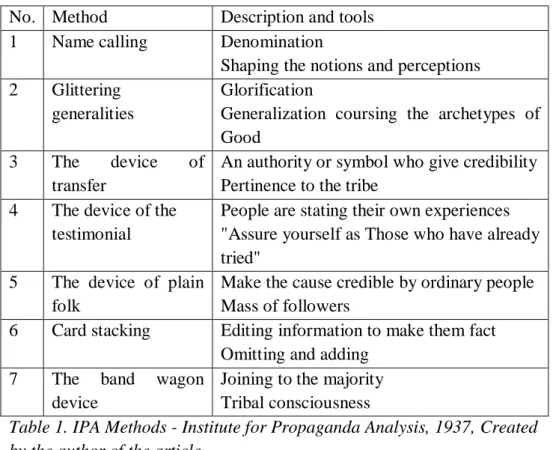
The device for ruling in ancient Greece and Rome was the speech (Taylor, 2003). The most successful propaganda effects are achieved by multimedia. A person remembers 40% of what he/she hears and 80% of what he/she sees. By combining five or more types of media the propaganda effect reaches 86% while the combination of three media only creates a 64% effect while the use of only one type of media only creates an effect of 35% (Spahić, 1990). Clearly the most efficient propaganda method is through combined audio-visual media. There are also many classifications for methods and means for persuasiveness. One of the most universal classification models of propaganda methods and the one that can be used for all kinds of propaganda (economic, political, and religious) is the classification made in 1937 by the Institute for Propaganda Analysis – IP (Delwiche, 2002). These methods were created to promote critical thought in democratic and civil societies and are used as the basis for all propaganda analysis, methods and activities. The IPA devices have been criticized because of over-simplification and because several categories can be included into the same method but also because they do not consider the differences between and among the various kinds of consumers, such as public and masses.
notion of New Media will be used in this article to describe the phenomenon that has the above mentioned characteristics.
By removing the mass media restrictions of time delay and subordination of the participants in the communication process, IPA methods remain efficient guidelines because everyone with access to the technology is both a consumer and a creator of communication. This means that everyone creates media and, due to the concept of “democratization,” the content of that media is determined by the majority. What is the majority’s perspective of reality? How much are notions and events influenced by stereotypes and spread again to the majority of participants and to those who are not in the majority (decision makers in the shaping of reality)? What does that do to our perceptions if they are formed and influenced by the media that makes the reality?
Concepts of Freedom, Democracy and Non-Control
Interesting YouTube research conducted by Alexandra Juhasz (2011) done as a Video-Book, states that high expectations were set for New Media considering the fact that they are not democratic. Therefore Juhasz & Dietrich (2011) claim that
YouTube is not democratic. Its architecture supports the popular. Critical and original expression is easily lost to or censored by its busy users, who not only make YouTube's content but sift and rate it, all the while generating its business… Free and easy to get on, the mob-rule system by which you get pulled off YouTube is user-initiated but corporate-ruled.
(http://vectors.usc.edu/projects/learningfromyoutube/texte o.php?composite=159&tour=18, retrieved 20/02/11)
engineering behind the network protocols. It offers evidence on how the online media is more controlling than classical media and how it is even designed for surveillance. The postmodern “logic of selection” (Manovich, 2001, 129-34) explains that users (media participants) have “Photoshop power” previously reserved only for producers of entertainment, art and visual media. The same Photoshop shaping of reality is used by those in control of new media, according to their logic of selection of information which is based on cultural and political background, which is nowadays shaped by visual or multimedia content presented in New Media, corporate-owned TV and online media.
Inoculation Theory
One of the theories that addresses the persuasion psychology and an automatic response from the receiver of the information is inoculation theory (McGuire, 1961), which argues that the effect of the propaganda is less if the recipient of the communication is previously warned about the threat. Inoculation theory gave insights into the process of persuasion psychology by using an analogy with medical inoculation.
Inoculation theory states that to prevent persuasion it is necessary to strengthen preexisting attitudes, beliefs, or opinions. First, the receiver must be warned of an impending attack. This establishes threat (or recognition of vulnerability) and initiates defenses to future attacks. Therefore, the idea is that when weak argument is presented in the inoculation message, the process of refutation will prepare the receiver for stronger persuasion later. It is critical that the attack is strong enough to keep the receiver defensive, but weak enough to not actually change those preexisting ideas. This will hopefully make the receiver actively defensive and allow them to create arguments in favor of their preexisting thoughts. The more active the receiver becomes in his or her defense the more it will strengthen their own attitudes, beliefs, or opinions (see McGuire, 1961).
and sociology, this theory relies on the resistant behavior of the receiver to the persuasive messages if information is received beforehand. Supplying information in advance will trigger counter arguing which leads to resistance to the persuasive messages. According to inoculation theory, to prevent persuasion, it is necessary to strengthen preexisting beliefs and / or opinions. The receiver must be warned against the oncoming communication content. This establishes that there is a threat and initiates defenses to the attacks. The most vulnerable in McGuire’s theory are those who are neither critical nor capable of understanding the persuader’s intentions (Simons, Morreale, & Gronbeck, 2001, 42). The “bewildered herd” (Lippmann, 1922) needs guidelines, especially in any situation where creators are active participants in communication. Therefore media is a tool for reframing the opinion of the majority and shaping the reality. But the consumers today are not warned of these threats and, in fact, media content is packed in such a clever ways so the difference between information and persuasion (facts and opinions) is very difficult to discern.
operating on the framed reality then it does the same as the antigen does in the vaccine.
McGuire argued that inoculation theory can be defined as a vaccine against propaganda. How does a participant in communication detect the threat of propaganda? What if a threat is a “candy protected” kind of content and the inoculation cannot work to protect the receiver from the propaganda message? Or it can work for vaccinating the beliefs for the purposes of those controlling the communication processes. Can the media be a tool for vaccination of the population and creator of an immune system according to the interests and framed reality of those infiltrating the vaccine to the system? If so, the role of media is not a “light persuasion”, but stealthy propaganda injected into the framed reality.
Vaccine Shaped Immunity – “Shape-Shifting” the Reality
The metaphor suggested in this article emerges from the comparison of the techniques media and process of vaccination against disease. Media consumers are subjected to shape shifted reality made that way by the media’s (or the transmitter of the message) perspective. Vaccinating our mind by perspectives that are based on politics or economics (corporate interests) media makes us immune to our own perceptions and discoveries of reality. As new media is by principle democratic (Shapiro, 1999), the majority’s point of view becomes the dominant perception. Using the propaganda repetition model (Spahić, 1990), the dominant perception is imprinted in our minds (as is the antigen in the vaccine), thus making the media operate as a tool for vaccination while producing shape shifted reality that is immune to the perspectives of and by the other.
communication. The comparative propaganda tools are described in IPA methods (see Table 1). These methods are describing major techniques used in political and marketing campaigns, for the purposes of propaganda. The notions of Good and Evil stereotypes and censorship are usually misinterpreted for propaganda itself.
The analysis of propaganda generates the relationship to censorship, which is one propaganda technique. The use of the term “propaganda” became a stereotyped notion for “censorship” imposed through the American movie stereotype. This connotation evokes the Communist or Nazi censorship boards and editors sitting in dark rooms full of cigarette smoke and giving approval for some texts or tearing up unfavorable scenarios. The censorship used in mass media is much more subtle; interference into the ideological concept of the author's work (artistic or journalistic) can come from the author himself (author's censorship) according to the interest of the tool they use to disseminate the information.
In the era of New Media and internet, everyone is participating and creating communication. This means that everyone is subject to media influence. Politics and corporate business as “hidden persuaders” (Packard, 2007) are places of power and influence which makes them shift the perception of everyone else included in the communication process. IPA methods (Delwiche, 2002) rely on the simple process of naming the reality and/or creating the perception of reality and perspectives on the notion or process that is subjected to this tool. They are based on shaping the opinions and use the tribal consensus as an easy access for accepting the shaped reality.
reality for persuasive purposes and uses the device for the transfer of messages, which occurs in any modern media. An NLP process states that the human brain simplifies the information by deleting, generalizing and distorting it in order to logically process the new data (McDermott & Jago, 2004, 69). In the propaganda process, the reality must be shape shifted. Tools for this are demonization, glorification and exclusion. The notion of propaganda (lat. pro, pax, agare – for peace spreading) is a good example of the method of demonization. Repetition of the negative connotation to this notion combined with movie representation of the image of dictators in front of microphones speaking to crowds of military, and dimmed lighting with smoke filled rooms full of conspirators, makes a stereotyped negative connotation of propaganda as fascist and communist or any other brutal method of oppression.
Naming or denominating the reality by glorifying and demonizing is persuasive by nature of human communication and if done by a mediator can have the same effect as a vaccine substance has to a human body. The arguments here employ a metaphor based on the relationship between vaccines and the immune system for explaining how an analogous phenomenon can be found in shape shifting the reality by media. Shape shifting is the term that explains the same process as Reframing used by NLP theory. A vaccine is a biological material that strengthens immunity against a particular disease. It contains an agent (antigen) that resembles a disease-causing microorganism (Encyclopedia
Britannica; Webster's Concise Interactive Encyclopedia, 1995). It is
produced by removing the infection but keeping the antigen features. This agent stimulates the human immune system to recognize the disease (in some cases a virus) as foreign, destroy it, and remember it. If the immune system later encounters the same virus it will recognize it, destroy it and discard it. A vaccine acts as the boost to the human immune system. The body that received the vaccine is protected in advance from any possible harm done by the disease itself. The material that the vaccine is made of possesses certain qualities. It should not be dangerous, should effectively protect the human body, and its distribution has to be simple and relatively cheap (see Enciklopedija leksikografskog
The vaccine for the human mind is the media. The creator of the vaccine is the journalist (an active participant in the communication or owner of the information) which makes him the manipulator of reality and consequently of the truth shaping. Propaganda method of naming (denominating) the reality uses the tools of persuasion, influencing and changing. Persuading factors would be injecting the vaccine into the body. Influencing the perception works as formatting antigens in the human body system. As a result the perception of reality is shaped (changed) making a new immunologic system ready to respond to the attack of the virus. The virus is the perception of reality that the human body is immune to. This perception has another perspective on the same subject of reality as does the vaccine antigen material. It is difficult to fight through it and change it, as the opinion is based on the platform of created immunology system. This is the stealthy persuasion platform that any media as a transfer of the message or the McLuhan’s message itself operates on; consciously or unconsciously shape shifting the reality of the subject. Creating the immune system makes it the persuasive tool. No matter how objective the vaccine or ethically and democratically conscious, it still operates on the principle of shaping the reality (reframing of an immune platform). Sometimes strong side-effects and long term consequences can be proven to be poisonous (McBean, 1957).
New Media, Mass Media and Corporate Media as Immunity Viewpoint of Reality
dystopian worlds of Lang's Metropolis (1927), Bradbury's Fahrenheit (1953) or Orwell's 1984?
The state of global fear is induced and accelerated by media terminology that enables the creation of the feeling that the population is in danger and the actions of the ruling elites and states are justified. News about the enemy includes phrases and "unchecked" terminology and it functions under the principle of the Card Stacking device (IPA). Such phrases in the news about possible terrorist attacks are as follows: alleged, believed to, not confirmed, unknown, suspects, possible, may be linked to, some people say and said to be. This terminology is used by mainstream media such as BBC and CNN news on the occasions of terrorist attacks and threats from 2002 to 2004 (Silberstein, 2002). Before September 11, this "unchecked" terminology was reserved only for the public relations industries as IPA testimonial device. Today it is used by the "independent" and mainstream media attacking all of our senses, distorting it more through interactivity on the net and multimedia communications. Do consumers even recognize the crude and unshaped reality of truth or just destroy it and discard it as our immune system is not capable of processing it?
Words used in media act as the biological material of antigens. They set a platform for the immune system to react to any sign of possible danger. Danger is everything the human mind recognizes as a deadly virus (not formatted as an antigen) so the body is prepared to react and discard it. In the case of before mentioned antigens (naming the reality - terminology), the body discards common sense and logical reasoning because the system is set to be immune to it. The antigens are carefully disseminated. They are cheap and easily acquired. The formula of stealthy persuasion by the media is not dangerous, as the real vaccine is cheap, easy to get and supposed not to be dangerous.
of being demonized in media. Islamic terrorism is put in the same pot with Islamic culture and religion, as Judah and Jews, who (allegedly) crucified Christ, were generally accepted as traitors and enemies of Christian love and peace. This is made possible because of the subtle language of fear in the media (whether media is medieval churches or news seen on the LCD at our home).
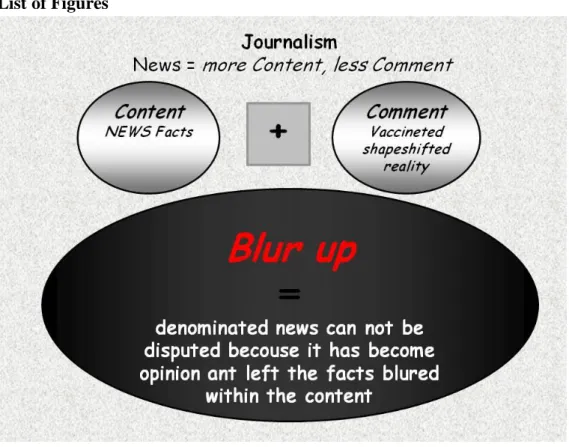
Figure 1 shows the method of journalism used by Rupert Murdoch’s corporate media (Greenwald, 2004). It doesn’t separate the content from the comment. The content of news is fact. The comment is opinion based on the fact. Opinion is subjective and/or fact made from a shape shifted perspective of the perceiver. The process of blurring the difference between fact and opinion is elaborated in a documentary film about Fox News (Greenwald, 2004). According to the linguistic propaganda terminology, the difference between integral parts of the basic journalist unit (news) is blurred. The news is created so that it is impossible to deny it because it is not fact but represents opinion. In such a way and by the repetition of the news, which in fact is not the news but the opinion (the comment) the shape shifted reality is created. The antigen is infiltrated and endlessly repeated (revaccinated) and makes the body immune to reasoning. By constant repetition the media confirms a general opinion which becomes the truth. A line from the film "All the King's Men" about how the main character in the film Willie Stark, a political candidate for a governer came to power, illustrates the repetition method of persuasion. "If you hollered long enough, hard and loud enough people begin to believe. Just in case they didn't he organized spontaneous demonstrations. In case anyone hollered back he organized spontaneous slugging." (Rossen, 1949). The spontaneous consent is given as our immune system is prepared for in advance.
advertising and propaganda messages where only a tiny portion is reserved for the facts and truth as these two categories are conditioned upon the market demands and profit.
The audience demand exciting and adrenaline provoking content (see Darley, 2000). The result is that the news now more closely resembles reality shows. In such sensationalistic programs (lat. sensation
– passing thrill, something that has no importance) we satisfy our need for tension, aggression, fear and bloodshed. Sensationalism has become the main foundation of the journalistic profession. Earlier, the members of this profession tried to work within the framework of defined standards. Today in the internet era, people care less for credibility. All values are subordinate to the sensational values and to the concept of making profit (Redfield, 1995). In "Utopia of a Tired Man" (Borges, 2000, 102-113) there is a philosophical review of our media reality and the humans in the future within the context of journalistic sensation and advertising industry. The consequence of this journalism is the loss of basic norms of truth and instead there is a victory and celebration of what is only peripheral and persuasive. So it is in fact welcoming to have media shape our immune system into whatever antigens are of interest to those who are offering it.
Conclusion
The media gives the “illusion of discussions” (Chomsky, 1989) suitable for the owners of media, the elite and conglomerate corporations in the global market of ideas to vaccinate our mind. The media as a conveyor of reality is controlling the vaccine material that makes the reality shape shift according to the current interest of corporations and politics. For instance, in the USA, fear of additional terrorist attacks produced the feeling of endangerment. This is a recipe for strategies of control and inducing hatred. For fear to be activated, human mind needs a palpable enemy, which is the emanation of The Evil archetype. Moral absolutism is essential to the creation of shape shifted reality in media based on archetypes.
Once the archetype enemy has been established, the mental immune system needs to create a fighting strategy which has to be controlled and monitored. This control in the USA is conducted in the form of The Patriot Act. The world is united against terrorism in the 21st century and accepts all kinds of fights with the Enemy, including the complete lack of privacy. The consumers have been prepared in advance to fight the virus and destroy it.
A good tool in the wrong hands creates a poor result. In this comparison of media as vaccine it is proven that both vaccination processes and media ontogenesis have good intentions. In the metaphor vaccine antigens are persuasive perspective on reality and the body is human brain immune to other perspectives but that one that is imposed by media. That perspective is the vaccine material. It is given from the point of the view of the corporations and profit and / or political interest in the media around the globe today. If a recipient in the communication process with media understands the threat then the persuasion effects are lessened as is explained in the inoculation theory. But, if the threat is candy wrapped in media content, as is done so by the demand of the market and consumers themselves, then the threat is no longer understood as a threat by the consumers.
The communicators are not entirely in control of the effects they produce. Persuasion theories tend to rely on a psychological operation of imitation and automatism. This proves that behaviorism theories understand that all human perception and thus communication are of a persuasive character. The New Media content is made of human language, which makes it a tool for persuasion expanded to everywhere and with no time limits.
Media vaccinates the human perception of reality in reframing the reality that is presented to the communicators. If everyone is a communicator, then the reality in democratized media is framed by the majority. Media transfers and creates shape shifted reality. As a vaccine is given in a very early stage of human development, so does the media give clear platforms of perspective on certain subjects in reality. That’s why the majority of participants are immune or almost immune, because no vaccine guarantees a 100% disease-free response. But, generally a vaccinated human body is protected from disease (protected from reasoning and making one’s own viewpoints and conclusions about reality).
List of Figures
List of Tables
No. Method Description and tools 1 Name calling Denomination
Shaping the notions and perceptions 2 Glittering
generalities
Glorification
Generalization coursing the archetypes of Good
3 The device of transfer
An authority or symbol who give credibility Pertinence to the tribe
4 The device of the testimonial
People are stating their own experiences "Assure yourself as Those who have already tried"
5 The device of plain folk
Make the cause credible by ordinary people Mass of followers
6 Card stacking Editing information to make them fact Omitting and adding
7 The band wagon device
Joining to the majority Tribal consciousness
References
Borges, J. L. (1989). El libro de arena. Budor, K. (trans.) (2000). Knjiga
od pijeska. Zagreb: Zabregačka naklada.
Bradbury, R. (2003). Fahrenheit 451. New York: Simon & Schuster. Chomsky, N. (1989). Necessary Illusions. USA: South and Press. Chomsky, N. (2002). Mediji, propaganda i sistem. Zagreb: Što čitaš? Darley, A. (2000). Visual digital culture: Surface play and spectacle in
new media genres. London, New York: Routlege Taylor &
Francis Group.
Delwiche, A. "Propagandacritic". Retrieved 2002. http://www.propagandacritic.com.
Encyclopedia Britannica. Retrieved 2011. http://www.britannica.com. Galloway, A. R. (2006). Protocol: How control exists after
decentralization. Cambridge: MIT Press.
Greenwald, R. (2004). Outfoxed: Rupert Murdoch's war on journalism. [Documentary Film]
Haag, E. (1969). The Jewish mystique. Zagreb: MISL. Juhasz, A. "Learning from YouTube." Retrieved 2011.
http://mitpress.mit.edu/catalog/item/default.asp?ttype=2&tid=125 96.
Juhasz, A. and Craig, D. (2011). "YouTube is not democratic" Learning
from YouTube: Video Book: Alliance for Networking Visual
Culture, Andrew Mellon Foundation, Vectors, The MIT Press, 2011. [Online Multimedia]
Jung, C. G. (1977). Odabrana djela K. G. Junga. Beograd: Matica Srpska.
Klaić, B. (1978). Rječnik stranih riječi. Zagreb: Nakladni zavod MH. Krleža, M. et al. (Eds.) (1969). Enciklopedija leksikografskog zavoda. 6
vols. Zagreb: Jugoslovenski leksikografski zavod "Miroslav Krleža."
Lang, F. (1927). Metropolis. [Film].
Lippmann, W. (1922). Public opinion. Minneapolis, MN: Filiquarian Publishing LLC.
McBean, E. (1957). The poisoned needle: Suppressed facts about
vaccination. Retrieved 2006. http://www.whale.to/a/mcbean.html.
McDermott, I. and Wendy, J. (2001). The NLP Coach. Verica, R. (trans.). (2004). NLP obuka: kompletan vodič ka ličnom blagostanju i
profesionalnom uspehu. Beograd: Mono & Manana.
McGuire, W. (1961). Resistance to persuasion conferred by active and passive prior refutation of the same and alternative counterarguments. Journal of Abnormal and Social Psychology, 63, 326-32.
McLuhan, M. (1967). The mechanical bride: Folklore of industrial men. London: Routledge Kegan Paul Limited.
Packard, V. (1957). The hidden persuaders. New York: IG Publishing. Redfield, J. (1995). Celestinsko proročanstvo. Beograd: Narodna knjiga
Alfa.
Rossen, R. (1949). All the King’s Men. [Film].
Shapiro, A. L. (1999). The control revolution: How the Internet is putting
individuals in charge and changing the world we know. New
York: Public Affairs,U.S., Perseus Book Group.
Silberstein, S. (2002). War of the words: Language, politics and 9/11. London and New York: Routledge Taylor and Francis Group. Simons, H. W., Joanne, M. and Bruce, G. (2001). Persuasion in society.
California: Sage Publications Inc.
Spahić, B. (1990). Biti propagandista. Sarajevo: Udruženje ekonomskih propagandista BiH.
Taylor, P. M. (2003) Munitions of the mind: A history of propaganda
from the ancient world to the present day. 3rd ed. Manchester and
New York: Manchester University Press.
Tucaković, Š. (2004). Leksikon mas-medija. Sarajevo: Prosperitet. Townshend, C. (2002). (2002). Terrorism. Oxford University Press.
Webster's Concise Interactive Encyclopedia. (1995). CD ROM