A STUDY ON FACTORS AFFECTING TO WOMEN PARTICIPATION IN THE ECONOMIC ACTIVITIES OF KACHCHH DISTRICT
Dr. Kalpana Satija, Head of Department of Economics,
Mr. Jagdish Maheshwari, Ph.D. Scholar KSKV Kachchh University, Bhuj, Gujrat
Abstract
Kachchh is popularly known for its development and is one of the well known district of Gujarat. It is famous for its geographical areas and natural beauty. Natural resources are basically found in Kachchh region. Because of great diversity among the people of Kachchh, they represent their culture in front of different countries with their life style and traditions. The ten talukas of Kachchh district are renowned in Gujarat for their different economic activities and these economic activities show good male and female participation. This study has been carried out by the researcher for the purpose of knowing.
Keywords: Women, Participation, Factors and Affecting.
Introduction
Kachchh is a developed district with ten talukas and the people are engaged in different economic activities. Some of the economic activities are very familiar as, Anjar is famous for making equipments like sword and knives. Gandhidham is famous for its industries and business on a very large scale. Mundra is very famous for its agricultural activities and due to Adani Port, it is now well known worldwide. Mandvi is famous for its tourism activities. Abdasa and Lakhpat are
well known for its making of traditional dresses. Bhuj is the main headquarter of Kachchh district and is popularly known due to its education. Where we find one of the famous university named as Shri Krantiguru Shyamji Krishna Verma University. Bhachau is mostly famous for its historical temples and for tourism. Rapar is famous for picnic spot like Dhola-Vira where people from different places come across for its sightseeing. Nakathrana is famous for its snacks and it is popularly known as making of the onion Samosas. Due to variation of economic activities among different talukas of Kachchh district, researcher has tried to find out women’s participation and factors affecting it in economic activities. As mentioned, Kachchh is already a developed region but to make it more developed along with women’s development the researcher has conducted this study.
Methodology
topics have been taken into account while selecting the samples:
Out of ten Talukas in the district, five Talukas namely Gandhidham, Anjar, Bhuj, Mundra, and Mandvi have been selected so that at least 50% areas can be covered under the investigation.
Employment opportunities are not the same in urban and rural areas. So both the areas were selected proportionately. A total of 500 families were selected. (250 families from urban areas and 250 families from rural areas).
All classes of people i.e. upper, middle, and lower living in the society were selected for this study.
One urban and two rural areas were selected in each Taluka. Among the five selected Talukas, a total of five urban areas and ten rural areas have been selected.
A total of 500 families have been selected in both urban and rural areas by the researcher. In which 250 families have been selected from rural areas and 250 families in urban areas. 283 working women in 250 families of urban areas and 298 working women in rural areas have been analyzed for this study.
The data was collected with the help of interview schedule method and simple random sampling method. The data was then organised and analysed. Percentage and averages are used to analysis the factors affecting to women participation in economic activities.
FACTORS AFFECTING TO WOMEN PARTICIPATION IN THE ECONOMIC ACTIVITIES OF KACHCHH DISTRICT
When compared to men and women in terms of responsibility, the highest responsibility is on women. The financial burden is on woman as she has to go out for work to satisfy her family needs. In terms of economic activities of
Kachchh District there are number of factors that affect female participation in economic activities compared to men
Age
Age is the most important factor that affects most of the work. In addition, effective work depends upon different ages or age group. Here a researcher tries to explore the effect of such factor on female participation in economic activities. Based on age and taluka, the proportion of female participation is shown in chart 1.4.1.
CHART 1.4.1. AGEWISE WOMEN PARTICIPATION IN ECONOMIC ACTIVITIES OF KACHCHH DISTRICT
Based on the above table it can be concluded that Women Participation in Economic Activities is seen highest between the age group of 26-35, which is 34% and is lowest between the age group of 56 - 60 that is only 2%.On the basis of this, it can be said that the women youth of Kachchh district are more involved in economic activities.
0%
15-25 24%
26-35 34% 36-45
25% 46-55
15%
CHART 1.4.2. AGE WISE WOMEN PARTICIPATION IN PRIMARY SECTOR OF KACHCHH DISTRICT
Here the researcher has shown the ratio of female participation according to age and sector, the information of which is shown in chart 1.4.2. In Primary Sector Women Participation in Economic Activities is seen highest between the age group of 26-35, which is 11% and is lowest between the age group of 56 - 60 that is only 1%.
CHART 1.4.3.AGE WISE WOMEN PARTICIPATION IN SECONDARY SECTOR OF KACHCHH DISTRICT
In Secondary Sector Women Participation in Economic Activities is seen highest between the age group of 26-35, which is 12% and is lowest in the age group of 56 - 60 that is only 1%.
9% 11% 10%
5% 1%
36%
15-25 26-35 36-45 46-55 56-60 Total Primary Sector Percentage
8% 12%
11% 7%
1% 39%
CHART 1.4.4.AGE WISE WOMEN PARTICIPATION IN TERTIARY SECTOR OF KACHCHH DISTRICT
In Tertiary Sector Women Participation in Economic Activities is seen highest between the age group of 26-35 which is 11% and there is no participation of women seen in the age group of 56-60. Here too, the participation of young women in all three areas of Kachchh is seen more.
Education
Education has also been named in the scriptures as an invisible weapon. Thus, the educated person can do well in every situation and the uneducated person is not able to defend himself in every situation. Thus, education shows a positive effect in any work. Here also a researcher has tried to show the effect of education on women belonging to the economic activities of Kachchh district. The proportion of participation of educated and uneducated women in the economic activities of Kachchh district is shown in chart 1.4.5.
CHART 1.4.5.EDUCATION WISE WOMEN PARTICIPATION IN ECONOMIC ACTIVITIES OF KACHCHH DISTRICT
Based on the above chart it can be concluded that 71% of the Educated Women of Kachchh District are engaged in Economic Activities whereas the percentage of uneducated women is only 29%, which do not form the part of economic activities. The proportion of educated women is higher than uneducated women, meaning that there has been a positive impact of education on women's participation in economic activities in Kachchh District.
Caste
The history of India reveals that most of the work is divided among the people based on their caste. Even today due to different castes’ women are not given enough freedom or any relaxation outside of the house. Here also an attempt has been made by a researcher to know the extent of female participation in the economic activities of the Kachchh district. According to the caste, the proportion of
7% 11%
5%
2%
0% 25%
15-25 26-35 36-45 46-55 56-60 Total Tertiary Sector Percentage
Educated Uneducated Total 414
167
500
female participation in economic activities is shown in chart 1.4.6.
CHART 1.4.6.CASTE WISE WOMEN PARTICIPATION IN ECONOMIC ACTIVITIES OF KACHCHH DISTRICT
Based on the above table and chart it can be concluded that Overall women participation in economic activities is more in Schedule caste women, which is around 43% as compared to Schedule tribe’s women, which is 9%. Based on this, it can be said that ratio of schedule caste women in economic activities of Kachchh district is high compare to other castes. Moreover, the main reason behind this is that even in Kachchh district, the economic condition of the scheduled caste families is poor, due to which the women of schedule caste have to work compulsory for their home.
Religion
India has a prominent place in the world in terms of religious diversity. However, discrimination between male and female is still found in certain religions in India. According to religion, efforts have been made by a
researcher to know the extent of female participation in economic activities in Kachchh district. The proportion of female participation according to religion is shown in chart 1.4.7.
CHART 1.4.7. RELIGION WISE WOMEN PARTICIPATION IN ECONOMIC ACTIVITIES OF KACHCHH DISTRICT
Researchers found that according to religion, the proportion of women in Hindu religion in Kachchh district is more in economic activities, which is 81%, followed by Muslim religion 11%. The lowest proportion is found in Parsi religion i.e., Only 1%.
Type of Family
There are three types of families like Nuclear, Joint and Expanded. Family type is also an important factor affecting female participation. Prior to the joint family practice in India, it was found that every member of the family was engaged in some kind of economic activity and because of this; the female participation in the joint family was more visible. However, in the present time, participation of females in Nuclear families is seen more in economic activities in Kachchh District. The proportion of
General SC ST OBC Total 169
248
53 111
581
29% 43% 9% 19% 100%
471
62 21
2 10 15 0 581
female participation based on the type of family is shown in chart 1.4.8.
CHART 1.4.8. FAMILY WISE WOMEN PARTICIPATION IN ECONOMIC ACTIVITIES OF KACHCCHH DISTRICT
Based on the above chart it can be concluded that Women Participation in Economic Activities is mostly seen in Nuclear Families which is 78% and in expanded families it is NIL.
Marital Status
Readiness among women in any type of job makes the women more powerful, but this may prove wrong as women has to face many problems in their families due to social restrictions and at the work place. This becomes the major obstacles in their development. Marriage is believed to be a dream in woman's life, but it is often considered a hindrance in the development of women. Thus, the researcher has tried to find out the effectiveness of the marriage on
working of women in the economic activities in Kachchh district.
Based on the above table and chart it can be concluded that Women participation in economic activities is seen more among Married Women, which is about 69% whereas
CHART 1.4.9. MARITAL STATUS WISE WOMEN PARTICIPATION IN ECONOMIC ACTIVITIES OF KACHCHH DISTRICT
it is lowest among Divorced women, which is less than 1%. This means that marriage has a positive effect on women's participation in economic activities in Kachchh District.
Gender
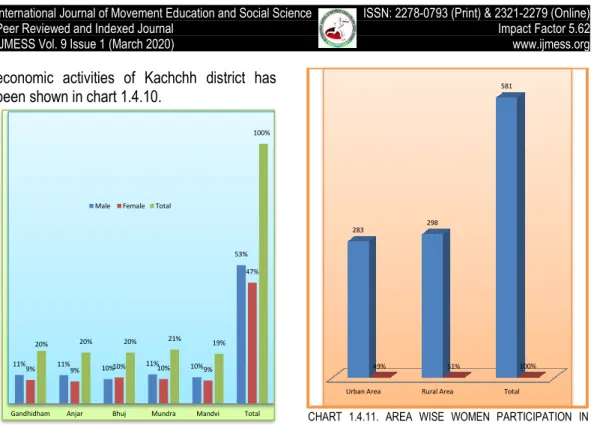
As India is a male dominated country, so women are not given more importance compare to men. In addition, adequate opportunities are seen for the development of women but this is not possible due to dominance of male to female. Here, an attempt is made by a researcher to know about the impact of gender on women’s participation in economic activities of Kachchh district. Gender wise Participation in the
Divided Joint Expanded Total 456
123
2
581
78% 21% 1% 100%
Married Unmarried Widow Divorced Total 401
154
25 1
581
economic activities of Kachchh district has been shown in chart 1.4.10.
TABLE 1.4.10. GENDER WISE PARTICIPATION IN ECONOMIC ACTIVITIES OF KACHCHH DISTRICT
Based on the above table and chart it can be concluded that Overall women participation in economic activities is low compared to men, which are about 47%, and Men participation is about 53% and Gender equality is seen in every taluka of Kachchh district.
Area
India is known by two names from all over the world, one Bharat and another India. Bharat represents the rural area, while India represents the urban area. Therefore, economic activities in both areas of the country are also different. Thus, efforts have been made to explore the extent of female participation in rural and urban areas of Kachchh district by the researcher here. Area wise women participation is shown in chart 1.4.11.
CHART 1.4.11. AREA WISE WOMEN PARTICIPATION IN ECONOMIC ACTIVITIES OF KACHCHH DISTRICT
Based on the above table and chart it can be concluded that Overall women participation in economic activities is low in urban area compared to rural area, which is about 49%, and in rural it is about 53%.
Conclusion
This study clarifies the picture of women involved in the economic activities of Kachchh district as most of the factors affecting female participation in this study are included. Many factors affecting to women participation in economic activities like Age, type of family, Education, religion, Caste etc. So through this study we can find out the effectiveness of these factors on women participation in economic activities. On the basis of the scale of these factors, the government will also be helped to formulate policies accordingly.
11% 11% 10% 11% 10%
53%
9% 9% 10% 10% 9%
47%
20% 20% 20% 21% 19%
100%
Gandhidham Anjar Bhuj Mundra Mandvi Total
Male Female Total
Urban Area Rural Area Total
283 298
581
References
Dave, Vandana (2012), “Women Workers In Unorganized Sector”, “Women’s Link, Vol. 18, No. 3”, Pg no. 9-17.
Hunt, Abigail and Samman, Emma (2016),”Women’s economic empowerment-Navigating enablers and constraints”
Lindberg, Anna (2004), “Modernization and feminization in India: Kerala Cashew Workers since 1930”, “Paper to be presented at the 18th European Conference on Modern South Asian Studies at Lund University, Sweden”, Pg no. 1-22.