301
STUDIES ON THE EFFICIENCY OF THE USE OF DUST FILTERS AT THE
WORKING FACILITIES FROM THE COMPOUND FEED FACTORIES
VASILE CRISTIAN, GLODEANU MIHNEA, ALEXANDRU TUDOR
Keywords: mills, granules, dust, filters, automation, compound feed
ABSTRACT
The technological process of obtaining the compound feeds involves the mixing of the milled cereals in the mills of the work installation with protein flours, mineral salts and vegetable oils. During the activities of grinding cereals and obtaining granules of finished product, it can be detached fine particles which forming the dust that is released in the air.
This article analyzes the technological process for the preparation of compound feeds with accent on the stages of grinding, granulation and homogenization of the finished product, for study the problems who can appear due to the eliminated dust in the air by the working installations.
The measurements effectuated attest the efficiency of the use of special filtres and automatized control systems of dust concentrations according to the pollution norms imposed by the European Union in order to protect the environment.
INTRODUCTION
In the last 10-20 years, on the consumer market it was noted a growing demand for animal products due to the
increased demographic growth
worldwide. This fact has led to a considerable progress of the livestock industry and especially of the compound feed factories.
Thus, the increase and the diversification of the food needs of the population also automatically determined an increase of the production of compound feeds, with the purpose of ensuring the necessary food for an increasing number of animals from the zootechnical farms.
Taking into account that depending on the species of animals, as well as their age, a certain type of feed is required, with certain weights of cereals and other
ingredients, the compound feed factories have diversified their recipes produced.
The zootechnical farms usually specialize in breeding certain animal and in order to provide food at optimal parameters have two options: they build their own compound feed factories or purchase the necessary quantities from different recipes of compound feed from the profile market.
302
Figure 1 - The distribution of the consumption of compound feed, by animal species
The grinding of the cereals which are necessary to obtain a certain recipe of compound feed is an activity that causes a high energy consumption. During this stage there is an increase of the temperature in the grain mass, as well as the possibility of small particles detachment, which form a powder that can spread in the atmosphere.
Granulation is another important step in the technological flow of the
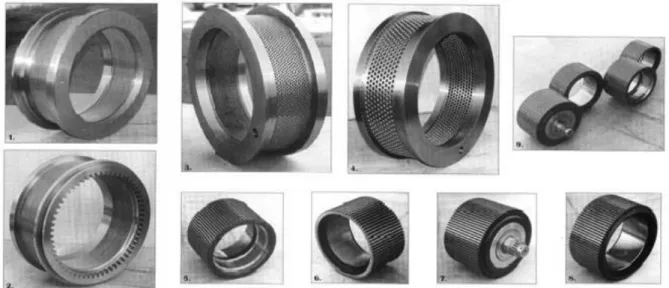
process of producing the combined feed. The homogeneous mixture of ground cereals, mineral salts and vegetable oils is pressed using hot steam jets through special sieves with holes of different sizes (figure ...). These steam jets at very high temperatures also have the role to sterilize the mixture, but also to homogenize the granules at the exit of the granulator sieves.
Figure 2 – Set of interchangeable molds with various sizes of the orifices
The process carried out in the compound feed factories, must be controlled very carefully in each phase of the technological flow, according to predetermined criteria to ensure both the quality of the final product, meaning the
303 MATERIAL AND METHOD
The activity of grain grinding can be done in two ways: with two different grinding machinery (a mill with rollers for the initial crushing of the beans and a mill with hammers for fine grinding) or with a single mill. This operation automatically determines detachments of small
particles that form dust which can spread into the air.
Depending on the dimensions of the particles resulting from the grinding process it can be highlight the weights of the different categories of fractions in the grinding mass (figure 3). The average diameter of the grinding product particles, determined by calculation, resulted of about 1,13 mm.
Figure 3 - The weight of fractions in the grinding mass
From the performed analyses it can be observed that the particles with the smallest sizes, below 0,3 mm, have a signifiant weight, over 20% of the mass of resulting grinding. In this fraction there are a lot of particles of very small sizes which are entrained in air in form of dust, a phenomenon which must be avoided or
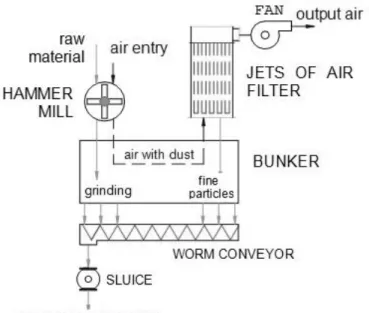
to be minimized as possbile. For this purpose it was made a lot of research for solving an essential problem: the reduction to the maximum of the released dust due to spreading in atmosphere of the particles of small sizes entrained by the air currents, by using an system for suction and dust filtration (figure 4).
304
The granulation activity is
performed in specialized
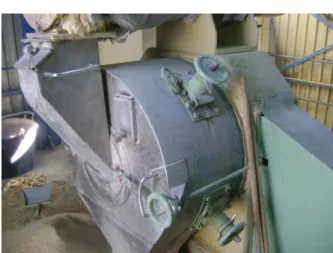
electromechanical devices (figure 5) in
which the mixture obtained according to the desired recipe is passed through the site with different sizes of the holes.
Figure 5 - The granulator of the working installation
Inside the granulation installation the mixture is pressed with the help of strong jets of steam at very high temperatures with the purpose of homogenization and sterilization of the granules of compound feeds and that is why the granules are very hot at the exit. Therefore, in order to be able to move to the packing of the granules, they must be cooled and this activity is carried out using air jets at room temperature.
The jets of hot stream, but also the air jets for cooling, determine the detachment of some small particles on
the surface of the granules, and in this way forming a mass of powders (dust) that can afect the environment.
For that very reason the problem of the dust eliminated from the atmosphere needs to be permanently held under control and that is why in this paper it are presented the analyzes and the measurements effectuated at working installatios from compound feed factory.
The device used to collect samples from the technological air eliminated is of type Strohlein and is shown in figure 6.
Figure 6 - The scheme of montage for device STROHLEIN
1-gas passage, 2-nozzle calibrated, 3-housing filter cartridge, 4-connectors, 5-socket electrical heating, 6-thermocouple, 7-tees, 8-tank condensate,
9-drying tower silica gel, 10-flow meter, 11-gauge, 12-thermometer, 13-meter vacuum pump exhaust, 14-channel, 15-Pitot-Prandtl tube, 16-electronic micromanometer, 17-well, 18-analyzer TESTO, R1-R4-taps
Dedusting is the process of separating the gaseous part of the technological air jet from the solid part
305
such or reinserted into the technological process. The solid particles from the technological air are powders in suspension, of organic or mineral origin, resulted from the handling of cereals or ground products.
The size which characterises from a qualitative point of view a system for the separation of the dust from the air is the efficiency of dedusting (also known as separation yield or dedusting degree), which is defined as:
100 G G 100 G G G η t e t r
t − =
=
where:
η - the yield of the separation system [%] Gt - the quantity of dust from the air which entering the separator [kg]
Gr - the quantity of dust that remains in the air which exits from separator [kg] Ge - the quantity of extracted dust [kg].
RESULTS AND DISCUSSIONS
The production of combined feeds in profiles factories suppose the performing of a complex technological flow.One of the problems that must be constantly controled is that of dust emissions due to the action of the strong jets of hot steam or of the granule cooling jets.
Depending on the species of animals that will be fed and also depending of their age, are used different recipes of compound feed, each of them determining a different composition of the finished product granules obtained.
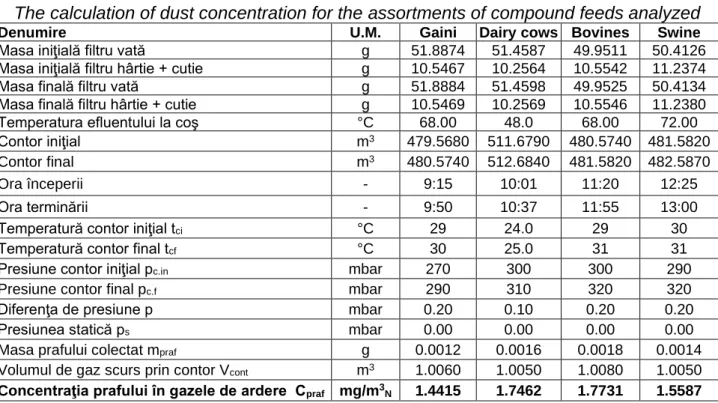
In order to analyse the dust concentrations eliminated of the working installations of the compound feed factories were carried out experimental measurements during the production of more assortments of compound feeds: for hens, dairy cows, bovines and swine.
The values obtained from these measurements are presented in table 1.
Table 1 The calculation of dust concentration for the assortments of compound feeds analyzed
Denumire U.M. Gaini Dairy cows Bovines Swine
Masa iniţială filtru vată g 51.8874 51.4587 49.9511 50.4126 Masa iniţială filtru hârtie + cutie g 10.5467 10.2564 10.5542 11.2374 Masa finală filtru vată g 51.8884 51.4598 49.9525 50.4134 Masa finală filtru hârtie + cutie g 10.5469 10.2569 10.5546 11.2380 Temperatura efluentului la coş °C 68.00 48.0 68.00 72.00 Contor iniţial m3 479.5680 511.6790 480.5740 481.5820
Contor final m3 480.5740 512.6840 481.5820 482.5870
Ora începerii - 9:15 10:01 11:20 12:25 Ora terminării - 9:50 10:37 11:55 13:00 Temperatură contor iniţial tci °C 29 24.0 29 30
Temperatură contor final tcf °C 30 25.0 31 31
Presiune contor iniţial pc.in mbar 270 300 300 290
Presiune contor final pc.f mbar 290 310 320 320
Diferenţa de presiune p mbar 0.20 0.10 0.20 0.20 Presiunea statică ps mbar 0.00 0.00 0.00 0.00
Masa prafului colectat mpraf g 0.0012 0.0016 0.0018 0.0014
Volumul de gaz scurs prin contor Vcont m3 1.0060 1.0050 1.0080 1.0050 Concentraţia prafului în gazele de ardere Cpraf mg/m3N 1.4415 1.7462 1.7731 1.5587
Figure 7 shows in graphical form the values of the dust concentrations determined during the production of the compound feed assortments analyzed. thus it can be observed that these values
306
Figure 7 - Dust concentration measured at the four assortments of combined feed
CONCLUSIONS
For the monitoring of the activites that are carried out during the technological flow from a compound feed factory and of working installations with a risk of affecting the environment were made experimental measurements of the dust concentrations at the evacuation basket of the jets of hot steam or of the jets of cooling air.
Order 462/1993 imposes, besides the limits of noxes and limits of the dust concentrations. Thus, the maximum permissible dust emission value for production installations of feeds and compound feeds is 5 mg/m3N.
To fall within the limits of dust emissions accepted by the current law, there are necessary the pursuit and the rigorous control of dust concentrations from the gases eliminated by the working equipments that disposes of burning sources, internal combustion engines or ventilators that collect different particles.
In this article are presented the studies and the measurements carried out, which proved that installations used at producing of compound feeds are reliable and are they comply with the European rules on environmental protection.
BIBLIOGRAPHY
1. Gaceu L., 2006 - Tehnici moderne de
uscare a cerealelor si plantelor tehnice,
Editura Universiății “Transilvania” Brașov, pp. 51-54;
2. Glodeanu M., 2003 - Technology and
equipment for environmental protection,
Universitaria Publishing House, Craiova; 3. Ionel, I., ş.a., 2002 – Protecţia
mediului, obiect de cercetare si
dezvoltare al laboratorului de analize de
combustibili şi investigaţii ecologice,
Revista AGIR, Nr. 1, ISSN 1224-7928, pag. 35-41;
4. Mihăilă, C., Procese şi instalaţii
industriale de uscare, Ed. Tehnică, pp.
36-43, 2001;
5. Popescu, C., 2017 – Reconstrucția
ecologică și ameliorarea solurilor și
terenurilor degradate, Editura Sitech
Craiova, ISBN 978-606-11-5397-3;
6. Ţucu, D., 2007 - Sisteme tehnologice
integrate pentru morărit şi panificaţie, Ed.
Orizonturi Universitare, Timişoara;
7. Vasile C., 2016 - The implementation
of an automated system of monitoring of the steam tempertures at the formation of
compound feed granules, Annals of the
University of Craiova - Agriculture, Montanology, Cadastre Series, Vol. XLVI, no. 2, ISSN: 1841-8317, pag. 588-593; 8.Vasile C., Glodeanu M., Alexandru T., 2017 - Environmental protection through
automated monitoring of steam
temperature in the work installations of
compound feed factories, SGEM 2017