425
STUDIES ABOUT THE AUTOMATED CONTROL OF STEAM
TEMPERATURE IN THE FORMING MOLD OF THE COMPOUND FEED
GRANULES IN VIEW OF ENVIRONMENTAL PROTECTION
VASILE CRISTIAN1)
1)
University of Craiova, Faculty of Agriculture E-mail: [email protected]
Keywords: automation, compound feed, steam temperature, environmental protection
ABSTRACT
The production process of
compound feed is a complex one, with activities that involve releasing some dust particles into the atmosphere by grinding cereals and using some steam jets at very high temperatures. For this reason, in compound feed factories must be designed and used working installations with a high degree of mechanization, automation and computerization, with a high productivity level and low specific consumption, whose functioning to be verified by experimental modeling so as to offer a rigorous monitoring of noxes and of the dust eliminated in accordance with the European accepted norms.
Thus, considering the complexity of the technological flow from a
compound feed factory (CFF), in this article the thermal parameters of the work installation are being analyzed, in the homogenization and sterilization area of the compound feeds using steam jets at very high temperatures.
In this article are presented the
results of the experimental
measurements carried out at the critical points of the technological flow for the production of different recipes of compound feed, that attest the advantage of using some automated working installations that function at the optimal designed parameters and at the same
time fully comply with the EU
requirements related to the protection of the surrounding environment.
INTRODUCTION
In any compound feed factory, usually are produced more assortments of finished products and the production process implies the execution of several distinct stages during a complete technological flow, each with its specificity and significance: the supply and the storage of the cereals in well defined spaces, the transport of the cereals from bunkers to the grinding mills, the mincing of cereal grains, the dosage of necessary ingredients according to the wanted compound fodder recipe, the mixing of the ingredients, the homogenization of the thus obtained blend by means of a steam jet with very high temperatures, the obtaining of the compound fodder granules by passing the blend through the orifices of a matrix and the sterilization of these granules with the hot
steam jet, the cooling of the granules and of the output air jet, the obtaining of finite product in the form of combined fodder, the packing and the distribution to the beneficiaries.[3, 8, 10]
426 acceptable limits for human operators serving the working installations and thus comply with the current norms of the European Union on environmental protection. [2, 7, 10]
Considering that the raw materials in the combpound feed factories are cereals, which must be grinding and then turned into granules of finished product, it is very clear that during the technological flow appear noxes and dust that can be released into the atmosphere. The experimental studies in this article propose an analysis of the functional parameters of the working installation from the compound feed factory for the automated control of the steam
temperature that causes the appearance of the dust clouds in the surrounding atmosphere. For this purpose, were used 6 distinct locations for conducting the experimental measurements, in the area of the mold of granulation, starting from the steam generator burner and through to the exit of the cooling system of the granules by the help of cold air jets. Also, knowing that each combined feed recipe requires different operating parameters of the working installations, was analyzed the samples obtained during the technical process of producing for two distinct recipes of compound feed: for feeding swine, respectively for feeding cattle.[6, 9]
MATERIAL AND METHODS
The activities from the technological flow corresponding to an automated system for the production of compound feed involves the crossing of some work stages with a very well
established succession. Thus, figure 1 shows the operations which are being executed in the production process that takes place in a compound feed factory. [9, 10]
Figure1: Diagram of the technological flow of production process of compound feed and the places for experimental measurement of temperatures
According to the working steps of the technological flow which was described in figure 1, it can observe the critical points of the working installation where the experimental measurement
activities were carried out using the system of data acquisition National Instruments:
427 - at the entrance of the mold, where the homogenised product arrives, according to the manufacturing recipe, where is treated with jets of steam at a temperature of 150-180°C, at a pressure of 7-8 barr (PM 3)
- in the granulation molds equipped with teeth, knives and holes of various sizes, the formation and the hygienisation of the granules is carried out with steam jets at very high temperatures, and after the formation of the granules the steam jet must be removed from the granulation molds and for the rapid decrease of the temperatures in order to protect the environment it is uses a filter, by the type a cooling buffer vessel (PM4)
- at the exit of the granulation installation (the granulation mold) the steam jet and the granules have a high temperature of about 80-90°C, being directed to the cooling system, where was established the five measuring point (PM5)
- at the exit of the cooling system (PM6), the air jet and the finished product granules have a temperature of about 26-28°C, so that there is no longer any danger to the environment or for the staff that works in the compound feed factory.[5, 10]
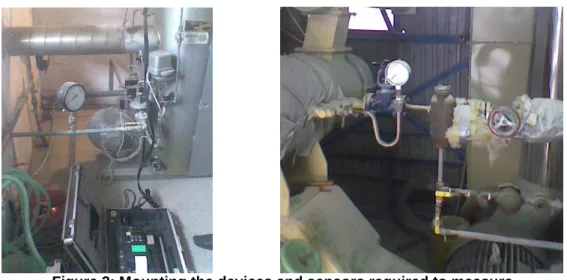
In figure 2 it is presented how were installed the devices and sensors which was used to read the values of temperatures at a specific point for experimental measurement.
Figure 2: Mounting the devices and sensors required to measure the steam jet temperatures in the area of granulation mold
RESULTS AND DISCUSIONS
The collection of the necessary samples for carrying out the experimental researches was made in the area of the mold where the granules of compound feed are formed, and, in continuation, are presented the results of the measurements obtained for two distinct types of compound feed recipes, considering that for each recipe of compound feed there are different characteristics of operating parameters for the working installation.
In this way, for the checking of operating in optimal parameters of working installation of compound feed
factory was measured temperatures in 6 distinct points of work from the technological flow. The 6 critical points in which were made the experimental measurements were not randomly chosen, because are strategically located in the technological flow and indicate the setpoints after which automated system of the installation adjust the manufacturing process of the combined feed according to the desired recipe.
428 of the process for the production of the compound feed, in the final file whit measured values were obtained 600 readings for this 6 temperatues.
The temperatures measured during these experimental research performed on the route of technological flow of the compound feed factory will be noted in the following way:
T_GA - temperature of combustion gasses
T_AC - temperature of the steam inside the boiler
T_AIM - the steam temperature upon the entrance in the mold
T_VT - temperature of the buffer vessel T_IR - temperature of the cooling installation
T_MA - temperature of the environment Table 1 shows some of the temperature values collected by the sensors at the 6 points where have been carried out the experimental measurements, in the case of the production of the compound feed assortment used for feeding swine.
Table 1 The values of temperatures of the working installation during the production
of the compound feed assortment used for feeding "swine" Time
t [s]
Temperatures [°C]
T_GA T_AC T_AIM T_VT T_IR T_MA
1 28 28 28 28 28 28
10 41 37,5 31,5 28,5 28 28
20 150,5 126 107 62 32,5 28
30 235 152 129 71,5 37 28,1
50 271,5 160 146,5 86 41 28,2
100 294 167 148 87 41,5 28,3
200 306 172,5 151 89 42 28,2
300 307 174 152 87 42 28,1
400 302,5 173 151,5 86,5 41,5 28,2
500 301 174 152 87 42 28,2
600 303 174,5 154 87,5 42,5 28,3
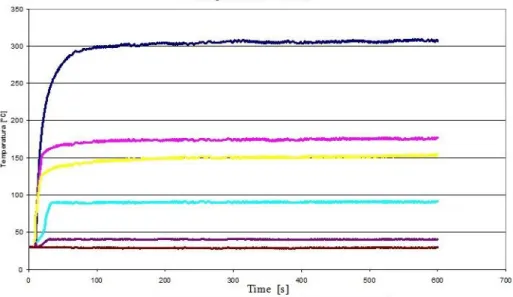
In this way, based on the values shown in tabel 1 it can be made a graphical representation of the evolution
of temperatures analyzed for the working installation of this compound feed factory (figure 3).
429
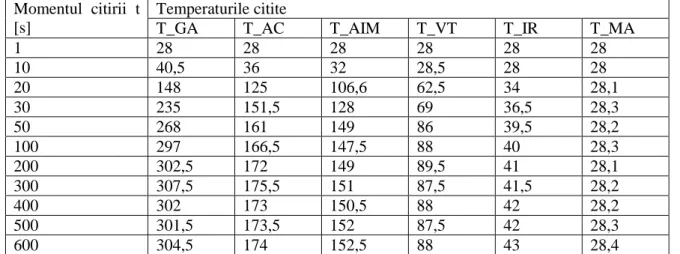
Experimental measurements were also carried out for another recipe of compound feed, namely the one used for feeding the cattle. Table 2 presents the values of the temperatures which was collected at the 6 distinct work points where the experimental measurements were made at certain times of this technological flow.
Table 2 The values of temperatures of the working installation during the production
of the compound feed assortment used for feeding "cattle" Momentul citirii t
[s]
Temperaturile citite
T_GA T_AC T_AIM T_VT T_IR T_MA
1 28 28 28 28 28 28
10 40,5 36 32 28,5 28 28
20 148 125 106,6 62,5 34 28,1
30 235 151,5 128 69 36,5 28,3
50 268 161 149 86 39,5 28,2
100 297 166,5 147,5 88 40 28,3
200 302,5 172 149 89,5 41 28,1
300 307,5 175,5 151 87,5 41,5 28,2
400 302 173 150,5 88 42 28,2
500 301,5 173,5 152 87,5 42 28,3
600 304,5 174 152,5 88 43 28,4
Thus, by analyzing the values of temperatures collected by the sensors and presented in the table 2, a graphical representation of the temperature
evolution in the analysis points of the working installation at this compound feed factory it can be made (figure 4).
Figure 4: The evolution in time of the temperatures of the working installations during the preparation of compound feed assortment for “cattle”
CONCLUSIONS
The experimental measurements which have been made during the technological flow of the production of the different recipes of compound feed show
430 values close to those of the reference indicated in the technical playbook of the working installation of compound feed factory.
Figures 3 and 4 are showing that the operation mode of the installation for the production of the combined fodders is constant, meaning that were not detected oscillations of the measured values for any of the recipe of compound feed analysed in these experimental research which were carried out in CFF (compound feed factory).
The values of temperatures at the exit of the working installation, for each recipe of the combined fodders produced, are fall within the range of 26-28°C, which confirm that this compound feed factory
dispose of facilities and filters to reducing environmental pollution.
Increasing the working performance in a FNC is also determined by the assumption of responsibilities regarding the quality of the technical equipment used, its reliability and efficiency during the technological flow.
Thus, the experimental research presented in this paper confirms that the compound feed production process has to be carried out in factories equipped with performing working installations, with high degree of automation and computerization, to ensure full compliance with EU rules on protection the environment.
BIBLIOGRAPHY
1. Bollen, J., Brink, C., Air pollution policy in Europe: Quantifying the interaction with greenhouse gases and climate change policies, Energy Economical, pp 202–
215, 2014;
2. Bond T.C., Covert D.S., Kramlich J.C., Larson T.V., Charlson R.J., Primary particle emissions from residential coal burning: Optical properties and size distributions, Journal of Geophysical Research: Atmospheres, vol. 107, no. D21, pp 1-14, 2002 ;
3. Gaceu L., Tehnici moderne de uscare a cerealelor si plantelor tehnice, Editura Universitatii “Transilvania” Brașov, pp. 68-71, 2006;
4. Heinsohn R.J. , Kabel R.L., Sources and
Control of Air Pollution, Prentice Hall, NJ, pp. 32-34, 1999;
5. Ionel, I., Măsurarea emisiilor din gazele
de ardere cu ajutorul senzorilor electrolitici, The National Conference of Thermodynamics, Romania, Vol. I, pp. 231-235, 1994;
6. Mihăilă, C., Procese şi instalaţii
industriale de uscare, Editura Tehnică, Romania, pp. 27-32, 2001;
7. Popescu C., The modification of some features of soils located nearby chemical plant Craiova zone that is affected by
noxioux substances. SGEM 2016
Conference Proceedings, vol. 2, pag. 409-415, 2016;
8. Şara, A., Odagiu, A., Controlul calităţii
nutreţurilor, AcademicPres Publishing House, Romania, pp. 52-58, 2005;
9. Vasile C., The implementation of an automated system of monitoring of the steam tempertures at the formation of compound feed granules, Annals of the University of Craiova - Agriculture, Montanology, Cadastre Series, Vol. XLVI, no. 2, 2016;
10. Vasile C., Glodeanu M., Alexandru T.,
Environmental protection through
automated monitoring of steam