Enhanced Rank-Estimated Searching for Dimensional Reliance Based
on Nearest Neighbor Search
Silla Srinivasrao1, K Sameer2
#1. M.Tech (CSE) in Department of Computer Science Engineering, #2. Assist.Prof, Department of Computer Science and Engineering,
Gonna Institute Of Information Technology & Sciences Aganampudi, Visakhapatnam AP, INDIA.
Abstract
The K-NN is a technique in which objects are classified relies upon nearest preparing illustrations which is available in the component query space. The K-NN is the least difficult order technique in information mining. In K-NN objects are classified when there is no data about the conveyance of the information objects is known. In K-NN execution of characterization is rely upon K and it can be dictated by the decision of K and also the separation metric of inquiry. The execution of K-NN arrangement is to a great extent influenced by determination of K which is having a reasonable neighborhood size. It is a key issue for order. This paper proposed an information structure which is for K-NN seek, called as Rank Cover Tree to build the computational cost of K-NN Search. In RCT pruning test includes the examination of objects comparative esteems applicable to query. In Rank Cover Tree each protest can allot a particular request and as indicated by that request query can chose which can be pertinent to the individual query inquiry. It can control the general inquiry execution cost .It gives result to Nonmetric pruning techniques for closeness seek and when high dimensional information is prepared it gives a similar outcome. It returns revises inquiry execution result in required time that depends on an inherent dimensionality of objects of the informational collection. RCT can surpass the execution of techniques including metric pruning and numerous determination tests including separation esteems having numerical imperatives on it.
Keywords: Nearest neighbor search, intrinsic dimensionality, rank-based search.
I. Introduction
In this paper, we address the issue of nearest neighbor (NN) seek in vast datasets of high dimensionality. It is utilized for characterization, arranging a test point on the premise of the classes in its nearby neighborhood. Non-parametric thickness estimation utilizes NN algorithms when the data
included element inspecting for nearby exception discovery information testing for grouping and estimated closeness search for k-NN arrangement (and in addition in its own particular right). Cases of quick rough similitude search records incorporate the BD-Tree, a broadly perceived benchmark for inexact k-NN seek; it makes utilization of part controls and early end to enhance the execution of the essential KD-Tree. A standout amongst the most prominent techniques for ordering, Locality-Sensitive Hashing can likewise accomplish great viable scan execution for go inquiries by overseeing parameters that impact a tradeoff amongst precision and time. The spatial approximation sample hierarchy (SASH) similarity search list has had handy accomplishment in quickening the execution of a mutual neighbor clustering algorithm, for an assortment of information sorts.
II. Related work
These techniques are as yet unfit to scale to high measurements. Be that as it may, they can be utilized as a part of mix with the supposition that high dimensional information really lies on a lower dimensional subspace. There are various quick DANN strategies that preprocess information with randomized projections to diminish dimensionality. Half and half spill trees [4] assemble spill trees on the haphazardly anticipated information to get huge speedups. Area touchy hashing hashes the information into a lower dimensional pails utilizing hash capacities which ensure that "nearby" focuses are hashed into a similar can with high likelihood and "more distant separated" focuses are hashed into a similar container with low likelihood. This technique has noteworthy upgrades in running circumstances over conventional strategies in high dimensional information and is appeared to be highly adaptable. In any case, the DANN techniques expect that the separations are very much carried on and not moved in a little range. The correct tree based algorithms neglected to be proficient in light of the fact that numerous datasets experienced by and by endured a similar grouping of pairwise separations. Utilizing DANN in such a circumstance prompts the loss of the requesting data of the pairwise separations which is basic for NN seek [6]. This is too expansive of a misfortune in exactness for expanded effectiveness. So as to address this issue, we propose a model of estimation for NN search which saves the data introduce in the requesting of the separations by controlling the blunder in the requesting itself regardless of the dimensionality or the appropriation of the pairwise removes in the dataset. We likewise give a versatile algorithm to acquire this type of guess. This paper incorporates searching technique
which makes client seek information very productive and a structure for parallel inquiry, the Rank Cover Tree, whose ordinal pruning arrangement ensure just of direct examinations between remove esteems. This technique gives a relationship or similitude between seek archive and client inquiry. This paper concentrate on pertinent element choice in content archives. It acquaints a strategy with select disconnected records for premium elements. It gives a skilled system to creating viable content digging models for pertinence include identification. It chiefly utilize page importance standards in view of data that must be gotten from the entire learning base, making their application frequently unachievable in gigantic semantic conditions .creators of this paper speaks to another ranking system, that is equipped for giving a weight score to a Web page into a clarified result set by essentially considering the client input query, the page clarification, and the essential metaphysics. This paper contains a technique which depends on ranking framework with enhanced HITS and Semantic Similarity techniques. This technique is utilized to rates the website pages. This technique is utilized to rank a site page from an arrangement of given website pages. This paper incorporates the framework which rank the website page. This framework depends on three techniques which are Semantic Similarity approach, HITS and on the premise of AI technique, AI technique is utilized to get to the client history to rank the page as indicated by the client inquiry.
III. Dimensionality Reduction
determination above and beyond by choosing important subspaces for each bunch independently.
Highlight Transformation
Highlight changes are normally utilized on high dimensional datasets. These strategies incorporate methods, for example, standard segment examination and solitary esteem deterioration. The changes by and large safeguard the first, relative separations between objects. Along these lines, they compress the dataset by making straight blends of the qualities, and ideally, reveal idle structure. Highlight change is regularly a preprocessing step, enabling the bunching calculation to utilize only a couple of the recently made components. A couple of bunching strategies have consolidated the utilization of such changes to distinguish essential elements and iteratively enhance their grouping. While frequently extremely valuable, these strategies don't really evacuate any of the first characteristics from thought. Along these lines, data from immaterial measurements is saved, making these strategies inadequate at uncovering groups when there are substantial quantities of insignificant characteristics that veil the bunches. Another burden of utilizing mixes of properties is that they are hard to translate, regularly making the grouping comes about less valuable. Along these lines, include changes are most appropriate to datasets where a large portion of the measurements are significant to the grouping errand, however many are profoundly connected or repetitive.
Highlight Selection
Highlight determination endeavors to find the qualities of a dataset that are most applicable to the information mining job needing to be done. It is a normally utilized and effective strategy for decreasing the dimensionality of an issue to more sensible levels. Highlight determination includes seeking through different element subsets and assessing each of these subsets utilizing some standard. The most famous inquiry systems are avaricious successive hunts through the component space, either forward or in reverse. The assessment criteria tail one of two essential models, the wrapper show and the channel display. The wrapper show strategies assess the dataset utilizing the information mining calculation that will eventually be utilized. In this way, they "wrap" the choice procedure around the information mining calculation. Calculations in light of the channel demonstrate inspect inborn properties of the information to assess the element subset before information mining. A great part of the work in highlight choice has been coordinated at regulated learning. The principle distinction between highlight choice in directed and unsupervised
learning is the assessment paradigm. Managed wrapper models utilize characterization exactness as a measure of goodness. The channel construct approaches quite often depend in light of the class names, most usually surveying relationships amongst's elements and the class names. In the unsupervised grouping issue, there are no generally acknowledged measures of exactness and no class marks. Notwithstanding, there are various strategies that adjust highlight determination to grouping. Entropy estimations are the premise of the channel show approach displayed in. The creators contend that entropy has a tendency to be low for information that contains tight groups, and subsequently is a decent measure to decide highlight subset pertinence. The wrapper strategy proposed in frames another element subset and assesses the subsequent set by applying a standard k-implies calculation. The EM bunching calculation is utilized as a part of the wrapper system in. Crossover techniques have additionally been produced that utilization a channel approach as a heuristic and refine the outcomes with a bunching calculation. One such technique by Devaney and Ram utilizes class utility to assess the element subsets. They utilize the COBWEB grouping calculation to manage the pursuit, however assess in light of inherent information properties. Another mixture approach utilizes a ravenous calculation to rank components in view of entropy esteems and after that utilizations k-intends to choose the best subsets of elements.
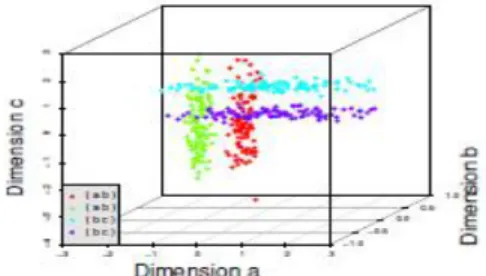
Figure 1: Sample dataset with four clusters, each in two dimensions with the third dimension being noise.
In addition to using different evaluation criteria, unsupervised feature selection methods have employed various search methods in attempts to scale to large, high dimensional datasets. With such datasets, random searching becomes a viable heuristic method and has been used with many of the aforementioned criteria. Sampling is another method used to improve the scalability of algorithms.
Problem Statement:
the design and analysis of scalable and effective similarity search structures has been the subject of intensive research for many decades. Until relatively recently, most data structures for similarity search targeted low-dimensional real vector space representations and the euclidean or other Lp distance metrics. However, many public and commercial data sets available today are more naturally represented as vectors spanning many hundreds or thousands of feature attributes that can be real or integer-valued, ordinal or categorical, or even a mixture of these types.
IV. Rank Cover Tree
We proposed a new data structure which is a probabilistic used for similarity search index; the rank-based search means Rank Cover Tree (RCT), in which no involvement of numerical constraints for selection and pruning of data element objects. All internal operation such as selections of objects are made by consider to specified ranks of that objects element according to that query , having strict control on query execution costs. A rank-based probabilistic method having huge probability, the RCT perform a correct result of query execution in specific time that relies on a high portion of the intrinsic dimensionality of that data set.
Construction:
1. Consider each item x To X, provides x into levels 0,. . . x. Height of tree is h, x can follows technique of a geometric distribution with q = jXj-1=h.
2. A partial RCT can be build by connecting each items in that level to an artificial root of tree on the highest level. 3. In partial RCT by using approximate nearest neighbors method which is found in the partial RCT can connect the next level of tree.
4. A RCT can be well-build with very high probability.
Figure 2: RCT Construction
To implement Rank Cover Tree it consists of design features of similarity search SASH and also design feature of Cover Tree. SASH can be used for approximate searching and cover tree for exact search of objects. both of these make use of a ordinal strategy for pruning of objects and it allows for strict control on query execution cost which is obtained with method of queries of approximate search . At each and every level of the tree structure visited the number of neighboring nodes can be restricted, the user also reduces average required execution time of that query at the each level of that query accuracy. The proximity search of Tree-based strategies make use of distance metric method in two ways in which numerical constraint of objects among three data objects on its the distances as it is examined by the method of triangle inequality, or distance of data candidates from its a reference point of numerical (absolute) value constraint present on it.
I. Objective:
1. The RCT can expand the execution of strategies that includes metric pruning system or other sort of choice tests having numerical imperatives on separate esteems.
2. To build the computational cost of K-NN Search.
3. Utilizing RCT client can limit the normal measure of time required for execution .to acquire an incredible question precision.
4. It gives more tightly control on general execution costs. Gives best outcome to comparability look
Ii. Need:
1. In RCT Rank limits technique particularly ascertain the quantity of information objects which is to be chosen for pruning it maintain a strategic distance from and diminish a noteworthy of variety of information components protests in the general execution time of question.
2. It enhances computational cost of similitude look.
The proposed Rank Cover Tree mixes a portion of the plan elements of the SASH likeness look structure and the Cover Tree. Like the SASH (and not at all like the Cover Tree), we might see that its utilization of ordinal pruning takes into consideration tight control on the execution costs related with estimated seek questions. By limiting the quantity of neighboring hubs to be gone to at each level of the structure, the client can diminish the normal execution time to the detriment of question precision. The algorithmic depictions of RCT development and question preparing are sketched out in individually. Tree-based systems for nearness seek normally utilize a separation metric in two distinctive courses as a numerical requirement on the separations among three information questions as exemplified by the triangle disparity, or as a numerical (outright) limitation on the separation of hopefuls from a reference point. The proposed Rank Cover Tree contrasts from most other pursuit structures in that it makes utilization of the separation metric exclusively for ordinal pruning, in this manner staying away from large portions of the troubles related with conventional methodologies in high-dimensional settings, for example, the loss of adequacy of the triangle disparity for pruning look ways. Proposes a rank based hashing plan, in which likeness calculation depends on rank averaging and other math operations. No trial comes about for this strategy have showed up in the examination writing up 'til now. Another calculation we considered, the combinatorial arbitrary association chart look strategy RanWalk, is for the most part of hypothetical enthusiasm, since the preprocessing time and space required is quadratic in the informational collection measure.
Applications
Limitations of current methods and the application of subspace clustering techniques to new domains drives the creation of new techniques and methods. Subspace clustering is especially effective in domains where one can expect to find relationships across a variety of perspectives. Some areas where we feel subspace clustering has great potential are information integration system, text-mining, and bioinformatics. Creating hierarchies of data sources is a difficult task for information integration systems and may be improved upon by specialized subspace clustering algorithms. In Bioinformatics, DNA microarray technology allows biologists to collect a huge amount of data and the explosion of the World Wide Web threatens to drown us in a sea of poorly organized information. Much of the knowledge in
these datasets can be extracted by finding and analyzing the patterns in the data. Subspace clustering techniques can be leveraged to uncover the complex relationships found in data from each of these areas.
Information Integration Systems
Information integration systems are motivated by the fact that our information needs of the future will not be satisfied by closed, centralized databases. Rather, increasingly sophisticated queries will require access to heterogeneous, autonomous information sources located in a distributed manner and accessible through the Internet. In this scenario, query optimization becomes a complex problem since the data is not centralized. The decentralization of data poses a difficult challenge for information integration systems, mainly in the determination of the best subset of sources to use for a given user query. An exhaustive search on all the sources would be a naive and a costly solution. In the following, we discuss an application of subspace clustering in the context of query optimization for an information integration system developed here at ASU, Bibfinder. The Bibfinder system maintains coverage statistics for each source based on a log of previous user queries. With such information, Bibfinder can rank the sources for a given query. In order to classify previously unseen queries, a hierarchy of query classes is generated to generalize the statistics. For Bibfinder, the process of generating and storing statistics is proving to be expensive. A combination of subspace clustering and classification methods offer a promising solution to this bottleneck. The subspace clustering algorithm can be applied to the query list with the queries being instances and the sources corresponding to dimensions of the dataset. The result is a rapid grouping of queries where a group represents queries coming from the same set of sources. Conceptually, each group can be considered a query class where the classes are generated in a one-step process using subspace clustering. Furthermore, the query classes can be used to train a classifier so that when a user query is given, the classifier can predict a set sources likely to be useful.
Web Text Mining
making information sharing and interoperability between heterogeneous systems difficult [72]. Recently, there has been strong interest in developing ontologies to deal with the above issues. The purpose of ontologies is to serve as a semantic, conceptual, hierarchical model representing a domain or a web page. Currently, ontologies are manually created, usually by a domain expert who identifies the key concepts in the domain and the interrelationships between them. There has been a substantial amount of research effort put toward the goal of automating this process.
VI. Conclusion
We have presented a new structure for similarity search, the Rank Cover Tree, whose ordinal pruning strategy makes use only of direct comparisons between distance values. The RCT construction and query execution costs do not explicitly depend on the representational dimension of the data, but can be analyzed probabilistically in terms of a measure of intrinsic dimensionality, the expansion rate. The RCT is the first practical rank-based similarity search index with a formal theoretical performance analysis in terms of the expansion rate; for small choices of parameter h, its fixed-height variant achieves a polynomial dependence on the expansion rate of much smaller degree than attained by the only other practical polynomially-dependent structure known to date (the Cover Tree), while still maintaining sub linear dependence on the number of data objects. An estimation of the values of the expansion rates several of the data sets considered in the experimentation they show that in most cases, the ability to trade away many factors of the expansion rate more than justifies the acceptance of a polynomial cost in terms of n. The experimental results support the theoretical analysis, as they clearly indicate that the RCT outperforms its two closest relatives the Cover Tree and SASH structures in many cases, and consistently outperforms the E2LSH implementation of LSH, classical indices such as the KD-Tree and BD-Tree, and for data sets of high dimensionality the KD-Tree ensemble method FLANN.
References
[1] T. Hastie, R. Tibshirani, and J. H. Friedman. The Elements of Statistical Learning: Data Mining, Inference, and Prediction. Springer, 2001.
[2] B. W. Silverman. Density Estimation for Statistics and Data Analysis. Chapman & Hall/CRC, 1986.
[3] J. B. Tenenbaum, V. Silva, and J.C. Langford. A Global Geometric Framework for Nonlinear
Dimensionality Reduction. Science, 290(5500):2319– 2323, 2000.
[4] S. T. Roweis and L. K. Saul. Nonlinear Dimensionality Reduction by Locally Linear Embedding. Science, 290(5500):2323–2326, December 2000.
[5] A. N. Papadopoulos and Y. Manolopoulos. Nearest Neighbor Search: A Database Perspective. Springer, 2005.
[6] N. Alon, M. Badoiu, E. D. Demaine, M. Farach-Colton, and M. T. Hajiaghayi. Ordinal Em- ˘ beddings of Minimum Relaxation: General Properties, Trees, and Ultrametrics. 2008.
[7] K. Beyer, J. Goldstein, R. Ramakrishnan, and U. Shaft. When Is “Nearest Neighbor” Meaningful? LECTURE NOTES IN COMPUTER SCIENCE, pages 217–235, 1999.
[8] J. M. Hammersley. The Distribution of Distance in a Hypersphere. Annals of Mathematical Statistics, 21:447–452, 1950.
[9] J. H. Freidman, J. L. Bentley, and R. A. Finkel. An Algorithm for Finding Best Matches in Logarithmic Expected Time. ACM Trans. Math. Softw., 3(3):209–226, September 1977.
[10] S. M. Omohundro. Five Balltree Construction Algorithms. Technical Report TR-89-063, International Computer Science Institute, December 1989.
Authors
Silla Srinivasrao Pursuing M.Tech (CSE) From Gonna Institute of Information Technology & Sciences, Aganampudi, Visakhapatnam Dist (A.P). His area of interest includes Cloud Computing and Network Security.