Volume 1, Issue 4, June 2012
Abstract— These Since their appearance in 1993, first
approaching the Shannon limit, turbo codes gave a new direction in the channel encoding field, especially since they have been adopted for multiple telecommunication norms. To obtain good performance, it is necessary to design a robust turbo code interleaver and the code rate. Compared to 1/3 Code rate 2/3 coder has less redundancy. So in this project we are using the code rate of 2/3. This paper proposes a differential evolution approach to find above average turbo code interleavers. Performance is compared with the conventional genetic algorithm approach and the empirical results illustrate that DE performs well.
Index Terms—BER, convolutional code capacity, evolutionary algprithms(EA), free distance, non trivial optimization problems, optimal code, random keys encoding, rate.
I. INTRODUCTION
The introduction of the turbo principle allowed close approach to the Shannon limit – a theoretical boundary describing the maximum capacity of a noisy communication channel. The invention of the turbo codes and its superior performance in practical applications also initiated a renaissance of channel coding [1, 2]. The exceptional performance of the turbo codes can be further improved by finding right settings for a particular system. The structure of the interleaver, performing a permutation of input bits, is one important property of any turbo code system. In this paper, we optimize the turbo code interleaver by genetic algorithms and differential evolution.
II. OPTIMAL 2/3 CONVOLUTIONAL CODES
Binary
linear convolution codes, like that of binary linear block codes are useful in the power-limited regime. Here, we see that the encoder is a LTI filter with banks gi (D) that are both rational and causal. More- over, the message m = [m1 , m2 , ..., mL ] of length L is passed in bit-by-bit producing n code words cn . From this, we can then form the encoded message ascnk = [c1, c2,…..cn,c1,c2,…cn,c1,c2,….cn]
Manuscript received June 15, 2012.
V.Glory, ECE Department, Sir C.R.R.College of Engineering, ., (e-mail: [email protected]). Eluru, India, 8096127476Ch.Ravi Kumar, ECE Department, Sir C.R.R College of Engineering, Eluru, India, 9440396021., (e-mail: [email protected]).
Dr.K.Padma Raju, ECE Department, JNTUK , Kakinada, India,, (e-mail: [email protected]).
Moreover, if one forms the “Delay Transform” of an impulse response gi (D), the n- th code word can then be formed as c(D) = m(D)gi (D). Together, all possible solutions of an message code forms what is known as a convolution code. Although the formulation of a convolution code assumes a message to be theoretically infinite (as well as the space of acceptable codes), we define block codes of length L.
(a)
(b)
Fig. 1(a) 2/3 convolutional encoder (b)corresponding binary/octal generator matrix
With this, an encoder can be viewed as a generator matrix G(x) of a linear block code, and hence, multiple encoding schemes can be designed to achieve a rate 2/3 system. In addition, each encoding scheme can contain μ memory elements, adding versatility to design of a particular convolution code. To this end, we seek to implement an optimal convolution code of different μ sizes..
III. TURBO CODES
The turbo codes were introduced by Berrou, Glavieux and Thitimajshima in 1993 [2] and they have become a hot topic since then. Prior to the turbo codes, 3dB or more separated the specfral efficiency of real world channel encoding systems from the theoretical maximum described by Shannon theorem[2].
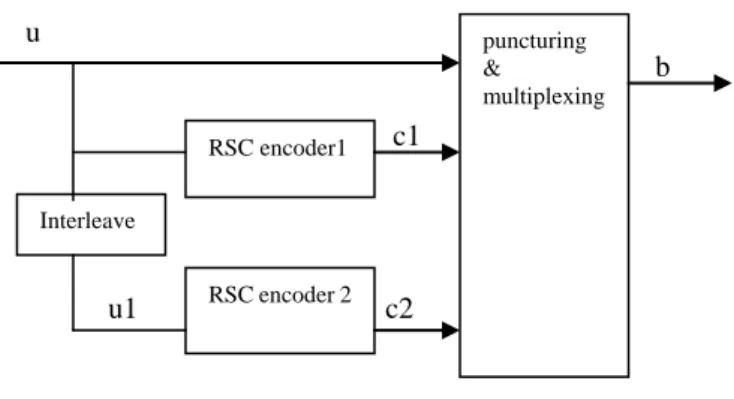
The turbo codes are an implementation of parallel concatenation of two circular recursive systematic convolutional (CRSC) codes based on a pseudorandom permutation (the interleaver). The general scheme of a classic turbo encoder is shown in Figure 2.
Design of Robust Turbo Code Interleaver by
Differential Evolution and Genetic Algorithms
u
b
c1
u1 c2
Fig. 2 A general scheme of turbo encoder
The encoder processes a -bit long information frame. The input frame is interleaved by the N–bit interleaver to form permuted frameu1. Original input frame is encoded by the
encoder RSC1 and interleaved frame is encoded by RSC2. Hereafter, the two encoded frames c1 and c2 are merged together and with the original input sequence u according to some puncturing and multiplexing scheme. The rate of the code is defined as r =𝑘
𝑛=
𝐼𝑛𝑝𝑢𝑡 𝑆𝑦𝑚𝑏𝑜𝑙𝑠
𝑂𝑢𝑡𝑝𝑢𝑡 𝑆𝑦𝑚𝑏𝑜𝑙𝑠
.
Previous studies have illustrated that a random block interleaver (random permutation of the input frame) can be in certain cases (e.g. for BER > 10-5) more efficient than other channel encoding schemes [3]. In this paper, an optimized turbo code block interleaver is compared with a random block interleaver by means of BER to evaluate its efficiency. The increase of the interleaver size gives better performance and better interleaving gain while worsening latency. Equation (1) illustrates the influence on the latency:
td =
𝐾𝑓
𝑅𝑏Ni (1)
In (1), Rb is the code bit rate, Kf stands for the frame size and Ni is the number of the decoding stages.
Interleaver matrix sizes vary from tens to ten thousands of bits. When optimizing, it is highly inefficient, if not impossible, to test all the possible input vectors 2N with all the possible N! interleaver matrices, requiring 2NN! tests in total. Therefore, advanced interleaver optimization methods are under investigation.
A. Interleaver Evaluation
As noted earlier, the performance of a turbo code can be evaluated by the means of bit error rate, i.e. the ratio of the number of incorrectly decoded bits to the number of all bits transmitted during some period. Unfortunately, it is rather hard to compute the BER for a turbo code and the simulations can be for larger interleavers very inaccurate. The error floor of a C(n,k) code can be analytically estimated:
BER = 𝑊𝑓𝑟𝑒𝑒2𝑘 erfc(√ dfree
𝑘 𝑛
𝐸𝑏
𝑁0 ) (2)
To estimate BER, the following code properties must be known [4]:
dfree = the free distance, i.e. the minimum number of different bits in any pair of code words.
Nfree = the free distance multiplicity, i.e. the number of input frames generating code words with dfree.
Wfree = the information bit multiplicity, i.e. the sum of the hamming weights of the input frames generating the code words with dfree.
There are several algorithms for free distance evaluation. Garello presented an algorithm designed to effectively compute free distances of large interleavers with unconstrained input weight based on constrained subcodes
This work introduces interleaver optimization driven by algebraical estimation of maximum dfree evaluated using analytical approach.
IV. GENETIC ALGORITHMS
Genetic algorithms are probably the most popular and wide spread member of the class of evolutionary algorithms (EA). EAs form a group of iterative stochastic search and optimization methods based on mimicking successful optimization strategies observed in nature [5, 6, 7, 8]. The essence of EAs lies in their emulation of Darwinian evolution, utilizing the concepts of Mendelian inheritance for use in computer science [6]. Together with fuzzy sets, neural networks, and fractals, evolutionary algorithms are among the fundamental members of the class of soft computing methods.
EAs operate with a population of artificial individuals (also referred to as items or chromosomes) encoding possible problem solutions. Encoded individuals are evaluated using a carefully selected objective function which assigns a fitness value to each individual. The fitness value represents the quality (ranking) of each individual as a solution to a given problem. Competing individuals explore the problem domain towards an optimal solution [8].
Genetic algorithms (GA) introduced by John Holland and extended by David Goldberg, are a widely applied and highly successful EA variant. Evolutionary principles are in GA implemented via iterative application of so called genetic operators: the mutation, the crossover and the selection. Mutation and selection can be found in more evolutionary techniques while crossover is significant for genetic algorithms. Many variants of the standard generational GA have been proposed. The main differences lay mostly in particular selection, crossover, mutation, and replacement strategies [8].
Genetic algorithms have been successfully used to solve non-trivial multimodal optimization problems. They inherit the robustness of emulated natural optimization processes and excel in browsing huge, potentially noisy problem domains. Their clear principles, ease of interpretation, intuitive and reusable practical use and significant results made genetic algorithms the method of choice for industrial applications, while carefully elaborated theoretical foundations attract the attention of academics.
V. GENETIC ALGORITHMS FOR INTERLEAVER OPTIMIZATION
The optimization of a turbo code interleaver is a nontrivial combinatorial optimization task. Genetic algorithms have already been considered for interleaver matrix optimization. Durand et al. [9] used customized GA to optimize an interleaver of the size 105, comparing their results to previous interleaver design techniques. The genetic algorithm that was used was fully based on mutation and the
puncturing &
multiplexing RSC encoder1
RSC encoder 2 Interleave
Volume 1, Issue 4, June 2012
crossover operator was omitted. The fitness criterion for every interleaver was maximum free distance.
Rekh et al. [10] presented another GA variant for interleaver optimization, introducing 2-point crossover to the interleaver evolution process. Nevertheless, the crossover impact was influenced by the necessary correction of errors caused by crossover applications. The fitness criterion was BER and the size of the optimized interleaver was 50.
A. Interleaver GA design
An interlaever with the dimension N performs a hardware permutation of N input bits and it can be seen as a general permutation of N symbols σN = (i1,i2,……..,iN) where ik ϵ [1,N] and in ≠ im for all m ≠ n ϵ [1,N]. The application of σN on a sample input vector IN for N=5 is illustrated in (3).
I5 = (0, 1, 0, 1, 1, 1)
σ5 = (5, 3, 4, 1, 2) (3) O5 = σ5(I5) = (1, 0, 1, 0, 1)
Intuitively, σN can be used as a permutation encoding for genetic algorithms, as utilized e.g. in [10]. Durand et al. [5] did not explicitly specify used interleaver encoding, although we can conclude that they used a similar interleaver representation.
In our GA implementation for turbo code interleaver optimization two types of selection techniques were used. In order to speed up the convergence of the algorithm, a semi-elitary hybrid selection scheme choosing one parent by elitary manners and the second by proportional manners of roulette wheel selection. Mutation was implemented by swapping the positions of two coordinates in σN. On the contrary, traditional crossover operators (except uniform crossover) would corrupt the structure of intuitively encoded permutation σN and hence they cannot be used without some post-processing used for chromosome fixing. This is a remarkable fact, since crossover is referred to as the primary operator for GA [7].
B. The Role of Crossover in GA
The crossover operator is the main operator of genetic algorithms that distinguishes it from other stochastic search methods [7]. Its role in the GA process has been intensively investigated and its omission or traversing is expected to affect the efficiency of a GA solution significantly.
A crossover operator is primarily a creative force in the evolutionary search process. It is supposed to propagate building blocks (low-order, low defining length schemata with above-average fitness) from one generation to another and create new (higher-order) building blocks by combining low order building blocks. It is intended to introduce large changes to the population with low disruption of building blocks [11]. In contrast, mutation is expected to insert new material to the population by random perturbation of chromosome structure. In this way, however, new building blocks can be created or old ones disrupted [11].
An experimental study on crossover and mutation in relation to the frequency and lifecycle of building blocks in a chromosome population showed that the ability of mutation and one-point crossover to create new building blocks is almost the same. However, crossover is irreplaceable for spreading newly found building blocks among the population (which can lead to loss of diversity in the population) [11].
A mutation-only genetic algorithm avoids the use of a crossover operator. This, as already mentioned, can be seen as a significant weakening of the algorithm.
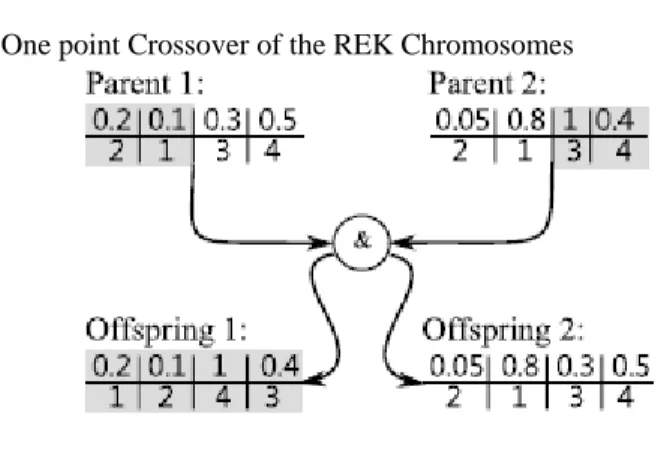
Another strategy available for problems involving permutation evolution is the random keys encoding [12]. With random keys encoding, the permutation is represented as a string of real numbers (random keys), whose position after ordering corresponds to the permutation index. Random keys encoded chromosomes and the crossover of randomly encoded permutations are illustrated in Figure 3. When there are two identical random keys in the population, randomly encoded permutations can be corrupted by crossover too. However, the occurrence of two equal random keys can be considered as a very rare situation.
There are two other more significant drawbacks of the RK encoding. First, it is rather computationally expensive. It requires sorting of the real array every time a chromosome is modified and needs to be evaluated. Second, genetic algorithms were not designed to deal with real-valued chromosomes, even though there are methods on how to process real valued chromosomes by GA.
A Chromosome with Random Key Encoding
Random key
0.2 0.1 0.3 0.5
Allele 2 1 3 4
One point Crossover of the REK Chromosomes
Fig. 3 Random key encoding example
VI. DIFFERENTIAL EVOLUTION
Differential Evolution is a reliable, versatile and easy to use stochastic evolutionary optimization algorithm [13]. DE is a population-based optimizer that evolves real encoded vectors representing the solutions to given problem. The real-valued nature of population vectors differentiates the DE notably from GAs that were originally designed to evolve solution encoded into binary or finite discrete alphabets.
The DE starts with an initial population of N real valued vectors. The vectors are initialized with real values either randomly or so, that they are evenly spread over the problem domain. The latter initialization leads to better results of the optimization process [13].
vector competes with a member of the current population with the same index. If the trial vector represents a better solution than the population vector, it takes its place in the population [13].
Differential evolution is parameterized by two parameters [13]. Scale factor F ϵ (0,1+) controls the rate at which the population evolves and the crossover probability C ϵ [0,1] determines the ratio of bits that are transferred to the trial vector from its opponent. The number of vectors in the population is also an important parameter of the population. The outline of classical DE algorithm is shown in Figure 3. There are more variants of differential evolution. They differ mostly by the way new vectors are generated. We used the classical differential evolution algorithm, also referred to as DE/rand/1/bin [13].
Differential evolution is prospective method for turbo code interleaver optimization since it operates on real valued vectors and a permutation represented by RK encoding is indeed a real vector. Moreover, differential evolution has been shown to outperform genetic algorithms in some problem domains [13].
_______________________________________________ I. Initialize the population P consisting of M vectors II. Evaluate an objective function ranking the vectors
in the population III. Create new population :
For i ϵ {1…M}:
a. Create a trial vector vit = v1r + F.(v2r - v3r),
Where F ϵ [0, 1] is a parameter and v1r, v2r, v3r
are three random vectors from the population P. This step is in DE called mutation.
b. Validate the range of coordinates of vit.
Optionally adjust coordinates of vit so, that vit is
valid solution for given problem.
c. Perform uniform crossover. Select randomly one point (coordinate) l in vit . With probability
1-C let vit[m] = vi[m] for each m ϵ {1……N}
such that m ≠ l.
d. Evaluate the trial vector. If the trial vector vit
represents better solution than population vector vi , replace vi in population P by vit.
IV. Check termination criteria; if not satisfied go back to III.
________________________________________________
Fig. 4 A summary of DE algorithm
VII. INTERLEAVER OPTIMIZATION EXPERIMENTS
A simulation framework built upon the IT++ library1 was used to experimentally evaluate the proposed interleaver generation method. IT++ is a robust and efficient C++ library of mathematical and telecommunication algorithms and objects. It provides high native code performance and excellent abstraction of a well-defined object-oriented framework. We have experimented with 64-bit, 128-bit and 256-bit interleavers. The settings for optimization experiments were:
Random key encoding of chromosomes
1000 generations (GA), 3000 and 5000 evaluations (DE)
Probability of crossover 0.8 and probability of mutation 0.2 for GA
C equals to 0.9 and F equals to 0.9 for DE
Population of 20 vectors for DE and population of 40 chromosomes for GA
The fitness function used in GA and DE for turbo code interleaver optimization was based on analytical dfree estimation as defined in [4]. The goal of the fitness function was to maximize dfree , and minimize Nfree and Wfree :
ffitness = A . dfree – B . Nfree – C . Wfree (4)
where the coefficients A, B and C were fixed to 100, 10 and 1 respectively. All experiments were executed several times to overcome the stochastic nature of the algorithms.
A. Optimization Results
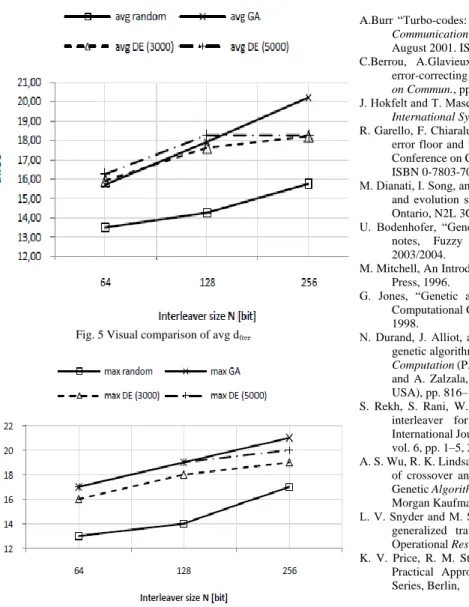
The results of experimental interleaver optimization are summarized in Tables I and II. Table I outlines the average obtained interleaver free distance for 64, 128 and 256-bit interleavers. The first column shows average free distance of a random interleaver, second column shows average dfree of an inteleaver optimized by GA and third and fourth column show average dfree of an interleaver optimized by DE after 3000 and 5000 evaluations respectively.
TABLEI
COMPARISON OF AVERAGE FREE DISTANCE
N avg
random
avg GA avg DE (3000)
avg DE (5000)
64 13,50 19,74 19,95 20,28
128 14,25 22,95 22,65 23,28
256 15,72 26,26 24,26 24,28
Table II represents maximum values of for investigated interleavers.
TABLEII
COMPARISON OF MAXIMUM FREE DISTANCE
N Max
random
Max GA
Max DE (3000)
Max DE (5000)
64 13 22 21 22
128 14 24 23 24
256 17 26 24 25
The experiment results illustrate that both algorithms are powerful interleaver optimizers. Differential evolution provided better average free distance for 64 and 128 bit interleaver. For 256 bit interleaver GA delivered the best empirical performance.
Volume 1, Issue 4, June 2012
Fig. 5 Visual comparison of avg dfree
Fig. 6 Visual comparison of max dfree
Both DE and GA obtained the same maximum dfree values for 64 and 128-bit interleavers. In case of 256- bit interleaver delivered GA better maximum dfree.
VIII. CONCLUSIONS
This paper discussed the problem of efficient turbo code interleaver optimization by genetic algorithms and differential evolution. The turbo code interleavers in the form of permutations were encoded by random keys encoding method as vectors of real numbers. An analytical estimation of free distance was used as a basis of fitness function for both, GA and DE. The results suggest that both GA and DE can provide good results. Both algorithms reached the same improved maximum dfree for 64 and 128-bit interleavers. DE delivered for 64 and 128-bit interleavers better average dfree across multiple experimental runs. Unlike for smaller interleavers, GA outperformed DE for 256-bit interleaver.
In our future work, we aim to investigate the performance of presented optimizers on more interleavers of different sizes to determine which algorithm performs better. Moreover, other DE variants can be also evaluated.
REFERENCES
A.Burr “Turbo-codes: the ultimate error control codes?,” in Electronic & Communication EngineeringJournal, vol. 13, pp. 155–165, IEEE, August 2001. ISSN: 0954-0695.
C.Berrou, A.Glavieux, and P. Thitimajshima, “Near Shannon limit error-correcting coding and decoding: turbo codes,” in Proc. Int. Conf. onCommun., pp. 1064–1070, 1993.
J. Hokfelt and T. Maseng, “Methodical interleaver design for turbo codes,”
InternationalSymposium on Turbo Codes, 1997.
R. Garello, F. Chiaraluce, P. Pierleoni, M. Scaloni, and S. Benedetto, “On error floor and free distance of turbo codes,” in IEEE International
Conference on Communications (ICC 2001), vol. 1, pp. 45–49, 2001. ISBN 0-7803-7097-1.
M. Dianati, I. Song, and M. Treiber, “An introduction to genetic algorithms and evolution strategies,” technical report, University of Waterloo, Ontario, N2L 3G1, Canada, July 2002.
U. Bodenhofer, “Genetic Algorithms: Theory and Applications,” lecture
notes, Fuzzy Logic Laboratorium Linz-Hagenberg, Winter 2003/2004.
M. Mitchell, An Introduction to Genetic Algorithms. Cambridge, MA: MIT Press, 1996.
G. Jones, “Genetic and evolutionary algorithms,” in Encyclopedia of Computational Chemistry (P. von Rague, ed.), John Wiley and Sons, 1998.
N. Durand, J. Alliot, and B. Bartolomé, “Turbo codes optimization using genetic algorithms,” in Proceedings of the Congress on Evolutionary
Computation (P. J. Angeline, Z. Michalewicz, M. Schoenauer, X. Yao, and A. Zalzala, eds.), vol. 2, (Mayflower Hotel, Washington D.C., USA), pp. 816– 822, IEEE Press, 6-9 1999.
S. Rekh, S. Rani, W. Hordijk, P. Gift, and Shanmugam, “Design of an interleaver for turbo codes using genetic algorithms,” The International Journal of Artificial Intelligence and Machine Learning, vol. 6, pp. 1–5, 2006.
A. S. Wu, R. K. Lindsay, and R. Riolo, “Empirical observations on the roles of crossover and mutation,” in Proc. of the Seventh Int. Conf. on Genetic Algorithms (T. Bäck, ed.), (San Francisco, CA), pp. 362–369, Morgan Kaufmann, 1997.
L. V. Snyder and M. S. Daskin, “A random-key genetic algorithm for the generalized traveling salesman problem,” European Journal of Operational Research, vol. 174, no. 1, pp. 38–53, 2006.