Journal of Global Pharma Technology
Available Online at:
www.jgpt.co.in
RESEARCH ARTICLE
The Study of Morbidity Structure in Children Using Automated
Computer Technology
Dmitriy Karlov
1*,Dmitry Butko
2,Ljuciya Shajmardanova
3,Uliana Borisova
4,Elena Pikalova
51. Armavirskiy mekhaniko-Tekhnologicheskiy Institut (filial) FGBOU VO “Kubanskiy gosudarstvennyy tekhnologicheskiy universitet”, Armavir, Russian Federation.
2. St. Petersburg State Pediatric Medical University, St. Petersburg, Russian Federation.
3. Kazan (Volga) Federal University, Kazan, Russian Federation.
4. North-Eastern Federal University, Yakutsk, Russian Federation.
5. Nosov Magnitogorsk State Technical University, Magnitogorsk, Russian Federation.
*Corresponding Author: Dmitriy Karlov
Abstract
The combination of new computer and electronic technologies with methodologies for analysing large databases is considered efficient for increasing the effectiveness of screening methods for detecting
diseases. Aim of the research is to study the effectiveness of using an automated complex of dispensary
examination (ACDE) for detecting pre-nosology conditions and pathologies of organs and systems in children compering to traditional medical examinations. 948 children aged 6 to 17 years were examined. There were 437 (46.1%) boys and 511 (53.9%) girls. The average age of children was (11.36 ± 1.25) years. First, all children underwent a traditional preventive medical examination, and then a programmed medical examination for all organs and systems using an automated complex of dispensary examinations. The following diseases predominated according to the structure of pathology among the children examined: the musculoskeletal system (in 74.3% of children), cardiac pathology (in 52.5% of children), dental diseases (in 51.4% of children), and diseases of the nervous system (in 48.6% of children) and ophthalmic pathology (in 46.5% of children). The detection frequency of pre-nosology conditions / pathology of organs and systems using the automated complex of dispensary examinations is significantly higher (p <0.05) compering to traditional preventive examinations. The use of a system of an automated complex of dispensary examinations can open up great opportunities for the development of preventive medicine, since it allows you to identify pathology at the pre-nosology stage.
Keywords: Pathology profile, Morbidity structure, Pre-nosology conditions, Automated complex of
dispensary examinations.
Introduction
Children are the most vulnerable part of society, and the state of children's health is an indicator of the health and well-being of the population as a whole [1, 2]. The preservation and improvement of children's health should be a priority in the health care system of each country, since children represent a significant potential for socio-economic development [3, 2]. Despite the superfast development of medicine over the past decades, the health condition of children remains uncompleted, and even in developed European countries the mortality rate are relatively high, about 567 per 100,000 in
That is why it is especially relevant to carry out measures aimed at the prevention of diseases, improving the standard of living of children and society as a whole, improving the current methods of diagnosis and treatment of pathologies through the
introduction of modern computer
technologies in the healthcare sector [7, 8]. The scientific and technological progress of recent decades has an unprecedented impact on the quality and lifestyle of society, which leads to an increase in life expectancy (from 50 years at the beginning of the 20th century to 80 years in the 21st century) in many developed countries, due to the large-scale production of highly effective medicines
drugs, the development of medical
technologies, increased food security [9, 10].
However, on a global scale, success is very doubtful, since the average life expectancy in many developing countries is only 50-60 years [10]. Another problem is high net cost of modern medical technologies [5, 11]. The health care costs take almost the main share of the budget in many developed countries, reaching 10%, while the average annual cost of medicine in the US is about $ 2000 per person, which is almost 17% of gross domestic product [11]. It is possible to significantly reduce health care costs without compromising the quality of the provision of medical services with the help of preventive and personalized medicine [11, 3]. Ideally, the main task of the healthcare system is to implement primary prevention, that is, to prevent the risk factors for chronic diseases. According to studies, such a model can
prevent or significantly delay the
manifestations of chronic pathology, that no modern drug or surgery can compete [12, 3].
The preventive approach in the health care system was not a priority a decade ago, and it is not sufficiently implemented even now, however, the main elements of this approach are recognized by leading institutions and authorities of many countries as the main steps for moving forward [7]. Due to new technologies, medical workers and patients have the opportunity to monitor the lifestyle and health more accurately and individually. This is especially important in paediatric practice, since children are often unable to objectify their complaints and feelings, which creates difficulties for doctors to see a real picture on the general somatic status of a particular child [13].
Modern computer technologies make it possible to obtain the necessary information by methods that are easy to understand and integrate into child health monitoring and control system [3]. The use of portable electronic devices is relevant, for example, popular nowadays smart watches and wristbands (Fitbit), which are used to monitor the health of individuals, but it is
absolutely obvious that large-scale
correlations can be obtained due to the analysis of data from millions of people [14]. Thus, it is possible to continuously monitor many metabolic parameters, which can fundamentally change the researchers' understanding of a large number of serious diseases, and will allow developing new methods for their prevention and treatment at an early stage [7].
Particularly, widely spread Continuous
Glucose Monitoring sensors help timely cure the slightest fluctuations in glycaemia. The main advantage of such sensors is that on the memory card are recorded graphs of diurnal fluctuations in the blood glucose level of a particular patient, which the doctor can examine in detail on a computer. Thus, it allows studying the glycaemic profile of a child with diabetes (or an adult) in detail and optimally adjust the scheme of hypoglycaemic therapy, prevent episodes of hyper- and hypoglycaemia, thereby achieving better control of the disease and reducing the risk of complications [14, 13]. The combination of new computer and electronic technologies with methodologies for analysing large databases is considered efficient for increasing the effectiveness of screening methods for detecting diseases [15].
Therefore, it is possible to integrate data on the state of health of a particular child, and to create regional networks that ensure the transmission of data from various medical institutions. Electronic medical records can be used for screening many diseases. For example, screening programs for physical abuse of children [16] and assessment of the mental status of children [17] are widely used in the USA, while the KIGGS monitoring system [18] etc. in Germany. There are a number of networks for exchanging medical data in Russia, namely the ECOMED information and analytical system, the
Automated Complex of Dispensary
the Federal Register for Monitoring Children with Phenylketonuria, and the Federal Register for Child Disability established in 2006 [19]. Thus, currently, a whole complex of automated information systems is being developed by the Russian healthcare system that will allow monitoring children’s functional conditions of disease, the physical and mental development of children, and the morbidity structure and rate of young population. The use of modern systems for monitoring children's health helps medical workers to conduct a quantitative and qualitative assessment of health, to carry out a dynamic analysis of a particular clinical case, spending a minimum amount of time. Particularly, the ACDE system makes it possible to evaluate pre-nosology conditions and pathologies in 24 profiles, which determines children who need dynamic monitoring by a local doctor and specialists [20].
The preventive examinations using this system has shown high screening efficiency regarding early primary detection of various pathologies of organs and systems, that makes possible to draw up a separate “portfolio” of physical development for each child and a probable prognosis regarding the risks of a particular pathology. The preventive examinations of children using the ACDE system significantly saves the doctor’s time and is cheaper comparing to traditional preventive examinations [19, 20]. The wholesale use of ACDE helps to obtain an integrated assessment of health at the population level, conduct a dynamic assessment of the situation and draw conclusions about the formation of trends, so that the right tactics for the prevention of specific nosology issues can be developed.
Despite the active use of ACDE system in Russia since 2000 [19], most monitoring examinations are aimed at studying morbidity as a whole, while currently there is not enough data to assess the pre-nosology conditions and pathology profiles in dynamics, as well as their correlation. Therefore, it is necessary to conduct further studies that will provide the results on pathology profiles assessment as indicators of a child condition in a particular region, will make it possible to assess the risk factors for a particular nosology, and will imply the ACDE system to practical medicine in both large cities and
villages, providing better use of health system resources.
The Purpose of the Study
Aim of the research is to study the
effectiveness of using an automated complex of dispensary examinations (ACDE) for
detecting pre-nosology conditions and
pathologies of organs and systems in children
compering to traditional medical
examinations.
Research Objectives:
To study the structure of morbidity and
pre-nosology conditions;
To analyse the profiles of pre-nosology
conditions and pathologies, as well as their age dynamics using the ACDE system among children aged 6-17 years.
Compare the frequency of detection of the
main pre-nosology conditions and pathology of organs and systems in children using the ACDE system and traditional medical examinations.
Materials and Methods
948 children aged 6 to 17 years were examined. There were 437 (46.1%) boys and 511 (53.9%) girls. The average age of children was (11.36 ± 1.25) years. All children underwent a traditional preventive medical examination, and then a programmed medical examination of all organs and systems using ACDE in order to study and compare the detection frequency # of pathologies and pre-nosology conditions of the main organs and systems.
The ACDE was carried out in several stages: Stage I - a survey of parents, which included 200 questions regarding the complaints of
children, chronic diseases, operations,
injuries, heredity; Stage II - programmed medical examination of all organs and systems (detected symptoms were evaluated in points depending on their severity); Stage
III - instrumental examination
(anthropometry, blood pressure
measurement, dynamometry,
electrocardiography, eye examination and
The program provided a conclusion at the end of the examination that indicated the history, examination of the doctor, the results of instrumental and laboratory tests, gender formula, somatotype, as well as pre-nosology conditions and pathologies profile of the child (24 in total) with a list of specialist doctors, to be addressed. Statistical data processing was performed using the ACDE software packages, Microsoft Excel 2013 (Microsoft, USA) and SPSS ™ 17. The detection frequency of pre-nosology conditions / pathology of organs and systems using the ACDE, as well as the age factor comparison
of the revealed pathologies were determined by the Pearson χ2 criterion. Differences were considered statistically significant at p <0.05.
Research Results and Discussion
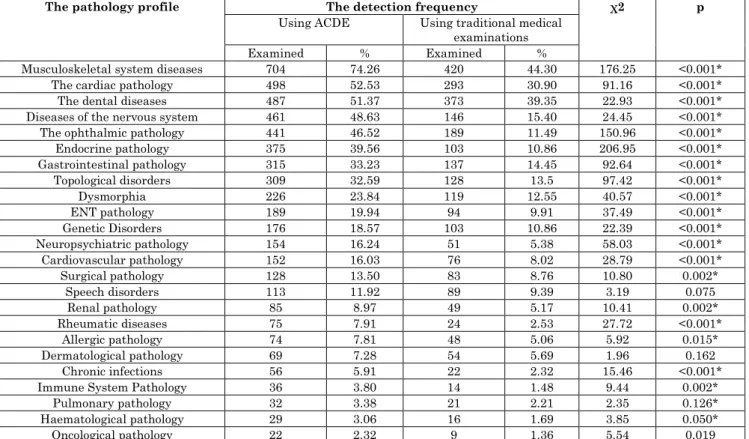
The detection frequency of various
pathologies of organs and systems in children aged 6 to 17 years using the ACDE, showed that diseases of the musculoskeletal system prevail among the children examined, followed by cardiac pathology, dental diseases, and nervous systems diseases and ophthalmic pathology (Table. 1).
Table 1: Comparative characteristic of the detection frequency of organs and systems pathology in children using ACDE and traditional medical examinations, %
The pathology profile The detection frequency χ2 р Using ACDE Using traditional medical
examinations
Examined % Examined %
Musculoskeletal system diseases 704 74.26 420 44.30 176.25 <0.001* The cardiac pathology 498 52.53 293 30.90 91.16 <0.001* The dental diseases 487 51.37 373 39.35 22.93 <0.001* Diseases of the nervous system 461 48.63 146 15.40 24.45 <0.001* The ophthalmic pathology 441 46.52 189 11.49 150.96 <0.001* Endocrine pathology 375 39.56 103 10.86 206.95 <0.001* Gastrointestinal pathology 315 33.23 137 14.45 92.64 <0.001* Topological disorders 309 32.59 128 13.5 97.42 <0.001*
Dysmorphia 226 23.84 119 12.55 40.57 <0.001*
ENT pathology 189 19.94 94 9.91 37.49 <0.001*
Genetic Disorders 176 18.57 103 10.86 22.39 <0.001*
Neuropsychiatric pathology 154 16.24 51 5.38 58.03 <0.001* Cardiovascular pathology 152 16.03 76 8.02 28.79 <0.001*
Surgical pathology 128 13.50 83 8.76 10.80 0.002*
Speech disorders 113 11.92 89 9.39 3.19 0.075
Renal pathology 85 8.97 49 5.17 10.41 0.002*
Rheumatic diseases 75 7.91 24 2.53 27.72 <0.001*
Allergic pathology 74 7.81 48 5.06 5.92 0.015*
Dermatological pathology 69 7.28 54 5.69 1.96 0.162
Chronic infections 56 5.91 22 2.32 15.46 <0.001*
Immune System Pathology 36 3.80 14 1.48 9.44 0.002*
Pulmonary pathology 32 3.38 21 2.21 2.35 0.126*
Haematological pathology 29 3.06 16 1.69 3.85 0.050*
Oncological pathology 22 2.32 9 1.36 5.54 0.019
Note: * - the difference is statistically significant relative to the detection frequency of pathology using ACDE and traditional medical examinations (p <0.05); ACDE - automated complex of dispensary examinations
Scoliosis, changes in posture, arthroplasty (mainly deforming), and flat feet were most
often encountered among orthopaedic
pathologies. The profile of neurological pathology was represented by functional diseases of the nervous system, headaches,
hyperkinetic disorders, asthenic and
neurosis-like reactions. The cardiac
pathology in the examined children was
represented by functional disorders,
arrhythmias, tachycardia, arterial
hypertension and arterial hypotension, and small congenital heart defects. The tooth
decay, fluorosis, periodontal disease,
malocclusion were most common among dental pathologies. Ophthalmic pathology was mainly represented by mild and
moderate myopia, strabismus, astigmatism, as well as accommodation spasm. Endocrine pathology ranks sixth in the detection frequency and is represented by thyroid diseases (mainly endemic goitre), overweight and obesity, growth disorders and sexual development disorder. Separately, it’s worth mentioning the gastroenterological pathology, as the children examined were most often
complaining about symptoms of
gastrointestinal tract diseases (irritable bowel syndrome, epigastric pain syndrome), gastritis, and biliary dyskinesia. The vitamins deficiency, micro and macro
elements prevailed among topological
Based on ACDE, only 8.6% of children were completely healthy and did not require specialist consultation. It was also found that the majority of children had comorbid pathology. Particularly, only 35 (3.7%) children had 1 deviation (disease), 181 (19.1%) children had 2 diseases / deviations, 3-54 (38.4%) – 3 to 5 diseases, 276 (29.1%) – more than 6 deviations / diseases. The
detection frequency of pre-nosology
conditions / pathology of organs and systems using ACDE are of higher efficiency
compering to traditional preventive
examinations.
Mainly, the deviations from the endocrine system were revealed 3.64 times (p <0.001) more often using ACDE, 3.2 times (p <0.001)- the nervous system diseases, 3.13 times (p
<0.001) - rheumatologic pre-nosology
conditions and pathology, 3.0 times (p <0.001) - speech disorders, 2.6 times (p <0.001) - immunological disorders, 2, 5 times (p <0.001) - chronic infections, 2.4 times (p <0.001) - topological disorders, 2.3 times (p <0.001) - gastroenterological and ophthalmic, 2.0 times (p <0.001) - cardiovascular disorders and ENT pathology. There was a tendency to more effective detection of the blood system, respiratory system, and skin and speech disorders by ACDE, but without a statistically significant difference (p> 0.05).
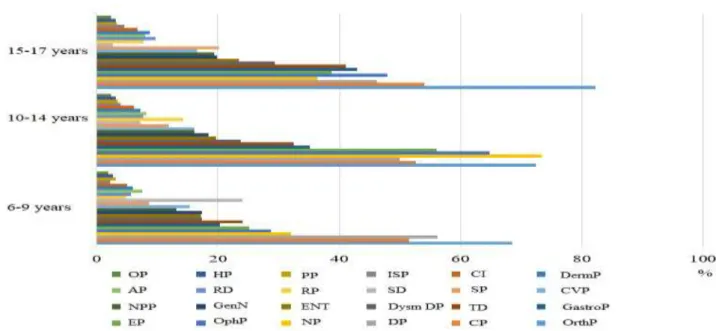
There was found statistically significant difference related to age (p <0.05, mainly the
range of orthopaedic, neurological,
neuropsychiatric, endocrine, renal, rheumatic, ophthalmic, gastroenterological, topological,
surgical pathology, and dysmorphia
significantly increases (Fig. 1) It should be noted that the largest share of endocrine (in 56.12% (p <0.05) children of the middle age group), nervous (in 73.4% (p <0.05) children of the middle age group) and urogenital (in 14.24% (p <0.05) of children of the middle age group) systems morbidity, as well as ophthalmic pathology (in 64.81% (p <0.05) of children of the middle age group) were among 10-14 year-old children. The speech disorders and dental pathology decreased significantly with age (p <0.05) (Fig. 1).
No statistically significant difference was found between the studied age groups (p> 0.05) in the age structure of pre-nosology conditions and pathology of the respiratory system, blood, heart, allergic disorders, chronic infections, and oncology, The deterioration in the health of children of the middle age group according to some pathology profiles can be explained by the onset of their puberty, which is characterized by sharp changes in the hormonal status of children, greater sensitivity to stress factors, as well as the “accumulation” of chronic pathology with age, and socio-economic factors.
Figure 1: Age distribution of the structure of paediatric pathology (%) diagnosed by ACDE
According to gender characteristics, the number of girls with pre-nosology conditions and diseases for most pathology profiles was significantly higher (p <0.05) in all age categories compared to boys, particularly, disorders of the musculoskeletal system (2.0 times (p <0.05)), endocrine (1.6 times (p <0.05), and immune (1, 35 times (p <0.05)) and the genitourinary system (1.57 times (p <0.05)) systems, neurological (1.3 times (p <0.05)) and neuropsychiatric (1, 56 times (p <0.05)) disorders, chronic infections (1.27 times (p <0.05)). Boys are characterized by a significant predominance of cardiovascular pathology compared to girls (1.84 times (p <0.05)), pathology of ENT organs (2.3 times (p <0.05)), diseases of the gastrointestinal tract (1.42 times (p <0.05)) and skin (1.75 times (p <0.05). Corresponding gender features of the incidence rate among children can be explained by the fact that girls have an earlier puberty period; therefore they were leading for the majority of pathology profiles in our study.
The study on the detection frequency of pre-nosology conditions and pathology of organs and systems as a whole coincide with the structure of childhood morbidity in Russia [6]. The data of our study are comparable to the results of similar studies conducted in other cities and regions of Russia. However, there are differences in the detection frequency of certain pathology profiles. Thus, a study of the structure of child morbidity in Moscow [21] is indicative of the results of routine examinations of 383 children (of which 200 are boys and 183 girls) and the results of a dynamic 9-year observation of 426 children (216 boys and 210 girls) from the beginning of their training in the first grade and up to grade 9 inclusive. It was found that most of the children had 3 or more health disorders (including chronic diseases and functional conditions).
In the structure of morbidity, the leading are disorders of the musculoskeletal system (deformation of the chest, impaired posture, flat feet) - 598 ‰; in second place is the pathology of ENT organs (hypertrophy of the tonsils and adenoids, curvature of the nasal septum without impaired breathing function, recurring nosebleeds, tonsillitis, sinusitis)- 228 ‰; in the third - neuropsychiatric disorders (neurotic and asthenic reactions, behaviour disorders, hyperkinetic reactions, sleep disorders) - 164.5 ‰; on the fourth -
ophthalmic pathology (myopia,
accommodation spasm, strabismus,
astigmatism) - 149 ‰; on the fifth- immune system disorders (99.2 ‰). According to the study results, the overall pathology was higher among boys (2145.0 ‰ in boys and 1743.2 ‰ in girls). The disorders of the cardiovascular system, skin diseases and ENT pathology were predominant among
boys, while neurological, endocrine,
orthopaedic disorders and pathology of the genitourinary system- among girls [21].
The study of the morbidity structure using ACDE conducted in Yakutia [22], showed the prevalence of cardiac pre-nosology conditions and pathology in 92.8% of children, endocrine - 50.3% of children, ophthalmic -40.4 % of children, and dental in 36.7% [23]. Somewhat different results were obtained in the course of a large-scale retrospective study of the morbidity structure among children [22], conducted in Russia using the computer program SOC / PEDIATRIA-3. The study analysed the morbidity according to the results of medical examinations and data from electronic registration databases of clinics.
The study includes data from about 300 thousand children aged 0-17 years living in big cities and villages. According to this study, the most common diseases among children were respiratory diseases (0-14 years old - 2317 ‰, 15-17 years old -1578 ‰), followed by diseases of the nervous system (333 ‰ and 379 ‰), digestive system (298 ‰ and 313 ‰), eyes (292 ‰ and 427 ‰), musculoskeletal system (169 ‰ and 336 ‰). Meanwhile no statistically significant gender differences were found (p <0.05) [22]. Such differences between the results of the above and our research are explained by different research methods. Our research is prospective, while the given example is retrospective based on the analysis of polyclinic databases and the results of traditional medical examinations.
particular pathology is affected by a number of factors, in particular, gender, age, the presence of trigger zone that contribute to the manifestation of the disease, climatic and environmental features of the region.
Conclusion
Thus, the following diseases predominated according to the structure of pathology
among the children examined: the
musculoskeletal system (in 74.3% of children), cardiac pathology (in 52.5% of children), dental diseases (in 51.4% of children), and diseases of the nervous system (in 48.6% of children) and ophthalmic pathology (in 46.5% of children).The overwhelming majority of children examined had a comorbid pathology: only 35 (3.7%) children had 1 deviation (disease), 181 (19.1%) children had 2 diseases / deviations, 3-54 (38.4%) -3 to 5 diseases, 276 (29.1%) -more than 6 deviations / diseases. The detection frequency of pre-nosology conditions / pathology of organs and systems using ACDE are of higher efficiency
compering to traditional preventive
examinations.
Mainly, the deviations from the endocrine system were revealed 3.64 times (p <0.001) more often using ACDE, 3.2 times (p <0.001)- the nervous system diseases, 3.13 times (p
<0.001) -rheumatologic pre-nosology
conditions and pathology, 3.0 times (p <0.001) -speech disorders, 2.6 times (p <0.001)- immunological disorders, 2, 5 times (p <0.001) -chronic infections, 2.4 times (p <0.001)-
topological disorders, 2.3 times (p <0.001)- gastroenterological and ophthalmic, 2.0 times (p <0.001) - cardiovascular disorders and
ENT pathology. The percentage of
orthopaedic, neurological, neuropsychiatric, endocrine, renal, rheumatic, ophthalmic,
gastroenterological, topological, surgical
pathology, dysmorphia increases significantly (p <0.05) with age. The number of girls with pre-nosology conditions and diseases for most pathology profiles was significantly higher (p <0.05) in all age categories compared to boys.
The use of ACDE shown high efficiency in identifying pre-nosology conditions and pathology of organs, and the introduction of a programmed method will allow doctors to use time and intellectual resources more effectively. Subsequently, the accumulation of the obtained data will open up great opportunities for the development of preventive and rehabilitation medicine since early detection of pre-nosology conditions with ACDE helps to take timely measures to prevent the development and chronicity of pathology.
Perspective for Further Study
A prospect for further research is the
assessment of cardiovascular system
functioning, the adaptive capabilities of the body of children and adolescents using ACDE, as well as the development of centile tables based on the data obtained to assess systolic and diastolic blood pressure, heart rate in children from 6 to 17 years old.
References
1. Lilly C M, Motzkus C, Rincon T, Cody S E,
Landry K, Irwin R S, Group UMCCO (2017) ICU telemedicine program financial outcomes. Chest, 151(2): 286-297.
2. Khoury M J (2019) Precision medicine vs
preventive medicine. Jama, 321(4): 406-406.
3. Sagner M, McNeil A, Arena R (2017) The
Next Chapter: The Future of Health Care and Lifestyle Interventions. In Lifestyle Medicine (437-446). Academic Press.
4. Duke T, Yano E, Hutchinson A,
Hwaihwanje I, Aipit J, Tovilu M, Amini J (2016) Large-scale data reporting of paediatric morbidity and mortality in
developing countries: it can be
done. Archives of disease in
childhood, 101(4): 392-397.
5. Garfield RL (2017) Spending on Children’s
Health Care in the United States: Accomplishments and Challenges in
Financing Health Services for
Children. JAMA pediatrics, 171(2): 110-111.
6. Ulumbekova G E, Kalashnikova A V,
Moklyachenko AV (2016) Health
indicators for children and adolescents in Russia. Bulletin of the High School of Health Organization and Management, 3: 18-33.
7. Psaty BM, Dekkers O M, Cooper RS (2018)
Comparison of 2 treatment models:
precision medicine and preventive
medicine. Jama, 320(8): 751-752.
8. Taylor RH, Kazanzides P, Fischer GS,
computer-integrated interventional
medicine. In Biomedical Information
Technology (617-672). Academic Press.
9. Scott Kruse C, Karem P, Shifflett K, Vegi
L, Ravi K, Brooks M (2018) Evaluating
barriers to adopting telemedicine
worldwide: A systematic review. Journal of telemedicine and telecare, 24(1): 4-12. 10. He J, Baxter S L, Xu J, Xu J, Zhou X,
Zhang K (2019) The practical
implementation of artificial intelligence
technologies in medicine. Nature
medicine, 25(1): 30-36.
11. Tricoli A, Nasiri N, De S (2017) Wearable and miniaturized sensor technologies for
personalized and preventive
medicine. Advanced Functional
Materials, 27(15): 1605271.
12. Åkesson A, Larsson S C, Discacciati A, Wolk A (2014) Low-risk diet and lifestyle habits in the primary prevention of
myocardial infarction in men: a
population-based prospective cohort
study. Journal of the American college of cardiology, 64(13): 1299-1306.
13. Bagot KS, Matthews SA, Mason M, Squeglia L M, Fowler J, Gray K, Tapert S (2018) Current, future and potential use of mobile and wearable technologies and social media data in the ABCD study to increase understanding of contributors to
child health. Developmental cognitive
neuroscience, 32: 121-129.
14. Vegesna A, Tran M, Angelaccio M, Arcona S (2017) Remote patient monitoring via
non-invasive digital technologies: a
systematic review. Telemedicine and e-Health, 23(1): 3-17.
15. Emmanuel J, Torres A (2018) The Impact of Automated Electronic Surveillance of Electronic Medical Records on Pediatric Inpatient Care. Cureus, 10: 10.
16. Berger RP, Saladino RA, Fromkin J, Heineman E, Suresh S, McGinn T (2018) Development of an electronic medical
record-based child physical abuse alert system. Journal of the American Medical Informatics Association, 25(2): 142-149. 17. Arauz-Boudreau A, Riobueno-Naylor A,
Haile H, Holcomb J M, Lucke C M, Joseph B, Murphy JM (2020) How an Electronic Medical Record System Facilitates and
Demonstrates Effective Psychosocial
Screening in Pediatric Primary
Care. Clinical Pediatrics, 52(9): L 154-162. 18. Schmitz R, Thamm M, Ellert U,
Kalcklösch M, Schlaud M (2014)
Prevalence of common allergies in children and adolescents in Germany: results of the KiGGS study: first follow-up (KiGGS Wave 1). Bundesgesundheitsblatt,Gesundheitsfo rschung, Gesundheitsschutz, 57(7): 771-778.
19. Kobrinsky BA (2009) Children’s health
monitoring using current computer
technologies: state-of-the-art and prospects. Russian Bulletin of Perinatology and Pediatrics, 1: 6-11.
20. Matalygina OA, Shapovalov VV (2010) Using a hardware-software complex system ACDO in preventive pediatrics. Bulletin of the North-West State Medical University. I.I. Mechnikov, 3: 67-78.
21. Namazova-Baranova L, Kuchma V, Ilyin A, Sukhareva L, Rapoport I K (2014) Morbidity of children aged 5 to 15 years in the Russian Federation. Medical Council, 1: 6-10.
22. Baranov AA, Albitsky V Yu, Ivanova A A, Terletskaya R N, Kosova S A (2012) Trends and the health status of the child population of the Russian Federation. Russian pediatric magazine, 6: 4-9.