All Rights Reserved © 2012 IJARCSEE
125
Energy Efficient and Secured
Routing
Geeta Rani
, Shalej Khera
Abstract
- Wireless sensor networks are a new type of
networked
systems,
characterized
by
severely
constrained computational and energy resources, and
an ad hoc operational environment. Wireless sensor
networks (WSNs) have been increasingly available for
large-scale applications in which energy efficiency &,
security is an important performance measure. Driven
by the energy &, security limitation nature of WSNs lots
of research works have been done in aspects such as
nodes replication, data aggregation routing, security
monitoring etc. In this paper we first study the flooding
algorithm and then remove limitation of flooding
algorithm.
Keywords –
Wireless sensor networks (WSNs),
node
replication, secure monitoring,
data aggregation
,
Packets Lost,
energy efficient
,
Secured Routing.
I.
I
NTRODUCTIONWireless Sensor Networks have emerged as an
important new area in wireless technology. In the
near future, the wireless sensor networks are
expected to consist of thousands of inexpensive
nodes, each having sensing capability with limited
computational and communication power [1], [2] &
[3] which enable us to deploy a large-scale sensor
network.
A wireless network consisting of tiny devices which
monitor physical or environmental conditions such as
temperature pressure, motion or pollutants etc. at
different areas. Such sensor networks are expected to
be widely deployed in a vast variety of environments
for commercial, civil, and military applications such
as surveillance, vehicle tracking, climate and habitat
monitoring, intelligence, medical, and acoustic data
gathering. The key limitations of wireless sensor
networks are the storage, power and processing.
These limitations and the specific architecture of
sensor nodes call for energy efficient and secure
communication protocols. The sensor sends collected
data, usually via radio transmitter, to a command
center (sink) either directly or through a data
concentration center (a gateway).Normally sensor
nodes are spatially distributed throughout the region
which has to be monitored; they self-organize in to a
network through wireless communication, and
collaborate with each other to accomplish the
common task. Basic features of sensor networks are
self-organizing
capabilities,
dynamic
network
topology, limited power, node failures and mobility
of nodes, short-range broadcast communication and
multi-hop routing, and large scale of deployment [4].
The strength of wireless sensor network lies in their
flexibility and scalability. The capability of
self-organize and wireless communication made them to
be deployed in an ad-hoc fashion in remote or
hazardous location without the need of any existing
infrastructure. Through multi-hop communication a
sensor node can communicate a far away node in the
network. This allows the addition of sensor nodes in
the network to expand the monitored area and hence
proves its scalability and flexibility property.
All Rights Reserved © 2012 IJARCSEE
126
extensively investigated in the literature [5], [6], [7]
and [8].
Security in data communication is another important
issue to be considered while designing wireless
sensor networks, as wireless sensor networks may be
deployed in hostile areas such as battlefields [2], [9]
&[10]. Therefore, data aggregation protocols should
work with the data communication security protocols,
as any conflict between these protocols might create
loopholes in network security.
II.
OBJECTIVE
OF
WORK
The major problem is
node replication problem
.In
order to solve node replication problem we use an
approach to detect the replicated node in wireless
sensor networks is centralized scheme. In the
Centralized scheme, all nodes in the network
transfers data to central node by comparing ID of
neighboring node to which data to be sent .If any
node have same ID that already exists then one node
is attacker node then remove that node from the
network. Central node contains ID of each node of
the network if there is any replicated node then it can
be detected on central node & replicated node is
removed from the network.
Another problem is related to
secure monitoring
of
sensor nodes in WSNs. To solve this problem we can
set an alarm watch on the central node. When load of
central node increases from threshold value means
increases from the value of neighboring node then
central node signals an alarm. After signaling alarm,
load of central node distributed to its neighbors. From
this we can save energy of sensor nodes which is
wasted due to false alarms.
Another problem is related to
data aggregation
on
sensor node. Routing protocols providing an optimal
data transmission route from sensor nodes to sink to
save energy of nodes in the network. Data
aggregation plays an important role in energy
conservation of sensor network. Data aggregation
methods are used not only for finding an optimal path
from source to destination but also to eliminate the
redundancy of data, since transmitting huge volume
of raw data is an energy intensive operation, and thus
minimizing the number of data transmission. Also
multiple sensors may sense the same phenomenon,
although from different view and if this data can be
reconciled into a more meaningful form as it passes
through the network, it becomes more useful to an
application. Moreover when data aggregation is
performing data is compress as it is passed through
the network, thus occupying less bandwidth. This
also reduces the amount of transmission power
expended by nodes. Hence secure data aggregation
can be considered as a very challenging problem in
wireless sensor network.
III.
P
ROPOSEDA
LGORITHMWe are representing energy efficient secure routing in
case of a Wireless Sensor Network. In it we use Grid
network to represent the proposed work.
This approach the load on the centralized node
increased.
To resolve this problem there are some existing
methods:-
Shifting the load on neighbor node based on
minimum load
Removing the center node.
The proposed algorithm we will use for
energy efficient & secure routing in wireless
sensor network. In this algorithm we follow
the following step:-
All Rights Reserved © 2012 IJARCSEE
127
IV. THEORETICAL DEVELOPMENT
In this section, we survey the state-of-the-art routing
protocols for WSNs. In general, routing in WSNs can
be divided into flat-based routing, hierarchical-based
routing, and location-based routing depending on the
network structure. In flat-based routing, all nodes are
typically assigned equal roles or functionality. In
hierarchical-based routing, however, nodes will play
different roles in the network. In location-based
routing, sensor nodes' positions are exploited to route
data in the network. A routing protocol is considered
adaptive if certain system parameters can be
controlled in order to adapt to the current network
conditions and available energy levels. Furthermore,
these protocols can be classified into
multipath-based, query-multipath-based, negotiation-multipath-based, QoS-multipath-based, or
coherent-based routing techniques depending on the
protocol operation. In addition to the above, routing
protocols can be classified into three categories,
namely, proactive, reactive, and hybrid protocols
depending on how the source finds a route to the
destination. In proactive protocols, all routes are
computed before they are really needed, while in
reactive protocols, routes are computed on demand.
Hybrid protocols use a combination of these two
ideas. When sensor nodes are static, it is preferable to
have table driven routing protocols rather than using
reactive protocols. A significant amount of energy is
used in route discovery and setup of reactive
protocols. Another class of routing protocols is called
the cooperative routing protocols. In cooperative
routing, nodes send data to a central node where data
can be aggregated and may be subject to further
processing, hence reducing route cost in terms of
energy use. Many other protocols rely on timing and
position information.
Fig2. Routing protocols in WSNs
V.
R
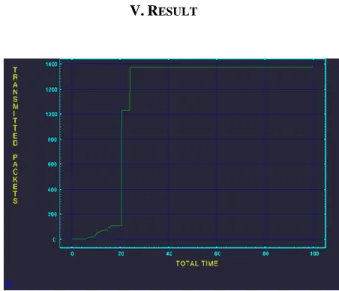
ESULTFig 5. Total no Packets Transmitted (existing)
Fig 6. Packet received (existing)
All Rights Reserved © 2012 IJARCSEE
128
Fig 8. Total no Packets Transmitted (Proposed)
Fig 9. Packet Received (Proposed)
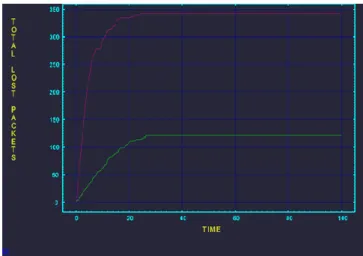
Fig 10. Packet Lost (Proposed)
Fig 11. Packets Received (Existing Vs. Proposed)
Fig 12. Packets Lost (Existing Vs. Proposed)
V.CONCLUSION
AND
FUTURE
WORK
A.
Conclusion -
All Rights Reserved © 2012 IJARCSEE
129
B.
Future Work -
In this proposed work we defined the whole
concept respective to a specific topological
representation i.e. Grid network. We can enhance our
work by using different topological areas. We can
also extend it to different kind of network like manet,
wimax etc.
VI.
REFERENCE
[1] W. Su Y. Sankarasubramaniam E. Cayirci Akyildiz, I.F. A survey on sensor- networks. IEEE Communications Magazine, pages 102{114, 2002.
[2] Kumar.S.P. Chee-Yee Chong. Sensor networks: Evolution, opportunities, and challenges. Proc IEEE, August 2003. [3] Ismail H. Kasimoglui Ian .F. Akyildiz. Wireless sensor and
actor: research challenges. (Elsevier) Journal, 2(38):351{367, 2004.
[4] Sarika Agarwal Leszek Lilien Maleq Khan, Bharat Bhargava and Pankaj. Self-configuring node clusters, data aggregation,
and security in microsensor networks. Department of
Management Information Systems Krannert Graduate [5] Sundeep Karthikeyan Vaidynathan, Sayantan sur and Sinha.
Data aggregation techniques in sensor networks. Technical
Report,OSU-CISRC-11/04- TR60, 2004.
[6] D. Agrawal N. Shrivastava, C. Buragohain and S. Suri. Medians and beyond: new aggregation techniques for sensor networks. Proceedings of the 2nd international conference on Embedded networked sensor systems, pages 239-249, 2004. ACM Press.
[7] Xiuli Ren and Haibin Yu1. Security mechanisms for wireless
sensor networks. IJCSNS International Journal of Computer
Science and Network Security, VOL.6 (No.3):100{107, March 2006.
[8] S. Setia S. Zhu and S. Jajodia. Leap: efficient security mechanisms for large scale distributed sensor networks. Proceedings of the 10th ACM conference on Computer and communications security, pages 62{72, 2003. ACM Press. [9] J. Stankovic A. Perrig and D. Wagner. Security in wireless
sensor networks.
[10] P.Nair H.Cam, S.Ozdemir and D. Muthuavinashiappan. Espda: Energy- efficient and secure pattern based data
aggregation for wireless sensor networks. Computer
Communications IEEE Sensors, 29:446-455, 2006.
[11] Feng Zhao and Leonidas Guibas, “Wireless Sensor Networks, an information processing approach”, Morgan Kaufmann publishers, pp.294-300, 2004.
[12] Culler D., Estrin D., and Srivastava M., “Overview of Sensor Networks”, IEEE Computer, Vol.37, Iss.8, Aug., 2004. [13] A. Cerpa, J. Elson, D. Estrin, L. Girod, M. Hamilton, and J.
Zhao, “Habitat monitoring: Application driver for wireless communications technology”, in proceedings of the 2001 ACM SIGCOMM Workshop on Data Communications in Latin America and the Caribbean, April, 2001.
[14] P. Palensky, “Current situation and future potential of intelligent building automation”, Proceedings of the European Conference and Cooperation Exchange 2006.
[15] Dietmar Loy, Dietmar Dietrich and Hans-Joerg Schweinzer, “Open Control Networks”, LonWorks/EIA 709 Technology, Kluwer Academic Publishers, 2001.
[16] Thilo Sauter , Dietmar Dietrich , Wolfgang Kaestner, “EIB: Installation Bus System” , Wiley-VCH March 19, 2002. [17] Sharp C., Schaffert S., Woo A., Sastry N., Karlof C., Sastry
S., and Culler D., “Design and implementation of a sensor network system for vehicle tracking and autonomous interception”, Proceeedings of the Second European Workshop on Wireless Sensor Networks, 31 Jan.-2 Feb. 2005.
[18] Venkata A. Kottapalli, Anne S. Kiremidjian, Jerome P. Lynch, Ed Carryer, Thomas W. Kenny, Kincho H. Law, and Ying Lei , “Two-tiered wireless sensor network architecture for structural health monitoring”, Proceedings of SPIE -- Volume 5057 Smart Structures and Materials 2003: Smart
Systems and Nondestructive Evaluation for Civil
Infrastructures, Shih-Chi Liu, Editor, August 2003.
[19] Mihaela Ulieru, S. A. Madani, “Application of Industrial Agents to concrete bridge monitoring”, tutorial, In proceedings of 3rd International Conference on Informatics in Control, Automation and Robotics, ICINCO06, Portugal, August 2006.
[20] Nemeroff J., Garcia L., Hampel D., and DiPierro S., “Application of sensor network communications”, Military Communications Conference, MILCOM01, Communications for Network-Centric Operations: Creating the Information Force., IEEE, vol.1, pp. 336- 341, 2001.
[21] Yoon-Gu Kim, Han-Kil Kim, Suk-Gyu Lee, and Ki-Dong Lee, “Ubiquitous Home Security Robot Based on Sensor Network”, pp. 700-704, IEEE/WIC/ACM International Conference on Intelligent Agent Technology (IAT 2006 Main Conference Proceedings) (IAT'06), 2006.
[22] Chen, A. and Muntz and R. R. and Yuen and S. and Locher, I. and Park, S. I. and Srivastava, “A Support Infrastructure for the Smart Kindergarten”, IEEE Pervasive Computing, vol.1, issue 2, pp. 49-57, 2002.
[23] Carreras I., Chlamtac I., Woesner H., and Zhang H., “Nomadic sensor networks”, Proceedings of the Second European Workshop on Wireless Sensor Networks, Jan.- 2 Feb., 2005.
[24] Pietro Ciciriello, Luca Mottola, and Gian Pietro Picco, “Efficient Routing from Multiple Sources to Multiple Sinks in Wireless Sensor Networks”, Fourth European Conference on Wireless Sensor Networks, Springer LNCS 4373, January, 2007.
[25] Jain S., Shah R. C., Brunette W., Borriello G., and Roy S., “Exploiting mobility for energy efficient data collection in wireless sensor networks”, Mob. Netw. Appl. 11, 3 Jun. 2006.
[26] I. S. S. Zhao, K. Tepe and D. Raychaudhuri, “Routing protocols for self-organizing hierarchical ad-hoc wireless networks”, in IEEE Somofl 2003 Symposium, March 2003. [27] F. Ye, A. Chen, S. Liu, L. Zhang, \A scalable solution to
minimum cost forwarding in large sensor networks", Proceedings of the tenth International Conference on Computer Communications and Networks (ICCCN), pp. 304-309, 2001.
[28] W. Heinzelman, J. Kulik, and H. Balakrishnan, "Adaptive Protocols for Information Dissemination in Wireless Sensor Networks," Proc. 5th ACM/IEEE Mobicom Conference (MobiCom '99), Seattle, WA, August, 1999. pp. 174-85. [29] J. Kulik, W. R. Heinzelman, and H. Balakrishnan,
"Negotiation-based protocols for disseminating information in wireless sensor networks," Wireless Networks, Volume: 8, pp. 169-185, 2002.
[30] C. Intanagonwiwat, R. Govindan, and D. Estrin, "Directed di®usion: a scalable and robust communication paradigm for sensor networks," Proceedings of ACM MobiCom '00, Boston, MA, 2000, pp. 56-67.
[31] D. Braginsky and D. Estrin, \Rumor Routing Algorithm for Sensor Networks," in the Proceedings of the First Workshop on Sensor Networks and Applications (WSNA), Atlanta, GA, October 2002.
All Rights Reserved © 2012 IJARCSEE
130
[33] S. Lindsey, C. Raghavendra, \PEGASIS: Power-Efficient Gathering in Sensor Information Systems", IEEE Aerospace Conference Proceedings, 2002, Vol. 3, 9-16 pp. 1125-1130. [34] L. Subramanian and R. H. Katz, \An Architecture for Building
Self Configurable Systems", in the Proceedings of IEEE/ACM Workshop on Mobile Ad Hoc Networking and Computing, Boston, MA, August 2000.
[35] N. Bulusu, J. Heidemann, D. Estrin,\GPS-less low cost outdoor localization for very small devices", Technical report 00-729, Computer science department, University of Southern California, Apr. 2000.
[36] A. Savvides, C-C Han, aind M. Srivastava,\Dynamic ¯ne-grained localization in Ad-Hoc networks of sensors," Proceedings of the Seventh ACM Annual International Conference on Mobile Computing and Networking (MobiCom), July 2001. pp. 166-179.
[37] S. Capkun, M. Hamdi, J. Hubaux,"GPS-free positioning in mobile ad-hoc networks", Proceedings of the 34th Annual Hawaii International Conference on System Sciences, 2001 pp. 3481-3490.
[38] Y. Xu, J. Heidemann, D. Estrin,\Geography-informed Energy Conservation for Ad-hoc Routing," In Proceedings of the Seventh Annual ACM/IEEE International Conference on Mobile Computing and Networking 2001, pp. 70-84. [39] B. Chen, K. Jamieson, H. Balakrishnan, R. Morris, \SPAN: an
energy-e±cient coordination algorithm for topology
maintenance in ad hoc wireless networks", Wireless Networks, Vol. 8, No. 5, Page(s): 481-494, September 2002. [40] Y. Yu, D. Estrin, and R. Govindan, \Geographical and
Energy-Aware Routing: A Recursive Data Dissemination Protocol for Wireless Sensor Networks", UCLA Computer Science Department Technical Report, UCLA-CSD TR-01-0023, May 2001.
[41] J.-H. Chang and L. Tassiulas, \Maximum Lifetime Routing in Wireless Sensor Networks", Proc. Advanced Telecommu- nications and Information Distribution Research Program (ATIRP2000), College Park, MD, Mar. 2000.
[42] C. Rahul, J. Rabaey, \Energy Aware Routing for Low Energy Ad Hoc Sensor Networks", IEEE Wireless Communications and Networking Conference (WCNC), vol.1, March 17-21, 2002, Orlando, FL, pp. 350-355.
[43] S. Dulman, T. Nieberg, J. Wu, P. Havinga, \Trade-O® between Tra±c Overhead and Reliability in Multipath Routing for Wireless Sensor Networks", WCNC Workshop, New Orleans, Louisiana, USA, March 2003.
[44] C. Intanagonwiwat, R. Govindan, and D. Estrin, "Directed di®usion: a scalable and robust communication paradigm for sensor networks," Proceedings of ACM MobiCom '00, Boston, MA, 2000, pp. 56-67.
[45] D. Ganesan, R. Govindan, S. Shenker, and D. Estrin,\Highly-resilient, energy-e±cient multipath routing in wireless sensor networks", ACM SIGMOBILE Mobile Computing and Communications Review, vol. 5, no. 4, pp. 1125, 2001. [46] D. Braginsky and D. Estrin,\Rumor Routing Algorithm For
Sensor Networks", International Conference on Distributed Computing Systems (ICDCS'01), November 2001.
[47] W. Heinzelman, J. Kulik, and H. Balakrishnan, "Adaptive Protocols for Information Dissemination in Wireless Sensor Networks," Proc. 5th ACM/IEEE Mobicom Conference (MobiCom '99), Seattle, WA, August, 1999. pp. 174-85. [48] J. Kulik, W. R. Heinzelman, and H. Balakrishnan,
"Negotiation-based protocols for disseminating information in wireless sensor networks," Wireless Networks, Volume: 8, pp. 169-185, 2002.
[49] K. Sohrabi, J. Pottie, "Protocols for self-organization of a wireless sensor network", IEEE Personal Communications, Volume 7, Issue 5, pp 16-27, 2000.
Geeta Rani
Student (M. Tech), BRCM College of
Engineering and Technology, Bahal,
Bhiwani, India
B.Tech (ECE) from BRCM College of
Engineering and Technology, Bahal,
Bhiwani, India
Diploma (ECE) from BPS Mahila
Vishwavidyalaya, Khanpur Kalan
Sonepat, India
Shalej Khera