http://www.sciencepublishinggroup.com/j/ijamtp doi: 10.11648/j.ijamtp.20190502.12
ISSN: 2575-5919 (Print); ISSN: 2575-5927 (Online)
Solution of an Initial Value Problemin Ordinary Differential
Equations Using the Quadrature Algorithm Based on the
Heronian Mean
Bazuaye Frank Etin-Osa
Department of Mathematics and Statistics, University of Port Harcourt, Port Harcourt, Rivers State, Nigeria
Email address:
To cite this article:
Bazuaye Frank Etin-Osa. Solution of an Initial Value Problemin Ordinary Differential Equations Using the Quadrature Algorithm Based on the Heronian Mean. International Journal of Applied Mathematics and Theoretical Physics. Vol. 5, No. 2, 2019, pp. 45-51.
doi: 10.11648/j.ijamtp.20190502.12
Received: May 16, 2019; Accepted: June 13, 2019; Published: August 6, 2019
Abstract:
Over the years, the Quadrature Algorithm as a method of solving initial value problems in ordinary differential equations is known to be of low accuracy compared to other well known methods. However, It has been shown that the method perform well when applied to moderately stiff problems. In this present study, the nonlinear method based on the Heronian Mean (HeM), of the function value for the solution of initial value problems is developed. Stability investigation is in agreement with the known Trapezoidal method.Keywords:
Harmonic Mean, Stability, Stiff Problems, Geometric Mean, Accuracy1. Introduction
Ordinary differential equations are the major form of mathematical model occurring in Science and Engineering, and, consequently, the numerical solution of differential equations is a very large area of research. The advent of computers has tremendously revolutionized the type and variety of numerical methods over the past three decades and these methods are applied to solve mathematical problems. Several methods have been developed using the idea of different means such as the geometric mean, centroidal mean, harmonic mean, contra-harmonic mean and the heronian mean. The three stage method based on the harmonic mean and a multi-derivative method using the usual arithmetic mean were developed respectively [1] and [2]. Also, a third-order method based on the geometric mean was presented [3]. But a fourth-order method based on the harmonic mean was introduce [4] while the fourth-order method which is an embedded method based on the arithmetic and harmonic mean was constructed [5] The comparison of modified Runge-Kutta methods based on varieties of means was studied [6]. The New 4TH Order Hybrid Runge –kutta methods for solving Ivps in ODEs was investigated [7]. In the paper, a new 4th Order Hybrid Runge-Kutta method
based on linear combination of Arithmetic mean, Geometric mean and the Harmonic mean to solve first order initial value problems (IVPs) in ordinary differential equations (ODEs).
authors propose a new version of explicit Runge-Kutta method, by introducing the harmonic mean as against the usual arithmetic averages in standard Runge-Kutta schemes.
The a nonlinear mid-point rule formula based on geometric means (GM) for the numerical solution of differential equations y′ = f x y( , ) was presented [11] with supporting numerical results. However, the New fifth order weighted Runge –kutta methods based on the Heronian mean for initial value problems in ordinary differential equations was developed and implemented [12]. In the paper Comparisons in terms of numerical accuracy and size of the stability region between new proposed Kutta(5,5) algorithm, Runge-Kutta (5,5) based on Harmonic Mean, Runge-Runge-Kutta(5,5) based on Contra Harmonic Mean and Runge-Kutta(5,5) based on Geometric Mean where also investigated.
We consider the numerical solution of the initial value problems.
0 0
( , ) ( )
v′ = f u v y x =v (1)
In the region ofx0 ≤ ≤x X.
Numerical integration as the process of finding the value of a definiteintegral,
( )
b
a
I=
∫
f u du (2)With a≤ ≤u b An approximate value of the integral is obtained by replacingthe function by an interpolating polynomial. Thus, different formulas for numericalintegration
would result for different interpolating formulas. In this case, the Newton’s forward difference formula shall be applied.
The interval [a, b] is dividedinto nequal subintervals:
0 1 2 ... n a=u <u <u < u =b.
With un+1− =un h then (2) becomes:
0
( )
n u
u
I=
∫
f u du (3)Suppose u=u0+rh anddu=hdr un =u0+nh
Makinga change of variable from uto r u: =u0+rh
The integral(3) becomes,
0
0
0 0
0
( ) ( )
u nh n
u
I f u rh hdr h f u rh dr
+
=
∫
+ =∫
+ (4)Approximating f u( )= f u( 0+rh) by the Newton’s
forward difference formula.
Then, from equation (4), and setting v= f u( ):
2 3
0 0 0 0
0
( 1) ( 1)( 2)
[ ...]
2 6
n
r r r r q
I=h
∫
u + ∆ +r u − ∆ u − − ∆ u + dr (5)Integrating (5) and substituting the limit of integration gives:
2 3
0 0 0 0
0
4
2 4 3 2
2 3 0
0 0 0 0
( 1) ( 1)( 2)
[ ...]
2 6
(2 3) ( 2) 3 11
3 ...
2 12 24 5 2 3 4!
n
r r r r q
I h u r u u u dr
u
n n n n n n n n
nh u u u u n
− − − = + ∆ + ∆ ∆ + − − ∆ = + ∆ + ∆ + ∆ + − + − +
∫
(6)One of the methods in literature for solving (1) is the trapezoidal rule. This is obtained by settingn equal to 1, and takes the curve between two consecutive points as linear. Thus, we terminate the sequence on the right in equation (6) at the linear term as the higher difference terms
2 3 0 0
(∆ u ,∆u , )etcwould be zero. Then,
The Trapezoidal rule for the solution of (1) is given as:
1 [ ( , ) ( 1, 1)]
2
n n n n n n
h
y + = y + f u v + f u + v+ (7)
where h is the mesh length in the u direction.
2. Materials and Methods
The numerical algorithm (7) is a one-step implicit method that has the desirable features of performing well when applied to stiff problems and also being A-stable method [13]. In another approach [14], the nonlinear equivalent of
the trapezoidal formula (7), referred to as the geometric mean(GM) Euler formula was derived [13]. The result reveals that for certain function λ( )x , the stability requirement imposes certain
1
[ ( n)] ( n )] 4
hλ x −λ x + ≤
restrict the step length to lie in the interval:
1 1
0< ≤h 4[ (
λ
xn)−λ
(xn+)]−This is a big challenge.[8]developed an alternative strategy to circumvent this challenge by replacing (1) by:
1 1 1 1
2 2
[ ( , ) ( , )] 2
n n n n
n n
h
y + y f u v f u v +
+ +
= + +
arithmetic means (AM) in the trapezoidal formula (1). was demonstrated [14] Instead of (7) they considered the geometric mean (GM) formula was
1 ( ) ( 1)
n n n n
y + = y +h f u f u + (8)
Due to the modification to [8], it gives a better accuracy when applied to certain problems.
In this present paper, the Arithmetic mean (AM) (7) and the Geometric Mean (GM) in (8)arereplaced by the Heronian Mean (Mean) as:
1 ( , ) ( 1, 1) ( , ) ( 1, 1)
3
n n n n n n n n n n
h
v+ =v + f u v + f u + v + + f u v f u + v + (9)
The method (9) above is implicit with high order. It is truly preferable to write (9) as:
( 1) ( ) ( )
1 ( , ) ( 1, 1) ( , ) ( 1, 1)
3
i i i
n n n n n n n n n n
h
v + + =v + f u v + f u + v + + f u v f u + v + (10)
The starting value v0(1)is obtained by an implicit formula, e.g., the Euler formula. Thus, Solving for vn+1 in:
1 ( , ) ( 1, 1) ( , ) ( 1, 1)
3
n n n n n n n n n n
h
v + =v + f u v + f u + v+ + f u v f u + v+
Define:
( 1) ( ) ( )
1 ( , ) ( 1, 1) ( , ) ( 1, 1)
3
i i i
n n n n n n n n n n
h
v + + =v + f u v + f u + v + + f u v f u + v +
the scheme would look like (for i= 0),
1 0 0
1 0 0 0 1 1 0 0 0 1
( 0), ( , ) ( , ) ( , } ( , ) 3
h
i= v = +v f u v + f u v + f u v f u v
(11)
2 1 1
1 0 0 0 1 1 0 0 0 1
( 1), ( , ) ( , ) ( , } ( , ) 3
h
i= v = +v f u v + f u v + f u v f u v
(12)
This is continuing recursively until convergence is obtained.
3. Results
Stability and Convergence analysis of the New Scheme. In this session, the stability of (10) shall be investigated. The stability region largely depends on the initial value problem (IVP). According to [15] and[16], it should be noted
that The condition n 1 1 n
u u
+ < must be satisfied in order to
determine the stability region [15] and [16]. To determine the stability region. To study the stability properties of method (11), we apply the new algorithm to the test equation
v′ =λv. This will yield:
1 1 1 1 1
3
n n n
n n n
v h v v
v v v
λ
+ = + + + + +
(13)
Defining n 1 n n2 n v P Z v + = = We obtain:
2 1 1 2
3
n n n
h
Z = +λ +Z +Z
Simplifying (13) yields:
2 2
3Zn −
λ
hZn −λ
hZn−λ
h− =3 02 3 0
3 3
n n
h h
Z λ Z λ
λ λ
+
− − − − =
(14)
For absolute stability, it is required that the roots:
1 n
Z <
(14) can be solved to obtain:
2
3 4
3 3 3
2
n
h h h
Z
λ λ λ
λ λ +λ
± −
− − −
= (15)
2
3 1 6 2 12 4 12 4
h h h
λ λ λ
λ λ λ
+ ± − ≤ − − − (16)
2
3 0
12 4 12 4
h h
λ
λ
λ
λ
+
− <
− −
This condition is satisfied if λ( )u a negative function, which agrees with the present circumstance. There is no restriction on the meshsize as far as the solution ofv′ =λ( )u v
is the object of consideration by using the present algorithm unlike in the conventional trapezoidal rule.
4. Discussion
In this section, we Illustrate the efficiency and suitability of the new computational methods discussed in this paper. The problems can be evaluated with different step sizes.
Problem 1. v 1 v(0) 1
v
′ = = and the exact solution is
1 2
(2 1) [0,1]
u= u+ on
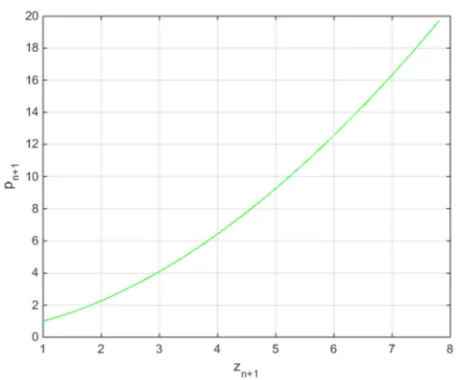
The results of problem 1 with different values of step sizes are presented in the figures below.
Figure 1. The graph of pn+1against zn+1for h=0 1. .
Figure 2. The graph of the number of iterations against yn( 1)i++1 −y(ni+1for
0.1
h= .
Figure 3. The graph of pn+1against zn+1for h=0.2.
Figure 4. The graph of the number of iterationsagainst yn( 1)i++1 −y(ni+1for
0.2
h= .
Figure 6. The graph of the number of iterations against yn( 1)i++1 −y(ni+1for
0.3
h= .
Figure 7. The graph of pn+1against zn+1for h=0.5.
Figure 8. The graph of the number of iterations against ( 1)1 ( 1
i i
n n
y ++ −y + for
0.5
h= .
Figure 9. The graph of the number of iterations against yn( 1)i++1 −y(ni+1for 0.1 ,0.2, 0.3, 0.5
h= .
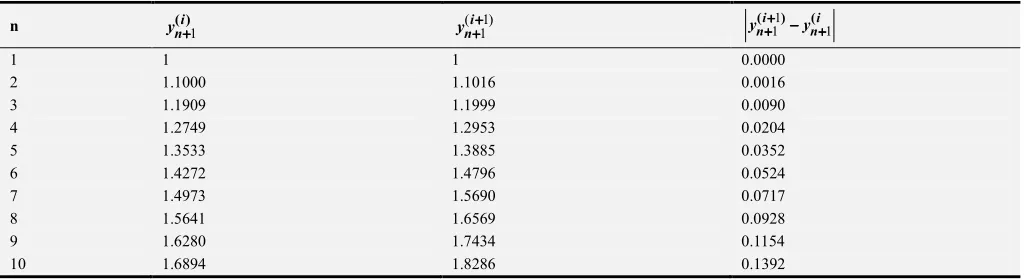
Table 1. Table of the value of ( 1)1 ( )1
i i
n n
y ++ −y + for h=0.1for ten iterations.
n yn( )i++++1 y(ni++++++++11) yn(i++++++++11)−−−−yn(i++++1
1 1 1 0.0000
2 1.1000 1.1016 0.0016
3 1.1909 1.1999 0.0090
4 1.2749 1.2953 0.0204
5 1.3533 1.3885 0.0352
6 1.4272 1.4796 0.0524
7 1.4973 1.5690 0.0717
8 1.5641 1.6569 0.0928
9 1.6280 1.7434 0.1154
Table 2. Table of the value of yn( 1)i++1 −yn( )i+1forh=0.2for ten iterations.
n ( )i1
n
y ++++ yn(i++++++++11) 11 1
(i ) (i
n n
y ++++++++ −−−−y ++++
1 1 1 0.0000
2 1.2000 1.2064 0.0064
3 1.3667 1.3993 0.0326
4 1.5130 1.5829 0.0699
5 1.6452 1.7596 0.1144
6 1.7668 1.9310 0.1642
7 1.8800 2.0980 0.2180
8 1.9863 2.2613 0.2750
9 2.0870 2.4215 0.3345
10 2.1829 2.5790 0.3961
Table 3. Table of the value of ( 1)1 ( )1
i i
n n
y ++ −y + for h=0.3for ten iterations.
n y( )ni++++1 yn(i++++++++11) 11 1
(i ) (i
n n
y ++++++++ −−−−y ++++
1 1 1 0.0000
2 1.3000 1.3140 0.014
3 1.5308 1.5981 0.0673
4 1.7267 1.8646 0.1379
5 1.9005 2.1192 0.2187
6 2.0583 2.3649 0.3066
7 2.2041 2.6037 0.3996
8 2.3402 2.8369 0.4967
9 2.4684 3.0655 0.5971
10 2.5899 3.2900 0.704
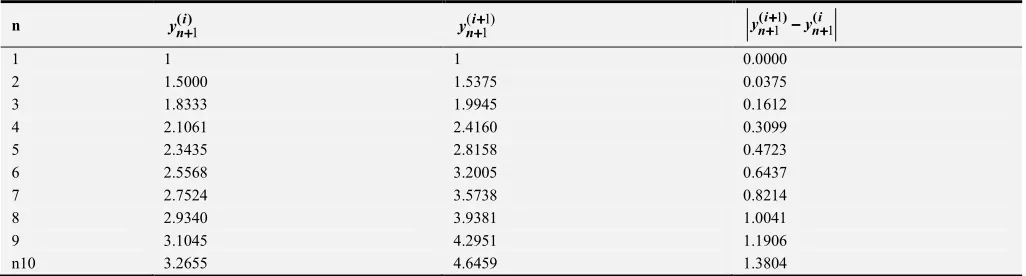
Table4. Table of the value of ( 1)1 ( )1
i i
n n
y ++ −y + f or h=0.5for ten iterations.
n y( )ni++++1 yn(i++++++++11) yn(i++++++++11)−−−−yn(i++++1
1 1 1 0.0000
2 1.5000 1.5375 0.0375
3 1.8333 1.9945 0.1612
4 2.1061 2.4160 0.3099
5 2.3435 2.8158 0.4723
6 2.5568 3.2005 0.6437
7 2.7524 3.5738 0.8214
8 2.9340 3.9381 1.0041
9 3.1045 4.2951 1.1906
n10 3.2655 4.6459 1.3804
5. Conclusion
In this paper, the relevance studies in literature were reviewed and the gaps identified. We have also successfully derived the Quadrature Algorithm based on the Harmonic (HM). This method is an improvement over the ones in literature. Also, the stability investigated with the aid of a MATLAB. Practical applicable problems have been considered to test the convergence of the scheme. The results indicate that the New method is stable. The convergence analysis indicate that only a slight increase in computing time is needed in the analysis to give a favorable result.
References
[1] A. S Wusu, S. A Okunuga, A. B Sofoluwe (2012). A Third-Order Harmonic explicit Runge-Kutta Method for Autonomous initial value problems. Global Journal of Pure and Applied Mathematics.8, 441-451
[2] A. S Wusu, and M. A Akanbi (2013). A Three stage Multiderivative Explicit Rungekutta Method. American Journal of Computational Mathematics. 3, 121-126
[4] J. D Evans and N. B Yaacob (1995). A Fourth Order Runge – Kutta Methods based on Heronian Mean Formula.
International Journal of Computer Mathematics 58,103-115
[5] N. B Yaacob and B. Sangui (1998). A New Fourth Order Embedded Method based on Heronian Mean Mathematica Jilid, 1998, 1-6.
[6] Wazwaz A. M. (1990). A Modified Third order Runge-kutta Method. Applied Mathematics Letter, 3(1990), 123-125 [7] F. E Bazuaye (2018). A new 4th order Hybrid Runge-Kutta
Methods for solving initial value problems. Pure and Applied Mathematics Journal 7(6): 78-87
[8] A. R Gourlay (1970). A note on trapezoidal methods for the solution of initial value problems. Math. Comput.. 24(1), 629-633.
[9] Rini Y. Imran M, Syamsudhuha. (2014). A Third RungeKutta Method based on a Linear combination of Arithmetic mean, harmonic mean and geometric mean. Applied and Computational Mathematics. 2014, 3(5), 231-234
[10] Ashiribo Senapon Wusu1, Moses Adebowale Akanbi1, Bakre Omolara Fatimah (2015). On the derivation and implementation of four stage Harmonic Explicit Runge –kutta Method. Applied Mathematics. 6, 694-699
[11] D. J Evans (1988). A Stable Nonlinear Mid-Point Formula for Solving O. D. E. s.Appl. Math. L&t. Vol. 1, No. 2, pp. 165-169.
[12] M. CHANDRU, R. PONALAGUSAMY, P. J. A. ALPHONSE (2017). A New fifth order weighted Runge –kutta methods based on the Heronian mean for initial value problems in ordinary differential equations. J. Appl. Math. & Informatics
Vol. 35 (2017), 191 – 204.
[13] Evans J. D and Sangui B. B (1988). A nonlinear Trapezoidal Formula for the solution of initial value problems. Comput. Math. Applic. 15 (1), 77-79
[14] Evans J. D and Sangui B. B (1991). A Comparison of Numerical O. D. E solvers based on Arithmetic and Geometric means. International Journal of Computer Mthematics, 32-35 [15] S. O. Fatunla (1986). Numerical Treatment of singular IVPs.
Computational Math. Application. 12:1109-1115.
[16] J. D Lawson (1966) An order Five R-K Processes with Extended region of Absolute stability. SIAM J. Numer. Anal