Contents
Description Page
Key Features, Functions, and Benefits . . . . 2
General Description . . . . 2
Features . . . . 3
Protection and Control Functions . . . . 4
Monitoring and Metering . . . . 6
Communication Software . . . . 10
Standards, Certifications and Ratings . . . . 11
Standards . . . . 13
Specifications . . . . 15
Ordering Information . . . . 18
EGR-4000
Key Features, Functions, and Benefits
• Microprocessor-based protection with monitoring and control for small to medium sized generators .
• Complete metering of voltage, currents, power, energy, minimum/ maximum and demand functions .
• Complete metering, protection, and control in a single compact case to reduce panel space, wiring and costs .
• Integral test function reduces maintenance time and expense . • Zone selective interlocking improves coordination and tripping
time, and saves money compared to a traditional bus differential scheme .
• Programmable logic control functions for providing customized protection and control solutions .
• Reduce trouble shooting time and maintenance costs - Trip and event recording in non-volatile memory provides detailed informa-tion for analysis and system restorainforma-tion . 6000 cycles of waveform capture aids in post fault analysis (viewable using Powerport-E software)
• Minimum replacement time - Removable terminal blocks ideal in industrial environments
• Front RS-232 port and Powerport-E software provides local com-puter access and user-friendly windows based interface for relay settings, configuration, and data retrieval .
• Breaker open/close from relay faceplate or remotely via commu-nications .
• Fast an easy troubleshooting, improved maintenance procedures and increased device security . Provides detailed traceability for system configuration changes .
• Relays self-diagnostics and reporting improves uptime and trou-bleshooting .
• Breaker trip circuit monitoring improves the reliability of the break-er opbreak-eration .
• Reduced relay to relay wiring and associated installation cost through high-speed inter-relay communications .
• Embedded IEC61850 protocol with GOOSE messaging capabili-ties .
General Description
Eaton’s EGR-4000 generator protection relay is a multi-functional, microprocessor-based relay for small to medium sized generators . It may be used as a primary or backup protection in stand by genera-tors, and cogeneration applications .
The EGR-4000 generator protection relay provides voltage controlled, voltage restrained, and standard directional three phase overcurrent protection, as well as directional phase-residual and independent ground overcurrent protection, and breaker failure . Three-phase over/ under voltage, voltage unbalance, current unbalance, over/under and rate-of-change frequency, vector surge, power factor, directional VARs, directional power, loss of excitation, overexcitation, and synch check functions are standard functions .
The EGR-4000 generator relay provides all required protection, con-trol, monitoring and metering for small and medium sized generators in a single, compact case . The relay has four current inputs rated for either five amperes or one ampere and four voltage inputs . Three of the voltage inputs are to be connected to the three-phase power voltage for voltage protection and for metering . They can be con-nected in wye-ground or open delta configuration . The fourth voltage is for independent single-phase undervoltage/overvoltage protection, or 100% ground protection for a high resistance grounded generator . The maintenance mode password protected soft key, can be used for arc flash mitigation to change to an alternate settings group, set to have instantaneous elements only . The multiple setting groups can also be changed, via communications or a digital input . An integral keypad and display is provided for direct user program-ming and retrieval of data without the need of a computer . 14 pro-grammable LEDs provide quick indication of relay status .
A front port is provided for direct computer connection . An RS-485 and an Ethernet ports in the back are optional for local area network-ing usnetwork-ing . Optional Modbus-RTU, Modbus-TCP, or IEC-61850 proto-cols are supported .
The EGR-4000 generator protection relay includes programmable logic functions . Logic gates and timers may be defined and arranged for customized applications . Programmable logic control functions make the EGR-4000 very flexible . Flash memory is used for the pro-gramming and all settings are stored in nonvolatile memory .
The EGR-4000 generator protection relay has mass memory for data storage and a real-time clock with one ms time resolution . The relay will log 300 sequence of event records, 20 detailed trip logs, mini-mum/maximum values, load profiles, breaker wear information and oscillography data .
The EGR-4000 has eight programmable binary inputs, two analog inputs, two analog outputs, two normally opened and two Form C heavy duty outputs and one Form C signal alarm relay . It can be powered from 19 Vdc to 300 Vdc or 40 Vac to 250 Vac auxiliary power .
Features
Protection Features
• Thermal protection (49/51) • Phase overcurrent elements:
• Three instantaneous elements with timers ( 50P[1], 50P[2], and
50P[3])
• Three inverse time overcurrent elements (51P[1], 51P[2], and
51P[3])
• 11 standard curves
• Instantaneous or time delay reset • Voltage Restraint (51P[2], and 51P[3])
• Directional Control (All Elements) • Ground overcurrent elements
• Two instantaneous measured elements with timers (50X[1],
and 50X[2])
• Two instantaneous calculated elements with timers (50R[1],
and 50R[2])
• Two inverse time overcurrent measured elements (51X[1], and
51X[2])
• Two inverse time overcurrent calculated elements (51R[1], and
51R[2])
• 11 standard curves
• Instantaneous or time delay reset • Directional Control (All Elements) • Breaker failure (50BF) .
• Phase unbalance negative sequence overcurrent (46[1], 46[2])) . • Phase voltage unbalance and sequence protection (47[1], 47[2]) . • Main three-phase under/overvoltage (27M[1], 27M[2], 59M[1],
59M[2])
• Auxiliary single-phase under/overvoltage (27A[1], 27A[2], 59A[1], 59A[2])
• Ground fault overvoltage relay (59N[1], 59N[2])
• Six Frequency elements that can be assigned to: over frequency, under frequency, rate of change, or vector surge (81[1], 81[2], 81[3], 81[4], 81[5], 81[6])
• Apparent and displacement power factor (55A[1], 55A[2], 55D[1], 55D[2])
• Forward and Reverse Watts (32[1], 32[2], 32[3]) • Forward and Reverse Vars (32V[1], 32V[2], 32V[3]) • Overexcitation, Volts-per-Hertz (24[1], 24[2]) • 64S, 100% Stator ground fault (27TN/ 59N) • Generator Unbalance (46G[1], 46G[2]) • Loss of Excitation (40[1],40[2]) • Synch Check (25)
• Lockout (86)
• Loss of Potential-LOP
• Zone interlocking for bus protection (87B) . • Switch onto fault protection
• Cold load pickup
Metering Features
• Generator Hours of Operation .
• Amperes: Positive, negative and zero sequence . • Ampere demand .
• Volts: Positive, negative and zero sequence . • Phase angles .
• Volt-amperes and VA demand . • Watts and kW demand . • kWh (forward, reverse, net) . • Vars and kvar demand . • kvarh (lead, leg and net) . • Power factor . • Frequency . • % THD V and I . • Magnitude THD V and I . • Minimum/maximum recording . • Sync Values
• Trending (load profile over time) • Temperature with remote URTD module
Monitoring Features
• Trip coil monitor • Breaker wear
• Oscillography (6000 cycles total) . • Fault data logs (up to 20 events) .
• Sequence of events report (up to 300 events) . • Clock (one ms time stamping) .
Control Functions • Breaker open/close • Remote open/close • Programmable I/O • Programmable Logic • Programmable LEDs • Multiple setting groups . • Cold load pickup . • CT supervision Communication Features • Local HMI . • Password protected . • Addressable . • IRIG-B
• Local communication port . • Remote communication port:
• RS-232 • RS-485 • Protocols: • Modbus-RTU • Modbus-TCP (Optional) • IEC-61850 (Optional) • Configuration software
Protection and Control Functions
The Eaton’s EGR-4000 generator protection relay has been designed for maximum user flexibility and simplicity . The EGR-4000 provides comprehensive protection, metering, and monitoring of small to medium sized synchronous or induction generators operating at 50 or 60 Hz . The base relay includes all the standard protection and metering functions . Protection features found in the EGR-4000 include:
Directional Overcurrent Protection
The EGR-4000 generator protection relay provides complete 3-phase and ground directional overcurrent protection . There are 14 inde-pendent ground overcurrent elements . The ground elements “X” use the independently measured ground (or neutral) current from a separate current-sensing input . The ground elements “R” uses a calculated 3Io residual current obtained from the sum of the 3-phase currents . This calculated current could be used for either the neutral or ground current in a 3-phase, 4-wire system . Each of the phase and ground overcurrent elements can be selected to operate based on fundamental or RMS current .
Phase direction is a function used to supervise all phase current ele-ments (50, 51) . A quadrature voltage is compared to a corresponding phase current to establish the direction of the fault . This function is selectable to operate in the forward, reverse or both directions . Ground direction is used to supervise ground current elements and is accomplished by using ground, negative sequence or residual currents supervised by zero, negative or positive sequence voltages or ground current . This function is selectable to operate in forward, reverse or both directions .
Voltage Restrained Overcurrent
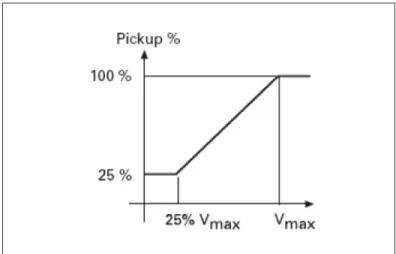
Voltage restraint reduces the overcurrent pickup level (51P[2], 51P[3]), to protect the distribution system components against excessive damage and to prevent the generator and its auxiliaries from exceeding their thermal limitations . This modification of the pickup overcurrent level is compared to the corresponding phase input voltage . The EGR-4000 uses the simple linear model below to determine the effective pickup value .
Figure 1. Voltage Restraint Coil Pickup Characteristics.
Sync-check
The sync-check function is provided for double-ended power source applications . The sync-check monitors voltage magnitude, phase angle and slip frequency between the bus and line . It also incorpo-rates breaker close time, dead bus dead line, dead bus live line and live bus live line features .
Reverse Power
Reverse power provides control for power flowing through a genera-tor . There are three elements to be configured:
operate in forward or reverse; or, under or over power conditions . Reverse power is typically applied to prevent generator motoring that can cause damage to the prime mover; while under power is generally applied to load loss and prevent an overspeed condition that could damage the prime mover .
Reverse Vars
Reverse vars can be used to detect loss of excitation in synchronous machines . There are three elements to be configured: operate in for-ward or reverse; or, under or over vars conditions .
Inverse Time Characteristics
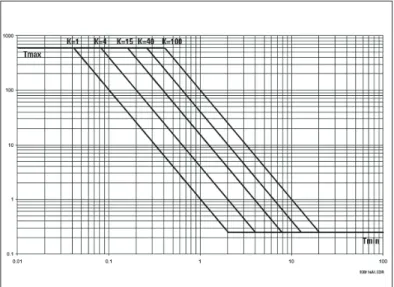
There are 11 User-selectable inverse-time overcurrent curve charac-teristics .
The user can select from the ANSI, IEC or thermal curve families and can select instantaneous or time delay reset characteristics . Breaker Failure
The EGR-4000 generator protection relay includes a breaker failure (50BF, 62BF) function that can be initiated from either an internal or external trip signal . This is an independent element that can be used to operate a lockout relay or trip an upstream breaker . The timer must be longer than the breaker operating time and the protective function reset times .
Voltage Protection
The EGR-4000 generator protection relay has four voltage-input circuits . There is a 3-phase set designated as Main Voltage (M) and a single-phase voltage circuit designated as Auxiliary Voltage (A) . Both include undervoltage (27) and overvoltage (59) protection . The 3-phase voltage protection can be set to operate on a single-phase, 2 out of 3 phases, or all 3-phase logic . The Main VTs also provide phase voltage unbalance/reversal (47 negative sequence) protection . Each element has an independent threshold set point and adjustable time delay .
100% Ground Stator Protection
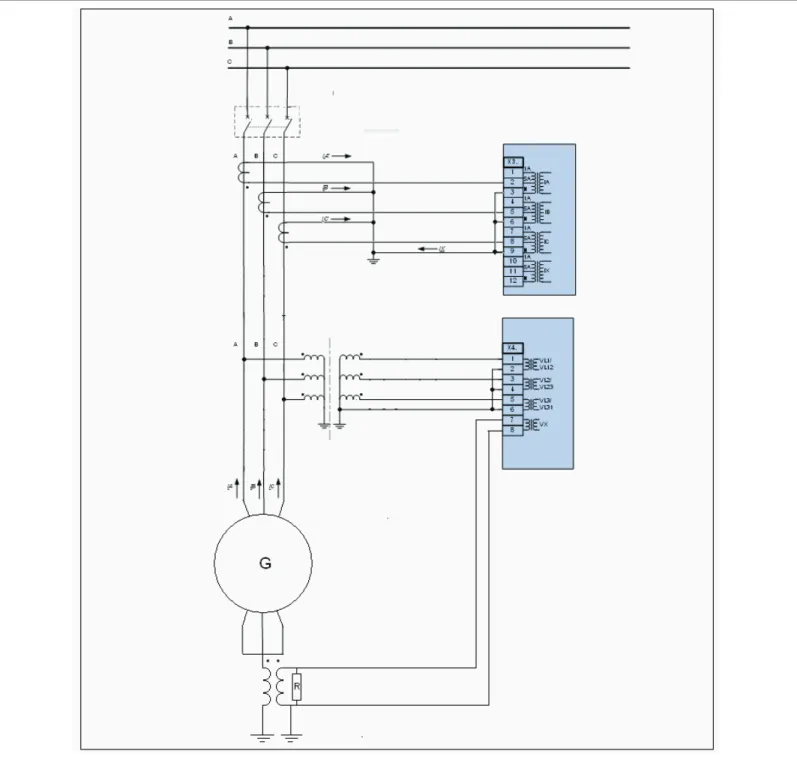
In high impedance grounded generators, ground fault protection is provided by the detection of voltage in the neutral of the generator by an overvoltage element (59N) connected to the secondary of the distribution grounding transformer, this overvoltage element has to be desensitized for 3rd harmonic voltages normally present in the generator . Under normal conditions there is no voltage across the secondary of the grounded transformer, when one of the phases goes to ground, voltage appears across the resistor and the overvolt-age element operates, indicating a ground conductor . However, the overvoltage element technique described above will protect around 90 percent to 95 percent of the winding . The last 5-10 percent is pro-tected by detecting the decayed of the 3rd harmonic voltage using a undervoltage element (27TN) tuned to the 3rd harmonic voltage . In the EGR-4000 we can provide 100% stator ground protection by measuring the zero sequence voltage through the 4th voltage input, and combining the 59N and 27A elements . The 27A element has to be programmed to operate for 3rd harmonic zero sequence voltages . Flexible Phase Rotation
The EGR-4000 generator protection relay can be applied on either an A-B-C or A-C-B phase rotation . A user setting permits correct opera-tion and indicaopera-tion of the actual system configuraopera-tion .
Frequency Protection
Operation of generators at off-nominal frequencies can have extremely detrimental effects on both the generator itself and the associated prime mover, in particular with steam turbine generators operating below normal frequency . The EGR-4000 relay provides 6 frequency elements than can be used to detect under/over frequen-cy, rate of change, and a vector surge (decoupling of two systems) protection on the Main VT inputs . Each element has an independent threshold set point and adjustable time delay .
Negative Sequence Protection
Negative sequence overcurrent protection prevents the generators from rotor overheating damage . Unbalanced loads, fault conditions or open phasing will produce a negative sequence current to flow . The unbalanced currents induce double system frequency currents in the rotor, which quickly causes rotor overheating . Serious damage will occur to the generator if the unbalance is allowed to persist . The EGR-4000 provides a negative sequence definite time overcurrent element and a negative sequence timed over current tripping ele-ment to ensure the generator stays within it’s short time and con-tinuous negative sequence current rated limits .
Figure 2. Overexcitation Protection.
Overexcitation Protection
Generator overexcitation occurs when the ratio of voltage versus frequency is too high, and the rotor iron saturates due to high flux density . High flux density results in stray flux in components not designed to carry it, which in turn causes overheating and can poten-tially damage the generator . This protection is provided through a Volts/Hertz function with a programmable inverse time characteristic .
Loss of Excitation
Loss of field protection or loss of excitation is used to avoid unstable operation, potential loss of synchronism, and possible damage to synchronous generators . When a synchronous generator loses its field, the generator can continue to generate power as an induction generator, provided that it can obtain its excitation from the other machines on the system . During this condition, the rotor will quickly overheat due to the slip frequency currents induced in it . Loss of excitation in one machine could jeopardize the operation of other machines beyond their capability, and also the stability of the entire system . The EGR-4000 supports the two typical distance relaying schemes used for detecting the loss excitation . The two schemes differ mainly in that scheme 1 uses a negative offset mho element and scheme 2 uses a positive offset mho element with directional unit supervision .
Figure 3. Scheme 1.
Figure 4. Scheme 2.
Maintenance Mode
The Maintenance Mode can improve safety by providing a simple and reliable method to reduce fault clearing time and lower incident energy levels at energized panels . The Maintenance Mode allows the user to switch to more sensitive settings via a password protect-ed soft key, communication or via a digital Input while maintenance work is being performed at an energized panel or device . The more sensitive settings provide greater security for maintenance person-nel and helps reduce the possibility of injury .
Monitoring and Metering
Sequence of Events Records
The EGR-4000 generator protection relay records a maximum of 300 events associated with the relay . An event is classified as a change of state as detected by the relay . These include relay pickups, drop-outs, trips, contact closure, alarms, setting changes and self-diagnos-tic failures . Each event is date and time stamped to a 1 ms resolu-tion . The events are stored in a FIFO log in chronological order . Trip Log
The EGDR-4000 protection relay will store a maximum of 20 trip records in a FIFO trip log . Each trip record will be date and time stamped to a one ms resolution . The trip log record will include infor-mation on the type of fault, protection elements that operated, fault location and currents and voltages at the time of the fault .
Waveform Capture
The EGR-4000 distribution protection relay provides oscillography-recording capabilities . The relay will record all measured signals along with the binary signals of pickup, trip, logic and contact clo-sures . The EGR-4000 relay can record up to 6000 cycles of data . The number of records is proportional to the size of each record; the maximum size per record is 600 cycles . The waveform capture is ini-tiated by up to 8 different triggers; it can also be generated manually through the display or via communications .
Integral User Interface
The front panel user interface has a 128 x 64 pixel LCD display with background illumination for wide angle viewing in all light condi-tions . 17 programmable LEDs provide quick and easy visual display of power on, mode of operation, alarm and trip indication . Soft keys are provided for operation mode selection, scrolling through data and settings . In addition, the relay settings and test functions are pass-word protected .
Load Profiling/Trending
The EGR-4000 relay automatically records selected quantities into non-volatile memory every 5, 10, 15, 30, or 60 minutes, depending on the trending report setting .
Programmable I/O
The EGR-4000 generator protection relay provides heavy-duty, trip-rated, 2 normally open and 2 Form C contacts . Two isolated inputs can be used for monitoring the trip circuit . One Form C contact is dedicated to the relay failure alarm function and is operated in a normally energized (failsafe) mode . There are eight user-configurable discrete inputs that accept a wet contact and can operate through a wide range of power . Each input and output is user-programmable for maximum application flexibility .
The EGR-4000 also has two analog inputs and two analog outputs . The analog inputs are available for providing protection and moni-toring of generator bearing vibration . The analog inputs are field programmable to measure transducer signals that operate over a range of 0 to 20 mA, 4 to 20 mA, or 1 to 10V . Two analog outputs are available for signaling the value of measured analog quantities to external process control devices such as PLCs . They can be pro-grammed to operate over a 0 to 20mA, 4-20 mA, or 1 to 10 V range . The nalog outputs can be configured to signal a representation of most analog quantities measured by the EGR-4000 including, cur-rent, voltages, and RTD temperature .
Programmable Logic
The EGR-4000 generator protection relay provides logic gates and timers that the user can customize for special or unique applications . Each gate can be assigned a logic function of either AND, OR, NAND or NOR . Each gate can have a maximum of four input signals and each input signal can be required to be a NOT . Input signals can be
external inputs received via the binary inputs or internal values asso-ciated with the protection, alarm or metering set points . Each gate has a unique output assignment and designation that can be used as the input to another gate . There are 24 independent timers that have adjustable pickup and dropout delay settings .
Figure 5. Visual Logic Editor.
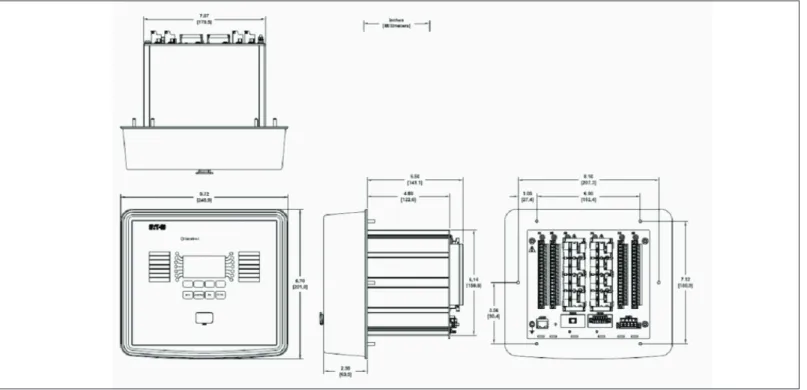
Figure 7. Projection Mount Front and Side Views.
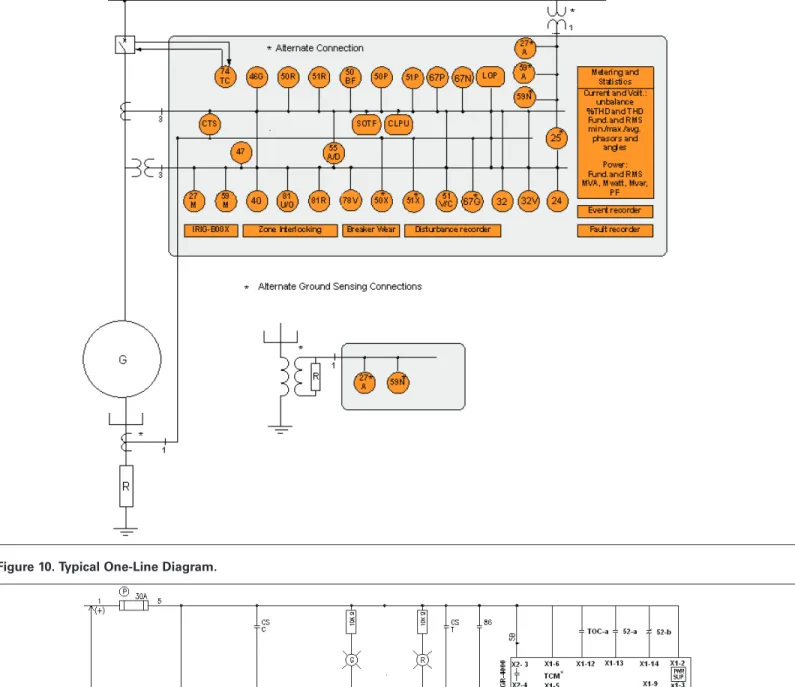
Figure 10. Typical One-Line Diagram.
Communication Software
Eaton provides two types of communication software . The first is PowerPort-E . It runs on a PC or laptop for easy access to a single relay to change set points or configuration and to view metered values and stored data . PowerPort-E is free and can be downloaded from the Eaton Web site at the following URL:
http://www .EatonElectrical .com/pr
The second package is Power Xpert Software . Power Xpert Software is a power management software package that is designed for con-tinuous, remote monitoring of many devices . It provides additional functions such as billing, trending and graphics . Contact your local Eaton representative for more information on Power Xpert software .
Standards, Certifications, and Ratings
Climatic Environmental Conditions
Storage Temperature: -30°C to +70°C (-22°F to 158°F)
Operating Temperature: -20°C to +60°C (-4°F to 140°F) Permissible Humidity at Ann. Average: <75% rel. (on 56d up to 95% rel.) Permissible Installation Altitude: <2,000 m (6,561.67 ft) above sea level
If 4,000 m (13,123.35 ft) altitude applies, a changed classification of the operating and test voltages may be necessary.
Degree of Protection EN 60529
HMI Front Panel with Seal: IP54
Rear Side Terminals: IP20
Routine Test
Insulation Test Acc. to IEC60255-5: All tests to be carried out against ground and other input and output circuits. Aux. Voltage Supply, Digital Inputs, Current
Measuring Inputs, Signal Relay Outputs: 2.5 kV (eff.) / 50 Hz Voltage Measuring Inputs: 3.0 kV (eff.) / 50 Hz All Wire-Bound Communication Interfaces: 1.5 kV DC
Insulation Test Acc to IEC60255-5: All tests to be carried out against ground and other input and output circuits.
Housing
Housing B2: Height / Width 183 mm (7.205 in.) / 212.7 mm (8.374 in.) Housing Depth (Incl. Terminals): 208 mm (8.189 in.)
Material, Housing: Aluminum extruded section
Material, Front Panel: Aluminum/Foil front
Mounting Position: Horizontal (±45° around the X-axis must be permitted)
Weight: Approx. 4.2 kg (9.259 lb)
Current and Ground Current Measurement
Nominal Currents: 1 A / 5 A
Max. Measuring Range: Up to 40 x In (phase currents) Up to 25 x In (ground current standard) Up to 2.5 x In (ground current sensitive) Continuous Loading Capacity: 4 x In / continuously
Overcurrent Proof: 30 x In / 10 s
100 x In / 1 s
250 x In / 10 ms (1 half-wave)
Power Consumption: Phase current inputs
At In = 1A S = 0.15 mVA At In = 5A S = 0.15 mVA Ground current input At In = 1A S = 0.35 mVA At In = 5A S = 0.35 mVA
Frequency Range: 50 Hz / 60 Hz ±10%
Terminals: Screw-type terminals with integrated short-circuiters (contacts) Connection Cross Sections: 1 x or 2 x 2.5 mm² (2 x AWG 14) with wire
end ferrule
1 x or 2 x 4.0 mm² (2 x AWG 12) with ring cable sleeve or cable sleeve
1 x or 2 x 6 mm² (2 x AWG 10) with ring cable sleeve or cable sleeve The current measuring board´s terminal blocks may be used as with 2 (double) con-ductors AWG 10,12,14 otherwise with single conductors only.
Plug-in Connector with Integrated Short-Circuiter (Conventional Current Inputs)
Nominal Current: 1 A and 5 A
Continuous Loading Capacity: 4 x In / continuously
Overcurrent Withstand: 30 x In / 10 s
100 x In / 1 s
250 x In / 10 ms (1 half-wave)
Screws: M4, captive type acc. to VDEW
Connection Cross Sections: 1 x or 2 x 2.5 mm² (2 x AWG 14) with wire end ferrule
1 x or 2 x 4.0 mm² (2 x AWG 12) with ring cable sleeve or cable sleeve 1 x or 2 x 6 mm² (2 x AWG 10) with ring cable sleeve or cable sleeve The current measuring board´s ter-minal blocks may be used as with 2 (double) conductors AWG 10,12,14 otherwise with single conductors only.
Voltage and Residual Voltage Measurement
Nominal Voltages: 100 V / 110 V / 230 V / 400 V (can be con-figured)
Max. Measuring Range: 2 x nominal voltage
Continuous Loading Capacity: 2 x nominal voltage (800 Vac)
Power Consumption: at Vn = 100 V S = 0.1 mVA
at Vn = 110 V S = 0.1 mVA at Vn = 230 V S = 0.4 mVA at Vn = 400 V S = 1.0 mVA
Frequency Range: 50 Hz or 60 Hz ±10%
Terminals: Screw-type terminals
Frequency Measurement
Nominal Frequencies: 50 Hz / 60 Hz
Voltage Supply
Aux. Voltage: 24 - 270 Vdc / 48 - 230 Vac (-20/+10%)
Buffer Time in Case of Supply Failure: >= 50 ms at minimal aux. voltage Interrupted communication is permitted. Max. Permissible Making Current: 18 A peak value for <0.25 ms 12 A peak
value for <1 ms
The voltage supply must be protected by a fuse of:
• 2,5 A time-lag miniature fuse 5 x 20 mm (approx . 0 .2 x 0 .8 in .) according to IEC 60127
• 3,5 A time-lag miniature fuse 6,3 x 32 mm (approx . 0 .25 x 1 .25 in .) according to UL 248-14
Power Consumption
Power Supply Range: Power consumption in Idle Mode Max. Power Consumption
24 - 270 Vdc: Approx. 7 W Approx.13 W
48 - 230 Vac (For
Frequencies of 40-70 Hz): Approx. 7 VA Approx.13 VA
Display
Display Type: LCD with LED background illumination
Resolution - Graphics Display: 128 x 64 pixel
LED
LED - Type: Two colored: red / green
Number of LEDs, Housing B2: 15
Front Interface RS232
Baud Rates: 115,200 Baud
Handshake: RTS and CTS
Connection: 9-pole D-Sub plug
Real Time Clock
Running Reserve of the Real Time Clock: 1 year min.
Digital Inputs
Max. Input Voltage: 300 Vdc / 259 Vac
Input Current: <4 mA
Reaction Time: <20 ms
Fallback Time: <30 ms
(Safe State of the Digital Inputs)
Switching Thresholds: Un = 24 Vdc, 48 Vdc, 60 Vdc, 110 Vac / dc, 230 Vac / dc Un = 24 Vdc
Switching Threshold 1 ON:
Switching Threshold 1 OFF: Min. 19.2 Vd Max. 9.6 Vdc Un = 48 V / 60Vdc
Switching Threshold 2 ON:
Switching Threshold 2 OFF: Min. 42.6 Vdc Max. 21.3 Vdc Un = 110 / 120 Vac / dc
Switching Threshold 3 ON:
Switching Threshold 3 OFF: Min. 88.0 Vdc / 88.0 Vac Max. 44.0 Vdc / 44.0 Vac Un = 230 / 240 Vac / dc
Switching Threshold 4 ON:
Switching Threshold 4 OFF: Min. 184 Vdc / 184 Vac Max. 92 Vdc / 92 Vac
Terminals: Screw-type terminal
Relay Outputs
Continuous Current: 5 A ac / dc
Max. Make Current:
25 A ac / 25 A dc up to 30 V for 4 s 30 A / 230Vac according to ANSI IEEE Std C37.90-2005
30 A / 250Vdc according to ANSI IEEE Std C37.90-2005
Max. Breaking Current:
5 A ac up to 250 Vac 5 A dc up to 30 V (resistive) 0.3 A dc at 300 V
Max. Switching Voltage: 250 Vac / 250 Vdc
Switching Capacity: 1,250 VA
Contact Type: Form C or normally open contact
Supervision Contact (SC)
Continuous Current: 5 A ac / dc
Max. Switch-on Current: 15 A ac / 15 A dc up to 30 V for 4 s
Max. Breaking Current:
5 A ac up to 250 Vac 5 A dc up to 30 Vdc 0,4 A at 125 Vdc
Contact Type: 1 Form C contact
Terminals: Screw-type terminals
Time Synchronization IRIG-B00X
Nominal input voltage: 5 V
Connection: Screw-type terminals (twisted pair)
Zone Interlocking otee:
N Only for Zone Interlock Tripping Outputs (Zone Interlock, semiconduc-tor output): 5 Vdc, <2mA for connection to electronic inputs only .
Zone Out:
Output voltage (High) 4.75 to 5.25 Vdc
Output voltage (Low) 0.0 to +0.5 Vdc
Zone In:
Nominal input voltage +5 Vdc
Max. input voltage +5.5 Vdc
Switching threshold ON min. 4.0 Vdc
Switching threshold OFF max. 1.5 Vdc
Galvanic isolation 2.5 kV ac (to ground and other IO)
Connection: Screw-type terminals (twisted pair)
RS485
Master/Slave: Slave
Connection: 6 screw-clamping terminals RM 3.5 mm (138 MIL) (terminating resistors internal)
otee:
N The RS485 interface is realized via terminals . The communication cable has to be shielded . The shielding has to be fixed at the screw that is marked with the ground symbol (rear side of the device) .
Standards
Approvals
• UL-listed file: e217753 Design Standards
Generic Standard EN 61000-6-2
EN 61000-6-3
Product Standard IEC 60255-6
EN 50178
UL 508 (Industrial Control Equipment)
CSA C22.2 No. 14-95 (Industrial Control Equipment) ANSI C37.90
High Voltage Tests (IEC 60255-6)
High Frequency Interference Test IEC 60255-22-1
Class 3 Within one circuitCircuit to ground Circuit to circuit
1 kV/2 s 2.5 kV/2 s 2.5 kV/2 s Insulation Voltage Test
IEC 60255-5
EN 50178 All circuits to other circuits and exposed conductive parts Except interfaces
Voltage measuring input
2.5 kV (eff.)/50Hz, 1 min. 1,5 kV DC, 1 min. 3 kV (eff.)/50 Hz, 1 min. Impulse Voltage Test
IEC 60255-5 5 kV/0.5J, 1.2/50 µs
EMC Immunity Tests
Fast Transient Disturbance Immunity Test (Burst) IEC 60255-22-4
IEC 61000-4-4 Class 4 ANSI C37.90.1
Power supply, mains inputs Other in- and outputs
± 4 kV, 2.5 kHz
± 2 kV, 5 kHz (coupling network) ± 4 kV, 2.5 kHz (coupling clamp) Surge Immunity Test
IEC 61000-4-5
Class 4 Within one circuit
Circuit to ground
2 kV 4 kV Electrical Discharge Immunity Test
IEC 60255-22-2 IEC 61000-4-2 Class 3 Air discharge Contact discharge 8 kV 6 kV Radiated Radio Frequency Electromagnetic Field Immunity Test IEC 61000-4-3 Class X ANSI C37.90.2 26 MHz – 80 MHz 80 MHz – 1 GHz 1 GHz – 3 GHz 10 V/m 35 V/m 10 V/m
Immunity to Conducted Disturbances Induced by Radio Frequency Fields IEC 61000-4-6
Class 3 10 V
Power Frequency Magnetic Field Immunity Test IEC 61000-4-8
Class 4 Continous
3 sec
30 A/m 300 A/m
Mechanical Tests
Test Fc: Vibration Response Test IEC 60068-2-6 IEC 60255-21-1 Class 1 (10 Hz – 59 Hz) Displacement (59Hz – 150Hz) Acceleration
Number of cycles in each axis
0.0014 in. (0.035 mm) 0.5 gn
1 Test Fc: Vibration Endurance Test
IEC 60068-2-6 IEC 60255-21-1 Class 1
(10 Hz – 150 Hz) Acceleration
Number of cycles in each axis 1.0 gn 20 Test Ea: Shock Test
IEC 60068-2-27 IEC 60255-21-2 Class 1
Shock response test 5 gn, 11 ms, 3 impulses in each direction
Shock resistance test 15 gn, 11 ms, 3 impulses in each direction
Test Eb: Shock Endurance Test IEC 60068-2-29
IEC 60255-21-2 Class 1
Shock endurance test 10 gn, 16 ms, 1,000 impulses in each direction
Test Fe: Earthquake Test IEC 60068-3-3
KTA 3503 IEC 60255-21-3
Single axis earthquake
vibration test 3 – 7 Hz: Horizontal 0.394 in. (10 mm), 1 cycle each axis
Class 2 7 – 35 Hz Horizontal: 2 gn,
1 cycle each axis
EMC Emission Tests
Radio Interference Suppression Test
IEC/CISPR11 Limit value class B
Radio Interference Radiation Test
IEC/CISPR11 Limit value class B
Environmental Tests
Classification:
IEC 60068-1 Climatic
Classification 0/055/56
IEC 60721-3-1 Classification of ambient conditions
(Storage) 1K5/1B1/1C1L/1S1/1M2but min. -25°C (-13°F) IEC 60721-3-2 Classification of ambient conditions
(Transportation) 2K3/2B1/2C1/2S1/2M2
IEC 60721-3-3 Classification of ambient conditions (Stationary use at weather protected locations)
3K6/3B1/3C1/3S1/3M2 but min. 0°C (32°F) and 3K8H for 2 h Test Ad: Cold
IEC 60068-2-1 Temperature
Test duration -20°C (-4°F)16 h
Test Bd: Dry Heat
IEC 60068-2-2 Temperature Relative humidity Test duration 55°C (131°F) <50% 72 h Test Cab: Damp Heat (Steady State)
IEC 60068-2-78 Temperature Relative humidity Test duration 40°C (104°F) 93% 56 d Test Db: Damp Heat (Cyclic)
IEC 60068-2-30 Temperature Relative humidity Cycles (12 + 12-hour) 55°C (131°F) 95% 2
Specifications
Specifications of the Real Time Clock
Resolution: 1 ms
Tolerance: <1 minute / month (+20°C [68°F])
Specifications of the Measured Value Acquisition
Phase and Ground Current Measuring
Max. Measuring Range: Up to 40 x In (phase currents) Up to 25 x In (ground current standard)
Frequency Range: 50 Hz / 60 Hz ± 10%
Accuracy: Class 0.5
Amplitude Error if I < In: ±0.5% of the rated value Amplitude Error if I > In: ±0.5% of the measured value Amplitude Error if I > 2 In: ±1.0% of the measured value
Resolution: 0.01 A
Harmonics: Up to 20% 3rd harmonic ±2%
Up to 20% 5th harmonic ±2%
Frequency Influence: <±2% / Hz in the range of ±5 Hz of the configured nomi-nal frequency
Temperature Influence: <±1% within the range of 0°C to +60°C (+32°F to +140°F)
Phase-to-Earth and Residual Voltage Measurement
Nominal voltage (Vn): 100 V / 110 V / 230 V / 400 V (configurable)
Max measuring range: 2 x nominal value (Vn)
Frequency range: 50 Hz or 60 Hz ±10%
Precision: Class 0,5
Amplitude error for V<Vn: ±0.5% (of the nominal value) Amplitude error for V>Vn: ±0.5% (of the nominal value)
Resolution: 0.1 V
Harmonics: Up to 20% 3rd harmonic ±1%, up to 20%
5th harmonic ±1%
Frequency influence: < ±2% / Hz in the range of ±5 Hz of the con-figured nominal frequency
Temperature influence: < ±1% within the range of 0°C up to +55°C
Frequency Measurement
Nominal frequency: 50 Hz / 60 Hz
Precision: ±0.05% of fn within the range of 40-70 Hz
Voltage dependency: frequency acquisition of 5 V – 800 V
Protection Elements Accuracy
NOTICE
THE TRIPPING DELAY RELATES TO THE TIME BETWEEN ALARM AND TRIP. THE ACCURACY OF THE OPERATING TIME RELATES TO THE TIME BETWEEN WHEN THE MEASURED VALUE HAS EXCEEDED THE THRESHOLD UNTIL THE PROTECTION ELEMENT IS PICKED-UP.
Overcurrent Protection Elements:
50P[x], 51P[x] Accuracy
Pickup ±1.5% of the setting value resp. 1% x In.
Dropout Ratio 97% or 0.5% x In
t DEFT
±1% resp. ±10 ms Operating Time
Starting from I higher than 1.1 x I> <35 ms
Disengaging Time <45 ms t-Multiplier ±5% IEC NINV IEC VINV IEC EINV IEC LINV ANSI MINV ANSI VINV ANSI EINV Flat It I2t I4t
Reset Mode ±1% resp. ±10 ms
IEC NINV IEC VINV IEC EINV IEC LINV 5% ANSI MINV ANSI VINV ANSI EINV Flat It I2t I4t
Protection Elements Accuracy (Cont’d)
Voltage restraint 51V[x] Accuracy
Pickup ±1.5% of the setting value resp. 1% x In.
Dropout Ratio 97% or 0.5% x In
Operating Time
Starting from I higher than 1.1 x I> <35 ms
Disengaging Time <45 ms t-Multiplier ±5% IEC NINV IEC VINV IEC EINV IEC LINV ANSI MINV ANSI VINV ANSI EINV Flat It I2t I4t
Reset Mode ±1% resp. ±10 ms
IEC NINV IEC VINV IEC EINV IEC LINV 5% ANSI MINV ANSI VINV ANSI EINV Flat It I2t I4t
Protection Elements Accuracy (Cont’d)
Ground Current Elements:
50X[x], 50R[x], 51X[x], 51R[x] Accuracy
Pickup ±1.5% of the setting value
Resp. 1% x In
Dropout Ratio 97% or 0.5% x In
t DEFT ±1% resp. ±10 ms
Operating Time
Starting from IE higher than 1.1 x IE> <35 ms
Disengaging Time <45 ms t-Multiplier ±5% IEC NINV IEC VINV IEC EINV IEC LINV ANSI MINV ANSI VINV ANSI EINV Flat It I2t I4t
Reset Mode ±1% resp. ±10 ms
IEC characteristics IEC NINV IEC VINV IEC EINV IEC LINV 5%
Reset curves if ANSI characteristics ANSI MINV ANSI VINV ANSI EINV Flat It I2t I4t
Phase under- and phase overvoltage
27M[x]/59M[x] Accuracy
Pickup ±1.5% of the setting value
Resp. 1% x In
Dropout Ratio 97% or 0.5% x In
t DEFT
±1% resp. ±10 ms Operating Time
Starting from V higher/lower than 1.1 x V> or V<
<35 ms
Disengaging Time <45 ms
Aux. under- and phase overvolt-age and neutral overvoltovervolt-age
27A[x]/59A[x]/59N[x] Accuracy
Pickup ±1.5% of the setting value
Resp. 1% x In
Dropout Ratio 97% or 0.5% x In
t DEFT
±1% resp. ±10 ms Operating Time
Starting from VG or VX higher than 1.1 x VG> or VX>
<35 ms
Protection Elements Accuracy (Cont’d)
Current unbalance: 46[x] Accuracy
Magnitude of unbalance (x times I1 or I2) ±2% of the setting value resp.1% In
Dropout Ratio 97% or 0.5% x In
t DEFT
±1% resp. ±10 ms Operating Time
Starting from ? higher than 1.3 x ? <60 ms
Release Time <40 ms
Voltage unbalance: 47[x] Accuracy
Magnitude of unbalance (x times V1 or V2) ±2% of the setting value resp.1% Vn
Dropout Ratio 97% or 0.5% x Vn
t DEFT
±1% resp. ±10 ms Operating Time
Starting from ? higher than 1.3 x ? <60 ms
Release Time <40 ms
Frequency Protection 81O[x] Accuracy
Threshold 10 mHz at fn
Dropout ratio 99.95%
or 0.05% x fn
t ±1% resp. ±10 ms
Operating time
Starting from f higher than f>+0.02 Hz 40-50Hz <60 ms50-70Hz <50 ms
Release time 40-50Hz <85 ms
50-70Hz <75 ms
Frequency Protection 81U[x] Accuracy
Threshold 10 mHz at fn
t ±1% resp. ±10 ms
Dropout ratio 100.05% or 0.05% x fn
Operating time
Starting from f lower than f<-0.02 Hz 40-50Hz <60 ms50-70Hz <50 ms
Release time 40-50Hz <85 ms
50-70Hz <75 ms
V Block f ±1.5% of the setting value resp. 1% x Un
Dropout ratio 103%
or 0.5% x Un Rate of Change of Frequency df/dt Accuracy
Treshold 100 mHz per Second
t ±1% resp. ±10 ms
Operating time <40 ms
Release time <40 ms
Rate of Change of Frequency Df/Dt Accuracy
Treshold 100 mHz per Second
t ±1% resp. ±10 ms
Operating time <40 ms
Release time <40 ms
Vector surge 78V Accuracy
Treshold ±0,5° [1-30°] at Vn and fn
Operating time <40 ms
PF-55D/PF-55A - Power Factor Accuracy
Treshold ± 0.01 (absolute)
Operating time <120 ms
SOTF – Switch onto fault Accuracy
Operating time <35 ms
I< ±1.5% of the setting value resp.1% x In
t-enable ±1% resp. ±10 ms
CLPU – Cold load pickup Accuracy
Operating time <35 ms
t-Load OFF ±1% resp. ±10 ms
t-Max Block ±1% resp. ±10 ms
I< ±1.5% of the setting value resp.1% x In
Breaker Failure Protection 50BF Accuracy
I-BF> ±1.5% of the setting value resp.1% x In
Dropout Ratio
t-BF ±1% resp. ±10 ms
Operating Time
Starting from I Higher than 1.3 x I-BF> <40 ms
Disengaging Time <40 ms
Trip Circuit Monitoring TCM Accuracy
t-TCM ±1% resp. ±10 ms
LOP - loss of potential Accuracy
t-Pickup ±1% resp. ±10 ms
Current Transformer Supervision CTS Accuracy
DI ±2% of the setting value resp. 1.5% In
Dropout Ratio 94%
Ordering Information
Sample Catalog Number
The catalog number identification chart defines the electrical char-acteristics and operation features included in the EGR-4000 . For example, if the catalog number were EGR-4000A0BA1, the device would have the following:
EGR-4000
(A) - 8 Digital Inputs, 5 Output Relays,2 AI + 2AO, Removable Terminals, Zone Interlocking, URTD Interface .
(0) - 5A/1A Phase and Ground CTs, Power Supply Range: 19-300 Vdc, 40-250 Vac .
(B) - Modbus-RTU (RS-485) . (A) - Without Conformal Coating . (1) - Projection Panel Mount .
Table 1. Ordering Table
EGR-4000 Eaton Distribution Relay Removable Terminals
EGR-4000 A 0 B A 1
Choose from the following options. Hardware Option 1
8 Digital Inputs, 5 Outputs, 2 Al + 2AO, Removable Terminals, Zone Interlocking, URTD Interface A Hardware Option 2
Phase Current 5A/1A, Ground Current 5A/1A, Power Supply Range: 19-300 Vdc, 40-250 Vac 0 (Zero) Phase Current 5A/1A Sensitive Ground Current, 0.5A/0.1A, Power Supply Range: 19-300 Vdc, 40-250 Vac 1 Communication Options
Modbus-RTU (RS-485) B
IEC-61850 (Goose) H
Modbus-RTU + Modbus-TCP I
Conformal Coating Options
None A
Conformal Coated Circuit Boards B
Mounting Options
Standard Mount 0 (Zero)
Projection Panel Mount 1
Standard Accessories EGR-4000
Catalogue Number Description
URTDII-01 UNVL RTD Mod. with Modbus-RTU 48-240 VAC/48-250 VDC
Eaton Corporation Electrical Sector 1111 Superior Ave . Cleveland, OH 44114 United States 877-ETN-CARE (877-386-2273) Eaton .com © 2011 Eaton Corporation All Rights Reserved Printed in USA
Publication No . TD02602015E / TBG00587 May 2011
Eaton is a registered trademark of Eaton Corporation .
All other trademarks are property of their respective owners .
These technical data materials are published solely for information purposes and should not be considered all-inclusive . If further infor-mation is required, you should consult an authorized Eaton sales representative .
The sale of the product shown in this literature is subject to the terms and conditions outlined in appropriate Eaton selling policies or other contractual agreement between the parties . This literature is not intended to and does not enlarge or add to any such contract . The sole source governing the rights and remedies of any purchaser of this equipment is the contract between the purchaser and Eaton . NO WARRANTIES, EXPRESSED OR IMPLIED, INCLUDING WARRANTIES OF FITNESS FOR A PARTICULAR PURPOSE OR MERCHANTABILITY, OR WARRANTIES ARISING FROM COURSE OF DEALING OR USAGE OF TRADE, ARE MADE REGARDING THE INFORMATION, RECOMMENDATIONS, AND DESCRIPTIONS CONTAINED HEREIN . In no event will Eaton be responsible to the purchaser or user in contract, in tort (including negligence), strict liability or otherwise for any special, indirect, incidental or conse-quential damage or loss whatsoever, including but not limited to damage or loss of use of equipment, plant or power system, cost of capital, loss of power, additional expenses in the use of existing power facilities, or claims against the purchaser or user by its cus-tomers resulting from the use of the information, recommendations and description contained herein .