Supporting Information
Core-shell Nanostructures Design in Polymer Nanocomposites Capacitor for Energy Storage Application
Hang Luo†,∇, Sheng Chen‡,∇, Lihong Liu*,†,§, Xuefan Zhou†, Chao Ma†, Weiwei Liu†,
Dou Zhang*,†
† State Key Laboratory of Powder Metallurgy, Central South University, Changsha 410083, Hunan Province, China
‡ Key Laboratory of Polymeric Materials and Application Technology of Hunan Province, College of Chemistry, Xiangtan University, Xiangtan 411105, Hunan Province, China
§ Department of Orthopedics, The Second Xiangya Hospital, Central South University, Changsha, Hunan 410011, China
Hang LuoandSheng Chen contributed equally to this work E-mail: [email protected] (D. Zhang)
E-mail: [email protected] (L. H. Liu)
Total number of pages: 11 Total number of figures: 7
Synthesis of BaTiO3 nanowires
Mixture of 1.446 g of titanium oxide (TiO2, anatase) and 70 ml NaOH solution
(10 M) were stirred for 2 h. The reactions were carried out at 210 °C under an auto-generated pressure for 24 h. The products were washed using distilled water and then soaked in diluted 0.2 M hydrochloric acid (HCl, 37%) for 4 hours to obtain hydrogen titanate nanowires (H2Ti3O7 NWs). 0.150 g H2Ti3O7 were
dispersed in 70 ml Ba(OH)2∙8H2O solution and sonicated for 10 min. The reactions were carried out at 210 °C under auto-generated pressure for 24 h. The products were soaked in 0.2 M HCl solution briefly, then washed by distilled water several times and dried at 80 °C in an oven.
Synthesis of 2, 5-bis[(4-trifluoro-methoxyphenyl)oxycarbonyl]styrene monomer (TFMPCS)
The monomer (TFMPCS) synthetic procedure is shown in Scheme S1. The details are described as following: 2-vinylterephthalic acid (VTA) (10.4 mmol, 2.0 g) was added into 50 mL of dried thionyl chloride in a 100-mL three-necked flask. The mixture was refluxed at 50 oC for 4 hours. The excess thionyl chloride was removed
under a reduced pressure. The residue was washed by petroleum ether twice to remove petroleum ether. The yellow liquid was dissolved in THF defined as Solution A. 4-(trifluoromethoxy)phenol (22.9 mmol, 11.7g) and DMAP (52.0 mmol, 6.36 g) were dissolved in 50 ml of chloroform to obtain Solution B. Solution A was slowly added into Solution B while stirring at 0 oC and then left to be stirred at room temperature
chromatography on silica gel with petroleum ether/diethyl ether=1/1 as an eluent. The characterization data of monomer is shown in Figure S1: 1H NMR, (400 MHz, δ,
CDCl3): 8.17-8.43 (m, 3H of phenyl), 7.50-7.53 (q, 1H of –CH=), 6.93-7.16 (m, 8H of phenyl), 5.44-5.89 (2 d, 2H of dCH2). Mass Spectrometry (MS) (m/z) [M] Calcd for C24H14O6F6, 512.3; found, 512.3+1.
Scheme S1. Synthetic route of 5-bis[(4-trifluoro-methoxyphenyl)oxycarbonyl]styrene (TFMPCS) monomer
Modification BaTiO3 nanowires by PTFMPCS
0.075 g TFMPCS, 60 μL of chlorobenzene solution of 0.01 g/ml AIBN, 2.0 g of chlorobenzene, 0.3 g BaTiO3−CPDB were added into a tube. After three freeze-pump-thaw cycles, the tube was sealed off under vacuum. Polymerization was carried out at 70 oC for 10 h. The reaction mixture was diluted with 10 mL of THF and were collected
by centrifugation followed by washing with toluene four times. The product was dried under vacuum at 80 °C for 24 h.
Preparation of polymer nanocomposites
BaTiO3@PTFMPCS nanowires are initially dispersed in DMF, and mixed with
P(VDF-TrFE-CTFE) with ultrasound and stirring for further dispersion. The suspension is transfered to a clean glass with a tape-casting process, and dried at 80 °C for 24 h. The treated nanocomposites are compressed into films at 160 °C.
Symmetric gold electrodes are sputtered on the film using a mask with 2 mm diameter eyelets.
Characterization
The permittivity and dielectric loss of the nanocomposite films were measured using an Agilent 4294A LCR meter with frequency ranging from 100 Hz to 10 MHz. The electric displacement-electric field loops were measured by TF analyzer 2000 ferroelectric polarization tester (aixACT, Germany) and Delta 9023 furnace at room temperature and 10 Hz. 1H NMR spectroscopy was performed on a Bruker ARX400
MHz spectrometer using with CDCl3 as solvent, tetramethylsilane (TMS) as the internal
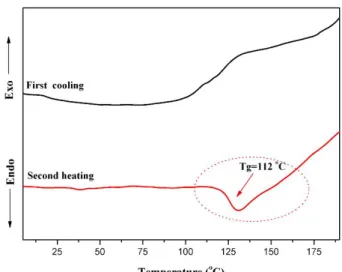
standard at ambient temperature. The texture of the liquid crystalline polymer was examined under polarised optical microscopy (Leica DM-LM-P) equipped with a Mettler Toledo hot stage (FP82HT). One-dimensional wide-angle X-ray diffraction (1D WAXD) experiments were performed on a BRUKER AXS D8 Advance diffractometer with a 40 kV FL tubes as the X-ray source (Cu Kα) and the LYNXEYE-XE detector.
Fig. S1 1H-NMR spectrum of PTFMPCS, whose chemical structure is shown in the
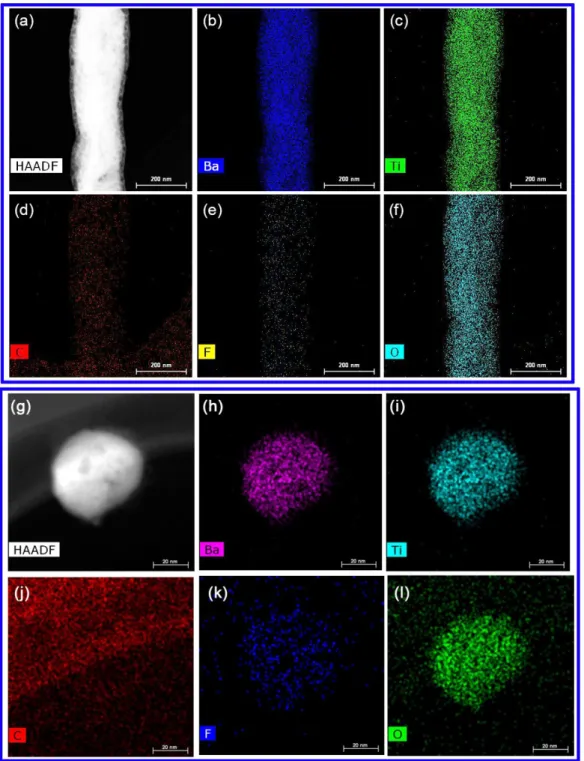
Fig. S3 (a) HAADF pattern TEM image of BaTiO3@PTFMPCS nanowire and the
Mapping pattern images of BaTiO3@PTFMPCS nanowire with (b) Ba, (c) Ti, (d) C,
(e) F, and (f) O elements. (g) HAADF pattern TEM image of BaTiO3@PTFMPCS
nanoparticle and the Mapping pattern images of BaTiO3@PTFMPCS nanoparticle with
elements of the BaTiO3@PTFMPCS nanowire and nanoparticle, which correspond to
the identified area in the TEM-HAADF image. Different elements are shown in different colors in order to identify their positions within the BaTiO3@PTFMPCS
nanowire and nanoparticle.
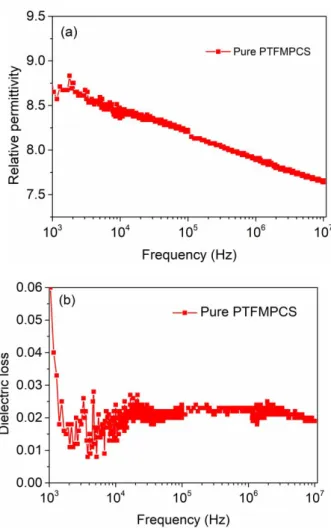
Fig. S4 Frequency dependence of (a) the relative permittivity and (b) dielectric loss of pure PTFMPCS
Fig. S5 Frequency dependent electric conductivity of the nanocomposites with various BaTiO3 nanowire loadings and PTFMPCS thicknesses (a) 9.2 nm (b) 14.8 nm
Fig. S6 Cross sectional SEM images of the nanocomposites with (a) 2.5 vol.%, (b) 5.0 vol.%, (c) 7.5 vol.%, (d) 10 vol.% BaTiO3@PFTMPCS nanowires, the scales are 5 μm.
Fig. S7 Polarization-Electric field (P-E) loops of the nanocomposites with (a) 0%, (b) 2.5%-thickness1, (c) 2.5%-thickness2, (d) 5.0%-thickness1, (e) 5.0%-thickness2, (f) 7.5%-thickness1, (g) 7.5%-thickness2 BaTiO3 nanowires under vaious applied electric