ISSN: 1223-6934, Online 2246-9958
Fragmentation and Data Allocation in the Distributed
Environments
Nicoleta - Magdalena Iacob (Ciobanu)
Abstract. The distributed data processing is an effective way to improve reliability, avail-ability and performance of a database system. In this paper we will concentrate on data allocation problem with the aim to assure an optimal distribution of data in the process of the distributed database design in correlation with data fragmentation. Efficient allocation of fragments requires a balance between costs (storage, processing and transmission of data), performance (especially response time) and data distribution restrictions. The allocation of fragments is closely related to the replication of data from distributed databases. In addition, we analyzed the cost of fragmentation and replication.
2010 Mathematics Subject Classification. Primary 68P05; Secondary 68P15, 68N17.
Key words and phrases. distributed databases, fragmentation design, allocation design, strategies, methods, cost analysis.
1. Distributed databases
Definition 1.1. Let K be a collection of dataKi={Ai1, ..., Aik},k= 1,2, ... which
consists of a set of attributes (fields, columns) and has an associated set of data (lines, tuples, records). The database: BD ={K1, ..., Ki, ...},i∈I,I = 1,2, ..., nis a collection of structured data.
Definition 1.2. Let C be a set of computers: C={C1, ..., Cj},j∈J,J = 1,2, ..., m then DDB is a distributed database and P1, P2, ..., Pj the parties that compose it. Therefore DDB = {P1 ∪P2∪...∪Pj}, with {P1∩...∩Pj} = ∅, where Pj is a corresponding part of the computerCj, Pj ∈ {K1, ..., Ki, ...}, i∈I, with 2≤j ≤m, i.e. Pj is a subset of the DDB database.
Definition 1.3. A distributed database system consists of a collection of sites, con-nected together via some kind of communications network, in which:
a. Each site is a full database system site in its own right, but
b. The sites have agreed to work together so that a user at any site can access data anywhere in the network exactly as if the data were all stored at the user’s own site. Definition 1.4. It follows that a distributed database (DDB) is really a kind of virtual database, whose component parts are physically stored in a number of distinct ”real” databases at a number of distinct sites (in effect. it is the logical union of those database) [2].
Received July 05, 2011. Revision received August 25, 2011.
This work was partially supported by the strategic grant POSDRU/88/1.5/S/52826, Project ID52826 (2009), co-financed by the European Social Fund - Investing in People, within the Sectoral Operational Programme Human Resources Development 2007-2013.
Definition 1.5. A distributed database management system (DDBMS) is a software system that manages a distributed database while making the distribution transparent to the user [3]. Distribution is normally discussed solely in terms of the fragmenta-tion and replicafragmenta-tion of data. A data fragment constitutes some subset of the original database. A data replicate constitutes some copy of the whole or part of the original database [1].
2. The design of a distributed database
The design of a distributed computer system involves making decisions on the placement of data and programs across the sites of a computer network. In the case of distributed DBMSs, the distribution of applications involves two things: the distribution of the distributed DBMS software and the distribution of the application programs that run on it [5].
The distributed nature of the data involves new further data: data fragmentation, partitioning, replication and fragments allocation as well as replicas on different sites. The design of DDB can be done, as in the case of centralized database, using the top-down and/or bottom-up approach.
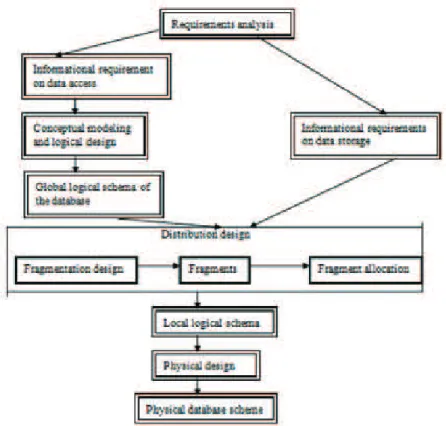
Top-down design shown schematically in Figure 1, aims to assure an optimal distribution of data and is used in the distributed database design phase.
Figure 1. Top-down design of distributed databases
The starting point in a top-down design approach is to identify and analyze the requirements of the system which will use the distributed database architecture and
identify the data storage requirements and the data access mode. Based on these requirements first will be designed the global scheme of DDB independent of physical constraints regarding distribution and implementation. The next step is the data dis-tribution design, which will show the fragmentation type of DDB and also allocation of fragments on nodes. The design process will end with the local database design for each node.
The design techniques for global scheme of DDB and local database are similar with those used in a centralized database scenario. Specific to DDB are aspects related to the fragmentation design and fragment allocation scheme to network nodes.
The two activities, fragmentation and data allocation are addressed independently, fragmentation results representing the input in data allocation phase. Both activities have the same inputs, the difference between them being the fact that fragmentation starts from global relationships, while the data allocation takes into account fragmen-tation results. Both take into account the data access requirements, but each of them ignore the way in which requirements are comprised by the other design decisions. The fragments and their allocation on sites aim to achieve, as much as possible, access to the local data references.
2.1. Fragmentation design.
Definition 2.1. Fragmentation. The system partitions the relation into several fragments, and stores each fragment at a different site.
If a distributed database B is partitioned this means that the partiesP1, P2, ..., Pj, i∈I,I= 1,2, ..., nwhich compose her form disjoint subsets: B={P1∪P2∪...∪Pj}, with{P1∩...∩Pj}=∅.
The fragmentation is the partitioning of a global relation R into fragments R1,
R2, ..., Ri, containing enough information to reconstruct the original relationR.
There are three basic rules that should be looked at during the fragmentation, which ensure that the database does not have semantic changes during fragmentation, i.e. ensure consistency of the database:
• Completeness. If relationR is decomposed into fragmentsR1, R2, ..., Rn, each
data item that can be found inR must appear in at least one fragment.
• Reconstruction. It must be possible to define a relational operation that will reconstructR from the fragments. Reconstruction for horizontal fragmentation isUnion operation andJoin for vertical.
• Disjointness. If data itemdiappears in fragmentRi, then it should not appear
in any other fragment.
Exception: vertical fragmentation, where primary key attributes must be repeated to allow reconstruction. In the case of horizontal fragmentation, data item is a tuple; for vertical fragmentation, data item is an attribute.
2.1.1. Fragmentation strategies. Consider a relation with schemeR. The fragmen-tation ofR consist of determining the number of fragments (subscheme)Riobtained
by applying an algebraic relation on R (as operations on relations which show the logical properties of data). In this context, the fragmentation of data collection can be done in two ways:
a) Horizontal. The horizontal fragmentation of a relation R is the subdivision of its tuples into subsets called fragments; the fragmentation is correct if each tuple of R is mapped into at least one tuple of the fragments (completeness condition). An additional disjointness condition, requiring that each tuple of R be mapped into
exactly one tuple of one of the fragments, is often introduced in distributed database systems in order to control the existence of duplication explicitly at the fragment level (by having multiple copies of the same fragment). The resulted fragments Ri have
the same scheme structure as well as collectionR, but differ by the data they contain and are resulted by applying a selection onR.
Selectionop(R) - defines a relation that contains only those tuples ofRthat satisfy
the specified condition (predicate p): op(
Q
a1, ..., an(R)). A horizontal fragment can
be obtained by applying a restriction: Ri =ðcondi(R). So we can rebuild the original
relation by union as follows: R=R1∪R2∪...∪Rk.
For example:
R1=σtype=’House’(PropertyForSale)
R2=σtype=’Flat’(PropertyForSale)
There are two versions of horizontal partitioning:
• primary horizontal fragmentationof a relation is achieved through the use of predicates defined on that relation which restricts the tuples of the relation.
• derived horizontal fragmentation is realized by using predicates that are defined on other relations.
b) Vertical. It divides the relation vertically by columns. The resulted fragments
Ri contain only part from the collection structure R. It keeps only certain attributes
at certain site and they contain the primary key of the relation R to ensure that the restore is possible and are resulted from the application of a projection operation of relational algebra: Qa1, ..., an(R), where a1, ..., an are attributes of the relation
R. The fragmentation is correct if each attribute of the relation is mapped into at least one attribute of the fragments; moreover, it must be possible to reconstruct the original relation by joining the fragments togetherR=R1
N R2
N
...NRn; in other
words, the fragments must be a lossless join decomposition of the relation. For example:
R1=
Q
staffNo, position, salary(Staff)
R2=
Q
staffNo, firstName, lastName, branchNo(Staff)
c)Sometimes, only vertical or horizontal fragmentation of a database scheme is in-sufficient to distribute adequately data for some applications. Instead it can be useful to implementmixed or hybrid fragmentation. A mixed fragment from a relation consists of a horizontal fragment that is vertically fragmented, or a vertical fragment that is horizontally fragmented. A mixed fragmentation is defined using selection and projection operations of relational algebra: σp(
Q
a1, ..., an(R)) or
Q
a1, ..., an(σp(R)).
The comparison of fragmentation strategies is showed in table 1. For each fragment of a relation R:
• ConditionC = True (all tuples are selected).
• List (L= ATTRS(R)) = True (all attributes are included in the list).
Vertical fragmentation Horizontal fragmentation Mixed fragmentation C True (all tuples ) False (not all tuples) False (not all tuples) L False (not all columns) True (all columns) False (not all columns)
Table 1: Comparison of fragmentation strategies The advantages of the fragmentation:
• Usage- applications work with views rather than entire relations;
• Efficiency - data is stored close to the place where it is mostly frequently used;
• Parallelism - with fragments are the unit of distribution, a transaction can be divided into several subqueries that operate on fragments;
• Security - data not required by local applications is not restored, and conse-quently not available to unauthorized users;
• Performance of global applications that require data from several fragments lo-cated at different sites many be slower.
2.2. Allocation design. A database is named distributed if any of its tables are stored at different sites; one or more of its tables are replicated and their copies are stored at different sites; one or more of its tables are fragmented and the fragments are stored at different sites; and so on. In general, a database is distributed if not all of its data is localized at a single site [6].
The problem of fragment allocation can be treated as a problem of placement optimization for each data fragment. Efficient distribution of fragments requires a balance between costs (storage, processing and transmission of data), performance (especially response time) and data distribution restrictions.
Give:
• a set of m fragments F = {F1, F2, ..., Fm} exploited by a set of k applications Q={Q1, Q2, ..., Qk} on a set of p sitesS={S1, S2, ..., Sp}.
Determine:
• Det(F, S) =
(
1, if F is alocated
0, if otherwise
The allocation problem involves finding the ”optimal” distribution of F to S. To minimize:
• storage cost + communication cost + local processing cost Subject to:
• response time constraints
• availability constraints
• network topology
• security restrictions
The allocation of fragments is closely related to the replication of data from DDB. In the data allocation phase the designer must decide whether DDB fragments will be replicated and also their degree of replication.
Definition 2.2. Replication. The system maintains several identical replicas (copies) of the relation, and stores each replica at a different site. The alternative to replication is to store only one copy of relation r.
A database is replicated if the entire database or a portion of it (a table, some tables, one or more fragments, etc.) is copied and the copies are stored at different sites. The problem with having more than one copy of a database is to maintain the mutual consistency of the copies-ensuring that all copies have identical schema and data content. Assuming replicas are mutually consistent, replication improves availability since a transaction can read any of the copies [4]. In addition, replica-tion provides more reliability, minimizes the chance of total data loss, and greatly improves disaster recoveryIn addition, replication provides more reliability, minimizes the chance of total data loss, and greatly improves disaster recovery.
Fragmentation and replication can be combined: A relation can be partitioned into several fragments and there may be several replicas of each fragment [7].
2.2.1. Methods of data allocation. In designing data allocation, the following rule must be respected: the data must be placed closer to the location in which will be used. In practice, the methods used for data allocation are:
• Method of determination of non redundant allocation (called the best choices method) implies evaluating each possible allocation and choosing a single node for each fragment. The method eliminates the possibility of placing a fragment at a particular node if a fragment is already assigned to that node.
• The redundant allocation methodon all profitable nodes implies the selec-tion of all nodes for which the benefit of allocating a copy of the fragment is greater than the cost of allocation. Redundant final allocation is recommended when data retrieval frequency is higher than the frequency of updating data. Data replication is more convenient for systems that admit temporary inconsis-tent data.
• Progressive replication methodimplies initial implementation of a non re-dundant solution and then progressively introduces the replicated copies from the most profitable node. The benefits are calculated by taking into consideration all query and update operations.
3. Cost analysis
Assume the set of sites is S = {S1, S2, ..., Sp}. Let p be the total number of
sites, NRel be the total number of relations, m be the total number of fragments, Nf rag be the cardinality of the fragmented relation, n be the number of fragments of
the fragmented relation,Nrepbe the cardinality of each other (NRel−1 ) replicated
relations,Njoinbe the cardinality of the joined relations, k be the number of attributes
in both fragmented and replicated relations,Kjoin be the number of attributes after
joining the relations from any site, Kp be the number of attributes to be projected, CTcomp be cost per tuple comparison, CTconc be the cost per tuple concatenation, Tcost−attr be transmission cost per attribute, T CR be the replication transmission
costs,CPp−attr be the cost per projected attribute.
3.1. Cost analysis of fragmentation and replication (CAFR). The CAFR algorithm requires one of the relations referenced by a query to be fragmented and other relations to be replicated at the sites that have a fragment of the fragmented relation. The query is decomposed into the same number of subqueries as the number of sites and each subquery is processed at one of these sites.
The cost for one of the relation to be fragmented across m sites is:
T CO−F =Nf rag∗k∗Tcost−attr∗n. (1)
The cost for all other (NRel−1) relations to be replicated across n sites is: T CR= (Nrep∗k∗Tcost−attr)∗(NRel−1). (2)
The local processing costs of these sites are (union cost for fragmented relation and natural join cost):
LP C=
r
X
j=1
Cost[
n
[
i=1
(F)i]j+[(Nf rag∗1)+Nrep∗(NRel−1)∗CTcomp+Njoin∗CTconc]∗p.
(3) It follows that, the total cost for CAFR strategy is:
The CAFR permits parallel processing of a query and are not applicable for pro-cessing distributed queries, in which all the non fragmented relations are referenced by a query.
3.2. Cost analysis of partition and replication (CAPR). The CAPR algorithm works as follows. For a given query, the minimum response time is estimated if all referenced data is transferred to and processed at only one of the sites. Next, for each referenced relation and each copy of the relation, the response time is estimated if the copy of the relation is partitioned and distributed to a subset of S and all the other relations are replicated at the sites where they are needed. A choice of processing sites and sizes of fragments for the selected copy of the chosen relation are determined by CAPR so as to minimize the response time. Finally, the strategy which gives the minimum response time among all the copies of all the referenced relations is chosen.
The union cost:
U C =
m
X
i=1
[kjoin∗Njoin∗CTconc]j. (5)
If all the relations are transferred to any of the sites, to project and union the relations then the cost is:
T CP ROJ−U N I = N T RX
I=1
[Nrep∗KP∗CPp−attr]I+U C. (6)
3.3. Comparison of cost analysis. CAFR or CAPR requires substantial data transfer and preparation before a query can be processed in parallel at different sites. Performing local reductions before data transfer can reduce the data replication cost and the join processing cost. However, local reduction takes time and it delays data transfer. It is not always true that local reduction will reduce the response time for the processing of a given query. But comparing equations (6) and (4) it is concluded that
T CP ROJ−U N I > T CCAF R ; as it is always true that sending all relations directly to
the assembly site, where all joins are performed, is unfavorable due to its high trans-mission overhead and little exploitation of parallelism. This case is the worst case depending on the given input query (wherein there are no conditions or predicates in the where clause of the given query). The fragment and replicate strategy (CAFR) permits parallel processing of a query. CAFR are not applicable for processing dis-tributed queries; in which all the non fragmented relations are referenced by a query. In case of CAFR strategy, if no relation referenced by a query is fragmented, it is nec-essary to decide which relation will be partitioned into fragments; which copy of the relation should be used; how the relation will be partitioned; and where the fragments will be sent for processing. To resolve this problem, CAPR (Partition and Replicate strategy) is presented. But CAPR algorithm favors joins involving small numbers of relations, and improvement decreases as the number of relations involved in joins increases. Improvement of CAPR over single site processing depends heavily on how fast a relation can be partitioned. If the implementation of relation partitioning is inefficient, CAPR actually gives worse response time than single site processing.
4. Conclusion
The objective of a data allocation algorithm is to determine an assignment of frag-ments at different sites in order to minimize the total data transfer cost involved in executing a set of queries. This is equivalent to minimization of the average query execution time, which has a primary importance in a wide area of distributed appli-cations. The fragmentation in a distributed database management system increases the level of concurrency and therefore system throughput for query processing. Dis-tributed databases have appeared as a necessity, because they improve availability and reliability of data and assure high performance in data processing by allowing parallel processing of queries, but also reduce processing costs.
References
[1] P. Beynon-Davies,Database systems(3rd ed.), New York: Palgrave-Macmillan, 2004.
[2] C.J. Date,An introduction to Database Systems(8th ed.), Addison Wesley, 2003.
[3] R. Elmasri and S. Navathe, Fundamentals of database systems (4th ed.), Boston: Addison-Wesley, 2004.
[4] N.M. Iacob (Ciobanu), The use of distributed databases in e-learning systems,Procedia Social and Behavioral Sciences Journal 15(2011), 3rd World Conference on Educational Sciences -WCES 2011, Bahcesehir University, Istanbul - Turkey, 03-07 February 2011, 2673–2677.
[5] M.T. Ozsu and P. Valduriez,Principles of Distributed Database Systems(3th ed.), New York: Springer, 2011.
[6] S. Rahimi and F.S. Haug,Distributed database management systems: A Practical Approach, IEEE, Computer Society, Hoboken, N. J: Wiley, 2010.
[7] A. Silberschatz, H.F. Korth and S. Sudarshan,Database System Concepts(6th ed.), McGraw-Hill, 2010.
(Nicoleta - Magdalena Iacob (Ciobanu))University of Pitesti, Faculty of Mathematics and Computer Science, Computer Science Department, Targu din Vale Street, No.1, 110040 Pitesti, Romania