171
5.1 Classification of Matter
5.2 Compounds and Chemical Bonds 5.3 Ionic Compounds 5.4 Molecular
Compounds 5.5 Drawing Lewis
Structures 5.6 Resonance
5.7 Molecular Geometry from Lewis
Structures
Review Skills
The presentation of information in this chapter assumes that you can already perform the tasks listed below. You can test your readiness to proceed by answering the Review Questions at the end of the chapter. This might also be a good time to read the Chapter Objectives, which precede the Review Questions.
Describe the particle nature of solids, liquids, and gases. (Section 3.1) Convert between the names and
symbols for the common elements. (Table 3.1)
Given a periodic table, write the number of the group to which each element belongs. (Figure 3.3)
Given a periodic table, identify the alkali metals, alkaline earth metals, halogens, and noble gases. (Section 3.3) Using a periodic table, classify elements
as metals, nonmetals, or metalloids. (Section 3.3)
Describe the nuclear model of the atom. (Section 3.4)
Define the terms ion, cation, and anion. (Section 3.4)
Define the terms covalent bond, molecule, and diatomic. (Section 3.5) Describe the covalent bond in a
hydrogen molecule, H2. (Section 3.5)
Write or identify the definition of atomic orbital. (Section 4.2) Write electron configurations and
orbital diagrams for the nonmetallic elements. (Section 4.3)
ook around you. Do you think you see anything composed of just one element… any objects consisting only of carbon, or of gold, or of hydrogen? The correct answer is almost certainly no. If you are lucky enough to have a diamond ring, you have a piece of carbon that is almost pure (although a gemologist would tell you that diamonds contain slight impurities that give each stone its unique character). If you have a “gold” ring, you have a mixture of gold with other metals, added to give the ring greater strength.
Even though a few elements, such as carbon and gold, are sometimes found in elemental form in nature, most of the substances we see around us consist of two or more elements that have combined chemically to form more complex substances called compounds. For example, in nature, the element hydrogen is combined with other elements, such as oxygen and carbon, in compounds
such as the water and sugar used to make a soft drink. (Perhaps you are sipping one while you read.) In this chapter, you will learn to (1) define the terms mixture and compound more precisely, (2) distinguish between elements, compounds, and mixtures, (3) describe how elements combine to form compounds, (4) describe the characteristics of certain kinds of chemical compounds, and (5) describe how atoms in compounds are attached and how these atoms are arranged in space. The chapter
will also expand your ability to visualize the basic structures of matter.
The flecks of gold in this pan are the only pure ele
-ments visible in this scene.
Chapter 5
5.1
Classification of Matter
Before getting started on your chemistry homework, you go into the kitchen to make some pasta for your six‑year‑old nephew. You run water into a pan, adding a few shakes of salt, and while you’re waiting for it to boil, you pour a cup of coffee. When the water begins to boil, you pour in the pasta. Then you add some sugar to your coffee.
Pure water, the sucrose in white sugar, and the sodium chloride in table salt are all examples of chemical compounds. A compound is a substance that contains two or more elements, with the atoms of those elements always combining in the same whole‑number ratio (Figure 5.1). There are relatively few chemical elements, but there are millions of chemical compounds. Compounds in our food fuel our bodies, and the compounds in gasoline fuel our cars. They can alter our moods and cure our diseases.
Water is composed of molecules that contain two atoms of hydrogen and one atom of oxygen. We describe the composition of water with the chemical formula H2O. White sugar is a highly purified form of sucrose, whose chemical formula is
C12H22O11. Its molecules are composed of 12 carbon atoms, 22 hydrogen atoms, and
11 oxygen atoms. Sodium and chlorine atoms combine in a one‑to‑one ratio to form sodium chloride, NaCl, which is the primary ingredient in table salt.
Figure 5.1
Elements Versus Compounds
Objective 2
ELEMENTS
COMPOUNDS
Silver exists as an
assembly of silver atoms. Neon is composed
of independent atoms. Hydrogen is composed
of molecules with two hydrogen atoms.
H2 molecule Neon atom Silver atom
100 400 300 200 500
Water is composed of molecules that contain one oxygen atom and two hydrogen atoms.
Sodium ion Chloride ion Water
molecule, H2O
Sodium chloride exists as an assembly of sodium and chloride ions, always in a one-to-one ratio.
5.1 Classification of Matter 173
Note that a chemical formula is a concise written description of the components of a chemical compound. It identifies the elements in the compound by their symbols and describes the relative number of atoms of each element with subscripts. If an element symbol in a formula is not accompanied by a subscript, the relative number of atoms of that element is assumed to be one.
Pure water, sodium chloride, and sucrose always have the composition described in their chemical formulas. In other words, their composition is constant. Elements, too, have a constant composition described by a chemical formula. (We have seen that the formula for hydrogen is H2.) When a substance has a constant composition—when it
can be described by a chemical formula—it must by definition be either an element or a compound, and it is considered a pure substance. For example, the symbol Na refers to pure sodium. The formula Na2CO3 refers to pure sodium carbonate and tells us that
this compound is always composed of sodium, carbon, and oxygen in a constant atom ratio of 2:1:3.
Mixtures are samples of matter that contain two or more pure substances and have variable composition (Figure 5.2). For example, when salt, NaCl, and water, H2O, are
combined, we know the resulting combination is a mixture because we can vary the percentage of these two pure substances. You can add one, two, or ten teaspoons of salt to a pan of water, and the result will still be salt water.
Figure 5.2
Automobile Exhaust—a Mixture The components and amounts vary.
Objective 4
Objective 3 Objective 3 Objective 2
Objective 3 Unburned
gasoline
Carbon dioxide, CO2
Water, H2O
Nitrogen oxides, NO and NO2
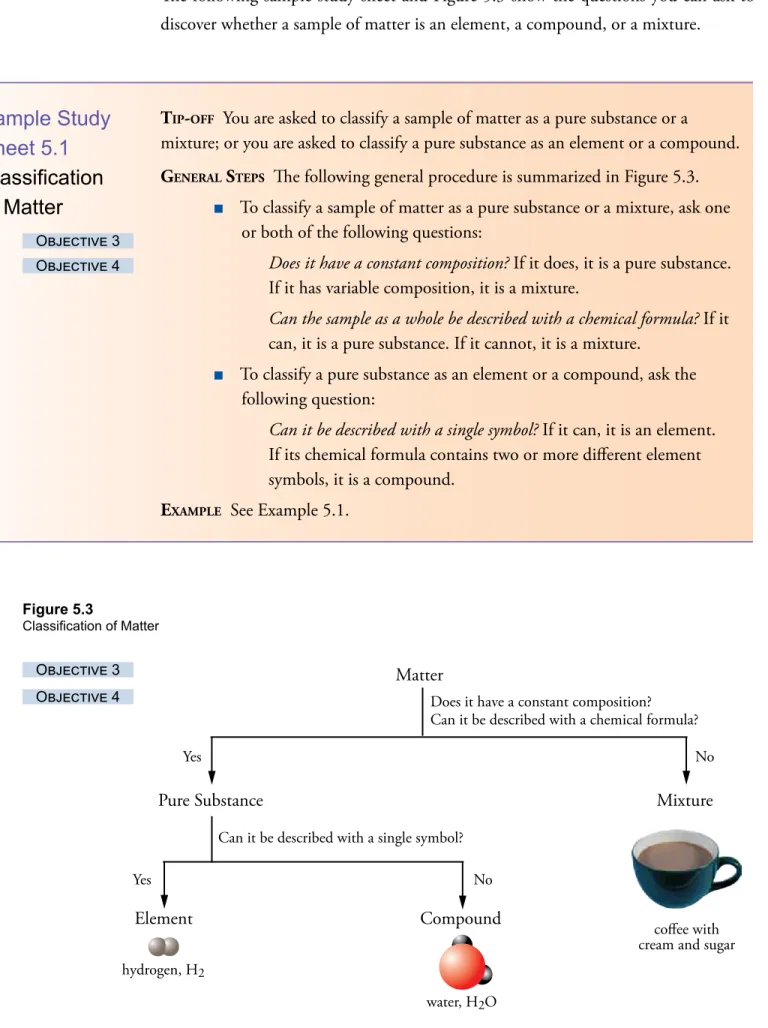
The following sample study sheet and Figure 5.3 show the questions you can ask to discover whether a sample of matter is an element, a compound, or a mixture.
Figure 5.3
Classification of Matter
Objective 3 Objective 4
Sample Study
Sheet 5.1
Classification
of Matter
Tip-off You are asked to classify a sample of matter as a pure substance or a
mixture; or you are asked to classify a pure substance as an element or a compound.
General STepS The following general procedure is summarized in Figure 5.3.
To classify a sample of matter as a pure substance or a mixture, ask one or both of the following questions:
Does it have a constant composition? If it does, it is a pure substance. If it has variable composition, it is a mixture.
Can the sample as a whole be described with a chemical formula? If it can, it is a pure substance. If it cannot, it is a mixture.
To classify a pure substance as an element or a compound, ask the following question:
Can it be described with a single symbol? If it can, it is an element. If its chemical formula contains two or more different element symbols, it is a compound.
example See Example 5.1.
Objective 3
Objective 4 Matter
Pure Substance Mixture
Element Compound
Does it have a constant composition? Can it be described with a chemical formula?
Can it be described with a single symbol?
Yes No
Yes No
coffee with cream and sugar
water, H2O
5.2 Compounds and Chemical Bonds
175
Objective 3
Example 5.1 - Classification of Matter
Many of us have a bottle in our medicine cabinet containing a mild disinfectant consisting of hydrogen peroxide and water. The liquid is about 3% hydrogen peroxide, H2O2, and about 97% water. Classify each of the following as a pure substance or a
mixture. If it is a pure substance, is it an element or a compound? a. the liquid disinfectant
b. the hydrogen peroxide, H2O2, used to make the disinfectant
c. the hydrogen used to make hydrogen peroxide Solution
a. We know that the liquid disinfectant is a mixture for two reasons. It is composed of two pure substances (H2O2 and H2O), and it has variable
composition.
b. Because hydrogen peroxide can be described with a formula, H2O2, it must be
a pure substance. Because the formula contains symbols for two elements, it represents a compound.
c. Hydrogen can be described with a single symbol, H or H2, so it is a pure substance and an element.
E
xercise 5.1
- Classification of Matter
The label on a container of double‑acting baking powder tells us that it contains cornstarch, bicarbonate of soda (also called sodium hydrogen carbonate, NaHCO3),
sodium aluminum sulfate, and acid phosphate of calcium (which chemists call calcium dihydrogen phosphate, Ca(H2PO4)2). Classify each of the following as a pure substance
or a mixture. If it is a pure substance, is it an element or a compound? a. calcium
b. calcium dihydrogen phosphate c. double‑acting baking powder
5.2
Compounds and Chemical Bonds
The percentage of H2O2 in the mixture of hydrogen peroxide and water that is used
as a disinfectant can vary, but the percentage of hydrogen in the compound water is always the same. Why? One of the key reasons that the components of a given compound are always the same, and present in the same proportions, is that the atoms in a compound are joined together by special kinds of attractions called chemical bonds. Because of the nature of these attractions, the atoms combine in specific ratios that give compounds their constant composition. This section will introduce you to the different types of chemical bonds and provide you with the skills necessary to predict the types of chemical bonds between atoms of different elements.
Objective 4
Objective 3 Objective 4
Equal and Unequal Sharing of Electrons
Let’s first consider the compound hydrogen chloride, HCl. When HCl is dissolved in water, the resulting mixture is called hydrochloric acid. Not only is this mixture a very common laboratory agent, but it is also used in food processing and to treat the water in swimming pools.
In Section 3.5, we learned about the bond between hydrogen atoms in H2 molecules.
We saw that the two electrons in the H2 molecule are shared equally between the atoms
and can be viewed as an electron‑charge cloud surrounding the hydrogen nuclei. This sharing creates a covalent bond that holds the atoms together. There is also a covalent bond between the hydrogen atom and the chlorine atom in each molecule of HCl. It is very similar to the covalent bond in hydrogen molecules, with one important exception.
The difference between the H–Cl bond and the H–H bond is that the hydrogen and chlorine atoms in HCl do not share the electrons in the bond equally. In the hydrogen‑chlorine bond, the two electrons are attracted more strongly to the chlorine atom than to the hydrogen atom. The negatively charged electrons in the bond shift toward the chlorine atom, giving it a partial negative charge, δ−, and giving the
hydrogen atom a partial positive charge, δ+ (Figure 5.4). The lower case Greek delta, δ, is a symbol that represents partial or fractional.
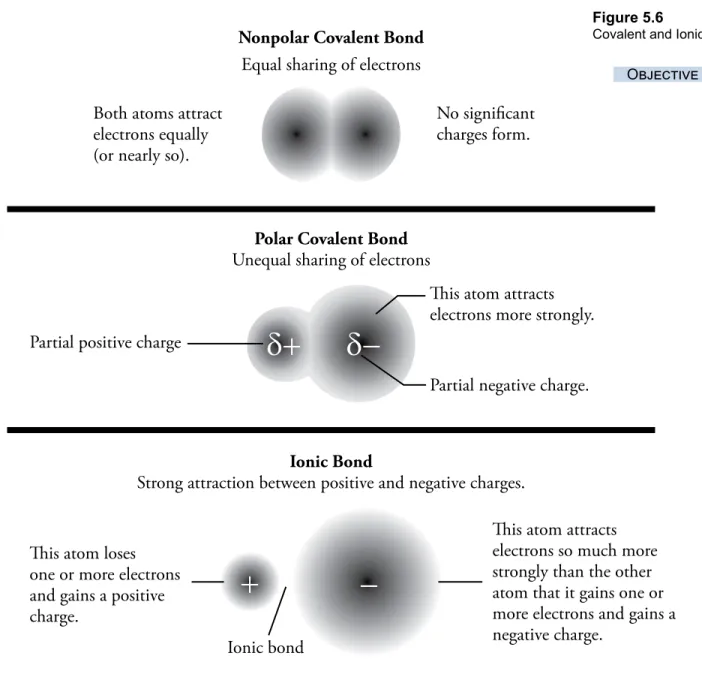
When the electrons of a covalent bond are shared unequally, the bond is called a polar covalent bond. Due to the unequal sharing of the electrons in the bond, a polar covalent bond has one atom with a partial positive charge, δ+, and one atom with a partial negative charge, δ−.
H2
Figure 5.4
Hydrogen Chloride Molecule
Objective 5 Objective 5
Objective 7
Objective 7
If the electron‑attracting ability of one atom in a bond is much greater than the others, there is a large shift in the electron cloud, and the partial charges are large. If the electron‑attracting ability of one atom in a covalent bond is only slightly greater than the others, there is not much of a shift in the electron cloud, and the partial charges are small. When the difference in electron‑attracting abilities is negligible (or zero), the atoms in the bond will have no significant partial charges. We call this type of bond a nonpolar covalent bond. The covalent bond between hydrogen atoms in H2 is an
example of a nonpolar covalent bond.
H
Cl
Chlorine attracts electrons more. Hydrogen attracts electrons less.δ−
δ+
Electrons shift toward the chlorine atom, forming partial plus and minus charges.
5.2 Compounds and Chemical Bonds 177
Transfer of Electrons
Sometimes one atom in a bond attracts electrons so much more strongly than the other that one or more electrons are fully transferred from one atom to another. This commonly happens when metallic atoms combine with nonmetallic atoms. A nonmetallic atom usually attracts electrons so much more strongly than a metallic atom that one or more electrons shift from the metallic atom to the nonmetallic atom. For example, when the element sodium combines with the element chlorine to form sodium chloride, NaCl, the chlorine atoms attract electrons so much more strongly than the sodium atoms that one electron is transferred from each sodium atom to a chlorine atom.
When an electron is transferred completely from one uncharged atom to another, the atom that loses the electron is left with one more proton than electron and acquires a +1 charge overall. It therefore becomes a cation. For example, when an uncharged
sodium atom with 11 protons and 11 electrons loses an electron, it is left with 11 protons (a charge of +11) and 10 electrons (a charge of −10), yielding an overall +1
charge.
Na → Na+ + e− 11p/11e− 11p/10e−
+11 + (−11) = 0 +11 + (−10) = +1
In contrast, an uncharged atom that gains an electron will have one more electron than proton, so it forms an anion with a −1 charge. When a chlorine atom gains an
electron from a sodium atom, the chlorine atom changes from an uncharged atom with 17 protons and 17 electrons to an anion with 17 protons and 18 electrons and an overall −1 charge.
Cl + e− → Cl− 17p/17e− 17p/18e−
+17 + (−17) = 0 +17 + (−18) = −1
Atoms can transfer one, two, or three electrons. Thus cations can have a +1, +2, or +3 charge, and anions can have a −1, −2, or −3 charge.
Because particles with opposite charges attract each other, there is an attraction between cations and anions. This attraction is called an ionic bond. For example, when an electron is transferred from a sodium atom to a chlorine atom, the attraction between the +1 sodium cation and the
−1 chlorine anion is an ionic bond (Figure 5.5 on the next page).
You will see as you read more of this book that substances that have ionic bonds are very different from those that have all covalent bonds. For example, compounds that have ionic bonds, such as the sodium chloride in table salt, are solids at room temperature and pressure, but compounds with all covalent bonds, such as hydrogen chloride and water,can be gases and liquids as well as solids.
Objective 6
Objective 6 Objective 6
The Salt-Encrusted Shore of The Dead Sea
Salt (sodium chloride) is an ionic compound. Water is molecular.
Summary of Covalent and Ionic Bond Formation
When atoms of different elements form chemical bonds, the electrons in the bonds can shift from one bonding atom to another.
The atom that attracts electrons more strongly will acquire a negative charge, and the other atom will acquire a positive charge.
The more the atoms differ in their electron‑attracting ability, the more the electron cloud shifts from one atom toward another.
If there is a large enough difference in electron‑attracting ability, one, two, or three electrons can be viewed as shifting completely from one atom to another. The atoms become positive and negative ions, and the attraction between them is called an ionic bond.
If the electron transfer is significant but not enough to form ions, the atoms acquire partial positive and partial negative charges. The bond in this situation is called a polar covalent bond.
If there is no shift of electrons or if the shift is negligible, no significant charges will form, and the bond will be a nonpolar covalent bond.
It might help, when thinking about these different kinds of bonds, to compare them to a game of tug‑of‑war between two people. The people are like the atoms with a chemical bond between them, and the rope is like the electrons in the bond. If the two people tugging have the same (or about the same) strength, the rope will not move (or not move much). This leads to a situation that is like the nonpolar covalent bond. If one person is stronger than the other person, the rope will shift toward that person, the way the electrons in a polar covalent bond shift toward the atom that attracts them more. If one person can pull a lot harder than the other person can, the stronger person pulls the rope right out of the hands of the weaker one. This is similar to the formation of ions and ionic bonds, when a nonmetallic atom pulls one or more electrons away from a metallic atom.
Figure 5.5
Ionic Bond Formation Objective 6
Objective 7
+
−
Chlorine gas, Cl2
Sodium metal, Na
Sodium atom, Na metallic element Each Na atom loses one electron and gets smaller
Each Cl atom gains one electron and gets larger Sodium ion, Na+
metallic cation Chlorine ion, Cl − nonmetallic anion Ionic bond, an attraction between a cation and an anion
e
−Chlorine atom, Cl nonmetallic element
5.2 Compounds and Chemical Bonds 179
Objective 8 Objective 7 Figure 5.6 summarizes the general differences between nonpolar covalent bonds,
polar covalent bonds, and ionic bonds.
Figure 5.6
Covalent and Ionic Bonds
Predicting Bond Type
The simplest way to predict whether a bond will be ionic or covalent is to apply the following rules.
When a nonmetallic atom bonds to another nonmetallic atom, the bond is covalent.
When a metallic atom bonds to a nonmetallic atom, the bond is usually ionic.
Some bonds between a metallic atom and a nonmetallic atom are better described as covalent. For now, however, we will keep our guidelines simple. All nonmetal‑nonmetal combinations lead to covalent bonds, and except when you are told otherwise, you can assume that all bonds between metallic atoms and nonmetallic atoms are ionic bonds.
δ−
δ+
Nonpolar Covalent Bond
Equal sharing of electrons
Ionic Bond
Strong attraction between positive and negative charges.
+
Polar Covalent Bond
Unequal sharing of electrons Both atoms attract
electrons equally (or nearly so).
No significant charges form.
Partial positive charge
This atom attracts electrons more strongly. Partial negative charge.
This atom loses one or more electrons and gains a positive charge.
This atom attracts electrons so much more strongly than the other atom that it gains one or more electrons and gains a negative charge.
Ionic bond
Objective 9
Figure 5.7
Classifying Compounds
Classifying Compounds
Compounds can be classified as molecular or ionic. Molecular compounds are composed of molecules, which are uncharged collections of atoms held together by all covalent bonds. Ionic compounds contain cations and anions held together by ionic bonds (Figure 5.7). You will see some exceptions later in this text, but for now, if a formula for a compound indicates that all the elements in it are nonmetals, you can assume that all of the bonds are covalent bonds, which form molecules, and that the compound is a molecular compound. We will assume that metal‑nonmetal combinations lead to ionic bonds and ionic compounds.
Example 5.2 - Classifying Compounds
Classify each of the following as either a molecular compound or an ionic compound. a. calcium chloride, CaCl2 (used for de‑icing roads)
b. ethanethiol, C2H5SH (a foul‑smelling substance used to odorize natural gas) Solution
a. Calcium, Ca, is a metal, and chlorine, Cl, is a nonmetal. We expect the bonds between them to be ionic, so calcium chloride is an ionic compound.
b. Carbon, hydrogen, and sulfur are all nonmetallic elements, so we expect the bonds between them to be covalent bonds. The formula, C2H5SH, tells us that
ethanethiol is composed of molecules that each contain two carbon atoms, six hydrogen atoms, and one sulfur atom. Ethanethiol is a molecular compound.
Objective 9
Exercise 5.2
- Classifying Compounds
Classify each of the following substances as either a molecular compound or an ionic compound.
a. formaldehyde, CH2O (used in embalming fluids)
b. magnesium chloride, MgCl2 (used in fireproofing wood and in paper
manufacturing) Objective 9
Objective 9
HCl molecule
Covalent bond Nonmetal Nonmetal
Metallic cations Nonmetallic anions
Molecular compound
As you saw in the last section, ionic compounds are substances composed of ions attracted to each other by ionic bonds. Let’s consider how they play a part in a “typical” family’s Fourth of July.
Before the family leaves the house to go to the holiday picnic, the kids are sent off to brush their teeth and change into clean clothes. Their toothpaste contains sodium fluoride, a common cavity‑fighting ionic compound. The white shirts in their red, white, and blue outfits were bleached with the ionic compound sodium hypochlorite, the stains on their red pants were removed by potassium oxalate, and dyes were fixed to their blue hats by aluminum nitrate.
While the kids are getting ready, dad and mom get the picnic dinner together. The hot dogs they are packing are cured with the ionic compound sodium nitrite, and the buns contain calcium acetate as a mold inhibitor and calcium iodate as a dough conditioner. The soft drinks have potassium hydrogen carbonate to help trap the bubbles, the mineral water contains magnesium sulfate, and the glass for the bottles was made with a variety of ionic compounds. Because it will be dark before they get home, Mom packs a flashlight as well. Its rechargeable batteries contain the ionic compounds cadmium hydroxide and nickel hydroxide.
When our family gets to the park, they find themselves a place on the lawn, which was fertilized with a mixture of ionic compounds, including iron(II) sulfate. They eat their dinner and play in the park until it’s time for the fireworks. The safety matches used to light the rockets contain barium chromate, and ionic compounds in the fireworks provide the colors: red from strontium chlorate, white from magnesium nitrate, and blue from copper(II) chloride.
Cations and Anions
Remember the sodium fluoride in the kids’ toothpaste? It could be made from the reaction of sodium metal with the nonmetallic atoms in fluorine gas. Metallic atoms hold some of their electrons relatively loosely, and as a result, they tend to lose electrons and form cations. In contrast, nonmetallic atoms attract electrons more strongly than metallic atoms, and so nonmetals tend to gain electrons and form anions. Thus, when a metallic element and a nonmetallic element combine, the nonmetallic atoms often pull one or more electrons far enough away from the metallic atoms to form ions. The positive cations and the negative anions then attract each other to form ionic bonds. In the formation of sodium fluoride from sodium metal and fluorine gas, each sodium atom donates one electron to a fluorine atom to form a Na+ cation and an F− anion.
The F− anions in toothpaste bind to the surface of your teeth, making them better able
to resist tooth decay. This section provides you with more information about other cations and anions, including how to predict their charges.
Ionic compounds play an important role in creating the excitement of a Fourth of July celebration.
5.3
Ionic Compounds
5.3 Ionic Compounds 181
Sodium fluoride is added to toothpaste to help fight tooth decay.
Predicting Ionic Charges
It is useful to be able to predict the charges the atoms of each element are most likely to attain when they form ions. Because the periodic table can be used to predict ionic charges, it is a good idea to have one in front of you when you study this section.
We discovered in Chapter 3 that the atoms of the noble gases found in nature are uncombined with other atoms. The fact that the noble gas atoms do not gain, lose, or share their electrons suggests there must be something especially stable about having 2 (helium, He), 10 (neon, Ne), 18 (argon, Ar), 36 (krypton, Kr), 54 (xenon, Xe), or 86 (radon, Rn) electrons. This stability is reflected in the fact that nonmetallic atoms form anions in order to get the same number of electrons as the nearest noble gas.
All of the halogens (group 17) have one less electron than the nearest noble gas. When halogen atoms combine with metallic atoms, they tend to gain one electron each and form −1 ions (Figure 5.8). For example, uncharged chlorine atoms have 17
protons and 17 electrons. If a chlorine atom gains one electron, it will have 18 electrons like an uncharged argon atom. With a −18 charge from the electrons and a +17 charge
from the protons, the resulting chlorine ion has a −1 charge. The symbol for this anion is Cl−. Note that the negative charge is indicated with a “−” not “−1” or “ 1−”.
Cl + 1e− → Cl− 17p/17e− 17p/18e−
The nonmetallic atoms in group 16 (oxygen, O, sulfur, S, and selenium, Se) have two fewer electrons than the nearest noble gas. When atoms of these elements combine with metallic atoms, they tend to gain two electrons and form −2 ions (Figure 5.8). For example, oxygen, in group 16, has atoms with eight protons and eight electrons. Each oxygen atom can gain two electrons to achieve ten, the same number as its nearest noble gas, neon. The symbol for this anion is O2−. Notice that the charge is indicated with “2−” not “−2”.
O + 2e− → O2− 8p/8e− 8p/10e−
Nitrogen, N, and phosphorus, P, have three fewer electrons than the nearest noble gas. When atoms of these elements combine with metallic atoms, they tend to gain three electrons and form −3 ions (Figure 5.8). For example, nitrogen atoms have seven
protons and seven electrons. Each nitrogen atom can gain three electrons to achieve ten, like neon, forming a N3− anion.
N + 3e− → N3−
7p/7e− 7p/10e−
Hydrogen has one less electron than helium, so when it combines with metallic atoms, it forms a −1 ion, H− (Figure 5.8). Anions like H−, Cl−, O2−, and N3−, which contain
single atoms with a negative charge, are called monatomic anions.
Some metallic atoms lose enough electrons to create a cation that has the same number of electrons as the nearest smaller noble gas. For example, the alkali metals in group 1 all have one more electron than the nearest noble gas. When they react with nonmetallic atoms, they lose one electron and form +1 ions (Figure 5.9 on page 184). For example, sodium has atoms with 11 protons and 11 electrons. If an atom of sodium loses one electron, it will have ten electrons like uncharged neon. With a −10 Objective 11
Objective 11
Objective 11 Objective 11
Objective 11
Objective 11
5.3 Ionic Compounds 183
charge from the electrons and a +11 charge from the protons, the sodium ions have a +1 overall charge. The symbol for this cation is Na+. Note that the charge is indicated
with a “+” instead of “+1” or “1+”. Na → Na+ + 1e− 11p/11e− 11p/10e−
The alkaline earth metals in group 2 all have two more electrons than the nearest noble gas. When they react with nonmetallic atoms, they tend to lose two electrons and form +2 ions (Figure 5.9 on the next page). For example, calcium has atoms with
20 protons and 20 electrons. Each calcium atom can lose two electrons to achieve 18, the same number as its nearest noble gas, argon. The symbol for this cation is Ca2+.
Note that the charge is indicated with “2+” not “+2”.
Ca → Ca2+ + 2e− 20p/20e− 20p/18e−
Aluminum atoms and the atoms of the group 3 metals have three more electrons than the nearest noble gas. When they react with nonmetallic atoms, they tend to lose three electrons and form +3 ions (Figure 5.9 on the next page). For example,
uncharged aluminum atoms have 13 protons and 13 electrons. Each aluminum atom can lose three electrons to achieve ten, like neon, forming an Al3+ cation.
Al → Al3+ + 3e−
13p/13e− 13p/10e−
Cations like Na+, Ca2+, and Al3+, which are single atoms with a positive charge, are called monatomic cations.
Figure 5.8
The Making of an Anion
Objective 11 When a
hydrogen atom gains one electron,
or when an atom in group 15 gains three electrons,
or when an atom in group 16 gains two electrons,
or when an atom
in group 17 gains one electron,
it has the same number of electrons as an atom of the nearest noble gas.
16 17
18
+e–
+2e– +e– X3– H– X– Atomic number equals number of electrons. H N P 7 15 O S Se 16 34 F Cl Br I 9 17 35 53 He Ne Ar Kr Xe 2 10 18 36 54
+3e–
X2– 15
1
When an atom in group 1 loses one electron,
or when an atom in group 2 loses two
electrons, or when an atom in group 3 loses three electrons,
or when an aluminum atom loses three electrons,
it has the same number of electrons as an atom of the nearest noble gas.
2
3
13
18
−3e−
−3e−
X3+
Al3+
1 Atomic number equals number of electrons. He Ne Ar Kr Xe 2 10 18 36 54 Rn 86 Li Na K Rb Cs 3 11 19 37 55 Fr 87 Be Mg Ca Sr Ba 4 12 20 38 56 Ra89 Sc 21 Y 39 Al 13
−2e−
X2+
−e−
X+
Figure 5.9
The Making of a Cation
Objective 11
Objective 11
The metallic elements in groups other than 1, 2, or 3 also lose electrons to form cations, but they do so in less easily predicted ways. It will be useful to memorize some of the charges for these metals. Ask your instructor which ones you will be expected to know. To answer the questions in this text, you will need to know that iron atoms form both Fe2+ and Fe3+, copper atoms form Cu+ and Cu2+, zinc atoms form Zn2+, cadmium atoms form Cd2+, and silver atoms form Ag+. Figure 5.10 summarizes the
charges of the ions that you should know at this stage.
Figure 5.10
Common Monatomic Ions
1 2
3 4 5 6 7 8 9 10 11 12
13 14 15 16 17
18 1A 8A 7A 6A 5A 4A 3A 2A
3B 4B 5B 6B 7B 8B 8B 8B 1B 2B
Li+ Fr+ Cs+ Rb+ K+ Na+ Be2+ Ra2+ Ba2+ Sr2+ Ca2+ Mg2+ Y3+ Sc3+ Cd2+ Zn2+ Ag+ Al3+ H– F– Cl– I– Br– O2–
S2– Se2– P3– N3–
Cu+ Cu2+ Fe3+
Fe2+ Objective 11
Objective 12
5.3 Ionic Compounds 185
Several of the monatomic cations play important roles in our bodies. For example, we need calcium ions in our diet for making bones and teeth. Iron(II) ions are found in hemoglobin molecules in red blood cells that carry oxygen from our lungs to the tissues of our bodies. Potassium, sodium, and chloride ions play a crucial role in the transfer of information between nerve cells. Enzymes (chemicals in the body that increase the speed of chemical reactions) often contain metallic cations, such as manganese(II) ions, iron(III) ions, copper(II) ions, and zinc ions. For example, Zn2+ ions are in the center of the enzyme alcohol dehydrogenase, which is the enzyme in our livers that accelerates the breakdown of the ethanol consumed in alcoholic beverages.
Structure of Ionic Compounds
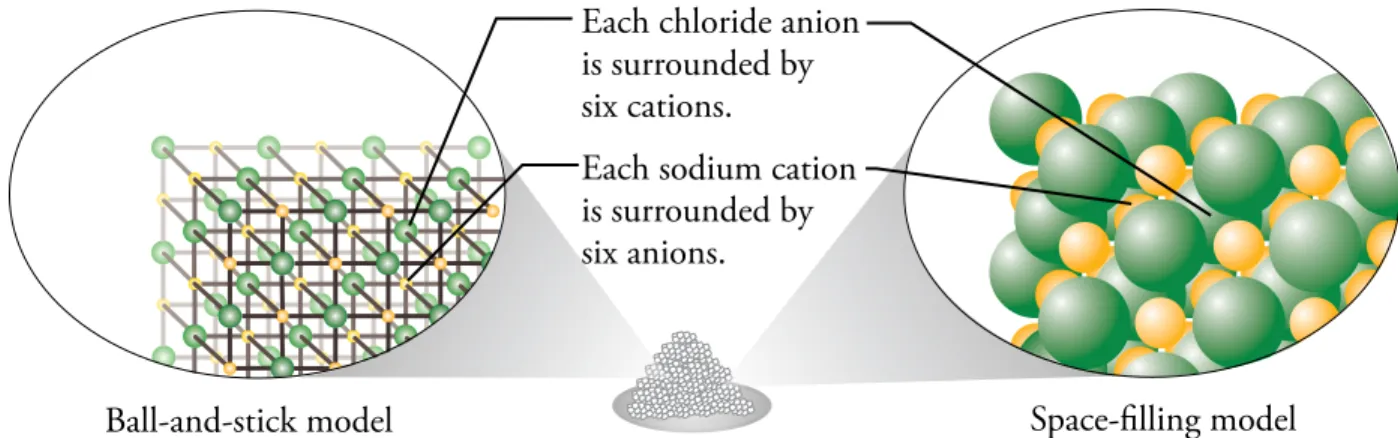
Figure 5.11 shows the solid structure of the ionic compound sodium chloride, NaCl. We have already seen that the particles that form the structure of ionic compounds are cations and anions, and the attractions that hold them together are ionic bonds. When atoms gain electrons and form anions, they get larger. When atoms lose electrons and form cations, they get significantly smaller. Thus the chloride ions are larger than the sodium ions. The ions take the arrangement that provides the greatest cation‑anion attraction while minimizing the anion‑anion and cation‑cation repulsions. Each sodium ion is surrounded by six chloride ions, and each chloride ion is surrounded by six sodium ions.
Any ionic compound that has the same arrangement of cations and anions as NaCl is said to have the sodium chloride crystal structure. The ionic compounds in this category include AgF, AgCl, AgBr, and the oxides and sulfides of the alkaline earth metals, such as MgO, CaS, etc. The sodium chloride crystal structure is just one of many different possible arrangements of ions in solid ionic compounds.
Figure 5.11
Sodium Chloride Structure
Objective 12
Polyatomic Ions
When an electric current is run through a purified saltwater solution (brine), hydrogen gas, chlorine gas, and an ionic compound called sodium hydroxide, NaOH, form. The sodium hydroxide, commonly called caustic soda or lye, is a very important compound that is used in paper production, vegetable oil refining, and to make many different compounds, such as soap and rayon. Like sodium chloride, NaCl, sodium
Salt (sodium chloride)
Ball-and-stick model Space-filling model Each sodium cation
is surrounded by six anions.
Each chloride anion is surrounded by six cations.
Objective 13
hydroxide, NaOH, contains a cation and an anion, but unlike the monatomic Cl
anion in NaCl, the hydroxide ion, OH−, in NaOH is a polyatomic ion, a charged collection of atoms held together by covalent bonds.
The ammonium ion can take the place of a monatomic cation in an ionic crystal structure. For example, the crystal structure of ammonium chloride, NH4Cl, which
is found in fertilizers, is very similar to the crystal structure of cesium chloride, CsCl, which is used in brewing, mineral waters, and to make fluorescent screens. In each structure, the chloride ions form a cubic arrangement with chloride ions at the corners of each cube. In cesium chloride, the cesium ions sit in the center of each cube, surrounded by eight chloride ions. Ammonium chloride has the same general structure as cesium chloride, with ammonium ions playing the same role in the NH4Cl structure
as cesium ions play in CsCl. The key idea is that because of its overall positive charge, the polyatomic ammonium ion acts like the monatomic cesium ion, Cs+ (Figure 5.12). Objective 13
Figure 5.12
Cesium Chloride Crystal Structure
Each NH4+ cation
is surrounded by eight Cl− anions. Each Cl− anion is surrounded by eight Cs+ cations. Each Cs+ cation is surrounded by eight Cl− anions.
Each Cl− anion is surrounded by eight NH4+ cations.
Ammonium chloride Cesium chloride
There are many polyatomic anions that can take the place of monatomic anions. For example, zinc hydroxide, used as an absorbent in surgical dressings, has a similar structure to zinc chloride, which is used in embalming and taxidermist’s fluids. The hydroxide ion, OH−, plays the same role in the structure of Zn(OH)2 as the chloride
ion, Cl−, plays in ZnCl2. (Note that to show that there are two hydroxide ions for each
5.4 Molecular Compounds 187
5.4
Molecular Compounds
It’s Monday morning, and you’d like a cup of coffee, but when you try cranking up the stove to reheat yesterday’s brew, nothing happens. Apparently, the city gas line has sprung a leak and been shut down for repairs.
The coffee cravings are strong, so you rummage in the garage until you find that can of Sterno left over from your last camping trip. You’re saved. Both Sterno and natural gas contain compounds that burn and release heat, but the compounds in each of these substances are different. Natural gas is mostly methane, CH4,
while Sterno contains several substances, including methanol, CH3OH.
The oxygen atom in methanol molecules makes methanol’s properties very different than methane’s. Methane is a colorless, odorless, and tasteless gas.
Methanol, or wood alcohol, is a liquid with a distinct odor, and is poisonous in very small quantities.
Chemists have discovered that part of the reason the small difference in structure leads to large differences in properties lies in the nature of covalent bonds and the arrangement of those bonds in space. The remaining sections of this chapter provide a model for explaining how covalent bonds form, teach you how to describe the resulting molecules with Lewis structures, and show how Lewis structures can be used to predict the three‑dimensional geometric arrangement of atoms in molecules.
We can use what we know from Chapter 4 about the electron configurations of atoms to begin to understand why atoms form bonds as they do. To describe the formation of covalent bonds in molecules, we use a model called the valence‑bond model, but before the assumptions of this model are described, let’s revisit some of the important issues relating to the use of models for describing the physical world.
The Strengths and Weaknesses of Models
When developing a model of physical reality, scientists take what they think is true and simplify it enough to make it useful. Such is the case with their description of the nature of molecules. Scientific understanding of molecular structure has advanced tremendously in the last few years, but the most sophisticated descriptions are too complex and mathematical to be understood by anyone but the most highly trained chemists and physicists. To be useful to the rest of us, the descriptions have been translated into simplified versions of what scientists consider to be true.
Such models have advantages and disadvantages. They help us to visualize, explain, and predict chemical changes, but we need to remind ourselves now and then that they are only models and that as models, they have their limitations. For example, because a model is a simplified version of what we think is true, the processes it depicts are sometimes described using the phrase as if. When you read, “It is as if an electron were promoted from one orbital to another,” the phrase is a reminder that we do not necessarily think this is what really happens. We merely find it useful to talk about the process as if this is the way it happens.
Objective 14
Methane or methanol? We use both to heat food. How do their molecules—and properties—differ?
One characteristic of models is that they change with time. Because our models are simplifications of what we think is real, we are not surprised when they sometimes fail to explain experimental observations. When this happens, the model is altered to fit the new observations.
The valence‑bond model for covalent bonds, described below, has its limitations, but it is still extremely useful. For example, you will see in Chapter 12 that it helps us understand the attractions between molecules and predict relative melting points and boiling points of substances. The model is also extremely useful in describing the mechanisms of chemical changes. Therefore, even though it strays a bit from what scientists think is the most accurate description of real molecules, the valence‑bond model is the most popular model for explaining covalent bonding.
The Valence-Bond Model
The valence-bond model, which is commonly used to describe the formation of covalent bonds, is based on the following assumptions:
Only the highest‑energy electrons participate in bonding. Covalent bonds usually form to pair unpaired electrons.
Fluorine is our first example. Using the process described in Section 4.3, we can draw its electron configuration and orbital diagram.
F 1s2 2s2 2p5 2s 1s
2p
The first assumption of our model states that only the highest energy electrons of fluorine atoms participate in bonding. There are two reasons why this is a reasonable assumption. First, we know from the unreactive nature of helium atoms that the 1s2
electron configuration is very stable, so we assume that these electrons in a fluorine atom are less important than others are for the creation of bonds. The second reason is that the electrons in 2s and 2p orbitals have larger electron clouds and are therefore more available for interaction with other atoms. The 2s2 and 2p5 electrons are the
fluorine atom’s valence electrons. Valence electrons are the highest‑energy s and p electrons in an atom.
In a similar way, we can show that for other elements, some electrons are more influential in the formation of chemical bonds than others are. Of chlorine’s 17 electrons, for example, only seven are important in predicting how chlorine will bond. Of sulfur’s 16 electrons, only six are important; of phosphorus’s 15 electrons, only five are important. The number of valence electrons for an atom of each nonmetallic element is equal to the element’s “A‑group” number on the periodic table (Figure 5.13). For example, the nonmetallic elements in group 7A (F, Cl, Br, and I) have seven valence electrons, those in group 6A (O, S, and Se) have six valence electrons, those in group 5A (N and P) have five, and carbon (C) in group 4A has four.
Objective 16 Objective 15
5.4 Molecular Compounds 189
Objective 19
Figure 5.13
Valence Electrons
When the columns in the periodic table are numbered by the A- group convention, the number of valence electrons in each atom of a representative element is equal to the element’s group number in the periodic table.
8A 7A 6A 5A 4A 3A
5 6 7 8 9
15 16 17
33 34 35
52 53
B C N O F
P S Cl
As Se Br Te I 1
H 2
10 18 36 54 He Ne Ar Kr Xe Number of valence
electrons equals the A-group number One valence electron
Objective 17(a) Fluorine is in group 7A, so it has seven valence electrons. The orbital diagram for the
valence electrons of fluorine is
2s 2p
When atoms pair their unpaired electrons by forming chemical bonds, the atoms become more stable. We know from Section 5.3 that one way for fluorine to pair its one unpaired electron is to gain an electron from another atom and form a fluoride ion, F−. This is possible when an atom is available that can easily lose an electron. For example, a sodium atom can transfer an electron to a fluorine atom to form a sodium ion, Na+, and a fluoride ion, F−.
If no atoms are available that can donate electrons to fluorine, the fluorine atoms will share electrons with other atoms to form electron pairs. For example, if we had a container of separate fluorine atoms, each fluorine atom would very quickly bind to another fluorine atom, allowing each of them to pair its unpaired valence electron.
To visualize this process, we can use electron‑dot symbols. The electron-dot symbol or electron‑dot structure is a representation of an atom that consists of its elemental symbol surrounded by dots representing its valence electrons. Electrons that are paired in an orbital are shown as a pair of dots, and unpaired electrons are shown as single dots. The paired valence electrons are called lone pairs (because they do not participate in bonding). In an electron‑dot symbol, the lone pairs and the single dots are arranged to the right, left, top, and bottom of the element’s symbol. The electron‑dot symbol for fluorine can be drawn with the single dot in any of the four positions:
F or F or F or F
According to the valence‑bond model, two fluorine atoms bond covalently when their unpaired electrons form an electron pair that is then shared between the two fluorine atoms.
F
F → F F
There seems to be something special about having eight valence electrons (often called an octet of electrons). For example, the noble gases (group 8A) have an octet of electrons (except for helium, which has only two electrons total), and they are so stable that they rarely form chemical bonds with other atoms.
Ne Ar Kr Xe
When atoms other than the noble gas atoms form bonds, they often have eight electrons around them in total. When the unpaired electron of one fluorine atom pairs with an unpaired electron of another fluorine atom to form a covalent bond, each fluorine atom has an octet of eight valence electrons around it: two from the two‑electron covalent bond and six from its three lone pairs.
F F
Usually, the covalent bonds in the electron‑dot symbols for molecules are indicated with lines. The nonbonding pairs of electrons (lone pairs) are described with dots. Each atom of fluorine in a F2 molecule has 1 covalent bond and 3 lone pairs.
Lone pairs (nonbonding electrons) covalent bond
F F Lone pairs
(nonbonding electrons)
This way of depicting a molecule or polyatomic ion—using the elements’ symbols to represent atoms, using lines to show two‑electron covalent bonds, and using dots to represent lone pairs—is called a Lewis structure. Although the bonds in Lewis structures can be described either with lines or with dots, in this text they will be described with lines.
Electron‑dot symbols are derived by placing valence electrons (represented by dots) around the element’s symbol. Starting on any of the four sides of the symbol, we place one dot at a time until there are up to four unpaired electrons around it. If there are more than four valence electrons for an atom, the remaining electrons are added one by one to the unpaired electrons to form up to four pairs.
X X X X X X X X
Each hydrogen atom in its ground state has one valence electron in a 1s orbital. Its electron‑dot symbol and orbital diagram are therefore
1s H
Because atoms become more stable when they pair their unpaired electrons, hydrogen atoms combine to form hydrogen molecules, H2, which allow each atom to share two
electrons.
H
H → H H or H H
Hydrogen atoms can also combine with fluorine atoms to form HF molecules.
F F or H F
H → H
Carbon is in group 4A on the periodic table, so we predict that it has four valence electrons. Looking at the orbital diagram for these electrons, we might expect carbon to form two covalent bonds (to pair its two unpaired electrons) and have one lone pair.
2s 2p C
Objective 17(a)
Objective 17(b)
Objective 17(c) Objective 19 Objective 18
5.4 Molecular Compounds 191
Carbon atoms do exhibit this bonding pattern in very rare circumstances, but in most cases, they form four bonds and have no lone pairs. Methane, CH4, is a typical
example. When forming four bonds to hydrogen atoms in a methane molecule, each carbon atom behaves as if it has four unpaired electrons. It is as if one electron is promoted from the 2s orbital to the 2p orbital.
2s 2p
C 2s
2p C →
The following describes the bond formation in methane using electron‑dot symbols.
H H H H C
C C or
4H H H
H H
+ →
Methane, CH4, is the primary component of natural gas. Other examples of compounds
for which carbon has four bonds and no lone pairs include ethane, C2H6, and propane,
C3H8, which are also found in natural gas, but in smaller quantities.
H H
H H C
H H
C H H
H H C
H H C
H H C Ethane Propane
Methane, ethane, and propane are hydrocarbons, compounds that contain only carbon and hydrogen (Figure 5.14). Fossil fuels that we burn to heat our homes, cook our food, and power our cars, are primarily hydrocarbons. For example, natural gas is a mixture of hydrocarbons with from one to four carbons, and gasoline contains hydrocarbon molecules with from six to twelve carbons. Like the hydrocarbons described above, many of the important compounds in nature contain a backbone of carbon‑carbon bonds. These compounds are called organic compounds, and the study of carbon‑based compounds is called organic chemistry.
Figure 5.14
Household Hydrocarbon
Liquid petroleum gas is a mixture of the hydrocarbons propane and butane.
Propane, C3H8
Butane, C4H10
Web Molecules
Carbon atoms also frequently form double bonds, in which they share four electrons with another atom, often another carbon atom. Double bonds are represented by double lines in a Lewis structure. Ethene (commonly called ethylene), C2H4, is an
example.
H H
H C
C or
4H H C H
H
+ 2
H C C
H
→
Note that each carbon atom in C2H4 has four bonds total, two single bonds to hydrogen
atoms and two bonds to the other carbon atom.
The bond between the carbon atoms in ethyne (commonly called acetylene), C2H2,
is a triple bond, which can be viewed as the sharing of six electrons between two atoms.
H C H
C or
2H + 2 → H C C H C
Note that each carbon atom in C2H2 has four bonds total, one single bond to a
hydrogen atom and three bonds to the other carbon atom.
Nitrogen is in group 5A, so it has five valence electrons. Its orbital diagram and electron‑dot symbol are
2s 2p N
Each nitrogen atom has three unpaired electrons, and as the model predicts, it usually forms three covalent bonds. For example, a nitrogen atom can bond to three hydrogen atoms to form an ammonia molecule, NH3:
H H
H N
N N or
3H H H
H
+ →
Another common bonding pattern for nitrogen atoms is four bonds with no lone pairs. The nitrogen atom in an ammonium polyatomic ion, NH4+, is an example. This
pattern and the positive charge on the ion can be explained by the loss of one electron from the nitrogen atom. It is as if an uncharged nitrogen atom loses one electron from the 2s orbital, leaving it with four unpaired electrons and the ability to make four bonds.
2s 2p
N 2s
2p N
−1e−
N N
4H H H
H H
+ →
Because nitrogen must lose an electron to form this bonding pattern, the overall structure of the ammonium ion has a +1 charge. The Lewis structures of polyatomic
ions are usually enclosed in brackets, with the overall charge written outside the brackets on the upper right.
H H
H H N
+ Objective 17(d)
5.4 Molecular Compounds 193
Phosphorus is in group 5A, so its atoms have five valence electrons, in this case, in the 3s23p3 configuration. Arsenic, also in group 5A, has atoms with a 4s24p3
configuration for their valence electrons. Because these valence configurations are similar to nitrogen’s, 2s22p3, the model correctly predicts that phosphorus and arsenic
atoms will form bonds like nitrogen. For example, they each form three bonds to hydrogen atoms and have one lone pair in NH3, PH3, and AsH3.
N
H H
H
As
H H
H P
H H
H
On the other hand, phosphorus and arsenic atoms exhibit bonding patterns that are not possible for nitrogen atoms. For example, molecules such as PCl5 and AsF5
have five bonds and no lone pairs. If you take other chemistry courses, you are likely to see compounds with bonding patterns like this, but because they are somewhat uncommon, you will not see them again in this text.
The most common bonding pattern for oxygen atoms is two covalent bonds and two lone pairs. Our model explains this in terms of the valence electrons’ 2s22p4 electron
configuration.
2s 2p O
The two unpaired electrons are able to participate in two covalent bonds, and the two pairs of electrons remain two lone pairs. The oxygen atom in a water molecule has this bonding pattern.
H H O
O O or
2H H
H
+ →
In another common bonding pattern, oxygen atoms gain one electron and form one covalent bond with three lone pairs. The oxygen atom in the hydroxide ion has this bonding pattern.
2s 2p
O 2s
2p O
+1e−
H O O O or
H + → H −
In rare circumstances, carbon and oxygen atoms can form triple bonds, leaving each atom with one lone pair. The carbon monoxide molecule, CO, is an example:
C O
According to the valence‑bond model, it is as if an electron is transferred from the oxygen atom to the carbon atom as the bonding in CO occurs. This gives each atom three unpaired electrons to form the triple bond, with one lone pair each left over.
2s 2p
O 2s
2p O
−1e−
2s 2p
C 2s
2p C +1e−
Objective 17(h) Objective 17(g) Objective 17(f)
Like oxygen, sulfur and selenium are in group 6A on the periodic table, so they too have six valence electrons, with 3s23p4 and 4s24p4 electron configurations, respectively.
We therefore expect sulfur atoms and selenium atoms to have bonding patterns similar to oxygen’s. For example, they all commonly form two bonds and have two lone pairs, as in molecules such as H2O, H2S, and H2Se.
S
H H
O
H H H Se H
Sulfur and selenium atoms have additional bonding patterns that are not possible for oxygen atoms. For example, they can form six bonds in molecules such as SF6 and
SeF6. You will not see these somewhat uncommon bonding patterns again in this text.
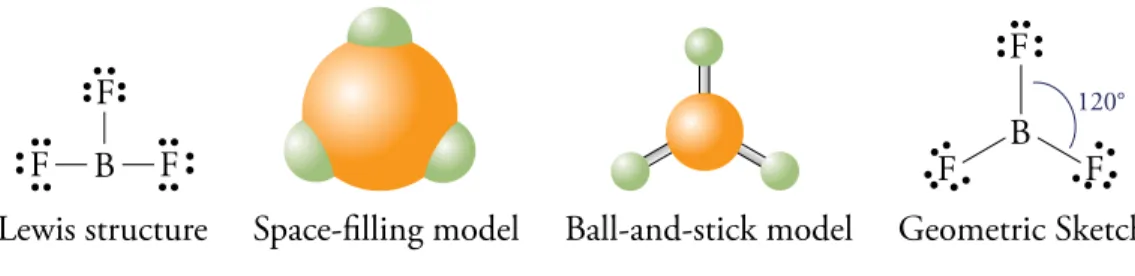
When the three equivalent B−F bonds form in boron trifluoride, BF3, it is as if one
of the boron atom’s valence electrons were promoted from its 2s orbital to an empty 2p orbital. This leaves three unpaired electrons to form three covalent bonds.
2s 2p
B 2s
2p B
→
B F F F
The elements in group 7A all have the ns2np5 configuration for their valence
electrons (3s23p5 for chlorine, 4s24p5 for bromine, etc.). Thus they all commonly
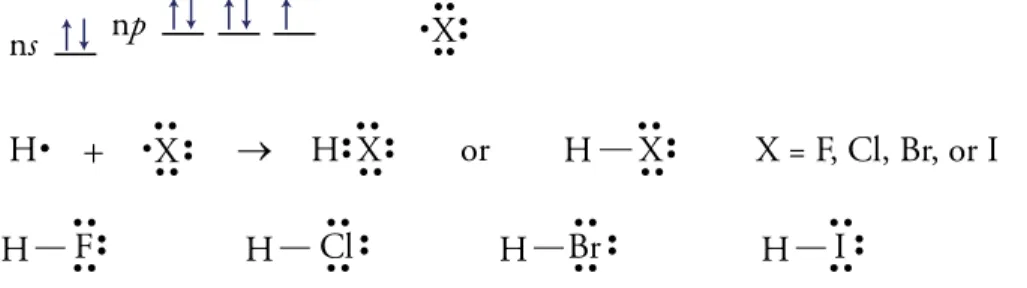
form one covalent bond and have three lone pairs. For example, their atoms all form one bond to a hydrogen atom to form HF, HCl, HBr, and HI.
ns np X
H
X X or
H + → H X X = F, Cl, Br, or I
Br
H H I
Cl H F
H
Chlorine, bromine, and iodine atoms have additional, less common bonding patterns that you might see in other chemistry courses.
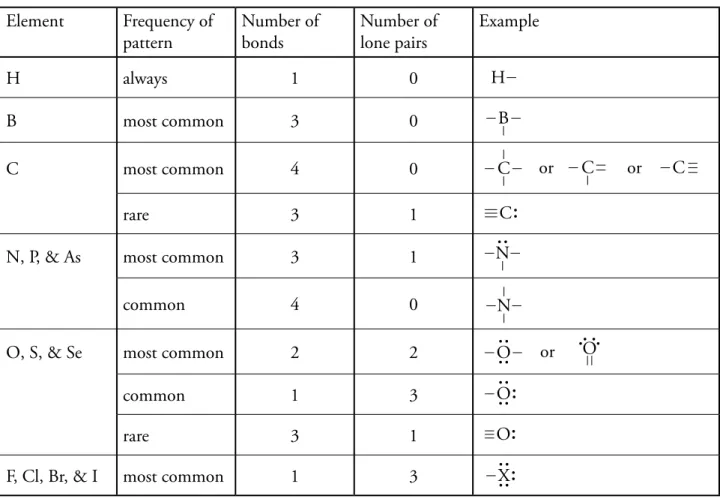
Table 5.1 summarizes the bonding patterns described in this section. The patterns listed there are not the only possible ones that these elements can have, but any patterns not listed are rare. In Section 5.5, you will be asked to draw Lewis structures from formulas, and knowledge of the common bonding patterns will help you to propose structures and evaluate their stability.
Objective 17(j) Objective 17(i)
Table 5.1 Covalent Bonding Patterns Element Frequency of
pattern Number of bonds Number of lone pairs Example
H always 1 0 H
B most common 3 0 B
C most common 4 0 C or C or C
rare 3 1 C
N, P, & As most common 3 1 N
common 4 0 N
O, S, & Se most common 2 2 O or O
common 1 3 O
rare 3 1 O
F, Cl, Br, & I most common 1 3 X
5.5 Drawing Lewis Structures 195
5.5
Drawing Lewis Structures
After studying chemistry all morning, you go out to mow the lawn. While adding gasoline to the lawnmower’s tank, you spill a bit, so you go off to get some soap and water to clean it up. By the time you get back, the gasoline has all evaporated, which starts you wondering…why does gasoline evaporate so much faster than water? We are not yet ready to explain this, but part of the answer is found by comparing the substances’ molecular structures and shapes. Lewis structures provide this information. You will see in Chapter 12 that the ability to draw Lewis structures for the chemical formulas of water, H2O, and hexane, C6H14, (one of the major components of gasoline) will help
you to explain their relative rates of evaporation. The ability to draw Lewis structures will be important for many other purposes as well, including explaining why the soap would have helped clean up the spill if the gasoline had not evaporated so quickly.
Simple Procedure
There are two general techniques for drawing Lewis structures. Because atoms of the nonmetallic elements usually have their most common bonding pattern, the simplest technique for drawing Lewis structures is to attempt to give each atom its most common bonding pattern as listed on Table 5.1.
Objective 20
Objective 21 Objective 22
To illustrate how Lewis structures can be drawn using the information on Table 5.1, let’s figure out the Lewis structure of methanol, CH3OH, which is often called methyl
alcohol or wood alcohol. Methanol is a poisonous liquid that is used as a solvent. When drawing its Lewis structure, we assume that the carbon atom will have four bonds (represented by four lines), the oxygen atom will have two bonds and two lone pairs, and each hydrogen atom will have one bond. The Lewis structure below meets these criteria.
C H
H H
O H
Methanol, CH3OH
(methyl alcohol)
Methanol is an alcohol, which is a category of organic compounds, not just the intoxicating compound in certain drinks. Alcohols are organic compounds that possess one or more –OH groups attached to a hydrocarbon group (a group that contains only carbon and hydrogen). Ethanol, C2H5OH, is the alcohol in alcoholic beverages (see
Special Topic 5.1: Molecular Shapes, Intoxicating Liquids, and the Brain), while the alcohol in rubbing alcohol is usually 2‑propanol (Figure 5.15). These alcohols are also called ethyl alcohol, C2H5OH, and isopropyl alcohol, C3H7OH.
H C O
H H
H C
H H
H C H H
C H H
H
O
C H
H
Ethanol, C2H5OH 2‑propanol, C3H7OH
(ethyl alcohol) (isopropyl alcohol)
Check to see that each of these compounds follows our guidelines for drawing Lewis structures.
Figure 5.15
Products Containing Alcohols
Objective 24 Objective 23
Methanol, CH3OH A poison Ethanol, C2H5OH
An intoxicant
Web Molecules
Objective 24 Objective 23
5.5 Drawing Lewis Structures 197
Objective 21
Exercise 5.3
- Drawing Lewis Structures from Formulas
Draw a Lewis structure for each of the following formulas:a. nitrogen triiodide, NI3 (explodes at the slightest touch)
b. hexachloroethane, C2Cl6 (used to make explosives)
c. hydrogen peroxide, H2O2 (a common antiseptic)
d. ethylene (or ethene), C2H4 (used to make polyethylene)
Objective 21
Example 5.3 - Drawing Lewis Structures from Formulas
Draw a Lewis structure for each of the following formulas:a. phosphine, PH3 (used to make semiconductors)
b. hypochlorous acid, HOCl (used to bleach textiles) c. CFC‑11, CCl3F (used as a refrigerant)
d. C2H2, acetylene (burned in oxyacetylene torches) Solution
a. Phosphorus atoms usually have three covalent bonds and one lone pair, and hydrogen atoms have one covalent bond and no lone pairs. The following Lewis structure for PH3 gives each of these atoms its most common bonding pattern.
P H H H
b. Hydrogen atoms have one covalent bond and no lone pairs, oxygen atoms usually have two covalent bonds and two lone pairs, and chlorine atoms usually have one covalent bond and three lone pairs.
H O Cl
c. Carbon atoms usually have four covalent bonds and no lone pairs. Fluorine and chlorine atoms usually have one covalent bond and three lone pairs. The fluorine atom can be put in any of the four positions around the carbon atom.
C Cl
Cl F
Cl
d. Carbon atoms form four bonds with no lone pairs, and hydrogen atoms form one bond with no lone pairs. To achieve these bonding patterns, there must be a triple bond between the carbon atoms.
C
Sample Study
Sheet 5.2
Drawing Lewis
Structures from
Formulas
Tip-off In this chapter, you may be given a chemical formula for a molecule or
polyatomic ion and asked to draw a Lewis structure, but there are other, more subtle tip‑offs that you will see in later chapters.
General STepS See fiGure 5.16 foraSummaryofTheSeSTepS.
STep 1 Determine the total number of valence electrons for the molecule or polyatomic
ion. (Remember that the number of valence electrons for a representative element is equal to its group number, using the A‑group convention for numbering groups. For example, chlorine, Cl, is in group 7A, so it has seven valence electrons. Hydrogen has one valence electron.)
For uncharged molecules, the total number of valence electrons is the sum of the valence electrons of each atom.
For polyatomic cations, the total number of valence electrons is the sum of the valence electrons for each atom minus the charge.
For polyatomic anions, the total number of valence electrons is the sum of the valence electrons for each atom plus the charge.
STep 2 Draw a reasonable skeletal structure, using single bonds to join all the atoms.
One or more of the following guidelines might help with this step. (They are clarified in the examples that follow.)
Try to arrange the atoms to yield the most typical number of bonds for each atom. Table 5.1 lists the most common bonding patterns for the nonmetallic elements.
Apply the following guidelines in deciding what element belongs in the center of your structure.
Hydrogen and fluorine atoms are never in the center. Oxygen atoms are rarely in the center.
The element with the fewest atoms in the formula is often in the center. The atom that is capable of making the most bonds is often in the center. Oxygen atoms rarely bond to other oxygen atoms.
The molecular formula often reflects the molecular structure. (See Example 5.7.)
Carbon atoms commonly bond to other carbon atoms.
STep 3 Subtract two electrons from the total for each of the single bonds (lines)
described in Step 2 above. This tells us the number of electrons that still need to be distributed.
STep 4 Try to distribute the remaining electrons as lone pairs to obtain a total of
eight electrons around each atom except hydrogen and boron. The atoms in reasonable Lewis structures are often surrounded by an octet of electrons. The following are some helpful observations pertaining to octets.
Objective 22
General Procedure
The shortcut described above works well for many simple uncharged molecules, but it does not work reliably for molecules that are more complex or for polyatomic ions. To draw Lewis structures for these, you can use the stepwise procedure described in the following sample study sheet.
5.5 Drawing Lewis Structures 199
In a reasonable Lewis structure, carbon, nitrogen, oxygen, and fluorine always have eight electrons around them.
Hydrogen will always have a total of two electrons from its one bond. Boron can have fewer than eight electrons but never more than eight. The nonmetallic elements in periods beyond the second period (P, S, Cl,
Se, Br, and I) usually have eight electrons around them, but they can have more. (In this text, they will always have eight electrons around them, but if you go on to take other chemistry courses, it will be useful to know that they can have more.)
The bonding properties of the metalloids arsenic, As, and tellurium, Te, are similar to those of phosphorus, P, and sulfur, S, so they usually have eight electrons around them but can have more.
STep 5 Do one of the following.
If in Step 4 you were able to obtain an octet of electrons around each atom other than hydrogen and boron, and if you used all of the remaining valence electrons, go to step 6.
If you have electrons remaining after each of the atoms other than hydrogen and boron have their octet, you can put more than eight electrons around elements in periods beyond the second period. (You will not need to use this procedure for any of the structures in this text, but if you take more advanced chemistry courses, it will be useful.)
If you do not have enough electrons to obtain octets of electrons around each atom (other than hydrogen and boron), convert one lone pair into a multiple bond for each two electrons that you are short. (See Example 5.5.)
If you would need two more electrons to get octets, convert one lone pair in your structure to a second bond between two atoms.
If you would need four more electrons to get octets, convert two lone pairs into bonds. This could mean creating a second bond in two different places or creating a triple bond in one place.
If you would need six more electrons to get octets, convert three lone pairs into bonds.
Etc.
STep 6 Check your structure to see if all of the atoms have their most common
bonding pattern (Table 5.1).
If each atom has its most common bonding pattern, your structure is a reasonable structure. Skip Step 7.
If one or more atoms are without their most common bonding pattern, continue to Step 7.
STep 7 If necessary, try to rearrange your structure to give each atom its most common
bonding pattern. One way to do this is to return to Step 2 and try another skeleton. (This step is unnecessary if all of the atoms in your structure have their most common bonding pattern.)
1 - Count total valence electrons 2 - Draw a provisional skeletal structure
7 - Try again 6 - Check for common bonding patterns
5- Check for octets
(experiment with multiple bonds if necessary) 4 - Distribute remaining valence electrons
3 - Count remaining electrons
Done
No Yes
Figure 5.16
Lewis Structure Procedure
Objective 22
Example 5.4 - Drawing Lewis Structures
Draw a reasonable Lewis structure for methyl bromide, CH3Br, which is an ozone
depleting gas used as a fumigant. Solution
Let’s start with the stepwise procedure for drawing Lewis structures.
STep 1 To determine the number of valence electrons for CH3Br, we note that carbon
is in group 4A, so its atoms have four valence electrons; hydrogen has one valence electron; bromine is in group 7A, so its atoms have seven valence electrons.
C H Br
CH3Br Number of valence e− = 1(4) + 3(1) + 1(7) = 14
STep 2 Before setting up the skeleton for CH3Br, we check Table 5.1, which reminds
us that carbon atoms usually have four bonds, hydrogen atoms always have one bond, and bromine atoms most commonly have one bond. Thus the following skeleton is most reasonable.
H H C
H Br
5.5 Drawing Lewis Structures 201
STep 3 We started with 14 total valence electrons for CH3Br, and we have used eight
of them for the four bonds in the skeleton we drew in Step 2.
Number e− remaining = total valence e−− number of bonds
= 14 − 4(2) = 6
2 e− 1 bond
STep 4 After Step 3, we have the following skeleton for CH3Br and six valence
electrons still to distribute.
H H C
H Br
Hydrogen atoms never have lone pairs, and the carbon atom has an octet of electrons around it from its four bonds. In contrast, the bromine atom needs six more electrons to obtain an octet, so we put the remaining six electrons around the bromine atom as three lone pairs.
H H C
H Br
STep 5 The structure drawn in Step 4 for CH3Br has an octet of electrons around the
carbon and bromine atoms. Hydrogen has its one bond. We have also used all of the valence electrons. Thus we move on to Step 6.
STep 6 All of the atoms in the structure drawn for CH3Br have their most common
bonding pattern, so we have a reasonable Lewis structure.
H H C
H Br
STep 7 Because the atoms in our structure for CH3Br have their most common
bonding pattern, we skip this step.
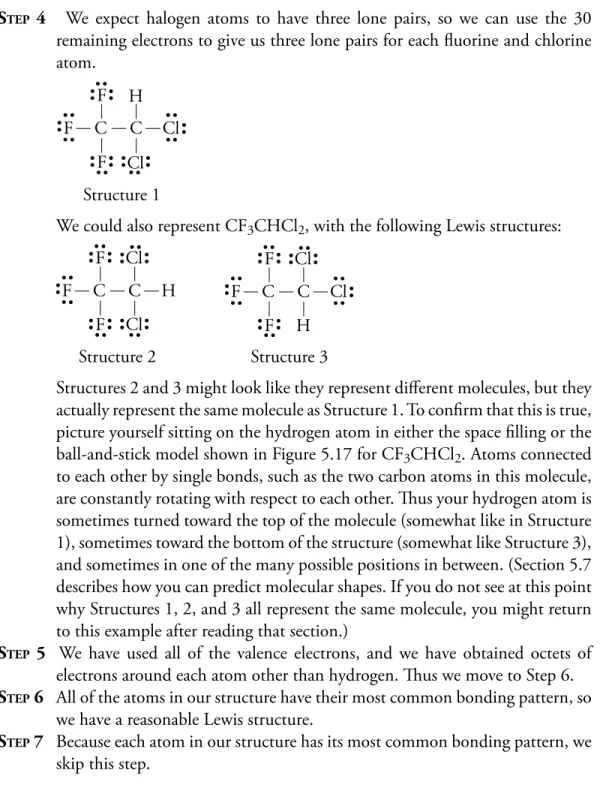
Shortcut The shortcut to drawing Lewis structures described at the beginning of this section can often be used for uncharged molecules such as CH3Br. Carbon atoms
usually have four bonds and no lone pairs, hydrogen atoms always have one bond, and bromine atoms most commonly have one bond and three lone pairs. The only way to give these atoms their most common bonding patterns is with the following Lewis structure, which is the same Lewis structure we arrived at with the stepwise procedure.
H H C