THE RELATIONSHIP BETWEEN CLASSROOM AGE COMPOSITION AND CHILDREN’S LANGUAGE AND SOCIAL SCHOOL READINESS OUTCOMES: EXAMINING THE ROLE
OF PEER EFFECTS
Tiffany Jamie Foster
A thesis submitted to the faculty at the University of North Carolina at Chapel Hill in partial fulfillment of the requirements for the degree of Master of Arts in the Department of Psychology
and Neuroscience in the College of Arts and Sciences.
Chapel Hill 2018
Approved by: Margaret Burchinal
ii
iii
ABSTRACT
Tiffany Jamie Foster: The Relationship Between Classroom Age Composition and Children’s Language and Social School Readiness Outcomes: Examining the Role of Peer Effects
(Under the direction of Margaret Burchinal)
Younger and older preschool-age children are commonly placed together in mixed age
classrooms. However, both theory and empirical evidence conflict over whether mixed age classrooms are the best environment for developing children. A factor that may play a role in the
is peer skill as children may benefit from being around more skilled peers. The present study uses a large sample of preschoolers from low income families to examine the influence of classroom age composition and peer skill on children’s social and language outcomes. Using
hierarchical linear analyses, results suggested that being in a mixed age classroom did not relate to the outcomes of children categorized into younger and older age groups. However, being
iv
v
TABLE OF CONTENTS
LIST OF TABLES...vii
LIST OF FIGURES...viii
LIST OF ABBREVIATIONS...ix
CHAPTER 1: INTRODUCTION TO THE LITERATURE AND THE PRESENT STUDY...1
Introduction...1
Research in Support of Mixed Age Classrooms...3
Research in Support of Same Age Classrooms...5
Research on Peer Effects...7
The Present Study...9
CHAPTER 2: METHOD...11
Sample...11
Measures...13
PLS...13
PPVT-4...15
DECA...15
Peer Skill...15
Covariates...16
Analysis...16
vi
Model 2...20
Model 3...22
Multiple Imputation...25
CHAPTER 3: RESULTS...26
Descriptive Statistics...26
Model 1...27
Model 2...27
Model 3...28
CHAPTER 4: DISCUSSION...31
Overview of Findings...31
Classroom Age Composition...32
The Role of Peer Skill...33
Implications...35
Limitations...37
Conclusion...38
vii
LIST OF TABLES
Table 1 - Overview of same age and mixed age classroom variables...12
Table 2 - Variables for younger and older children in same age and mixed age classrooms...14
Table 3 - Correlations among main predictors and school readiness outcomes...26
Table 4 - HLM outcomes for model 1...29
viii
LIST OF FIGURES
ix
LIST OF ABBREVIATIONS
CLASS Classroom Assessment Scoring System DECA Devereux Early Childhood Assessment
PLS Preschool Language Scale
1
CHAPTER 1: INTRODUCTION TO THE LITERATURE AND THE PRESENT STUDY
Introduction
In the preschool setting, many children attend mixed age classrooms where both older and younger children are placed together in the same class. Mixed age classrooms are thought to
help preschool-age children make the transition to school by promoting socialization and cognitive development through peer interaction (Katz, Evangelou, & Hartman, 1990). This idea stems from a large body of evidence illustrating the important role peers play in children’s early
schooling with relations to outcomes such as long-term school success, classroom performance, and both externalizing and internalizing behaviors (Coolahan, Fantuzzo, Mendez, & McDermott,
2000; Hymel, Rubin, Rowden & LeMare, 1990; Ladd, 1990). However, there are also those who argue that mixed age classrooms may not be the best environment, particularly for the older children in the classroom (Bailey, Burchinal, & McWilliam, 1993). A child’s development can
be influenced both directly and indirectly by the skill level of their peers (Henry & Rickman, 2007), which could be problematic for older children in mixed age classrooms with many
younger children who are at a lower skill level. Thus, the present study will aim to examine the relation of both classroom age composition and peer skill level to child outcomes while
considering both older and younger preschool-age children.
Even with the potential concern for the outcomes of older children, mixed age classrooms are currently in widespread use. For example, in 2009, it was determined that mixed age
2
Xue, 2012). Head Start classrooms may have children who are as young as three and as old as
five in the same classroom. Furthermore, professional organizations, such as the National Association for the Education of Young Children (NAEYC), support the use of mixed age
classrooms with the belief that a mixed age environment best promotes the development of preschool-age children (Katz et al., 1990) despite not all research supporting this claim (Moller,
Forbes-Jones, & Hightower, 2008).
Due to widespread support and use, it is important to question and reach a better
understanding of the potential positive and negative influences being in a mixed age classroom may have on a child’s development. This question is particularly important to address within the
context of federally or state-funded programs, such as Head Start, which commonly use mixed
age classrooms. Such programs are designed to promote the development of young children, but in order to best accomplish this goal, these programs need to be evidence-based. However, both theory and research disagree over whether mixed age or same age preschool classrooms create
the best environment for the development of young children.
Examining the theoretical basis behind same age and mixed age classrooms, there are
currently two main theories that conflict over which type of classroom environment is best for the development of preschool children. Vygotskian theory (1930/1978) is in line with the view that the development of younger children is best supported in mixed age environments. In mixed
age groups, younger children are able to interact with and learn from older children that likely have a higher level of skill and competency. Younger children likely benefit from exposure to
3
older children by giving them opportunities to practice and develop their own skills. Those in
favor of mixed age classrooms tend to focus on these age-specific benefits a child may experience, particularly when they are in the younger age group.
On the other hand, Piagetian theory (1932) is consistent with the idea that same age environments are best for developing children. In such an environment, children are likely to be
better matched in terms of their knowledge, skill level, and power. Furthermore, each child may learn how to play multiple roles in resolving social and cognitive conflicts. Those who support same age classroom environments argue that older children in mixed age classrooms may not be
challenged by a curriculum appropriate for their age since teachers will also need to meet the developmental needs of the younger children (Moller et al., 2008). Under this view, the quality
of the classroom environment will be higher when teachers and curriculum are focused on the developmental needs of a narrower age range of children.
Research in Support of Mixed Age Classrooms
Similar to the theoretical conflict, research examining the academic, behavior, and social outcomes of children in mixed age classrooms has also provided mixed evidence. These
conflicting findings make it difficult to determine whether mixed age classrooms are the most appropriate environment for developing children. Some research has found no consistent relationship between being in a mixed age classroom and child outcomes. For example, one
study found no significant relationship between classroom age composition and children’s academic outcomes in terms of emergent literacy and emergent numeracy skills (Bell,
Greenfield, & Bulotsky-Shearer, 2013). Studies have also been performed that found no significant relationship between classroom age composition and children’s social outcomes
4
patterns (Mounts & Roopnarine, 1987). Furthermore, although another study found social
affiliation advantages in terms of age and gender desegregation in mixed age classrooms, these advantages faded over the course of the school year (Winsler, Caverly, Willson-Quayle, Carlton,
Howell, & Long, 2002). The results of these studies suggest that although mixed age classrooms may not have large benefits for children, they can still be an appropriate environment that does
not appear to greatly differ from same age classrooms.
However, research in support of mixed age classrooms has generally focused more on the beneficial influences mixed age environments appear to have on younger children. For younger
children, positive relationships have been found between being in a mixed age classroom and cognitive development (Bailey et al., 1993). Some researchers have found that younger children
in mixed age classrooms engaged in more mature forms of play as compared to younger children in same age classrooms (Mounts & Roopnarine, 1987; Urberg & Kaplan, 1986). Younger
children in mixed age classrooms have also been found to behave more like older children from
same age classrooms. For example, younger children in mixed age classrooms had a greater ability to sustain their attention on goal-directed on-task activities than younger children in same
age classrooms (Winsler et al., 2002).
Although positive relationships between child outcomes and mixed age environments are typically found for the younger children in a classroom, an argument can be made that a child
within a program will experience the benefits of being a young child in the classroom as long as they enter the program at the appropriate time. However, not every child attends multiple years
5
Still, there is also some research to suggest that the older children in mixed age
classrooms experience benefit as well. Older children in a mixed age classroom may have more opportunities to build their prosocial behavior (Derscheid, 1997; Urerg & Kaplan, 1986) and
practice leadership skills (French, Waas, Stright, & Baker, 1986). Another study found that older children in mixed age classrooms tend to be more popular and better accepted by their peers than
older children in same age classrooms (Lemerise, 1997). Goldman (1981) also found that both 3- and 4-year-olds in mixed age classrooms engaged in less parallel play, a form a play thought to be less mature than interactive play, as compared to those in same age classrooms. These
findings illustrate how older children could still benefit in a mixed age environment even if the younger children in the classroom are the ones that appear to experience the primary benefits.
Research in Support of Same Age Classrooms
Research in support of same age classrooms has generally shown the negative influences being in a mixed age classroom appears to have on the older children. For example, older
children were found to be more negatively influenced by mixed age classrooms in terms of their cognitive, motor, and social development than their younger classmates (Moller et al., 2008).
Similarly, in another study, it was found that even a moderate number of 3-year-olds in the classroom was related to a loss of 2 months of academic development for the 4-year-olds as compared to 4-year-olds in classrooms with a low number of 3-year-olds. A further increase in
the number of 3-year-olds in the classroom was found to relate to a total loss of about 4 to 5 months of academic development for the 4-year-olds (Ansari et al., 2016).
6
greater difficulty providing varied activities to get children at different age and ability levels
engaged in the classroom (Urberg & Kaplan, 1986). In addition, older children in mixed age classrooms have been found to behave more like younger children in same age classrooms. In one study that examined a preschool’s transition from same-age classrooms to mixed-age
classrooms, older children in mixed age classrooms were less focused and less likely to engage
in goal-directed activities than older children in same age classrooms (Winsler et al., 2002). Such findings for older children seem to call into question the widespread support and use of mixed age classrooms in the preschool setting, and it has been suggested that same age
classrooms for children age 4 and older may be better for school preparation (Bailey et al., 1993).
Furthermore, older children are not necessarily the only ones to experience negative effects from a mixed age environment. One study found that being in a mixed age classroom as compared to being in a classroom with less age variability was negatively related to cognitive,
motor, and social development for children overall (Moller et al., 2008). Children in mixed age classrooms have also been found to engage in less conversation with their peers than children in
same age classrooms, which may be because of the differing levels of verbal fluency between older and younger children (Urberg & Kaplan, 1986). Roopnarine et al. (1992) found children in same-age classrooms to engage in more mature dramatic play as compared to children in
mixed-age classrooms. On the other hand, children in mixed-mixed-age classrooms engmixed-aged in more
manipulative play, which is considered a less mature form of play. Finally, one study found that
7
Overall, many of the researchers who have examined the influences of classroom age
composition appear to agree that mixed age classrooms should be used with caution due to the potential negative effects such environments may have on children, particularly those who are
the oldest in the classroom (Ansari et al., 2016; Bell et al., 2013; Moller et al., 2008). However, due to the conflicting body of evidence that currently exists, researchers need to continue to
examine the relationship between classroom age composition and variables related to school readiness. Such research can help us reach a better understanding of whether mixed age
classrooms support the successful development of both younger and older children. The present
study will continue the exploration of the relationship between classroom age composition and child outcomes by examining whether younger children, older children, or both appear to
experience positive or negative influences on their school readiness outcomes from attending mixed age preschool classrooms.
Research on Peer Effects
One factor that needs to be considered when studying same age and mixed age
classrooms is peer effects. Previous research on mixed age classrooms has generally examined how classroom age composition relates to child outcomes without considering the role the skill
level of the peers within the classroom may play. Throughout the day, children interact with their peers through both play and educational activities and may be influenced by their peers’ skill
levels in a variety of ways. According to the peer-effects framework (Henry & Rickman, 2007; Justice, Logan, Lin, & Kaderavek, 2014; Mashburn, Justice, Downer, & Pianta, 2009), children may be influenced by their peers through a direct-effects pathway. For example, a child may
directly learn from a peer who is more skilled in a given area. Children may also be influenced by their peers’ abilities through an indirect-effects pathway due to changes in the classroom
8
child may benefit from more behaviorally skilled peers who are less likely to disrupt the class or take up a lot of the teacher’s time (Henry & Rickman, 2007).
In a mixed age classroom, there is likely to be a wider range of peer skill than in a same
age classroom due to the greater variability in child age. Although peer skill may not be
determined by age alone, the older children in a mixed age classroom will tend to be more skilled
than their younger counterparts. Thus, the average level of peer skill in a mixed age classroom is likely to be somewhat higher than what a younger child would experience in a same age
classroom and lower than what an older child would experience in a same age classroom. This,
in turn, may benefit the younger children while negatively influencing the older children in a mixed age classroom.
Prior research has shown that the ability level of peers in young children’s classrooms
relates to individual child outcomes. Henry and Rickman (2007) created a composite score of peer ability level that included cognitive skills, pre-reading skills, language skills, and other basic
skills. They found that in preschool classrooms, peer ability positively related to the cognitive skills, expressive language skills, and pre-reading skills of individual children. In another study, peers’ preschool competency in terms of early noncognitive skills that set the foundation for academic performance related to individual children’s competency (DeLay, Hanish, Martin, &
Fabes, 2016). Looking at behavior, one study found that high levels of peer aggression related to
greater changes in the level of aggression of individual children in early elementary school (Thomas, Bierman, Power, & The Conduct Problems Prevention Research Group, 2011), and
another found higher peer behavior problems related to poorer cognitive outcomes for
(Atkins-9
Burnett, Xue, & Aikens, 2017; Justice, Petscher, Schatschneider, & Mashburn, 2011; Mashburn,
Justice, Downer, & Pianta, 2009).
From the existing literature, it appears that peer skill relates to the school readiness
outcomes of young children. Peer effects have not been a focus in research on mixed age classrooms but may help to explain why being in a mixed age or same age classroom relates to
child outcomes. The present study will build from the existing peer effects literature by
simultaneously examining the effects of the average language and behavior skill level of peers within a classroom and classroom age composition on child outcomes.
The Present Study
The work that has been done on the relationship between classroom age composition and
child outcomes has generally been limited to small samples of children often within only a few classrooms (Bailey et al., 1993; Lemerise, 1997; Mounts & Roopnarine, 1987; Urberg & Kaplan, 1986; Winsler et al., 2002). Furthermore, children from families with low socioeconomic status
were not of focus in many of the existing studies, limiting the generalizability of previous findings to these populations. Some of the programs that commonly use mixed age classrooms,
such as Head Start, are designed to serve low income children, highlighting the specific need to examine the influence of mixed age classrooms in low income samples.
To address some of the existing limitations of the literature, data from the Educare study
is used in the present study to explore the relationship between classroom age composition and school readiness outcomes in terms of language and social skills. Children receive childcare
10
(Educare Learning Network, 2016). Since all Educare sites participate in the Educare study, there is data available on a large sample of children that can be used to explore the present study’s
research questions.
Currently, there is a great deal of mixed evidence concerning the relationship between classroom age composition and school readiness outcomes, and the proposed study will aim to
reach a better understanding of the potential benefits and drawbacks of mixed age classrooms for both older and younger children. Furthermore, the present study will combine work on classroom age composition and peer effects by examining how classroom average peer language and peer
behavior skills relate to child outcomes. To accomplish these goals, three hypotheses will be examined: (1) It is predicted that younger children will have better outcomes in mixed age
classrooms than in same age classrooms, and older children will have better outcomes in same age classrooms than in mixed age classrooms. (2) Better peer language and peer behavior skills are predicted to relate to better school readiness outcomes for children. (3) It is predicted that
11
CHAPTER 2: METHOD
Sample
In the present study, previously collected data on children in Educare classrooms was used. Educare classrooms are designed to support the learning and development of children
ranging from birth to age 5 who come from low-income families by providing high quality early childhood education and family support services. The four main components of the Educare model are data utilization, high quality teaching practices, embedded professional development,
and intensive family engagement. Children enrolled in Educare are evaluated annually. There are currently 21 Educare sites across the country, and these sites have opened and entered the study
at different time points (Educare Learning Network, 2016).
The dataset for the present study included 6,338 preschool-age children in 206 classrooms across 17 different sites. To categorize the children’s classrooms as mixed age or
same age, it was first considered that children in Educare classrooms often vary in age by more than a year due to entering the program at different ages even in same age classrooms where
children are promoted based on age. A distribution of classroom age differences was then examined, and a natural break in the distribution was found at 18 months. Children were categorized as being in a mixed age classroom if the age difference between the oldest and
12
As shown in Table 1, a total of 2,333 children were in same age classrooms. The children
came from 80 classrooms from 17 different Educare sites. The average number of children in the same age classrooms was 17.04 (SD = 1.66), and at the time of spring assessment, the children
ranged in age from 3- to 5.71-years-old. The average age difference between the oldest and youngest children in the spring was 1.06 years (SD = .22) with the average age of the youngest
children being 3.82-years-old (SD = .47) and the average age of the oldest children being 4.87-years-old (SD = .44).
There were 4,005 children in mixed age classrooms. The children came from 126
different classrooms across 16 Educare sites. The average number of children in the mixed age classrooms was 16.77 (SD = 1.17), and at the time of spring assessment, the children ranged in
age from 2.92- to 5.78-years-old. The average age difference between the oldest and youngest children in the spring was 1.95 years (SD = .28) with the average age of the youngest children being 3.47-years-old (SD = .28) and the average age of the oldest children being 5.42-years-old
(SD = .21). Table 1
Overview of Same Age and Mixed Age Classroom Variables
Variable Statistic Same Age Mixed Age
Number of Sites N 17 16
Number of Classrooms N 80 126
Number of Children N 2,333 4,005
Children Per Classroom M(SD) 17.04 (1.66) 16.77 (1.17) Age of Youngest Children M(SD) 3.82 (.47) 3.47 (.28) Age of Oldest Children M(SD) 4.87 (.44) 5.42 (.21)
13
As shown in Table 2, for same age classrooms, there were 1,543 children in the younger group
with an average age of 4.01 years (SD = .29) and 790 children in the older group with an average age of 4.93 years (SD = .34). In the mixed age classrooms, there were 2,540 children in the
younger group with an average age of 3.96 years (SD = .33) and 1,465 children in the older group with an average age of 4.96 years (SD = .34). In all groups, about half of the children were
male and about half were female. In addition, most of the children in all groups were either Black or Hispanic/Latino. Although English was the primary language for the majority of the children, a substantial number of children in all groups spoke Spanish as their primary language.
Measures
PLS. The Preschool Language Scale (PLS; Zimmerman, Steiner, & Pond, 2002;
Zimmerman, Steiner, & Pond, 2011) was used to assess auditory comprehension and expressive communication. Children completed the PLS during the fall of their first year in the program as well as each spring. Some children were assessed using the fourth version of the PLS. Later in
the Educare study, the switch was made to the fifth version of the PLS. Although the items remained largely unchanged between the two versions, a different norming population was used,
which was taken into account in the models of the present study.
The PLS-4 was standardized on a sample of 1,564 English-speaking children and the PLS-5 was standardized on a sample of 1,400 English-speaking children. The test-retest
reliability coefficients ranged from .90 to .97 for the PLS-4 and from .86 to .95 for the PLS-5. The internal consistency reliability coefficients ranged from .66 to .96 for the PLS-4 and from
14
Table 2
Variables for Younger and Older Children in Same Age and Mixed Age Classrooms Variable Same Age
Younger Same Age Older Mixed Age Younger Mixed Age Older
N Prop N Prop N Prop N Prop
Gender
Female 746 .48 369 .47 1239 .48 685 .47 Male 797 .52 421 .53 1301 .52 780 .53
Race/Ethnicity
Black 1073 .70 476 .60 1006 .40 517 .35
Hispanic/Latino
278 .18 218 .28 909 .36 565 .39
White 61 .04 40 .05 324 .13 168 .11
Other 129 .08 54 .07 301 .12 215 .15 Primary
Language
English 1320 .86 609 .77 1839 .72 989 .68 Spanish 214 .14 171 .22 608 .24 387 .26
Other 9 .01 10 .01 93 .04 89 .06
N M(SD) N M(SD) N M(SD) N M(SD)
Child Age 1543 4.01(.29) 790 4.93(.34) 2540 3.96(.33) 1465 4.96(.34) CLASS
Instructional 1470 3.26(.96) 757 3.13(1.02) 2366 3.54(1.09) 1252 3.58(1.19) Organization 1470 5.59(.84) 757 5.28(.84) 2366 5.76(.82) 1252 5.69(.90) Emotional 1470 6.18(.58) 757 6.02(.62) 2366 6.27(.57) 1252 6.26(.61) Peer Language 1543 106.87(7.67) 790 116.58(9.13) 2540 111.70(8.61) 1465 112.77(8.42) Peer Behavior 1543 11.94(3.17) 790 11.62(3.49) 2540 11.20(3.54) 1465 10.87(3.67) Child Outcomes
PLS: AC 1040 95.99(12.60) 464 91.95(12.48) 1467 96.71(13.05) 776 93.56(13.59) PLS: EC 647 93.73(11.19) 297 91.06(14.41) 679 94.91(12.62) 321 92.24(13.57) PPVT 1483 91.88(13.94) 776 91.22(14.98) 2515 92.81(15.05) 1443 91.90(15.54) Behavior 1504 51.92(9.84) 760 50.07(10.76) 2466 51.57(9.78) 1402 48.77(10.80) Self-Control 1503 49.03(9.93) 760 52.07(10.13) 2479 49.45(9.61) 1402 52.44(10.29) Note: CLASS = Classroom Assessment Scoring System; PLS = Preschool Language Scale; AC = Auditory
15
PPVT-4. The Peabody Picture Vocabulary Test Fourth Edition (PPVT-4; Dunn & Dunn,
2007) was used to assess English receptive vocabulary skills. Children completed the PPVT-4 during the fall of their first year in the program as well as each spring. The PPVT-4 has been
normed to examine vocabulary development from 2.5-years-old to adulthood. During the test, children point to one of four pictures that best matches the meaning of a word stated by a
researcher. A baseline of skill is established, and the children are tested until they reach a defined ceiling. For children between 2- and 6-year-olds, internal consistency ranges from .95 to .97. Test-retest reliability has also been found to range from .91 to .94.
DECA. The Devereux Early Childhood Assessment (DECA; LeBuffe & Naglieri, 1999), a questionnaire completed by the children’s teachers, was used to assess social development risks
by examining within-child behavioral factors that are related to resiliency. The DECA was collected each fall and spring. Teachers rated children’s behaviors during the past 4 weeks on a 5-point scale from “Never” to “Very Frequently.” For the present study, two subscales were of
interest: the self-control (alpha = .90) subscale (e.g. “how often did the child handle frustration well”) and the behavior problems (alpha = .85) subscale (e.g. “how often did the child fight with
other children”).
Peer skill. To examine peer language skills and peer behavior problems, peers’ scores on the PPVT and the behavior problems subscale of the DECA were used. Growth scores for the
PPVT and raw scores for behavior problems were used, so scores reflect skill level rather than relative position within the measure’s age norming groups. Classroom average scores on each of
16
Covariates. Information on mother’s depression, level of education, and marital status as
well as whether the family experienced food insecurity was collected from parents upon their child’s enrollment into Educare. At the classroom level, classroom quality was assessed each
year using the Classroom Assessment Scoring System (CLASS; Pianta, LaParo, & Hamre, 2008). Trained observers went to classrooms and assessed quality in terms of Emotional Support,
Classroom Organization, and Instructional Support. Analysis
As shown in Tables 1 and 2, descriptive statistics were calculated to examine differences
between same age and mixed age classrooms and between children who fell into the older and younger age groups. Correlational analyses were also performed to examine the associations
between the main predictors and outcome variables (see Table 3). To address the research questions for the present study, hierarchical linear modeling (HLM) was used to account for the nesting of children within classrooms. A set of models was designed to address each research
question. The first model addresses the hypothesis that younger children will have better outcomes in mixed age classrooms than in same age classrooms and older children will have
better outcomes in same age classrooms than in mixed age classrooms. The model includes classroom age composition, child age group, and the interaction between these two variables as the main predictors. The second model addresses the hypothesis that greater peer skill will relate
to better individual child outcomes and built off the first model by adding peer language skill and peer behavior skill as predictors. The final model addresses the hypothesis that peer skill
17
skill and the link between peer skill and the outcomes of interest. Multiple imputation is used to
handle missing data.
Model 1. The first set of models address the hypothesis that younger children will have
better outcomes in mixed age classrooms and older children will have better outcomes in same age classrooms. Level 1 covariates to account for within classroom differences in children
include child age group (coded as 0 for younger and 1 for older). Additional Level 1 covariates include age at assessment, gender, race/ethnicity, primary language, and disability status.
Children’s initial scores on the outcomes of interest are included as measures of baseline ability,
to allow for the analysis of residualized gain scores, which should reduce any confounding between initial skill and the predictors of interest. In addition, for the models where the outcome
is PLS score, PLS version is included as a control. The primary caregiver’s level of education, whether they experienced depression, and marital status are also included as covariates along with whether the family experienced food insecurity.
Classroom age composition (coded as 0 for same age and 1 for mixed age) is included at Level 2 of the model as a predictor of variability in children’s scores due to classroom level
differences. Child age group is also interacted with classroom age composition to examine whether the effects of classroom age composition differed for older and younger children. Classroom site and classroom quality in terms of Emotional Support, Classroom Organization,
and Instructional Support as assessed by the CLASS are included as covariates at Level 2 to account for between classroom differences. Variables are standardized to have a mean of zero to
aid in the interpretation of the results.
18
Level 1: Yij = β0j + β1j AgeGroupij + β2jGenderij + β3jRaceij + β4jLanguageij +
β 5jDisabilityij + β6jInitialScoreij + β7jDepressij + β8jEducationij + β9jMaritalij +
β10jFoodInsecurityij + rij
Where Yij is the school readiness outcome of interest for child i in classroom j and βpj is the
regression coefficient for the pth predictor at Level 1 with β0j representing the intercept, β1j
representing the coefficient for the slope relating child age group to the outcome of interest when controlling for the other variables, and β2j through β10j representing the regression coefficients for
the Level 1 controls. Finally, rij is the unexplained variance at Level 1.
The Level 2 equation is:
Level 2: β0j = γ00 + γ01MixedAgej + γ02Sitej + γ03Instructionalj + γ04Organizationalj + γ05Emotionalj + u0j
β1j = γ10 + γ11MixedAgej
β2j = γ20
β3j = γ30
β4j = γ40
β5j = γ50
β6j = γ60
β7j = γ70
β8j = γ80
β9j = γ90
β10j = γ100
19
Where γpr indicates the effect of the rth predictor at Level 2 on the coefficient associated with the
pth predictor at Level 1 with γ00 representing the intercept, γ01 representing the effect of classroom
age composition on the coefficient associated with the Level 1 intercept, γ02 through γ05
representing the effect of the Level 2 controls on the coefficient associated with the Level 1 intercept, γ10 representing the effect of the intercept on the coefficient associated with child age
group, γ11 representing the effect of classroom age composition on the coefficient associated with
child age group, and γ20 through γ110 representing the effect of the intercept on each of the other
coefficients associated with the Level 1 controls. Finally, u0j is the unexplained Level 2
variability in the intercept.
The Level 1 and Level 2 equations can by described more precisely by the Reduced Form
equation:
Reduced-Form: Yij = γ00 + γ10AgeGroupij + γ01MixedAgej + γ20Genderij + γ30Raceij +
γ 40Languageij + γ50Disabilityij + γ60InitialScoreij + γ70Depressij + γ80Educationij +
γ 90Maritalij + γ100FoodInsecurityij + γ02Sitej + γ03Instructionalj + γ04Organizationalj +
γ05Emotionalj + γ11MixedAgej*AgeGroupij + u0j+ rij
Based on this set of models, to support the first hypothesis that being in a mixed age
classroom will be related to better outcomes for younger children and being in a same age classroom will be related to better outcomes for older children, the interaction term between classroom age composition and child age group would need to be significant. This would
indicate that child age group moderates the relationship between classroom age composition and child outcomes. The interaction could then be probed and plotted at the younger and older child
20
classrooms will score higher than younger children in same age classrooms. On the other hand, it
is expected that older children in same age classrooms will score higher than older children in mixed age classrooms.
Model 2. The second set of models address the hypothesis that better peer language and peer behavior skills will relate to better school readiness outcomes for children overall. All of the
Level 1 and Level 2 variables that are included in the first set of models and the interaction between classroom age composition and child age group are included in the second set of models. To address the second hypothesis, the first model is extended by entering classroom
average peer behavior and peer language skills as Level 1 predictors. Average peer skill is considered a Level 1 predictor as each child had a unique average peer skill level without their
own score included in the average. As in the previous model, variables are standardized to have a mean of zero.
The Level 1 model is:
Level 1: Yij = β0j + β1j AgeGroupij + β2j PeerLanguageij + β3j PeerBehaviorij + β4jGenderij
+ β5jRaceij + β6jLanguageij + β7jDisabilityij + β8jInitialScoreij + β9jDepressij + β10jEducationij +
β11jMaritalij + β12jFoodInsecurityij + rij
Where Yij is the school readiness outcome of interest for child i in classroom j, βpj is the
regression coefficient for the pth predictor at Level 1 with β0j representing the intercept, β1j
representing the coefficient for the slope relating child age group to the outcome of interest when controlling for the other variables, β2j representing the coefficient for the slope relating peer
language skill to the outcome of interest when controlling for the other variables, β3j representing
21
controlling for the other variables, and β4j through β12j representing the regression coefficients for
the Level 1 controls. Finally, rij is the unexplained variance at Level 1.
The Level 2 model is:
Level 2: β0j = γ00 + γ01MixedAgej + γ02Sitej + γ03Instructionalj + γ04Organizationalj + γ05Emotionalj + u0j
β1j = γ10 + γ11MixedAgej
β2j = γ20
β13j = γ130
Where γpr indicates that effect of the rth predictor at Level 2 on the coefficient associated with the
pth predictor at Level 1 with γ00 representing the intercept, γ01 representing the effect of classroom
age composition on the coefficient associated with the Level 1 intercept, γ02 through γ05
representing the effect of the Level 2 controls on the coefficient associated with the Level 1 intercept, γ10 representing the effect of the intercept on the coefficient associated with child age
group, γ11 representing the effect of classroom age composition on the coefficient associated with
child age group, and γ20 through γ130 representing the effect of the intercept on each of the other
coefficients associated with the Level 1 variables. Finally, u0j is the unexplained Level 2
variability in the intercept.
The equations can be summarized in the Reduced Form:
Reduced-Form: Yij = γ00 + γ01MixedAgej + γ10AgeGroupij + γ20PeerLanguageij + γ30PeerBehaviorij
+ γ40Genderij + γ50Raceij + γ60Languageij + γ70Disabilityij +
γ 80InitialScoreij + γ90Depressij + γ100Educationij + γ110Maritalij + γ120FoodInsecurityij +
22
γ02Sitej + γ03Instructionalj + γ04Organizationalj + γ05Emotionalj +
γ11MixedAgej*AgeGroupij + u0j+ rij
To support the second hypothesis that higher peer language and peer behavior skills will
relate to better school readiness outcomes for children, the parameter estimates for peer language and peer behavior skills would need to be positive and significant. This would suggest that higher peer language skills and higher peer behavior skills both relate to better language and
social outcomes for individual children.
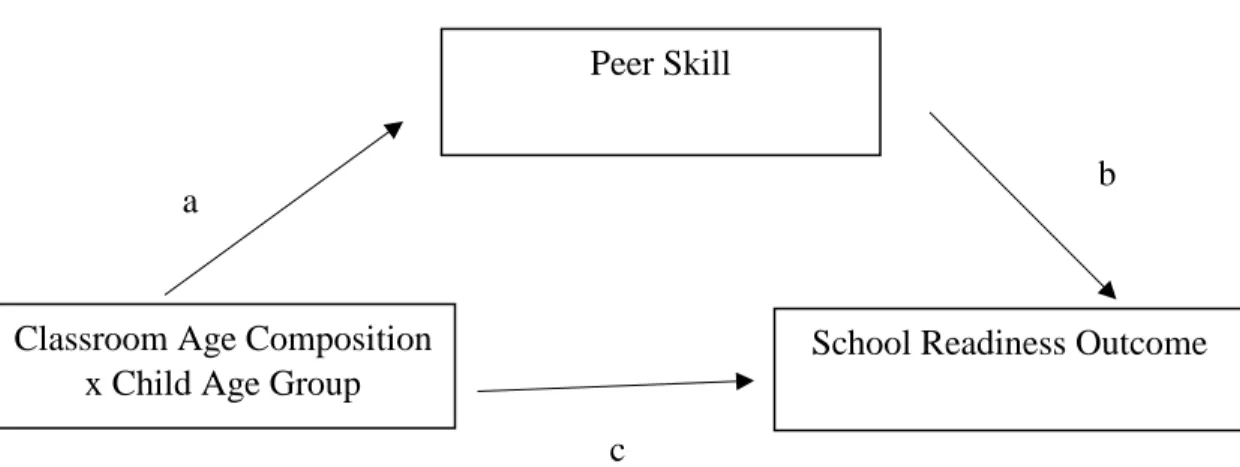
Model 3.Thefinal set of models address the hypothesis that peer skill will partially
mediate the interaction between child age group and classroom age composition based on methods described by Preacher and Hayes (2004). The test of the direct effect (path c) between
the interaction and the school readiness outcomes is performed in Model 1. The next step is to test the relationship between the interaction and each of the peer skill mediators (path a). Finally, the relationship between the peer skill mediators and the school readiness outcomes is tested
(path b; see Figure 1). This allows for an examination of the indirect effect of the peer skill mediators.
Figure 1. Mediated moderation model. Classroom Age Composition
x Child Age Group
Peer Skill
School Readiness Outcome
a b
23
To test path a or the relationship between the classroom age composition by child age
group interaction and the peer skill mediators, a model is run that includes all of the Level 1 and Level 2 variables and the interaction between classroom age composition and child age group
from the first set of models. The model is run once with peer language skill as the outcome and once with peer behavior skill as the outcome.
The Reduced Form equation is:
Reduced-Form: Mij = δ 00 + δ 10AgeGroupij + δ 01MixedAgej + δ 20Genderij + δ 30Raceij +
δ40Languageij + δ 50Disabilityij + δ 60InitialScoreij + δ 70Depressij + δ 80Educationij + δ
90Maritalij + δ100FoodInsecurityij + δ 02Sitej + δ 03Instructionalj + δ 04Organizationalj + δ
05Emotionalj + δ11MixedAgej*AgeGroupij+ u0j+ rij
Where Mij is the peer skill mediator being examined and δ 11 represents the coefficient thatwill be used in the tests of mediated moderation for path a relating the interaction to the peer skill
mediators.
To test path b, the relationship between both peer behavior and peer language skill and
the outcomes of interest is tested. This part of the mediated moderation model includes all of the Level 1 and Level 2 variables from the models designed to test the first hypothesis. The only
variables that are excluded are classroom age composition, child age group, and the interaction between these two variables as this is a test of the indirect effect of peer skill on the outcomes of interest.
The Reduced Form equation is:
24
γ40Raceij + γ50Languageij + γ60Disabilityij + γ70InitialScoreij + γ80Depressij +
γ90Educationij + γ100Maritalij + γ110FoodInsecurityij + γ01Sitej + γ02Instructionalj +
γ03Organizationalj + γ04Emotionalj + u0j+ rij
Where Yij is the school readiness outcome of interest and γ10 and γ20 represent the coefficients that
will be used in the tests of mediated moderation for path b relating each of the peer skill variables to the school readiness outcomes.
Separate tests of mediated moderation are run for peer language skill and peer behavior
skill. For each test, the parameter estimate for the interaction from the test of path a and the parameter estimate for peer skill from the test of path b are used to test for partial mediation. The
Sobel test is performed using the formula:
a*b SE(a*b)
Where SE stands for the standard error. The resulting value is used to determine whether significant partial mediation is present for either peer language skill or peer behavior skill.
This final set of models allows for an examination of the third hypothesis that peer skill
partially mediates the relationship between the classroom age composition by child age group interaction and the school readiness outcomes. For this hypothesis to be supported, it would first
need to be found that the direct effect of the interaction predicting child outcomes is at least marginally significant. This is to prevent an examination of indirect effects in the absence of a direct effect. It would then need to be found that peer language skill, peer behavior skill, or both
significantly partially mediate the relationship between the interaction and the outcomes of interest. Stemming from previous expected findings for the relationship between the interaction
25
anticipated finding that younger children will have better outcomes in mixed age classrooms
because their peers will be more skilled on average than if they were in same age classrooms. On the other hand, older children will have better outcomes in same age classrooms than in mixed
age classrooms partially because their peers will be more skilled on average in same age classrooms than in mixed age classrooms.
Multiple imputation. To account for missing data, forty datasets are imputed using the Markov chain Monte Carlo method and Rubin’s approach (Rubin, 1987; Schafer, 1997). Rubin’s approach is an iterative process where each variable with missing data is regressed on all others,
missing values are imputed, and variance parameters are estimated. The process is continued until the convergence criteria are met. The imputations include all of the predictors of interest,
the control variables, and the outcome variables. With the 40 complete data sets, the analyses to address the research questions of interest are performed resulting in 40 sets of parameter
estimates and standard errors for each model that was run. A single set of final results for each
26
CHAPTER 3: RESULTS
Descriptive Statistics
Descriptive statistics for the outcome variables of interest are included in Table 2.
Correlational analyses were also performed to examine the relationship between the predictors of interest and the outcomes (see Table 3). Being in a mixed age classroom showed very small
associations with better child outcomes. Being an older child showed small associations with lower language outcomes and better behavior and self-control outcomes. Higher average peer language skill showed small to moderate positive associations with language outcomes. On the
other hand, higher average peer language skill showed very small associations with more behavior problems and lower self-control. Finally, higher average peer behavior problems
showed small positive associations with child language outcomes and a moderate association with more individual child behavior problems and lower self-control.
Table 3
Correlations among Main Predictors and School Readiness Outcomes Mixed
Age
Age Group
Average Peer Language
Average Peer Behavior PLS Auditory Comprehension .03 -.11*** .14*** .08*** PLS Expressive Communication .05 -.09*** .11*** .02
PPVT .03** -.02 .32*** 0.07***
DECA Behavior Problems -.03** -.11*** .01 .44*** DECA Self-Control .02 .14*** -.03** -.26***
27 Model 1
In the first set of models, the primary variable of interest is the interaction between classroom age composition and child age group (younger versus older). As shown in Table 4,
classroom age composition was not found to significantly predict any of the examined child outcomes (p > .05). On the other hand, age group significantly related to all of the language
outcomes. Older children scored significantly lower on auditory comprehension (B = -.92, SE = .43, p = .04) and expressive communication (B = -1.24, SE = .53, p = .02) but significantly higher on receptive vocabulary (B = 1.39, SE = .26, p < .001) relative to children their age as
compared to the younger children. Looking at the social outcomes, older children had
significantly fewer behavior problems (B = -.94, SE = .23, p < .001) and higher self-control (B =
1.47, SE = .23, p < .001) relative to children their age as compared to younger children. Looking at the interaction between classroom age composition and child age group for the language outcomes, the interaction was not found to be significant for auditory
comprehension (B = .24, SE = .73, p = .74), expressive communication (B = -.25, SE = .96, p = .79), or receptive vocabulary (B = -.28, SE = .54, p = .61). Similarly, the interaction was not
found to be significant for either the behavior problems (B = -.42, SE = .48, p = .39)or self-control outcomes (B = -.12, SE = .48, p = .81). Thus, the first hypothesis that younger children will have better outcomes in mixed age classrooms and older children will have better outcomes
in same age classrooms was not supported by the first set of models. No evidence was found to suggest that the effect of being in a mixed age classroom differs for older and younger children.
Model 2
28
Table 5). Looking at the language outcomes, peer language skill significantly predicted
children’s auditory comprehension (B = .05, SE = .03, p =.04), expressive communication (B =
.15, SE = .04, p < .001), and receptive vocabulary (B = .16, SE = .02, p < .001). Having peers
with higher average language skills related to higher language skills for individual children. Peer behavior skill did not significantly predict any of the language outcomes.
Looking at the social outcomes, peer behavior skill significantly predicted both behavior problems (B = .85, SE = .03, p < .001) and self-control (B = -.47, SE = .04, p < .001). Being in a classroom with peers who exhibited more behavior problems related to more behavior problems
and lower self-control for individual children. Furthermore, peer language skill significantly predicted behavior problems (B = .04, SE = .02, p = .01) and self-control (B = -.05, SE = .02, p =
.005). Being in a classroom with peers with greater language skills related to more behavior problems and lower self-control for individual children. Overall, the hypothesis that higher peer language and peer behavior skills will relate to better school readiness outcomes for children was
partially supported by the data. Model 3
The final set of models was intended to examine whether peer language and peer
behavior skill acted as mediators in the relationship between the classroom age composition and child age group interaction and the child outcomes. It was determined that Sobel tests would only
be run to test for mediation if the interaction was found to be at least marginally significant in Model 1 (p < .10) to avoid examining indirect effects in the absence of direct effects. As none of
29
Table 4
HLM Outcomes for Model 1
Note: +p<.10, * p<.05, ** p<.01, *** p<.001; PLS = Preschool Language Scale; AC = Auditory Comprehension; EC = Expressive Communication; PPVT = Peabody Picture Vocabulary Test; DECA = Devereux Early Childhood Assessment; CLASS = Classroom Assessment Scoring System; IS = Instructional Support; OS = Organizational Support; ES = Emotional Support; model also included site as a covariate, which is not shown in the table.
School Readiness Outcomes
PLS: AC PLS: EC PPVT DECA Behavior
DECA Self-Control
B(SE) B(SE) B(SE) B(SE) B(SE)
Intercept 93.15***(.21) 90.80***(0.33) 92.17***(0.14) 50.92***(.20) 50.33***(.19) Mixed Age 0.85+(.51) 0.23(0.71) 0.69+(0.40) 0.22(0.36) -0.05(0.35) Age Group -.92*(.43) -1.24*(0.53) 1.39***(0.26) -0.94***(0.23) 1.47***(0.23) Mixed Age*Age
Group
.24(.73)
-0.25(0.96) -0.28(0.54) -0.42(0.48) -0.12(0.48)
PLS Version 7.67(4.59) 17.44*(6.65) - - -
30
Table 5
HLM Outcomes for Model 2
Note: +p<.10, * p<.05, ** p<.01, *** p<.001; PLS = Preschool Language Scale; AC = Auditory Comprehension; EC = Expressive Communication; PPVT = Peabody Picture Vocabulary Test; DECA = Devereux Early Childhood Assessment; CLASS = Classroom Assessment Scoring System; IS = Instructional Support; OS = Organizational Support; ES = Emotional Support; model also included site as a covariate, which is not shown in the table.
School Readiness Outcomes
PLS: AC PLS: EC PPVT DECA Behavior DECA Self-Control
B(SE) B(SE) B(SE) B(SE) B(SE)
Intercept 93.15***(.21) 90.78***(0.32) 92.15***(0.12) 50.85***(.11) 50.34***(.17) Mixed Age 0.85(.51) 0.23(0.70) 0.72+(0.39) -0.05(0.32) 0.13(0.35) Age Group -1.16*(.45) -1.86**(0.56) 0.70*(0.27) -1.11***(0.22) 1.62***(0.24) Mixed Age*Age
Group
.71(.77)
0.92(0.96) 1.06+(0.55) -0.06(0.45) -0.46(0.49) Peer Language 0.05*(.03) 0.15***(0.04) 0.16***(0.02) 0.04*(0.02) -0.05**(0.02) Peer Behavior 0.04(.06) 0.13+(0.08) -0.01(0.04) 0.85***(0.03) -0.47***(0.04)
PLS Version 7.67(4.60) 17.38*(6.65) - - -
Pre-Test Score 0.69***(.05) 0.34***(0.04) 0.67***(0.01) 0.51***(0.01) 0.53***(0.01) Child Disability -3.34***(.79) -7.92***(0.85) -2.28***(0.39) 1.73***(0.31) -2.12***(0.32) Gender -1.94***(.37) -2.77***(0.48) -0.55*(0.24) 1.98***(0.20) -1.59***(0.20) Black .46(.65) -0.24(0.98) -1.79***(0.44) 0.28(0.35) 0.03(0.37) Hispanic 1.95+(1.00) 1.30(1.65) -1.90***(0.49) -0.53(0.40) 0.69+(0.41) Primary
Language
-.38(.96)
1.23(1.14) 1.54***(0.42) 0.68*(0.33) -0.74*(0.34) Caregiver
Depression
10.07***(1.92)
16.37***(1.52) -0.58**(0.22) 0.34+(0.18) -0.21(0.18) Caregiver
Education
2.30***(.56)
31
CHAPTER 4: DISCUSSION
Overview of Findings
The present study examined the influence of classroom age composition on language and
social school readiness outcomes for both older and younger children in a low-income sample. Furthermore, the study aimed to expand the classroom age composition literature by examining
average peer skill as a predictor of child outcomes and possible mediator of the relationship between the classroom age composition by child age group interaction and child outcomes.
One of the main findings was that classroom age composition did not appear to relate to
child outcomes for children overall. Although it was expected that older children would benefit more from a same age environment and younger children would benefit more from a mixed age
environment, this hypothesis was not supported in the present sample. This finding conflicts with some prior research and theory that has suggested that younger will benefit more from a mixed age environment than older children (Bailey et al., 1993; Urberg & Kaplan, 1986; Winsler et al.,
2002). On the other hand, this finding is consistent with other research that found no significant relationship between classroom age composition and academic and social outcomes (Ansari et
al., 2016; Bell et al., 2013).
The present study also extended beyond previous research on classroom age composition by considering peer effects. Although peer skills were not examined as potential mediators as the
interaction between classroom age composition and child age group was not found to
32
predictors. It was found that classroom average peer language and peer behavior skill predicted
individual child outcomes. This is in line with the peer effects framework, which suggests that children’s peers can have direct and indirect effects on their outcomes (Henry & Rickman, 2007;
Justice et al., 2014; Mashburn et al., 2009). Overall, these results further contribute to debate in the literature over the best preschool environment for young children.
Classroom Age Composition
The present study examined whether the effects of classroom age composition differed for older and younger children. Neither older nor younger children were found to benefit more
from a mixed age classroom environment as compared to a same age classroom environment. These findings relate back to the mixed evidence in the current literature on classroom age
composition. Some studies suggest that mixed age classrooms are beneficial for younger children but not older children (Bailey et al., 1993). On the other hand, consistent with the present results, some studies have found that mixed age classrooms did not have any beneficial or harmful
influences on either age group (Bell et al., 2013). The results of the present study suggest that a mixed age classroom may be an environment that does not differ from a same age classroom in
its appropriateness for developing preschoolers, at least when considering language, behavior, and self-control outcomes.
Researchers have noted that findings suggesting that classroom age composition does not
relate to child outcomes are surprising due to research that shows that peers are very influential on children’s classroom experiences (Bell et al., 2013; Bulotsky-Shearer, Dominguez, & Bell,
33
encountered in the classroom environment, but peer skill is not determined by age alone. For
example, a younger child in a preschool classroom may be more skilled than their older peer if they have a richer home learning environment and more opportunities to build their skills under
the guidance of a supportive adult. Thus, looking at classroom age composition alone is likely not enough to understand the role peers play in influencing individual child outcomes.
The Role of Peer Skill
The present study looked beyond classroom age composition alone by considering the effect of average peer language and peer behavior skill on child outcomes. It was found that peer
language and peer behavior skill significantly predicted language and social child outcomes. Children in a classroom with peers who had higher language skill on average were more likely to
have better auditory comprehension, expressive communication, and receptive vocabulary skills. On the other hand, higher peer language was also related to more behavior problems and lower self-control for individual children. Furthermore, being in a classroom with peers who had more
behavior problems related to more behavior problems and lower self-control for individual children. As explained by the peer effects framework, these findings may be due to either the
direct or indirect influences peer skill can have on child outcomes (Henry & Rickman, 2007; Justice et al., 2014; Mashburn et al., 2009). For example, a child may directly learn from a more skilled peer or may indirectly benefit from more skilled peers as a teacher may provide access to
more advanced learning materials that would have otherwise been unavailable if all of the children in the classroom were at a lower skill level.
34
they hear and much of the day is spent interacting with peers, which provides opportunities for children to learn from their peers’ language skills (Mashburn et al., 2009). A more difficult to
explain finding is the relationship between peer language skill and greater child behavior
problems and lower self-control. One possibility is that children who are around peers with more advanced language skills may display behavior problems and lower self-control if they lack the
language skills to engage and verbally problem-solve with their more linguistically advanced peers.
Less work has looked at the link between average peer behavior and the outcomes of
young children. The work that has been done suggests that average peer behavior can influence individual child outcomes (Neidell & Waldfogel, 2010; Thomas et al., 2011). Being exposed to
the problem behaviors of peers in the classroom may lead to individual children imitating these behaviors, which, in turn, may be reflected in more problem behaviors and lower self-control. However, peers with more problem behaviors may still use advanced language when they
interact with others in the classroom, which could help explain why a link was not found between peer behavior problems and individual child language outcomes.
Importantly, this study did not capture which peers a child was interacting with in the classroom. It is possible that being in a classroom with more skilled peers on average has a smaller benefit for a child if they primarily interact with children who are at a lower skill level.
In contrast, being in a classroom with less skilled peers on average may not negatively influence a child who tends to interact with peers who are at a higher skill level. Additional work is needed to consider whether a child’s primary peer group more strongly relates to their outcomes than the
35 Implications
The findings of the present study suggest that being in a mixed age classroom appears to neither benefit nor harm the examined language and social outcomes of a low-income sample of
children in Educare classrooms. These findings are consistent with some previous research (Ansari et al., 2016; Bell et al., 2013) and the practices of early childhood education programs,
such as Head Start, that commonly serve low-income children and often place children of
varying ages together into a single classroom (Moiduddin et al., 2012). Although no great benefit of mixed age classrooms was found in the present study, there was also no evidence to suggest
that mixed age classrooms should not be used for preschoolers.
However, although the age composition of classroom peers may not have been found to
relate to the examined outcomes, the results still suggest that is important to reach a better understanding of the role peers play in the preschool classroom and the influences they have on individual child development. Peer skill was found to relate to both language and social child
outcomes. If a child is placed in either a mixed or same age classroom with many peers who are at a lower skill level, the child’s own skill development may be negatively influenced. Due to the
influence peer skill appears to have on child outcomes, there is a need for preschool classrooms to focus on building the skills of children with lower skill levels while still providing the more skilled children with challenging experiences that will support the further development of their
own skills. Although classroom age composition did not play a role in the present study,
providing these experiences is still likely to be particularly challenging in mixed age classrooms
36
support the successful development of children who come to preschool with a wide range of
skills.
These findings also support the importance of peer-to-peer interaction in the preschool
setting. Considering language development specifically, there has been a recent push to emphasize teacher-managed instruction to support language development (DeBaryshe &
Gorecki, 2007; Justice, Chow, Capellini, Flanigan, & Colton, 2003). However, this should not be done at the expense of peer-to-peer interactions as research suggests that frequent peer-to-peer interactions are an important factor that contributes to children’s language development (Connor,
Morrison, & Slominski, 2006).
Based on the results of the present study, it may be beneficial to ensure that children who
are at a lower skill level have opportunities to interact with children who are more skilled on average. These more skilled peers may be able to pass on some of their skills to the less skilled children in the classroom through modeling or even direct teaching. At times, this may be
accomplished through mixed age groupings as on average the older children in the present sample were more skilled than their younger counterparts. However, it also important not to
assume skill based on age alone.
At the same time, always playing the role of teacher or model may not be most beneficial for the development of the more skilled children, suggesting the need to create specific
opportunities for these children to interact with the more highly skilled peers in the classroom. To ensure such peer interactions occur would require facilitation by a teacher or another adult in
the classroom. Children at this age often need support for successful peer interactions as the preschool classroom is many children’s first opportunity to learn how to navigate the peer
37
influence and minimize negative peer influence through the strategic management of peer
interactions (DeLay et al., 2016). This again indicates that work is needed to develop training for teachers, so they can better understand how to best support the peer interactions of children who
are at varying skill levels. Limitations
One limitation of the present study is that the relationship between classroom age composition and children’s outcome trajectories was not examined as most of the children only
had data available at two time points. Some past work on mixed age classrooms has examined children’s outcome trajectories (Bailey et al., 1993; Bell et al., 2013), but more work is needed in
this area to explore whether mixed age classrooms have lasting influences on child outcomes.
Another limitation is that there were many school readiness variables that could not be examined as they were not collected for the present dataset. Past research has revealed many potentially important school readiness skills, such as math skills, literacy skills, and fine motor
skills (Grissmer et al., 2010; Pace, Alper, Burchinal, Golinkoff, & Hirsh-Pasek, 2018), that may relate to classroom age composition in ways that differ from the present study. Although no
difference was found between mixed age classrooms and same age classrooms for the language and social outcomes examined in the present sample, it is possible that mixed age classrooms are beneficial or harmful to other school readiness skills that were not examined. For example, being
in a mixed age classroom has been found to negatively influence the math and literacy outcomes of older preschool children, which were outcomes that were not examined in the present study
38
A final limitation is that the classrooms in the present study were generally of a higher
quality due to the nature of Educare schools. Classroom quality may play a role in the
relationship between classroom age composition and child outcomes. Lower quality classrooms
may not be equipped to properly handle the needs of two developmentally different age groups leading to poorer child outcomes. Future research could examine classroom quality as a
moderator in the relationship between classroom age composition and child outcomes. Conclusion
Overall, the results of the present study suggest that classroom age composition did not
relate to the examined language and social outcomes for either younger or older children in a large sample from Educare schools. This finding can be viewed as positive given that both mixed
age and same age preschool classrooms are in widespread use. However, peers did appear to have an effect on child outcomes through their average level of skill. This suggests that it is important for preschoolers to have peer-to-peer contact and to specifically have opportunities for
interactions with more skilled peers. Additional work is needed to further current understanding of the role of peer skill in the preschool classroom and how teachers can best support peer
39
REFERENCES
Ansari, A., Purtell, K., & Gershoff, E. (2016). Classroom age composition and the school readiness of 3- and 4-year-olds in the Head Start program. Psychological Science, 27, 53-63.
Atkins-Burnett, S., Xue, Y., & Aikens, N. (2017). Peer effects on children’s expressive vocabulary development using conceptual scoring in linguistically diverse preschools. Early Education and Development, 28, 901-920.
Bailey, D. B., Burchinal, M. R., & McWilliam, R. A. (1993). Age of peers and early childhood development. Child Development, 64, 848-862.
Bandura, A. (1986). Social foundations of thought and action. Englewood Cliffs, NJ: Prentice Hall.
Bell, E. R., Greenfield, D. B., & Bulotsky-Shearer, R. J. (2013). Classroom age composition and rates of change in school readiness for children enrolled in Head Start. Early Childhood Research Quarterly, 28, 1-10.
Bulotsky-Shearer, R. J., Domínguez, X., & Bell, E. R. (2012). Preschool classroom behavioral context and school readiness outcomes for low-income children: A multilevel
examination of child and classroom level influences. Journal of Educational Psychology, 104, 421–438.
Connor, C. M., Morrison, F. J., & Slominski, L. (2006). Preschool instruction and children's emergent literacy growth. Journal of Educational Psychology, 98, 665-689.
Coolahan, K. C., Fantuzzo, J., Mendez, J., & McDermott, P. (2000). Preschool peer interactions and readiness to learn: Relationships between classroom peer play and learning behaviors and conduct. Journal of Educational Psychology, 92, 458-465.
DeBaryshe, B. D., & Gorecki, D. M. (2007). An experimental validation of a preschool emergent literacy curriculum. Early Education and Development, 18, 93-110.
DeLay, D., Hanish, L. D., Martin, C. L., & Fabes, R. A. (2016). Peer effects on Head Start children’s preschool competency. Developmental Psychology, 52, 58-70.
Derscheid, L. E. (1997). Mixed-age grouped preschoolers’ moral behavior and understanding. Journal of Research in Childhood Education, 11, 147-151.
Dunn, L. M., & Dunn, D. M. (2007). The Peabody Picture Vocabulary Test, Fourth Edition. Bloomington, MN: Pearson.