Intergenerational continuity in high conflict family environments
W. Andrew Rothenberg, M.A.1, Andrea M. Hussong, Ph.D.1, and Laurie Chassin, Ph.D.2
1The University of North Carolina at Chapel Hill
2Arizona State University
Abstract
In the current study, we examined continuity in conflict across generations and explored potential mediators and moderators that could explain this continuity. We followed 246 targets from adolescence to adulthood and examined family conflict as reported by multiple reporters in targets' family of origin and current families. Results showed that conflict in the current family was strongly correlated with that of the family of origin in women but not in men. Continuity in family conflict across generations was mediated by patterns of elevated adolescent externalizing behavior in members of the second generation (G2). Additionally, analyses revealed an interaction between both G2 partners' externalizing behavior such that if one partner in the G2 family demonstrated high levels of externalizing behavior, elevated levels of family conflict resulted. Potential explanations and implications of these findings are considered.
Keywords
family conflict; intergenerational; externalizing behavior; assortative mating; gender differences
Although family conflict is associated with the development and persistence of numerous maladaptive behaviors (Dishion & Patterson, 2006; Pelton & Forehand, 2001), less is known about how family environments relate to the persistence of maladaptive behavior across generations (Silberg, Maes, & Eaves, 2012). Some aspects of the family environment, such as harsh parent-child dyadic interactions, show significant continuity across generations (Belsky & Jaffee, 2006; Hops, Davis, Leve, & Sheeber, 2003; Neppl, Conger, Scaramella & Ontai, 2009; Thornberry, Freeman-Gallant, Lizotte, Krohn, & Smith, 2003). Additionally, continuities in harsh parenting may be linked to cross-generational continuities in
externalizing behavior, though findings are mixed (Bailey, Hill, Oesterle, & Hawkins, 2009; Capaldi, Pears, Patterson, & Owen, 2003; Conger, Neppl, Kim, & Scaramella, 2003; Hops et al., 2003; Silberg et al., 2012; Thornberry et al., 2003). Little is known about how these findings generalize to indicators of the larger family environment beyond the dyad. In the current study, we used a multigenerational study of high risk families and matched controls to evaluate cross-generational continuities in a broad indicator of family functioning, namely family conflict, as reported by multiple family members across generations. In addition, we
Corresponding Author: W. Andrew Rothenberg, Department of Psychology, 235 E. Cameron Avenue, CB#3270 Davie Hall,
UNC-HHS Public Access
Author manuscript
Dev Psychopathol
. Author manuscript; available in PMC 2017 February 01.Published in final edited form as:
Dev Psychopathol. 2016 February ; 28(1): 293–308. doi:10.1017/S0954579415000450.
A
uthor Man
uscr
ipt
A
uthor Man
uscr
ipt
A
uthor Man
uscr
ipt
A
uthor Man
uscr
assessed whether externalizing behaviors mediate cross-generational consistencies in family conflict and what factors may make these consistencies more likely to occur.
Defining Family Conflict
Though family conflict is a frequently investigated construct, no definitive definition of family conflict exists. Common to many definitions of family conflict is a focus on physical and verbal aggression, frequent criticism and displays of anger, and recurring arguments that occur across multiple relationships in the family (Choe, Stoddard & Zimmerman, 2014; Cummings & Schatz, 2012; Fosco, Caruthers, & Dishion, 2012; Van Ryzin & Dishion, 2012). Family theorists suggest that conflicts between parents, between parents and children, and between siblings synergistically interact to create the overall climate of the family environment (Cummings & Davies, 2010; Cummings & Schatz, 2012). Accordingly, family conflict cannot be inferred from assessments of individual dyads only but must also be assessed as a broader, family-level construct (Cummings & Schatz, 2012; Emery, 1993). The present investigation defines family conflict as the experiencing of physical or verbal aggression, criticism, anger, or arguments within the overall family climate, and utilizes measures of family conflict which align with this definition.
Additionally, developmental researchers suggest that intergenerational continuities in family environment are best captured when families in successive generations are studied at similar points in development (Conger, Belsky & Capaldi, 2009; Kovan, Chung & Sroufe, 2009; Van IJzendoorn, 1992) because patterns of family interaction are most similar at these points. Thus, the present investigation will examine conflict in families in successive generations with adolescent children, as opposed to conflict in families with dissimilar structures (e.g. studying families with adolescents in one generation and families with no children in the next generation).
Mechanisms Underlying Cross-generational Continuities in Family Conflict
According to Social Interactional Theory (SIT), children's behavior is shaped by the quality of their interactions with specific environments, including the family environment (Dishion & Patterson, 2006; Scaramella, Conger, Spoth, & Simons, 2002). Theorists have utilized SIT to posit that a high conflict family environment will promote harsh, coercive parent-child interactions (Dishion & Patterson, 2006; Patterson, 1982; Patterson, Reid & Dishion, 1992; Scaramella et al., 2002). Through these coercive interactions children learn to employ externalizing behavior as an effective strategy that can be used to obtain goals, avoid parental demands, and gain control in a hostile family environment (Dishion & Patterson, 2006; Patterson, 1982). Children may generalize this pattern of externalizing behavior to shape their interactions in other social environments when it is effective in attaining other social goals (e.g., avoiding authority figure demands, associating with other deviant peers, etc.; Dishion & Patterson, 2006; Scaramella et. al, 2002). SIT predicts that once children learn externalizing behavior through coercive parent-child interactions and extend that behavior to the larger social context, externalizing behavior is likely to endure into adulthood.
A
uthor Man
uscr
ipt
A
uthor Man
uscr
ipt
A
uthor Man
uscr
ipt
A
uthor Man
uscr
Recently, investigators have extended the SIT model to explain how aspects of maladaptive family environments are passed from one generation (i.e., families including generation 1, or G1 parents and their G2 children) to the next (families including grown G2 children who are now parents and their G3 children; Capaldi, Pears, Kerr, & Owen, 2008; Hops et. al, 2003). Specifically, they hypothesize that the same patterns of externalizing behavior that are learned by G2s as a strategy for goal attainment in social situations across childhood and adolescence are applied by G2s to attain their parenting goals as they form their own families (Bailey et. al, 2009; Brook, Lee, Finch, & Brown, 2012; Neppl et. al, 2009). Thus, SIT makes two predictions about cross-generation family processes: first, there is
intergenerational continuity in high conflict family environments; and second, this continuity is mediated by externalizing behavior in members of the second generation.
Although no studies have tested these predictions regarding high conflict in family
environments beyond the dyad, these predictions are tested in several literatures which index dyadic family conflict and similar constructs including those regarding harsh parenting, intimate partner violence, and child maltreatment. Longitudinal studies show significant prospective associations between G1 harsh parenting behavior and G2 harsh parenting behavior (r = .15 – .40 across studies; Bailey et. al, 2009; Capaldi et al., 2008; Capaldi et. al, 2003; Conger et al., 2003; Conger, Schofield, & Neppl, 2012; Neppl et al., 2009; Scaramella & Conger, 2003). Moreover, the association between G1 parenting practices and G2
parenting practices is robust across five (Conger et al., 2003; Hops et al., 2003) to fourteen year (Bailey et al., 2009) intervals separating G1 and G2 parenting assessments as well as across parent self-reports (Capaldi et al., 2008) and independent observations (Conger et. al, 2012; Hops et. al, 2003) of harsh parenting behavior. Similarly, longitudinal and meta-analytic studies demonstrate moderate, significant associations between G2 exposure to G1 intimate partner violence and subsequent G2 intimate partner violence perpetration in adulthood (Busby, Holman & Walker, 2008; Roberts, Gilman, Fitzmaurice, Decker & Koenen, 2010; Stith et al., 2000). In contrast, past reviews (e.g. Ertem, Leventhal & Dobbs, 2000) have noted that continuity of child maltreatment from one generation to the next is questionable, largely because the retrospective methodologies most investigations used to establish continuity in child abuse from one generation to the next were unreliable and subject to reporter bias. However, more recent prospective longitudinal investigations (Thornberry & Henry, 2013) and meta-analytic reviews (Schofield, Lee & Merrick, 2013) find moderate, significant associations between G1 parents' maltreatment of G2s and subsequent G2s' maltreatment of their own G3 children. Overall, it appears that dyadic family conflict and other similar constructs show at least moderate intergenerational continuity.
Somewhat less consistent is evidence regarding the mediating role of externalizing behavior in these cross-generation continuities in dyadic family conflict. Externalizing behavior in young adult G2s appears to mediate observed intergenerational continuities in G1–G2 harsh parenting behaviors (Capaldi et al., 2008; Conger et al., 2009; Neppl et al., 2009; Smith & Farrington, 2004). However, evidence is less consistent for externalizing behavior in adolescent G2s (Conger et al., 2009) with some studies supporting the mediational role of G2 adolescent externalizing behavior in G1–G2 harsh parenting behaviors (Capaldi et al., 2003; Hops et al., 2003) and others finding no support (Bailey et al., 2009; Conger et al.,
A
uthor Man
uscr
ipt
A
uthor Man
uscr
ipt
A
uthor Man
uscr
ipt
A
uthor Man
uscr
2003; Kerr, Capaldi, Pears, & Owen, 2009). We found only two longitudinal investigations that prospectively examined adolescent externalizing behavior as a mediator of continuities in intimate partner violence across generation. One study found G2 externalizing behavior at age 16, along with G2 life stress at age 23, to be part of a mediating pathway between G2 childhood externalizing behavior and G2 perpetration of dating violence in adulthood (Narayan, Englund, & Egeland, 2013). The second study did not find evidence that G2 conduct disorder diagnosis in adolescence mediated the association between intimate partner violence in G2 childhood and G2 perpetration of, or victimization from, intimate partner violence in adulthood, but did find significant unique effects of G2 conduct disorder diagnosis in adolescence on G2 adult intimate partner violence perpetration and
victimization (Ehrensaft et al., 2003). Moreover, though there is evidence that adolescent maltreatment predicts subsequent delinquency and violence (Stewart, Livingston & Dennison, 2008), we found no investigations that have examined G2 externalizing behavior as a mediator of cross-generational continuities in child maltreatment. Taken together, these studies suggest that evidence for G2 adolescent externalizing behavior as a mediator of cross-generational continuities in family processes is mixed, and in some domains, largely unstudied.
Although the dyadic family conflict literature provides an exciting test of SIT as a way of understanding cross-generation continuities in high conflict family environments, it is limited in three significant ways. Perhaps most important is its narrow conceptualization of the family environment. Dyadic parenting behaviors are only one component of the larger family environment which impacts child outcomes (Patterson, 1998). Conflict between parenting partners (Cummings & Schatz, 2012), between parents and children (Lam, Solmeyer, & McHale, 2012), and between siblings (Campione-Barr, Greer, & Kruse, 2013) each interact with one another to inform the development of high conflict family
environments (Cummings & Davies, 2010; Lam et al., 2012). Measures of dyadic behaviors are unable to account for how the behaviors of multiple family members interact to influence intergenerational continuities in high conflict family environments. Moreover, measures of dyadic conflict are unable to take into account how such conflict is observed and
experienced by other family members, even if they are not part of the conflictual dyad. To address these issues, studies are needed that consider family-level, rather than dyadic-level, conflict within the family environment (Emery, 1993).
In addition, many intergenerational studies rely on single reporters of the family
environment (though see Capaldi et al., 2008 and Kerr et al., 2009 for exceptions). Reliance on single reporter indices can introduce bias (i.e., underreporting socially undesirable behaviors) and limit construct validity (i.e., present patterns of family functioning from only one perspective).
Furthermore, many studies testing externalizing behavior as a mediator of intergenerational continuity in dyadic family conflict do not effectively account for issues of temporal precedence. For example, many investigations measure G1 harsh parenting behavior and G2 externalizing behavior at the same time point, making it impossible to delineate whether G1 harsh parenting practices lead to increases in G2 externalizing behavior or vice-versa. Determining the most appropriate timing for assessing G2 externalizing behavior as a
A
uthor Man
uscr
ipt
A
uthor Man
uscr
ipt
A
uthor Man
uscr
ipt
A
uthor Man
uscr
mediator is also challenging, particularly because most studies do not measure externalizing behavior repeatedly across time. Conger and colleagues (2009) compared results from several prospective longitudinal investigations on intergenerational continuity in parenting behavior and concluded that G2 externalizing behaviors mediated the association between G1 and G2 maladaptive parenting only when they extended into early adulthood. However, no investigations have simultaneously measured the unique mediating effects of G2 adolescent and G2 young adult externalizing behavior on continuity in family-wide, as opposed to dyadic, conflict. Testing this hypothesis could build on existing work by identifying the salience of these mediating externalizing processes during different developmental periods.
To address these limitations, we tested whether high conflict family environments
demonstrate continuity across generations when assessed with multiple reporters of family environment within each generation. We also used repeated measures of externalizing behavior to test whether adolescent or young adult externalizing behavior mediates intergenerational continuities in family environments.
The Influence of Partners
The level of externalizing behavior of a G2's partner may also underlie continuities in high conflict family environments (Capaldi et al., 2008; Conger et al., 2012; Patterson, 1998; Rutter, 1998). If a G2 and their partner both exhibit high levels of externalizing behavior then the coercive interactions among the two partners are likely to be volatile and damaging, with negative effects for children and the G2–G3 family environment (Humbad, Donnellan, Iacono & Burt, 2010). As a result, G2–G3 high conflict family environments may represent continuity over time from both the G1–G2 and G1–G2-partner family histories.
The increased likelihood that G2s who engage in greater externalizing behavior will select a partner high in externalizing behavior is consistent with studies on "assortative mating" (Burt & Klump, 2012; Krueger, Moffitt, Caspi, Bleske, & Silva, 1998; Rhule-Louie & McMahon, 2007). G2 externalizing behavior may be more strongly associated with G2–G3 family conflict when the G2's partner has elevated externalizing behavior, and due to assortative mating this may be a more common occurrence for G2s with greater externalizing behavior. This moderation hypothesis has never been directly tested in the literature, though studies show that one parenting partner's history of externalizing behavior (Capaldi et al., 2008) or harsh parenting (Conger et al., 2012) predicts less supportive, harsher parenting behavior from the other partner. To address this issue, we tested whether G2-partners' externalizing behavior moderates the association between G2s' externalizing behavior and conflict in the G2–G3 family environment.
The influence of G2 Gender
Whether continuities in family environment across generations are more likely to occur for women or men is still unclear (Conger et al., 2009). Longitudinal investigations show that persistence of warm, sensitive parenting (Belsky, Jaffee, Silgo, Woodward, & Silva, 2005; Thornberry et. al, 2003), and parental discipline (Thornberry et. al, 2003) from G1–G2 to
A
uthor Man
uscr
ipt
A
uthor Man
uscr
ipt
A
uthor Man
uscr
ipt
A
uthor Man
uscr
G2–G3 homes occurred for G2 mothers but not fathers. However, these studies largely relied on G1 maternal reports of parenting behavior which may account for stronger effects for women (Belsky et al., 2005) and no studies have addressed this question with a focus on the broader family environment. Other studies have found no moderating effect for G2’s gender on continuities in harsh parenting (Neppl et. al, 2009) or parenting quality (Shaffer, Burt, Obradovic, Herbers, & Masten, 2009). The current study adds to this literature by testing whether G2s' gender moderates the intergenerational continuity of high conflict family environments.
The Current Study
The current study is the first to prospectively examine intergenerational continuities in the broader construct of family conflict (as opposed to dyadic conflict) using multiple reporters of family environment, incorporating repeated assessments of G2s' externalizing behavior spanning adolescence to adulthood, and taking into account potential moderators of this association. Specifically, as depicted in Figure 1, we tested three hypotheses using a longitudinal study assessing children of alcoholic parents and matched controls over a twenty year period. This high risk data set is advantageous for the current hypotheses given that patterns of high externalizing behavior in G2s and G2-partners may be more prevalent. Our hypotheses were as follows: (1) high conflict family environments will show moderate but significant levels of continuity across generations, (2) externalizing behavior measured in G2 adolescence and young adulthood will mediate continuity in family conflict across generations and (3) greater externalizing behavior in G2 partners will be associated with a stronger association between G2s externalizing behavior and high conflict G2–G3 family environments. We also explored the possible moderating effects of G2 gender on the association between G1–G2 and G2–G3 family environment. Given previous conflicting findings, we could not justify making this hypothesis directional.
Methods
Data from the Adolescent & Family Development Project (AFDP; Chassin, Pitts, DeLucia, & Todd, 1999; Chassin, Rogosch, & Barrera, 1991) were used for this study. AFDP is an ongoing longitudinal study of children of alcoholic parents (COAs) and matched controls assessed from adolescence into adulthood. AFDP uses a multi-generational design involving assessments of parents (G1s), target adolescents who were followed over time (G2s), and the children of these targets (G3s). AFDP presently consists of 6 waves of data collected annually for waves 1 through 3 (where data were collected on G1s and G2s) and then at 5 year-intervals through wave 6 (where data were collected on G2s, G2 partners, and eventually G3s).
Participants
At wave 1, the AFDP sample consisted of 246 adolescents with at least one alcoholic parent and 208 matched adolescents with no biological or custodial alcoholic parent (Chassin et al., 1999) for a total of 454 G2 adolescents and their parents in G1–G2 families. COA families were recruited using court arrest records for driving under the influence, health maintenance organization wellness questionnaires and community telephone screenings (see Chassin et.
A
uthor Man
uscr
ipt
A
uthor Man
uscr
ipt
A
uthor Man
uscr
ipt
A
uthor Man
uscr
al, 1999; Chassin et al., 1991). COA families had to meet the following criteria: parents reported being either Hispanic or non-Hispanic Caucasian, Arizona residency, a child aged 10.5–15.5 years at wave 1, English-speaking, and parents and children with no cognitive limitations that would preclude interview. Further, direct interview data had to confirm that at least one parent met Diagnostic and Statistical Manual for Mental Disorders, third edition (DSM-III) criteria for alcohol abuse or dependence.
When a COA family was identified, reverse directories were used to locate families living in the same neighborhood and matched controls were recruited from this match. Controls were screened to match COA participants in ethnicity, family structure, target child's age and gender, and socioeconomic status. Direct parent interview data were used to confirm that neither biological nor custodial parents of controls met DSM-III criteria. Attrition biases are minimal as 409 of the original 454 families were retained at wave 6 (90.1% of original sample).
To be included in the current analysis, G2's needed to have at least one child by wave 6 (n=273 of 409 interviewed at wave 6) and complete data on the family conflict measure at wave 6 (n=246 of 273 G2s with children, with 27 having missing data because they
contacted their child less than once a week). The decision was made to drop families without children from study analysis because we desired to investigate conflict in families at similar stages of development, in line with theory and existing work (e.g., Conger et al., 2009; Kovan et al., 2009). However, families without children did not differ from included families on levels of family conflict reported by G1 mothers (t(323) = −0.60, p = 0.55), G1 fathers (t(392) = −1.07, p = 0.29), or G2 targets (t(408) = 1.61, p = 0.11). Additionally, attrition analyses showed that the 27 G2 parents who were dropped from the sample because they contacted their child less than once a week did not significantly differ from the 246 retained G2s on mother-reported G1–G2 family conflict (t(257) = 1.75, p = 0.08), father-reported G1–G2 family conflict (t(209) = 1.14, p = 0.25) or externalizing behavior at wave 3 (t(267) = 1.50, p = 0.13), wave 4 (t(244) = 0.64, p = 0.52), or wave 5 (t(250) = −0.24, p = 0.81).
Missing data among the remaining 246 G2–G3 families was addressed using full information maximum likelihood procedures (see missing data) such that all 246 G2–G3 families were retained in analyses of hypotheses 1, 2 and 4. G2–G3 families ranged in size from 1 to 4 children (M=1.75 children). Indicators of family environment were based on G2 reports and on available G2 partner and G3 reporters who were present at the time of the G2 interview. Of these 246 G2s, a subsample of 102 G2s whose parenting partners also
provided self-reports of externalizing behavior and family conflict at wave 6 was used to evaluate hypothesis 3. This subsample did not significantly differ from the full sample of 246 G2–G3 families on any study variables except G2 age at wave 6 (t(244) = −5.48, p < . 01). G2s in this subsample (M = 32.5 years, SD = 1.70) were significantly older than G2s in the full sample (M = 31.8 years, SD = 1.76). Demographic characteristics for G2s, G2 partners, and G3s can be found in Table 1.
Procedure
At each wave, data were primarily collected via in-person computer-assisted interviews (Chassin et al., 1999). Family members were typically interviewed simultaneously and in
A
uthor Man
uscr
ipt
A
uthor Man
uscr
ipt
A
uthor Man
uscr
ipt
A
uthor Man
uscr
separate rooms to avoid contamination and to increase privacy. In waves 1–3 of data collection, at least one biological and custodial G1 caregiver, and one G2 adolescent age 10 to 15 completed interviews. In wave 6 of data collection, only G2 targets were required to complete interviews. However, G2 partners and any G3s who were 7 years old or older were also invited to complete interviews if they were available at the time the G2 was interviewed. Interviews typically lasted from 1 to 3 hours and participants were paid up to $70 per wave.
Measures
Control variables—We controlled for potential confounds in all analyses by including covariates for G2 age (wave 2), G2 ethnicity, G2 educational attainment and G1 antisocial behavior and alcoholism diagnoses. At wave 6, G2's and their partners reported their gender, ethnicity, and highest education level obtained, with education assessed using an 11-point scale ranging from 1=8th grade or less to 11=completed graduate/professional school. Socioeconomic status was indexed as the highest education level obtained by either parent in the G2–G3 family. Other studies using the AFDP data set have accounted for socioeconomic status by controlling for education level in similar ways (Chassin, Flora, & King, 2004; Hussong, Huang, Serrano, Curran, & Chassin, 2012). G1 mother and G1 father antisocial behavior and alcoholism were measured via self-reported lifetime DSM-III diagnoses of antisocial personality disorder and alcohol abuse or dependence. These diagnoses were obtained using a computerized version of the DIS interview (Version 3; Robins, Helzer, Croughan & Ratcliff, 1981; Robins, Helzer, Ratcliff, & Seyfried, 1982). Although all reports of antisocial personality disorder were based solely on self-report by mother or father, alcoholism diagnoses were based on self-report as well as spousal report for
non-participating parents using Research Diagnostic Criteria (FH-RDC; Andreasen, Endicott, & Spitzer, 1977). In current analyses, family-level diagnoses were dichotomized as either present (at least one G1 parent meet lifetime criteria) or absent (participating G1 parents did not meet lifetime criteria). Zero-order correlations among study variables including
demographic characteristics are presented in Table 2.
G2 and G2-partner externalizing behavior—G2 externalizing behavior was measured
at waves 3 (MG2Age = 15.33 years, SD = 1.42 years, Range: 12.55–18.01 years), 4 (MG2Age
= 20.54 years, SD = 1.33 years, Range: 17.48 – 23.61 years), and 5 (MG2Age = 25.96 years,
SD = 1.61 years, Range: 22.48 – 29.87 years) using the same 12 self-report items from the Aggression and Delinquent Behavior subscales of the Achenbach Childhood Behavior Checklist (CBCL; Achenbach & Edelbrock, 1981) at each wave of assessment. G2 partners completed these same items at wave 6. Participants rated how often an item was true for them within the past 3 months on a scale ranging from 1=almost always to 5=almost never.
A mean of items served as the indicator of externalizing behavior within each wave (α=.65
– .82 across waves for G2s and α=.80 for G2 partners).
Family conflict—Family conflict was measured using the 5-item family conflict subscale derived from Bloom's Family Processes Scale (Bloom, 1985). Participants rated the extent to which they agreed that a statement reflected their family life in the past 3 months using a five-point response scale ranging from 1=strongly agree to 5=strongly disagree. Items included "We fought a lot in our family", "Family members sometimes hit each other",
A
uthor Man
uscr
ipt
A
uthor Man
uscr
ipt
A
uthor Man
uscr
ipt
A
uthor Man
uscr
"Family members rarely criticized each other", "Family members hardly ever lost their tempers" and "Family members sometimes got so angry they threw things". Bloom found
the family conflict subscale to have adequate internal reliability in previous studies (α=.76 to
α=.85) and to demonstrate discriminate validity in distinguishing levels of family conflict
before and after marital disruptions (Bloom, 1985). In the present study, G1 mothers, G1 fathers, and early adolescent G2s (aged 12–16) completed the family conflict scale at wave 2 in reference to G1–G2 families. In wave 6, G2s, G2 partners, and all participating G3 children (aged 7–17) completed the family conflict subscale in reference to G2–G3 families. Items were reverse scored so that higher scores indicated higher family conflict. In the
present study, internal reliability estimates were as follows: wave 2 G1 father-reports (α=.
69), G1 mother-reports (α=.65) and G2 reports (α=.73); and wave 6 G2 reports (α=.70), G2
partner reports (α=.67), and G3 reports (α=.65).
Missing Data
The analysis sample consists of 246 target G2s, however there is modest to moderate missingness on key variables. Specifically, some G1–G2 families are missing mother reports (11 families) and father reports (56 families) of family conflict and some G2–G3 families are missing G2 partner reports (144 families) and G3 child reports (123 families) of family conflict. Missingness among G2 partner reports is due to the fact that some G2 partners declined to participate in the study. Missingness among G3 child reports is due to the fact that G3 children could not participate in study unless they were over the age of 7.
Additionally, the number of G2s who failed to report on their externalizing behavior in any particular wave ranged from 3 to 22. However, every G2 reported on externalizing behavior on at least one of waves 3, 4, and 5. Notably, G2–G3 families with versus without missing data did not significantly differ on G2–G3 family conflict (t (244) = −1.21, p = 0.23), G1– G2 family conflict (t (244) = −1.06, p = 0.29), or externalizing behavior at wave 3 (t(241) = −1.22, p = 0.22), wave 4 (t(222) = −1.83, p = 0.07), or wave 5 (t(227) = −1.48, p = 0.14). Because data appear to be missing at random, full information-maximum likelihood
procedures were used in Mplus to account for missing data in subsequent analyses following Kline (2005).
Data Analytic Strategies
Prior to conducting factor analysis to evaluate the measurement model of family conflict, we used parceling procedures to integrate reports of conflict in each generation. Family
members’ responses to the family conflict scale were averaged at the item level for both G1– G2 and G2–G3 families (i.e., G1 mother, G1 father, and G2 adolescent responses to item 1 of the family conflict subscale were averaged to create a single indicator of G1–G2 family conflict for item 1). This technique has been used to create latent factor indicators in other intergenerational longitudinal studies (e.g. Lohman, Neppl, Senia, & Schofield, 2013), and is appropriate for this investigation because analyses are focused on associations between latent constructs and because in each generation, every item loads onto the same, single factor (Williams & O'Boyle, 2008). This method provides a data reduction approach collapsing across the diverse perspectives offered by reporters while equaling weighting the perspective of each reporter. Sensitivity analyses conducted using alternative models in which just G1 mother, G1 father, or G2 adolescent reports of family conflict were used to
A
uthor Man
uscr
ipt
A
uthor Man
uscr
ipt
A
uthor Man
uscr
ipt
A
uthor Man
uscr
predict G1–G2 family conflict and just G2 target reports of family conflict were used to predict G2–G3 family conflict did not produce any substantive changes in results.
We then conducted maximum likelihood confirmatory factor analyses using Mplus Version 5.2 (Muthén & Muthén, 2007) to estimate latent variables representing underlying conflict in the family environment following Bollen and Bauldry (2011). Separate analyses for G1–G2 and G2–G3 families used the five family-averaged item indicators of conflict as depicted in Figure 2. Skewness and kurtosis estimates for all indicators fell in acceptable ranges (skew<2.0, kurtosis<3.0), suggesting no violation of the assumption of normally distributed indicators. Additionally, no problematic heteroscedasticity of residuals in indicators was observed. Evaluation of model fit was based upon recommended fit index cut-off values which indicate excellent model fit (CFI/TLI cut-off values > 0.95, RMSEA cut-off value < 0.05, SRMR cut-off value <.08; Schreiber, Stage, King, Nora, & Barlow, 2006). Path modeling was conducted within Mplus Version 5.2.
Results
Confirmatory Factor Models of Family Conflict
Initial model fit for G1–G2 family conflict was not acceptable (χ2 (5) = 26.84, p<.01, CFI =
0.93, TLI = 0.86, RMSEA = 0.13, SRMR = 0.05). Two correlated errors were added to the model based on modification indices (between item 3 and 7 which both involved acts of physical aggression and between items 5 and 9 which were both reverse scored), resulting in
significantly improved model fit (χ2 (2) = 22.73, p < .05). Fit indices showed that the revised
model fit the data well (χ2 (3) = 4.11, p = 0.25, CFI = 0.99, TLI = 0.988, RMSEA = 0.04,
SRMR =0.02), indicating that the model was appropriate to estimate a latent variable for G1–G2 family conflict.
Similarly, initial model fit for G2–G3 family conflict was not acceptable (χ2 (5) = 38.78, p<.
01, CFI = 0.89, TLI = 0.77, RMSEA = 0.17, SRMR = 0.06). The same correlated errors were added to the model as for G1–G2 family conflict, once again resulting in significantly
improved model fit (χ2 (2) = 36.53, p < .05). Fit indices showed that the model fit the data
well (χ2 (3) = 2.18, p = 0.53, CFI = 1.00, TLI = 1.00, RMSEA = 0.00, SRMR = 0.01),
indicating that the model was appropriate to estimate a latent variable for G2–G3 family conflict.
Intergenerational Continuity in Family Conflict
Before modeling intergenerational continuity, a descriptive analysis of continuity in conflict across generations was conducted. Families were categorized into above- or below-average conflict groups in each generation, and stability in these categories was investigated. Results indicated continuity in family conflict from one generation to the next. Among the 246 families, 72 families (29.2% of the sample) had above average family conflict scores as reported by at least one reporter in both G1–G2 and G2–G3 homes. 15 families (6.10% of the sample) had above average family conflict scores as reported by all reporters in each generation.
A
uthor Man
uscr
ipt
A
uthor Man
uscr
ipt
A
uthor Man
uscr
ipt
A
uthor Man
uscr
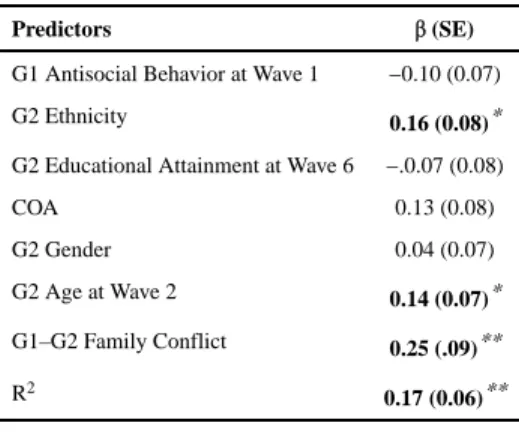
We then used path analysis estimated in Mplus Version 5.2 to test the hypothesis that high conflict family environments show moderate but significant continuity across generations. To test this model, the latent G2–G3 family conflict variable was regressed on the latent G1– G2 family conflict variable along with the following covariates: G1 parent antisocial
behavior, G2 educational attainment, G2 ethnicity, G2 COA status, G2 gender, and G2 age at wave 2. To control for across-time inter-item correlations in the family conflict measurement models, all identical items were correlated over time (i.e., item 1 in the G1–G2 family was correlated with item 1 in the G2–G3 family). The resulting structural path between G1–G2 family conflict and G2–G3 family conflict tested for continuity in family conflict over time while accounting for over time consistency in item response. The resulting model fit the data
well (χ2 (73) = 98.27, p=.03, CFI = .96, TLI = .95, RMSEA = 0.04, SRMR = 0.04) and
explained a significant amount of variance in G2–G3 family conflict (R2 = 0.17, p = .002;
see Table 3). Significant covariates indicated that older G2s at wave 2 (standardized β =
0.14, p = .04) and Hispanic as compared to non-Hispanic Caucasian G2s (standardized β =
0.16, p = .05) had higher levels of G2–G3 family conflict. Moreover, the direct path from G1–G2 family conflict to G2–G3 family conflict was significant even after controlling for
covariates (standardized β = 0.25, p<.01). This result supports hypothesis 1 and shows that
high family conflict in the G1–G2 family predicts high family conflict in the G2–G3 family.
Mediating Effect of G2 Externalizing Behavior
Structural equation modeling was used to test the hypothesis that indicators of externalizing behavior (G2 self-reported externalizing behavior at waves 3, 4, and 5) mediate the
association between G1–G2 and G2–G3 high conflict family environment. The unique mediational effects of G2 externalizing behavior at each of waves 3, 4, and 5 were explored. To test this model, these three mediating variables were added to the model testing
Hypothesis 1. Covariates in this model predicted both G2–G3 family conflict and G2 externalizing behavior at wave 3 and included the same covariates used in the Hypothesis 1 model. Additionally, auto-regressive parameters among the G2 externalizing behavior variables were estimated. We estimated direct pathways from G1–G2 family conflict to indicators of externalizing behavior at each wave (3, 4 and 5) as well as direct pathways from each indicator of externalizing behavior to G2–G3 family conflict. This model fit the
data well, (χ2 (113) = 164.04, p < .01, CFI = .94, TLI = .92, RMSEA = 0.04, SRMR = 0.05).
The model explained a significant amount of variance in G2–G3 family conflict (R2 = 0.23,
p <.01), and explained an additional 5.6% of the variance in G2–G3 family conflict beyond G1–G2 family conflict and covariates alone. No covariates were significant predictors of G2–G3 family conflict. Figure 3 depicts key model results.
Total indirect effects of G1–G2 family conflict on G2–G3 family conflict were significant
(standardized β = 0.14, p <.02). Decomposition of specific indirect effects showed that only
the wave 3 (MG2Age = 15.33 years) indicator of G2 externalizing behavior significantly
mediated the effect of G1–G2 family conflict on G2–G3 family conflict (standardized β =
0.08, p = .02); non-significant effects were found for the mediator at wave 4 (MG2Age =
20.54 years; standardized β = 0.03, p = 0.24) and wave 5 (MG2Age = 25.96 years;
standardized β = 0.02, p = 0.44). Moreover, the specific path from G1–G2 family conflict to
G2–G3 family conflict was no longer significant (standardized β = 0.13, p = 0.25),
A
uthor Man
uscr
ipt
A
uthor Man
uscr
ipt
A
uthor Man
uscr
ipt
A
uthor Man
uscr
indicating that the effect of G1–G2 family conflict on G2–G3 family conflict was fully mediated. These results suggest that the association between G1–G2 and G2–G3 family conflict is primarily mediated by elevated rates of G2 externalizing behavior evident in adolescence and that G2 externalizing behavior in adulthood adds minimally to this prediction.
Moderating Effect of G2 Partner Externalizing Behavior
We also used a structural equation model to test whether G2 partner externalizing behavior (measured at wave 6) moderated the association between G2 externalizing behavior in adulthood (measured at wave 5) and G2–G3 high conflict family environment. Covariates predicting G2–G3 family conflict were those used in the model testing Hypothesis 1. Predictor variables included G2 partner’s externalizing behavior at wave 6, G2’s externalizing behavior at wave 5 and the interaction between these two externalizing variables as well as the latent variable for G1–G2 family conflict. All continuous manifest predictor variables and covariates were centered at their mean, and an interaction term was created by multiplying G2 externalizing behavior at wave 5 by G2 partner externalizing behavior at wave 6.
The resulting model fit the data adequately, (χ2 (105) = 142.25, p<.01, CFI = .95, TLI = .93,
RMSEA = 0.04, SRMR = 0.04), and explained a significant amount of variance in G2–G3
family conflict (R2 = 0.47, p <.01). As depicted in Table 4, G1–G2 family-conflict
(standardized β = .30, p < .05), and G2 partner externalizing behavior at wave 6
(standardized β = 0.54, p < .01) each significantly predicted G2–G3 family conflict. A
significant interaction between G2 externalizing behavior at wave 5 and G2 partner
externalizing behavior at wave 6 was also found (standardized β = −0.39, p < .01). We
probed the simple slopes for the association between G2’s externalizing behavior and G2– G3 family conflict as a function of G2 partner’s externalizing behavior set to one standard deviation below the mean, the mean, and one standard deviation above the mean by extending procedures outlined by Aiken and West (1991; see Figure 4). The pattern of findings show that G2s' externalizing behavior predicted higher G2–G3 family conflict at
low (β = 0.96, p < .01) but not high (β = −0.26, p = 0.32) or moderate (β = 0.35, p = 0.10)
levels of G2 partners’ externalizing behavior. In other words, the unique impact of G2 externalizing behavior on G2–G3 family conflict was only evident when levels of G2 partner externalizing behavior were low. Additionally, as shown in Figure 4, the highest levels of G2–G3 family conflict were associated with high externalizing behavior in both G2s and G2 partners.
Moderating Effect of G2 Gender
We used multiple group analyses in a structural equation modeling framework to explore the moderating effect of G2 gender on the association between G1–G2 and G2–G3 family conflict. First, we explored whether the latent family conflict construct we were measuring in each gender group had the same meaning and metric across groups by establishing strong measurement invariance. Results indicated that when factor loadings and intercepts were
constrained to be equal across gender, there was no significant decrement in model fit (χ2 (8)
= 8.30, p > .05), and the model fit the data extremely well (χ2 (66) = 61.84, p = .62, CFI =
A
uthor Man
uscr
ipt
A
uthor Man
uscr
ipt
A
uthor Man
uscr
ipt
A
uthor Man
uscr
1.0, TLI = 1.0, RMSEA = 0.00, SRMR = 0.06) indicating that strong invariance held for the measurement model across gender. Because strong invariance held for this model,
differences in factor variances, covariances, and means across gender could be compared.
Next, we tested the moderating effect of G2 gender on the direct effects of G1–G2 family conflict on G2–G3 family conflict. We compared the same model estimated for hypothesis 1 with the structural path between G1–G2 and G2–G3 family conflict constrained to be equal for men and women (but allowing all other parameters to freely vary over gender) to a model
that allowed this path to be free. The χ2 difference test revealed that the multiple group
model in which the effect of G1–G2 family conflict on G2–G3 was freely estimated across gender fit the data significantly better than model in which the effect of G1–G2 family
conflict was constrained to be equal (χ2 (1) = 5.39, p < .05). In the freed model, greater G1–
G2 family conflict predicted greater G2–G3 family conflict in G2 women (standardized β =
0.44, p < .01) but not in G2 men (standardized β = −0.04, p = .79).
Next we tested whether the mediating effects of G2 externalizing behavior differed by gender. To do so, we compared a model where all structural paths between indicators of family conflict and indicators of G2 externalizing behavior were constrained to be equal across gender, to a model where they were free to vary. In both models, all other paths were
free to vary. The χ2 difference test revealed that the model in which the mediating effects of
G2 externalizing behavior was allowed to be freely estimated across gender fit the data
significantly better than the model in which these effects were constrained to be equal (χ2 (7)
= 15.83, p < .05). This freed model fit the data adequately, (χ2 (218) = 301.19, p < .01, CFI
= .91, TLI = .88, RMSEA = 0.06, SRMR = 0.07), however after consulting modification indices one correlation (between G2 externalizing behavior at wave 4 and G1 antisocial behavior) was added to significantly improve model fit. Since sensitivity analyses revealed that adding this correlation did not substantively change any model results, and because adding the correlation made theoretical sense (G1 antisocial behavior was expected to relate to G2 externalizing behavior), the correlation was retained. The final model fit the date well
(χ2 (216) = 285.72, p < .01, CFI = .93, TLI = .90, RMSEA = 0.05, SRMR = 0.07) and
explained a significant amount of variance in G2–G3 family conflict for women (R2 = 0.42,
p <.01), but not men (R2 = 0.16, p =.08). The only significant covariate was G1 antisocial
behavior, which was significantly associated with G2 externalizing behavior at wave 4
(standardized β = 0.34, p < .05), and G2–G3 family conflict at wave 6 (standardized β =
−0.20, p < .05). Figure 5 depicts key model results.
Total indirect effects of G1–G2 family conflict on G2–G3 family conflict were significant
for women (standardized β = 0.28, p <.01), but not for men (standardized β = 0.05, p = .31).
Decomposition of specific indirect effects showed that only the wave 3 (MG2Age = 15.33
years) indicator of G2 externalizing behavior significantly mediated the effect of G1–G2
family conflict on G2–G3 family conflict in women (standardized β = 0.16, p < .01);
non-significant effects were found for G2 externalizing behavior at all other time points in both men and women. These results suggest that continuity between G1–G2 and G2–G3 family conflict is found in G2 women but not men and that this continuity is mediated primarily by externalizing behavior in adolescence.
A
uthor Man
uscr
ipt
A
uthor Man
uscr
ipt
A
uthor Man
uscr
ipt
A
uthor Man
uscr
Discussion
In the current study, we examined whether family conflict is passed from one generation to the next and explored potential mediators and moderators which could explain this continuity. Results showed that conflict in the G2–G3 family was strongly correlated with that of the G1–G2 family in women but not in men. Continuity in family conflict was also mediated by elevated G2 adolescent externalizing behavior. Additionally, analyses revealed an interaction between G2 and G2 partner externalizing behavior such that if only one partner in the G2–G3 family demonstrated high levels of externalizing behavior, elevated levels of family conflict in the G2–G3 family resulted. The roles that G2 gender, G2 externalizing behavior, and G2 partner externalizing behavior play in the continuity of family conflict from one generation to the next as well as study limitations and future directions are considered below.
G2 Gender as a Moderator
The current study is one of the first multi-generational longitudinal investigations to recruit and follow large numbers of both G2 mothers and G2 fathers and is thus uniquely designed to explore the moderating effects of gender. As a result, the finding that family conflict persists across generations only in women is novel. One explanation for this finding may be the role externalizing behavior plays as a mediator of family conflict. We found that externalizing behavior mediated continuity in conflict for women but not men. Similarly, other researchers have suggested that women high in externalizing behavior may adjust especially poorly to roles which are traditionally more salient to women, such as caretaking roles (Elder, Caspi & Downey, 1986; Thornberry et al., 2003). Therefore, it is possible that women high in externalizing behavior are much more likely to employ the aggressive, coercive interactional styles in the family context which are posited to give rise to conflict according to SIT. Additionally, assortative mating may explain this gender effect. Men demonstrate externalizing behaviors with greater frequency, severity, and stability across the life course than do women (Moffitt, Caspi, Rutter & Silva, 2001; Thornberry et al., 2003), perhaps making it easier for a high externalizing woman to find a high externalizing partner who may also raise the risk of conflict in the family environment. Finally, because of the more central role caretaking still plays in the lives of women in our society (Craig & Mullan, 2011; Powell & Greenhaus, 2010) women may pay particular attention to interaction patterns in their family of origin and be more likely to emulate those patterns in their own families (Thornberry et al., 2003). We suspect that it is a combination of these mechanisms that cumulatively create this risk for women.
Developmental Sensitivity of G2 Externalizing Behavior
Findings from the current investigation support G2 externalizing behavior as one mechanism by which family conflict is passed from one generation to the next. However, this
mediational process appears to be developmentally sensitive. G2 externalizing behavior in adolescence is a stronger mediator of the association between G1–G2 and G2–G3 family conflict than is G2 externalizing behavior in adulthood. In other investigations, G2
externalizing behavior in adolescence is not a significant mediator of dyadic family conflict (Conger et. al, 2009; Conger et. al, 2003; Neppl et. al, 2009). This difference could arise
A
uthor Man
uscr
ipt
A
uthor Man
uscr
ipt
A
uthor Man
uscr
ipt
A
uthor Man
uscr
because previous studies analyzed individual parent-child dyads, whereas the current investigation studied the family as a whole, across multiple dyads. Family-wide conflict could provide greater opportunity for adolescents to learn externalizing behaviors used in social interactions in adulthood. Since adolescence is a period in which patterns of social interaction which influence adult functioning can be established, reinforced, and internalized (Jaffee, Belsky, Harrington, Caspi, & Moffitt, 2006; Thornberry et al., 2003), greater exposure to high conflict in adolescence could make it more likely that adolescents learn and engage in coercive, externalizing behaviors which lead to conflict in their adult families.
Effect of the G2 Partner
Evidence from the current study indicates that G2 externalizing behavior uniquely predicts G2–G3 family conflict only when G2 partners demonstrate low externalizing behavior. Since interactions are symmetrical, this also means that G2 partner externalizing behavior uniquely predicts elevated G2–G3 family conflict only when G2 externalizing behavior is low. Together, these results suggest that even if only one parent in a G2–G3 family
demonstrates externalizing behavior, elevated conflict in the G2–G3 family can result. This finding is consistent with previous work that has examined the association between parent externalizing behavior and family disruption within a single generation. Couples with at least one externalizing partner report more problematic marriages, less relationship satisfaction, and lower family cohesion (Bornovalova, Blazei, Malone, McGue, & Iacono, 2013) as well as greater likelihood for partner violence (Kim & Capaldi, 2004). It may be that families with only one parent who demonstrates high externalizing behavior may be at elevated risk for conflict because the relationship between parenting partners in these families is especially incompatible. For example, if one partner demonstrates externalizing behavior, while the other demonstrates prosocial behavior, the prosocial partner may expect the externalizing partner to demonstrate more adaptive behavior in the family environment. Those expectations may lead to conflicts and arguments across the family environment. Another explanation for this finding is that high externalizing behavior in just one partner is so disruptive to the family environment that it accounts for much of the variance in family conflict scores. As a result, the addition of the second partner's externalizing behavior to the model adds little to the prediction of high family conflict not already being accounted for by the high externalizing behavior of the first partner. Notably, as can be seen in Figure 4, families in which both parents demonstrate high externalizing behavior have the highest absolute levels of conflict. Therefore, our findings suggest that having one parent with high externalizing behavior is enough to elevate conflict in the family, but having two parents with high externalizing behavior generates the highest conflict in the family. These results support existing literature which demonstrates that one partners' history of externalizing or hostile behavior predicts similar behaviors in their parenting partner, and that this
combination is associated with deleterious family outcomes (Capaldi et al., 2008; Conger et al., 2012).
Continuity versus Discontinuity
Some may question whether the study of intergenerational parenting and family patterns is worthwhile, given the somewhat modest continuity found in this and other intergenerational investigations. However, results from the present investigation provide evidence that this
A
uthor Man
uscr
ipt
A
uthor Man
uscr
ipt
A
uthor Man
uscr
ipt
A
uthor Man
uscr
endeavor is justified. The present study reveals that family processes which may initially appear to demonstrate modest continuity across generation, may actually demonstrate sizable continuity among certain groups of people or within certain contexts. For example, though the main effect for family conflict across generation in the present study was
somewhat modest, (standardized β = 0.25, p<.01), continuity in conflict across generations
for women was more substantial (standardized β = 0.44, p < .01), and direct and indirect
effects (via G2 externalizing behavior) of G1–G2 family conflict accounted for over 40% of variance in G2–G3 family conflict scores. Notably, these effects were found even after other covariates known to influence family conflict, such as antisocial personality disorder, alcoholism and socio-economic status, were controlled. Identifying groups and contexts for which continuity in conflict is especially salient justifies continued investigation of
intergenerational family conflict processes. Continued investigation of these processes will aid in identifying for which families, and at which stages of family development, preventive and intervention-based programming would be most effective in reducing family conflict and associated deleterious outcomes. Similarly, if interventions in one generation can be demonstrated to reduce deleterious conflict across multiple generations in a single family, such interventions would prove even more attractive to policy-makers as well as the general public. Continued investigation of the mechanisms of continuity in family environments across generations allows for the creation of a body of knowledge to compare results of interventions too, and to draw from in designing new cross-generational interventions. However, it is also important to recognize that significant discontinuity in conflict exists in the present sample. Further investigations are needed to understand the mediating and moderating mechanisms through which this discontinuity is achieved. Warm supportive parenting by at least one parent, which has been shown to disrupt continuity in harsh parenting (Conger et al., 2012), and G2 academic attainment, which has been shown to mediate continuities in positive parenting (Neppl et al., 2009), are two potential protective factors which could facilitate such discontinuity.
Limitations
Though study findings present a new perspective on the processes by which family conflict can be passed from one generation to the next, several limitations should be noted. First, each available family member's report of conflict was equally weighted in the estimation of the latent family conflict variable. However, it is possible that one family member's perception of family conflict may play a larger role in how conflict within a family is shaped, and thus each perspective should not have been equally weighted in the calculation of family conflict. Relatedly, because questions about family conflict attempt to assess conflict across the family environment as a whole (e.g. "We fought a lot in our family"), it cannot be determined whether conflict was observed or experienced across single or multiple family dyads. Additionally, G2 partner and G3 adolescent reports of family conflict were not available for all G2–G3 families. Thus, some estimates of conflict in G2–G3 families incorporated fewer family perspectives than others. Also, to ensure that G1–G2 family conflict was measured before G2 externalizing behavior, family conflict was not measured at more than one wave for each generation in the present sample. Therefore, other unmeasured factors may influence family conflict scores. Furthermore, family conflict in each generation was self-reported, not observed, perhaps introducing reporter bias in conflict
A
uthor Man
uscr
ipt
A
uthor Man
uscr
ipt
A
uthor Man
uscr
ipt
A
uthor Man
uscr
estimates. However, multiple reporters of conflict were used as often as possible in each generation, and other investigators have noted that self-report and observational measures both demonstrate cross-generational associations in other family processes, such as parenting (Conger et al., 2009). Additionally, though we controlled for G1 antisocial behavior in the current investigation, genetic mechanisms of risk were not part of the present investigation, so the role of genetic effects in these findings cannot be discerned. Finally, as in all studies which measure intergenerational parenting and family processes, the present investigation was only able to collect data on G1–G2 family conflict and adolescent externalizing behavior for one of the two parents in the G2–G3 family environment. As a result, the extent to which the mediating and moderating processes implicated in the current study apply to the "other" G2 partner is unknown.
Future Directions
Future research should expand the exploration of intergenerational family conflict in several ways. First, in the present study, levels of family conflict were measured when children in both G1–G2 and G2–G3 families were young adolescents. However, changes in family conflict could occur across development, so continuities in family conflict across generations may differ for families without children, with younger children or with older adolescence. Future studies should examine whether persistence in family conflict patterns depends on developmental timing by examining whether conflict persists across generations when G1–G2 and G2–G3 families are at different stages in their development. Second, continued examination of how gender roles moderate continuity in family conflict is warranted. Future research could investigate whether taking on certain roles in the G2–G3 family (primary caretaker, primary family activity planner) impacts which G2s' family of origin most strongly influences their G2–G3 family environment. Third, future studies should incorporate G1, G2, and G3 genetic data to investigate how family conflict is passed from one generation to the next. Genetic factors influence externalizing behavior (Dionne, Tremblay, Boivin, Laplante, & Perusse, 2003; Silberg et al., 2012) and are exacerbated by maladaptive environments in one's family of origin (Moffitt, 1993; Moffitt, 2006).
Understanding how gene-environment interactions inform the development and persistence of G1–G2 family conflict and G2 externalizing behavior could lead to a deeper
understanding of how G2 externalizing behavior mediates continuity in family conflict across generations.
Though much work remains to be done, it appears that considering family-level, in addition to dyadic-level, conflict across generations is useful in understanding current family
functioning. This study represents a significant first step in investigating how conflict can be passed across generation in families.
Acknowledgments
This research study was supported by Grant AA016213 from the National Institute of Alcohol Abuse and Alcoholism (to L.C.). We gratefully acknowledge the contribution of our study participants, the Developmental Risk and Resilience Lab at UNC-Chapel Hill, and the invaluable feedback provided by Dr. Lilly Shanahan and Dr. Don Baucom.
A
uthor Man
uscr
ipt
A
uthor Man
uscr
ipt
A
uthor Man
uscr
ipt
A
uthor Man
uscr
References
Achenbach, T.; Edelbrock, C. Behavioral problems and competencies reported by parents of normal and disturbed children aged four through sixteen (Monograph of the Society for Research in Child Development). Chicago: University of Chicago Press; 1981.
Aiken, LS.; West, SG. Multiple regression: Testing and interpreting interactions. Newbury Park, CA, US: Sage Publications, Inc; 1991.
Andreasen NC, Endicott J, Sptizer RL. The family history method using diagnostic criteria. Archives of General Psychiatry. 1977; 34:1229–1235. [PubMed: 911222]
Bailey JA, Hill KG, Oesterle S, Hawkins J. Parenting practices and problem behavior across three generations: Monitoring, harsh discipline, and drug use in the intergenerational transmission of antisocial behavior. Developmental Psychology. 2009; 45(5):1214–1226. [PubMed: 19702387] Belsky, J.; Jaffee, SR. The multiple determinants of parenting. In: Cicchetti, D.; Cohen, DJ., editors.
Developmental psychopathology, Vol 3: Risk, disorder, and adaptation. 2nd. Hoboken, NJ: John Wiley & Sons Inc; 2006. p. 38-85.
Belsky J, Jaffee SR, Sligo J, Woodward L, Silva PA. Intergenerational Transmission of Warm-Sensitive-Stimulating Parenting: A Prospective Study of Mothers and Fathers of 3-Year-Olds. Child Development. 2005; 76(2):384–396. [PubMed: 15784089]
Bloom BL. A factor analysis of self-report measures of family functioning. Family Process. 1985; 24(2):225–239. [PubMed: 4018243]
Bollen KA, Bauldry S. Three Cs in measurement models: Causal indicators, composite indicators, and covariates. Psychological Methods. 2011; 16(3):265–284. [PubMed: 21767021]
Bornovalova MA, Blazei R, Malone SH, McGue M, Iacono WG. Disentangling the relative contribution of parental antisociality and family discord to child disruptive disorders. Personality Disorders: Theory, Research, and Treatment. 2013; 4(3):239–246.
Brook JS, Lee J, Finch SJ, Brown EN. The association of antisocial behavior and parent–child relationships: An intergenerational study. Journal of Child and Family Studies. 2012; 21(3):418– 427. [PubMed: 23667304]
Burt S, Klump KL. Etiological distinctions between aggressive and non-aggressive antisocial behavior: Results from a nuclear twin family model. Journal of Abnormal Child Psychology. 2012; 40(7): 1059–1071. [PubMed: 22466619]
Busby DM, Holman TB, Walker E. Pathways to relationship aggression between adult partners. Family Relations: An Interdisciplinary Journal of Applied Family Studies. 2008; 57(1):72–83. Campione-Barr N, Greer K, Kruse A. Differential associations between domains of sibling conflict and
adolescent emotional adjustment. Child Development. 2013; 84(3):938–954. [PubMed: 23278528] Capaldi DM, Pears KC, Kerr DR, Owen LD. Intergenerational and partner influences on fathers'
negative discipline. Journal of Abnormal Child Psychology. 2008; 36(3):347–358. [PubMed: 17899359]
Capaldi DM, Pears KC, Patterson GR, Owen LD. Continuity of parenting practices across generations in an at-risk sample: A prospective comparison of direct and mediated associations. Journal of Abnormal Child Psychology. 2003; 31(2):127–142. [PubMed: 12735396]
Chassin L, Flora DB, King KM. Trajectories of alcohol and drug use and dependence from
adolescence to adulthood: The effects of familial alcoholism and personality. Journal of Abnormal Psychology. 2004; 113(4):483–498. [PubMed: 15535782]
Chassin L, Pitts SC, DeLucia C, Todd M. A longitudinal study of children of alcoholics: Predicting young adult substance use disorders, anxiety, and depression. Journal of Abnormal Psychology. 1999; 108(1):106–119. [PubMed: 10066997]
Chassin L, Rogosch F, Barrera M. Substance use and symptomatology among adolescent children of alcoholics. Journal of Abnormal Psychology. 1991; 100(4):449–463. [PubMed: 1757658] Choe D, Stoddard SA, Zimmerman MA. Developmental trajectories of African American adolescents’
family conflict: Differences in mental health problems in young adulthood. Developmental Psychology. 2014; 50(4):1226–1232. [PubMed: 24294879]
A
uthor Man
uscr
ipt
A
uthor Man
uscr
ipt
A
uthor Man
uscr
ipt
A
uthor Man
uscr
Conger RD, Belsky J, Capaldi DM. The intergenerational transmission of parenting: Closing comments for the special section. Developmental Psychology. 2009; 45(5):1276–1283. [PubMed: 19702391]
Conger RD, Neppl T, Kim K, Scaramella L. Angry and aggressive behavior across three generations: A prospective, longitudinal study of parents and children. Journal of Abnormal Child Psychology. 2003; 31(2):143–160. [PubMed: 12735397]
Conger RD, Schofield TJ, Neppl TK. Intergenerational continuity and discontinuity in harsh parenting. Parenting: Science and Practice. 2012; 12(2–3):222–231.
Craig L, Mullan K. How mothers and fathers share childcare: A cross-national time-use comparison. American Sociological Review. 2011; 76(6):834–861.
Cummings, EM.; Davies, PT. Marital conflict and children: An emotional security perspective. New York, NY: The Guilford Press; 2010.
Cummings E, Schatz JN. Family conflict, emotional security, and child development: Translating research findings into a prevention program for community families. Clinical Child and Family Psychology Review. 2012; 15(1):14–27. [PubMed: 22311087]
Dionne G, Tremblay R, Boivin M, Laplante D, Perusse D. Physical aggression and expressive vocabulary in 19-month-old twins. Developmental Psychology. 2003; 39:261–273. [PubMed: 12661885]
Dishion, TJ.; Patterson, GR. The development and ecology of antisocial behavior in children and adolescents. In: Cicchetti, D.; Cohen, DJ., editors. Developmental psychopathology, Vol 3: Risk, disorder, and adaptation. 2nd. Hoboken, NJ: John Wiley & Sons Inc; 2006. p. 503-541.
Ehrensaft MK, Cohen P, Brown J, Smailes E, Chen H, Johnson JG. Intergenerational transmission of partner violence: A 20-year prospective study. Journal of Consulting and Clinical Psychology. 2003; 71(4):741–753. [PubMed: 12924679]
Elder, GH., Jr; Caspi, A.; Downey, G. Problem behavior and family relationships: Life course and intergenerational themes. In: Sorensen, A.; Weinert, F.; Sherrod, L., editors. Human development and the life course: Multidisciplinary perspectives. Hillsdale, NJ: Erlbaum; 1986. p. 293-340. Emery, R. Family conflicts and their developmental implications: A conceptual analysis of meanings
for the structure of relationships. In: Hartup, W.; Shantz, C., editors. Family conflicts. New York, NY: Cambridge University Press; 1993. p. 270-298.
Ertem IO, Leventhal JM, Dobbs S. Intergenerational continuity of child physical abuse: How good is the evidence? The Lancet. 2000; 356:814–819.
Fosco GM, Caruthers AS, Dishion TJ. A six-year predictive test of adolescent family relationship quality and effortful control pathways to emerging adult social and emotional health. Journal of Family Psychology. 2012; 26(4):565–575. [PubMed: 22709261]
Hops H, Davis B, Leve C, Sheeber L. Cross-generational transmission of aggressive parent behavior: A prospective, mediational examination. Journal of Abnormal Child Psychology. 2003; 31(2):161– 169. [PubMed: 12735398]
Hussong AM, Huang W, Serrano D, Curran PJ, Chassin L. Testing whether and when parent
alcoholism uniquely affects various forms of adolescent substance use. Journal of Abnormal Child Psychology. 2012; 40(8):1265–1276. [PubMed: 22886384]
Humbad MN, Donnellan MB, Iacono WG, Burt AS. Antisocial psychopathology and marital adjustment in long-term marriages: Results from a large combined sample of married couples. Journal of Abnormal Psychology. 2010; 119(1):151–162. [PubMed: 20141252]
Jaffee SR, Belsky J, Harrington H, Caspi A, Moffitt TE. When parents have a history of conduct disorder: How is the caregiving environment affected? Journal of Abnormal Psychology. 2006; 115(2):309–319. [PubMed: 16737395]
Kerr DCR, Capaldi DM, Pears KC, Owen LD. A prospective three generational study of fathers' constructive parenting: Influences from family of origin, adolescent adjustment, and offspring temperament. Developmental Psychology. 2009; 45(5):1257–1275. [PubMed: 19702390] Kim HK, Capaldi DM. The association of antisocial behavior and depressive symptoms between
partners and risk for aggression in romantic relationships. Journal of Family Psychology. 2004; 18:82–96. [PubMed: 14992612]