PHARMACOGENETIC PREDICTORS OF TAXANE-INDUCED PERIPHERAL NEUROPATHY
Daniel L. Hertz
A dissertation submitted to the faculty of the University of North Carolina at Chapel Hill in partial fulfillment of the requirements for the degree of Doctor of
Philosophy in Pharmaceutical Sciences in the School of Pharmacy (Pharmacotherapy and Experimental Therapeutics).
Chapel Hill 2013
Approved by:
Howard L. McLeod, Pharm.D. Tim Wiltshire, Ph.D.
ii
iii
ABSTRACT
DANIEL HERTZ: Pharmacogenetic Predictors of Taxane-Induced Peripheral Neuropathy
(Under the direction of Dr. Howard L. McLeod)
Peripheral neuropathy is an adverse event of taxane treatment that is related both to the patient’s cumulative drug exposure and their inherent
sensitivity to neurotoxicity. Discovery and validation of genetic loci that determine neuropathy risk is an important first step towards individualization of taxane treatment with the ultimate goal of maximizing treatment efficacy and minimizing the risk of severe adverse events.
Paclitaxel exposure is regulated by enzymes and transporters that have common variants known to influence protein expression or activity. Paclitaxel is primarily metabolized by the CYP2C8 enzyme, and prior research from our group and others suggests that patients who carry a common low-activity variant,
CYP2C8*3, may be at increased risk of neuropathy. Using a cohort of paclitaxel-treated breast cancer patients, I was able to confirm the association between
iv
in a gene not thought to be relevant to paclitaxel pharmacokinetics, ABCG1, which was associated with neuropathy risk.
Less is known about the clinical or genetic factors that modulate
docetaxel-induced neuropathy risk. I performed genome-wide association in a large cohort of docetaxel-treated patients to discover genetic loci that modulate risk of neuropathy. I discovered several candidates, one of which was an intergenic polymorphism that surpassed genome-wide significance after adjustment for relevant clinical covariates.
I then attempted, unsuccessfully, to replicate these discoveries in independent cohorts of taxane-treated patients. This inability to replicate
indicates that either the associations of these variants are limited to the cohort in which they were discovered or that they were merely spurious discoveries. Replication should be attempted in independent patient cohorts that are more similar to those in which these discoveries were made to validate the influence of these variants on neuropathy risk, enabling translation into routine clinical
v
ACKNOWLEDGMENTS
Completion of this doctoral dissertation would not have been possible without the help and support of many individuals. I would first like to acknowledge my research mentor, Dr. Howard L. McLeod, for the many ways in which he has guided me during this process. I truly appreciate that Howard gave me the
vi
I could not have performed the work enclosed in this dissertation without the assistance and guidance of the other members of my student advisory and dissertation committees. The chair of my committee, Dr. Tim Wiltshire, has been extremely helpful both within and outside of his duties on my committee. Tim’s open door policy was much appreciated and he was always willing to give me feedback, particularly during my faculty negotiations. I also had the opportunity to work with Tim on projects that were not included in this dissertation and I hope to continue collaborating on future projects within the field of chemotherapy-induced neuropathy. Dr. Kouros Owzar’s expertise in statistical genetics has been
instrumental, particularly in the development and application of the methods within the third aim, but I also appreciate his contributions to the analyses of the first two aims. These projects benefitted tremendously from the insight and
support of my clinical colleagues Drs. Chris Walko and Claire Dees. Chris helped coordinate my clinical practice experiences including opportunities to work
vii
advisory committee is an expert in trial design and analysis who worked patiently with me to guide me through my first ever study analysis and publication. He has continued to provide me with opportunities for teaching and publishing and our interactions have been very productive. I would like to thank each of these individuals for shaping the research I conducted while in graduate school and contributing immensely to this body of work.
Translational research is by its nature a collaborative endeavor and there are a number of other individuals whom I must recognize. I have had the
opportunity to work with many collaborators at Lineberger Comprehensive Cancer Center but I must thank Dr. Lisa Carey in particular. Lisa has been an incredibly helpful collaborator, granting me access to her patient database and samples in which the first two studies were carried out. She has also contributed substantially to the conception and execution of these studies and the abstracts and manuscripts that have been and continue to be produced from this work. I am also thankful for the funds she provided from her Breast Cancer Research Foundation grants and for giving me the opportunity to contribute to the process of writing these grant proposals and progress reports. Lisa has been helpful in many other ways including providing letters of recommendation, giving me
viii
Another aspect of the collaborative team that I must acknowledge is the talented statistical geneticists and biostatisticians that I have had the pleasure of working with, beginning with Dr. Alison Motsinger-Reif from NC State University. Alison has been extremely helpful, particularly with the first two aims of this dissertation. She was always willing to meet with me to plan the statistical analyses for these projects and help interpret the results. She also made significant contributions to my F32 proposal and several manuscripts and abstracts. I also must acknowledge her students whom I have worked with directly including Stacey Winham and Siddharth Roy, both of whom did an immense amount of work on the projects within this dissertation. I also owe thanks to the data managers and statisticians on the Cancer and Leukemia Group B team including Dee Watson, Chen Jiang, Ivo Shterev, and Susan Halabi for their work on the analysis in Chapter 3. The final piece of our collaborative team is the individuals and institutions that helped with the genotyping on this project. I need to thank our collaborators at Gentris Corp. including L. Scott Clark and Nathan Campbell who performed the genotyping for Chapters 1 and 2 and the team at the Riken Center for Genomic Medicine under the direction of Michiaki Kubo who performed the genome-wide genotyping for Chapter 3.
I would also like to acknowledge a number of individuals within the Institute for Pharmacogenomics and Individualized Therapy (IPIT) and the
Division of Pharmacotherapy and Experimental Therapeutics (DPET). During my time in the lab I have interacted with brilliant scientists and great friends. I
ix
Wagner, Janelle Hoskins, and Todd Auman and the help of Anne Misher, Walter Scheper, Kevin Long and Tammy Havener on these projects. I would also like to thank the DPET administration and faculty, including Drs. Kim Brouwer, Craig Lee, Roy Hawke, and Dhiren Thakker, all of whom have worked with me on some project or initiative during my time at UNC. Thank you to the IPIT staff including Peggy Quinn, Cindy Lodestro, and Jessie Bishop, members of the DPET staff including Kathy Maboll and Arlo Brown, and the ITSOP staff who all have been extremely patient and helpful.
x
PREFACE
All of the work within this dissertation was done in collaboration with other scientists, clinicians, and statistical geneticists. Each chapter represents a
xi
TABLE OF CONTENTS
LIST OF TABLES ... XVI
LIST OF FIGURES ... XVIII
LIST OF ABBREVIATIONS ... XX
CHAPTER I: INTRODUCTION ... 1
TAXANE DISCOVERY AND FORMULATION ... 1
ADME AND PHARMACOKINETICS ... 2
MECHANISM AND INDICATIONS ... 4
TOXICITY PROFILE AND DOSE-LIMITING TOXICITY ... 5
TAXANE-INDUCED PERIPHERAL NEUROPATHY ... 6
Mechanism ... 6
Description ... 7
Risk Factors ... 8
GERMLINE GENETIC VARIABILITY AND PHARMACOGENETICS (PGX)... 9
Pharmacogenetics of Taxane-Induced Peripheral Neuropathy... 10
PERSPECTIVE ... 12
xii
CHAPTER II: CONFIRM IN AN INDEPENDENT COHORT THAT PATIENTS WHO CARRY CYP2C8*3 ARE AT
INCREASED RISK OF PACLITAXEL-INDUCED PERIPHERAL
NEUROPATHY ... 14
INTRODUCTION ... 14
METHODS ... 16
Patients and Treatments ... 16
SNP Genotyping ... 17
Statistical Analysis ... 18
RESULTS ... 19
Patient Population ... 19
CYP2C8*3 ... 20
Neuropathy by Genotype ... 20
Analysis in European-American cohort ... 20
Replication in African-American Cohort ... 21
Cox Proportional Hazards Model in Mixed-Race Cohort ... 22
DISCUSSION ... 22
TABLES ... 30
FIGURE LEGENDS ... 32
FIGURES ... 34
CHAPTER III: DISCOVER AND VALIDATE VARIANTS IN GENES RELEVANT TO DRUG METABOLISM, ELIMINATION, AND TRANSPORT THAT INCREASE A PATIENT’S RISK OF EXPERIENCING GRADE 2+ NEUROPATHY DURING PACLITAXEL TREATMENT ... 40
xiii
METHODS ... 42
Patients and Treatments ... 42
Genotyping ... 42
Statistical Analysis ... 42
RESULTS ... 44
Patient Population ... 44
DMET™ Markers ... 44
Neuropathy by Genotype ... 44
DISCUSSION ... 45
TABLES ... 49
FIGURE LEGENDS ... 52
FIGURES ... 53
CHAPTER IV: DISCOVER VARIANTS ANYWHERE IN THE GENOME THAT ARE ASSOCIATED WITH MODULATED RISK OF EXPERIENCING GRADE 3+ NEUROPATHY BY A CUMULATIVE DOSE OF DOCETAXEL THROUGH COMPETING-RISKS ANALYSIS AND GENOME-WIDE ASSOCIATION ... 55
INTRODUCTION ... 55
METHODS ... 56
Patient Cohort ... 56
Docetaxel Treatment ... 57
Genome-Wide Genotyping ... 58
Statistical Analysis ... 58
RESULTS ... 59
xiv
TABLES ... 66
FIGURE LEGENDS ... 72
FIGURES ... 74
CHAPTER V: DISCUSSION AND PERSPECTIVE ... 83
CHAPTER 2 ... 85
CHAPTER 3 ... 90
CHAPTER 4 ... 93
CONCLUDING REMARKS ... 97
FIGURE LEGENDS ... 99
FIGURES ... 100
APPENDIX 1: CYP2C8*3 PREDICTS BENEFIT/RISK PROFILE IN BREAST CANCER PATIENTS RECEIVING NEOADJUVANT PACLITAXEL ... 102
INTRODUCTION ... 102
MATERIALS AND METHODS ... 104
Patients and Treatments ... 104
SNP Genotyping ... 105
Statistical Analysis ... 106
RESULTS ... 108
Patient Population ... 108
Allele Frequencies ... 108
Response by Genotype ... 109
Toxicity by Genotype ... 110
xv
TABLES ... 117
FIGURE LEGENDS ... 125
FIGURES ... 126
APPENDIX 2: PILOT STUDY OF ROSIGLITAZONE AS AN IN VIVO PROBE OF PACLITAXEL EXPOSURE ... 128
INTRODUCTION ... 128
METHODS ... 129
RESULTS ... 130
DISCUSSION ... 131
TABLES ... 133
FIGURE LEGENDS ... 134
FIGURES ... 135
xvi
LIST OF TABLES
1. Characteristics of LCCC 9830 CYP2C8*3 Patient Cohort ... 30
2. Cox Proportional Hazards Model for Grade 2+ Neuropathy ... 31
3. Characteristics of LCCC 9830 DMET™ Patient Cohort ... 49
4. DMET™ SNPs Most Stongly Associated with Grade 2+ Neurpathy in LCCC 9830 Caucasian Cohort... 50
5. Contingency Table of Grade 2+ Neuropathy Occurrence by Genotype for rs492338 ... 51
6. Relevant Characteristics of CALGB 90401 Cohort and Patients Stratified by Grade 3+ Neuropathy ... 66
7. CALGB 90401 Patient Classification for Competing-Risks Analysis ... 67
8. 100 SNPs with Strongest Association with Grade 3+ Neuropathy in 90401 Caucasian Subjects ... 68
9. List of priority SNPs from GWAS Discovery in CALGB 90401 ... 71
10. Patient Characteristics of LCCC9830 Neoadjuvant Cohort ... 117
11. LCCC 9830 Neoadjuvant PGx Study Genotyping Results ... 118
12. Haplotype Grouping for CYP3A4/3A5 and ABCB1 ... 119
13. Response to Paclitaxel Therapy in LCCC 9830 Neoadjuvant PGx Efficacy Cohort ... 120
14. Association of Genotype and Haplotype with Clinical Complete Response in LCCC 9830 Efficacy Cohort ... 121
15. Final Multivariable Model of Clinical Complete Response in LCCC 9830 Neoadjuvant PGx Efficacy Cohort ... 122
16. Grade 3+ Toxicities During Paclitaxel Treatment in LCCC 9830 Toxicity Cohort ... 123
xvii
18. Demographic and Clinical Characteristics of Rosiglitazone
xviii
LIST OF FIGURES
1. Neuropathy by CYP2C8 Genotype in LCCC 9830 Europeans ... 34
2. Neuropathy by CYP2C8 Genotype in LCCC 9830 African-Americans ... 35
3. Grade 2+Neuropathy Incidence by Race in LCCC 9830 ... 36
4. Neuropathy by CYP2C8 Genotype in LCCC 9830 Cohort ... 37
5. Neuropathy Incidence Stratified by Race and Diabetes ... 38
6. Principal Components Analysis of LCCC 9830 Patients with Hapmap Controls ... 39
7. Grade 2+ Neuropathy by rs492338 Genotype for LCCC 9830 Caucasian Subjects ... 53
8. Grade 2+ Neuropathy by rs492338 Genotype for LCCC 9830 Non-Caucasian Subjects ... 54
9. Principal Components Analysis of CALGB 90401 Cohort ... 74
10. Consort Diagram for Patients Included in CALGB 90401 Neuropathy GWAS ... 75
11. Cumulative Incidence of Grade 3+ Neuropathy and Competing Risks ... 76
12. Cumulative Incidence of Grade 3+ Neuropathy Stratified by Treatment Arm ... 77
13. Manhattan Plot of Results for All SNPs Included in CALGB 90401 GWAS ... 78
14. SNAP Plot of rs11017056 ... 79
15. Incidence of Grade 2+ Neuropathy Stratified by rs11017056 Genotype in 90401 ... 80
16. Incidence of Grade 2+ Neuropathy Stratified by rs875858 Genotype in CALGB 90401 ... 81
xix
18. Incidence of Grade 2+ Neuropathy by Metabolizer Status in
LCCC 9830 ... 100 19. Incidence of Dose-at-Grade 2+ Neuropathy for rs7770619 ... 101 20. Clinical Complete Response by CYP2C8 Genotype in LCCC
9830 Neoadjuvant PGx Study Cohort ... 126 21. Grade 3+ Neuropathy by CYP2C8 Genotype in LCCC 9830
Neoadjuvant PGx Cohort ... 127
22. In Vivo Correlation Between Paclitaxel and Rosiglitazone
xx
LIST OF ABBREVIATIONS
95% CI 95% Confidence Interval AAG Alpha 1-acid glycoprotein
ABCB1 ATP-binding cassette sub-family B member 1 ABCG1 ATP-binding cassette sub-family G member 1 AC Doxorubicin (Adriamycin) and cyclophosphamide ADME Absorption, distribution, metabolism, and excretion
AF Allele Frequency
ArPIKfyve Associated Regulator of PIKfyve ASW African Ancestry in Southwest USA AUC Area under the curve
BMI Body mass index
BSA Body surface area
CALGB Cancer and Leukemia Group B cCR Clinical complete response cPD Clinical progressive disease cPR Clinical partial response cRR Clinical response rate cSD Clinical stable disease
CDC42 Cell division control protein 42
CEU Utah residents with Northern and Western European Ancestry CHB Han Chinese in Beijing, China
xxi
CMT Charcot-Marie-Tooth disease
CTCAE Common Terminology Criteria for Adverse Events CYPXYZ Cytochrome P450 XYZ (3A4, 3A5, 2C8 etc.)
D.f. Degrees of freedom
DNA Deoxyribonucleic acid DOK6 Docking protein 6 EBF3 Early B-cell factor 3
ER Estrogen Receptor
ERMBT Erythromycin Breath Test FANCD2 Fanconi anemia group D2 FDA Food and Drug Administration
FGD3 FYVE, RhoGEF and PH domain-containing protein 3 FGD4 FYVE, RhoGEF and PH domain-containing protein 4 Foxj1 Forkhead/winged-helix J1
GCRC General Clinical Research Center Grade 2+ Grade 2 or higher
Grade 3+ Grade 3 or higher
GWAS Genome-wide association study
HER2 Human Epidermal Growth Factor Receptor 2
HLA Human leukocyte antigen
HR Hazard ratio
xxii
JPT Japanese in Tokyo, Japan
K399R Lysine-to-Arginine substitution at amino acid 399 LCCC Lineberger Comprehensive Cancer Center
Ln Loge
MAF Minor Allele Frequency MTD Maximum tolerated dose NAV1 Neuron navigator 1
NCBI National Center for Biotechnology Information NCI National Cancer Institute
OPCML Opioid-binding protein/cell adhesion molecule-like
OR Odds ratio
P-gp P-glycoprotein
PCR Polymerase chain reaction
PD Pharmacodynamics
PGx Pharmacogenetics or pharmacogenomics PI(3,5)P2 Phosphatidylinositol 3,5-biphosphate PI5P Phospatidylinositol 5-phosphate
PK Pharmacokinetic(s)
RECIST Response Evaluation Criteria in Solid Tumors Rosi3 Rosiglitazone concentration at 3 hours
SD Standard Deviation
xxiii
T Paclitaxel (Taxol)
TIPN Taxane-induced peripheral neuropathy TUBB2A β-Tubulin IIa
UGT1A1 UDP glucuronosyltransferase 1 family, polypeptide A1 UNC University of North Carolina
CHAPTER I
INTRODUCTION
TAXANE DISCOVERY AND FORMULATION
The taxanes are a class of chemotherapeutic agents that are highly efficacious for the treatment of a wide array of cancer types. The original taxane, paclitaxel (Taxol), was isolated from the Pacific Yew tree Taxus brevifolia in the early 1970s after a crude extract of the bark demonstrated cytotoxic activity in a screening protocol(1). Due to solubility issues, paclitaxel was developed with a formulation vehicle, Cremophor EL, which enabled intravenous administration(2). Even before approval there were foreseeable issues with Cremophor, leading to investigations into alternative vehicles such as triacetin(3) and a continued effort toward developing alternative paclitaxel formulations such as encapsulation in liposomes(4) or bound to albumin (Abraxane) which has received Food and Drug Administration (FDA) approval(5).
Production of a kilogram of pure paclitaxel required the destruction of thousands of Taxus brevifolia trees, spawning understandable fears about the continued supply of drug(6). This provoked efforts toward culturing bark in the lab, producing synthetic paclitaxel, or producing paclitaxel from similar
2
which is based off of a starting material isolated from the needles of the Taxus baccata(8) and demonstrated superior in vitro cytotoxicity in pre-clinical structure-activity studies of paclitaxel analogs(9, 10). Docetaxel had solubility issues of its own, which were overcome by formulation with polysorbate (Tween) 80(11). Almost a half decade later a fully synthetic pathway for paclitaxel production was discovered(12, 13), assuaging fears of a taxane supply shortage. Taxoids with superior pharmacological or pharmaceutical properties continue to be developed, such as the recently FDA approved cabazitaxel (Jevtana)(14), or the currently in-development tesetaxel (DJ-927)(15). Due to the lack of clinical experience and knowledge of these agents only paclitaxel and docetaxel in their original
formulations (herein referred to as taxanes) will be considered for the remainder of this dissertation.
ADME AND PHARMACOKINETICS
3
hepatocytes. Here, however, is a major difference between the ADME of the taxanes. Docetaxel, like many other drugs, is metabolized mainly by
CYP3A4/5(21) while paclitaxel is metabolized primarily by CYP2C8(22) with a minor contribution from CYP3A4(23, 24) at a site distinct from that metabolized on docetaxel(25). Systemic concentrations of the hydroxylated metabolites of both taxanes are negligible as they are eliminated immediately after formation via MRP2 transport into the biliary system(26, 27); and the metabolites are not
thought to contribute to either the efficacy or toxicity of the parent compound(28-30). Pre-clinical rat studies revealed that very little paclitaxel is eliminated via the kidneys(31), which is consistent with estimates of <5% renal elimination in early clinical studies of both paclitaxel(32) and docetaxel(33). Another route of taxane elimination is direct P-glycoprotein (P-gp) efflux(34, 35), which is important in a variety of ways. P-gp is expressed in the intestine, and a large portion of taxane elimination occurs through this direct intestinal efflux(36). Perhaps just as important for taxane pharmacology is that P-gp is over-expressed in many tumors and functions as a cancer resistance mechanism by extruding cytotoxic agents from the cell cytoplasm(34, 37).
4
Population pharmacokinetic models have improved our ability to detect and understand factors that influence pharmacokinetic behavior. For both paclitaxel and docetaxel, patient age, BSA, liver function (bilirubin level), and AAG
influence drug exposure but it is unclear whether the influence of other factors such as sex(43) or hormone levels(44) are limited to only one taxane.
Regardless, after accounting for these variables 15-25% of inter-individual variability in estimates of free paclitaxel or docetaxel clearance remain unexplained(40, 45).
MECHANISM AND INDICATIONS
The taxanes work by binding to microtubules(46); protein pipes that form the mitotic spindle during chromosomal separation, among other tasks necessary for cellular growth and replication(47, 48). Microtubules, comprised of two
subunits (α and β), exist in a state of ‘dynamic stability’ in which assembly and disassembly remain in balance. The taxanes specifically bind to the same binding site(49) on the β-subunit(50, 51) and interfere with microtubule disassembly(52). Disruption of dynamic stability leads to accumulation of microtubules and inability to form the spindle centromeres(53) which is necessary for mitosis. This causes cells to remain in the G2/M replication phase(54) inducing cellular apoptosis(55).
5
Kaposi’s Sarcoma)(56) and docetaxel (breast, non-small cell lung, hormone refractory prostate, gastric adenocarcinoma, squamous cell carcinoma of the head and neck)(57) is limited to specific indications in just a few tumor types.
TOXICITY PROFILE AND DOSE-LIMITING TOXICITY
Similar to other chemotherapeutic agents, the taxanes are highly toxic and are administered at the highest dose that is associated with an acceptable risk of severe toxicity (maximum tolerated dose [MTD]). During the original
dose-escalation studies, the primary dose limiting toxicities of paclitaxel were infusion-related ‘hypersensitivity’(58) and leukopenia(59). In subsequent studies
pretreatment with granulocyte colony-stimulating factor (Filgrastim) was used to overcome the hematologic toxicity(60). The infusion reaction, which may not be true hypersensitivity, can also be circumvented through the use of prophylactic antihistamines(61) and successful re-challenge with pretreatment and slower infusion has been reported without incident(62). Prevention of these original dose-limiting toxicities enabled further escalation, to a dose at which peripheral neuropathy is the most common, severe toxicity associated with paclitaxel treatment(32).
6
dangerous syndrome called febrile neutropenia that often requires
rehospitalization and can be fatal(66). Though it’s not often treatment limiting, docetaxel is also associated with sensory peripheral neurotoxicity, but for reasons not entirely clear the incidence of severe, grade 3 or higher (grade 3+) peripheral neuropathy tends to be lower with docetaxel (1%-7%) than paclitaxel (2.5%-9%) in head-to-head studies(67-70).
TAXANE-INDUCED PERIPHERAL NEUROPATHY
Mechanism
Microtubules are necessary for formation of peripheral neurons,
specifically the development of neuronal axons(71). It is unsurprising, then, that neuropathy is a characteristic toxicity of many microtubule targeting agents, including those outside of the taxane class such as the vinca alakaloids and the epothilones(72, 73). However, despite a vast research effort within in vitro and animal systems, it is not clear what the true mechanism of taxane-induced peripheral neuropathy (TIPN) is. Early in pre-clinical development it was
discovered that in vitro paclitaxel treatment of spinal neurites from dorsal route ganglia led to microtubule accumulation(74) and inhibition of neurite branching and growth(75). There is also evidence from these in vitro studies that Schwann cells may be a primary site of action for taxanes(76) leading to decreased myelin production and myelination of neuronal axons(77). These effects on neurons and Schwann cells have been confirmed in studies of paclitaxel treated rats in which both neuronal axons and Schwann cells accumulated microtubules(78).
7
function and axonal myelination were restored within 6 months of treatment discontinuation(79, 80). Our knowledge of the neurotoxic effects in humans is very limited but a biopsy of a sural nerve from a paclitaxel treated patient confirmed that axonal demyelination and atrophy occur in vivo(81).
Description
TIPN manifests in a “glove-and-stocking” presentation with symptoms beginning symmetrically in the fingers and toes and spreading inward to the hands and feet(73, 82). Most patients originally describe a tingling sensation(83) which will progress to numbness and loss of function of the affected extremities with continued treatment(84). Discontinuation of therapy typically impedes the progression of neuropathy and in most cases the patient’s symptoms will dissipate over time(85, 86), recapitulating the findings from the previously described animal studies. Descriptively the neuropathy seen with paclitaxel and docetaxel are very similar and it is unclear why there is a difference in incidence between the agents. The paclitaxel vehicle Cremophor EL is known to be
8 Risk Factors
Risk factors for taxane-induced neuropathy, particularly for paclitaxel, have been reported from analyses in large patient cohorts. The primary risk factor is increased drug exposure, with cumulative dose administered being the strongest predictor for neuropathy development(85, 90-93). Beyond cumulative dose, the exposure to a single dose as measured by either the paclitaxel area under the curve (AUC)(94) or the amount of time paclitaxel concentration
remains above a threshold level(95, 96) influence risk of neuropathy, suggesting that cumulative exposure to the free compound is the most important risk factor. Some comparative clinical studies of paclitaxel infusion times and frequencies have suggested differences in neurotoxicity for 24 hour vs. 1 hour infusions and tri-weekly vs. weekly schedules(97, 98). However, the results of these studies are not entirely consistent(99), and are difficult to interpret due to non-uniformity in the cumulative dose received between the comparator arms. Interestingly, in a meta-analysis of the studies comparing the weekly vs. 3-weekly schedule the dose intensity (mg/m2/week) was a stronger predictor of neuropathy risk than the
9
Aside from differences in drug administration or exposure, some patients are inherently sensitive to taxane-induced neuropathy. One group of patients who are at increased risk are those with prior neuropathy(92, 104) either from previous chemotherapy(105) or secondary to comorbidities such as diabetes or alcohol abuse(106, 107). There is also evidence that the risk of paclitaxel-induced neuropathy is higher in African-Americans than Caucasians(108, 109). Whether this reflects an inherent sensitivity or there are currently unappreciated differences in drug exposure between races is currently unknown.
GERMLINE GENETIC VARIABILITY AND PHARMACOGENETICS (PGX)
Based on the available evidence, neuropathy risk is determined in part by exposure to the offending agent and in part by inherent patient sensitivity. Both of these factors are themselves influenced by a multitude of inputs which form a complex network of processes that ultimately results in the unpredictable and unexplainable variability in the development of taxane-induced peripheral neuropathy.
One factor that may be responsible for some of the observed variability is variation in germline genetics(110). Small changes in the DNA code can lead to dramatic changes in gene transcription(111), post-transcriptional
processing(112), or protein activity(113) among other possible influences on biology(114). These seemingly minor changes in DNA sequence can have clinically relevant downstream effects on drug pharmacokinetics or
10
Examples of putative genetic alterations that influence pharmacotherapy outcomes are catalogued and evaluated by various organizations(116-118). Inclusion of this information into the drug package insert by the FDA is viewed as regulatory validation that the genetic marker could be useful in clinical
practice(119). A number of pharmacogenetic markers have surpassed this
stringent level of validation, including the use of genetic markers in common drug metabolizing enzymes or transporters such as: CYP2C19(120), CYP2D6(121),
CYP2C9(122), UGT1A1(123) and SLCO1B3(124). Similarly, markers in genes relevant to drug mechanism or etiology of adverse events have also been validated including: VKORC1(125), IL28B(126), and the HLA system(127-129).
Pharmacogenetics of Taxane-Induced Peripheral Neuropathy
Discovery and validation of the genetic loci that determine the risk of TIPN are the first steps toward the clinical use of patient genetics in treatment
individualization. Early work utilized a candidate-gene approach and focused primarily on single nucleotide polymorphisms (SNPs) involved in taxane
metabolism and elimination in small patient cohorts. Because of the lack of rigid statistical methodology, many of the findings of these studies are likely to be false positives(130), necessitating replication in independent cohorts of patients. The first SNP reported to modulate risk of paclitaxel-induced neuropathy is the
CYP2C8*3 (rs10509681 K399R, rs11572080 R139K) variant(131). This finding was replicated once by Leskela et al.(132) and I was able to replicate it in a sub-analysis of a small patient cohort (Appendix 1)(133). As with most PGx
11
necessitating replication in additional cohorts of patients with a priori defined analysis plans and rigorous statistical methodology. Leskela et al. also reported that the CYP2C8 haplotype-C SNP (rs1113129) and CYP3A5*3C are protective for risk of paclitaxel-induced neuropathy, however these findings could not be replicated by Gréen et al.(138). Similarly inconsistent findings have been reported for three linked SNPs in the ABCB1 gene and their influence on paclitaxel(139) and docetaxel(140) induced neuropathy.
More recently groups have reported significant associations with neuropathy for SNPs in genes that are relevant to taxane pharmacodynamics (PD) such as β-Tubulin IIa (TUBB2A)(141) and FANCD2(142), though attempted replication of these findings has not been reported. Because our understanding of taxane pharmacology and neuropathy etiology is so limited, groups have attempted to use a genome-wide approach to discover SNPs that are associated with paclitaxel-induced neuropathy risk. The first genome-wide association study (GWAS) was published earlier this year by Baldwin et al. Using a large cohort of breast cancer patients they identified a single SNP in the FGD4 gene that they were able to replicate in two smaller independent patient cohorts(143).
Preliminary results of one other paclitaxel-induced neuropathy GWAS have been reported(108), however, attempted replication of these unpublished SNPs was unsuccessful(144).
12
alternative therapies to maximize efficacy while minimizing toxicity. The first step in this process, the discovery of these genetic loci, is a formidable task given the millions of known polymorphisms, thousands of relevant genes, and our limited understanding of taxane pharmacokinetics and pharmacology.
PERSPECTIVE
The taxanes are an effective class of chemotherapeutic agents that are associated with development of peripheral neurotoxicity. This adverse event provokes a great deal of patient suffering and often necessitates discontinuation of therapy. Part of the variability in neuropathy risk is explained by differences in drug exposure or clinical factors, both of which are likely to be influenced, at least in part, by variation in germline genetics. The overall hypothesis of this
dissertation is that germline variants that modulate a patient’s risk of
experiencing taxane-induced peripheral neuropathy can be discovered and validated using a variety of pharmacogenetic analysis techniques in independent cohorts of taxane-treated patients. Despite previous attempts to discover and validate genetic loci that modulate risk of taxane-induced neuropathy there are critical gaps in our knowledge in this area. Clinical validation of variants could improve our understanding of the etiology of taxane-induced peripheral
13
SPECIFIC AIMS
I. Confirm in an independent cohort that patients who carry CYP2C8*3 are at
increased risk of paclitaxel-induced peripheral neuropathy.
Hypothesis. Patients from the Lineberger Comprehensive Cancer Center (LCCC) 9830 database who carry CYP2C8*3 are at increased risk of experiencing grade 2+ peripheral neurotoxicity by a cumulative dose of paclitaxel.
II. Discover and validate variants in genes relevant to drug metabolism,
elimination, and transport that increase a patient’s risk of experiencing grade
2+ neuropathy during paclitaxel treatment.
Hypothesis. Interrogation of variants on the Affymetrix DMET™ Plus Chip in Caucasian patients from the LCCC 9830 database will identify variants in genes relevant to paclitaxel pharmacokinetics that modulate a patient’s risk of experiencing grade 2+ peripheral neurotoxicity during treatment.
III. Discover variants anywhere in the genome that are associated with modulated
risk of experiencing grade 3+ neuropathy by a cumulative dose of docetaxel
through competing-risks analysis and genome-wide association.
Hertz DL, Roy S, Motsinger-Reif AA, Drobish A, Clark LS, McLeod HL, Carey LA, Dees EC. CYP2C8*3 increases risk of neuropathy in breast cancer patients treated with paclitaxel. Annals of Oncology 2013; (In press)
CHAPTER II
CONFIRM IN AN INDEPENDENT COHORT THAT PATIENTS WHO
CARRY CYP2C8*3 ARE AT INCREASED RISK OF
PACLITAXEL-INDUCED PERIPHERAL NEUROPATHY
INTRODUCTION
Paclitaxel is one of the most highly effective therapies in the treatment of breast cancer, improving disease free survival when added sequentially to
anthracycline based combination therapy in the adjuvant setting(145, 146). Many patients, however, are unable to tolerate the full course of paclitaxel therapy due to the appearance and progression of sensory neurotoxicity. In large trials, the rate of grade 2 and higher (grade 2+) sensory neuropathy is 15-20%(146-148). Grade 2 neuropathy manifests as a tingling or burning sensation, which can progress to paresthesia that interferes with activities of daily living (grade 3 toxicity)(149). Paclitaxel-induced neuropathy typically resolves over time if treatment is discontinued, but may be irreversible beyond a certain level of severity(85). For this reason paclitaxel therapy is often discontinued once a patient experiences grade 2+ neurotoxicity.
African-15
American(108), though these associations may reflect some other causal factor. The progressive nature of paclitaxel-induced neuropathy suggests toxicity development may be attributed to cumulative drug exposure. Indeed, increased cumulative dose(90) and an increase in the time that the drug concentration remains above a threshold for a given dose(95) are both associated with increased neuropathy risk.
Paclitaxel is primarily metabolized by CYP2C8(22), with a contribution from CYP3A4(23), and exposure to paclitaxel in cancer patients is correlated with CYP2C8 activity(151) (Appendix 2). Thus, any factor which modulates the
activity of CYP2C8 is likely to influence the patient’s exposure to paclitaxel. Fortunately, CYP2C8 has few inhibitors and inducers with which paclitaxel would have drug interactions. Despite the relative lack of interactions, there is still appreciable inter-patient variability (19-26%) in clearance of unbound paclitaxel left unexplained after accounting for baseline factors such as body size and bilirubin(45).
Some common single nucleotide polymorphisms (SNPs) in the CYP2C8
16
tested in isolation(153, 154). It was recently reported that patients carrying the K399R variant exhibit decreased clearance of the free parent compound, and increased overall exposure(155).
Gréen et al. were the first to suggest a potential increase in neuropathy risk for patients who carried the CYP2C8*3 variant(131). We recently reported results from a small pharmacogenetic study demonstrating that breast cancer patients treated with neoadjuvant paclitaxel who carried the *3 allele were more likely to achieve clinical complete response from paclitaxel treatment (55% versus 23%; OR=3.92, 95% CI: 1.46-10.48, corrected p=0.046), but tended to have higher incidence of grade 3+ neuropathy (22% vs. 8%; OR=3.13, 95% CI: 0.89-11.01, uncorrected p=0.075)(133) (Appendix 1). Leskela et al. also
detected a significant increase in risk of experiencing neuropathy in patients who were homozygous for the *3 allele(132). Therefore we hypothesized that these findings could be replicated in a larger, independent cohort of
European-American breast cancer patients treated with paclitaxel, then replicated again in a cohort of African-American patients.
METHODS
Patients and Treatments
CYP2C8*3 K399R (referred to as CYP2C8*3 from now on) was genotyped in a cohort of patients treated between 2005 and 2011 and derived from the University of North Carolina Lineberger Comprehensive Cancer Center (UNC LCCC) Breast Cancer Database, which includes prospective collection of
17
Eligible women received neoadjuvant and/or adjuvant paclitaxel-containing regimens and enrolled in an IRB approved clinical trial that collected genomic DNA from all newly diagnosed patients. In most cases patients received paclitaxel on a familiar neoadjuvant or adjuvant treatment protocol, with a predefined dose, schedule, and duration. Some patients received treatment concurrent with paclitaxel, most commonly with a biological agent for HER2 over-expressing tumors. Toxicities were evaluated during paclitaxel treatment,
recorded prospectively, and coded by National Cancer Institute Common
Terminology Criteria for Adverse Events (NCI CTCAE) based on the physician’s description(149). Use of supplemental neuropathy prevention (glutamine, vitamin B complex, or vitamin B6) or treatment (gabapentin or amitriptyline) was at the discretion of the treating clinician and prospectively recorded. All patients signed informed consent to participate and agreed to allow DNA to be collected for additional pharmacogenetic studies. The study protocol was approved by the UNC Institutional Review Board.
SNP Genotyping
A 30 mL blood sample was collected from each subject at the time of study enrollment. DNA used for genotyping was extracted by the UNC
18
with call rate <98% was excluded from analysis. CYP2C8*3 K399R (rs10509681) (AM_10125) was the only SNP analyzed for this replication study; all non-*3 loci are assumed to be wild-type (*1) enabling classification of every subject as CYP2C8*3 variant (*3/*3), heterozygote (*1/*3), or wild-type (*1/*1).
Statistical Analysis
The primary analysis was carried out in a cohort of self-reported European-American patients who were not included in the previous
analysis(133). African-American patients were analyzed separately in a cross-race replication. These two groups were then combined with patients of other races and previously reported patients to create a large mixed-race cohort.
CYP2C8*3 was assessed for concordance with Hardy-Weinberg Equilibrium (HWE) using Fisher’s exact test. The primary toxicity endpoint was the
cumulative paclitaxel dose at which grade 2+ neuropathy was first reported and any patient not experiencing grade 2+ toxicity was censored at their cumulative dose received. The primary analysis plan was to use the log-rank test to
determine whether there is a difference in risk of grade 2+ neuropathy across European-American patients classified by CYP2C8*3 K399R genotype. A
standard α=0.05 was utilized due to the single SNP-phenotype association tested in the primary analysis.
19
taxane schedule [80-90mg/m2 weekly vs. 175mg/m2 every 2 or 3 weeks], use of prophylactic or therapeutic neuropathy treatment [yes vs. no]) were included in a multiple Cox proportional hazards model to adjust for their potential influence on neuropathy risk. Backward selection using Akaike Information Criteria (AIC) as a selection criterion was used to select the final model. AIC balances model
goodness of fit and complexity by penalizing the inclusion of extra covariates; it has been shown to be an effective model selection tool(156). Replication of positive findings in the European-American cohort was attempted via log-rank analysis in the self-reported African-American patients. Finally, the entire patient cohort was analyzed in a multiple Cox proportional hazards model which
included self-reported race (European vs. Non-European) in addition to the previously described covariates. All statistical analyses were carried out in R Statistical Software, version 2.13.0 (R Development Core Team, Vienna, Austria).
RESULTS
Patient Population
20 CYP2C8*3
The distribution of the CYP2C8*3 variant conformed to Hardy-Weinberg Equilibrium separately in the European-American (p=0.79) and African-American (p=0.77) cohorts(157). Allele frequency (AF) in the European- (AF=0.14) and African- (AF=0.03) American patients were consistent with that previously
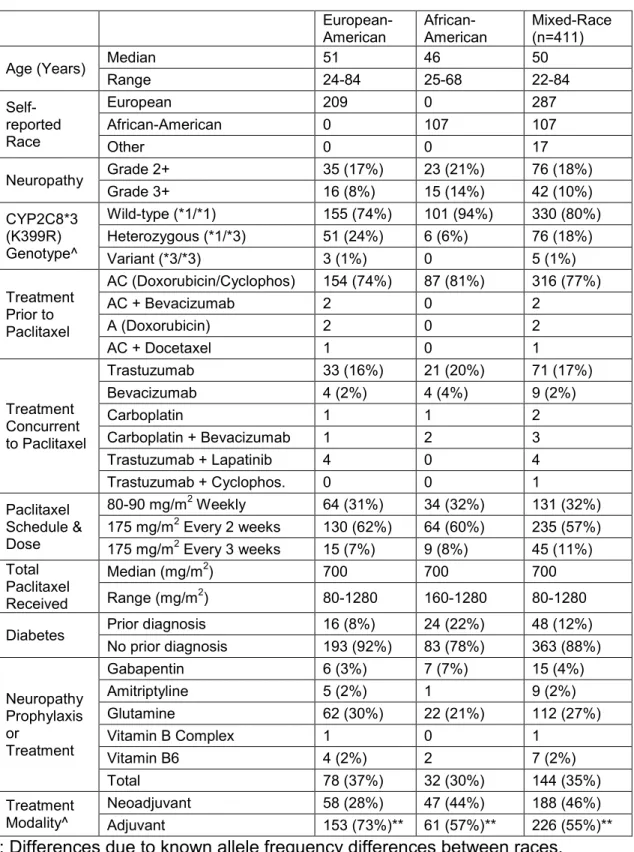
reported for each reference population in the International Hapmap Project : CEU (Utah residents with Northern and Western European ancestry) AF=0.14 and ASW (African Ancestry in Southwest USA) AF=0.04, respectively(158, 159). The number of *1/*1, *1/*3, and *3/*3 women in each cohort is displayed in Table 1 along with the frequencies of grade 2+ (17%-21%) and grade 3+ (8-14%) neuropathy, which were similar to those reported in prior paclitaxel studies(146-148).
Neuropathy by Genotype
Analysis in European-American cohort
21
individual carries (0, 1, or 2) also gave significant results (HR=1.93, 95% CI: 1.05-3.55, p=0.032) but the hazard ratio for comparing carriers of the *3 variant vs. the wild-type homozygotes (*3/*3 & *1/*3 vs. *1/*1: dominant genetic model) was not statistically significant (HR=1.74, 95% CI: 0.88-3.45, p=0.110). In the secondary analysis, which did not account for cumulative dose, the incidence of grade 2+ neurotoxicity differed across the three genetic groups (Variant: 67%, Heterozygote: 22%, Wild-type: 14%, p=0.042) while the results from the grade 3+ analysis were consistent in trend but did not reach significance (p=0.313, data not shown).
Clinically relevant covariates: age, prior diabetes diagnosis, use of
neuropathy prophylaxis or treatment, and paclitaxel schedule, were included in a multiple Cox proportional hazards model. The only covariate that was kept in the backwards selection procedure was diabetes history (Table 2). Similar to the unadjusted analysis, in the final model the association between CYP2C8*3
genotype and risk of grade 2+ neuropathy was significant assuming a recessive (HR = 6.88, 95% CI: 1.62-29.14, p=0.009) or additive (HR=1.95, 95% CI: 1.06-3.58, p=0.031), but not a dominant (HR = 1.77, 95% CI: 0.89-3.52, p = 0.102), genetic effect.
Replication in African-American Cohort
22
patients again showed greater risk of grade 2+ peripheral neuropathy in the log-rank analysis (HR=3.30, 95% CI:1.04-10.45, p=0.043) and a trend in the same direction using the Fisher’s exact test (50% vs. 20%, p=0.112) (Figure 2).
Cox Proportional Hazards Model in Mixed-Race Cohort
411 paclitaxel treated women were available for inclusion in a Cox proportional hazards model that included self-reported race (European vs. non-European). In the final model there was a higher risk of grade 2+ neuropathy in non-European women (HR=1.76, 95%CI: 1.05-2.93, p=0.031) (Figure 3) and a non-significant, negligible increase in risk as patient age increases (HR=1.02, 95% CI: 1.00-1.04, p=0.102) (Table 2). After adjustment for these covariates the association between increased risk of grade 2+ neuropathy and CYP2C8*3 was significant (Figure 4) in either a dominant (HR = 2.04, 95% CI: 1.21-3.43,
p=0.007) or additive genetic model (HR = 1.98, 95% CI: 1.25-3.13, p=0.004) but not in a recessive model (HR = 3.41, 95% CI: 0.82-14.16, p=0.092). In follow-up exploratory model building an interaction between race and diabetes history was discovered, in which a diagnosis of diabetes increased risk of neuropathy in European patients but decreased risk in non-European patients (p=0.029, Figure 5).
DISCUSSION
23
endpoint. Only grade 3+ toxicities were considered and the cumulative dose received at the time of toxicity was not accounted for. Also, because there were other variants besides CYP2C8*3 being interrogated, and the cohort was
relatively small, the analysis was not stratified by race a priori. Despite these limitations a trend was discovered for greater grade 3+ neuropathy incidence in patients carrying the CYP2C8*3 variant (Odds ratio (OR)=3.13, 95% CI: 0.89-11.01, uncorrected p=0.075). Based on this exploratory finding, and two previously published concurring studies, we attempted to replicate the association in two independent cohorts from the same database, and then combined these replication sets with other available patients to more comprehensively investigate this association.
The current study provides replication of an association between the
CYP2C8*3 K399R variant and increased risk of grade 2+ paclitaxel-induced neuropathy in European-American patients. The association was then replicated separately in the African-American patients. Finally, a model was built that included all patients and relevant clinical covariates, and after adjusting for race, age, and diabetes, the risk of grade 2+ neuropathy was greater in women
carrying CYP2C8*3.
24
results confirm their findings. Although they assumed an additive model, their data suggested that a recessive effect may best characterize the influence of the *3 variant. The results from our European-American cohort also suggested a recessive model but the results in the larger mixed-race cohort are significant with either the dominant or additive model. Indeed, the approximate doubling of risk associated with the addition of each *3 allele, found both by Leskela et al. and us, suggests an additive genetic effect may be most appropriate.
While the association between CYP2C8*3 and paclitaxel-induced neuropathy has now been replicated multiple times, there are previous reports which did not demonstrate this association(134-137). Differences in patient inclusion, study design, and end point likely explain these discrepant findings, similar to that seen with other inconsistently demonstrated pharmacogenetic associations(160). Specifically, one study combined patients on either paclitaxel (24%) or docetaxel (76%) and analyzed these groups together(135). While docetaxel has both structural and mechanistic similarity to paclitaxel, it has a lower incidence of neurotoxicity and is not metabolized by CYP2C8. The other three studies utilized patient cohorts that were treated concomitantly with
25
patients (1.2%) were concurrently treated with a drug associated with neuropathy (carboplatin). Moreover, patients who received treatment prior to paclitaxel (78%) received almost exclusively doxorubicin/cyclophosphamide (98%), which is not neurotoxic, and only one patient was previously treated with a known neurotoxin (docetaxel) (Table 1).
Hapmap reference populations indicate that the *3 variant is not found in patients of African descent (Yoruban in Ibadan, Nigeria [YRI] AF=0.00), however, the allele frequency in our African-American patients (AF=0.03) was very similar to that reported for individuals of African ancestry living in the United States (ASW AF=0.04), corroborating past reports that African-American patients harbor varying amounts of European and African genetic loci(162) (Figure 6). Based on our findings, not only is the *3 variant found in individuals from a wide range of self-reported races, the increase in neuropathy risk it confers is consistent across racial groups.
Despite the lower frequency of the high risk variant in non-European individuals, these patients were at an increased risk of neuropathy overall (HR=1.76, 95% CI: 1.05-2.93, p=0.031). This finding confirms a recent
publication from Schneider et al.(109) and suggests that while CYP2C8*3 is one factor that influences a patient’s risk of paclitaxel-induced neuropathy, perhaps along with age and diabetes history, there are other currently unappreciated factors at work. An inter-race difference in paclitaxel exposure is possible, but to our knowledge this has never been reported and does not exist with
26
the risk of HIV-associated distal neuropathy(164) and diabetes-related
neuropathy(165) are greater in African-Americans than European-Americans; thus there seems to be a general predisposition to neuropathy in African-Americans regardless of etiology. We hypothesize that there are inter-race differences in frequencies of genetic loci responsible for this phenotype that are not currently known. We also identified an unexpected interaction between race and diabetes in which diabetes history increased neuropathy risk in Europeans but decreased risk in non-Europeans, which caused diabetes history to be eliminated from the final Cox model in the mixed race cohort. However, this finding may be merely a statistical artifact secondary to testing many interactions in exploratory model building in a relatively small number of diabetic individuals (n=48, Figure 5).
The major limitation of this study is the retrospective use of a clinical registry instead of a prospective clinical study. This manifests in a number of ways, most notably the differences in paclitaxel treatment and schedule, the use of neuropathy prophylaxis or treatment, and the non-uniformity in toxicity
collection. We have attempted to adjust for these factors when possible. In meta-analyses comparing the risk of neuropathy for the weekly vs. 3-weekly
schedules, the dose intensity was found to be a more important factor than schedule itself(100). The patients in this analysis were treated with one of three standard paclitaxel regimens: 3-hour infusion of 175 mg/m2 every three weeks
27
not detect a significant influence on neuropathy risk for paclitaxel dose, schedule, or infusion time, all of which are highly collinear in this dataset.
Use of supplementary agents to prevent or treat neuropathy was
somewhat common in this patient cohort (35%, Table 1). The majority of these patients (78%) received the non-FDA approved amino-acid supplement
glutamine, which has shown inconsistent efficacy in clinical studies(166, 167). Perhaps due to differences in effectiveness of the various agents administered, or the timing of neuropathy development and supplement use, we did not see an association with the risk of neuropathy.
The neuropathy data was collected and recorded by the treating
28
experiencing grade 2+ neuropathy before therapy is initiated, and analyses with this endpoint are free of the confounding present in assessing grade 3+ toxicity.
We have previously reported that patients carrying the *3 variant
experience superior clinical response from paclitaxel treatment, consistent with the demonstrated correlation between paclitaxel exposure and treatment
efficacy(39, 169). This apparent shift of the therapeutic window suggests that the optimal dose of paclitaxel may need to be stratified in the general population based on CYP2C8*3 status, similar to a recent Phase I study which identified maximum tolerated irinotecan doses based on the patient’s UGT1A1*28
genotype(123). Further work with population pharmacokinetic models that account for key patient factors in addition to CYP2C8 genotype(155, 170) may enable appropriate dose selection for a patient, bypassing stratified therapy and realizing truly individualized therapy.
In conclusion, we have replicated a previous finding that CYP2C8*3
29
30 TABLES
Table 1 Characteristics of LCCC 9830 CYP2C8*3 Patient Cohort
European-American African-American Mixed-Race (n=411)
Age (Years) Median 51 46 50
Range 24-84 25-68 22-84
Self-reported Race
European 209 0 287
African-American 0 107 107
Other 0 0 17
Neuropathy Grade 2+ 35 (17%) 23 (21%) 76 (18%)
Grade 3+ 16 (8%) 15 (14%) 42 (10%)
CYP2C8*3 (K399R) Genotype^
Wild-type (*1/*1) 155 (74%) 101 (94%) 330 (80%) Heterozygous (*1/*3) 51 (24%) 6 (6%) 76 (18%)
Variant (*3/*3) 3 (1%) 0 5 (1%)
Treatment Prior to Paclitaxel
AC (Doxorubicin/Cyclophos) 154 (74%) 87 (81%) 316 (77%)
AC + Bevacizumab 2 0 2
A (Doxorubicin) 2 0 2
AC + Docetaxel 1 0 1
Treatment Concurrent to Paclitaxel
Trastuzumab 33 (16%) 21 (20%) 71 (17%)
Bevacizumab 4 (2%) 4 (4%) 9 (2%)
Carboplatin 1 1 2
Carboplatin + Bevacizumab 1 2 3
Trastuzumab + Lapatinib 4 0 4
Trastuzumab + Cyclophos. 0 0 1
Paclitaxel Schedule & Dose
80-90 mg/m2 Weekly 64 (31%) 34 (32%) 131 (32%) 175 mg/m2 Every 2 weeks 130 (62%) 64 (60%) 235 (57%) 175 mg/m2 Every 3 weeks 15 (7%) 9 (8%) 45 (11%) Total
Paclitaxel Received
Median (mg/m2) 700 700 700
Range (mg/m2) 80-1280 160-1280 80-1280
Diabetes Prior diagnosis 16 (8%) 24 (22%) 48 (12%) No prior diagnosis 193 (92%) 83 (78%) 363 (88%)
Neuropathy Prophylaxis or
Treatment
Gabapentin 6 (3%) 7 (7%) 15 (4%)
Amitriptyline 5 (2%) 1 9 (2%)
Glutamine 62 (30%) 22 (21%) 112 (27%)
Vitamin B Complex 1 0 1
Vitamin B6 4 (2%) 2 7 (2%)
Total 78 (37%) 32 (30%) 144 (35%)
Treatment Modality^
31
Table 2 Cox Proportional Hazards Model for Grade 2+ Neuropathy European Cohort (n=209) Mixed-race Cohort (n=411) Hazard
Ratio
95% Confidence
Interval
P-value Hazard Ratio
95% Confidence
Interval
P-value
CYP2C8^
*1/*3 vs. *1/*1 1.55 0.75-3.21 0.234 1.95 1.14-3.32 0.015* CYP2C8^
*3/*3 vs. *1/*3 5.01 1.09-23.02 0.038* 2.14 0.50-9.27 0.307 CYP2C8^
*3/*3 vs. *1/*1 7.78 1.80-33.62 0.004* 4.17 0.99-17.60 0.052 Diabetes
Diagnosis 2.18 0.84-5.63 0.110 Not included in final model Age Not included in final model 1.02 1.00-1.04 0.102 Self-Reported
Race** No racial heterogeneity 1.76 1.05-2.93 0.031* ^CYP2C8 comparisons are made between individual genotype groups, not based on assumptions of genetic effect (recessive, additive, or dominant).
*Statistically Significant Difference
32
FIGURE LEGENDS
Figure 1 Incidence curve for grade 2+ neuropathy across genotype groups in the European cohort (n=209). The highest risk was seen in the variant homozygotes and the lowest risk in the wild-type homozygotes.
Figure 2 Incidence curve for grade 2+ neuropathy across genotype groups in the African-American replication cohort (n=107). Higher risk was seen in the carriers of the CYP2C8*3 variant homozygotes as compared to the wild-type
homozygotes (p=0.043). No homozygous variant individuals were found in this cohort.
Figure 3 Incidence curve for grade 2+ neuropathy across racial groups in the entire mixed-race cohort (n=411). Higher risk was seen in the non-European-American (n=124) as compared to the European-non-European-American (n=287) women after adjusting for CYP2C8 and age (p=0.031).
Figure 4 Incidence curve for grade 2+ neuropathy across genotype groups in the mixed-race cohort (n=411). This data indicates that each *3 variant
approximately doubles a patient’s risk of grade 2+ neuropathy, supporting an additive genetic effect.
33
increased in European patients with diabetes but decreased for non-European patients.
Figure 6 Principal components analysis of DMET™ genotype data for entire cohort (N=411, circles) and reference Hapmap populations (triangles): CEU (Utah residents with Northern and Western European ancestry), CHB (Han Chinese in Beijing, China), JPT (Japanese in Tokyo, Japan), and YRI (Yoruban in Ibadan, Nigeria). The self-reported white patients (orange circles)
34 FIGURES
35
36
37
38
39
Daniel L. Hertz, Siddharth Roy, Alison A. Motsinger-Reif, Amy Drobish, L. Scott Clark, Howard L. McLeod, Lisa A. Carey, E. Claire Dees. Affymetrix DMET™ Plus Chip Identifies SNP in ABCG1 that Modulates Risk of Paclitaxel-Induced Neuropathy in Caucasians
CHAPTER III
DISCOVER AND VALIDATE VARIANTS IN GENES RELEVANT TO
DRUG METABOLISM, ELIMINATION, AND TRANSPORT THAT
INCREASE A PATIENT’S RISK OF EXPERIENCING GRADE 2+
NEUROPATHY DURING PACLITAXEL TREATMENT
INTRODUCTION
In breast cancer treatment, the sequential addition of paclitaxel to standard anthracycline therapy has improved rates of pathological complete response in neoadjuvant treatment(171) and overall survival in the adjuvant setting(145, 146). Along with its impressive efficacy, paclitaxel treatment is associated with a variety of severe adverse events, including the development of peripheral sensory neuropathy which typically presents as tingling in the fingers and toes that will often resolve if treatment is discontinued(85). However, mild neuropathy will progress with continued treatment to potentially irreversible loss of tactile function and balance(84).
Neuropathy development is partly determined by the cumulative paclitaxel dose administered over the course of therapy(85, 90-93), and may also depend in part on the exposure to a given dose(95). Patients who carry the CYP2C8*3
41
transporters(20, 26, 36) known to be involved in paclitaxel pharmacokinetics. Variability in the activity of these enzymes and transporters may also contribute to variability in paclitaxel exposure and consequently modify the risk of paclitaxel-induced neuropathy.
Many prior studies have investigated whether there is an association between variants in these candidate genes and risk of neuropathy(132, 134, 137, 139, 141, 142, 172-175), however, none have accounted for the underlying influence of CYP2C8*3 or used an approach that can comprehensively and directly interrogate thousands of variants that are most likely to influence paclitaxel exposure. The Affymetrix (Santa Clara, CA) DMET™ Plus Chip is a commercially available genotyping panel that interrogates nearly 2,000 genetic variants within genes that are responsible for Drug Metabolism, Elimination, and Transport (DMET™)(176). We hypothesized that using the DMET™ Plus Chip to further genotype a cohort of patients who have previously been analyzed
specifically for the CYP2C8*3 variant, we could identify additional genetic loci that influence a patient’s risk of paclitaxel-induced neuropathy. By conditioning our analysis on CYP2C8*3, we can eliminate the known effect of this variant and more directly investigate the genetic sources of the remaining variability,
42 METHODS
Patients and Treatments
The subjects, toxicity, and covariate data for this analysis were the same as those used in Chapter 2. The primary analysis for this aim was restricted to the self-reported Caucasian patients; all non-Caucasian patients were included in a secondary cohort for potential replication. The study protocol was approved by the UNC Institutional Review Board.
Genotyping
A 30 mL blood sample was collected from each subject at the time of study enrollment. DNA used for genotyping was extracted by the UNC
Biospecimen Processing Facility and plated at 60 ng/uL. Genotyping was carried out blinded to clinical data using the Affymetrix DMET™ Plus Chip (Affymetrix Inc., Santa Clara, CA, USA) at Gentris Corp. (Gentris Corp. Morrisville, NC) following the manufacturer’s protocol with known genomic DNA controls provided by Affymetrix Inc. to monitor inter- and intra-assay performance. Any patient sample or assay with successful call rate <95% or <90%, respectively, was excluded from analysis. Variants were also excluded if the minor allele frequency was <5% in the entire population or if the p-value for the Fisher’s Exact estimate of Hardy-Weinberg proportions was <0.05 in either the Caucasian or
non-Caucasian cohort.
Statistical Analysis
43
analyzed results for the CYP2C8*3 (K399R, rs10509681) variant, was used to compare the risk of neuropathy incidence across genotype groups for each marker that passed quality control. Due to the exploratory nature of this study, uncorrected p-values were compared with a significance threshold α=0.001 which was selected for consistency with prior pharmacogenetic discovery studies utilizing the DMET™ Plus Chip(177).
Variants that surpassed the exploratory significance threshold were tested in a log-rank analysis utilizing the dose-at-onset of grade 2+ neuropathy in order to account for the known effect of cumulative paclitaxel treatment. Any patient not experiencing grade 2+ neuropathy was censored at the cumulative dose they were administered over the course of therapy. Variants with significant findings in the dose-to-event analysis were then tested in a cross-race replication in the non-Caucasian subjects (n=124). Finally, covariates that are thought to be relevant to neuropathy risk including: age (continuous), race (Caucasian vs. non-Caucasian), paclitaxel dose and schedule (80-90mg/m2 weekly vs. 175mg/m2 every 2-3 weeks), diabetes (yes vs. no), and supplemental neuropathy treatment (as defined in the methods above, yes vs. no) were tested in a multiple Cox proportional hazards model with backward elimination via AIC to identify only those covariates that significantly contributed to model performance. All statistical analyses were carried out in R Statistical Software, version 2.13.0 (R
44 RESULTS
Patient Population
After exclusion of patients whose samples failed genotyping, 288
Caucasian paclitaxel-treated patients were included in the primary analysis and 124 non-Caucasians were evaluable in the replication cohort. Demographic data including patient and treatment characteristics for the primary and replication cohorts can be found in Table 3. Overall 71 patients experienced grade 2+ neuropathy during paclitaxel treatment (71/412=18%) which is consistent with other studies of paclitaxel treatment in breast cancer(146).
DMET™ Markers
Of the 1,936 genetic markers on the DMET™ Plus chip, a total of 1,372 were excluded from analysis. 1,275 markers were excluded for minor allele frequency <0.05, which is consistent with previously reported DMET™ marker allele frequencies in primarily Caucasian cohorts(177). 30 markers were excluded from the analysis for call rate <90% and 67 were eliminated for significant deviation from Hardy-Weinberg proportions. Thus after appropriate quality control 564 markers (29.1%) were included in the analysis.
Neuropathy by Genotype
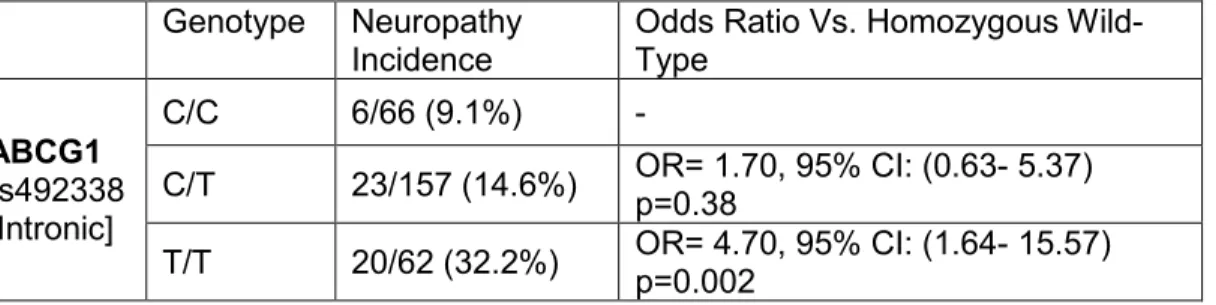
Results of the exact tests conditioned on CYP2C8*3 for the 10 markers with the strongest association with neuropathy incidence are displayed in Table 4, including one marker that surpassed the exploratory significance threshold (α=0.001). This was an intronic SNP in ABCG1 (rs492338, uncorrected
45
patients with genotype calls at this locus is presented in Table 3, exhibiting increased neuropathy risk for the minor (T) allele.
The results of the secondary analysis using the cumulative dose-at-onset of neuropathy were not meaningfully different from the primary findings (HR(per allele)=2.11, 95% CI: 1.36-3.29, p=0.0008, Figure 7). In the cross-race
replication in non-Caucasian patients, rs492338 was not significantly associated with grade 2+ neuropathy in either the Fisher’s exact (p=0.60, data not shown) or log-rank analysis (p=0.54, Figure 8). We attempted to adjust for covariates of interest: age, race, diabetes, taxane schedule, and supplemental neuropathy therapy in the entire patient cohort, however, none of the clinical covariates survived backward elimination when included with rs492338 in a multiple Cox proportional hazards model (data not shown). Finally, the results of this analysis were not meaningfully influenced by the conditioning for CYP2C8*3; re-running the primary analysis in the Caucasian cohort unconditioned had a negligible impact on the Fisher’s Exact p-values of the top 10 hits (Table 4).
DISCUSSION
46
genes that encode for the proteins responsible for Drug Metabolism, Elimination, and Transport (DMET)(176). This chip has been previously used to identify
genetic variants that influence treatment outcomes from various other drugs used in cancer(178-181) and other diseases(181, 182).
Despite the use of a genotyping platform that comprehensively interrogates markers relevant to drug pharmacokinetics, the only hit that
surpassed our exploratory significance threshold is located in a gene (ABCG1) not thought to be involved in paclitaxel PK. ABCG1 is an intracellular sterol transporter that is primarily recognized for its role in regulation of intracellular cholesterol levels, particularly in cholesterol-laden macrophages(183). ABCG1 is also expressed in peripheral neurons(184) where cholesterol is converted to pregnenolone, a reaction that is inhibited by paclitaxel in vitro(185).
Pregnenolone is then metabolized to progesterone, 5α-dihydroprogesterone, and allopregnanolone, which are referred to as neuroactive steroids(186).
Neuroactive steroids are key regulators of Schwann cell proliferation and myelin formation(187); processes initiated in response to axonal demyelination, a prominent finding in paclitaxel-induced neurotoxicity both in vitro(188) and in vivo(81). Interestingly, co-treatment with neuroactive steroids enhances recovery from docetaxel-induced neuropathy in rats(189).
Several groups have investigated whether SNPs in genes relevant to paclitaxel pharmacokinetics are associated with risk of neurotoxicity. None of the significant findings from these previous candidate studies, including SNPs in
47
their influence on paclitaxel-induced neuropathy risk could not be verified.
Attempts to discover loci that modulate risk of paclitaxel-induced neuropathy on a genome-wide scale have been reported by multiple groups(108, 143, 190),
yielding attractive candidates for replication. Unfortunately, the top hits from these genome-wide association studies, including EPHA5 and FGD4(143),
FANCD2(142), and RWDD3(108) are not found on the DMET™ Plus chip and could not be assessed in this analysis.
Our study leveraged the power of the DMET™ Plus chip to simultaneously interrogate hundreds of variants that could be relevant to paclitaxel PK. This hypothesis-directed discovery approach could be a powerful tool for discovering variants in genes not previously recognized to influence drug exposure or
treatment outcome. However, our results demonstrate one of the fundamental limitations of this discovery approach. In the unconditioned analysis, CYP2C8*3, which has been reported in multiple independent cohorts to influence paclitaxel-induced neuropathy, was our 14th highest ranked variant (p=0.016) and did not approach our significance threshold (α=0.001). True associations do not
necessarily show the strongest association in discovery studies(191), and the necessity for rigorous statistical correction may lead to many false
negatives(130).